Category Archives: Songbirds

WHERE EVER TRAVELS A FLOCK OF SONGBIRDS, SO FOLLOWS THE COOPER’S HAWK

Throughout the summer and autumn, juvenile Cooper’s Hawk(s) have been observed hunting on Eastern Point. We see them zooming low and stealthily down roadways and soaring high amongst the treetops. There is no way of knowing if they are one and the same although one bird in particular appears to have developed a keen interest in the flock of Dark-eyed Juncos currently foraging in the neighborhood. Nearly every evening at dusk he hungrily swoops in, but never seems to capture one.

Well-camouflaged Dark-eyed Juncos, also known as Snowbirds

The Snowbirds have a neat set of tricks. They all scatter to the surrounding trees and shrubs. The slate gray and brown Dark-eyed Juncos are well camouflaged but that is not their only secret to survival.  Rather than singing their typical lovely bird song, from their hiding places, they all begin making an odd chirping-clicking sound. From every bush and shrub within the nearby vicinity, you can hear the clicks. I think the clicking is meant to confuse the Cooper’s Hawk!

He’ll first dive into a bush hunting a Junco, come up unsuccessfully, then swoop over to a nearby tree, perched and well hidden in the branches while on the lookout for dinner. The Snowbirds click non-stop until the Cooper’s departs. After the hunter flies away, they all come out of their hiding places, some from branches mere feet from where the Cooper’s was perched. After a short time, they resume their lovely varied birdsong.  I recorded audio of the Junco’s clicking and hope to find out more about this fascinating behavior.

Although we hope the young Cooper’s is finding food, I am rather glad he’s not that good at catching Snowbirds.

Cooper’s Hawks are a conservation success story. You can read more about the reason why in a post form several years ago: SPLENDID COOPER’S HAWK – A CONSERVATION SUCCESS STORY GIVES HOPE. Note the difference in the plumage in the two stories. The Cooper’s Hawk in that post is an adult. The Cooper’s chasing the Snowbirds is a juvenile. Both are about crow-sized, with the typical flat topped head.

Adult Cooper’s Hawk

Juvenile Cooper’s Hawk

INVASION OF THE GOLDEN-CROWNED KINGLETS AND SNOWBIRDS!

Dark-eyed Junco (Snowbird)

A beautiful multitudinous flock of choristers has been chattering from every vantage point. The mixed flock of Dark-eyed Juncos and Golden-crowned Kinglets arrived to Cape Ann’s eastern edge on the same day. I don’t know if they are traveling together but they can be seen foraging in close proximity, from leaf litter to treetops.

Golden-crowned Kinglet

Golden-crowned Kinglets are one of the teeny-tiniest of songbirds;  a bit larger than the Ruby-throated Hummingbird, but not quite as large as the Black-capped Chickadee. They zoom in and out of the trees (mostly evergreens), hovering and hanging every which way when probing for insect prey.

The Dark-eyed Juncos (also know as Snowbirds) are mostly foraging close to the ground in grass and fallen leaves. They hop from place to place and flip up leaves looking for seeds. The Snowbirds fly up to the trees and shrubs when disturbed.

Note the array of shading in the individual Snowbird’s feathers, from slate gray to milk chocolate

Learn the birdsongs of these two beautiful species and you will easily be able to locate them. The Golden-crowned Kinglet sings a lovely ascending high pitched series of notes that end in a lower pitched warble. The Snowbird sings a series of kew, trills, whistles, and warbles that is also lovely and when the two are foraging in close proximity, it’s a joy to hear their mini symphony.

Golden-crowned Kinglet range map

Dark-eyed Junco range map

LEAVES OF THREE, LET IT BE

In thinking about our community’s efforts to Save Salt Island from deforestation and development, I wanted to share evidence that the vines and shrubs on the island are an important source of food for a host of small mammals and birds.

One of the most reviled of plants, Poison Ivy, is an excellent food plant for wildlife and will not cause the itchy uncomfortable rash if you do not touch the leaves, stems, fruits, and roots. Poison Ivy can either look like a shrub or a vine. Regardless of the shape, the leaves are easily identifiable in that they are always arranged in three; two leaves opposite one another, and between them the third leaf is borne on a stem growing at a right angle from the two shorter leaves.

Common Bonnet Fungi and Poison Ivy

Out on Eastern Point there are large patches of Poison Ivy that grow smack on the edge of very well traveled pathways. They have grown that way for decades, yet no one bothers the Poison Ivy and the Poison Ivy bothers no one. The spring blooming greenish yellow clusters of flowers are beloved by bees and myriad pollinators, while the vitamin rich white waxy berries are relished by resident and migrating songbirds alike.

In autumn, the plant’s glossy green leaves turn a brilliant red, which acts as a “red flag” to hungry songbirds. The long list of birds that dine on Poison Ivy fruits include Yellow-rumped Warblers, Eastern Bluebirds, Downy Woodpeckers, Northern Mockingbirds, Song Sparrows, Gray Catbirds, Bobwhites, and many, many more.

Poison Ivy Tips – If you come in contact, rinse the area with cold water, not soap, as soon after contact as possible. Ocean water works well when near to the beach. If you have Jewelweed growing handily nearby, smear the juice of the stem on the exposed skin. Never burn Poison Ivy. With burning,  urushiol (the poisonous oil in Poison Ivy) becomes volatilized in the smoke and you can get it in your lungs, which is very dangerous and can even lead to death.

Yellow-rumped Warbler and Poison Ivy

“BIRDS AND POETRY” WITH AUTHOR AND BROOKLINE BIRD CLUB DIRECTOR JOHN NELSON!

You are invited to join Brookline Bird Club director John Nelson at 7-9 a.m. on Saturday, Sept. 24 for a walk around Gloucester’s Eastern Point–the opening event of the Dry Salvages Festival 2022: A Celebration of T. S. Eliot.

We will look for birds around Eliot’s childhood patch, with commentary about Eliot’s bird poems.

The event is free and open to the public. Free parking at the Beauport lot at 75 Eastern Point Blvd. Participation limited. Registration by email is required: tseliotfestival@gmail.com.

Go, said the bird, for the leaves were full of children,
Hidden excitedly, containing laughter.
Go, go, go, said the bird: human kind
Cannot bear very much reality.
Time past and time future
What might have been and what has been
Point to one end, which is always present.”

T. S. Eliot Four Quartets

John Nelson is  the author of Flight Calls: Exploring Massachusetts Through Birds

Photos of Eliot on boat, view of harbor from Eliot house

Some wild creatures you may see on your walk –

MOM AND DAD EASTERN BLUEBIRDS IN THE GREAT MARSH

Listen to the music, where seaside marsh meets grassland meadow, while Mom and Dad Eastern Bluebirds feed their nestlings. 

Filmed at Cox Reservation, Great Marsh, Essex County.

BOBOLINKS, BLUEBIRDS, BLACKBIRDS, BUTTERFLIES AND MORE – MAGICAL WILDLIFE MOMENTS AT GREENBELT’S COX RESERVATION

This past week after enjoying a delicious lunch of clam chowder and fried clams at Woodman’s, Charlotte, my friend Claudia, and I stopped by Greenbelt’s Cox Reservation en route home. Claudia moved to CapeAnn a year ago and had never been. She was delighted to know about Cox Reservation for future beauty walks through meadow and marsh and of course Charlotte had a fantastic time as she always does when running about in nature. While there, we spied a Monarch depositing eggs on Common Milkweed shoots emerging in the grassland meadow.

I returned the following day to see if the female Monarch was still afield and to try also to capture an audio recording of the music where ‘seaside marsh meets grassland meadow.’

I found so much more. A photo tour for your Memorial Day weekend –

Bobolinks in the Chokecherry Tree (Prunus virginiana)

There are several fields at Cox Reservation that are maintained grassland habitat to help nesting birds such as Bobolinks; a beautiful songbird in steep decline.

We’re accustomed to hearing and seeing male Red-winged Blackbirds; it’s not often we see the females as they are usually on the nest. This pretty female flew into a tree, waved her wings, and stuck out her very showy cloaca. I wasn’t sure what she was up to and when a male came from nowhere and suddenly jumped on her back to mate, I was startled and unfortunately jerked the camera, but you get the idea.

Female Red-winged Blackbird

Male and Female Eastern Bluebirds feeding their brood


Common Ringlet

Yellow Warbler

American Copper

Osprey pair nesting in the far distant marsh

With deep appreciation and thanks to Essex County Greenbelt Association’s Director of Land Stewardship Dave Rimmer for his continued help with Cape Ann’s Piping Plovers. Dave has been providing free of charge guidance, along with exclosing the Plover nests, since 2016.

Allyn Cox Reservation is located at 82 Eastern Avenue, Essex, MA

BEAUTIFUL ORIOLE ALERT- BOTH ORCHARD AND BALTIMORE ORIOLES!!

Time to put out orange slices (and hummingbird feeders, if you haven’t already done so.) Orioles are nectar feeders and follow the blooming times of fruit trees on their northward migration along the East Coast. My friend Sally Jackson spotted a Baltimore Oriole at her hummingbird feeder several days ago, and they are delighting in our pear tree blossoms and orange halves we have placed in the garden.

Baltimore Oriole male

Recently while recording audio in a field, I was delightfully surprised by an Orchard Oriole, a species new to my eyes. Orchard Orioles are slightly smaller than Baltimore Orioles and their plumage is more rusty red rather than vivid orange. Nonetheless, they sing a characteristically beautiful bird song and it was a joy to hear the chorister from across the meadow.

Orchard Oriole male

You can see from the photos that orioles have evolved with long pointed bills, ideal for extracting nectar from fruit blossoms. Their toes, too, are especially well adapted to forging for tree fruits and nectar as they are long and flexible, allowing the birds to dangle every which way while clinging to the branches.

Ancient Crabapple tree, where the Orchard Oriole was spotted

*    *    *

Please join me at the Sawyer Free Library on Saturday, May 14th, at 2pm for a FREE in-person all ages presentation about the life story of the Piping Plover –

Why Give a Peep for Plovers?

The Piping Plover is one of only a handful of birds that nests on North Atlantic beaches. By learning about this tiny but most resilient of shorebirds, we gain a deeper understanding on how best to protect Piping Plovers and our shared coastal habitat.

Told through the lens of Kim Smith’s photo journal work, the Piping Plover’s life story is presented from migration to nesting to fledging. We’ll also cover the current status of the bird’s population, learn about where Piping Plovers spend the winter, and how communities and conservation organizations can work together to help Piping Plovers flourish for generations to come.

If you are new to or have ever considered joining our Piping Plover Ambassador group, this presentation is a great way to become introduced to Piping Plovers. Please come and learn more about these most lovable and charismatic shorebirds.

We hope to see you there!

BLUEBIRD LOOK SEE

Dad Bluebird peering out to make sure the coast is clear.

HAPPY EARTH DAY ON THIS MOST BEAUTIFUL OF EARTH DAYS!!

“There is symbolic as well as actual beauty in the migration of the birds, the ebb and flow of the tides, the folded bud ready for the spring. There is something infinitely healing in the repeated refrains of nature – the assurance that dawn comes after night, and spring after the winter.” –Rachel Carson

Dear Friends,

It’s glorious outdoors today and I hope you have a chance to get outside.  See below for photos from my morning Earth Day walk, although I can’t bear to sit at my computer all day when it’s so gorgeous out and will head back out this afternoon to see what we see.

For Earth Day this past week I gave several screenings of Beauty on the Wing (thank you once again most generous community for all your help funding BotWing!) along with presenting “The Hummingbird Habitat Garden” to the Massachusetts Horticultural Society. For over twenty years I have been giving programs on how to create pollinator habitats. People are hungry for real information on how to connect to wildlife and wild habitats and each year the interest grows and grows. It’s truly a joy to witness!

Last night it was especially rewarding to bring Beauty on the Wing to Connecticut’s Sherman Conservation Commission attendees. We had a lively Q and A following the screening with many thoughtful questions and comments. My gratitude and thanks to Michelle MacKinnon for creating the event. She saw the film on PBS and wanted to bring it to her conservation organization. Please let me know if you are interested in hosting a Beauty on the Wing screening

Monarchs are on the move! The leading edge in the central part of the country is at 39 degrees latitude in Illinois and Kansas: the leading edge along the Atlantic Coast is also at 39 degrees latitude; Monarchs have been spotted in both Maryland and New Jersey. Cape Ann is located at 43 degrees — it won’t be long!

Monarchs are heading north! Female Monarch depositing egg on Common Milkweed

Hummingbirds have been seen in Mashpee this past week (41 degrees latitude). Don’t forget to  put out your hummingbird feeders. Dust them off and give a good cleaning with vinegar and water. Fill with sugar water and clean regularly once installed. The sugar water recipe is one part sugar to four parts water; never replace the sugar with honey, and never use red food coloring.

Happy Glorious Earth Day!

Female Ruby-throated Hummingbird

Super surprised to see this mystery duck asleep on a rock. I was so curious and kept hoping he would wake up so as to identify. He at last lifted his head for all of ten seconds and then promptly tucked back in and went back to sleep. I’ve only ever seen Surf Scoters bobbing around far off shore in the distance. Skunk bird- what a cutie!

American Kestrel, male, too far away to get a good photo but a joy to see!

Beautiful, beautiful Great Egret preening its luxurious spray of feathers. An egret’s spray of feathers is also referred to as aigrette.

No Earth Day post would be complete without our dear PiPls – Mom and Dad foraging at the wrack line this am, finding lots of insects for breakfast.

A seal’s life


HAPPY EASTER, HAPPY PASSOVER, JOYFUL SPRING!

Wishing dear friends and readers Happy Easter, Happy Passover, and a Joy-filled Spring 

Beauty everywhere you turn in these first few weeks of spring – the return of songbirds, shorebirds, and Osprey, blossoming trees, beach bunnies, and garden helpers.

Beach bunny, Piping Plovers courting, neighbor Melissa’s flowering plum tree, Charlotte, Osprey, Killdeer eggs, Piping Plover eggs, Cedar Waxwings courting, and male Eastern Bluebird wing waving

YELLOW-RUMPED WARBLER IN THE SNOW!

One of the earliest warblers to migrate in spring, I don’t recall seeing a Yellow-rumped Warbler this early in the season. This little fellow was finding insects, seeds, and berries in the snow covered scrub line along the shore.

Yellow-rumped warblers have a highly varied diet, which allows them to winter further north than any other warbler, including as far north as Nova Scotia. Their diet consists of every imaginable insect, along with seeds, fruits, and berries including bayberry, myrtle, juniper,  poison ivy, Virginia creeper, dogwood, grapes, poison ivy, grass and goldenrod seeds.

Until 1973, Yellow-rumped Warblers were listed as two different species, the western Audubon’s Warbler and the eastern Myrtle Warbler. Both names are much lovelier than the undignified ‘yellow-rumped,’  don’t you think? More research and DNA studies has revealed they are two distinct species. Let’s hope the names Audubon’s and Myrtle will be reinstated 🙂

Perhaps this young warbler has been here all winter. Please write and let me know fellow bird lovers, are you too seeing Yellow-rumped Warblers?


SNOW BUNTING SNOWBIRD SNOWFLAKES AND WHAT DOES BEACH HABITAT RESTORATION LOOK LIKE IN WINTER TIME?

One of the most beautiful creatures of the snowy landscape has to be the Snow Bunting.  Also known as Snowflakes, Snow Buntings light up winter scapes with swirls of flight and highly animated foraging habits.

During the breeding season in the high Arctic, Snow Buntings eat a protein rich insect diet but while here during the winter months in the relatively milder climate of Massachusetts, they forage on tiny grass seeds and must constantly eat. Although their feeding habits are highly entertaining to the human observer, it’s really a matter of life or death for these cold weather warriors.

Standing on tiptoes for breakfast

Snow Buntings have several methods for extracting seeds. Sometimes they vigorously shake a wildflower or stalk of grass at the base of the plant. Other times they alight on a single blade of dried beach grass and slide their beaks along, shredding the stalk and releasing teeny seeds. They may stay alit and eat their foraged treasure, but more often than not, they shake the blade while perched and release the seeds to the ground. The Snow Bunting’s fellow flock member will seize upon the shower of released seeds and try to gobble them up. Herein lies the the conflict and disputes occur non stop while a flock is feeding. Typically one will readily retreat while the other dines, but occasionally a nasty battle ensues.

The wonderfully rich beach grass habitat where the Snow Buntings flock was formerly a barren scape that persistently washed away after every storm. Beach grass was planted, temporary dune fencing installed, and small rocks were added. After only several seasons, this habitat restoration project began attracting butterflies, songbirds, and nesting shorebirds during the spring and summer months, along with glorious creatures such as the beautiful Snow Bunting during the winter months.

I plan to find out exactly what this species of beach grass is that the Snow Buntings find so appealing because there are several locations on Cape Ann where habitat restoration is badly needed and I think this precise species of grass would surely be at the top of the list for stabilizing shoreline conservation projects.

Snow Bunting tracks

See Snow Bunting previous posts:

WHEN SNOW BUNTINGS FILL THE SKIES

BEAUTIFUL SNOWSHOEING AND SNOW SLEDDING SNOW BUNTING SNOWFLAKES

FLIGHT OF THE SNOW BUNTINGS


LOVELY ORANGE-CROWNED WARBLER IN OUR MIDST!

Yet another beautiful vagrant has been spotted on our shores, the Orange-crowned Warbler!

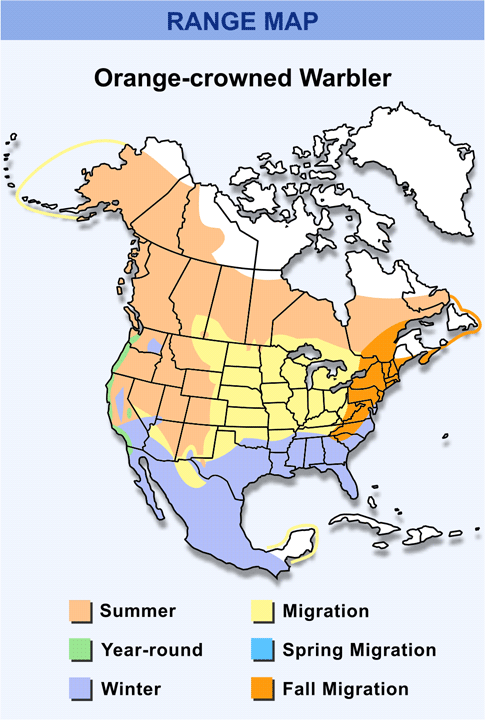
As you can see from the map, the Orange-crowned Warbler is nowhere near its winter range. This, from Cornell, “Medium to long-distance nocturnal migrant. Many birds winter in Mexico, with some continuing south to Guatemala and Belize. Others winter in central California and the southern U.S.”

Finding insects in the brush, bark, and rotting wood

Finding plenty of insects in rotting pieces of driftwood, peeling bark, and drying seaweed, the little fellow is very active and seems relatively unperturbed by the below freezing temperatures of the past month. Orange-crowned Warblers are purported to be one of the most hardiest of warblers. I met up with some old time knowledgeable gentlemen birders and they shared that about once a year an OCW shows up in Massachusetts, but rarely as far east as Cape Ann.

After looking at the photos you may wonder, as did I, why this yellowish-olive green songbird is so named ‘orange crowned?’ You can just barely see a very slight rusty orange hued patch of feathers when its head is bowed forward.

beautiful birds

2021 WILD CREATURES REVIEW! PART TWO

Cape Ann Wildlife – a year in pictures and stories

July through December continued from part one

July 2021

Conserve Wildlife NJ senior biologist Todd Pover makes a site visit to Cape Ann beaches, summer long updates from “Plover Central,” GHB Killdeer dune family raise a second brood of chicks,  Cape Hedge chick lost after fireworks disturbance and then reunited with Fam, Great Black-backed Gulls are eating our Plover chicks, thousands of Moon Snail collars at Cape Hedge,  Monarchs abound, #savesaltisland, missing Iguana Skittles, and Earwig eating Cecropia Moth cats.

August 2021

New short film for the Sawyer Free Library The Marvelous Magnificent Migrating Monarch!, Coastal Waterbird Conservation Cooperators meeting new short Piping Plover film, Ruby-throated Hummingbirds in the garden, why we love Joe-pye and other wildflowers, butterfly friends, Monarch cats in the garden, what is the purpose of the gold dots found on Monarch chrysalides?,Black Beauty came calling, Tigers in the garden, School Street sunflowers, Hoverflies, luminescent Sea Salps return to Cape Ann beaches, Petal Dancers and lemony Yellow Sulphurs on the wing.


September 2021

Flower Fairies, irruptive Green Darner migration, mini glossary of late summer butterflies, what to do if you find a tagged Monarch, Painted Ladies, White-tailed Deer family, Monarchs mating, Tangerine Butterflies,  yellow fellow in the hood, and Beauty on the Wing first ever live screening at the Shalin Liu.

October 2021

Bee-sized butterfly the American Copper, Monarch conga line, Thunder and Cloud, abandoned Piping Plover egg, School Street Sunflowers, Monarchs migrating, quotidian splendor, Monarch fundraiser updates, collecting milkweed seeds, the Differential Grasshopper, Cooper’s Hawk – a conservation success story,  #ploverjoyed, and nor’easter from the EP Lighthouse.

November 2021

Bridges between life and death, ancient oak tree uprooted, autumn harvest for feathered friends, Monarch migration update, we have achieved our fundraising goal!, Harbor Seal pup hauled out,  flight of the Snow Buntings, and a very rare for these parts wandering Wood Stork calls Cape Ann home for a month.

December 2021

New short film Wandering Wood Stork, tiny tender screech owl suffering from rat poison under the care of Cape Ann Wildlife Inc., Praying Mantis in the autumn garden, masked bandits in the hood, short film The Majestic Buck and Beautiful Doe Courtship Frolic, Snowy Owl boy in the dunes, short film Cedar Waxwing vocalization, the story of the Steller’s Sea-Eagle’s foray to Massachusetts, and Harbor Seal Pig Pile.


SEE PART ONE, JANUARY THROUGH JUNE, HERE


BEAUTY ON THE WING: LIFE STORY OF THE MONARCH BUTTERFLY COMING SOON (FEBRUARY 2022) TO A PBS STATION NEAR YOU!


2021 WILD CREATURES REVIEW!

Wishing you peace, love and the best of health in 2022 – Happy New Year dear Friends. I am so grateful for blog, Facebook, and Instagram friendships, new and old. Thank you for your kind comments throughout the year.

I would like to thank our wonderfully dedicated volunteer crew of Piping Plover Ambassadors, who provide round-the-day protections to one of Cape Ann’s most tender and threatened species.

I wish also to thank you for your kind support and contributions to our Monarch documentary, Beauty on the Wing: Life Story of the Monarch Butterfly. 2021 was a fantastic year for the film, winning many awards, including honors at both environmental festivals and awards at family-oriented film festivals, We also had a very successful fundraiser that allowed us to re-edit the film, and to distribute Beauty on the Wing through American Public in order to bring to the widest television audience possible.

Please stay healthy in the coming year. Wishing all your dreams come true. To peace, love, and great health in 2022. <3


Cape Ann Wildlife – a year in pictures and stories

Thinking about the wonderful wildlife stories that unfolded before us this past year I believe helps provide balance to the daily drone of the terrible pandemic. 2021 has been an extraordinarily beautiful and exciting year for our local wildlife. Several are truly stand out events including the three pairs of Piping Plovers that nested on Cape Ann’s eastern edge, the most ever! The summer of  2021 also brought a tremendous up take in Monarch numbers, both breeding and migrating, and in autumn a rare wandering Wood Stork made its home on Cape Ann for nearly a month. The following are just some of the photographs, short films, and stories. Scroll through this website and you will see many more!

January 2021

A rarely seen in these parts Black-headed Gull (in winter plumage), a Horned Lark, American Pipits, Red Fox kit all grown up, and an illusive Snowy Owl living at Gloucester Harbor.

February 2021

A red and gray morph pair of Eastern Screech Owls, flocks of winter Robins, and snowshoeing and snow sledding Snow Buntings grace our shores. 


March 2021

Bluebirds return to declare their nesting sites, the raptors delight in songbirds’ returning, American Wigeon lovebirds, signs of spring abound, and the Good Harbor Beach Piping Plovers return on March 26th, right on schedule! Gratefully so, Gloucester’s DPW Joe Lucido and crew install PiPl fencing on March 29th!

April 2021

Ospreys mating, Cedar waxwing lovebirds, Ruby-throated Hummingbirds return, and the Plovers are nest scraping and courting. The early spring storms also brought a dead Minke Whale to the shores of Folly Cove. 

May 2021

The Good Harbor Beach Killdeer family hatches four chicks, beautiful new PiPl on the block, many PiPl smackdowns with three pairs vying for territory, eggs in the nest at Area #3!, warblers and whatnots migrating, Make way for Ducklings – Cape Ann Style, the Salt Island PiPls have a nest with eggs but it is washed away by the King Tide of May 29th, and Cecropia Moths mating and egg laying.

June 2021

Piping Plover ambassadors first meeting of the season, on June 9th the Boardwalk #3 PiPls hatch four chicks, one chick perishes, Super Mom has a foot injury, Horseshoe Crabs at Good Harbor Beach, Piping Plover Ambassador badges from Jonathan and Duncan, a second nest is discovered at Salt Island with a new pair of parents (the first was washed away in the storm surge during the May King Tide), and for the first time, Piping Plovers are nesting at Cape Hedge Beach.

SEE PART TWO, JULY – DECEMBER, TOMORROW!


FAT FLEDGLING FEEDING AND IT’S SAFE TO PUT YOUR BIRD FEEDERS BACK UP!

While watching a young Mockingbird grooming its wings, the fledgling suddenly perked up as one of its parents approached with a mouthful of dinner. Mom and Dad Northern Mockingbirds both care for their young so the adult in the photos could have been either or. Mockingbird pairs are strongly monogamous and boldly defend their nests and nestlings from people, pets, and predators.

With their fluffy new feathers, fledglings of many species often appear larger than the parent. I sometimes wonder how baby birds ever get off the ground as they become plumper and plumper from the rich diet provided by their parents. Mockingbird fledglings and adults eat a wide variety of fruits, berries, and insects.

As you may or may not be aware, a statewide moratorium on feeding birds at feeders was declared because of an avian disease killing birds in the South. No cases have been found in New England and the mysterious disease seems to be waning in the South. Mass Audubon has announced it it safe to once again resume feeding at feeders. For the health and well being of songbirds, to help prevent the spread of any disease, it is recommended to clean bird feeders and bird baths about every two weeks with a solution of bleach and water, 1 part bleach to 9 parts water. Thank you to Monarch friend Judy A. for sharing the update!


WARBLERS AND WHATNOTS! HAVE YOU EVER SEEN A BAY-BREASTED WARBLER?

The past week I have been astounded with the array of warblers that we are seeing in our garden and on walks in the neighborhood. The big attraction in the garden is the native pink flowering dogwood tree (Cornus florida ‘Rubra’), my neighbor’s maple tree and the tiny insects feeding there, and our funky weathered old bird bath. There has been so much activity in the bird bath we are changing the water several times a day! Perhaps the travelers are dusty and dirty and appreciate the fresh bathing water.

American Redstart

One of the most fun to see was an American Redstart and the new-to-my-eyes Bay-breasted Warbler.

Bay-breasted Warbler

We also had a trio of black and white birds for an afternoon, the Black and White Warbler, Black-throated Blue Warbler, and a female Yellow-rumped Warbler.

Black and White Warbler, Black-throated Blue Warbler, and Yellow-rumped Warbler

There’s much that could be written about each species. I’m posting these photos for ID purposes in case anyone else has noticed a recent influx of warblers in your backyard or neighborhood. Please write if you do. Thank you!

Common Yellowthroat taking a bath


CEDAR WAXWING LOVEBIRDS

Here my love, have a yummy bug for breakfast – (notice the bug poised on the tip of the Waxwing’s bill).

Within a recent flock of visiting Cedar Waxwings one pair was courting. Touching bill to bill and animatedly sharing insects and torn off bits of budding trees, we observed the same behavior last spring. It’s very sweet to see. I wish it hadn’t been so hazy but still lovely.

Here is this spring’s pair of lovebirds –


Cedar Waxwings are frugivores (fruit-eaters) and they subsist mainly on fruit, although they eat plenty of insects, too. Reportedly, they are becoming increasingly more prevalent in backyards because people are planting more ornamental flowering and fruiting trees.

A courting pair in 2020 –

A beautiful thing to see – Cedar Waxwing male and female pair courting. They were feeding each other, hopping through the branches and passing insects and fruits back and forth.

If you would like to attract Cedar Waxwings  to your garden below is a handy list that I compiled of some of their most favorite fruits and berries –

What to plant to attract Cedar Waxwings to your landscape

Dogwood (Cornus florida, C. alternifolia)
Creeping Juniper (Juniperus horizontals)
Common Juniper (Juniperus communis)
Eastern Red Cedar (Juniperus virginiana)
Chokecherry (Prunus virginiana)
Honeysuckle (Lonicera sempervirens)
Holy (Ilex opaca)
Crabapple (Malus sp.)
Hawthorn (Crataegus sp.)
Tall Shadblow (Amelanchier arborea)
Smooth Shadbush (Amelanchier laevis)
Canadian Serviceberry (Amelanchier canadensis)
Mulberry (Morus rubra)
Winterberry (Ilex verticilata)
Virginia Creeper (Parthenocissus quinquefolia)
Raspberry
Blackberry
Wild Grape
Strawberry

WHY DO THESE CEDAR WAXWINGS LOOK SO HAPPY?

A flock of what has to be one of North America’s most enchanting birds, the Cedar Waxwing, has magically, albeit temporarily, taken residence in our garden and neighbor’s gardens. Their lovely chattering arrival has become an annual event my family looks forward to, especially Charlotte and me.

What have they found to eat that makes them so delighted? Primarily, tiny black insects living on the twigs, stems, and buds of our neighbor’s maple trees. I believe they are Black Bean Aphids, or some type of scale. If you look closely at the photos, in some you can see the bugs. The Waxwings hang every which way pecking and plucking at the insects and have a technique, too, of rubbing their beaks sideways across the bark, which usually results in a tremendous mouthful.

I am overjoyed that our neighbors do not spray their trees with pesticides. By not killing insect pests, a natural balance is restored to the garden. Your gardening pest is a songbird’s dietary mainstay!

About fifteen years ago, the keeper of the historic Gardens at Versailles, Alain Baraton, was beyond dismayed that few if any birds resided in the garden. He ditched pesticides and began promoting native plants. Now nicely plump bugs infest nearly all of the trees, and the songbird’s have returned! Additionally, “Baraton also changed the practice of planting row after row of the same tree. Now Versailles varies the trees — beech, hawthorn, poplar, chestnut — to minimize losses from disease. This is important when your garden has 200,000 trees.”

If the gardener-in-chief of the world’s grandest garden does not use pesticides, I think we need never either.

Trees at Versailles, image courtesy Google image search


WHY DO BIRDS LAY BLUE EGGS?

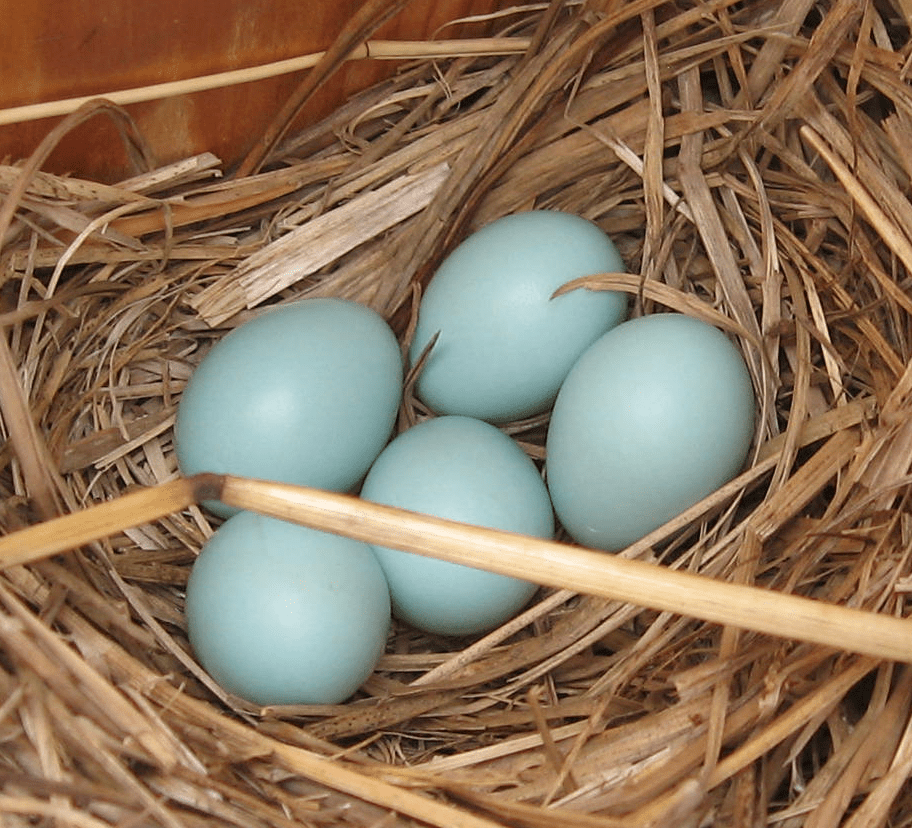
Did you ever wonder why some birds, such as Bluebirds and Robins, lay blue or bluish green eggs? And just as interesting why, in some cases, Bluebirds which generally lay blue eggs, a nest may comprise eggs that are almost white?

The earliest avian eggshells probably lacked color, or pigmentation. Over time, most likely to protect the eggs from predators, birds evolved a diverse range of colored shell markings from mottled brown, gray and beige to rainbow hues from pure white to pale pink, lavender, yellow, aqua, orange, blue, born and even black.

The molecules that cause pigmentation in bird eggs are biliverdin (the blue-green shades) and protoporphyrin (red and brown colors and speckles) but we can talk about blue eggs without getting too technical.

Basically, blue and blue-green strikes a balance between white and very dark colored eggs. Darker eggs are predicted in moderate light to shield the embryo from intense light, including harmful UV radiation. If when eggs are in an exposed nest and the shells are too dark, it can cause the interior to heat up, similar to a “dark car effect.” Simply stated, blue eggs regulate the effects of sunlight on the developing chick (embryo).

This doesn’t explain entirely why Eastern Bluebird eggs range from white to blue green. Many cavity nester’s eggs are white because the adults need to see the eggs in the dark. Wood Ducks are an example of cavity nesters with white eggs. American Robins generally nest in trees or a semi-exposed site and their eggs are blue, affording both protection from dangerous UV light and low risk from heating up. Eastern Bluebirds are cavity nesters but only about 4 to 5 percent of their eggs are white. Oftentimes when learning about a topic, myriad more questions come to mind!

White Eastern Bluebird Eggs

To read more –

https://www.researchgate.net/publication/298798982_Shedding_Light_on_Bird_Egg_Color_Pigment_as_Parasol_and_the_Dark_Car_Effect

https://journals.sagepub.com/doi/abs/10.3184/175815511X13207833399666

In reading about blue eggs I thought readers would enjoy seeing the amazing speckled and pear-shaped brilliant blue egg of the Common Murre, from USFWS

Some birds with blue eggs that nest locally include Red-winged Blackbird, Gray Catbird, Snowy Egret, Great Blue Heron, Little Blue Heron, House Finch, Bluejay, Goldfinch, European Starling, Eastern Bluebird, and American Robin.

American Robin nest at a friend’s home

Both Bluebird nest egg photos courtesy Google image search


“HOPE” IS THE THING WITH FEATHERS

Happy Spring, Happy Easter dear Friends. To new beginnings for us all as the pandemic hopefully soon recedes. Sending much love and appreciation for your kind comments and friendship throughout the year.

“Hope” is the thing with feathers –
That perches in the soul –
And sings the tune without the words –
And never stops – at all –

And sweetest – in the Gale – is heard –
And sore must be the storm –
That could abash the little Bird
That kept so many warm –

I’ve heard it in the chillest land –
And on the strangest Sea –
Yet – never – in Extremity,
It asked a crumb – of me.

By Emily Dickinson


BEAUTIFUL BLUEBIRD “WING-WAVING!”

Bluebird courtship is as beautiful as is the bird! Last week my daughter Liv joined me on a film scouting mini adventure. She loves learning about wildlife and living in Southern California as she does, Liv is surrounded by beautiful wild creatures and wild lands. We had a fantastic morning of it. Brant Geese, Piping Plovers, Great Egrets, Tree Swallows, and Eastern Bluebirds were just some of the creatures we observed.

The Eastern Bluebirds were especially stunning in the crisp early morning sunshine. One particular gent had not yet secured his partner’s affections. From tree branches adjacent to nesting boxes, he sang softly and flashed his glorious blue wings to a female that had flown in on the scene.

At first we thought he was preening, but no, the bachelor was clearly enticing his lady friend with lapis lazuli flags, gesturing with quick up and down lifting movements. Called wing-waving, these gestures are part of Eastern Bluebird courtship.

The male first sings loudly from treetops. If a female shows interest, he further shows off his skill sets with wing-waving and soft warbles. He then entices her to join him at a nesting box or cavity, he entering first. After he flies out of the box and if all goes well, she enters the cavity, a sure sign the pair are hitting it off!

Male Eastern Bluebird Wing-waving

The lucky female


EARLY SIGNS OF BEAUTIFUL SPRING SURROUND

Blessedly warmer weather has made it all that much more enjoyable to spend time outdoors. Beautiful birds are arriving on our shores, some to rest and refuel for their journey further north and some will call Cape Ann home for the spring and summer nesting season.

Gadwall

A lone Gadwall, along with several American Wigeons, are hungrily consuming great quantities of sea lettuce to feast upon before embarking on the next leg of their migration. Black-crowned Night Herons flew in over the weekend, the Killdeers arrived over week ago, and the American Pipits have returned.

Killdeer

Black-crowned Night Herons

Resident Cardinals and Song Sparrows are chortling from the tip tops of budding Pussy Willows and Bluebirds are moving into their nesting boxes and tree holes. The woods are alive with rat-a-tat-tat, rat-a-tat-tat – Downy, Red-bellied, and Northern Flicker are drumming their woodpecker rhythms.

Crocuses, squill, fiddleheads, and snow bulbs- the Snowdrops and Snow Glories -are poking through slowly awakening soil. My friend DB wrote to say she noticed a Mourning Cloak butterfly over the weekend. Mourning Cloaks are typically the earliest butterflies on the wing because they winter over as adults, safely tucked in the cracks and crevices of tree bark. Mourning Cloaks generally do not drink nectar but feed on tree sap in the spring and rotting fruit in autumn. The females will soon be depositing their eggs on leaves of deciduous trees including hackberry, willow, elm, poplar, rose, birch, aspen, cottonwood, and mulberry.

Oh Happy Spring!

BLUEBIRD LOVEBIRDS! – DO BLUEBIRDS MATE FOR LIFE?

Love is in the air!

Consistently when out in fields, I see Bluebird pairs that appear strongly committed to each other. I wondered, do Bluebirds mate forever? In our region, we see Eastern Bluebirds. Ornithologists found from a long term study of Western Bluebirds  that the great majority stay together for life. No such studies exist for Eastern Bluebirds however, field observations suggest that about 95 percent mate for life when both are still alive.

Eastern Bluebird female, left, male, right

Interestingly though, mating for life does not exclude extra pair copulations. Genetic studies of broods show that about twenty percent of nestlings are sired by more than one male.

Pairs softly warble to each other early in the morning, the male brings nesting material to a chosen site, and once she has entered his nesting cavity, she will begin to bring nesting material and he will bring food to her to “seal the deal.” In our north of Boston region, you can see the courtship behavior beginning as early as February and March.

Eastern Bluebirds re-mate with another partner if one dies.

In the photos below, it’s very easy to see the difference between a male and female Bluebird. The female’s blue is a more subdued grayish hue while the male’s blue feathers are brilliantly hued.

Bluebird nest with eggs, courtesy wikipedia

CAPE ANN WILDLIFE 2020: THE YEAR IN PICTURES, MOVIES, AND STORIES

Several years ago my husband suggested I write a “year end” wildlife review about all the creatures seen over the preceding year. That first review was a joyful endeavor though daunting enough. Over the next several years the reviews became more lengthy as I tried to cover every beautiful, wonderful creature that was encountered on woodland hikes, beaches, dunes, marshes, ponds, and our own backyards and neighborhoods. 2020 has been a very different year. There were just as many local wildlife stories as in previous years however, the pandemic and political climate have had far reaching consequences across geographic regions around the world, touching every living creature in the interconnected web of life we call our ecosystems.

This first year of the global pandemic has had a profoundly negative impact on wildlife and their habitats. In urban areas in developed countries, perhaps the economic slowdown afforded wildlife a break, with less pollution, less air travel, and some wild animals even reclaiming territory. Though the true downside of Covid-19 is that the pandemic has had an extraordinarily harmful impact on wildlife in rural areas and in less developed countries People who are dependent upon tourism, along with people who have lost jobs in cities and are returning to rural areas, are placing increasing pressure on wildlife by poaching, illegal mining, and logging. As mining and logging destroy wildlife habitats, animals are forced into ever shrinking areas, causing them to become sick, stressed, and to starve to death. These same stressed wild animals come in contact with people and farm animals, creating an ever increasing potential to transmit horrifically deadly illness, diseases such as Covid-19.

There are many, many organizations working to protect wildlife and conserve their habitats. I am especially in awe of one particular grass roots non-profit organization located in Macheros, Mexico, previously featured here, Butterflies and Their People. Co-founded by Ellen Sharp and Joel Moreno Rojas, the work they are doing to both protect the butterfly’s winter habit and provide employment for the forest’s guardians is outstanding.

All the butterfly sanctuaries (their winter resting places), are closed this year due to the pandemic. Dozens of people in the tiny town of Macheros are wholly dependent upon the income received by the work they do protecting the butterfly trees from illegal logging, as well as income from the tourist industry.  Ellen, Joel, and their team of arborists have come up with a wonderfully creative way to bring the butterflies to you. For a modest fee, you can sign up to “Adopt a Colony” to receive monthly newsletters and video tours of the Monarchs at Cerro Pelon. The newsletters are written by Ellen, who writes beautifully and clearly about the month-by-month current state of the butterflies in their winter habitat, as well as human interest stories drawn from the community. To subscribe to “Adopt a Colony” from Butterflies and Their People, go here.

We can be hopeful in 2021 that with a new administration, a much greater focus will be paid by our federal government to stop the spread of the virus in the US as well as around the globe. Not only is there hope in regard to the course correction needed to battle the pandemic, but the Biden/Harris administration has made climate change and environmental justice a cornerstone of their platform, including measures such as stopping the environmental madness taking place along our southern border and reversing many of the previous administration’s mandates that are so harmful to wildlife and their habitats.

Around the globe, especially in less developed countries, the pandemic has set back environmental initiatives by years, if not decades. We are so fortunate in Essex County  to have conservation organizations such as Greenbelt, MassWildlife, The Trustees, and Mass Audubon; organizations that protect the sanctity of wildlife and recognize the importance of protecting habitats not only for wildlife but equally as important, for the health and safety of human inhabitants.

The following are just some of the local images and stories that make us deeply appreciate the beauty of wildlife and their habitats found on Cape Ann and all around Essex County. Each picture is only a brief window into the elusive, complex life of a creature. Every day and every encounter brings so much more to observe, to learn, to enjoy, and to love.

To read more, each image and story from the past year is Google searchable. Type in the name of the creature and my name and the link to the story and pictures posted on my website should come right up.

Some Beautiful Raptors of 2020 – Red-tailed Hawk, Short-eared Owl, American Bald Eagle, Cooper’s Hawk, Merlin, Sharp-shinned Hawk, Osprey, and Snowy Owls


Essex County Greenbelt’s Osprey pair, Annie and Squam, successfully fledged three chicks, Vivi, Rusty, and Liz (nestling photo courtesy ECGA)

Dave Rimmer video from the Osprey cam at Lobstaland

The Snowy Owl Film Project was completed in March, with the objective of providing pandemic- virtually schooled kids a window into the world of Snowy Owls in their winter habitat (see all five short films here).


Spunky Mute Swan Cygnets

Utterly captivated by the winsome Red Fox Family

A tiny sampling of the beautiful songbirds that graced our shores in 2020 – Cedar Waxwings, Baltimore Orioles, Catbirds, American Robins, Tree Swallows, Barn Swallows, Snow Buntings, American Pipits, Horned Larks, and Eastern Bluebirds


A new favorite place to film is at my friend Paul’s wonderfully fun sunflower field in Ipswich, School Street Sunflowers. Beautiful Bobolinks, Common Yellowthroat Warblers, and Bluejays were just some of the songbirds seen feasting on the expiring seedheads  of sunflowers and wildflowers growing amongst the rows of flowers.

Graceful White-tailed Deer herd of adult females and youngsters

Snowy Egrets, Great Blue Herons, Great Egrets, and juvenile Little Blue Herons delight with their elegance, beauty, and stealth hunting skills. Included in the montage is a juvenile Black-crowned Night Heron that spent the winter at Niles Pond

A fraction of the different species of Shorebirds and Gulls seen on Cape Ann this past year – Dowitchers, Killdeers, Black-bellied Plovers, Common Tern, Least Tern, Laughing Gulls, Bonaparte’s Gulls, Glaucus Gull, and rarely seen Dovekie, or”Little Auk.”

Cecropia Moth life cycle unfolding in our garden, from mating, to egg laying, to caterpillar, to adult.


Dozens and dozens of orb spider webs draped a small patch of wildflowers. The dream catchers were attracting Cedar Waxwings to feast on the insects caught in the webs. The following day I returned after a rainstorm. The webs had melted away in the downpour and the Waxwings had vanished into the treetops.

Harbor and Gray Seals hauled out on the rocks at Brace Cove, as many as 28 were counted on a winter’s day!

Piping Plovers and Marshmallow Montage

In 2020, our Good Harbor Beach Piping Plover pair fledged one chick, nicknamed Marshmallow. Despite the global pandemic, a group of super dedicated Piping Plover Ambassadors worked tirelessly from sunrise until sunset to help ensure the safety of the Piping Plover family and to help educate beachgoers about the beautiful life story of the Plovers unfolding on Gloucester’s most popular beach destination. We worked with Essex Greenbelt’s Dave Rimmer, the Gloucester DPW, and Gloucester City Councilor Scot Memhard, with much appreciated advice from Mass Wildlife Coastal Waterbird Biologist Carolyn Mostello.

Read more about Marshmallow, the Ambassadors, and the Piping Plover Film Project here.

Piping Plover Marshmallow Montage, from egg to thirty-eight days old. Filmed at Good Harbor Beach, Gloucester, Massachusetts.

MONARCHS!

It has been a wonderful, exhilarating, infinitely educational, and beautifully challenging journey creating my documentary, Beauty on the Wing: Life Story of the Monarch Butterflies. The film was released in February 2020, but because of the pandemic, was not seen by the public until August, when it premiered (virtually) at the New Haven Documentary Film Festival. Beauty on the Wing has gone on to win honors and awards at both environmental and children’s film festivals, including the tremendous honor of Best Documentary at the Boston International Kids Film Festival. I’ve just received the very attractive award in the mail and have not had time to post a photo yet.

Beauty on the Wing portrays Cape Ann in the most beautiful light and I think when we are ever able to have a live premiere in this area, local friends will be delighted at the outcome. Joyfully so, Beauty is now being distributed to schools, libraries, institutions, and the travel industry through American Public Television Worldwide.

Beauty on the Wing continues to be accepted to film festivals and I will keep you posted as some are geo-bloced to this area, including the upcoming Providence Children’s Film Festival.


Last but not least, our wonderfully wildy Charlotte, little adventurer and nature-loving companion throughout the year