
They’re Not Called Ruby-crowned Kinglets for Nothin!
Leave a reply


Whether or not to ban gas-powered leaf blowers sure is creating a maelstrom of divisiveness in our communities. Everyone who has an opinion feels strongly, very strongly, that their viewpoint is the correct pov. Let’s think of the pros and cons and perhaps there is a solution. If I missed a pro or con, please feel free to write so we can include your point of view.
PROS of Gas Powered Leaf Blowers
Landscapers and homeowners appreciate the lower cost associated with gas-powered leaf blowers.
GPs are more powerful than electric, saving time and money.
Many landscapers and homeowners already own gas powered blowers.
CONS of Gas Powered Leaf Blowers
Gas powered leaf blowers are very loud particularly when multiple blowers are in use simultaneously. The noise pollution is disruptive and unpleasant to neighbors.
GP blowers emit a strong odor of gas fumes, harmful to the environment and to the person operating the leaf blower.
Some observations – our home is located in a middle class neighborhood where leaf blowing does not occur regularly, if at all, whether gas or electric. I do however have clients in more affluent neighborhoods where the use of leaf blowers is much more prevalent. People are correct, the noise level is extremely loud. A crew of men, typically Latino, will disembark from company pick-up trucks, with gas powered blowers strapped to their backs and ear phones snugly wrapped over their ears. The crew of half dozen or so will spend a good part of an hour blowing the leaves off a driveway that won’t even be driven on again until the summer resident homeowner returns the following year. Not only does it seem like an utter waste of time, it concerns me that the employees are breathing the fumes. This is also the same crew that I see spraying pesticides around the base of the homeowner’s foundations, also not wearing protective covering. I am wondering if protective masks and clothing can be provided to the employees that are required to use gas-powered leaf blowers and pesticides.
Do homeowners need half a dozen men blowing leaves off driveways and the street in front of their homes? Perhaps with less demand for an immaculate leaf-be-gone landscape, one gentleman wearing a mask, as opposed to six maskless men, could do the work. If a homeowner is having considerable work done and a leaf blower is needed to assist in clean-up, that seems to me like a reasonable use. Or if a pathway is covered with wet leaves creating an unsafe situation for an elderly person, that too seems like a reasonable use.
In my own landscape design firm, I encourage clients and friends not to remove leaves and the expired stalks of flowering plants. To my way of thinking, leaves on lawns and in flower beds is a beautiful thing! Not only are the decaying leaves providing a protective layer and adding nutrients to the soil, leaves also provide habitat for all manner of insects. I think at this point in our shared awareness about the environment, we all understand that insect populations the world over have plummeted. We homeowners and landscapers can help insect populations by leaving leaf litter in our gardens. The most delightful benefit of a garden that supports insects, is that the insects attract a host of beautiful songbirds that in turn conveniently eat the insects <3
For the benefit of insects, especially native bees, we also do not cut down the expired stalks of flowers until the end of April. In the late summer and early fall, native bees and other insects burrow into the stalks. When we do eventually cut down the stalks, we leave them in a pile for several weeks before discarding, hoping our little pollinator friends have wiggled out of their winter home.
Perhaps if we can change people’s mindsets about what constitutes a healthy landscape, the fashion of blowing leaves will become mush less problematic.
The song of a Carolina Wren chortling from a treetop has to be one of the sweetest songs you can imagine hearing in you garden. They love to rumple about in the leaf litter, foraging for insects. Insects are an important part of a songbird’s diet, especially during the breeding season when the females are producing eggs.
Carolina Wren nest with eggs tucked under our porch eaves –

Later in the season, a Carolina Wren fledgling is perched on the back fence. She was made fat and healthy from a diet rich in your average garden variety insects –


When the tiniest of songbirds with the fanciest of names flits alongside on your walk, you may be lucky enough to catch a photo. Well-camouflaged in their generally olive plumage, they elusively dart about the wooded edge of the path but flashes of their little golden crown gives them away.
Kinglets, both the Golden-crowned and Ruby-crowned are migrating through eastern Massachusetts. They are laser focused on insect meals and are often found along shrubby woodland pond banks where there is typically no shortage of bite-sized-for-kinglets arthropods.
For previous posts about kinglets, see the following –

My first encounter with the sweet little American Tree Sparrow, but perhaps not; I may have been looking right at one all along and thought it was a Song Sparrow or any one of a number of little brown songbirds. Now that I know what to look for, most notably its beautiful rusty brown cap and that the bottom half of its beak is yellow, it may be easier to notice.
Several were foraging alongside a mixed flock of songbirds. They were feeding on the ground but at the tiniest disturbance, flew into the camouflage provided by neighboring trees. As territorial as was the Dark-eyed Junco, the Tree Sparrows behaved just as badly to one of its own kind.
American Tree Sparrow range map, courtesy Cornell

Only weighing about as much as a quarter, the Ruby-crowned Kinglet’s tiny stature belies its vigorous foraging habits. The Kinglet flits and forages along the pond’s muddy edge, energetically snatching insects, all the the while flicking its tail. He leaps from stem to stem then takes off to hover mid-air, simultaneously pecking spiders from slender stalks.
The Kinglet’s ruby crown is well-hidden and mostly seen in spring during courtship display. RCKinglets are so incredibly fast; I was just hoping to capture some tiny bit of footage/documentation and was absolutely delighted when one flew to an adjacent bush only several feet away. He began floofing after his bath, with brilliant vermilion crown on full display.
We are at the tippy northern range of the Ruby-crowned Kinglets wintering grounds. Perhaps with the warming weather trend, we will see more and more.

For comparison sake, two years ago (November 2022), a flock of Golden-crowned Kinglets graced our eastern most shores, staying for about a week.

We are sooooo delighted to have a pair of Carolina Wrens nesting on our porch!
I believe this is the pair’s second brood. While we watched in June as they fed their lively and very hungry fledglings, they were rebuilding a nest left over from the House Finches.
Re-building is not exactly accurate. After our resident House Finch pair fledges their first brood, my husband usually takes down the remains and cleans up the corner in the eaves. He didn’t do that this year after the Finches fledged. The Carolina Wrens built their nest right on top of the Finch nest. It’s very deep and you can’t see the nesting bird or the eggs unless you look at it from above. Tom stood on a ladder with his phone camera held way over head to try to get an egg count. There appear to be three, possibly four eggs.
We have Carolina Wrens all year round in our garden but this is the first year they have built a nest on our porch. So excited for babies!!

When you hear Baltimore Orioles, but a Rose-breasted Grosbeak flies by instead- what fabulous underwing color!!.

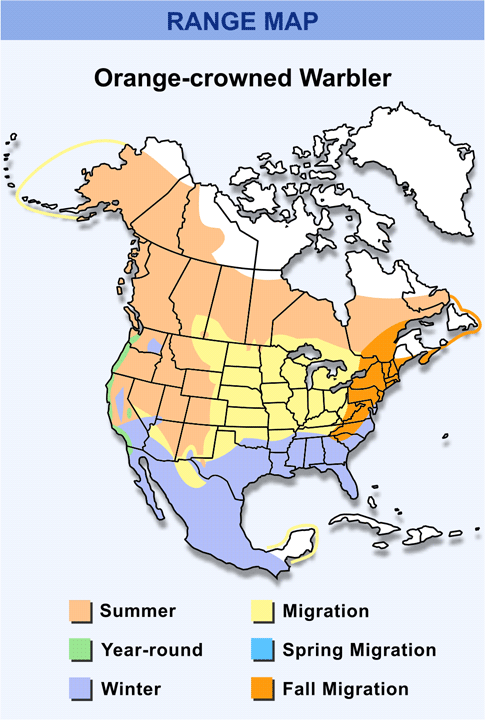
Yet another beautiful vagrant has been spotted on our shores, the Orange-crowned Warbler!
As you can see from the map, the Orange-crowned Warbler is nowhere near its winter range. This, from Cornell, “Medium to long-distance nocturnal migrant. Many birds winter in Mexico, with some continuing south to Guatemala and Belize. Others winter in central California and the southern U.S.”
Finding insects in the brush, bark, and rotting wood
Finding plenty of insects in rotting pieces of driftwood, peeling bark, and drying seaweed, the little fellow is very active and seems relatively unperturbed by the below freezing temperatures of the past month. Orange-crowned Warblers are purported to be one of the most hardiest of warblers. I met up with some old time knowledgeable gentlemen birders and they shared that about once a year an OCW shows up in Massachusetts, but rarely as far east as Cape Ann.
After looking at the photos you may wonder, as did I, why this yellowish-olive green songbird is so named ‘orange crowned?’ You can just barely see a very slight rusty orange hued patch of feathers when its head is bowed forward.


 beautiful birds

While watching a young Mockingbird grooming its wings, the fledgling suddenly perked up as one of its parents approached with a mouthful of dinner. Mom and Dad Northern Mockingbirds both care for their young so the adult in the photos could have been either or. Mockingbird pairs are strongly monogamous and boldly defend their nests and nestlings from people, pets, and predators.


With their fluffy new feathers, fledglings of many species often appear larger than the parent. I sometimes wonder how baby birds ever get off the ground as they become plumper and plumper from the rich diet provided by their parents. Mockingbird fledglings and adults eat a wide variety of fruits, berries, and insects.
As you may or may not be aware, a statewide moratorium on feeding birds at feeders was declared because of an avian disease killing birds in the South. No cases have been found in New England and the mysterious disease seems to be waning in the South. Mass Audubon has announced it it safe to once again resume feeding at feeders. For the health and well being of songbirds, to help prevent the spread of any disease, it is recommended to clean bird feeders and bird baths about every two weeks with a solution of bleach and water, 1 part bleach to 9 parts water. Thank you to Monarch friend Judy A. for sharing the update!

The past week I have been astounded with the array of warblers that we are seeing in our garden and on walks in the neighborhood. The big attraction in the garden is the native pink flowering dogwood tree (Cornus florida ‘Rubra’), my neighbor’s maple tree and the tiny insects feeding there, and our funky weathered old bird bath. There has been so much activity in the bird bath we are changing the water several times a day! Perhaps the travelers are dusty and dirty and appreciate the fresh bathing water.
 American Redstart
One of the most fun to see was an American Redstart and the new-to-my-eyes Bay-breasted Warbler.
 Bay-breasted Warbler
We also had a trio of black and white birds for an afternoon, the Black and White Warbler, Black-throated Blue Warbler, and a female Yellow-rumped Warbler.


Black and White Warbler, Black-throated Blue Warbler, and Yellow-rumped Warbler
There’s much that could be written about each species. I’m posting these photos for ID purposes in case anyone else has noticed a recent influx of warblers in your backyard or neighborhood. Please write if you do. Thank you!


Common Yellowthroat taking a bath


If you are looking to be inspired by creatures and colors of the upcoming season, and what to plant to make your garden a welcoming haven for wildlife, please join me tonight at 7pm. I am super excited to be presenting “The Pollinator Garden” for the Mass Pollinator Network. Because it is a Keynote presentation, I was able to add and collage many more photos. The presentation looks great and is chock full of ideas for your pollinator paradise. I hope to see you there!

Located in our East Gloucester neighborhood is a rare bit of New England coastal habitat called a Relic Sandplain Grassland or Open Heathland (see below to read more about Sandplain Grasslands). I love walking there in the early morning when the light is especially beautiful. The native flora attracts a wide array of wildlife, including favorite songbirds, skippers, butterflies, hawks, and Eastern Coyotes.


Eastern Coyote (Canis latrans) Seine Field
Earlier in the summer on an evocatively lit semi-foggy morning I went to photograph. The sun was pouring long shooting rays through the atmosphere and it was stunning to see.


Several weeks later I went again on a foggy morning and was delighted to find the field shrouded in seine nets. Called Seine Field because during the 19th and 20th centuries, fisherman laid out their seine nets across the expansive field to dry and to repair.


Seine nets were used by Gloucester’s seiner boat fishermen, the same type of boats we see during Fiesta: the Nina, the Pinta, and the Santa Maria. The field is still used by local fishermen and it was totally random and by chance when I was there while in use.


Gloucester Seine Boats
In 2018, Essex Greenbelt applied for, and received, a Community Preservation Act grant to improve the quarter mile trail. The wide, newly graded walkway provides accessibility for most and I especially love it because ever since I had complications from a tick bite, I don’t feel much like traipsing through grass and dense vegetation, particularly during the summer months, and especially when with Charlotte (she loves Seine Field, too!). The trail is fantastic for adults and young children alike.
Seine Field is managed by Essex County Greenbelt Association and is located on Farrington Avenue in Gloucester. For more information about ECGA and to learn how you can be come involved follow this link: Essex County Greenbelt Association
Sandplain Grasslands are open, essentially treeless, grass dominated communities that generally occur on sand or other dry, poor soils; Occurrences are maintained by fire, salt spray, and, now, mowing.
Differentiating from Related Communities: Sandplain Grasslands are part of a structural and successional continuum with other coastal communities. When communities are not distinct the best fit should be named. Sandplain Heathlands and Sandplain Grasslands share ~70% of their dominant species: the proportions of the species and the community structure separate the types. Sandplain Heathlands look shrubbier with a taller shrub layer comprised of scrub oak, black huckleberry, and/or lowbush blueberry, and overall have fewer plant species. Both Sandplain Grasslands and Maritime Dune Communities have grasses, forbs, and low shrubs, with patches of bare soil. Dune communities are often dominated by beach grass and beach heather that occur less abundantly in grasslands, where if they occur they are with other plants. Sandplain Grasslands – Inland Variant are located inland away from maritime influences and fewer coastal species including sandplain flax, golden heather, and sandplain blue-eyed grass.
 Male Northern Cardinal Seine Field
 With early predictions of a Snowy Owl irruption heading our way and several sightings in Gloucester, I have been periodically popping over to Cranes Beach in Ipswich. Thanks to Bill Foley, Cranes Chief of Police (and Kate’s awesome Dad!), who showed me around and provided some great tips on locating the Snowies, I was able to find one second time out. The first day was a bust because a dog owner had allowed his dog off leash. I watched the dog chase the Snowy, who then headed far and away over the dunes. This made me so very sad for myriad reasons, but especially so at Cranes Beach because there is a fabulously huge area that dogs are allowed off leash. Anyhow, seeing the Snowy that first day, and knowing he was there, was all I needed to keep trying.


Dunlins, Sanderlings, Snow Buntings, and Horned Lark
That day, a flock of Dunlins was resting in the sand, with one lone Sanderling, and there was a small flock of Snow Buntings in the parking lot. Feeding amongst the flock was, what I believe to be, a female Horned Lark!
Second day out was wonderfully rewarding. Approaching the stairs to descend to the beach, I inadvertently startled a Snowy and he flew from the area, way, way down the beach, perching on one of the poles that mark the access to the Green Trail. Off I trudged in 15 degree weather, keeping my eyes peeled on where he was resting. He stayed for quite some time while I stood back at a great distance, not wanting to disrupt his hunting. Suddenly, and with what I thought, great bravery, he flew quite close and past me, heading over to the sandy beach. I wasn’t anticipating his flight and didn’t get much of a photo, but it was exquisite to see.

 The temperature had climbed to twenty, but I was getting worried about exposed photo fingers and frostbite. After taking a few more photos and some footage of the Snowy in the sand, I very reluctantly headed home.


Today I didn’t see the Snowy Owl, but did find a scattering of Snowy feathers in the sand, in the same area where one had been hunting the previous week. I showed the ranger at the gate, Emily White, the feathers and she confirmed they were from a Snowy. She said that hawks and falcons will attack Snowies. I didn’t see any bones or body parts, so hopefully it wasn’t a fight to the death. Emily was super helpful and shared lots of useful information. This year’s Audubon Christmas Bird Count at Cranes was relatively uneventful, with fewer numbers counted than usual. Many more beautiful birds will be arriving to our shores in the coming weeks, foraging in the dunes and shrubby habitat, and hopefully, there will be lots more Snowy Owl sightings!
 Emily White, Cranes Ranger


Song Sparrow eating ripe beach grass seed heads.


Yellow-rumped Warbler winter plumage.


More scenes from the Green Trail
 Scofflaw dog owner
Northern Cardinals have been extending their range for decades and are now a beautiful and beloved part of the New England landscape, all the year long. Safflowers seeds are a favorite (and squirrels don’t care much for these seeds). At this time of year, we daily place a small handful of chopped peanuts in a bowl to help fatten the fledglings, and they also love the Catbird’s blueberries. Meet our resident Cardinal family!
 Papa Cardinal is always first on the scene in the morning, scoping his territory for potential danger. His feathers are mottled because at this time of year, like many songbirds, Cardinals are molting.
 Fledgling #1 – The fledglings are shyer than the adults, but also persistently vocal, nonstop actually, especially when hungry. Notice how its beak has not gained its red-orange color.


Splish Splash! Mama Cardinal taking a bath. Oh no, Junior shows up–“haven’t you had enough to eat?”
 Hungry Fledgling #2
All are welcome at The Mary Prentiss Inn, people and pollinators!
 Pollen-dusted Honey Bee
We’ve planted the front dooryard garden with an array of eye-catching, fragrant, and nectar rich flora for both guests and neighbors to enjoy, and to sustain the growing number of bees, butterflies, and songbirds frequenting the garden.
 Fabulously fragrant Oriental Lilies are planted adjacent to the front door to welcome visitors as they enter the Inn.
 The Mary Prentiss Inn, from the pollinators point of view ~


 The Mary Prentiss is a stunning twenty-room Greek-Revival style inn located on a quiet street minutes away from Harvard Square. Elegant, comfortable, and charming, with period architectural detail and decor, the Inn is outfitted with all modern amenities. Visit The Mary Prentiss Inn website for more information.
 Enjoy a delicious made-to-order breakfast or afternoon tea at the Inn’s secret garden.

 The Mary Prentiss Inn is listed on the National Register of Historic Places and is the proud recipient of the Massachusetts Historical Commission Preservation Award for 1995.
 The Mary Prentiss Inn is located at 6 Prentiss Street, Cambridge. Call 617-661-2929 or visit maryprentissinn.com