Tag Archives: Warblers

Wall of Fragrance

Walking around Niles Pond at this time of year you can’t helped but be knocked out by the fabulous combined scent of the blooming Summersweet (Clethra alnifolia)  and Rosa rugosa. Summersweet, also know as Honeysweet and Sweet Pepperbush, is the large shrub that densely lines both sides of Niles Pond Road. With racemes that look like bottlebrushes, the many florets provide nectar for dozens of species of pollinators, of all sizes. The tiniest winged wonders attracted to the panicles provide sustenance to hummingbirds and I often see them zipping in and out of the Clethra blossoms, too.

The Summersweet shrubs growing so closely together creates a “Wall of Fragrance,” which always reminds me of Phil Spector’s “Wall of Sound,”  where his musical arrangements called for multi tracking multiple instruments, creating “symphonic saturation.” Niles Pond right now is a symphonic saturation of sweet summer scents – GO!

The following is an excerpt from a book that I wrote back in 2004-2007, which was published by David R. Godine in 2009. The book is about designing landscape habitats for wild creatures and for people, titled Oh Garden of Fresh Possibilities: Notes from a Gloucester Garden, and all that I wrote then, still holds true to day.

“Summersweet is a native shrub that bears small white florets held on racemes, and depending on the cultivar may be shaded with varying hues of pink to rose-red. The tapering spires of fragrant blossoms appear in mid to late summer. Clethra has a sweet and spicy though somewhat pungent aroma, and when the summer air is sultry and humid, the fragrance permeates the garden, Summersweet is a nectar food attractive to bees and a wide variety of butterflies, notably the Silver-spotted Skipper.” See more at Oh Garden

Myriad species of bees and butterflies, along with Ruby-throated Hummingbirds, are attracted to Clethra for its sweet nectar, while American Robins, Goldfinches and warblers dine on Summersweet’s ripened berries.

Beach Rose (Rosa rugosa)

WARBLERS AND WHATNOTS – CAN YOU GUESS?

The recent whoosh of wind from the north brought a new batch of migrating songbirds. They are loving the great insect, seed, and berry feast found at Cape Ann woods, marsh sides, and roadways.

I am often puzzled about which species of warblers when out filming our local wildlife, especially at this time of year when many songbirds are in their non-breeding plumage and there are many juveniles on the wing. After I have a chance to look at the images at my desktop, it’s simpler to id, but not always.

This warbler is easier to identify than many. Is it a:

1) Magnolia Warbler

2) Yellow-rumped Warbler

3) Nashville Warbler

Clue – stay til the end of the clip and you can see why this warbler is named as such.

LOVELY ORANGE-CROWNED WARBLER IN OUR MIDST!

Yet another beautiful vagrant has been spotted on our shores, the Orange-crowned Warbler!

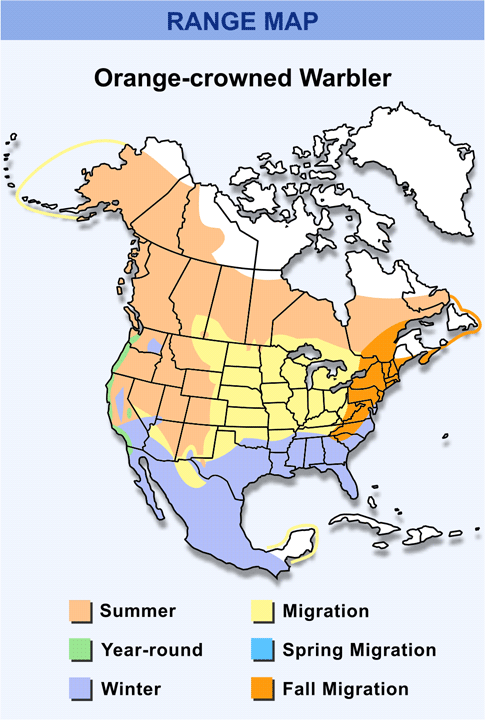
As you can see from the map, the Orange-crowned Warbler is nowhere near its winter range. This, from Cornell, “Medium to long-distance nocturnal migrant. Many birds winter in Mexico, with some continuing south to Guatemala and Belize. Others winter in central California and the southern U.S.”

Finding insects in the brush, bark, and rotting wood

Finding plenty of insects in rotting pieces of driftwood, peeling bark, and drying seaweed, the little fellow is very active and seems relatively unperturbed by the below freezing temperatures of the past month. Orange-crowned Warblers are purported to be one of the most hardiest of warblers. I met up with some old time knowledgeable gentlemen birders and they shared that about once a year an OCW shows up in Massachusetts, but rarely as far east as Cape Ann.

After looking at the photos you may wonder, as did I, why this yellowish-olive green songbird is so named ‘orange crowned?’ You can just barely see a very slight rusty orange hued patch of feathers when its head is bowed forward.

beautiful birds

WARBLERS AND WHATNOTS! HAVE YOU EVER SEEN A BAY-BREASTED WARBLER?

The past week I have been astounded with the array of warblers that we are seeing in our garden and on walks in the neighborhood. The big attraction in the garden is the native pink flowering dogwood tree (Cornus florida ‘Rubra’), my neighbor’s maple tree and the tiny insects feeding there, and our funky weathered old bird bath. There has been so much activity in the bird bath we are changing the water several times a day! Perhaps the travelers are dusty and dirty and appreciate the fresh bathing water.

American Redstart

One of the most fun to see was an American Redstart and the new-to-my-eyes Bay-breasted Warbler.

Bay-breasted Warbler

We also had a trio of black and white birds for an afternoon, the Black and White Warbler, Black-throated Blue Warbler, and a female Yellow-rumped Warbler.

Black and White Warbler, Black-throated Blue Warbler, and Yellow-rumped Warbler

There’s much that could be written about each species. I’m posting these photos for ID purposes in case anyone else has noticed a recent influx of warblers in your backyard or neighborhood. Please write if you do. Thank you!

Common Yellowthroat taking a bath