Tag Archives: Goldfinches

National Learn About Butterflies Day

In recent years, March 14th has been designated National Learn About Butterflies Day. Butterfly populations, as are many species of insects, plummeting around the globe. Climate change, loss of habitat, and the use of pesticides are at the top of the list as to why we are losing our insects.

What can we do as individuals, and collectively with like-minded friends? I have been writing about the plight of butterflies for nearly 30 years and at the risk of sounding repetitive, the following are easy to follow guidelines:

Refrain from Using ALL Pesticides and Herbicides. 

Do Not Spring Into Spring Cleaning!

For the sake of all pollinators, and many songbirds, do not do a spring garden clean up too early. When is a good time? Wait until your grass is growing tall and needs to be mowed and ideally, apple and pear trees in your area have finished blooming. You can also clean-up some spots and leave others unkempt for an even later season clean-up.

Grow Native and Not Invasively

Plant native species of trees, shrubs, vines, wildflowers, and ground covers. Only plant non-native species (such as tulips and zinnias for example) that do not spread outside the area in which you wish them to grow.

American Copper, Bee, and native aster

Provide Continuous Blooms from Early Spring Through November 1st

Create a landscape that provides nourishment for pollinators and songbirds, from the earliest days of spring though the last hard frost. Include colorful nectar plants and equally as important, grow native larval host plants for butterfly caterpillars.

Although these lovely pink Korean Daisies are not native, they are not invasive and bloom until the first hard frost. They are especially welcome to late migrating scragglers such as the Monarch pictured here.

Plant in Clumps and Drifts  Whenever Possible.

Butterflies and bees love to drink nectar at a buffet where they can flit easily from one floret to the next. Allow perennials to spread into drifts and clumps. Panicle-shaped flower heads (think goldenrods) and aster-type flowers, with their ray flowers conveniently arrayed around a center disk of florets, provide a convenient landing pad onto which butterflies can land while they are sipping nectar.

Monarchs and Seaside Goldenrod

Plant and They Will Come!


Wall of Fragrance

Walking around Niles Pond at this time of year you can’t helped but be knocked out by the fabulous combined scent of the blooming Summersweet (Clethra alnifolia)  and Rosa rugosa. Summersweet, also know as Honeysweet and Sweet Pepperbush, is the large shrub that densely lines both sides of Niles Pond Road. With racemes that look like bottlebrushes, the many florets provide nectar for dozens of species of pollinators, of all sizes. The tiniest winged wonders attracted to the panicles provide sustenance to hummingbirds and I often see them zipping in and out of the Clethra blossoms, too.

The Summersweet shrubs growing so closely together creates a “Wall of Fragrance,” which always reminds me of Phil Spector’s “Wall of Sound,”  where his musical arrangements called for multi tracking multiple instruments, creating “symphonic saturation.” Niles Pond right now is a symphonic saturation of sweet summer scents – GO!

The following is an excerpt from a book that I wrote back in 2004-2007, which was published by David R. Godine in 2009. The book is about designing landscape habitats for wild creatures and for people, titled Oh Garden of Fresh Possibilities: Notes from a Gloucester Garden, and all that I wrote then, still holds true to day.

“Summersweet is a native shrub that bears small white florets held on racemes, and depending on the cultivar may be shaded with varying hues of pink to rose-red. The tapering spires of fragrant blossoms appear in mid to late summer. Clethra has a sweet and spicy though somewhat pungent aroma, and when the summer air is sultry and humid, the fragrance permeates the garden, Summersweet is a nectar food attractive to bees and a wide variety of butterflies, notably the Silver-spotted Skipper.” See more at Oh Garden

Myriad species of bees and butterflies, along with Ruby-throated Hummingbirds, are attracted to Clethra for its sweet nectar, while American Robins, Goldfinches and warblers dine on Summersweet’s ripened berries.

Beach Rose (Rosa rugosa)

What is Adaptive Radiation?

One of the most striking evolutionary patterns observed is called adaptive radiation. To radiate means to spread outward; not in the sense of speading out physically, but referring to a species that diversifies (“spreads out”) and generates multiple daughter species.

From Biology Online: When Charles Darwin was in the Galapagos islands, one of the first things he noticed is the variety of finches that existed on each of the islands. All in all, there were many different species of finch that differed in beak shape and overall size. This is adaptive radiation and natural selection at work.

Darwin’s Finches

These finches, better known as ‘Darwin’s Finches’ illustrated adaptive radiation. This is where species all deriving from a common ancestor have over time successfully adapted to their environment via natural selection.

Previously, the finches occupied the South American mainland, but somehow managed to occupy the Galapagos islands, over 600 miles away. They occupied an ecological niche with little competition.

As the population began to flourish in these advantageous conditions, intraspecific competition became a factor, and resources on the islands were squeezed and could not sustain the population of the finches for long.

Due to the mechanisms of natural selection, and changes in the gene pool, the finches became more adapted to the environment, illustrated by the diagram below.

Adaptive Radiation in Darwin's Finches

As competition grew, the finches managed to find new ecological niches, that would present less competition and allow them, and their genome to be continued.

As indicated by the diagram above, the finches adapted to take advantage of the various food sources available on the island, which were being used by other species. Over the long term, the original finch species may have disappeared, but by diversifying, would stand a better chance of survival.

All in all, the finches had adapted to their environment via natural selection, which in turn, has allowed the species to survive in the longer term, the prime directive of any species.

See related post Silversword Alliance.

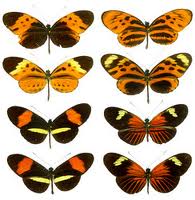
Follow this link to read more about rapid adaptive radiation in the species rich Heliconius butterflies (longwings or passion-flower butterflies).

Heliconius butterflies