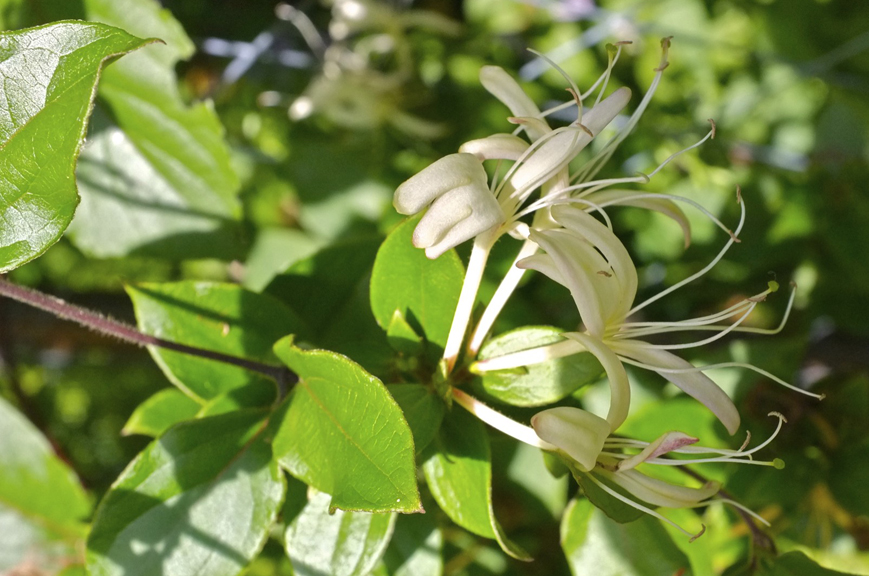
While snapping a photo of the divinely scented honeysuckle embowering the outside shower…

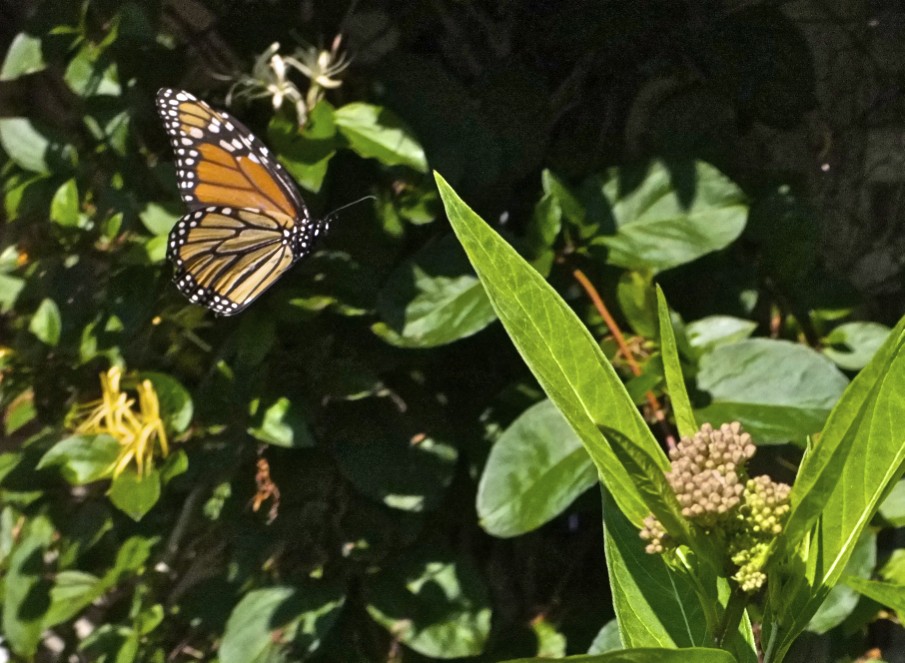
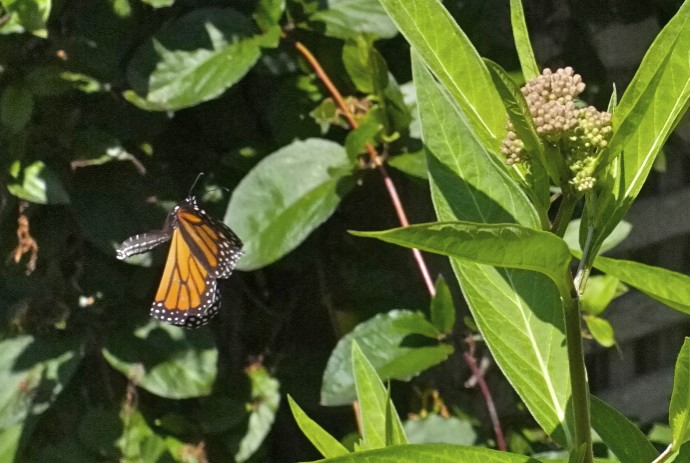
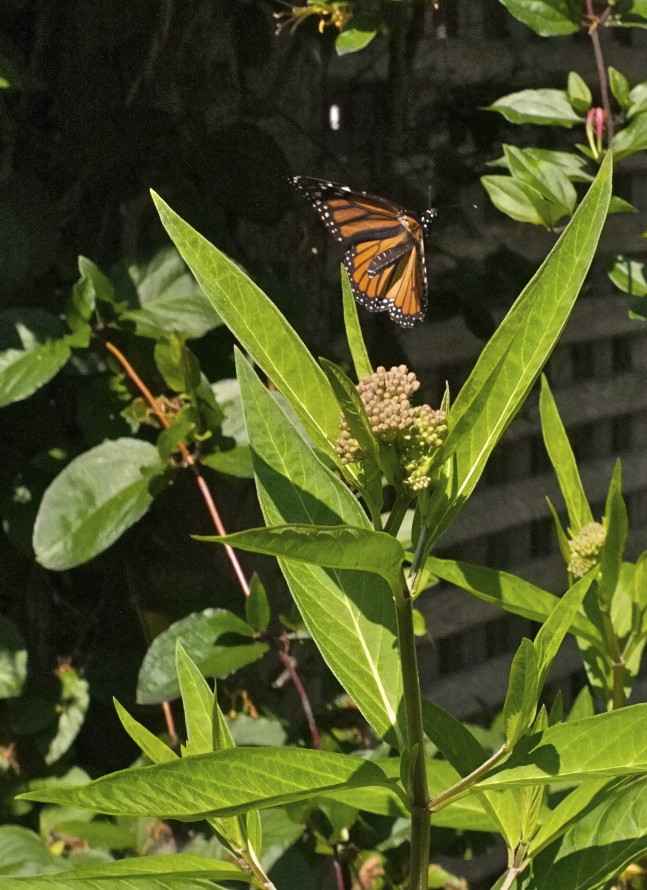
I spotted our first female Monarch butterfly of the season.
 She’s arrived a bit earlier than usual this year, or more accurately, the milkweeds in our garden are slightly behind in blossoming time-Marsh Milkweed won’t bloom for another half-week and Common Milkweed won’t flower for another two weeks (both milkweed patches are growing nearby the shower enclosure). However, she did not have nectaring in mind.
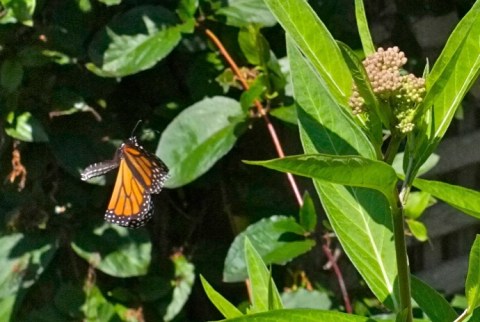 Pausing at the emerging buds and foliage of the Marsh Milkweed, then to the Common Milkweed, then back to Marsh, and curling her abdomen to the underside, one by one she oviposited golden egg after golden egg.


Typically, she searches for the uppermost, freshly emerging foliage in which to deposit her eggs. Click the above photo to make it larger. The newly deposited egg, no larger than the size of a pinhead, is a visible pale yellow dot adjacent to her abdomen.
 After ovipositing an egg on the Marsh Milkweed, she next deposited several on the Common.

Click the above photo. Five eggs are visible, two on the upper leaf of the plant to the left and three on the upper leaf of the plant to the right.
I never tire of watching butterflies, especially Monarchs, whether in our garden or further afield, and eagerly anticipate their arrival each year. Monarchs are particularly gratifying to observe and record because they are one of the larger butterflies that grace our region. Oftentimes when I am photographing a smaller butterfly such as a Summer Azure, with a mere one-inch wingspan, I don’t know what I have captured through the camera’s lens until returning to the computer to download and edit. Monarchs, with their big and bold wing patterning and approachableness (is that a word?) are a joy to photograph. Because of their extraordinary migration, I believe the Monarch butterflies are one of the natural wonders of the world. We are so blessed to live in a community that plays host to such great numbers. PLANT MILKWEED and you, too, will have Monarchs! I guarentee it!
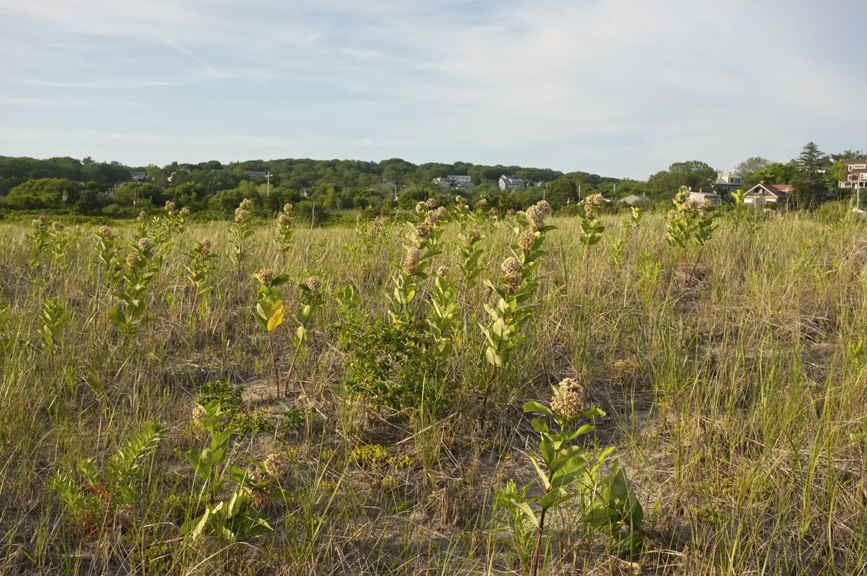
 Common Milkweed in full bloom at Good Harbor Beach this week.

Common Milkweed (Asclepias syriaca) found along the shoreline grows in sandy soil and is exposed daily to windy seaside conditions. In these rough and tumble conditions it typically grows two- to two and a half -feet tall. Conversely, where in our garden it grows in fertile, friable soil and lives in a sheltered corner protected from wind, Common Milkweed often grows six to seven feet tall.
Walking along the boardwalk I often catch the sweet honey-hay fragrance of the Common Milkweed when in full bloom. Marsh Milkweed has little to no fragrance. Several Monarchs were seen while photographing this patch of milkweed.

 Blooming along the pathway leading to the outdoor shower is the magnificent hummingbird attractant Torch Lily (Kniphofia uvaria) and bee magnet Helenium, commonly called Sneezeweed or Dog Tooth Daisy.


The foliage of the diminutive Mexican marigolds (Tagetes tenuifolia), commonly referred to by the Mexican people as “flowers of the dead,” bears a fabulous spicy citrus fragrance. Flowers and foliage are edible and add both a tangy color and taste. I grow it in a pot, keeping it sometimes near the shower and sometimes moving it to the dining area.
The female Monarch stayed the morning and I have not seen her since. Lucky us, though. I found fifteen eggs, without really trying too hard, and will now have lots of caterpillars and chyrsalids for upcoming butterfly programs!
End Note regarding Japanese honeysuckle: The variety discussed here is a purple-stemmed variant and I have seen it written as Lonicera japonica var. repens and Lonicera japonica ‘Purpurea.’ In our zone 6 garden, I have found it to be well-behaved, neither bearing fruit nor sending runners. I do not recommend planting in zones 7 and above. Lonicera ‘Purpurea is highly attractive to all manner of bees. As richly scented as the species, the blossoming time of L. ‘Purpurea’ lasts well over six weeks, equating weeks of showering while enwrapped in the spellbinding sweet scent of honeysuckle.
 Lonicera japonica var. repens or Lonicera japonica ‘Purpurea’

 Pollen-dusted Honey Bee
 Fabulously fragrant Oriental Lilies are planted adjacent to the front door to welcome visitors as they enter the Inn.
 The Mary Prentiss Inn, from the pollinators point of view ~


 The Mary Prentiss is a stunning twenty-room Greek-Revival style inn located on a quiet street minutes away from Harvard Square. Elegant, comfortable, and charming, with period architectural detail and decor, the Inn is outfitted with all modern amenities. Visit The Mary Prentiss Inn website for more information.
 Enjoy a delicious made-to-order breakfast or afternoon tea at the Inn’s secret garden.
 The Mary Prentiss Inn is listed on the National Register of Historic Places and is the proud recipient of the Massachusetts Historical Commission Preservation Award for 1995.
 The Mary Prentiss Inn is located at 6 Prentiss Street, Cambridge. Call 617-661-2929 or visit maryprentissinn.com