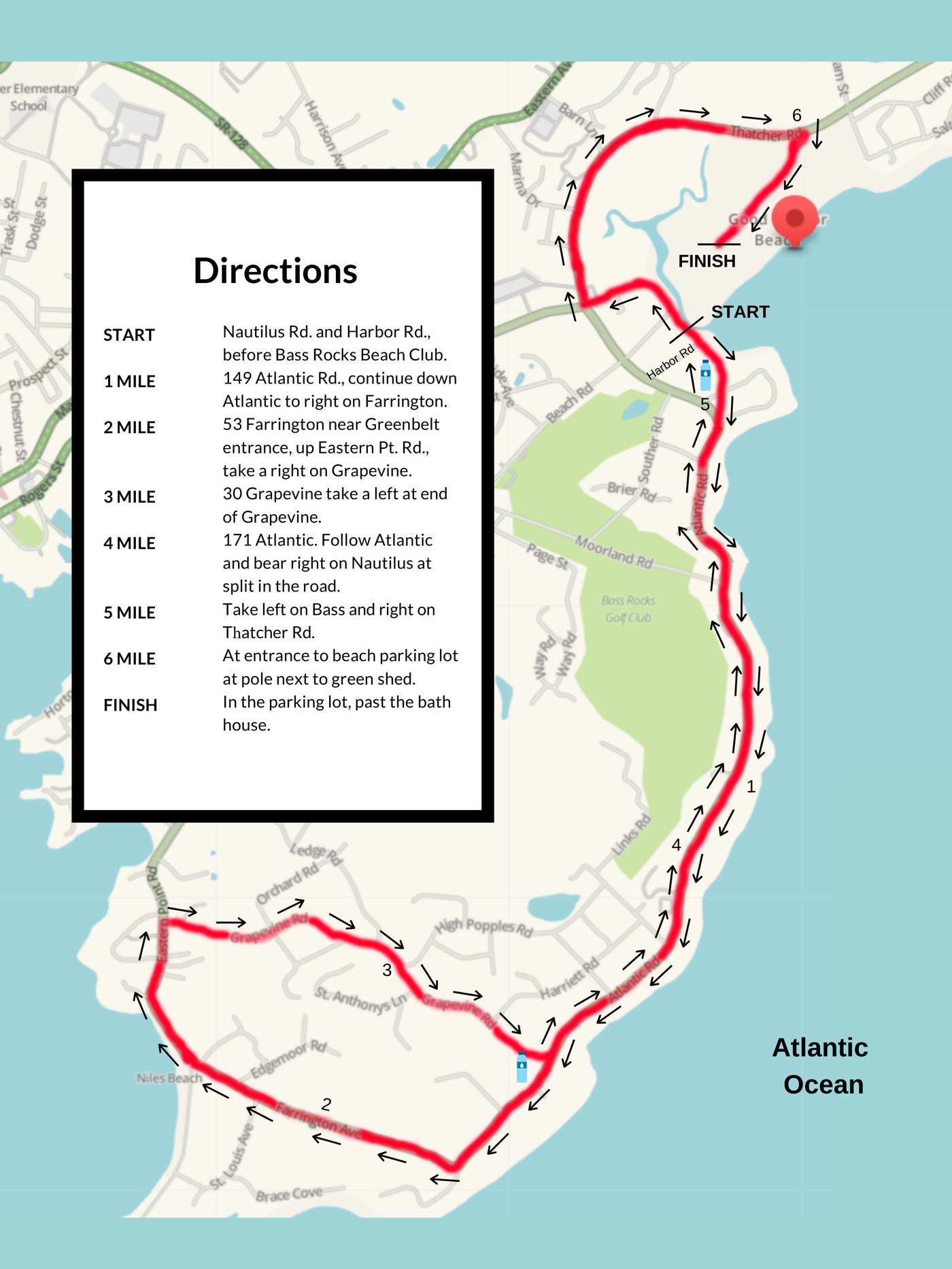
Plovie marathon moves-
Happy Marathon Monday!
Leave a reply
Plovie marathon moves-
A Bluenoser at Good Harbor Beach – the fascinating world of shorebirds!
At this time of year, we Gloucester Plover Ambassadors are at Good Harbor Beach (trying) to keep track of the comings and goings of the Plovers. Some birds are arriving to set up house while others are passing through on their way to their summer nesting homes. Last week while out on Plover patrol, Super Dad was spotted, along with a sweet pair that we’re fairly certain is a mated pair from last summer, and a new little friend. It wasn’t until I returned home and began looking at the footage that I noticed that this unfamiliar one was banded!
Finding a banded bird at Good Harbor Beach is pretty exciting because instead of wondering where the bird came from, you can learn from just looking at the tag . Several years ago Good Harbor Beach was a stopover for a Plover with a green tag and white letters, which indicated that it was banded by Virginia Tech. He had flown from the southern coast of Georgia to Gloucester in just under five days!
As you can see in the photo, N5’s band is white with a black alphanumeric code, which indicates he was banded in Canada. A quick Google search led to several contacts where to report Canadian banded birds and we sure hit the jackpot of information from these kind wildlife biologists, Dr. Cheri Gratto-Trevor and Hilary Mann.
People are always asking us Ambassadors, where do the birds go after departing GHB in August? The following is not a complete picture, but does provide a tiny widow into the flight pattern of one of these remarkable little travelers.
Cheri writes, “White flag N5 was banded as an adult in June 2024 at Sandy Bay, in southern Nova Scotia. The bird was seen in Fall (Aug) 2024 at Sunset Beach, Tubbs Inlet, NC.”
Hilary writes the following, ” In 2024, we put a nanotag on N5. This is a small radio transmitter that helps us track birds, when they fly close to a station that is part of the motus wildlife tracking network. We got a track of N5, which you can see below. The dashed lines show the ‘direct flight’, and if this is no line connecting dots as the plover moved south, it just shows that they may have stopped somewhere along the way. N5 crossed from southern Nova Scotia to Cape Cod in about 10 hours, on the night of August 6, 2024. By August 10, it was down in North Carolina. We do not have any detections past August 10, but there are fewer stations to detect the tags south of North Carolina. The tag is glued on, so it falls off in the winter when the battery dies, and we do not have tracks of its Northbound movements.”
Think about that – In 2024, N5 flew from Nova Scotia to North Carolina in four and half days! After first departing Sandy Bay, N5 flew nonstop to Cape Cod, when it appears he was next tracked at either a Rhode Island or Connecticut beach, across the sound on to Montauk, at the eastern end of Long Island, then a non-stop flight to Cape May, which is also an important holdover location for Monarchs waiting for the ideal wind to carry them over the mouth of the Delaware Bay. He is next hitting locations at Virginia beaches and North Carolina’s Outer Banks before arriving at Sunset Beach, which is just south of Ocean Isle at the southern point of North Carolina.
And in 2025, N5 returned to Sandy Bay, Nova Scotia and successfully fledged two chicks!
Our deepest thanks and appreciation to Dr. Cheri Gratto-Trevor, research scientist emeritus with Environment and Climate Change Canada and to Hilary Mann, wildlife biologist with Canadian Wildlife Service.
I pulled this map off Google to show what a direct flight it is for Plovers flying from Cape Ann to southern Nova Scotia.

Nova Scotia Piping Plover N5 in the foreground. The film clip is in 10 times slow motion so you can see the band placed on the upper right tibia.
Read more about banded Piping Plovers seen at Cape Ann beaches here –
FUN 411 UPDATE ON ETM, THE CUMBERLAND ISLAND BANDED PLOVER
Many, many thanks to Gloucester Daily Times reporter Bobby Grady and editor-in-chief Andrea Holbrook for the Times‘s continued coverage of our Gloucester Plovers. The story appeared in Thursday’s Times with a gentle reminder to give the Plovers lots of space as they are establishing their nesting territories.
The coverage the Times has provided since the Plovers first arrived back in 2016 has been invaluable in helping to create an awareness about these very vulnerable, yet valiant, threatened shorebirds. Thank you again Andrea, Bobby, and the GDTimes!
Happy Spring,
xxKim
PiPl N5 at time of banding provided by Hilary Mann
Many, many thanks to Gloucester Daily Times reporter Bobby Grady and editor-in-chief Andrea Holbrook for the Times continued coverage of our Gloucester Plovers. The story appeared in today’s Times with a gentle reminder to give the Plovers lots of space as they are establishing their nesting territories.
The coverage the Times has provided since the Plovers first arrived back in 2016 has been invaluable in helping to create an awareness about these very vulnerable, yet valiant, threatened shorebirds. Thank you again Andrea, Bobby, and the GDTimes!
Dear Friends,
I hope so much you are doing well. Spring weather hasn’t quite sprung here in our region, nonetheless we know warmer days are just around the bend. I haven’t been writing lately, managing health hurdles but they are manageable and things are looking better.
The wonderful good news is that Piping Plovers have been returning to their breeding grounds all along the Great Lakes and Atlantic Coast nesting locations and ours are no exception. The first PiPl arrived on March 26th, one of our females from last year, and Super Original Dad has returned for the ELEVENTH year to nest at Good Harbor Beach. He only landed several days ago and is wiped out from the migration. Super Dad is staying close to his territory and seems to be waiting patiently. Waiting I think for the return of his love, handicapped Super Mom. It will be nothing short of a miracle if she returns, too, as maneuvering with a missing foot takes a great deal more energy. The average lifespan of a Piping Plover is 3 to 5 years. Our Original pair is at least 12 years old and has far exceeded that statistic. Despite the fact that Plover pairs may winter over in two entirely different locations, last year Mom and Dad returned on exactly the same day, March 19th.
Super Dad March 2026
Plovers typically arrive at their northern breeding grounds needing plenty of R and R so if you see them on the beach, please give them lots and lots of space. If they pipe in your direction, you know you are too close. A gentle reminder to all our beach friends – the earlier Plovers can court and mate undisturbed on the beach, the earlier they begin laying eggs, and the sooner the chicks will have fledged. Although Good Harbor Beach is now closed to pets for the season, Wingaersheek is open until May 1st, and Crab Beach, which is downtown adjacent to the dog park, is open all year round
Hats off to our incredibly hard working DPW Crew. Thank you to this great group of guys for placing the symbolic roping and threatened species signs up prior to April 1st. And thank you to the DPW Crew for taking such care and pride of our City beaches.
More good news for Plovers is that we are again partnering with Mass Audubon to watch over the Plovers. The Audubon team of young biologists are some of the most conscientious and caring individuals you will meet and we are so delighted to learn from, and work with, Mass Audubon. If you would like to be a Piping Plover ambassador this summer, please contact me. We would love to have you!
Happy Easter, Happy Spring!
xxKim
A short video of our newly arrived and very loveable, sleepy Super Dad –
Happy Bday to our 45-day-old Piping Plover fledgling! He/she is the last of the Good Harbor Beach flyers. The photo/video was taken on Thursday when the little one was 42 days, or six weeks old. This is the age when we typically see them head out for their southbound migration. He’s still here as of Saturday but we are hoping to not see him any day now 🙂
I am very sorry to share that the rescue Plover did not survive. Tufts wrote that the chick had multiple chronic healed fractures and that the wing was held in a permanently drooped position. He would never be able to fly. I was at first feeling extremely low about this but both our partners at Audubon and Lis from DCR wrote that if left on the beach its demise would have been very traumatic and, if not eaten by a predator, would slowly starve to death.
Thank you so very much to everyone who wrote with well-wishes for the injured Plover.
A special Waves of Impact event is happening right now at Good Harbor Beach. They were setting up for the day when I was there earlier this morning with Liv to check on Plovers. When I drove past just now the beach is full of families having a wonderful time and learning how to surf!
Waves of Impact is a surf camp, with branches in California, Texas, New Jersey, and Massachusetts. Their mission statement reads, “Waves of Impact is dedicated to providing access to the healing and therapeutic power of the ocean to individuals with exceptional challenges. Our mission is to foster growth, self-esteem, and wellness through adaptive surfing. We strive to create an inclusive and safe space for our participants, and to provide the highest quality of surf and ocean-based therapy to those in need.”
Gloucester lifeguard volunteers John Dalone, Kansas Ricci-Munn, and Charlotte Morris
Every year volunteers are needed on the beach and to help with the kids in the water. I’d love to learn more about the camp and help next year. Read more about Waves of Impact here.
Dear PiPl Friends,
Our youngest fledgling has resurfaced at Good Harbor Beach! He/she had not been since the morning of the fierce hail and rain storm but there she was in the soft sand today, preening and sleeping alongside a mini flock of Semipalmated Plovers. Will they migrate south together? Piping Plovers are reportedly solitary but are often seen during the non-breeding months foraging in mixed groups of Semipalmated Plovers, Sanderlings, and Dunlins. Several years ago, during their southward migration, I saw a flock of a dozen Piping Plovers tucked in with several hundred Semipalmated Plovers, all resting on the upper part of the beach.
39 day old Piping Plover fledgling with Semipalmated Plovers
Semipalmated Plover range map – orange = breeding, yellow = migration, blue = wintering grounds
You can see from the map that the range of Semipalmated Plovers is vast when compared to Piping Plovers. They nest in subarctic and arctic environments and that is why we do not see them nesting at our local beaches. August is the peak time of year for the Semipalmated Plover’s southbound migration and we have seen many at Good Harbor Beach over the past month. Partners in Flight estimates the global population to be about 200,000 while the Piping Plover population as of 2020 was only about 8,000 adults.
Semipalmated Plovers are often mistaken by beachgoers for Piping Plovers. During the southward migration, their feathers are faded and worn, which only increases confusion.
Semipalmated Plovers are called as such because only their two outer toes are webbed, ie. semi. The photos show the webbed tracks and the partial webbing of the toes.
From Life Traces of a Georgia Coast
Enjoy this beautiful Labor Day,
xxKim
The morning after the first super high tide at Good Harbor Beach we were surprised and delighted to see a third Plover had joined our Fierce Dad and his almost-fledged chick. We found the three on the narrowest strip of beach that had not been impacted by the hurricane tide. They have been seen together ever since!
Mystery/Butterball left, Fierce Dad right
30 day old Piping Plover chick
I think my daughter may have solved the Mystery and we believe this Plover could be what would now be the 54-day-old fledgling we were calling Butterball. He appears to be a similar stage of development and it makes sense; after Butterball’s Dad departed, Butterball attempted to forage alongside Fierce Dad’s chick several weeks back, but FDad would have none of it and was in maximum defensive mode for his little one at that time. Now that his chick is older and more independent perhaps he feels it’s safe to socialize with other Plovers; although at one point FDad planted himself firmly between his chick and Mystery.
Below are photos of 40 to 42 day old Plovers from years past and they are the only photos I can locate at the moment of Plovers past 36 days. Our Mystery Plover looks to be at least as old as the Plovers in the photos
This last photo is of HipHop, Super Dad, and HipHop’s 46-day-old sibling. Although the sibling is out of focus, you can see its feather patterning is similar to the Mystery Plover. This was such a sweet sibling; he stayed with HipHop until he could fly. You may recall HipHop who was developmentally challenged. The first year Mom returned to Good Harbor Beach missing a foot, one of her chicks sustained a hip injury.He was nicknamed HipHop for his hopping gait and it took him many, many weeks to catch up to his siblings. Both Super Dad and this one sibling gave HipHop lots of snuggles and stayed with him well beyond the time frame in which they would typically migrate.
For my New Jersey Friends and Family – Montclair Film and The Nature Conservancy of NJ are hosting a special screening of The Piping Plovers of Moonlight Bay on Tuesday, August 26th at 7pm. QandA with me to follow. To purchase tickets, please go here: https://theclairidge.org/events/the-piping-plovers-of-moonlight-bay/
I hope you can come!
Dear PiPl Friends,
The anticipated update for the 2025 season with these most beautiful and most vulnerable of mini beach friends I feel is finally ‘safe’ to write. I only write safe because we try very hard to find a balance between sharing information to help create an awareness about the Plovers and also not bringing too much attention to the nesting birds.
First off I would like to thank our outstanding crew of kind-hearted volunteers, especially our core group who sign up for shifts that are an hour or longer and come everyday. This summer we had a very extended season with the chicks (more about that below) yet despite that, they stuck it out to the very end. Thank you to Jennie Meyer, Paula and Alexa Niziak, Kim Bouris, Steve Spina, Sandy Barry, Deborah Brown, Barbara Boudreau, Jill Ortiz, and Marty Coleman. We’d also like to thank our subs Heidi, Velia, Sally, and Jonathan.
If you see these kind and caring people around town, please thank them for their dedicated wildlife conservation work that they do so graciously and so tirelessly.
Thank you to Lyra Brennan, Rose Caplan, Jamie Infanti, and all our Audubon partners. We saw a great deal of Emma this summer and she is wonderful, staying extra long hours in the summer’s heat to watch over the chicks. Audubon does such great work and are responsible for not only Good Harbor Beach, but many other shorebird nesting areas all along the Massachusetts coastline. We appreciate their thoughtful and action oriented responses so much, especially when it comes to some of the more serious issues that arise over the course of the season. With thanks and gratitude to Lyra, Rose, Jamie, Will, Emma, Charles, and Claudia.
Thank you also to Gloucester’s Joe Lucido, Tom Nolan, and the entire DPW Crew. These guys are amazing and are always working so hard to make our beaches safe and presentable. Despite the double load imposed on the Crew (because of the additional work they are doing during the garbage strike), they are ever present and so very much appreciated.
DPW Crew setting the roping in place n March
We’d also like to thank several gentlemen who are at GHB nearly every single morning, starting in the spring. While most beach visitors are still sleeping, these gentlemen voluntarily pick up the plethora of garbage found littering the beach leftover from the previous day. They ensure our beaches look pristine by the time the gate opens at 8am. Chris Cefalo, his brother Fred, Michael Cook (and there is a fourth gentleman whose name I don’t know), work tirelessly cleaning the beach, from the tiniest bits of plastic to hauling off the larger items like chairs, tables, umbrellas, and tents. If you see these gentlemen around town, please thank them for the good work they do.
And a huge shout out to all the many, many beachgoers who express interest in the Plovers, want to learn more, give the chicks lots of space, and respect the cordoned off areas.
Piping Plover Smooshies
One of the many gifts we receive as Plover Ambassadors is watching tiny baby birds the size marshmallows develop into beautiful little flyers. The clips are of Fierce Dad and FairFeathered Mom’s offspring; the first clip is of two-day-old hatchlings, the second clip is of two-week-old chicks, and the last clips of the three- and a half-week-old chick. When Plovers hatch they can feed themselves entirely independent of the parent however, they need to thermoregulate to keep warm (otherwise known as thermo-snuggles and smooshies). The birds instinctively know to tuck under Mom and Dad’s wing to keep warm.
The 2025 Piping Plover Season at Good Harbor Beach
The season started phenomenally well, with the earliest arrival ever of Super Dad and our footless Handicapped Mom. Fierce Dad also arrived on the very same day as this original pair. It is always a much anticipated and joyful moment when we begin to see the first Plovers returning, especially Super Mom and Dad. This resilient little pair are at least 11 years old. We know this because they began nesting at Good Harbor Beach in 2016 and Plovers have to be at least one year old before they can begin breeding. Each year its become more and more tenuous as to whether or not we will see the return of our wonderful original pair. Plovers only live on average 3 to 5 years and this pair, at 11 years young, are quite a respectable age for their species.
Fierce Dad and Original Dad spent a good part of the first few weeks in competition for territory and for Super Mom, with Fierce Dad even putting the moves on Mom several times. At one point we had nine Plovers, and four were nesting pairs, the most ever! There were lots of territorial disputes, some ending in serious smackdowns but for the most part, the birds began to settle in to brood their eggs.
Piping Plovers Mating
Original Mom and Dad’s clutch was nearing hatch date when on May 22nd, the coast of Massachusetts was walloped by a late season nor’easter. The tide rose higher than we have ever seen in late May and three of the four nests were washed away. As devastating as that was, it was a joy to find one remaining nest, the young parents that are a new pair to Good Harbor Beach. From their nest of three eggs, two chicks hatched.
Over time original Mom and Dad attempted to re-nest. After a brief recovery period, Mom laid a new clutch of three eggs. However, this second clutch of eggs was predated by a Crow. As the season progresses there are more and more Crows and gulls scavenging the beach, seeking garbage left behind by people. We know it was a Crow from the tracks found around the nest.
Remarkably Mom and Dad laid four more eggs, a grand three clutches, 11 eggs in total. Once again, the eggs were snatched and Crow tracks were found encircling the nest scrape. Our Handicapped Mom left shortly after the third nest was lost. Super Dad hung on for a bit longer but he too departed. All was not lost as the one remaining chick from the young parents grew and developed into a lovely, albeit super chunky, fledgling and has begun its southward migration. Note – we love super chunky fledglings. They’ll have lots of stored fat reserves to get them through their first migration.
FairFeathered Mom and one-day-old hatchling
Today we still have one almost-fledged chick remaining at Good Harbor Beach. This little chunkola is Fierce Dad and FairFeathered Mom’s offspring, from their re-nest. Because the eggs hatched so late in the season and the females usually begin migrating before the males, FairFeathered Mom left when her chick was only five days old, leaving Fierce Dad to raise the chick solo. Fierce Dad has lived up to his name, fighting off every gull, crow and even other shorebirds that dare to come within 100 yards of his offspring. He is still parenting the chick who is quite independent at this point. Nonetheless, the almost fledged chick still goes in for snuggles and smooshies and relies on Dad to keep the gulls at bay.
Along with a great bounty of seaweed washed in with the late May nor’easter, the seaweed was littered with zillions of pieces of small yellow and green plastic
Just as has happened at GHB this summer, nests were washed out along the entire coastline of Massachusetts. With many pairs re-nesting, the conservation biologists from every Mass coastal region saw much lower productivity with these second nests, and in some cases (Super Mom and Dad), third nests. What does low-productivity mean? Not as many eggs were laid and of the eggs that were laid, fewer than usual hatched. So, for example a second clutch with only three eggs, only one or two of the eggs may hatch. And all coastal areas across the region experienced higher than usual heavy predation by Herring and Great Black-backed Gulls, Crows, and Eastern Coyotes. My own theory for that is because when chicks hatch in May for example there are far fewer flocks of seagulls on the beach. But when chicks hatch in July and August, Crows, Gulls, and Coyotes are acclimated to finding free food, i.e. garbage, at the beach, which leads to greater interest in shorebird eggs and chicks. Also at this later time in the summer, there are thousands of hungry fledglings on beaches begging their parents for food.
We are hopeful that next year we won’t have another late, late nor’easter and all the pairs that attempted to nest at GHB this season will return and try again. If you would like to join our volunteer team of Plover Ambassadors, please contact me either by leaving a comment or emailing me at kimsmithdesigns@hotmail.com. We would love to have you!
If you would like to learn more about how we can all help protect shorebird wildlife and their habitats, please watch our film The Piping Plovers of Moonlight Bay. Our documentary is streaming on the PBS Passport AP anytime you would like to watch it. Everyone can become a member of PBS Passport by donating to PBS. It’s so worthwhile, especially for young children with curious minds. What other streaming service can you get for $5.00 a month!!
According to the Gloucester City ordinance code, it is a $300.00 fine (doubled during the season) to bring a dog to Good Harbor Beach. For example, if you bring two dogs, that is 600. x 2 = $1200.
But stating the fines right off doesn’t explain why.
Our beaches are wonderfully filled with beachgoers during the summer months. Can you imagine adding dogs, either on or off leash, to the mix? Dog ownership is at a record high, much greater than even a generation ago. In 2000 there were roughly 68 million pet dogs, today there are about 90 million dogs. What if everyone who owns a dog brought theirs to the beach?
Let’s face the facts, a great many dogs are not on voice command. We have dogs jumping on children, knocking over the young and old, biting people, and getting into dog fights and biting each other. That is not a safe scenario for any beachgoer.
But what if the law were changed to allow dogs on leash?
We would have half abiding by the leash law and half saying “I left my leash at home,” or “I thought it was okay to let my dog off leash after 5pm,” or “I thought it was okay before 8am,” etc. etc. How do we know this? Because we already hear these statements during the off leash/on leash days at Good Harbor Beach.
Pile of poop at the Good Harbor Beach snack bar area
Dog Poop is a consequential environmental issue. During the season when dogs are allowed on the beach we see the gamut of poop-maintenance behaviors. Most people clean up after their pet. However, many people bury the poop in the sand or leave their poop bags behind. When someone leaves their bag by the footbridge, then other dog owners take it as a sign as a place to deposit their bag. The pile of dog poop in a rainbow color of bags grows and grows. Do we want beachgoers stepping in sand covered poop or being confronted with piles of dog poop? There is no poop cleaning fairy. It is left to our awesome DPW or one of the very nice volunteers, like Chris Cefalo, his brother, and Michael Cook who regularly cleans GHB to remove garbage and also the bags of poop.
Good Harbor Beach footbridge
If you regularly visit Good Harbor Beach during the off season, you can’t help but notice, the “Keep out of Dunes” signs are frequently ignored by pet owners. There are many who do respect this vital habitat, but also many who don’t. Dogs running and playing vigorously through the vegetation tears at the roots and weakens the plants. Vegetation holds the dune sand in place and without plants the dunes continually recede.
Over the past several years, you may also have noticed the vast improvement in the overall health of the dunes. There is a direct correlation to keeping the symbolically roped off areas up through out the summer season and into the fall because by preventing people and pets from recreating right up to the base of the dunes, it allows just that much more room for vegetation to take hold, and is one fantastic tool in the tool box against fighting erosion.
Dog going pooh within nesting area
Last, but not least, dogs on the beach are a well-known threat to shorebird nests and especially to young birds that can’t yet fly to escape danger.
How so you may wonder? “My dog is so sweet and would never harm a baby bird.”
When there are baby birds on the beach, the Plover parents do their absolute utmost best to keep the chicks safe. The parents exhibit all sorts of distraction behaviors including dragging and fluttering their wings on the ground to fake injury, thereby encouraging the predator to follow it and drawing the threat away from their most vulnerable chicks.
Plovers cannot tell the difference between a domestic dog, Fox, or Coyote. Dogs bound exuberantly on the beach through nesting areas and Coyotes and Fox dig in the sand for eggs and chicks. The ever vigilant Plover parent will leave the nest and fly at any creature Canid. Often, both parents will fly away from the nest in a sort of tag team distraction method. But while they are busy defending the chicks from a member of the dog family, that is the perfect time for a gull, crow, hawk, or falcon to swoop in and snatch the eggs or eat the baby chicks. Crows focus on eggs and gulls not only eat the eggs, they also eat chicks at every stage of development, even fledglings that have grown as large as the parent. Coyotes eat both eggs and chicks.
Especially during pupping season, Red Fox scavenge the beach looking for shorebird eggs, small mammals, and birds to feed their growing family. Plovers cannot distinguish the difference between a Coyote, Fox, or domestic dog.
Fierce Dad and FairFeathered Mom tag team distracting a Herring Gull
As I am writing this message, please know that we still have young birds at Good Harbor Beach that can’t yet fly well enough to escape predators. This is extremely late in the season and is due to the tremendous loss of nests during the May Nor-easter; losses all along the coast of Massachusetts. Many of the nesting birds eventually re-nested and we are seeing their offspring. Shorebird managers across Massachusetts are contending with taking care of these late flying chicks.

Here are on Cape Ann we are blessed with many beautiful alternative locations to walk our dogs, including Crab Beach (adjacent to the Boulevard), which is open year round to dogs and dog owners.
If you would like to see scenes of Plovers displaying their fascinating distraction techniques and learn more about predators on beaches, please watch our film The Piping Plovers of Moonlight Bay, which I created specifically for people to learn more about how we can all help protect shorebird wildlife and their habitats. Our documentary is streaming on the PBS Passport AP 24/7. Anyone can become a member of PBS Passport by donating to PBS. It’s so worthwhile, especially for young children with curious minds. What other streaming service can you get for $5.00 a month!!
As I first wrote, it is a $300.00 fine and doubled during the season to bring dogs to Good Harbor Beach, so please dog owners, for your sake, for the health of the beach ecosystem, and for the safety of growing shorebirds, please do not walk your dog at Good Harbor Beach or any beach where there is precious habitat and baby birds. Thank you!
The No Dogs from April 1st through September 30th signs are boldly displayed at every entryway to Good Harbor Beach
We are seeing this particular species of jellyfish washed up nearly daily at Good Harbor Beach. This one was the largest so far, about 20 inches in diameter. Whether or not they are Lion’s Mane, please don’t touch. Dead or alive, contact with a Lion’s Mane can cause pain. Read more here
Dear PiPl Friends,
I am behind in providing updates and I apologize for that. Frankly, with the scale of all that is so very dark currently taking place in our country, I struggle with focusing on what is positive and good in the world of wildlife. Fortunately for them they know none of this. Happy news to share is that our Good Harbor Beach Plovers are recovered from the very late season nor’easter and are back on track with nesting activities. Not only Gloucester Plovers, but Plovers all around the region are regaining their bearings after the catastrophic loss of nests and habitat.
Plovers will re-nest (in other words, lay another clutch of eggs) as much as 3 to 4 times and in some extreme cases, have been known to re-nest 7 times. We always hope the first clutch is successful for several reasons. The earlier in the season the chicks hatch, the earlier they will fledge and be off the beaches. It is also very taxing on the female to lay additional eggs. Conservation biologists are very protective of breeding pairs, in a way even more so than chicks, because pairs that are known to breed are the birds that will carry on the species.
Wonderful news for our documentary The Piping Plovers of Moonlight Bay, which has been accepted to the New Hope Film Festival, a truly stellar festival founded by a gentleman Doug Whipple, with the intention of highlighting independent filmmakers. New Hope sounds like a fun boho arts community and I am looking forward to attending this festival. The dates are August 15-24th and as we get closer to the event, I’ll let you know more.

Rockport Middle Schoolers Cora and Juniper reached out to me for information about Piping Plovers for a project they were working on for their civics class. Don’t you love that Plovers are part of a civics discussion! I was delighted to help the girls with their project. They did an absolutely fantastic job and with permission, I am sharing the storyboard they put together for their presentation. Many thanks to Juniper and Cora for their interest in Plover conservation. I have been inspired by the two of them to create a shorter program for middle school kids as an hour long film presentation is suitable for high school, but the class periods are shorter in middle school from what I have learned.
My friend Jane in Nova Scotia shares an amazing ‘Plover Resiliency’ photo – the Plovers in her community are nesting at the TOP of the breakwater. The pair have found a tiny bit of grass and sand amidst the rocks. In case you were wondering, as was I, she reports that the tide never goes that high.
And my new Plover friend, Rhonda, in Ocean City, New Jersey, shares that their chicks have hatched and are doing well. Like Good Harbor Beach, the beach where their Plovers are nesting is also a highly trafficked location and has been consistently voted New Jersey’s most popular beach. Rhonda organized a screening of POMB with a virtual QandA at the Ocean City Public Library and the audience was so engaged. It was an utter joy to present to this very enthusiastic crowd. You can read more about the screening here: Ocean City Has Some Good Things to Say About The Piping Plovers of Moonlight Bay
That’s all the Plover news for now. Happy Sunday!
xxKim

Widow’s Bay Island – it sure sounds like a spooky and foreboding place!
Parked at the Good Harbor Beach lot is an assemblage of vintage cars as Apple TV + sets the stage for a new series, titled Widow’s Bay. Filming is planned to begin today. The series is starring one of our favorite actors, Matthew Rhys. While at my daughter’s in LA, we binged watched Perry Mason and it was truly gripping, with a stellar performance by Rhys.
“Matthew Rhys is heading to The Bay State and Pine Tree State for his next show! The Welsh actor is set to star in the new Apple TV+ series, ‘Widow’s Bay,’ which will begin filming in Massachusetts and Maine in May 2025. Katie Dippold will serve as the showrunner, with Hiro Murai directing the series. There has been no revelation about the rest of the cast so far.
‘Widow’s Bay’ takes place on a secluded New England island shrouded in mystery and plagued by an ominous curse — at least, that’s what its deeply superstitious residents believe. At the center of it all is Mayor Tom Loftis (Matthew Rhys), a pragmatic and no-nonsense single father who remains steadfast in his refusal to entertain such notions. Determined to transform the island into a sought-after destination, he envisions it as the next Nantucket. However, his unwavering ambition clashes with the townspeople’s persistent fears, forcing him to navigate the delicate balance between progress and the long-held superstitions threatening to hold Widow’s Bay in their grip.”
The ducklings just kept coming and coming! Moms, aunties, grandmoms, and sisters raise Common Eider ducklings in large communal nurseries called crèches. This crèche of Common Eiders was feeding at Good Harbor Beach on the abundant seaweed brought in by the recent nor’easter.
Common Eider male, duckling, and female
Hilary Frye, Extraordinary Duckling Rescuer! The Common Eider ducklings in the photos above are a pair that Hilary Frye and I rescued several years back. With soooo many ducklings in a crèche, it’s easy for ducklings to become separated from their family. But, as I learned from Hilary, the adults aren’t too fussy about taking in a few more!
Dear PiPl Friends,
First the bad news – our Super Mom and Dad’s nest was washed away during Thursday’s nor’easter. We are very sad about this especially as chick hatching was imminent.
Our Original Pair have never before lost a nest because of a storm however, several years ago, a pair at GHB did lose their nest due to wash out as it was in a very unsafe place, smack dab in the middle of the beach. That pair successfully renested.
We are much more fortunate than some beaches. Our Plover ambassador friends at Hull lost a total of 25 nests and the high tides have destroyed miles of their symbolic shorebird protections.
Super Mom and Dad after the nor’easter
Fierce Dad catching breakfast after the storm
For the good news – Piping Plovers often renest, especially when this early in the season. One pair was documented renesting a total of seven times in one season. And it appears as though Super Mom and Dad are preparing to do just that. After a day of looking lost and forlorn, Dad is making scrapes in the sand and calling to Mom. Producing a new batch of eggs is very taxing for the female and our Super Mom is already very vulnerable due to her loss of one foot. A gentle reminder that when you see Plovers on the beach, please give them lots of space to forage, and hopefully, make new eggs.
Despite the extremely high storm tide going all the way to the base of the dunes, Good Harbor Beach survived the storm fairly well and looks better after this nor’easter than any nor’easter that I can recall. Why you may wonder? As a direct result of the symbolically roped off areas in place for the Plovers, beachgoers and pets are restricted from recreating right up to the base of the dunes. This has allowed native vegetation to take hold, and in some areas, to thrive. This vegetation, such as beach grass and Sea Rocket, holds the sand in place and is our very best defense against rising sea level and the ravaging effects of the highest of tides and gale force winds.
The photos tell the story best
Compare the above photos from storm damage in 2018 and how the dunes look in 2024. Note how far back is the dune, the sheer drop off, and complete lack of vegetation. I recall a time when people were so very worried about how much beach we were losing each year to severe storm damage. That is no longer the case!
Click on the above photos from 2018 to enlarge and get a sense of how much the beach has filled in and how much healthier are the dunes. 
Good Harbor Beach 2021, 2024, and 2025 – vegetation gradually taking hold and the sand is filling in.
A plethora of Atlantic Surf Clams tossed ashore by the sea
What are these peculiar mounds dotting the beach after the nor’easter? The photos are included to show how much the sand shifted during the storm and how vegetation helps keep sand in place
Soooo much seaweed at Brace Cove! The insects attracted to the drying seaweed is fantastic for wildlife, but get ready for super smelliness!
Happy Memorial Day Weekend,
xxKim
A huge shout out today to the volunteers from Happy Valley for the Good Harbor Beach clean-up Saturday morning! The photo below shows Richard and Donna setting up a tent of provisions for the volunteers.
Happy Valley is the fourth group of volunteers to tackle Good Harbor Beach this spring. You may ask, does the beach need so many clean-ups? The answer is a resounding yes!
This past week was Senior Skip Day with, at one point, reportedly, approximately one thousand kids at GHB. The teens came from high schools all around Massachusetts including Brookline, Stoneham, Wakefield, and Marlborough (these are the names of the schools provided by the kids). Beginning around 9am, the kids began pouring onto GHB, and drinking right from the get-go. Fortunately, the portable bathrooms this year are open in May (thank you City!) But they ran out of toilet paper so the dunes soon became the place of choice to relieve themselves. The kids were asked repeatedly to keep out of the dunes and to clean up their trash.
By early afternoon, there was an alcohol related fender bender in the parking lot. I don’t know if this is what prompted the Gloucester Police to come but at around 3:00 pm, there were two officers on the beach breaking up the party and carrying six-packs off the beach.
Thank you to whoever called the police! The weather was lovely and warm and there were a number of families on the beach that appeared very uncomfortable around the large groups of drunk and belligerent teens.
The above photos are of how the kids left the beach, and this is after the trash had been collected into piles by volunteers and the DPW. The gulls got into some and many pieces were blown into the dunes, along the shoreline, the marsh, and all around the parking lot.
We citizens who love and treasure Good Harbor Beach do not mind sharing the beach with teens skipping school, we just don’t think they should leave their mountains of trash behind, and also relieve themselves in the dunes. We are grateful to the DPW for cleaning up the garbage and grateful to all the volunteer groups that have been coming this past spring however, we really need to manage out trash better. Allowing it to blow into the ocean and beach habitat is simply not acceptable!
Two suggestions, and if you think of any, please share-
Hand out trash bags to beachgoers, especially large groups.
Assign an officer on the beach to give out tickets for littering. Word would get out soon enough if the fines were steep enough.
Our valiant Super Mom has adapted extraordinarily well despite her missing right foot. This is her ninth year nesting at Good Harbor Beach, her third summer after losing her toes!
Happy Mom’s Day to all the Mom Superstars. We Love YOU!
Good morning PiPl Friends,
Just a quick note to let you all know that the Mass Audubon team will be on Gloucester beaches monitoring the Plovers. I saw someone there yesterday at GHB from the roadside but Charlotte and I were on our way to an appointment and I couldn’t stop to say hello,. We did confirm though that the contract was signed yesterday. Mass Audubon did a great job last year and the Plover Ambassadors are looking forward to working with the Audubon team again this summer.
I am flat out with film finishing and planning client’s gardens and tried my best to keep the two from happening simultaneously but as the saying goes – the best laid plans… Things should ease up a bit soon and I will hopefully be providing you with more frequent updates about our Good Harbor Beach PiPls <3
Happy May!
Warmest wishes,
xoxoKim
Post Update – Thank you so very, very much to whoever cleaned the parking lot this morning. We are so appreciative of your good work!
Hello Twin Lights Half Marathoners,
I hope you had all had a great run along the beautiful shores of Cape Ann. You came from towns all around Massachusetts, Connecticut, Rhode Island, New Hampshire, New Jersey, and even further afield. When you arrived at Good Harbor Beach to begin your race, you found a pristine parking lot. The past three weekends, three separate local organizations did an extraordinary job cleaning the beach, the dunes, and the parking lot. I stop by the beach early nearly every morning and Saturday, the day of the race, the parking lot was in fantastic shape however, when I returned after the race, that is not how the race’s start and finish line were left!
We are inviting you and the organizers of the Twin Lights Half Marathon to return to Good Harbor Beach and clean up your trash. I picked up a bunch of your plastic water bottles, discarded socks, Starbucks and Dunkin’ plastic coffee cups but there is still a good amount left.
Perhaps you aren’t aware that all that trash you leave behind blows into the marsh, the dunes, and eventually, into the ocean. Or perhaps you haven’t seen the no littering signs. Good Harbor is a Carry In, Carry Out beach. But whatever your reasoning for just dumping your garbage at the base of the dunes around the parking lot perimeter, and on the asphalt, from one end of the parking lot to the far end, we would greatly appreciate it if you would please return to our beautiful beach to clean up your trash. Thank You so much for your consideration.
Garbage left behind after Twin Lights Half Marathon at Good Harbor Beach
A huge shoutout to Rebecca Spencer, Colleen Meister Murdock, and all the volunteers with Seaside Sustainability for their tremendous clean up efforts at Good Harbor Beach.
This is the third week in a row that clean ups have been taking place at GHB, beginning with Cape Ann Climate Coalition Interfaith Group, followed by Applied Materials, and then Seaside Sustainability on Saturday. Each group of volunteers has come away with bags and bags of trash.
We are all so very grateful for these extraordinary good works by all the volunteers!
We would also like to give a ginormous shout out to USMC veteran Chris Cefalo. I have seen Chris often at GHB cleaning up trash but I didn’t realize until after speaking with him this morning that one of his main focusses is small pieces of plastics, roping, and monofilaments that you see entwined in the seaweed and debris at the wrack line. These bits of plastic are ubiquitous. They break down into micro plastics. We breathe them and they are now in our lungs and hearts. The bits of plastic are consumed by sea creatures of every imaginable shape and size. And it was monofilament wrapped around Super Mom’s foot that caused her to lose her toes.
Chris’s bucket this morning was overflowing and he had only traveled half the distance he had planned. Several years ago, Jill Ortiz, one of our Plover ambassadors, had been lobbying to get a (free) micro plastic bin set up at GHB. This would have helped volunteers like Chris dispose of the plastics. Unfortunately, the City showed zero interest and nothing came of her efforts. Perhaps now is the right time to revisit the topic. Just saying!
Many, many thanks again to all the super volunteers working so hard to keep Good Harbor Beach clean and safe for people and for wild creatures <3
With thanks and our deepest appreciation to the crew from Cape Ann’s Applied Materials for the awesome cleanup at Good Harbor Beach today!
We’d also like to give a shout out to Cape Ann’s Climate Coalition’s Interfaith Group for the clean up that they did on Saturday.
Truly, Good Harbor Beach has never looked so pristine! We, and the PiPls, thank you!
Meet “Fierce” Dad. He arrived this year shortly after our original Mom and Dad returned. Fierce Dad successfully nested last year at Good Harbor Beach and he is waiting impatiently for his mate to also return. I write impatiently because he and Original Dad like to provoke each other over territorial boundaries.