Sunrise between Twin Lights, Thacher Island
Each year customers ask nursery growers for plants earlier and earlier in the season. Yes, purchase if you are worried about stock, but do not plant outdoors until after May 31st. Keep in a protected location and gradually acclimate to outdoor temps (hardening off*). In the old days, after Memorial Day was the standard rule of thumb for New Englanders. We’ve gotten away from that. It’s risky business to plant your annual flowers, eggplant, peppers, tomatoes, and herbs such as basil oregano outdoors too early, especially this year when we may have a snowfall this coming Mother’s Day weekend.
The following is a handy chart specifically for Cape Ann from the Farmer’s Almanac, although I would modify, ignore the frost date, and plant my warm weather seedlings closer to the June1st – June 5th Moon dates. The first date in each box is based on frost dates, the second line is based on Moon dates. Follow the Moon dates, especially this year when we are having an unusually cool spring.
*What does hardening off your seedlings mean? Think of it this way – seedlings are weaklings. They have delicate slender stalks that are easily blown over and their tiny tender leaves will freeze in a heart beat or shrivel in the penetrating sun of May. Seedlings need time to toughen up before planting out in the garden.
Hardening off is the practice of gradually exposing the seedlings to outdoor conditions. Place plants in a protected area for a few hours a day, out of the way of wind and direct sun. On cold nights bring indoors to a garage, shed, or back inside. Gradually increase the plant’s time spent outdoors. Keep moist and don’t let the soil dry out. In a week or so you will see the stalk and leaves have visibly thickened. House plants and herbs that have been grown indoors all winter (essentially babied) will also benefit from hardening off if you are planning to move outdoors.
| Crop | Based on Frost Dates Based on Moon Dates | ||
|---|---|---|---|
| Start Seeds Indoors | Plant Seedlings
or Transplants |
Start Seeds Outdoors | |
| Basil | Mar 13-27 Mar 24-27 |
May 8-29 May 22-29 |
N/A |
| Beets | N/A | N/A | Apr 24-May 15 May 8-15 |
| Bell Peppers | Feb 27-Mar 13 Feb 27-Mar 9 |
May 22-Jun 12 May 22-Jun 5 |
N/A |
| Broccoli | Mar 27-Apr 10 Mar 27-Apr 7 |
Apr 17-May 8 Apr 22-May 7 |
N/A |
| Brussels Sprouts | Mar 27-Apr 10 Mar 27-Apr 7 |
Apr 10-May 1 Apr 22-May 1 |
N/A |
| Cabbage | Mar 13-27 Mar 24-27 |
Apr 10-24 Apr 22-24 |
N/A |
| Cantaloupes | Apr 10-17 | May 22-Jun 12 May 22-Jun 5 |
N/A |
| Carrots | N/A | N/A | Apr 3-17 Apr 8-17 |
| Cauliflower | Mar 27-Apr 10 Mar 27-Apr 7 |
Apr 10-24 Apr 22-24 |
N/A |
| Celery | Feb 27-Mar 13 Feb 27-Mar 9 |
May 15-29 May 22-29 |
N/A |
| Chives | N/A | N/A | Apr 10-17 |
| Cilantro (Coriander) | N/A | N/A | May 8-22 May 22 |
| Corn | N/A | N/A | May 8-22 May 22 |
| Cucumbers | Apr 10-17 | May 22-Jun 12 May 22-Jun 5 |
N/A |
| Dill | N/A | N/A | Apr 3-17 Apr 3- 7 |
| Eggplants | Feb 27-Mar 13 Feb 27-Mar 9 |
May 22-Jun 12 May 22-Jun 5 |
N/A |
| Green Beans | N/A | N/A | May 15-Jun 5 May 22-Jun 5 |
| Kale | Mar 27-Apr 10 Mar 27-Apr 7 |
Apr 10-May 1 Apr 22-May 1 |
N/A |
| Lettuce | Mar 27-Apr 10 Mar 27-Apr 7 |
Apr 24-May 22 Apr 24-May 7, May 22 |
N/A |
| Okra | N/A | N/A | May 22-Jun 5 May 22-Jun 5 |
| Onions | N/A | N/A | Apr 10-May 1 Apr 10-21 |
| Oregano | Feb 27-Mar 27 Feb 27-Mar 9, Mar 24-27 |
May 8-29 May 22-29 |
N/A |
| Parsley | N/A | N/A | Apr 10-24 Apr 22-24 |
| Parsnips | N/A | N/A | Apr 17-May 8 Apr 17-21, May 8 |
| Peas | N/A | N/A | Mar 27-Apr 17 Mar 27-Apr 7 |
| Potatoes | N/A | N/A | May 1-22 May 8-21 |
| Pumpkins | Apr 10-24 Apr 22-24 |
May 22-Jun 12 May 22-Jun 5 |
N/A |
| Radishes | N/A | N/A | Mar 13-Apr 3 Mar 13-23 |
| Rosemary | Feb 27-Mar 13 Feb 27-Mar 9 |
May 15-Jun 5 May 22-Jun 5 |
N/A |
| Sage | Mar 13-27 Mar 24-27 |
May 8-22 May 22 |
N/A |
| Spinach | N/A | N/A | Mar 27-Apr 17 Mar 27-Apr 7 |
| Squash (Zucchini) | Apr 10-24 Apr 22-24 |
May 22-Jun 12 May 22-Jun 5 |
N/A |
| Sweet Potatoes | Apr 10-17 Apr 10-17 |
May 22-Jun 12 Jun 6-12 |
N/A |
| Swiss Chard | Mar 27-Apr 10 Mar 27-Apr 7 |
Apr 17-24 Apr 22-24 |
N/A |
| Thyme | Feb 27-Mar 27 Feb 27-Mar 9, Mar 24-27 |
May 8-29 May 22-29 |
N/A |
| Tomatoes | Mar 13-27 Mar 24-27 |
May 15-Jun 5 May 22-Jun 5 |
N/A |
| Turnips | N/A | N/A | Apr 10-May 1 Apr 10-21 |
| Watermelons | Apr 10-17 | May 22-Jun 12 May 22-Jun 5 |
N/A |
Thank you so very much to Scott Weidensaul from Project SNOWStorm for his thoughtful suggestions and kind assistance while writing the script for the film A Snowy Owl Comes to Cape Ann. Not only that, but he has shared the project with the Project SNOWStorm community and people are making very kind comments. Means much coming from knowledgeable owl-lovers <3
Scott writes,
Wherever you are during this pandemic lockdown, here’s a special treat to ease the passing of time.
Kim Smith, a naturalist and filmmaker on the North Shore of Massachusetts, spent the winter of 2018 shadowing a young female snowy owl on windy, stormy Cape Ann. The result was five short films about the owl, which Kim was kind enough to share with our team during production, and is generous enough to share with the whole Project SNOWstorm community now that they’re finished. They’re simply beautiful.
You can find all five of Kim’s films here — enjoy!
I started following Project SNOWStorm several years ago and love their posts.. You can sign up here: Subscribe by email, on the right side of the page, or on any of the blog post pages. I promise, you will enjoy reading the fascinating information provided and will look forward to their arrival in your inbox. You can also make a donation here, too, if so inclined 🙂
One of the most haunting images is dog poop in plastic, found haphazardly discarded in every corner of the City, but nowhere more prominently than at our beaches.
What are we leaving for our children to uncover in fifty years?
These photos were taken on the weekend of March 28th, 2020. For two and a half days, the pile grew larger and larger, greeting everyone as they came on and off the beach. The pile was removed by the DPW on Monday morning.
Good News Cape Ann! – Episode #3
The opening clip is a beautiful scene overlooking Good Harbor Beach. The sun was beginning to appear through a snow squall – April snow squalls bring May flowers.
Good Harbor Beach was jam packed with surfers this morning and Brant Geese were bobbing around at Brace Cove.
Quick glimpse of pretty mystery bird? Palm Warbler?
Fisherman’s Wharf Gloucester fresh fish curbside pickup. Each week they have gotten better and better. It was dream of ease and coronavirus protocols. Tuesday through Saturday and here is the number to call 978-281-7707
Rockport Exchange Virtual Farmer’s Market https://kimsmithdesigns.com/2020/04/19/rockport-exchange-virtual-farmers-market-is-open-heres-how-it-works/
Brother’s Brew, Seaview Farm, Breakwater Roasters, Sandy Bay Soaps, and many more.
What are some of the favorite dishes you are cooking during Coronavirus?
Tragedies can bring out the best in people, but also the very worst. Cruel people only become crueler and more mean spirited, posting mean thoughtless pranks that they think elevate themselves. I wish this wasn’t happening in our own lives and on social media. We all need to support each other.
Share your local business news.
Last episode of the Snowy Owl Film Project at kimsmithdesigns.com
Wonderful hopeful news for our Good Harbor Beach Piping Plovers. The City has created a safe zone in the spot where they are attempting to nest. Thank you Mayor Sefatia and Gloucester’s DPW for installing the symbolic roping. We need signs and hopefully they will be along very soon.
Thanks so much to everybody for watching 🙂
VIRTUAL ROCKPORT FARMERS MARKET — PICK UP SATURDAY, APRIL 25Welcome to our first Virtual Rockport Farmers Market!
Orders maybe placed starting Sunday, April 19, and the store will close Thursday, April 23, at 4 p.m. (**Orders from Dancing Daisy Bakers will close WEDNESDAY.) Orders will be picked up during a designated time window on Saturday, April 25, at Seaview Farm in Rockport. You will receive your pick-up time window via email on Friday, April 24.
All sales must be prepaid.
Thank you!
Vendor Include:
@seaviewfarmandfarmstand @brothersbrewcoffeeshop @dancingdaisybakers
@breakwaterroasters @sandybaysoaps @banginbutter @halvahheaven
Hello Friends on this rainy, windy day. People’s holiday weekend ran the gamut from joyful to tragic and I so hope yours was not too difficult and you were able to find some light. It was such a beautiful day weather-wise yesterday and if there is one thing about the coronavirus is how wonderful it is to see so many families enjoying each other’s company while out in the fresh air.
Part four, Snowy Owl Takes a Bath, was filmed early one morning. I stopped by to check on Snowy Owl (her nickname at the time was Hedwig) and noticed her face was stained red from breakfast. I only planned to take a few snapshots when she hopped over to a rocky tide pool and began to wash her face. I ran back to the car to get my movie camera and am so glad I did! For the next 40 – 45 minutes she bathed, preened, and fluffed.
I am calling this rare footage because I can’t find anything else like it. Unlike most owls, which are nocturnal (active at night) Snowy Owls are active during the day (diurnal), providing a rare glimpse into the world of owls in the wild.
Thank you for watching!
Again, thank you to Scott Weidensaul from ProjectSNOWstorm for script advice.
A Snowy Owl Comes to Cape Ann
Part Four: Snowy Owl Takes a Bath
After a snow squall and as the sun was beginning to appear, a Snowy Owl came out to take a bath. She found a watery icy pool tucked out of sight from dive bombing crows and gulls.
Snowy Owls, like most non-aquatic birds, take baths to clean their feathers.
First washing her face, she tip-dipped and then dunked. After bathing, Snowy fluff dried her feathers, pooped, and preened. During preening, oil from the preen gland, which is located at the base of the tail, is distributed through the feathers to help maintain waterproofing.
Washing, fluffing, and preening took about forty-five minutes from head to talon.
Out shopping with Liv and we stopped top see the beautiful sunset at Cape Hedge.
We mentioned the Ursids during this morning’s podcast and in the meantime I found this handy chart. The best time to see the meteor shower is tonight until dawn.
| Ursids meteor shower for Gloucester (Night between December 22 and December 23) | ||
|---|---|---|
| Time | Azimuth/Direction | Altitude |
| Sun 4:00 pm | 345° |
34.8° |
| Sun 5:00 pm | 348° |
32.2° |
| Sun 6:00 pm | 352° |
30.2° |
| Sun 7:00 pm | 355° |
29.0° |
| Sun 8:00 pm | 0° |
28.5° |
| Sun 9:00 pm | 4° |
28.8° |
| Sun 10:00 pm | 8° |
29.9° |
| Sun 11:00 pm | 11° |
31.8° |
| Mon 12:00 midnight | 15° |
34.3° |
| Mon 1:00 am | 17° |
37.3° |
| Mon 2:00 am | 19° |
40.8° |
| Mon 3:00 am | 19° |
44.4° |
| Mon 4:00 am | 19° |
48.1° |
| Mon 5:00 am | 16° |
51.5° |
| Mon 6:00 am | 13° |
54.3° |
| Mon 7:00 am | 7° |
56.2° |
Visionary iartcolony gallerists Bob Armstrong and Jill Whitney Armstrong created an outstanding opening for their new show “be present.” Evocative and thought provoking, the lineup included visual work by artists David Robinson and Jane Hudson (currently exhibiting at iartcolony), Ken Brown video from Psychedelic Cinema,* an oration given by Darin Murphy, and live drawing and painting demonstrations given by Will Pappenheimer and Michael Talbot.
Brian King (What Time is it Mr. Fox) performed his Dionysian piece from his newest playMedusa: Reclaiming the Myth, which premiered this summer at the Museum of Science.
Artist and drummer for the Cars, David Robinson, and cult filmmaker Ken Brown.
be present runs through November 22, 2019. For more information, call 978-764-5495.
*Psychedelic Cinema revives Brown’s Super 8 films, which were shot at the Boston Tea Party, one of Boston’s legendary live rock and blues music venues. The artists he created light shows and films for include Jimi Hendrix, the Velvet Underground, Sly Stone, Frank Zappa, Led Zeppelin, Muddy Waters, and many, many more.
My friend Jill Whitney Armstrong writes that “this is one exhibit not to be missed, with tents in the yard, interactive augmented reality, a magical live painter, free reiki and more! Plus David Robinson has work in the show – a communal atmosphere.”
I am looking forward to attending and hope to see you there! 
Hoping to capture the Supermoon, in all its huge glory, rising between the Twin Lights last night, but the sky was pink and hazy around the horizon line. Still, I think it’s good to have a record of a rarely occurring full moon on the first day of spring.
Thacher Island Twin Lights, waiting for the Moon to rise, North Light, left; South Light right.

Over the winter, a Black Vulture has been calling Cape Ann home. My friend Lois first alerted me to this back in December where he has been seen quite often in Rockport. I have been trying to capture some footage of him/her but only ever saw him soaring high above. The Black Vulture in flight is stunning and you can recognize the bird by its distinctive white wing tips.
As luck would have it, East Gloucester resident Larry shared a photo recently and his friend Frank generously allowed me to stop by and take some photos and footage.
White wing tips of the Black Vulture
Being found mostly in South America, Central America, and the southern US, the Black Vulture’s range does not historically include Cape Ann (nor anywhere in Massachusetts). The bird’s range has been expanding northward since the early decades of the previous century and it is safe to say there may even be a few pairs breeding in the furthest most western regions of Massachusetts!
Black Vultures feed primarily on carrion. They fly high above on thermal winds looking for dead creatures, and also follow Turkey Vultures, which reportedly have a better sense of smell and can more easily locate carcasses. Black Vultures also kill skunks, possums, Night Herons, turtle hatchlings, chickens, young livestock, and sickly small pets. And, too, they pick through dumps and dumpsters, and even wade into water for small fish and floating carrion. It’s no wonder their range is expanding!
The Black Vulture visiting Frank’s yard appeared to be communicating with Frank. Black Vultures lack a voice box; instead of singing, one of the sounds they make is a low ruff sort of bark. Frank can imitate the bark perfectly, and the bird barks back!
Black Vulture Historic Status in Massachusetts, from Mass Audubon:
The first Black Vulture identified in Massachusetts was shot in Swampscott in November of 1850. The second appeared in Gloucester on September 28, 1863, where it, too, was killed (Howe & Allen 1901). Throughout the next century, the bird was considered an accidental straggler in Massachusetts; and, by the middle of the nineteenth century, the species was on the move from its deep Southern roots, breeding in southern Maryland for the first time in 1922 (Court 1924) and in Pennsylvania by 1952 (Brauning 1992).
If you see Cape Ann’s Black Vulture hanging around your property, please let me know at kimsmithdesigns@hotmail.com. Thank you so much!
As was everyone else, the Harbor Seals were enjoying Tuesday’s 50 degree weather. Much jockeying, grunting, and gnarling over prime rock-real estate was taking place. Paintings of nudes by Renoir and Botero, along with the made-up word tubylette, come to mind whenever I see these bathing beauties basking on the rocks at Brace Cove.
By the time I left after sunset, there were no less than fourteen Harbor Seals hauled out on the rocks.
Brants are monogamous and juvenile Brants typically stay with the parents until their first spring, most likely to learn migrations routes. Whether this was a battle between family members or between competing families I am not sure. From previous observations, Brants mostly feed together amicably, so it was surprising to see this extended battle for the best feeding platform.
Enjoy the Brants while they are here on our shores, most leave during the moth of April.
Covering storms back to back, I didn’t have time to post on both Good Morning Gloucester and on my blog. The following are links to storm posts from the region’s three March nor’easters, beginning on March 2nd.
The northward avian migration is heating up! The following are just three of the fascinating species of wild birds readily seen at this time of year, found all around Cape Ann. Look for Brants, Scaups, and Ring-necked Ducks at coves, bays, ponds, quarries, and marshes.
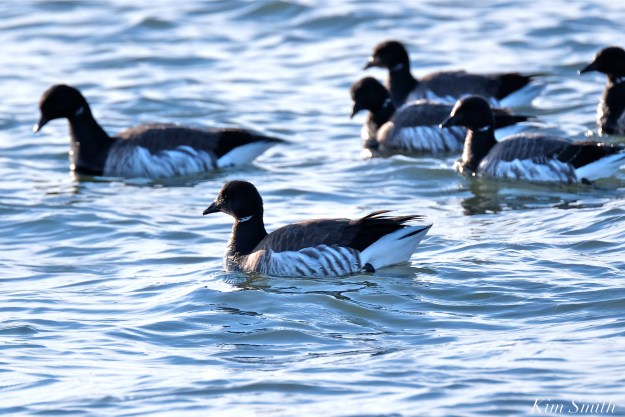
Currently migrating along Cape Ann’s shoreline is a beautiful brigade of Brant Geese. They usually turn up at about this time of year, late winter through early spring, and I have been looking for them in all the usual places. Brants thrive in Cape Ann coves, devouring sea lettuce while riding the incoming and outgoing waves. I see them eating and pecking for food atop barnacle-crusted rocks and am not sure if they are eating seaweed caught on the rocks or tiny crustaceans.
Brants eating bright green sea lettuce.
In the 1930s a terrible disease devastated eel grass and the Brant population plummeted. Surviving Brants adapted to sea lettuce and as the eel grass recovered, so too is the population of Brants recovering.
Brants are wonderfully vocal, making a funny “cronk” sound. I was walking past a flock of geese off in the distance and wasn’t paying much attention. Thinking they were Canada Geese, I ignored them until hearing their vigorous cronking.
They fight with each too, over rocks and food. Tomorrow if I can find the time I will try to post photos that I took of a Brant scuffle.
Brants feeding on the rocks are knocked off by the incoming tide, but then quickly get right back up again.
Brants migrate the furthest north of any species of goose, as far north as Hedwig territory.
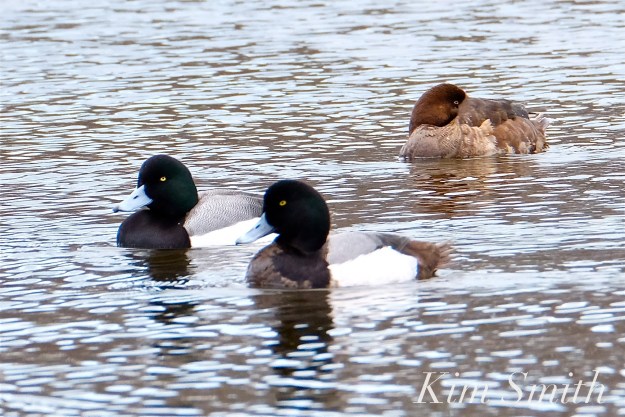
Two Males and a Female Greater Scaup
The Greater Scaup breeds as far north as Snowy Owls and Brant Geese, and Ring-necked Ducks are also passing through, not traveling quite as far, but on their way to the Alaskan and Canadian boreal forests. Greater Scaups travel in flocks, sometimes forming rafts of thousands. You can see why in the photos Greater Scaups are colloquially called Bluebills.
Three male Greater Scaups and a Red-breasted Merganser
The most significant threat to Greater Scaups is habitat loss, oil, and sewage pollution. Nearly eighty percent winter over in the Atlantic Flyway where they are subjected to heavy metals in foods and habitat.

So many suitors! Lone female Ring-necked Duck with potential mates.
The two species are closely related (Aythya collaris and Atythya marila); both are small diving ducks and both are vulnerable to becoming poisoned by lead from diving for food and incidentally eating the lead shot and lures that continues to cause problems in our wetlands.
READ MORE HERE Continue reading
A number of friends have been texting and emailing that they are seeing a swan all along the Annisquam. I suspected that it was Mr. Swan as I have seem him on the Annisquam, near the bridge and Cape Ann Marina after he lost his second mate. It would be swan-logical that he would head over to the Annisquam in search of open, fresh water because both Henry’s and Niles ponds are still frozen.
Thanks to Craig Kimberley, who texted a swan sighting in real time, I was able to get a closeup of the swan, and YES, it is Mr. Swan that many of our readers are seeing. Mr. Swan’s bill is uniquely marked and he has beautiful blue eyes, which is unusual for most Mute Swans seen in these parts. In the closeup photo above it is difficult to tell his eyes are blue. It’s much easier to notice when his eyes reflect sunlight, but trust me, if it were a black-eyed swan, you would not be able to distinguish the iris at all.
Thanks so much to Craig, Brianne, and facebook friends for sharing your Mr. Swan sightings, so very much appreciated 🙂
Craig Kimberley iPhone photo from this morning.
The Annisquam River stretches from Annisquam Harbor on the north to Gloucester Harbor on south.
CAPE ANN WILDLIFE: A YEAR IN PICTURES 2017
By Kim Smith
Cape Ann provides welcome habitat for a menagerie of creatures beautiful, from the tiniest winged wonder to our region’s top predator, the Eastern Coyote. Last year I posted a Cape Ann Wildlife Year in Pictures 2016 and I hope you will find the wildlife stories of 2017 equally as beautiful. Click on the image to find the name of each species.
Winter: Only partially frozen ponds allowed for dabblers and divers such as Mallards, Mergansers, and Buffleheads to forage at the freshwater. Mr. Swan had his usual entourage of quwackers and daily heads to the other side of the pond to get away for his morning stretches. Sightings of Red-tailed Hawks and other raptors abounded. Although photographed in Newburyport, the owl photos are included, well, just because I like them. An Eastern Screech Owl (red-morph) was seen daily perched above a playground and Barred Owl sightings too were reported throughout the winter. Raptors live on Cape Ann all year round but are much easier to see in winter when the trees are bare of foliage.
The beautiful green eyes of the juvenile Double-crested Cormorants were seen wintering at both Niles Pond and Rockport Harbor. And during a warm February day on a snowless marsh a turkey bromance shindig commenced.
In early spring, a male and female American Wigeon arrived on the scene making local ponds their home for several weeks. In the right light the male’s electric green feathers at the top of his head shine brightly and both the male and female have baby blue bills.
Meadow and marsh, dune and treetop were graced with the heralding harbingers of spring with photos of a Red-winged Blackbird, a pair of Cedar Waxwings, Northern Mockingbird, Brown Thrasher, Eastern Towhee, Eastern Kingbird, Tree Swallow, and Grackle included here.
The Great Swan Escape story made the news in Boston as Mr. Swan eluded captors for hours. He had re-injured his foot and someone took it upon themselves to call the animal rescuers, which would have surely meant death for our beloved 27-year old swan if he had been wrangled into captivity.
M is clearly for Migration through Massachusetts and the month-long arrivals and departures did not abate. Short-billed Dowitchers, winsome Willets, Yellow Legs, and Ruddy Turnstones are just some of the migrating shorebirds spied on Cape Ann beaches and marshes. The best news in May was the return of the Piping Plovers. Of the five or six that camped at Good Harbor Beach to investigate potential nesting sites, one pair bonded and built their nest mere yards from the nesting pair of last year. Could it be the same pair? The nesting Piping Plover story took up much of the spring and by early summer four little Piping Plover chicks hatched over Fiesta weekend. Hundreds of photos and hours of film footage are in the process of being organized with a children’s book and documentary in progress.
The survival of one Piping Plover chick was made possible by a wholesale community effort, with volunteers covering all hours of daylight, along with Mayor Sefatia and her team, Ken Whittaker from the conservation office, Chief McCarthy, and animal control officer Diane Corliss all lending a hand.
Sadly, several Northern Gannets came ashore to die on our Cape Ann beaches, struck by the same mysterious and deadly disease that is afflicting Northern Gannets in other regions. During the summer season they are typically at their North American breeding grounds, which are six well-established colonies, three in the Gulf of St. Lawrence, Quebec, and three in the North Atlantic, off the coast of Newfoundland.
An orphaned swan was introduced to Niles Pond, much to the dismay of Mr. Swan. Eastern Point residents Skip and Lyn kept watch over the two while they reluctantly became acquainted.
By mid-July many of us were seeing Monarchs in much greater numbers than recent years. Nearly every region within the continental United States experienced a fantastic Painted Lady irruption and butterflies of every stripe and polka dot were seen flitting about our meadows, fields, and gardens.
The tadpoles and froglets of American Bullfrogs and Green Frogs made for good eating for several families of resident otters, who are making their homes in abandoned beaver lodges. Little Blue Herons too, find plentiful frogs at our local ponds.
In early August we see the Tree Swallows begin to mass for their return migration. They find an abundance of fruits and insects in the dunes, headlands, and beaches. The Cedar Waxwings and Ruddy Trunstones were back again observed foraging on their southward journey, along with myriad species of songbird, shorebird, diver, and dabbler.
Tree Swallows Massing
The Late Great Monarch migration continued into the fall as we were treated to a wonderfully warm autumn. Waves and waves of Monarchs came ashore and more butterflies arrived on the scene including new batches of Painted Ladies, Clouded Sulphurs and Common Buckeyes (nothing common about these beauties!).
A pair of Northern Pintails called Cape Ann ponds and coves home for nearly a month while we seem to be seeing more and more raptors such as Red-tailed Hawks, Osprey, Bald Eagles, and Peregrine Falcons. Juvenile herons of every species that breeds on Cape Ann lingered long into the fall—Black-crowned Night Herons, Yellow-crowned Herons, Great Blue Herons, Snowy Egrets, Great Egrets, and Green Herons.
Just as Mr. Swan and the Young Swan appeared to be warming to each other, the Young Swan, who has yet to learn to fly, became trapped in the ice at Niles Pond. He was rescued by caretakers Lyn and Dan and is now spending the winter at a cozy sanctuary built by Lyn and friends.
Thank you to all our readers for your kind comments of appreciation throughout the year for the beautiful wild creatures with which we share this gorgeous peninsula called Cape Ann. If you’d like to read more about a particular animal, type the name of the animal in the search box and the original post should come up
With its expansive marshes and dunes, bodies of fresh clear water, saltwater coves and inlets, and geographic location within the Atlantic Flyway, 2017 has been a banner year for Cape Ann’s wild and wonderful creatures. I can’t wait to see what awaits in 2018!
David Robinson, owner of the beautiful local gallery Windemere Art and Antiques, and drummer for the rock band The Cars, has been inducted into the Rock and Roll Hall of Fame. Rock on David!
You can read the full story here in today’s Gloucester Times.
My friends Donna, David, and Lisa in front of David’s shop Windemere, located on Main Street Rockport