Category Archives: Hummingbirds

Outphloxed by Our Phlox!

Look how lovey our patch of Summer Phlox has grown. I wish I could say it was my genius garden design skills but alas, this is all nature’s doing!

Where this border is growing I originally had only planted the mildew resistant and pure white Phlox paniculata ‘David.’ Some distance away, we planted the striking P. paniculata ‘Bright Eyes,’ a light pink with deep magenta centers and adjacent to ‘Bright Eyes,’ a pretty lavender called ‘Franz Shubert. ‘

Several years have gone by and we now have a patch of volunteers blooming in beautiful shades of pink, lavender, and magenta. I think this may have happened because the plants have cross-pollinated and are allowed to reseed. We don’t deadhead and don’t mulch and that encourages little seedlings to take hold and spread far and wide in our garden.

Phlox paniculata is native to the eastern US and grows in a range of conditions. The location in our garden where it is thriving is partially shaded by the Magnolia grandiflora. This beautiful, beautiful wildflower is also wonderfully fragrant, with a heady floral scent especially potent in the early morning and late in the day. I have on occasion seen Ruby-throated Hummingbirds and Eastern Tiger Swallowtails drinking nectar from the blossoms but mostly the blooms are especially attractive to Bumblebees.

Pollen-dusted Bumblebee

Did I mention that P. paniculata blooms for many weeks??

Plant this native beauty. I promise, you will be delighted for many years to come.

Return of the Yellow-bellied Sapsucker(s)!

For well over a year, our garden has been graced with the fascinating Yellow-bellied Sapsucker. The visits began with a male eating Pokeberries in December of 2023 and have continued intermittently through today.

A female was here for a day last week however, we have had so many Cedar Waxwings in the Dragon Lady Holly, they may have frightened her off. For the past three days, a male YBSS has been industriously revitalizing the sap wells created by the female last year. He is also meowing!! That’s right, the appropriately named bird for a cartoon (or a proper insult), makes a crinkly mewing sound!

Listen for the mews-


Photos to Help ID Male, Female, or Juvenile Yellow-bellied Sapsucker

Male YBSS – Red cap and red throat

Female YBSS – note that she does not have a red throat

Juvenile YBSS -softly mottled brown

Male Sapsucker in the rain yesterday


Yellow-bellied Sapsucker Timeline

Summer 2023 – Newly seeded Pokeberry bush grows six feet first summer (most likely the seed was deposited by a bird).

December 2023 – First ever male YBSS. Stays for several days eating Pokeberries.

March – May 2024 –  Female YBSS created striking grid pattern of sap wells on both the Dragon Lady Holly and Magnolia soulangeana trees, concentrating her efforts much more on the Holly. She spends many weeks drinking the sap, digging more wells, and eating insects attracted to the sap flows. Ruby-throated Hummingbirds discover the sap wells.

Summer 2024 – Ruby-throated Hummingbirds daily drink nectar from the small pinkish whiteish flowers of the Pokeweed.

October -November 2024 – Female Yellow-bellied Sapsucker returns. She is drinking nectar and eating insects attracted to the sap wells every day, through November 17th.

November 12, 2024 – Both a juvenile and female at the DLHolly saplicks.

March 26, 2025 – female YBSS at the Holly tree. Flock of Cedar Waxwings may have frightened her off.

April 3rd, 4th, and 5th – Male Yellow-bellied Sapsucker drumming and drilling at the Dragon Lady Holly, crabapple, and Magnolia soulangeana. Mewing frequently.

Our Beautifully Industrious Yellow-bellied Sapsucker Has Returned!

Last spring I wrote about a female Yellow-bellied Sapsucker that stayed in our garden for over a month. We were fascinated watching her daily activities; so much so  that I was inspired to write a poem and Charlotte nicknamed her Miss Featherton. We are excited beyond measure to see the return of our beautiful YBSS. Just as she did in the spring, Miss Featherton perches in the Dragon Lady Holly throughout the day.  She cautiously guards, and continues to maintain, the sap wells that she so pertinaciously dug. The sap is not flowing as vigorously as during the spring months but there is enough for her to take in a bunch of licks and the wells continue to attract insects. This morning I filmed her snatching a Yellowjacket that had stopped by to investigate the sweet sap.

We read that YBSS drill holes in unhealthy trees and were concerned our tree may beginning to decline. No need to worry though as you can see in the film clip, the holly is absolutely loaded with plump cadmium red berries.

My Yellow-bellied Sapsucker poem –

Sap-licker

Startled songbird silently flings
from approaching steps.

Behavior not usually seen by the insouciant
feathered friends that call our garden home.

Why so timorous?

Neatly arranged squares and holes
riddle the bark of the Dragon Lady Holly.

The masterfully drilled, cambium pierced checkered grid is glistening
in the sun – with deep wells and narrow streamlets of sweetness.

A sap-lick!

I wait to see her, half hidden and as
quiet as the owl after a long night

Weary and bedraggled, the Sapsucker returns
An arduous migration, no doubt.

She pauses guardedly
No one must know of her creation
with its treasured life fluid seeping down branches.

Her soft yellow belly and stippled feather patterning
Mirrors the spotty bark.

Her camouflage is not blown. She dives in with tender gusto
Delicately excavating the holes with brush tongue.

Wind rustles through leaves and she flings off
Only to return again and again and again
To her life-giving channels of gold flowing through tree veins.

YBSS are the only woodpeckers that are completely migratory. They breed further north and west of eastern Massachusetts and spend the winter months in warmer climates; some females traveling as far south as Panama. I wonder if we will see the return of the male this fall as well. It was just a year ago in December that we had our first ever Yellow-bellied Sapsucker, a male, and he was eating the fruits of the Pokeberry bush. It was also the first year with a Pokeberry. The plant is rather ungainly and I had some trepidation about allowing it to take hold but if a bit of awkwardness is the price to pay for a garden inviting Yellow-bellied Sapsuckers and Ruby-throated Hummingbirds, I’ll take it!

Male Yellow-bellied Sapsucker and Pokeberry – note the male has a red chin as well as a red cap.

Timeline of Yellow-bellied Sapsucker and Pokeberry –

Summer 2023 – Newly seeded Pokeberry bush grows six feet first summer (most likely the seed was deposited by a bird).

December 2023 – First ever male YBSS. Stays for several days eating Pokeberries.

March – May 2024 –  Female YBSS created striking grid pattern of sap wells on both the Holly and Magnolia trees, concentrating her efforts much more on the Holly. She spends many weeks drinking the sap, digging more wells, and eating insects attracted to the sap flows. Ruby-throated Hummingbirds discover the sap wells.

Summer 2024 – Ruby-throated Hummingbirds daily drink nectar from the small pinkish whiteish flowers of the Pokeweed.

October 2024 – Female Yellow-bellied Sapsucker returns, with daily visits into November. How long will she stay?

Grow native and they will come!

A Mutant Lilliputian Lobster Flying in My Garden?

Saturday mid-morning I returned home from filming shorebirds at dawn to find an extravaganza of winged wonders in our garden. The weather was gloriously warm and sunny, filming the birds had been a great success, and seeing all these creatures flying around our front dooryard garden was the best kind of morning greeting!

Mama and Papa Carolina Wrens were zipping to and from the nest feeding their hungry hatchlings every kind of insect imaginable, a nearly whole Canadian Tiger Swallowtail was pausing to drink nectar from the butterfly bushes, our resident pair of fledgling Ruby-throated  Hummingbirds were whirring about the Rose of Sharon, half a dozen male Monarchs were patrolling the milkweed patches, and two visitors I hadn’t seen in our garden for some time–a  newly emerged Red-spotted Purple Butterfly and a Hummingbird Clearing Moth (Hemaris thysbe)

Hummingbird Moths have been described as resembling a tiny flying lobster or an enormous furry bee and are often confused with Ruby-throated Hummingbirds. Not only do Hummingbird Clearwing Moths share similar coloring to that of RTHumminbirds, perhaps the confusion stems from a characteristic behavior of the clearwing moths, which is a technique for drinking nectar called ‘swing hovering.’  Only certain bats, hummingbirds, and the clearwing moths have the ability to swing from side to side while hovering over a flower to drink nectar.

The Hummingbird Clearwing Moth only visited for a few brief moments, but i was glad to have camera in hand when stepping out of the car. To attract these beauties to your garden plant native honeysuckle, viburnums, and Snowberry bushes for their caterpillar’s food plants and native Phlox ‘david,’ Monarda didyma, and butterfly bushes for the adults to nectar from.

You can read more about the wonderfully unique Clearwing Moths in an article I wrote nearly a dozen and a half years ago, which was eventually picked up by the New England Wild Flower Society publications.

How to Grow Fresh Flowers All Season! (with a take-home plantng guide)

Message from my friend Elise at Cedar Rock Gardens –

Planting a cut flower garden: How to have fresh blooms all season with a take home planting guide.

Hello!

As the season winds down on the seedling side of our business – the field and greenhouse crops really start to ramp up. We are currently harvesting cucumbers, eggplant, kale, chard, cherry tomatoes, jalapeno peppers, many greens, onions, herbs and flowers among other things. I am hoping you are all having success with your gardens also despite the blistering heat we have had lately. Heres to hoping this next forecasted rain will actually amount to something??

Most of you know this already but Tucker and I started Cedar Rock Gardens initially as a cut flower farm back in 2014. We had success in that venture but it slowly turned into what it is today which is a robust seedling operation alongside a diversified vegetable, herb and flower farm. The flowers have not been lost on us though. I still find my creative outlet each week lies happily with the small amount of bouquets I get to make for our wholesale accounts and for my own kitchen table. We were selling cut flowers to the Boston Flower exchange as well as to many florists locally and even dabbled in wedding arrangements for a short time. It was a labor of love for a while and then we decided to move in a different direction to focus on edible crops.

Alas, flowers still have my heart and I am very excited to share my knowledge with you. Join me this Thursday evening at Cedar Rock Gardens for a cut flower course sponsored by Gloucester SaLT. We will cover some tried and true varieties from seed to bouquet visiting on succession planting and planting layout. This course is specifically designed for home gardeners who want to make the most out of limited space. You will be able to take home a plating guide and I will do my best to answer any questions you have. The course is free and I am happily donating my time – if you get something out of it or just feel generous you can donate to SaLT Here.

Please respond to this email if you do plan to attend so I can have a better idea on how much I need to psych myself up to speak to a crowd. I also need a general count for hand-outs.

Currently we are open:
Thursday to Saturday 8 am to 4 pm

Hope you are having a wonderful summer!

We will continue to be set up at the Farmer’s Market at Burnhams Field in Gloucester every Wednesday from 2:30 to 6:30 selling our produce.

All the best,

Elise Smith
CedarRockGardens@gmail.com

How to tell the Difference Between a Male and Female Hummingbird

This past week we have had a mini entourage of three male Ruby-throated Hummingbirds vying for the affections of one female.  We think the boys have moved on but she has stayed. This is not unusual behavior. If she mated with one, which I think I saw but it was so fast I am not really certain, she will then build a nest and raise the youngsters all on her own.

In one clip, the hummingbird is cleaning it’s bill, in another, the female is going pooh. As you may or may not know, the male Ruby-throated Hummingbirds are easy to spot as they have the red gorget (pronounced GOR-jit) throat feathers. When light hits the iridescent feathers, the gorget lights up a brilliant red, otherwise, the gorget looks like a deep brown throat patch. The female’s throat is the same color as her breast feathers. You can see the female at 1:05. All the other clips are of the boys.


HUMMINGBIRD ALERT!

A newly arrived female Ruby-throated Hummingbird has been frequenting our garden since the last day of April! She has been stopping to drink nectar from the flowering Japanese Quince ‘Toyo-Nishiki’ and visiting the hummingbird feeder.

Please write if you have been graced by one of these little beauties yet this spring <3


More from the Industrious Yellow-bellied Sapsucker and Time to Hang Your Hummingbird Feeders!

Despite that our little woodpecker friend has an injury under her right wing, the extraordinarily industrious Yellow-bellied Sapsucker has, for the past five days, worked on, and dined from, her sapwells. She arrives each morning at sunrise, departing around noontime. The timelapse video shows only one hour of her morning, compressed into one minute.

Dubbed Miss Featherton by Charlotte, the Yellow-bellied Sapsucker arrived bedraggled and injured but I think is becoming rejuvenated from the sap. Insects, too, are beginning to appear at the wells. I read that Ruby-throated Hummingbirds often follow the migration of sapsuckers as they too will imbibe on the sap and insects attracted. We usually hang our Ruby-throated Hummingbird feeders out at the end of March, but with all the sap flowing, we hung our feeders a few days ago.Notice the red wound under her right wing from the still taken from the video

Happy World Wildlife Day! #WWD2024

Every year on March 3rd, United Nations World Wildlife Day (WWD) is celebrated  The purpose of the celebration is to recognize the unique roles and contributions of wildlife to people and the planet.  Read more here.

A special event for World Wildlife day is being held at the UN tomorrow, March 4th, that anyone is welcome to tune into. Here is the link and more information:

#SaveTheDate 📅 🌱 Tune in online to watch the hashtag#WorldWildlifeDay 2024 UN Celebration!

When: 4 March (10AM-1PM EST)
Where: webtv.un.org

This year, we are exploring digital innovation and highlighting how digital conservation technologies and services can drive wildlife conservation, sustainable and legal wildlife trade and human-wildlife coexistence, now and for future generations in an increasingly connected world. 📱💻🐟🐯🌳

Meet our organizing partners: UNDP, ifaw, Jackson Wild, and WILDLABS Community

hashtag#WWD2024 hashtag#ConnectingPeopleAndPlanet hashtag#DigitalInnovation hashtag#TechForWildlife


RUBY-THROATED HUMMINGBIRD NOT SHARING GARDEN WITH MIGRATING MONARCHS!

Our summer resident Ruby-throated Hummingbirds stayed at our Cape Ann garden well into the fall. Daily, and frequently throughout the day, they made their rounds from the back borders to the front borders, making brief stops at each nectar station. But the backyard was clearly their personal fiefdom. Here they spent a great deal of time splashing in the bird bath and preening while perched in the ancient pear trees.

The Monarchs and other late summer butterflies mostly stay in the sunnier front border however, whenever a Monarch ventured to the New England Aster patch round back, a hummingbird was sure to harass. The attacks were seemingly not vicious; the RTH would simply fly to and from the butterfly until it departed. I wondered if this was a juvenile RTHummingbird checking out a never-before-seen-butterfly-equal-to-its-size, or a more experienced female defending her territory.

Despite repeated attempts on my part, this was extremely hard to capture on film. I was looking at footage from this past season and was delighted to find a very few brief seconds of both beauties together.

Drop in Planting Night at Cedar Rock Gardens!

Thursday May 25th from 6pm to 8pm

Join us for a fun night of planting! We will have a mini class discussing planters and hanging basket combinations. We will talk about utilizing plants that work for you and making the most of bloom time and combination placement.

We will go over maintenance, design and try to answer any other questions you may have!

Feel free to BYOB – we will have light refreshments and snacks. You may also bring your own planter from home if you wish, we will have some pots and hanging baskets available for purchase.

The drop in style class will be held on Thursday, May 25th from 6PM to 8PM. Class attendees will get 10% off all materials purchased for planting.

Please send questions to Elise (978) 471 – 9979

Cost $15/ Class. Please sign up no later than Wednesday night.

Sign up Here

The beautiful array of plants in the above photo all came from Cedar Rock Gardens. The photo was taken at the urban pollinator garden I designed for The Mary Prentiss Inn, Cambridge.

The featured photo (top) is of the planters at the Kendall Hotel, also located in Cambridge, and all the flowers in the planters are also from Cedar Rock Gardens!

OUTSTANDING WORK IN PROGRESS BY LOCAL LAND STEWARDS ORGANIZATION CREATING COMMONS COLLECTIVE

Lucas, Xavier, Mark, Nick, Kim, Molly, and Sarah

What a joy to meet these members of Creating Commons Collective, a grassroots organization passionate about developing beautiful, native plants landscapes for our community.

The project at Blackburn traffic circle began last spring.The soli was tilled (with the help of Mass DOT) and the first batch of plants were introduced. The group is selectively adding native flowering plants with the long term goal of creating a self-sustaining, pollinator friendly, native plants meadow.

Sarah mentioned Creating Commons Collective native plants project at Burnham’s Field, which I am very eager to go check out, and Nick shared a recent article “Improvised Landscapes” that he wrote for Arnoldia, the quarterly publication of the Arnold Arboretum. It’s a great read and you can find the link to the article below.

Improvised Landscapes

By Nicholas Anderson April 4, 2023

OVER THE YEARS I have abandoned and inverted my horticultural training, and today, I struggle to describe what I do. When time is short, I simply say that I make meadows with native plants; sometimes I use the term “ecological maximalism.” But definitions don’t really matter when it’s late September, and I’m stopping off at a patch of dirt in Gloucester, Massachusetts, sandwiched between a new housing development and a Market Basket on the edge of a woodland remnant. Just now I don’t particularly need any new plants, as I have a dozen or so ongoing meadow projects that double as plant nurseries, but I can’t resist a salvage mission before going grocery shopping. I walk past orange-painted surveyors’ stakes through one of the spots where I scattered seeds the previous winter. Most of the seedlings have succumbed to the drought, but a few anemic partridge-pea plants (Chamaecrista fasciculata) are visible amidst the tire tracks. This space is used as a parking lot for little league games in the summer and the city deposits untold tons of salty snow here every winter. Remarkably, whorled loosestrife (Lysimachia quadrifolia) and sweet fern (Comptonia peregrina) insist on colonizing into the very spot that gets savaged by the plows year after year. I pull up four rhizomes of the sweet fern and grab two tiny volunteers of winged sumac (Rhus copallinum) before heading over to the other side of the lot, where frost aster (Symphyotrichum pilosum) and oldfield goldenrod (Solidago nemoralis) are in bloom amidst mugwort (Artemisia vulgaris) and tendrils of asian bittersweet (Celastrus orbiculatus). Out of the midst of these introduced species, I yank up twenty-odd plants with tender violence and put them in a wet, plastic bag.

READ more here


Monarchs drinking nectar from Seaside Goldenrod florets

LIGHTS OUT FOR BIRDS AND TIME TO HANG YOUR HUMMINGBIRD FEEDERS!

From National Audubon

Providing Safe Passage for Nocturnal Migrants

Every year, billions of birds migrate north in the spring and south in the fall, the majority of them flying at night, navigating with the night sky. However, as they pass over big cities on their way, they can become disoriented by bright artificial lights and skyglow, often causing them to collide with buildings or windows.

Contribute to Lights Out

  • Turn off exterior decorative lighting
  • Extinguish pot and flood-lights
  • Substitute strobe lighting wherever possible
  • Reduce atrium lighting wherever possible
  • Turn off interior lighting especially on higher stories
  • Substitute task and area lighting for workers staying late or pull window coverings
  • Down-shield exterior lighting to eliminate horizontal glare and all light directed upward
  • Install automatic motion sensors and controls wherever possible
  • When converting to new lighting assess quality and quantity of light needed, avoiding over-lighting with newer, brighter technology

READ MORE HERE

Reminder –

We’ve had several Ruby-throated Hummingbirds passing through our garden and one male is checking in regularly. There isn’t much yet available in the way of nectar plants blooming, either in fields or gardens. If you place your feeders out at this time year, you may encourage a female to nest in your garden. Every year we see (mostly) females, and by summer’s end, two juveniles appear at the feeders. I wish I could see their nest but it is so small, merely the size of a walnut! 

Don’t you love this poster for Lights Out for Birds!

WHY NILES POND IS VITALLY IMPORTANT TO CAPE ANN’S ECOSYSTEM AND WHAT IS BEING DONE TO PROTECT THE CAUSEWAY

Repair work to the Niles Pond/Brace Cove berm was completed last week. Severe storms over the past several years had breached the area of the Pond adjacent to the Retreat House. Sand, rocks, popples, and even boulders have been pushed by the pounding surf into the Pond.

Despite the excellent repairs, this corner of Niles Pond continues to remain vulnerable. The causeway needs not only to be repaired, but to also be rebuilt to withstand future storms and rising sea level.

Why not just let nature take its course and let the sea pour in you may ask? Won’t Niles Pond eventually become a saltwater marsh? Wouldn’t that be a good thing?

The answer is a resounding NO!

For readers not familiar, the very narrow strip of land that runs between freshwater Niles Pond and Brace Cove is interchangeably referred to as a berm or causeway. This narrowest bridge of land plays an outsized, yet invaluable, role in preventing the salty sea of the Atlantic from swallowing Niles Pond.

It is believed that long ago Niles Pond was a lagoon, which was sealed off by rising sand and rock. Over time, it became a freshwater pond, fed by springs and rainfall. The detail of the Mason map from 1831 clearly shows the division between the Pond and the Cove.

It can’t be overstated enough how uniquely invaluable is the ecosystem created by the causeway, this juncture where Niles Pond meets Brace Cove. Ponds are widely regarded as ecological “hotspots,” for the diversity of life they support. Nowhere is that more evident than at Niles Pond. The sheer number of species of wildlife supported by Niles Pond is simply breathtaking. To name but a few: Painted Turtles, Snapping Turtles, Spring Peepers, American Bullfrogs, Leopard Frogs, Muskrats, Minks, Red Squirrels, Green Herons, Little Blue Herons, Great Egrets, Snowy Egrets, Great Blue Herons, Black-crowned Night Herons, Screech Owls and Barred Owls, Cedar Waxwings and songbirds of every tune and color, Honeybees and native pollinators, Ruby-throated Hummingbirds, Coyotes, Red Fox, White-tailed Deer … the list goes on and on.

Common Buckeye drinking nectar from Seaside Goldenrod, Niles Pond causeway

The Niles Pond ecosystem not only supports myriad species of resident wildlife but also hundreds of species of migrating songbirds, waterbirds, raptors, and insects. Eastern Point is an important stopover and staging area for wildlife traveling the Atlantic flyway. Niles Pond provides essential freshwater while both the Pond and Brace Cove provide much needed sustenance. Berries, wildflower seeds, pond vegetation, and the zillions of invertebrates found at the Pond, in the seaweed, and at the shoreline support a wondrous array of travelers; a small sampling includes herons, Merlins, hawks, songbirds, Monarch butterflies, Bald Eagles, gulls and ducks and geese (rare and common), Snow Buntings, Plovers, Whimbrels, and many more.

Monarch Butterfly drinking nectar Smooth Asters Niles Pond

Juvenile Wood Stork

Why, even the wildly-rare-for-these-parts White Pelican and juvenile Wood Stork have stopped at Niles Pond to rest and to refuel!

To lose Niles Pond to some misguided notion that it needs to become a saltwater marsh would be tragic beyond measure. Our nation as a whole is losing its freshwater ponds at an alarming rate. Ponds are absolutely critical to the survival of local and migrating wildlife, especially large scale, healthy natural ponds that are located within the four US Flyway zones. Niles Pond has been a great pond for millennia. The accessibility of the fresh water ecosystem found at Niles Pond is part of the instinctual DNA of both resident and migrating wild creatures.

The Association of Eastern Point Residents has assumed responsibility for the maintenance of the causeway. In the future, the Association needs permission to bring riprap in to distribute at the weakest points of the causeway. Every time the topography of the causeway is redistributed to rebuild the corner where the greatest number of breaches are occurring, the vegetation from another part of the berm is disturbed. This is wholly counterproductive because it is in part preventing a natural succession of vegetation to permanently take hold.

Migrating yellow-rumped Warbler Niles Pond

Niles Pond is enjoyed by dog lovers, ice skaters, ice boat sailors, birders, painters, photographers, joggers, walkers, and more. We can all give thanks to the Association of Eastern Point Residents for the stellar job they are doing in maintaining the causeway. Their time and expense is a gift of the greatest kind to the entire community.

This narrowest of causeways plays the critical role in preventing a freshwater dedicated Massachusetts great pond from becoming a salty marsh or lagoon. Cherished greatly by residents and guests alike for the beautiful, peaceful walk it affords along the banks of the Pond, the preservation of Niles Pond benefits all of Cape Ann, her citizens and wildlife. 

With thanks to Karen Gorczyca, John McNiff, and Mike S. for sharing information about preserving the Niles Pond causeway.

American Bullfrog Niles Pond

Cattails Niles Pond


IF YOU GO TO GOOD HARBOR BEACH AT SUNRISE BE SURE TO…

Take in the wonderful fragrance of the flowering Black Locust trees adjacent to the footbridge entrance. The air is redolent with the scent of orange blossoms and honey, along with the Rosa rugosa blooming nearby.

The stand at Good Harbor Beach has been increasing in size and I don’t ever recall the scent quite as potent as it is this year. You can smell the flowers halfway down Nautilus Road!

Black Locust are native to the Appalachian Mountains. The leaves are a host to over 67 species of Lepidoptera, including  Eastern Tiger Swallowtail, Mourning Cloak, Red-spotted Purple, Viceroy, Giant Leopard Moth, and the Elm Sphinx Moth. A host plant is a caterpillar food plant. And they offer nectar to pollinators, including Ruby-throated Hummingbirds.

2021 WILD CREATURES REVIEW! PART TWO

Cape Ann Wildlife – a year in pictures and stories

July through December continued from part one

July 2021

Conserve Wildlife NJ senior biologist Todd Pover makes a site visit to Cape Ann beaches, summer long updates from “Plover Central,” GHB Killdeer dune family raise a second brood of chicks,  Cape Hedge chick lost after fireworks disturbance and then reunited with Fam, Great Black-backed Gulls are eating our Plover chicks, thousands of Moon Snail collars at Cape Hedge,  Monarchs abound, #savesaltisland, missing Iguana Skittles, and Earwig eating Cecropia Moth cats.

August 2021

New short film for the Sawyer Free Library The Marvelous Magnificent Migrating Monarch!, Coastal Waterbird Conservation Cooperators meeting new short Piping Plover film, Ruby-throated Hummingbirds in the garden, why we love Joe-pye and other wildflowers, butterfly friends, Monarch cats in the garden, what is the purpose of the gold dots found on Monarch chrysalides?,Black Beauty came calling, Tigers in the garden, School Street sunflowers, Hoverflies, luminescent Sea Salps return to Cape Ann beaches, Petal Dancers and lemony Yellow Sulphurs on the wing.


September 2021

Flower Fairies, irruptive Green Darner migration, mini glossary of late summer butterflies, what to do if you find a tagged Monarch, Painted Ladies, White-tailed Deer family, Monarchs mating, Tangerine Butterflies,  yellow fellow in the hood, and Beauty on the Wing first ever live screening at the Shalin Liu.

October 2021

Bee-sized butterfly the American Copper, Monarch conga line, Thunder and Cloud, abandoned Piping Plover egg, School Street Sunflowers, Monarchs migrating, quotidian splendor, Monarch fundraiser updates, collecting milkweed seeds, the Differential Grasshopper, Cooper’s Hawk – a conservation success story,  #ploverjoyed, and nor’easter from the EP Lighthouse.

November 2021

Bridges between life and death, ancient oak tree uprooted, autumn harvest for feathered friends, Monarch migration update, we have achieved our fundraising goal!, Harbor Seal pup hauled out,  flight of the Snow Buntings, and a very rare for these parts wandering Wood Stork calls Cape Ann home for a month.

December 2021

New short film Wandering Wood Stork, tiny tender screech owl suffering from rat poison under the care of Cape Ann Wildlife Inc., Praying Mantis in the autumn garden, masked bandits in the hood, short film The Majestic Buck and Beautiful Doe Courtship Frolic, Snowy Owl boy in the dunes, short film Cedar Waxwing vocalization, the story of the Steller’s Sea-Eagle’s foray to Massachusetts, and Harbor Seal Pig Pile.


SEE PART ONE, JANUARY THROUGH JUNE, HERE


BEAUTY ON THE WING: LIFE STORY OF THE MONARCH BUTTERFLY COMING SOON (FEBRUARY 2022) TO A PBS STATION NEAR YOU!


2021 WILD CREATURES REVIEW!

Wishing you peace, love and the best of health in 2022 – Happy New Year dear Friends. I am so grateful for blog, Facebook, and Instagram friendships, new and old. Thank you for your kind comments throughout the year.

I would like to thank our wonderfully dedicated volunteer crew of Piping Plover Ambassadors, who provide round-the-day protections to one of Cape Ann’s most tender and threatened species.

I wish also to thank you for your kind support and contributions to our Monarch documentary, Beauty on the Wing: Life Story of the Monarch Butterfly. 2021 was a fantastic year for the film, winning many awards, including honors at both environmental festivals and awards at family-oriented film festivals, We also had a very successful fundraiser that allowed us to re-edit the film, and to distribute Beauty on the Wing through American Public in order to bring to the widest television audience possible.

Please stay healthy in the coming year. Wishing all your dreams come true. To peace, love, and great health in 2022. <3


Cape Ann Wildlife – a year in pictures and stories

Thinking about the wonderful wildlife stories that unfolded before us this past year I believe helps provide balance to the daily drone of the terrible pandemic. 2021 has been an extraordinarily beautiful and exciting year for our local wildlife. Several are truly stand out events including the three pairs of Piping Plovers that nested on Cape Ann’s eastern edge, the most ever! The summer of  2021 also brought a tremendous up take in Monarch numbers, both breeding and migrating, and in autumn a rare wandering Wood Stork made its home on Cape Ann for nearly a month. The following are just some of the photographs, short films, and stories. Scroll through this website and you will see many more!

January 2021

A rarely seen in these parts Black-headed Gull (in winter plumage), a Horned Lark, American Pipits, Red Fox kit all grown up, and an illusive Snowy Owl living at Gloucester Harbor.

February 2021

A red and gray morph pair of Eastern Screech Owls, flocks of winter Robins, and snowshoeing and snow sledding Snow Buntings grace our shores. 


March 2021

Bluebirds return to declare their nesting sites, the raptors delight in songbirds’ returning, American Wigeon lovebirds, signs of spring abound, and the Good Harbor Beach Piping Plovers return on March 26th, right on schedule! Gratefully so, Gloucester’s DPW Joe Lucido and crew install PiPl fencing on March 29th!

April 2021

Ospreys mating, Cedar waxwing lovebirds, Ruby-throated Hummingbirds return, and the Plovers are nest scraping and courting. The early spring storms also brought a dead Minke Whale to the shores of Folly Cove. 

May 2021

The Good Harbor Beach Killdeer family hatches four chicks, beautiful new PiPl on the block, many PiPl smackdowns with three pairs vying for territory, eggs in the nest at Area #3!, warblers and whatnots migrating, Make way for Ducklings – Cape Ann Style, the Salt Island PiPls have a nest with eggs but it is washed away by the King Tide of May 29th, and Cecropia Moths mating and egg laying.

June 2021

Piping Plover ambassadors first meeting of the season, on June 9th the Boardwalk #3 PiPls hatch four chicks, one chick perishes, Super Mom has a foot injury, Horseshoe Crabs at Good Harbor Beach, Piping Plover Ambassador badges from Jonathan and Duncan, a second nest is discovered at Salt Island with a new pair of parents (the first was washed away in the storm surge during the May King Tide), and for the first time, Piping Plovers are nesting at Cape Hedge Beach.

SEE PART TWO, JULY – DECEMBER, TOMORROW!


HUMMINGBIRD USES HER TINY TOES TO CLEAN HER BILL!

As has been the case for many summers (ever since we first planted Cardinal Climber), we have had a Mama Ruby-throated Hummingbird nesting nearby. I have looked and looked for the nest, but our garden is a bit of a jungle and I don’t have any real hopes of finding her half-walnut shell sized nest; it’s just fun to look.

This past week her two young fledglings have been joining her at the feeders and special flowers planted just for them. The youngsters are more playful than the Mama and give chase to each other. I wish I could get a snapshot of all three but am happy with what I can get.

One of the three perched in the pear tree several days ago and proceeded to giver herself a thorough grooming from tip to toe.

She first floofed and fluffed.


Then rubbed both sides of her bill, back and forth, against the gnarly rough bark of the pear tree.

Then used her tiny mouse-sized toes to clean her bill from the base to the tip!

Lastly, she used her toes to arrange (or scratch) her neck feathers.

All floofed and ready for action

HUMMINGBIRDS HAVE ARRIVED IN MASSACHUSETTS!

On the afternoon of 25th, we had just refilled our newest hummingbird feeder when while cooking dinner a little whirr appeared at the window. He made several trips around the garden, alternately sipping sweetened sugar water at the feeders and nectar from the Japanese flowering quince ‘Toyo-nishiki.’  Like clockwork, for the past several years the Ruby-throated Hummingbirds have arrived to our garden in April, while the quince is in bloom.

Hummingbird feeder recipe: To one cup warm water add 1/4 cup pure cane sugar (4 parts to1 part). Dissolve thoroughly. Please don’t put up feeders if you don’t have the time to change the water frequently, and even more frequently in warmer weather.

Over the past few days there has been a burst of Hummingbird sightings coming from around the state. Hang your feeders if you haven’t already done so and remember to change the sugar water often, every few days. Hummingbird feeders are a terrible idea if you are not willing to provide fresh water frequently. Hummingbirds get a fatal fungal infection on their tongue, called hummers candidiasis when folks don’t change the water, or when honey, or any sweetener other than pure white cane sugar is used. And never add red food coloring. The bird’s tongue becomes terribly swollen, they can’t retract it, and without medical attention will starve to death.

Japanese flowering quince ‘Toyo-nishiki.’

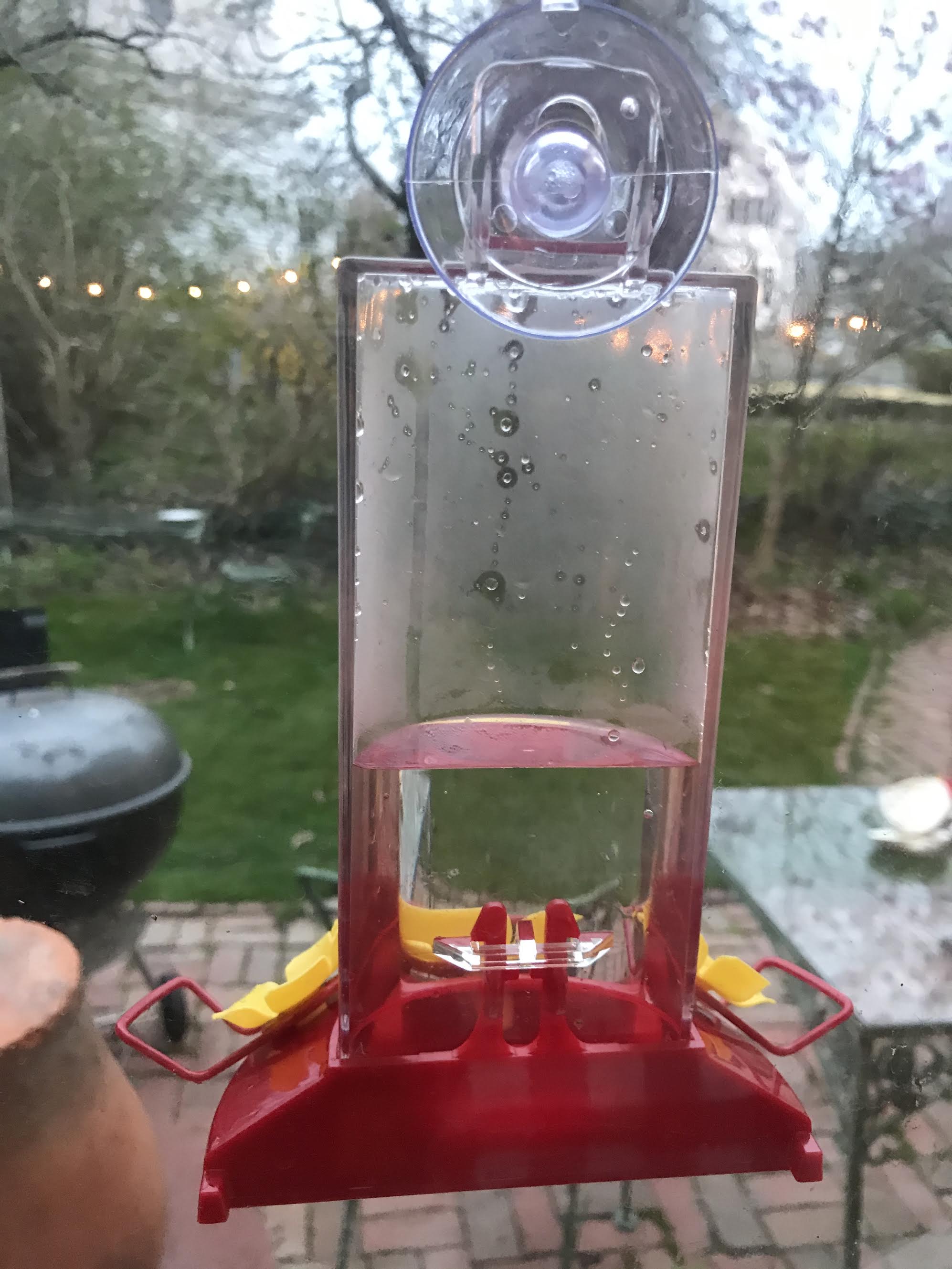
I love this newest feeder and purchased it with Charlotte in mind. It’s positioned at her eye level and suction cupped to the window she likes to stand at to look into the garden. The small feeder was modestly priced and bought at Smiths Hardware in Rockport.

Hummingbird feeders serve the purpose of providing sustenance especially during the time of year when there is a lull in blooms however, the very best gift you can give hummers is to provide their favorite plants, and there are many, including trees, shrubs, vines, perennials and annuals.

HOW TO ATTRACT HUMMINGBIRDS (AND KEEP THEM COMING) TO YOUR GARDEN

https://vimeo.com/281869646

PLEASE JOIN ME TONIGHT FOR “THE POLLINATOR GARDEN” VIRTUAL PRESENTATION FUNDRAISER FOR MASS POLLINATOR NETWORK

If you are looking to be inspired by creatures and colors of the upcoming season, and what to plant to make your garden a welcoming haven for wildlife, please join me tonight at 7pm. I am super excited to be presenting “The Pollinator Garden” for the Mass Pollinator Network. Because it is a Keynote presentation, I was able to add and collage many more photos. The presentation looks great and is chock full of ideas for your pollinator paradise. I hope to see you there!

Please join me Wednesday evening, March 17th, at 7pm for “The Pollinator Garden” presentation, via Zoom, for the Massachusetts Pollinator Network.

From early spring through winter, I will take you on a journey of understanding the beautiful creatures found in your gardens and how you can create a welcoming haven by planting trees, shrubs, vines, native wildflowers, and non-invasive ornamentals. Some of the wild creatures covered include Ruby-throated Hummingbirds, moths and butterflies, bees, Baltimore Orioles, and much, much more.

This lecture is the second in a three part fundraising series. For more information and to register please go here: MA Pollinator Network: The Pollinator Garden with Kim Smith and please consider making a donation to MA Pollinator Network. Donations of any amount are welcome.

Thank you!

ONE OF THE MOST BEAUTIFUL SCENTS ON ALL OF CAPE ANN – ‘SAILOR’S DELIGHT’ SUMMERSWEET

Clethra alnifolia is more commonly known by its many descriptive names of Summersweet, Sweet Pepperbush, and Honeysweet. In an old book on fragrance, written by Louise Beebe Wilder, she writes that in Gloucester of old it was described as ‘Sailor’s Delight.’ During the 19th and early 20th century, as told by Wilder, the sailors entering the harbor on homebound ships would reportedly delight in its fragrance wafting out to see.

Much of Niles Pond road is to this day lined with great thickets of ‘Sailor’s Delight.’ Wild Clethra growing on Cape Ann blooms during the month of August.

The following is an excerpt from a book that I wrote back in 2004-2007, which was published by David R. Godine in 2009. The book is about designing landscape habitats for wild creatures and for people, titled Oh Garden of Fresh Possibilities: Notes from a Gloucester Garden, and all that I wrote then, still holds true to day.

“Summersweet bears small white florets held on racemes, and depending on the cultivar may be shaded with varying hues of pink to rose-red. The tapering spires of fragrant blossoms appear in mid to late summer. Clethra has a sweet and spicy though somewhat pungent aroma, and when the summer air is sultry and humid, the fragrance permeates the garden, Summersweet is a nectar food attractive to bees and a wide variety of butterflies, notably the Silver-spotted Skipper.” See more at Oh GardenMyriad species of bees and butterflies, along with Ruby-throated Hummingbirds, are attracted to Clethra for its sweet nectar, while American Robins, Goldfinches and warblers dine on Summersweet’s ripened berries.
Clethra fruits ripening

WHERE HAVE ALL THE BUTTERFLIES GONE?

In thinking about where have all the butterflies gone, I am reminded of the poignant song written by Pete Seeger “Where Have All the Flowers Gone,” which although a song about the futility of war, sums up much about the environmental impact of habitat loss. Without wildflower habitat, there will be no pollinators of any sort.

Where have all the flowers gone?
Long time passing
Where have all the flowers gone?
Long time ago.

Buckeye and Seaside Goldenrod

Where have all the butterflies gone? Different species of butterfly populations fluctuate from year to year. For example, some years you may see far greater numbers of Buckeyes, the next year not so much. That same year you may hardly see any Tiger Swallowtails but will the following.

That being said,, everyone must realize that every year there are fewer butterflies than the year before. Butterflies thrive in meadows, the very same topography that is the easiest to build upon. Every time a new house or shopping mall is built on a meadow, we decrease not just butterfly habitat, but a whole community of wildlife habitat.

In the above photo you can see a Monarch with a Black Swallowtail flying overhead. This stunning patch of wildflowers and nectar plants was sited in Gloucester at a prime spot for Monarchs to rest and refuel after migrating across Massachusetts Bay. The new home owners ripped out most of the wildflowers and planted the site in a more formal style, with non-native perennials and shrubs. At this location, I would often see Monarchs, Tiger Swallowtails, Black Swallowtails, Painted and American Ladies, Sulphurs, and many other species. That is no longer true.

Tiger Swallowtail drinking nectar from Joe Pye-weed at the same wildflower patch, no longer in existence.

Butterfly and bee populations are declining overall, not only because of habitat loss, but because of the unbridled use of herbicides and pesticides in agriculture and home lawn care.

Butterflies are especially sensitive to fluctuations in weather, and also to overall climate change. This year we had a long, cold wet spring. The inclement weather is continuing, too, from a butterflies perspective, because although we are seeing some warmer temperatures the past few days, it has mostly been rainy, foggy, or overcast. Butterflies thrive during long stretches of sunny, hot weather. Their wings don’t work very well in the damp and cold. Because of global climate change, we have seen a seven percent increase in precipitation worldwide.

One of the best years I have ever seen for dozens and dozens of species of butterflies, including Monarchs, in the Northeast, was the summer and fall of 2012. That year, we had a warm winter followed by a warm spring, then a warm, dry summer, and a long, warm Indian summer. It was butterfly bonanza that summer and autumn!Adding to people’s concern is the fact that last year, there was an abundance of spring rain that in turn created an extraordinary wildflower bloom in Texas, which got all the butterflies off to a good start. In 2019, we were seeing Monarchs as early as early June, which was very unusual for Cape Ann. Folks are comparing this year to that of 2019, however, 2019 was not an average year.

Monarchs are a case unto themselves. Their spring and summer numbers depend upon a variety of additional conditions, including how successful was the previous year’s autumn migration, whether or not there were nectar providing wildflowers on their northward and southward  migrations, and wind and weather conditions from Canada to Mexico.

Note the bar graph in that the eastern population of the Monarchs plummeted by half, according to this year’s spring count by the World Wildlife Fund Mexico.

Particularly in the northeast, the wind patterns during the Monarchs spring northward migration matter tremendously. My friend Charmaine at Point Pelee, in southern Ontario, which is 49 degrees latitude (we are 43 degrees latitude) has been raising and releasing Monarchs for over a month now, while most of us on Cape Ann have only seen a smattering. The Monarchs moved this year in a straight northward trajectory. If the wind does not blow from west to east during some part of their northward migration, far fewer will end up along the eastern shores.Monarchs and Seaside Goldenrod

All is not lost. I am 90 percent certain we will soon be seeing some of our migratory and non-migratory local populations, we just need some good weather. They are later than usual, but not gone entirely.

For so many more reasons, I am hopeful for the future of wildlife and their habitats and see such tremendous, positive change. Despite the current administration’ s extremely harmful stance against the environment, many, many individuals and organizations are gaining a deeper appreciation about the importance of habitats and taking positive action. Many have made it their life’s work. These individuals and organizations are creating wildlife sanctuaries and conserving existing habitats. If the Monarch is declared an endangered species, that will surely bring an added awarenesses and increased federal spending for protecting and creating habitats.

How can you help the Monarchs, which in turn will help myriad species of other butterflies and pollinators? Plant wildflowers! Both Marsh and Common Milkweed for their northward migration, and lots of nectar-rich later summer blooming wildflowers for their southward migration, including New England Aster, Smooth Aster, Purple-stemmed Aster, Seaside Goldenrod, and Canada Goldenrod.Monarchs and New England Aster

CHECK OUT THIS AWESOME VIDEO ABOUT CEDAR ROCK GARDENS FROM NOFA!

GOOD NEWS CAPE ANN! – EPISODE 5

Good News Cape Ann! – Episode #5

 Sounds of Cape Ann, fog horn, songbirds, boats

Red-winged Blackbird singing across the marsh and calling to his mate in the reeds below.

Musing over name of show-  Good News Cape Ann, Finding Hope, my friend Loren suggested Beauty of Cape Ann, and husband Tom suggests Coastal Currents – what do you think?

Loren Doucette beautiful pastels and paintings. Follow her on Facebook and Instagram.

Castaways gift certificate

Fishermans Wharf Gloucester now also selling lobsters in addition to scallops, haddock, and flounder. Our son made a fabulous scallop ceviche this week, so easy and delicious.

Cedar Waxwings, Hummingbird, Yellow-Rumped Warbler, Baltimore Orioles, and Palm Warbler

Mini tutorial on how to plant a hummingbird garden

TWO MONARCH CONTORVERSIES! Is it okay to raise Monarchs at home? What is the problem with Butterfly Bushes?

Jesse Cook new release “One World One Voice”

Beautiful Piping Plover courtship footage – Piping Plovers in the field, what are they doing right now?

Charlotte stops by.

Take care and be well <3

Alex’s Scallop Ceviche Recipe

1 lb. sea scallops completely submerged in fresh lime juice

Dice 1/2 large white onion. Soak in a bowl with ice water to the reduce bitterness.

Dice 1 garden fresh tomato, 1 jalapeño, and cilantro to taste

Strain the onions.

Strain scallops but leave 1/4 of the lime juice.

Gently fold all ingredients. Add cubed avocado just prior to serving.


HOW TO ATTRACT HUMMINGBIRDS (AND KEEP THEM COMING) TO YOUR GARDEN

A Ruby-throated Hummingbird’s diet is comprised of nectar and insects. In early spring there isn’t much to offer in the way of flowering sustenance or insects. Around the first of April, we take our feeders out of storage, give them a good wash with vinegar, soap, and water, fill with a sugar/water mixture, and hang them throughout the garden.

Sugar water recipe: 4 parts water to 1 part sugar. Stir to dissolve thoroughly. Never add red dye or replace the sugar with honey. Provide fresh sugar/water every 4 – 5 days. The water will need to be changed more frequently in hot humid weather. Discard water that has black mold and clean feeders throughly.

You can keep hummingbirds coming to your garden throughout the growing season by providing nectar-rich tubular-shaped flora in shades of primarily red, orange, and yellow (although I see them drinking nectar from a rainbow of hues), along with flowers comprised of small florets that attract small insects (the florets at the center of a zinnia plant, for example).

If I could only grow one plant to attract the Ruby-throats, it would be honeysuckle. Not the wonderfully fragrant, but highly invasive Japanese honeysuckle, but our beautiful native Trumpet Honeysuckle (Lonicera sempervirens) that flowers in an array of warm-hued shades of Spanish orange (‘John Clayton’), deep ruby red (‘Major Wheeler’), and my very favorite, the two-toned orange and red ‘Dropmore Scarlet.’

Lonicera sempervirens ‘Dropmore Scarlet’

Trumpet Honeysuckle has myriad uses in the landscape. Cultivate to create vertical layers, in a small garden especially. Plant Lonicera sempervirens to cover an arbor, alongside a porch pillar or to weave through trelliage. Allow it to clamber over an eyesore or down an embankment. Plant at least one near the primary paths of the garden so that you can enjoy the hummingbirds that are drawn to the nectar-rich blossoms. We practically bump into our hummingbirds as they are making their daily rounds through the garden flora.

Did you know Ruby-throated Hummingbirds make a funny squeaky sound? I began to take notice of their presence in our garden, when at my office desk one afternoon in late summer, with windows open wide, I heard very faint, mouse-like squeaks. Glancing up from my work, fully expecting to see a mouse, and was instead delighted to discover a female Ruby-throated Hummingbird outside my office window, nectaring at the vines. Trumpet Honeysuckle not only provides nectar for the hummingbirds, it also offers shelter and succulent berries for a host of birds.

The following are several posts written over the years to help readers attract Ruby-throated Hummingbirds to their homes and gardens.

Three Hummingbirds in Our Garden Today!

Ruby-throated Hummingbird

A Hummingbird’s Perspective

Where to Place YOur Hummingbird Feeders

Harbingers of spring, flowering Quince, both the vivid ‘Texas Scarlet’ and less common Chaenomeles speciosa ‘Toyo-Nishiki’ are wonderfully attractive to hummingbirds.

A question written awhile back from my friend Kate:

Where do you place the feeders? Are they okay out in the open and, if so, do the hummingbirds become too nervous to feed if they can be seen by birds of prey?

Ruby-throated Hummingbirds prefer feeding at a station where they perch and observe the landscape, and then zoom in. Hang feeders on the lower limbs of trees and on shepherd’s hooks close to shrubs and above perennial wildflowers, about five to six feet off the ground. I haven’t read or heard too much about birds of prey in regard to hummingbirds; they move too fast, however, bluejays are said to attack nestlings. House cats and praying mantis pose a more serious threat to hummingbirds.

Eye-catching Red Riding Hood tulips, although not a good source of nectar, will attract by the sheer brilliance of their color, are a wonderful species tulip that reliably returns year after year, and multiplies. We plant Red Riding Hood tulips beneath the boughs of flowering and fruiting trees and shrubs, in hopes, that they too will lure the hummingbirds to our garden during their northward migration. And then, again with high hopes, that the hummingbirds will nest in our garden. For the past nine years, it has been our great good fortune to host throughout the nesting season female Ruby-throated Hummingbirds and then later in the summer, their fledglings!

Mallows provide nectar in later summer and Red Riding Hood tulips attracts by their color. Both are perennial.

The later blooming annual vine, Cardinal Climber, provides nectar for southward migrating RT Hummingbirds.

A chance encounter with the brilliant emerald green feathered female Ruby-throated Hummingbird, drinking nectar from the Wild Sweet William growing in the sand at the base of the Welcome Good Harbor Beach sign.

She is drinking nectar from the wildflower Saponaria officinalis. The plant’s many common names include Soapwort, Bouncing-bet, and Wild Sweet William. The name Soapwort stems from its old fashioned use in soap making. The leaves contain saponin, which was used to make a mild liquid soap, gentle enough for washing fine textiles.

Saponaria blooms during the summertime. Although introduced from Eurasia, you can find this wildflower growing in every state of the continental US.

The hummingbird in the clip is a female. She lacks the brilliant red-feathered throat patch, or gorget, of the male. Ruby-throated Hummingbirds are all around us, you just have to know what to plant to bring them to your garden. Mostly they eat tiny insects but if you plant their favorite nectar-providing plants, they will come!