Spectacular wildy waves after the March 6th storm. And stunning sunrise this am. Photos from around the back shore of Cape Ann, from Gloucester to Rockport, taken Saturday afternoon and Sunday morning.



Spectacular wildy waves after the March 6th storm. And stunning sunrise this am. Photos from around the back shore of Cape Ann, from Gloucester to Rockport, taken Saturday afternoon and Sunday morning.

At sunset this evening, the skies cleared for a bit and one could see the snowstorm departing in an easterly direction, while more squalls were beginning to blow ashore from the west. The nearly half-Moon was rising over the marsh through the clouds. Swells along the backshore were larger than average, but nothing nearly as dramatic as the waves during a nor’easter. Perhaps the waves were bigger on the other side of the Island.
Although I didn’t get a snapshot, the small flock of Wild Turkeys was leaping about at the base of a bird feeder, hungrily looking for food. Which was actually pretty funny because grace is decidedly not a characteristic shared with these large-bottom birds. I wished I had a handful to give them.


Frost Moon rising between the Twin Lights. The Frost Moon is also known as the Beaver Moon and Mourning Moon. Oh how I wish I had my tripod with me tonight, but this image is fun anyway. I think it would make a better painting.

Beautiful August Twin Lights sunrise

Vivid rainbow-hued sunrise this morning


A kitesurfer must have amazing athleticism, with an ability to balance on the kiteboard while also controlling the powerful kite. And withstand Gloucester’s current 36 degree water temperature.


 Hoping to capture the Supermoon, in all its huge glory, rising between the Twin Lights last night, but the sky was pink and hazy around the horizon line. Still, I think it’s good to have a record of a rarely occurring full moon on the first day of spring.


Thacher Island Twin Lights, waiting for the Moon to rise, North Light, left; South Light right.

The Cape Ann Museum has a wonderful children’s activity room, perfect for a winter day when its too cold to go to the park. Come on by and enjoy!


Caffe Sicilia is super family friendly, too, with friendly faces, yummy treats, and spacious seating. Charlotte had her first bites of cannoli, and of course, she loved it!
https://www.instagram.com/p/BtWMsf7Hqa7/

My fingers froze and I had to call it quits yet despite the bitterly cold five degree temperature and biting wind, day break brought blue skies and beautiful sea smoke all along the backshore, from Gloucester’s Ten Pound Island Lighthouse to Rockport’s Twin Lighthouses.


Take heart friends -today is the last day of January- only 48 more days until the spring equinox!
Fresh wild animal tracks crossing Niles Pond


Snapshots from a brief tour around the back shore while out doing errands. With temperatures hovering at 5 degrees, Cape Ann was blanketed with a thick layer of impenetrable ice, snow squalls, and sea smoke.
Happy to see the temperatures are heading towards the forties after Tuesday!


 A crazy person surfing at GHB
 Friday afternoon, after the nor’easter, the sun came out just barely before the skies again darkened with a brief snow squall. I was driving along Atlantic Road during those fleeting in between moments when way off in the distance I spied a flock of birds, with the distinct shape of swans in flight. Swans fly with their long necks extended, unlike herons and egrets, which fly with their necks curved in. What on Earth is Mr. Swan doing out in this wildly windy weather I thought. But it wasn’t Mr. Swan, it was an entire family of Swans! There were two adults and four cygnets. Stunning to see and very uplifting. They flew over the Twin Lights and then further and further until I could not see them any longer.
The first and third swans are the adults, the second, fourth, fifth and sixth are the cygnets, or first-hatch year juveniles.The young swans will retain their grayish brown feathers until their second summer.
 Swans and wave crashing


A few more of the Mute Swan family flying toward and over Thacher Island
 Channeling Edward Steichen’s moonlit landscape paintings.
 Twin Lights October Storm
 Just another spectacular Cape Ann sunrise 🙂
 The photos were taken after the storm on Tuesday morning, at dead low tide, standing almost to Salt Island and looking toward Thacher Island. I don’t recall ever seeing such enormous waves at low tide and will stay tuned in the future. Look for the surfer’s head in the waves 🙂


 Covering storms back to back, I didn’t have time to post on both Good Morning Gloucester and on my blog. The following are links to storm posts from the region’s three March nor’easters, beginning on March 2nd.
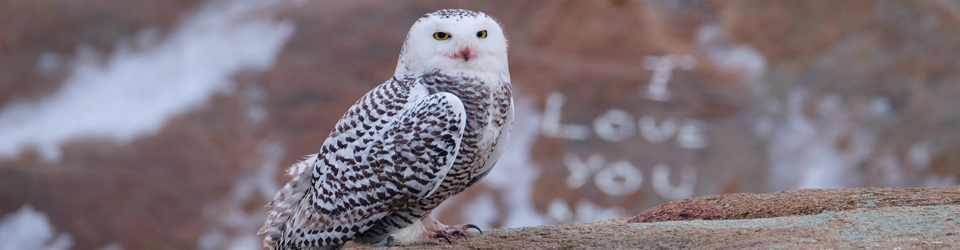
 Hedwig was observed Saturday morning, when repeated harassment by a flock of crows sent her hiding. She reappeared Saturday afternoon, and was again seen Sunday morning in the drizzle, not too far from where she was perched Saturday evening. Later Sunday afternoon she slept and rested in the pouring rain.
 Hedwig sleeping in the rain (thank you to Arly Pett for letting me know she was out in the rain!)
That she stays in a highly localized winter territory seems in keeping with known Snowy Owl behavior traits. I read that during the summer season in the Arctic, male Snowies hunt over hundreds of miles, whereas female Snowies typically hunt within a much smaller range. She has been observed eating sea ducks and rabbits and there are plenty of rat holes along the backshore rocks.
Both rats and lemmings (the Snowies super food in the Arctic) belong to the order Rodentia. From wiki, “A lemming is a small rodent usually found in or near the Arctic in tundra biomes. Lemmings are subnivean animals. They make up the subfamily Arcicolinae together with voles and muskrats which forms part of the superfamily Muroidea which also includes rats, mice, hamsters, and gerbils.”
 Lemming (Lemmini)
Often Hedwig has been seen flying straight out over the water towards Twin Lights. I wondered, if she is hunting there, does Thacher Island have a rat population. Thacher Island Association president Paul St. Germain answers that question for our readers,
“Hi Kim, there are lots of rats on Thacher mostly in the shore line rocks. We don’t see them often but know they are there. I discovered a bunch in the cellar of the keeper house making their nest in an old tarp. I would love to see Hedwig out there but we don’t go out in the winter. Have never seen snowy owls in the summer.”
Great info and thanks to Paul for sharing that! A Snowy Owl has been seen on the rocks in Rockport, across the strait, opposite Twin Lights, and wonder if it is our Hedwig.
 Rat and Lemming photos courtesy wiki commons media
This brings up the topic, what to do if you have a rat problem. The absolute worst way to control rats is with rat poison, namely for the sake of beautiful predatory birds such as Snowy Owls, falcons, hawks, and eagles. Birds that ingest rats that have been poisoned with rat poison will generally become gravely ill and die. Secondly, it is a cruel, slow death for the rat. They will usually go back to their nest to die. If that nest is located behind a wall in your home, you will smell that unmistakeable horrendous smell for many months. Thirdly, rat poison is only 60 percent effective. I wonder if the rats that survive rat poison will go on to breed super rats.
The best way to avoid having to kill a rat is to make sure they cannot gain access to your home or business by regularly inspecting soffits and woodwork for holes. Old-fashioned snap traps and live trapping continue to be the most effective way to rid your home or business of rats.
 Saturday I stopped to say hello to a group of birders flocked together along the backshore who had traveled all the way from western Mass. They were observing Grebes, Buffleheads, and a Common Murre. And a Puffin had been spotted! I asked if they were planning to go to any of our local restaurants for lunch, but they had packed lunches. One Mom shared that an expert from Audubon told the group that there were at least a “dozen Snowy Owls” on Bass Rocks. Bananas! I have to say that it makes me hoppin’ mad when folks spread misinformation about our local wildlife. I gently told her that no, there were not a dozen owls, but that if she and her group waited until late afternoon, they might catch sight of Hedwig.


 Twin Lights from a Snowy Owl POV
 Twin Lights Thacher Island Sunrise
 Evocative views looking through sea smoke along the shoreline this morning, from Ten Pound Island to Twin Lights, and at every vantage point along the way. On my very last stop photographing a buoy in the sea smoke, I spied a mystery bird far off shore. Bobbing in the water and with a bill not at all shaped liked a seagulls, it was a SNOW GOOSE! He was too far away to get a great photo, but wonderful to see nonetheless!


Thacher Island North Light Sunrise
 Running pell mell, pecking in the tide pools for tasty morsels, and softly peeping, our perky twenty-two-day-old Piping Plover is becoming quite the little plumpling.
We observed an exciting self-defense development today. While foraging in the sand at the high tide line, Little Chick suddenly crouched down, completely flattening himself level with the sand. Seconds later, a seagull swooshed over him, flying, very, very low. It was tremendous to see this defense mode kick in and wonder whether instinctual, or learned from the parents.
Piping Plover chick and Mom foraging at the high water line. Our chick is growing so quickly. Even though he is nearly as large as Mom, he still needs snuggles in the morning to thermoregulate.
 Piping Plover volunteer Catherine Ryan keeping an eye on the PiPl from her favorite perch.
 The cold weather may be dampening beach goers fun, but we lovers of the Piping Plovers like it because GHB has been much quieter than usual.
  Twenty-two-day-old Piping Plover
Gorgeous good morning, from GHB.


Basking Harbor Seals dotting the rocks all around Brace Cove during sunrises this past week. The funny thing is watching them battle for top dog spot. When standing on the Niles Pond/Brace Cove causeway you are close enough to hear their quite audible grunting and snorting. Click photos to enlarge to get a closer look. 


 Bedazzled by a single morning’s sunrise–every shade all at once–from hues of rose-violet-blue giving way to fiery bands of red-orange-yellow. I can’t decide which I like best, you choose 🙂


Salt Island in the foreground, Thacher Island in the background


