Tag Archives: Cooper’s Hawk

Important Information for Cape Ann Wildlife Supporters!

Do you want to help rid our community of rat poison, specifically SGARS, which is the rat poison attributed to killing our local hawks, eagles, owls, and falcons? Please attend the City Council meeting on Tuesday, Aril 8th, and read the following from Caroline Haines, founder of the organization Rescue Gloucester Wildlife.

Dear Rescue Gloucester Wildlife supporters,


There is good news regarding our efforts to eliminate or reduce the use of SGARS (second-generation anti-coagulant rodenticides) in Gloucester. The Gloucester City Council will consider a proposed ordinance to ban the use of rodenticides on city owned property.  It is scheduled for a Public Hearing at the next council meeting on Tuesday April 8th at City Hall. The meeting begins at 6, but the agenda is lengthy, and the ordinance is not early on the agenda. Advocates will have three minutes to speak about the proposal.  I will be speaking, and I plan to prepare ahead so that I can get all of my points squeezed in, in the allotted time. I hope that many of you will consider giving heartfelt testimony, too. If you are not able to attend, sending an email or making a call to a councilor is another way you can make an impact. There is a lot of support on the council itself, but the more they hear from us, the better. Councilors Gilman, Gross, Grace, Nolan, and Benson have been very encouraging and helpful. And Councilor Worthley put the motion forward. 


Currently the proposed ordinance is being reviewed by the city’s legal department and some technical language is being revised.  There is a caveat in subsection (d) that allows that “the Director of Public Works may choose, after determining that less toxic integrated pest management strategies would be or are ineffective, to use SGARS for the period of time he/she deems necessary. The only requirement is that he/she share this information publicly as well as directly with the Mayor and the City Council.”   This is somewhat concerning. I would prefer a clear time limit on the temporary use of SGARS and I don’t like the “would be” language, which seems to imply that the DPW doesn’t have to try integrated pest management first, before resorting to rodenticide use. If this concerns you, too, please speak up about it, or email your councilor. Council email addresses are simply first initial, last name @gloucester-ma.gov  (i.e., tgross@gloucester-ma.gov).


Council Chair Tony Gross has promised to keep me posted if the proposed ordinance is rescheduled for any reason.  I will post on our Rescue Gloucester Wildlife Facebook page if this should happen. Otherwise, I hope to see some of you at the Council meeting on April 8th.  Thank you all for interest and efforts in eliminating these destructive poisons from our environment.


Onward,
Caroline Haines

Beautiful Autumn

Autumn scenes from around Cape Ann


WHERE EVER TRAVELS A FLOCK OF SONGBIRDS, SO FOLLOWS THE COOPER’S HAWK

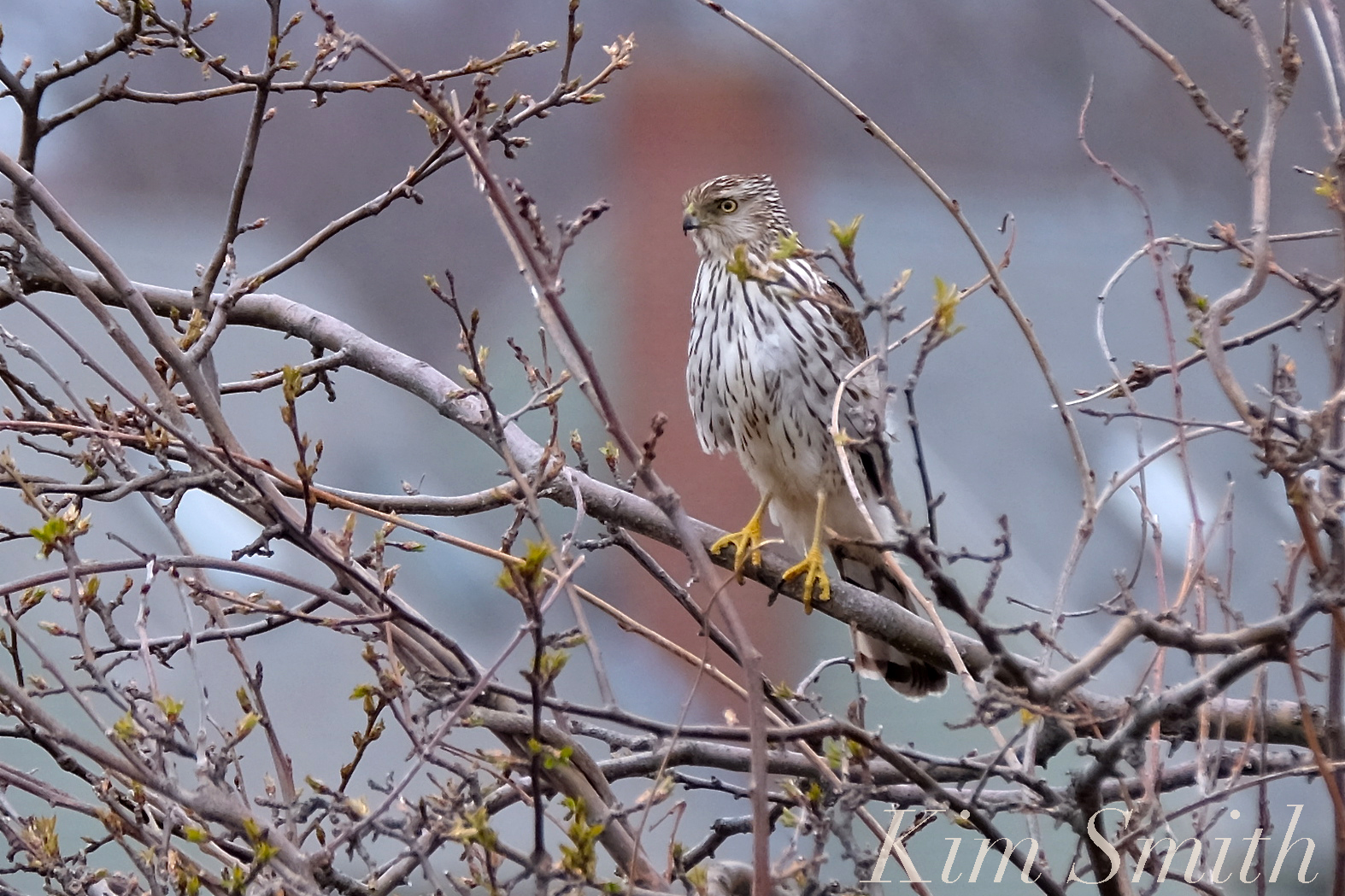
Throughout the summer and autumn, juvenile Cooper’s Hawk(s) have been observed hunting on Eastern Point. We see them zooming low and stealthily down roadways and soaring high amongst the treetops. There is no way of knowing if they are one and the same although one bird in particular appears to have developed a keen interest in the flock of Dark-eyed Juncos currently foraging in the neighborhood. Nearly every evening at dusk he hungrily swoops in, but never seems to capture one.

Well-camouflaged Dark-eyed Juncos, also known as Snowbirds

The Snowbirds have a neat set of tricks. They all scatter to the surrounding trees and shrubs. The slate gray and brown Dark-eyed Juncos are well camouflaged but that is not their only secret to survival.  Rather than singing their typical lovely bird song, from their hiding places, they all begin making an odd chirping-clicking sound. From every bush and shrub within the nearby vicinity, you can hear the clicks. I think the clicking is meant to confuse the Cooper’s Hawk!

He’ll first dive into a bush hunting a Junco, come up unsuccessfully, then swoop over to a nearby tree, perched and well hidden in the branches while on the lookout for dinner. The Snowbirds click non-stop until the Cooper’s departs. After the hunter flies away, they all come out of their hiding places, some from branches mere feet from where the Cooper’s was perched. After a short time, they resume their lovely varied birdsong.  I recorded audio of the Junco’s clicking and hope to find out more about this fascinating behavior.

Although we hope the young Cooper’s is finding food, I am rather glad he’s not that good at catching Snowbirds.

Cooper’s Hawks are a conservation success story. You can read more about the reason why in a post form several years ago: SPLENDID COOPER’S HAWK – A CONSERVATION SUCCESS STORY GIVES HOPE. Note the difference in the plumage in the two stories. The Cooper’s Hawk in that post is an adult. The Cooper’s chasing the Snowbirds is a juvenile. Both are about crow-sized, with the typical flat topped head.

Adult Cooper’s Hawk

Juvenile Cooper’s Hawk

2021 WILD CREATURES REVIEW! PART TWO

Cape Ann Wildlife – a year in pictures and stories

July through December continued from part one

July 2021

Conserve Wildlife NJ senior biologist Todd Pover makes a site visit to Cape Ann beaches, summer long updates from “Plover Central,” GHB Killdeer dune family raise a second brood of chicks,  Cape Hedge chick lost after fireworks disturbance and then reunited with Fam, Great Black-backed Gulls are eating our Plover chicks, thousands of Moon Snail collars at Cape Hedge,  Monarchs abound, #savesaltisland, missing Iguana Skittles, and Earwig eating Cecropia Moth cats.

August 2021

New short film for the Sawyer Free Library The Marvelous Magnificent Migrating Monarch!, Coastal Waterbird Conservation Cooperators meeting new short Piping Plover film, Ruby-throated Hummingbirds in the garden, why we love Joe-pye and other wildflowers, butterfly friends, Monarch cats in the garden, what is the purpose of the gold dots found on Monarch chrysalides?,Black Beauty came calling, Tigers in the garden, School Street sunflowers, Hoverflies, luminescent Sea Salps return to Cape Ann beaches, Petal Dancers and lemony Yellow Sulphurs on the wing.


September 2021

Flower Fairies, irruptive Green Darner migration, mini glossary of late summer butterflies, what to do if you find a tagged Monarch, Painted Ladies, White-tailed Deer family, Monarchs mating, Tangerine Butterflies,  yellow fellow in the hood, and Beauty on the Wing first ever live screening at the Shalin Liu.

October 2021

Bee-sized butterfly the American Copper, Monarch conga line, Thunder and Cloud, abandoned Piping Plover egg, School Street Sunflowers, Monarchs migrating, quotidian splendor, Monarch fundraiser updates, collecting milkweed seeds, the Differential Grasshopper, Cooper’s Hawk – a conservation success story,  #ploverjoyed, and nor’easter from the EP Lighthouse.

November 2021

Bridges between life and death, ancient oak tree uprooted, autumn harvest for feathered friends, Monarch migration update, we have achieved our fundraising goal!, Harbor Seal pup hauled out,  flight of the Snow Buntings, and a very rare for these parts wandering Wood Stork calls Cape Ann home for a month.

December 2021

New short film Wandering Wood Stork, tiny tender screech owl suffering from rat poison under the care of Cape Ann Wildlife Inc., Praying Mantis in the autumn garden, masked bandits in the hood, short film The Majestic Buck and Beautiful Doe Courtship Frolic, Snowy Owl boy in the dunes, short film Cedar Waxwing vocalization, the story of the Steller’s Sea-Eagle’s foray to Massachusetts, and Harbor Seal Pig Pile.


SEE PART ONE, JANUARY THROUGH JUNE, HERE


BEAUTY ON THE WING: LIFE STORY OF THE MONARCH BUTTERFLY COMING SOON (FEBRUARY 2022) TO A PBS STATION NEAR YOU!


AUTUMN HARVEST – SONGBIRDS FEASTING ON FRUITS, BERRIES, AND SEEDS

A very berry morning to you!

During early morning walks it has been a joy to observe the many beautiful songbirds breakfasting  on the array of autumn foods readily available, truly a smorgasbord of seeds, berries, and fruits.

My wild creature habitat radar has been especially drawn to a wonderful spot, so nicknamed ‘Four Berries Corners.’ Always alive at this time of year with chattering songbirds, there is a lovely crabapple tree, bittersweet, a small tree with black berries, privet I think, and two scraggly, but highly productive, Eastern Red Cedar trees.

In thinking about the about the most successful habitats for songbirds, a combination of seed-producing wildflowers, grasses, and garden flowers are planted along with primarily native flowering and fruiting trees and shrubs. The shrubs and trees also play the important role of providing nesting habitat and protective cover. The photo collection is a small sampling, and meant for design inspiration.

Native Eastern Red Cedar (Juniperus virginiana) and Male House Finches

A male and female House Finch feeding each other in the Crabapples!


Grass seeds, much beloved by many including Song Sparrows, Bobolinks, and even Snow Buntings

Poison Ivy berries – by no means am I suggesting to plant, just mentioning that over 60 species of birds have been documented eating Poison Ivy drupes.

Cattail seed heads for male Red-winged Blackbirds


Sunflower Seeds fo all!

Along with songbirds, come their predators. Look for Merlins, Red-tailed and Cooper’s Hawks

Blue Jay preening after a morning of berry eating

The berries of Spindle Tree are the most beautiful part of the tree, but the tree is not recommended as it reseeds freely and is notorious for pushing out species of native trees and shrubs.

Seed heads make great perches for dragonflies and damselflies

Coyotes getting in on the action– much of their scat at this time of year has plainly visible partially digested fruits and berries.


SPLENDID COOPER’S HAWK – A CONSERVATION SUCCESS STORY GIVES HOPE

Cooper’s Hawk at Twilight

A crow-sized bird, we often see Cooper’s Hawks at the edge of woodlands where mature trees grow. They have a blue-gray back and rusty orange streaking on white breast, similar to Sharp-shinned Hawks. The easiest way  to differentiate the two species is by their head shape and size. Sharp-shinned Hawks have smaller, rounder heads, while the Cooper’s head is larger and flatter on top.

The explosion of Cooper’s Hawks in Massachusetts is a result of several factors. Partly because fewer dairy farms has led to plant succession and maturing forests. Cooper’s nest toward the top of tall trees.

As with so many species of birds, the banning of DDT has also played a role in the bird’s resurgence.

Cooper’s Hawks prey on chickens. They were at one time considered a pest and hunted mercilessly. Because of the Migratory Bird Treaty Act, it is illegal to hunt and kill birds of prey, and punishable by a fine of up to 15,000.00 and six months in jail.

Cooper’s Hawks also prey on squirrels, pigeons, starlings, and sparrows, all of which are abundant in suburban and urban environments. With their ability to adapt to human behaviors and habitats, Cooper’s Hawks, Barred Owls, and Red-tailed Hawks are rapidly expanding their breeding range in Massachusetts. In thinking about the Migratory Bird Treaty Act and in banning dangerous chemicals that harm wildlife, it gives hope to think about how changes in our laws and behavior have had a profoundly positive impact on these three beautiful species.

Most Cooper’s Hawks migrate south for the winter but increasingly more and more are choosing to overwinter in Massachusetts.

Cooper’s Hawk range map

CAPE ANN WILDLIFE 2020: THE YEAR IN PICTURES, MOVIES, AND STORIES

Several years ago my husband suggested I write a “year end” wildlife review about all the creatures seen over the preceding year. That first review was a joyful endeavor though daunting enough. Over the next several years the reviews became more lengthy as I tried to cover every beautiful, wonderful creature that was encountered on woodland hikes, beaches, dunes, marshes, ponds, and our own backyards and neighborhoods. 2020 has been a very different year. There were just as many local wildlife stories as in previous years however, the pandemic and political climate have had far reaching consequences across geographic regions around the world, touching every living creature in the interconnected web of life we call our ecosystems.

This first year of the global pandemic has had a profoundly negative impact on wildlife and their habitats. In urban areas in developed countries, perhaps the economic slowdown afforded wildlife a break, with less pollution, less air travel, and some wild animals even reclaiming territory. Though the true downside of Covid-19 is that the pandemic has had an extraordinarily harmful impact on wildlife in rural areas and in less developed countries People who are dependent upon tourism, along with people who have lost jobs in cities and are returning to rural areas, are placing increasing pressure on wildlife by poaching, illegal mining, and logging. As mining and logging destroy wildlife habitats, animals are forced into ever shrinking areas, causing them to become sick, stressed, and to starve to death. These same stressed wild animals come in contact with people and farm animals, creating an ever increasing potential to transmit horrifically deadly illness, diseases such as Covid-19.

There are many, many organizations working to protect wildlife and conserve their habitats. I am especially in awe of one particular grass roots non-profit organization located in Macheros, Mexico, previously featured here, Butterflies and Their People. Co-founded by Ellen Sharp and Joel Moreno Rojas, the work they are doing to both protect the butterfly’s winter habit and provide employment for the forest’s guardians is outstanding.

All the butterfly sanctuaries (their winter resting places), are closed this year due to the pandemic. Dozens of people in the tiny town of Macheros are wholly dependent upon the income received by the work they do protecting the butterfly trees from illegal logging, as well as income from the tourist industry.  Ellen, Joel, and their team of arborists have come up with a wonderfully creative way to bring the butterflies to you. For a modest fee, you can sign up to “Adopt a Colony” to receive monthly newsletters and video tours of the Monarchs at Cerro Pelon. The newsletters are written by Ellen, who writes beautifully and clearly about the month-by-month current state of the butterflies in their winter habitat, as well as human interest stories drawn from the community. To subscribe to “Adopt a Colony” from Butterflies and Their People, go here.

We can be hopeful in 2021 that with a new administration, a much greater focus will be paid by our federal government to stop the spread of the virus in the US as well as around the globe. Not only is there hope in regard to the course correction needed to battle the pandemic, but the Biden/Harris administration has made climate change and environmental justice a cornerstone of their platform, including measures such as stopping the environmental madness taking place along our southern border and reversing many of the previous administration’s mandates that are so harmful to wildlife and their habitats.

Around the globe, especially in less developed countries, the pandemic has set back environmental initiatives by years, if not decades. We are so fortunate in Essex County  to have conservation organizations such as Greenbelt, MassWildlife, The Trustees, and Mass Audubon; organizations that protect the sanctity of wildlife and recognize the importance of protecting habitats not only for wildlife but equally as important, for the health and safety of human inhabitants.

The following are just some of the local images and stories that make us deeply appreciate the beauty of wildlife and their habitats found on Cape Ann and all around Essex County. Each picture is only a brief window into the elusive, complex life of a creature. Every day and every encounter brings so much more to observe, to learn, to enjoy, and to love.

To read more, each image and story from the past year is Google searchable. Type in the name of the creature and my name and the link to the story and pictures posted on my website should come right up.

Some Beautiful Raptors of 2020 – Red-tailed Hawk, Short-eared Owl, American Bald Eagle, Cooper’s Hawk, Merlin, Sharp-shinned Hawk, Osprey, and Snowy Owls


Essex County Greenbelt’s Osprey pair, Annie and Squam, successfully fledged three chicks, Vivi, Rusty, and Liz (nestling photo courtesy ECGA)

Dave Rimmer video from the Osprey cam at Lobstaland

The Snowy Owl Film Project was completed in March, with the objective of providing pandemic- virtually schooled kids a window into the world of Snowy Owls in their winter habitat (see all five short films here).


Spunky Mute Swan Cygnets

Utterly captivated by the winsome Red Fox Family

A tiny sampling of the beautiful songbirds that graced our shores in 2020 – Cedar Waxwings, Baltimore Orioles, Catbirds, American Robins, Tree Swallows, Barn Swallows, Snow Buntings, American Pipits, Horned Larks, and Eastern Bluebirds


A new favorite place to film is at my friend Paul’s wonderfully fun sunflower field in Ipswich, School Street Sunflowers. Beautiful Bobolinks, Common Yellowthroat Warblers, and Bluejays were just some of the songbirds seen feasting on the expiring seedheads  of sunflowers and wildflowers growing amongst the rows of flowers.

Graceful White-tailed Deer herd of adult females and youngsters

Snowy Egrets, Great Blue Herons, Great Egrets, and juvenile Little Blue Herons delight with their elegance, beauty, and stealth hunting skills. Included in the montage is a juvenile Black-crowned Night Heron that spent the winter at Niles Pond

A fraction of the different species of Shorebirds and Gulls seen on Cape Ann this past year – Dowitchers, Killdeers, Black-bellied Plovers, Common Tern, Least Tern, Laughing Gulls, Bonaparte’s Gulls, Glaucus Gull, and rarely seen Dovekie, or”Little Auk.”

Cecropia Moth life cycle unfolding in our garden, from mating, to egg laying, to caterpillar, to adult.


Dozens and dozens of orb spider webs draped a small patch of wildflowers. The dream catchers were attracting Cedar Waxwings to feast on the insects caught in the webs. The following day I returned after a rainstorm. The webs had melted away in the downpour and the Waxwings had vanished into the treetops.

Harbor and Gray Seals hauled out on the rocks at Brace Cove, as many as 28 were counted on a winter’s day!

Piping Plovers and Marshmallow Montage

In 2020, our Good Harbor Beach Piping Plover pair fledged one chick, nicknamed Marshmallow. Despite the global pandemic, a group of super dedicated Piping Plover Ambassadors worked tirelessly from sunrise until sunset to help ensure the safety of the Piping Plover family and to help educate beachgoers about the beautiful life story of the Plovers unfolding on Gloucester’s most popular beach destination. We worked with Essex Greenbelt’s Dave Rimmer, the Gloucester DPW, and Gloucester City Councilor Scot Memhard, with much appreciated advice from Mass Wildlife Coastal Waterbird Biologist Carolyn Mostello.

Read more about Marshmallow, the Ambassadors, and the Piping Plover Film Project here.

Piping Plover Marshmallow Montage, from egg to thirty-eight days old. Filmed at Good Harbor Beach, Gloucester, Massachusetts.

MONARCHS!

It has been a wonderful, exhilarating, infinitely educational, and beautifully challenging journey creating my documentary, Beauty on the Wing: Life Story of the Monarch Butterflies. The film was released in February 2020, but because of the pandemic, was not seen by the public until August, when it premiered (virtually) at the New Haven Documentary Film Festival. Beauty on the Wing has gone on to win honors and awards at both environmental and children’s film festivals, including the tremendous honor of Best Documentary at the Boston International Kids Film Festival. I’ve just received the very attractive award in the mail and have not had time to post a photo yet.

Beauty on the Wing portrays Cape Ann in the most beautiful light and I think when we are ever able to have a live premiere in this area, local friends will be delighted at the outcome. Joyfully so, Beauty is now being distributed to schools, libraries, institutions, and the travel industry through American Public Television Worldwide.

Beauty on the Wing continues to be accepted to film festivals and I will keep you posted as some are geo-bloced to this area, including the upcoming Providence Children’s Film Festival.


Last but not least, our wonderfully wildy Charlotte, little adventurer and nature-loving companion throughout the year


STARTING THE NEW YEAR OFF ON A HAPPY BUT MELANCHOLY NOTE

As was the case for so many, New Year’s Day was joyful but bittersweet, too. I drove Liv to the airport at dawn for her return trip to LA. She can work remotely and was able to travel home in early December, before the second surge. When she arrived home she quarantined, taking a Covid test prior to, and again after arriving. Liv extended her visit an extra week so that she did not have to fly back last weekend. It’s nerve wracking dropping her off at the airport but she has had to fly occasionally for work during the pandemic and Delta is only allowing at most 50 percent capacity. She flies at odd times so the planes are mostly empty, and she is often allowed to upgrade to first class for free, as she was on this flight. All that being said, with the surge on top of the surge and the new strain running rampant, praying and hoping she will remain safe and Covid-free.

Having both adult children home, along with our darling Charlotte here with us full time, we are having more fun as a family – cooking together, playing card games, laughing, joking, and telling stories. This family time together has been the silver lining to the pandemic and the part I will choose to remember.

I stopped on the way home to watch the planes taking off and snap a photo of the first sunrise of 2021.

After returning from the airport, Charlotte and I took one of our mini nature walks around Eastern Point. The very first creature we encountered was a young Double-crested Cormorant. He was attempting to cross the berm. We almost walked right into him! For some reason we couldn’t quite understand, he didn’t care to fly from Brace Cove to Niles Pond, but was on foot.

After we stood very quietly for several minutes (no small feat for a three-year-old) he decided we weren’t a threat and crossed our path, not three feet away!

Continuing on our mini trek, we spotted the rare Black-headed Gull bobbing along in the cove (see yesterday’s post).

To top off our day, a young Cooper’s Hawk flew overhead and landed in a nearby tree.

Wishing you a healthy New Year Friends!

AN EAR-FULL OF CEDAR WAXWINGS! ALONG WITH MERLINS AND HAWKS ON THE HUNT

During the last weeks of summer, I was blessed with the great good fortune to come across a flock of Cedar Waxwings. Everyday I followed their morning antics as they socialized, foraged, preened, and was even “buzzed” several times when making too quick a movement or crunched on a twig too loudly for their liking. They were actually remarkably tolerant of my presence but as soon as another person or two appeared on the path, they quickly departed. I think that is often the case with wildlife; one human is tolerable, but two of us is two too many. 

The Cedar Waxwings were seen foraging on wildflower seeds and the insects attracted, making them harder to spot as compared to when seen foraging at berries on trees branches. A flock of Cedar Waxwings is called a “museum” or an “ear-full.” The nickname ear-full is apt as they were readily found each morning by their wonderfully soft social trilling.  When you learn to recognize their vocalizations, you will find they are much easier to locate.

These sweet songbirds are strikingly beautiful. Dressed in a black mask that wraps around the eyes, with blue, yellow, and Mourning Dove buffy gray-brown feathers, a cardinal-like crest atop the head, and brilliant red wing tips, Cedar Waxwings are equally as beautiful from the front and rear views.

Cedar Waxwings really do have wax wings; the red wing tips are a waxy secretion. At first biologist thought the red tips functioned to protect the wings from wear and tear, but there really is no evidence of that. Instead, the red secondary tips appear to be status signals that function in mate selection. The older the Waxwing, the greater the number of waxy tips. Birds with zero to five are immature birds, while those with more than nine are thought to be older.

Waxwings tend to associate with other waxwings within these two age groups. Pairs of older birds nest earlier and raise more fledglings than do pairs of younger birds. The characteristic plumage is important in choosing a mate within the social order of the flock.

By mid-September there were still seeds and insects aplenty in the wildflower patch that I was filming at when the beautiful Waxwings abruptly departed for the safety of neighboring treetops. Why do I write “safety?” I believe they skeedaddled because a dangerous new raptor appeared on the scene. More falcon-like than hawk, the mystifying bird sped like a torpedo through the wildflower patch and swooped into the adjacent birch tree where all the raptors like to perch. It was a Merlin! And the songbird’s mortal enemy. Cooper’s and Sharp-shinned Hawks, too, had been hunting the area, but the other hawks did not elicit the same terror as did the Merlin.

Merlin, Eastern Point

Cooper’s and Sharp-shinned Hawks

A small falcon, the Merlin’s short wings allow it to fly fast and hard. The Merlin is often referred to as the “thug” of the bird world for its ability to swoop in quickly and snatch a songbird out of the air. The day after the Merlin appeared, I never again found the Waxwings foraging in the wildlflowers, only in the tree tops.

Within the sociable ear-full, Waxwings take turns foraging. Some perch and preen, serving as sentries while flock-mates dine. Cedar Waxwings eat berries and they love a wide variety. The first half of their name is derived from one of their favorite fruits, the waxy berries of cedar trees. During the breeding season, Waxwings add insects to their diets. Hatchlings are fed insects, gradually switching to berries.

Juvenile Cedar Waxwing with adult Waxwings

If you would like to attract Cedar Waxwings  to your garden here is a handy list that I compiled of some of their most favorite fruits and berries –

Dogwood, Juniper, Chokecherry, Cedar, Honeysuckle, Holy, Crabapple, Hawthorn, Serviceberry, Mulberry, Raspberry, Grapes, and Strawberry. Cedar Waxwings are becoming increasingly more prevalent in backyards because people are planting more ornamental flowering and fruiting trees.

GOOD EATING AT GOOD HARBOR! IF YOU ARE A BIRD, THAT IS :)

Over the past several months of documenting our Good Harbor Beach Piping Plovers, beginning in March, we have seen a beautiful collection of shorebirds, gulls, hawks, and wading birds. The continuous ebb and flow of replenishing waters at the tidal creek, expansive marsh, and intertidal pools make for a range of rich habitat where birds can find food and shelter. Minnows, sea worms, crabs, tiny mollusks, and a wide variety of other invertebrates provide fuel for hungry travelers as well as summer residents.

Too many photos for one post I just realized and will post heron and egret photos next.

Here are just some of the beauties!

Beautiful, beautiful trio of Dowitchers

Herring Gull eating a Green Crab

Cooper’s Hawk

Spotted Sandpiper

Least and Semipalmated Sandpipers

Semipalmated Sandpiper

Semipalmated Plovers

Killdeer

Laughing Gulls
Yellow Legs

And of course, Marshmallow and Dad 🙂


SOME BEAUTIFUL CREATURES YOU’LL SEE ON OUR SHORES IN EARLY JUNE

A random grouping of recently spotted birds. The Song Sparrow and Cooper’s Hawk were seen in the lot at Good Harbor beach. Beautiful creatures surround here on Cape Ann, even in parking lots 🙂

Sanderlings migrating north

Cape Ann Wildlife: A Year in Pictures

snowy-owl-gloucester-massachusetts-c2a9kim-smith-2015My husband Tom suggested that I write a year-end post about the wildlife that I had photographed around Cape Ann. Super idea I thought, that will be fun and easy. Not realizing how daunting and many hours later, the following is a collection of some favorite images from this past year, beginning with the male Snowy Owl photographed at Captain Joe’s dock last winter, to December’s Red-tailed Hawk huntress.
red-tailed-hawk-eating-prey-gloucester-massachusetts-21-copyright-kim-smith

Living along the great Atlantic Flyway, we have been graced with a bevy of birds. Perhaps the most exciting arrival of all occurred when early summer brought several pairs of nesting Piping Plovers to Gloucester’s most beloved (and most highly trafficked) of beaches, Good Harbor Beach. Their story is being documented on film.

piping-plovers-chicks-nestlings-babies-kim-smithWork on Mr. Swan’s film will also resume this January—the winters are simply not long enough for all I have planned!swan-outstretched-wings-niles-pond-coyright-kim-smith

While photographing and filming Red-winged Blackbirds this past spring, there was a face-to-face encounter with a hungry coyote, as well as several River Otter sightings.

female-red-winged-blackbird-copyright-kim-smitrhFemale Red-winged Blackbirdeastern-coyote-massachusetts-kim-smith

The summer’s drought brought Muskrats out from the reeds and into full view at a very dry Henry’s Pond, and a short film about a North American Beaver encounter at Langsford Pond. Numerous stories were heard from folks who have lived on Cape Ann far longer than I about the extraordinary number of egrets, both Snowy and Great, dwelling on our shores.
three-muskrat-family-massachusetts-copyright-kim-smithThree Muskrateers
female-monarch-depositing-eggs-1-copyright-kim-smithnewly-emerged-monarch-butterfly-copyright-kim-smith-jpgThere were few Monarch sightings, but the ones seen thankfully deposited eggs in our garden. Thank you to my new friend Christine who shared her Cecropia Silkmoth eggs with me and thank you to the countless readers who have extended an invitation to come by and photograph an exciting creature in their yard.

cecropia-moth-caterpillar-copyright-kim-smith

Pristine beaches, bodies of fresh water, and great swathes of protected marsh and woodland make for ideal wildlife habitat, and Cape Ann has it all. With global climate change pushing species further away from the Equator, I imagine we’ll be seeing even more creatures along our shores. Butterfly and bee populations are overall in decline, not only because of climate change and the use of pesticides, but also because of loss of habitat. As Massachusetts has become less agrarian and more greatly forested, fields of wildflowers are becoming increasingly rare. And too fields often make the best house lots. Farmers and property owners developing an awareness of the insects’ life cycle and planting and maintaining fields and gardens accordingly will truly help the butterflies and bees.
female-mallard-nine-ducklings-kim-smith

Thank you to all our readers for your kind comments of appreciation throughout the year for the beautiful wild creatures with which we share this gorgeous peninsula called Cape Ann.

The images are not arranged in any particular order. If you’d like to read more about a particular animal, type the name of the animal in the search box and the original post should come up.

I wonder what 2017 will bring?

nine-piping-plovers-napping-gloucester-copyright-kim-smith

sandpipers-copyright-kim-smith

EXQUISITE COOPER’S HAWK

Cooper's Hawk Rockport MA www.kimsmithdesigns.com 2016 -3Cooper’s Hawk, at least I think it is an immature Cooper’s Hawk. Raptor experts reading this please weigh in!

Several nights ago while filming at T Wharf in truly gorgeous fading light a very cool hawk flew on the scene, hungrily hunting amidst the flock of pigeons that were circling around Motif #1. The kerfuffle was captured on film, and then he perched about fifteen feet away from where I was standing! I very slowly and quietly turned cameras toward him. The hawk stayed for a few moments longer before heading back out to chase the pigeons.

I believe this is an immature Cooper’s Hawk because of the beautiful teardrop-shaped patterning of the feathers on its breast, the distinguishing three bars on its long tail, and the yellow eyes. What do you think?

Cooper's Hawk Rockport MA www.kimsmithdesigns.com 2016 -2Cooper's Hawk Rockport MA www.kimsmithdesigns.com 2016

The light was so dim and the hawk photos were shot at only a shutter speed of 40 and high ISO of 5400. Nonetheless, I’m impressed with the clarity of the images from my new lens when shooting in very low light conditions.

Filming at TWharf last night in beautiful light

A photo posted by Kim Smith (@kimsmithdesigns) on

Motif #1 (Not fuji, iPhone 6sPlus photo)