Category Archives: Wildflowers

Why We Love Pokeberry (and so do Scissor-tailed Flycatchers!)

Dear Friends,

Taking a break from thinking about the heart-rending reality of our national politics to talk about a native plant that you may want to encourage to grow in your wildflower garden. Pokeberry is a large, gangly native plant that goes by many names: American Pokeweed, Dragonberry, Pigeonberry, and Inkberry, to name but a few. Although all parts of the plant can be toxic to livestock, the berries are much beloved by a variety of songbirds including Mockingbirds, Yellow-bellied Sapsuckers, Cardinals, Brown Thrashers, Cedar Waxwings, Bluebirds, and many more.

Pokeberry was one of several fruiting plants favored by the exquisite (and rarely seen in the Northeast) Scissor-tailed Flycatcher that was visiting the Spencer-Pierce-Little Farm. The Pokeberry was growing in the pigpen and around the edges of the farm fields. If you plan to grow it in your garden, know that Pokeberry can reach five to six feet and is a good candidate for the back of a border or along property edges.

In our own garden, we never had Yellow-bellied Sapsuckers until I let a volunteer Pokeberry grow where a bird had deposited a seed. Now we have a tribe of YBS stopping over during spring and autumn migration, a male, a female, and even a  juvenile. This past autumn, our “pet” Yellow-bellied Sapsucker, as Charlotte likes to call the male who comes daily, was with us from October through December. He was mostly focused on procuring  sap from our tree garden but I don’t think it would be here unless it had been initially attracted to the beautiful deep purple berries of the Pokeberry plant.

Grow Native and They Will Come!

P.S. Ruby-throated Hummingbirds drink nectar from the tiny white Pokeberry flowers.

The Fabulous Four Plants for Monarchs (and Bees)!


Plant goldenrods, asters, and milkweeds to provide Monarchs (and as you can see, many other pollinators) all the sustenance they will need during their breeding season and southward migration.

Wildflowers in order of appearance:

Seaside Goldenrod (Solidago sempervirens)

Smooth Aster (Symphyotrichum laeve)

New England Aster (Symphyotrichum novae-angliae)

Common Milkweed (Asclepias syriaca)

The Piping Plovers of Moonlight Bay comes to Canada x 2

Dear PiPl Friends,

I am delighted to share two good things. The Piping Plovers of Moonlight Bay has been accepted to the Brampton Canada International Film Festival, which is a relatively new festival based in Ontario, and we are having a film screening in December at the City Cinema, sponsored by the Island Nature Trust, which is located at Prince Edward Island. We love our neighbors to the north and I am deeply honored. Thank you BCIFF and Island Nature Trust. We are so very grateful for the opportunity to share our documentary with Canadians.

Recently I attended a great talk given by the entomologist and conservationist Doug Tallamy, which was sponsored by a fantastic local organization, 400 Trees Gloucester and hosted by the Annisquam Village Church.  Please read more about local efforts to grow native here.

Winged wonders continue to migrate across our shores, with Little Blue Herons the most recently departed. I posted photos of LBHerons and Snowy Egrets, along with a short video of a dragonfly run-in with a Little Blue here.Monarch Butterflies and native wildflower Seaside Goldenrod (Solidago sempervirens)

We had another wave of migrating Super Monarchs, the third this season however, the wind conditions have kept the butterflies moving and that is why we are not seeing many in our gardens during this year’s migration. Continue to keep on the lookout. Goldenrods are winding down their blooming period but asters, especially New England Asters and Smooth Asters, are still flowering.

Please continue to share what creatures you are seeing in your neighborhoods. Thank you 🙂 This morning I saw a tiny little member of the weasel family, a Short-tailed Weasel, also called an Ermine or a Stout. She was only about six inches in length, with chocolate brown fur and a bright white belly. She was so fast and darted between rocks before I could take a photo, but we did have a few seconds of startled eye to eye contact. Just adorable!

Thinking about Jane Goodall – her beautiful, thoughtful spirit and the extraordinary gift she left, inspiring all to protect our planet.

xxKim

Gombe, Tanzania – Jane Goodall and infant chimpanzee reach out to touch each other’s hands. (National Geographic Creative/ Hugo Van Lawick)

Homegrown National Parks Coming to Cape Ann!

What are Homegrown National Parks?   HNP is an exciting movement that raises awareness and urgently inspires EVERYONE to address the biodiversity crisis. How can we as individuals and organizations do this? By adding native plants and removing invasives where we live, work, learn, pray, and play.

We all know that wildlife populations are crashing the world over. The statistics are staggering, with approximately one-third of our breeding birds lost since 1970, or about 3 billion birds, and 40 percent of our insects (bird food!) in the past 40 years. HNP is showing people how we can address this crisis, backyard by backyard.

Sunday evening, Doug Tallamy, the esteemed entomologist, author, and co-founder of Homegrown National Parks, presented “The Power of Plants.” The event was hosted by 400 Trees and the Annisquam Village Church, and was followed the next morning by an informal idea-sharing discussion at our newly renovated gorgeous library. The presentation was rich with imagery and case studies of what can be accomplished in our own backyards, from teeny urban lots to suburban homes to substantial acreage. The group discussion was especially thoughtful and interesting, providing a wonderful opportunity to meet people in our community with similar interests, missions, and goals, Many, many thanks to Peter Lawrence and Sara Remsen for organizing the Tallamy talk and discussion.

Visit the Homegrown National Parks website. It is overflowing with super helpful information to get you started on your native plants journey. You can also listen to several of his excellent talks right there on the website. I have been teaching people how to grow pollinator gardens and documenting the wildlife supported by native trees, shrubs, wildflowers, and ground covers for over twenty years now. Not a day goes by where I don’t observe and learn some new, vital and fascinating information about the beautiful ecosystems created in a native plant’s habitat. When you plant native they will come!

Join the Movement Now!

1. Plant Native

2. Remove Invasives

3. Get on the Map

Where Shall We Start?

Images courtesy Doug Tallamy “The Power of Plants”

Identify the most productive plants. How to find native plants keystone species –

Native Plant Finder from the National Wildlife Federation: go to the following website and type in your zip code for an extensive list of highly valuable native trees, shrubs, wildflowers, and ground covers specifically beneficial to wildlife in your region. https://nativeplantfinder.nwf.org/

I was listening to Doug’s talk via Zoom in my office, which is also Charlotte’s art room. Charlotte is illustrating a book she is working on, all about the history of Gloucester’s monsters. It’s very imaginative and even includes mini side bars of illustrations of the eggs unique to each monster, along with the monster’s baby pictures (Nessie is well-represented). She was also enjoying glancing over at all the fascinating caterpillar images in Doug’s slideshow, when she overheard the expression ‘keystone species.’ She commented, “just like oysters are a keystone species for the ocean.” We had been to the Seacoast Science Center a week earlier where she had learned about the importance of keystone species in an ecosystem. I just thought how wonderful for her to connect the two and how much like mental sponges are these beautiful curious-minded children of the up and coming generation. I surely never learned at eight years old what a keystone species is, but how easy it was for her to understand the concept. If for no other reason, our beautiful children, and our children’s children, are why we simply can not leave to them a barren, diversity-less world.


Winged Wonders Migration!

The great North to Central to South American magnificent southward migration of wildlife is fully underway. These beautiful creatures do not see borders, religion, nor ethnicities and bind us together in myriad meaningful ways. As birds are taking to the skies by the hundreds of thousands, we are seeing the beginnings of the Monarch migration as well. During these first weeks of September local meadows and gardens are  graced with newly emerged Monarchs. At this time of year, these recently eclosed butterflies are nicknamed the “Super” Monarchs.

You can see the above Monarch has just emerged from his chrysalis as his wing cells are still a bit crumpled. 

A tell tale sign of a male Super Monarch, also called a Methuselah Monarch, is that they are not at all interested in finding a mate. A male Monarch that is not migrating stops only briefly to nectar. For the most part he ceaselessly patrols the milkweed looking for a female and chases away any other winged pollinator. He has evolved with the main objective of reproducing; whereas a Methuselah Monarch takes its time sucking up nectar and is very tolerant of other butterflies it encounters.

Methuselah Monarchs emerge in a state of sexual immaturity, called diapause. They evolved to drink lots and lots of nectar to build their fat reserves for the long journey south and to sustain them through the winter. This super generation of Monarchs are oftentimes larger but will lose some of their body weight by the time they reach the trans-Mexican volcanic forests

The Monarchs rest through the winter, then will break diapause next spring when they begin their journey north.

To help all of our winged friends during the spectacular southward migration please remember Lights Out for Birds

To learn more about the magnificent Monarch migration see our documentary Beauty on the Wing: Life Story of the Monarch Butterfly streaming on PBS Passport. To arrange a screening and QandA for your organization, please contact me at kimsmithdesigns@hotmail.com or leave a comment in the comment section.

I hope you enjoy these last glowing days of summer,

xxKim

Female (left) and male Monarch Butterflies, Stone Harbor Point NJ

Love, Love Felix’s Family Farm!

Unable are the loved to die, for love is immortality

Paul Wegzyn and his family have created a most magical family friendly farm event. The theme this season is LOVE and beautiful quotes are placed throughout the fields.

Every season Paul develops new and wonderful experiences for people and this year is no exception. If you do, as do we, have a bunny- and goat-loving youngster in your family, they will be utterly delighted with the very pet-able, softest bunnies and sweetest goats around!

He has created a lovely butterfly garden with Mexican Sunflowers, Zinnias, and Cleome and you can PYO all the flowers on the farm, including Paul’s beautiful dahlias.

A new crop of lavender is almost ready to pick as is a freshly opening field of orange sunflowers with dark centers, which I can not wait to see.

Felix’s Family Farm is open everyday from now until about the third week in September, or as long as the flowers last.

Felix’s Family Farm

20 Lowes Lane, Ipswich, MA

978-229-1071

The following is a list of even more activities Felix’s Family Farm has to offer. To learn more, please go here.

  • Baby Goat Yoga
  • Alpaca Yoga
  • Yoga Yurt with a variety of classes and events
  • Luxury Glamping Experience on The Farm
  • The Ability To Host Private Parties and Events
  • Honey From The Farm
  • Professional Cow Photoshoots
  • Picnics on The Farm

Outphloxed by Our Phlox!

Look how lovey our patch of Summer Phlox has grown. I wish I could say it was my genius garden design skills but alas, this is all nature’s doing!

Where this border is growing I originally had only planted the mildew resistant and pure white Phlox paniculata ‘David.’ Some distance away, we planted the striking P. paniculata ‘Bright Eyes,’ a light pink with deep magenta centers and adjacent to ‘Bright Eyes,’ a pretty lavender called ‘Franz Shubert. ‘

Several years have gone by and we now have a patch of volunteers blooming in beautiful shades of pink, lavender, and magenta. I think this may have happened because the plants have cross-pollinated and are allowed to reseed. We don’t deadhead and don’t mulch and that encourages little seedlings to take hold and spread far and wide in our garden.

Phlox paniculata is native to the eastern US and grows in a range of conditions. The location in our garden where it is thriving is partially shaded by the Magnolia grandiflora. This beautiful, beautiful wildflower is also wonderfully fragrant, with a heady floral scent especially potent in the early morning and late in the day. I have on occasion seen Ruby-throated Hummingbirds and Eastern Tiger Swallowtails drinking nectar from the blossoms but mostly the blooms are especially attractive to Bumblebees.

Pollen-dusted Bumblebee

Did I mention that P. paniculata blooms for many weeks??

Plant this native beauty. I promise, you will be delighted for many years to come.

Ruby-throated Hummingbirds, Jewelweed, and Canna Lily

I loved filming Ruby-throated Hummingbirds on the beautiful bold flowering stalks of Canna Lilies (Canna indica) and just as much, I love seeing them drinking nectar from our North American native wildflower Jewelweed (Impatiens capensis). Even though not native to North Ameirca, it makes perfect sense that RTH forage from Canna Lilies as they grow natively in the Tropical Americas, the birds winter home!

Some fun things to know about Jewelweed:

Jewelweed has long been used in Native American medicine. Apply the watery sap topically to relieve itching and pain from Poison Ivy, Stinging Nettle, and hives.

The fruit of Jewelweed is an elongated capsule and at the slightest touch will burst open and send a little seed popper some distance, a fun activity to do with children and adults alike 🙂

You can grow Jewelweed in your native plant’s garden provided it is in a somewhat shaded and somewhat moist location. The Ruby-throated Hummingbirds, bees, and butterflies will thank you!

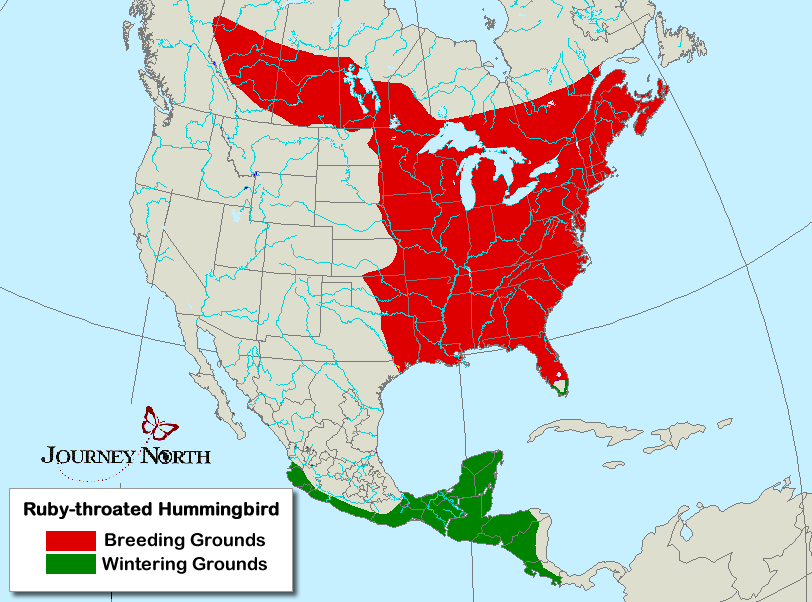
Ruby-throated Hummingbird Range Map courtesy Journey North

Finding Monarch Cats in the Garden!

We’ve been graced with Monarchs and fat healthy caterpillars this summer. Please write and let me know if you are seeing Monarchs (or not) in your garden <3

Milkweed is the Bees Knees!

This vibrantly hued milkweed is most commonly known as Butterflyweed (Asclepias tuberosa). Orange Milkweed, Pleurisy Root, Chigger Flower, and Chiggerweed are a few of its other common names.

Butterflyweed blooms in a range of hot colors from buttery yellow to Spanish orange to fire orange red and is a welcome source of nectar for butterflies and bees.

Thank you Miss Ladybug!

In the garden experimenting with my new camera and I came across Ladybugs devouring aphids on our Common Milkweed (Asclepias syriaca) buds.

What a love and we so appreciate your appetite for all things aphids <3


Azure Blue Butterfly in the Garden!

Good morning sweet Spring Azure! Look for these tiny one-inch wide wingspan butterflies drinking nectar from the flowers of crabapple, Common Milkweed, blackberry, dandelion, violet and many more spring bloomers.

The female deposits her eggs on a variety of woody shrubs and trees including dogwood (native Cornus florida, not the non-native Korean Kousa), viburnum, blueberry, sumac, and cherry. In our garden, the females mostly oviposit eggs around the pale pink buds of our native Meadowsweet (Spirea alba var. latifolia).

One Night. One Building. 1,000 Dead Birds: A Simple Change Made a World of Difference

My friend Deborah shared this fantastic article. Please read 🙂

50 States, 50 Fixes

An Illinois Building Was a Bird Killer. A Simple Change Made a World of Difference.

Chicago is one of the most dangerous cities in the United States for migrating birds, and a glassy lakefront conference center was especially lethal.

The morning promised to be deadly.

High above Chicago, in the predawn dark, flew an airborne river of migratory birds. It was peak spring migration traffic, in late April, and the tiny travelers were arriving at one of the most perilous points along their journey.

These birds, inhabitants of forests and grasslands, do not perceive glass as solid and get confused by its reflections. Bright city lights seem to attract them, luring them into glassy canyons. The gleaming buildings of Chicago, curving along the shore of Lake Michigan, are especially lethal.

Palm Warbler


50 States, 50 Fixes is a series about local solutions to environmental problems. More to come this year.


A call went out to volunteers across the city: Be ready to hit the streets early to rescue the injured and document the dead.

But at the building that has long been the city’s most notorious bird killer, a sprawling lakefront conference venue that claimed almost a thousand birds on a single day in October 2023, new protections were in place.

Read more here

Yellow-rumped Warbler eating Poison Ivy berries

Thoughts About Leaf Blowers and How We Can Possibly Find a Solution Working Together :)

Whether or not to ban gas-powered leaf blowers sure is creating a maelstrom of divisiveness in our communities. Everyone who has an opinion feels strongly, very strongly, that their viewpoint is the correct pov. Let’s think of the pros and cons and perhaps there is a solution. If I missed a pro or con, please feel free to write so we can include your point of view.

PROS of Gas Powered Leaf Blowers

Landscapers and homeowners appreciate the lower cost associated with gas-powered leaf blowers.

GPs are more powerful than electric, saving time and money.

Many landscapers and homeowners already own gas powered blowers.

CONS of Gas Powered Leaf Blowers

Gas powered leaf blowers are very loud particularly when multiple blowers are in use simultaneously.  The noise pollution is disruptive and unpleasant to neighbors.

GP blowers emit a strong odor of gas fumes, harmful to the environment and to the person operating the leaf blower.

Some observations – our home is located in a middle class neighborhood where leaf blowing does not occur regularly, if at all, whether gas or electric. I do however have clients in more affluent neighborhoods where the use of leaf blowers is much more prevalent. People are correct, the noise level is extremely loud. A crew of men, typically Latino, will disembark from company pick-up trucks, with gas powered blowers strapped to their backs and ear phones snugly wrapped over their ears. The crew of half dozen or so will spend a good part of an hour blowing the leaves off a driveway that won’t even be driven on again until the summer resident homeowner returns the following year. Not only does it seem like an utter waste of time, it concerns me that the employees are breathing the fumes. This is also the same crew that I see spraying pesticides around the base of the homeowner’s foundations, also not wearing protective covering. I am wondering if protective masks and clothing can be provided to the employees that are required to use gas-powered leaf blowers and pesticides.

Do homeowners need half a dozen men blowing leaves off driveways and the street in front of their homes? Perhaps with less demand for an immaculate leaf-be-gone landscape, one gentleman wearing a mask, as opposed to six maskless men, could do the work. If a homeowner is having considerable work done and a leaf blower is needed to assist in clean-up, that seems to me like a reasonable use. Or if a pathway is covered with wet leaves creating an unsafe situation for an elderly person, that too seems like a reasonable use.

In my own landscape design firm, I encourage clients and friends not to remove leaves and the expired stalks of flowering plants. To my way of thinking, leaves on lawns and in flower beds is a beautiful thing! Not only are the decaying leaves providing a protective layer and adding nutrients to the soil, leaves also provide habitat for all manner of insects. I think at this point in our shared awareness about the environment, we all understand that insect populations the world over have plummeted.  We homeowners and landscapers can help insect populations by leaving leaf litter in our gardens. The most delightful benefit of a garden that supports insects, is that the insects attract a host of beautiful songbirds that in turn conveniently eat the insects <3

For the benefit of insects, especially native bees, we also do not cut down the expired stalks of flowers until the end of April. In the late summer and early fall, native bees and other insects burrow into the stalks. When we do eventually cut down the stalks, we leave them in a pile for several weeks before discarding, hoping our little pollinator friends have wiggled out of their winter home.

Perhaps if we can change people’s mindsets about what constitutes a healthy landscape, the fashion of blowing leaves will become mush less problematic.

The song of a Carolina Wren chortling from a treetop has to be one of the sweetest songs you can imagine hearing in you garden. They love to rumple about in the leaf litter, foraging for insects. Insects are an important part of a songbird’s diet, especially during the breeding season when the females are producing eggs.

Carolina Wren nest with eggs tucked under our porch eaves – 

Later in the season, a Carolina Wren fledgling is perched on the back fence. She was made fat and healthy from a diet rich in your average garden variety insects – 


National Learn About Butterflies Day

In recent years, March 14th has been designated National Learn About Butterflies Day. Butterfly populations, as are many species of insects, plummeting around the globe. Climate change, loss of habitat, and the use of pesticides are at the top of the list as to why we are losing our insects.

What can we do as individuals, and collectively with like-minded friends? I have been writing about the plight of butterflies for nearly 30 years and at the risk of sounding repetitive, the following are easy to follow guidelines:

Refrain from Using ALL Pesticides and Herbicides. 

Do Not Spring Into Spring Cleaning!

For the sake of all pollinators, and many songbirds, do not do a spring garden clean up too early. When is a good time? Wait until your grass is growing tall and needs to be mowed and ideally, apple and pear trees in your area have finished blooming. You can also clean-up some spots and leave others unkempt for an even later season clean-up.

Grow Native and Not Invasively

Plant native species of trees, shrubs, vines, wildflowers, and ground covers. Only plant non-native species (such as tulips and zinnias for example) that do not spread outside the area in which you wish them to grow.

American Copper, Bee, and native aster

Provide Continuous Blooms from Early Spring Through November 1st

Create a landscape that provides nourishment for pollinators and songbirds, from the earliest days of spring though the last hard frost. Include colorful nectar plants and equally as important, grow native larval host plants for butterfly caterpillars.

Although these lovely pink Korean Daisies are not native, they are not invasive and bloom until the first hard frost. They are especially welcome to late migrating scragglers such as the Monarch pictured here.

Plant in Clumps and Drifts  Whenever Possible.

Butterflies and bees love to drink nectar at a buffet where they can flit easily from one floret to the next. Allow perennials to spread into drifts and clumps. Panicle-shaped flower heads (think goldenrods) and aster-type flowers, with their ray flowers conveniently arrayed around a center disk of florets, provide a convenient landing pad onto which butterflies can land while they are sipping nectar.

Monarchs and Seaside Goldenrod

Plant and They Will Come!


Turkey Towns – A Conservation Success Story!

Dear Friends,

I hope this Thanksgiving finds you well. Hopefully you have a joyful weekend ahead.

I was speaking over the phone with a dear friend who hasn’t visited New England in many years and misses it very much. I mentioned to her how the Wild Turkeys in our neighborhood look so comical when they take off to roost for the night onto tree branches.  She said wait, what, Turkeys in your neighborhood? I said yes, of course, they are everywhere, not remembering that when she lived here there was none. She has never seen a single Wild Turkey nonchalantly perusing a city street, let alone gobbling gangs.

Eastern Wild Turkeys were once widespread. An estimated 10 million Wild Turkeys roamed North America, from southern Canada, throughout the continental US to Mexico. As the nation became colonized, the settlers cut down forests as they went. New England was particularly hard hit. The birds lost not only their food supply of acorns and chestnuts, but also their protective cover. Turkeys became extirpated from Massachusetts (no longer living in the state); the last Massachusetts native Wild Turkey was killed in 1851.

As Turkeys became scarcer and scarcer nationwide, many states tried to reintroduce the birds to their historic habitats. According to Mass Wildlife, between 1911 and 1967, at least 9 unsuccessful attempts were made to restore Turkeys to Massachusetts. At first, they tried to release farm Turkeys, not wild ones, but those birds did not survive. “In 1937, the Federal Aid in Wildlife Restoration Act, also known as the Pittman-Robertson Act, provided much-needed funding for wildlife studies and restoration. With the additional resources, wildlife management methods improved and new capture techniques provided a safe and effective means for live-capture of birds (Wild Turkeys) for translocating to new areas.”

Biologists like Jim Carodoza, who led the Turkey Game and Upland Game Project at Mass Wildlife during the 1970s, began to explore the idea of live-trapping Wild Turkeys from southwestern New York. They would sit in their trucks for hours waiting for the Wild Turkeys to follow a trail of cracked corn, oats, and wheat to an open pasture. Once a gaggle of 20 or so had gathered, the biologists fired an enormous 2600 square foot net to capture the Turkeys.

By the early 1970s, 37 Wild Turkeys had been live trapped in the Adirondacks and released in Berkshire County. By autumn of 1978, the Massachusetts Turkey population had grown to about 1,000 birds. Mass Wildlife biologists and volunteers began live-trapping Turkeys from the growing flocks, transporting them to other areas of the state with suitable habitat. A total of 26 releases of 561 birds made in 10 counties took place between 1979 and 1996.

In just over fifty years, the Turkey population of Massachusetts has grown from that first 37 introduced birds to an estimated 30,000 to 35,000 Turkeys!

Turkey was served at the first Thanksgiving although, according to the journals of Pilgrims, it was one of many game birds served that day.

Aren’t the young ones beautiful! Newly hatched baby Turkeys are called poults, juvenile males called jakes, and juvenile females, jennies.

Happy Thanksgiving and travel safely <3

xxKim


Our Beautifully Industrious Yellow-bellied Sapsucker Has Returned!

Last spring I wrote about a female Yellow-bellied Sapsucker that stayed in our garden for over a month. We were fascinated watching her daily activities; so much so  that I was inspired to write a poem and Charlotte nicknamed her Miss Featherton. We are excited beyond measure to see the return of our beautiful YBSS. Just as she did in the spring, Miss Featherton perches in the Dragon Lady Holly throughout the day.  She cautiously guards, and continues to maintain, the sap wells that she so pertinaciously dug. The sap is not flowing as vigorously as during the spring months but there is enough for her to take in a bunch of licks and the wells continue to attract insects. This morning I filmed her snatching a Yellowjacket that had stopped by to investigate the sweet sap.

We read that YBSS drill holes in unhealthy trees and were concerned our tree may beginning to decline. No need to worry though as you can see in the film clip, the holly is absolutely loaded with plump cadmium red berries.

My Yellow-bellied Sapsucker poem –

Sap-licker

Startled songbird silently flings
from approaching steps.

Behavior not usually seen by the insouciant
feathered friends that call our garden home.

Why so timorous?

Neatly arranged squares and holes
riddle the bark of the Dragon Lady Holly.

The masterfully drilled, cambium pierced checkered grid is glistening
in the sun – with deep wells and narrow streamlets of sweetness.

A sap-lick!

I wait to see her, half hidden and as
quiet as the owl after a long night

Weary and bedraggled, the Sapsucker returns
An arduous migration, no doubt.

She pauses guardedly
No one must know of her creation
with its treasured life fluid seeping down branches.

Her soft yellow belly and stippled feather patterning
Mirrors the spotty bark.

Her camouflage is not blown. She dives in with tender gusto
Delicately excavating the holes with brush tongue.

Wind rustles through leaves and she flings off
Only to return again and again and again
To her life-giving channels of gold flowing through tree veins.

YBSS are the only woodpeckers that are completely migratory. They breed further north and west of eastern Massachusetts and spend the winter months in warmer climates; some females traveling as far south as Panama. I wonder if we will see the return of the male this fall as well. It was just a year ago in December that we had our first ever Yellow-bellied Sapsucker, a male, and he was eating the fruits of the Pokeberry bush. It was also the first year with a Pokeberry. The plant is rather ungainly and I had some trepidation about allowing it to take hold but if a bit of awkwardness is the price to pay for a garden inviting Yellow-bellied Sapsuckers and Ruby-throated Hummingbirds, I’ll take it!

Male Yellow-bellied Sapsucker and Pokeberry – note the male has a red chin as well as a red cap.

Timeline of Yellow-bellied Sapsucker and Pokeberry –

Summer 2023 – Newly seeded Pokeberry bush grows six feet first summer (most likely the seed was deposited by a bird).

December 2023 – First ever male YBSS. Stays for several days eating Pokeberries.

March – May 2024 –  Female YBSS created striking grid pattern of sap wells on both the Holly and Magnolia trees, concentrating her efforts much more on the Holly. She spends many weeks drinking the sap, digging more wells, and eating insects attracted to the sap flows. Ruby-throated Hummingbirds discover the sap wells.

Summer 2024 – Ruby-throated Hummingbirds daily drink nectar from the small pinkish whiteish flowers of the Pokeweed.

October 2024 – Female Yellow-bellied Sapsucker returns, with daily visits into November. How long will she stay?

Grow native and they will come!

Beautiful Autumn

Autumn scenes from around Cape Ann


United Nations World Migratory Bird Days!

In honor of World Migratory Bird Day, yesterday I visited the Manomet Center for Conservation Sciences. The Center is located in Manomet, a seaside village of Plymouth. Special free programming included a presentation by the Center’s bird banding experts, children’s activities, and a bird-a-thon. I was especially interested in learning how the Center bands songbirds. Banding takes place annually from April through November. Some days the Center bands as few as 10, on other days, upwards of 200. Manomet has records on migrating and resident birds dating back over 50 years and it was fascinating to learn about their banding protocols and population trends.

Juvenile Carolina Wren – The Carolina Wren population is growing in Massachusetts

while the Blue Jay population is in steep decline.

The theme of Wold Migratory Bird Days 2024 is insects and the importance of insects as a critical source of protein for migrating birds.

Insects sightings at Manomet on included Autumn Meadowhawk damselflies, American Lady Butterfly, skipper of unknown species, a variety of bees, and several Monarchs. Unlike Cape Ann, the Seaside Goldenrod is still blooming on Cape Cod.

Monarch Butterfly and Seaside Goldenrod

The public is welcome from dawn to dusk to walk the trails, enjoy the view from the bluff and bird watch.

Address:
125 Manomet Point Road
Plymouth, MA 02360
(508) 224-6521

From the Center’s Website:

Overview of the Bird Banding Lab

At the Trevor Lloyd-Evans Banding Lab, we use science and education to create opportunities that connect people to nature. Migratory and resident birds have been banded at our Manomet’s Plymouth, Mass. location since 1966.  Manomet’s Founding Director Kathleen (Betty) Anderson banded the first recorded bird – a Black-capped Chickadee.

For more than 50 years, Manomet has maintained a spring and fall migration bird banding program. Bird banding is an effective method of research that helps answer important questions on issues from conservation to climate change. Manomet’s banding lab, one of the first bird observatories established in North America, focuses on areas including:

  • Migration: When and where birds arrive can tell us about habitat and food availability. This information can be used to inform habitat management and land use strategies.
  • Population: With the data we collect in the lab, we can produce estimates on changes in population and notate trends over time.
  • Life history: Banding contributes valuable information on longevity, habitat, diet, and other physiological trends across species.
  • Productivity: Banding helps us detect shifts in age or sex ratios that would otherwise go undetected.

Manomet staff has recorded over 1,000 plant, animal, and fungus species on site, showing the value of our coastal forest and shoreline as a rich laboratory for research.

Why band birds?

Migratory bird banding operations represent an underutilized source of data about bird migration. Long-term data sets in ecology, like ours, may lead to discoveries often missed in shorter-term studies, and are critical for establishing baselines and tracking changes in the natural world. Because birds are widely surveyed by professional and amateur observers alike, and their natural histories are often well-understood, wild bird populations can be useful sentinels of environmental change and ecosystem condition.

Check here for weekly summaries of current and past banding seasons.

The banding team operates 50 mist nets on the property surrounding Manomet headquarters in southeastern Massachusetts along Cape Cod Bay. Nets are kept open during daylight hours, Monday through Friday, in the spring and fall. Banders walk the net lanes, safely removing trapped birds and returning them to the lab where their species, age, sex, weight, and fat content are measured and recorded. We have banded over 250,000 birds and handled over 400,000 since banding began on the property in 1966. We band around 2,500 new birds each year.

As Manomet’s longest-standing program, the banding lab has helped train hundreds of prospective researchers, educators, and conservation advocates since its inception. We educate about 1,000 visiting school children, volunteers, and college students every year. We strive to engage people of all ages with nature and to measurably increase people’s understanding of environmental change.


In 1993, the Smithsonian Migratory Bird Center created International Migratory Bird Day (IMBD). This educational campaign focused on the Western Hemisphere celebrated its 25th year in 2018. Since 2007, IMBD has been coordinated by Environment for the Americas (EFTA), a non-profit organization that strives to connect people to bird conservation.

In 2018, EFTA joined the Convention on Migratory Species (CMS) and the Agreement on the Conservation of African-Eurasian Migratory Waterbirds (AEWA) to create a single, global bird conservation education campaign, World Migratory Bird Day (WMBD). Continuing our tradition with IMBD, WMBD celebrates and brings attention to one of the most important and spectacular events in the Americas – bird migration.

This new alliance furthers migratory bird conservation around the globe by creating a worldwide campaign organized around the planet’s major migratory bird corridors, the African-Eurasian flyway, the East Asian-Australasian flyway, and the Americas flyway. By promoting the same event name, annual conservation theme, and messaging, we combine our voices into a global chorus to boost the urgent need for migratory bird conservation.

EFTA will continue to focus its efforts on the flyways in the Americas to highlight the need to conserve migratory birds and protect their habitats, and will continue to coordinate events, programs, and activities in Canada, the United States, Mexico, Central and South America, and the Caribbean at protected areas, refuges, parks, museums, schools, zoos, and more. As many as 700 events and programs are hosted annually to introduce the public to migratory birds and ways to conserve them.

CALLING ALL GARDENERS – MONARCHS NEED OUR HELP!

Please don’t tidy up your garden just yet. The Monarch migration is really lagging compared to other years. The weather has not been cooperating and they have been waiting for the winds to shift from the northwest. Finally, it happened and yesterday and we saw our first signs of the migration with several small passels. The issues are that because the migration is later than normal and because of the drought, many wildflowers have passed peak. In other words, the Monarch migration is out of sync with the blooming time of the most nectar-rich native wildflowers.

Monarchs and Seaside Goldenrods back in September

How can gardeners help? If we must tidy up, please at least wait until the end of the October. Leave your sunflowers, asters, goldenrods, dahlias, verbenas, cosmos, Mexican sunflowers, zinnias, butterfly bushes, and Montauk Daisies in place. Even if they appear a bit unruly, in many instances, the butterflies are still able to extract some nectar.

Monarchs migrating in October need our garden stalwarts, such as Zinnias

Tracking the migration overnight roost population numbers from Journey North, you can see that by October 10th, 2024, so far, the Atlantic Flyway population is way, way down.

The northwest winds are predicted for the next several days. Please write and share any Monarch sightings. Thank you!

Monarch and Mexican Sunflowers – safe travels Monarca!

Blue Jay Caching Acorn!

What a treat to observe the half dozen or so Blue Jays zooming around the garden, caching acorns for the winter.  They’d perch with nut in beak, carefully eyeing  the ground for an ideal spot. Once located, the Jay would swoop down. I didn’t want to move from my perch and risk being noticed so I couldn’t see exactly how they were hiding the acorn but when they resurfaced, no nut!

Some interesting notes about Blue Jays – Research has shown Blue Jays making over 1,000 trips in one day to hide food. They mainly select undamaged nuts that are viable, meaning if the bird does not recover the nut, it will grow. The record a Blue jay traveled to hide food is 2.5 miles. This behavior has greatly helped helped the the range of expansion of oak trees and now over 11 species of oaks are dependent upon Blue Jay dispersal of acorns.  The rapid expansion of oaks after the ice age may be a result of the northern transport of acorns by Blue Jays.


Katy-did-did-did

Love moments in the garden with Charlotte and her eagle eyes! The fabulously camouflaged  Fork-tailed Bush Katydid seen here was poised on a Common Milkweed leaf. Katydids mostly eat foliage, but they also eat dead bugs and insect eggs (was he planing on eating the freshly deposited Monarch eggs?).One quick, easy way to distinguish katydids from grasshoppers when out in a field is by looking at their antennae. A katydid’s antenna is super long and seemingly very delicate, sometimes as long, and possibly longer, than its body. Grasshoppers antennae are shorter and thicker.

Differentail Grasshopper

Fork-tailed Bush Katydid

WOWZA! Doing a Victory Dance for Mama Pipevine!

The stunning Pipevine Swallowtail that you see in the video is depositing a clutch of several dozen eggs. Her gift represents a success for me of sorts. Years ago, we had a Pipevine Swallowtail in our garden, a male, and he was investigating the heart shaped leaves of our Moonvine. I made a promise to the Pipevine Butterflies that the next time they made it this far north, I would have a Pipevine growing in the garden on which a traveling female could deposit her eggs. I can’t resist but to add – not a “pipe dream after all!”

You see, Dutchman’s Pipevine is one of the few caterpillar food plants of the Pipevine Swallowtail that grows well in northern climates. Like the Moonvine, the leaves of the Dutchman’s Pipevine are large and heart-shaped.

A hundred years or so ago, Pipevine Swallowtails regularly occurred in New England because people planted Dutchman’s Pipevine to embower their porches. In one season, the vine can grow two stories high and equally as wide, providing lush green cooling shade on a hot summer afternoon. When you look at old photographs of porches in New England, most often it’s Pipevine climbing up the porch pillars and along the roof. With the advent of air conditioning, folks no longer needed to plant Dutchman’s Pipevine to cool their homes The vine, and the butterflies, were forgotten.

Julia Lane, later Julia Wheeler, posed for Alice M. Curtis on August 12th, 1915, in Gloucester. Photo courtesy Fred Bodin.

Our visiting Mama Pipevine cautiously investigated the entire plant from top to bottom, fluttering in and out of the large leaves before deciding on this tiny tender leaf to deposit her treasure trove. We had a female come to our garden about ten years after the vine was planted. She deposited a clutch of eggs however, a tiny spider ate them all, every single one. I am not taking any chances this time and placed  the stem with the eggs in a terrarium, covering the terrarium with several layers of cheesecloth, and a wire screen, in hopes of keeping the spiders out.

If you would like to attract the exquisite Pipevine Swallowtail to your garden, plant Dutchman’s Pipevine. It’s an enthusiastic grower, but no need to worry, you can cut it all down to the bare ground after the first frost and it will come back just as beautifully and plush the following spring.

From an older post – Plant! and They Will Come

Nearly five years ago, in late September 2007, I photographed a male Pipevine Swallowtail Butterfly (Battus philenor) nectaring in my garden. I found mesmerizing its dark beauty, with black wings punctuated by brilliant orange spots and shimmering iridescence. The wings flashed electric blue in the fading late day sunlight and I became completely captivated!

Although the Pipevine Swallowtail is not rare in its southern range, this exotic looking butterfly is an unusual occurrence in the northeast, and even more rarely found on the eastern outer reaches of Cape Ann. Mine was a stray, carried in on a southerly breeze. I imagined that if a male can drift into our garden, so can a female. And if a visiting female found in my garden her caterpillar food plant, she would deposit her eggs. The following spring we planted the Dutchman’s Pipevine (Aristolochia macrophylla) Read more here

Hummingbird and Bumblebee Hawk Moth Caterpillars ARE NOT Eating Your Tomato Plants!

Last week I posted a video and photos of the beautiful Hummingbird Clearwing Moth. Several comments led me to believe that people are confusing Clearwing Moth caterpillars with the caterpillars that may be eating your tomato plants.

Tomato Hornworm caterpillars, the ones that eat tomatoes, look like this –Image courtesy wiki commons media

The adults look like this –

Manduca quinquemaculata MHNT CUT 2010 0 116 Schuylkill Haven, Schuylkill Co. Penna male dorsal Image courtesy wikicommons media

Hummingbird Clearwing Moth (Hemaris thysbe) caterpillars look like this –

Image courtesy wiki commons media

The adults like this –


This morning when I arrived home from filming I was fortunate to get a brief glimpse of the Bumblebee Moth, also known as the Snowberry Clearwing Moth (Hemaris diffinis).

Bumblebee Moths are named as such because their colors resemble a bumblebee –


Images courtesy wiki commons media

Wall of Fragrance

Walking around Niles Pond at this time of year you can’t helped but be knocked out by the fabulous combined scent of the blooming Summersweet (Clethra alnifolia)  and Rosa rugosa. Summersweet, also know as Honeysweet and Sweet Pepperbush, is the large shrub that densely lines both sides of Niles Pond Road. With racemes that look like bottlebrushes, the many florets provide nectar for dozens of species of pollinators, of all sizes. The tiniest winged wonders attracted to the panicles provide sustenance to hummingbirds and I often see them zipping in and out of the Clethra blossoms, too.

The Summersweet shrubs growing so closely together creates a “Wall of Fragrance,” which always reminds me of Phil Spector’s “Wall of Sound,”  where his musical arrangements called for multi tracking multiple instruments, creating “symphonic saturation.” Niles Pond right now is a symphonic saturation of sweet summer scents – GO!

The following is an excerpt from a book that I wrote back in 2004-2007, which was published by David R. Godine in 2009. The book is about designing landscape habitats for wild creatures and for people, titled Oh Garden of Fresh Possibilities: Notes from a Gloucester Garden, and all that I wrote then, still holds true to day.

“Summersweet is a native shrub that bears small white florets held on racemes, and depending on the cultivar may be shaded with varying hues of pink to rose-red. The tapering spires of fragrant blossoms appear in mid to late summer. Clethra has a sweet and spicy though somewhat pungent aroma, and when the summer air is sultry and humid, the fragrance permeates the garden, Summersweet is a nectar food attractive to bees and a wide variety of butterflies, notably the Silver-spotted Skipper.” See more at Oh Garden

Myriad species of bees and butterflies, along with Ruby-throated Hummingbirds, are attracted to Clethra for its sweet nectar, while American Robins, Goldfinches and warblers dine on Summersweet’s ripened berries.

Beach Rose (Rosa rugosa)