Tag Archives: Pipevine Swallowtail

PIPEVINE SWALLOWTAIL CATERPILLARS HATCHING!

Our beautiful Mom Pipevine Swallowtail left several clutches of eggs and both hatched yesterday. They are so teeny tiny, but I think there are about 25 caterpillars in all.

She laid several additional clutches over a period of several days and these batches are way up in the treetops. Good thing our Pipevine plant is so vigorous, possibly about 15 feet high, with still plenty of growth left in it for the season.

The eggs were oviposited on August 13, emerging on the 20th – a one week gestation period.

WOWZA! Doing a Victory Dance for Mama Pipevine!

The stunning Pipevine Swallowtail that you see in the video is depositing a clutch of several dozen eggs. Her gift represents a success for me of sorts. Years ago, we had a Pipevine Swallowtail in our garden, a male, and he was investigating the heart shaped leaves of our Moonvine. I made a promise to the Pipevine Butterflies that the next time they made it this far north, I would have a Pipevine growing in the garden on which a traveling female could deposit her eggs. I can’t resist but to add – not a “pipe dream after all!”

You see, Dutchman’s Pipevine is one of the few caterpillar food plants of the Pipevine Swallowtail that grows well in northern climates. Like the Moonvine, the leaves of the Dutchman’s Pipevine are large and heart-shaped.

A hundred years or so ago, Pipevine Swallowtails regularly occurred in New England because people planted Dutchman’s Pipevine to embower their porches. In one season, the vine can grow two stories high and equally as wide, providing lush green cooling shade on a hot summer afternoon. When you look at old photographs of porches in New England, most often it’s Pipevine climbing up the porch pillars and along the roof. With the advent of air conditioning, folks no longer needed to plant Dutchman’s Pipevine to cool their homes The vine, and the butterflies, were forgotten.

Julia Lane, later Julia Wheeler, posed for Alice M. Curtis on August 12th, 1915, in Gloucester. Photo courtesy Fred Bodin.

Our visiting Mama Pipevine cautiously investigated the entire plant from top to bottom, fluttering in and out of the large leaves before deciding on this tiny tender leaf to deposit her treasure trove. We had a female come to our garden about ten years after the vine was planted. She deposited a clutch of eggs however, a tiny spider ate them all, every single one. I am not taking any chances this time and placed  the stem with the eggs in a terrarium, covering the terrarium with several layers of cheesecloth, and a wire screen, in hopes of keeping the spiders out.

If you would like to attract the exquisite Pipevine Swallowtail to your garden, plant Dutchman’s Pipevine. It’s an enthusiastic grower, but no need to worry, you can cut it all down to the bare ground after the first frost and it will come back just as beautifully and plush the following spring.

From an older post – Plant! and They Will Come

Nearly five years ago, in late September 2007, I photographed a male Pipevine Swallowtail Butterfly (Battus philenor) nectaring in my garden. I found mesmerizing its dark beauty, with black wings punctuated by brilliant orange spots and shimmering iridescence. The wings flashed electric blue in the fading late day sunlight and I became completely captivated!

Although the Pipevine Swallowtail is not rare in its southern range, this exotic looking butterfly is an unusual occurrence in the northeast, and even more rarely found on the eastern outer reaches of Cape Ann. Mine was a stray, carried in on a southerly breeze. I imagined that if a male can drift into our garden, so can a female. And if a visiting female found in my garden her caterpillar food plant, she would deposit her eggs. The following spring we planted the Dutchman’s Pipevine (Aristolochia macrophylla) Read more here

Red-spotted Purple and the Brilliant Blue Iridescence Found in Butterfly Wings

Little flashes of blue iridescence flitting through the garden quickly caught my attention.

A number of black butterflies sport blue iridescence in their wing scales, including the Pipevine Swallowtail, female Eastern Black Swallowtail, Red-spotted Purple, and the Spicebush Swallowtail. Which one was gracing our garden today?

The newly emerged beauty was a Red-spotted Purple, which I had not seen for several years! The much tastier (to birds) Red-spotted Purple Butterflies are thought to have evolved to mimic the foul tasting and toxic Pipevine Swallowtail. Red-spotted Purple caterpillars eat non-toxic leaves of Serviceberry, oaks, Black Cherry, aspens, birches, Eastern Cottonwood, and hawthorns, which would make both the caterpillars and adults appetizing to birds. By mimicking the Pipevine Swallowtail, which eats toxic foliage of plants in the genus Aristolochia, the mimics–Red-spotted Purple, Spicebush Swallowtail, and female Eastern Black Swallowtail–find some protection, to a certain degree.

Under wing, or ventral wing pattern

Upper wing, or dorsal, wing pattern

The beautiful blue iridescence in butterfly wings is created from the microscopic ridges, cross-ribs, and other structural layers of the individual scales, which play with light waves to reflect brilliant blues and speckles.

We had just watered the garden and I think the Red-spotted Purple was drinking up droplets of water. Perhaps there was salt or some necessary nutrients in the droplets when mixed with the foliage.

WONDERFUL WILD CREATURES 2023 YEAR IN REVIEW!

Saying goodbye to 2023 with a look back at just some of the magnificent creatures and scenes we see all around our beautiful North Shore.

The slide show begins with January and runs through December. When clicking through, you can see the photos are captioned and dated. If you would like more information, all the photos are from posts written throughout the year, and most of the posts have short videos featuring the animal.

Some of the highlights were a Northern Lapwing blown far off course, Barred Owls, flocks of Snow Buntings, successful Gray Seal rescue by Seacoast Science Center, the return of handicapped Super Mom and Super Dad to Good Harbor Beach, Great Blue Herons nesting, Rick Roth from Cape Ann Vernal Pond team helping me find frog’s eggs for my pond ecology film, Bald Eagle pair mating, Earth Day Good Harbor Beach clean-up, Osprey nesting,Creative Commons Collective native plantings at Blackburn Circle, mesmerizing encounter with a Fisher, Mama Dross Humpback and her calf, Beth Swan creating PiPl logo, PiPl chicks and Least Terns hatching, Pipevine Swallowtail pupa, PiPl t-shirts and decals selling at Alexandra’s Bread, rare Nighthawk, Spring Peepers, chicks fledging, trips to Felix’ Family Farm with Charlotte, Monarchs in the garden, Merlin, juvenile Glossy Ibis, and a  flock of Horned Larks.

Perhaps the very most memorable moment was a wonderfully close (and extended) encounter with a Fisher. Read more about that here: Lightning in a Bottle


Happy New Year Friends. We’ll see what 2024 brings our way <3

Butterflies of Ohio

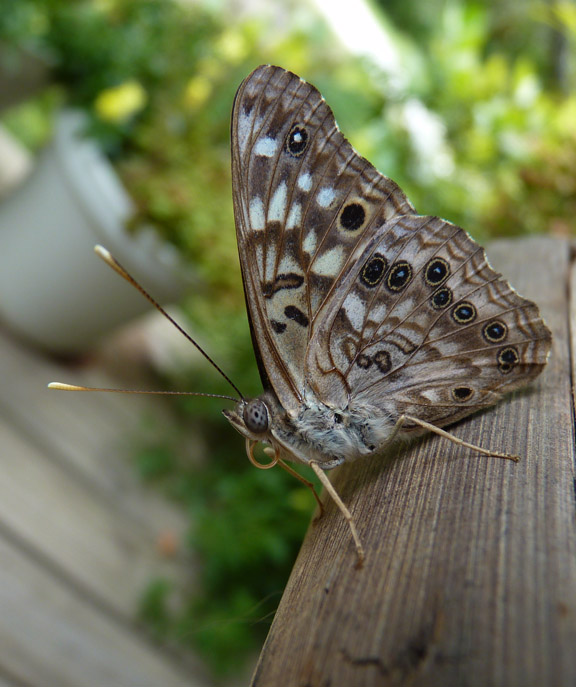
Hackberry EmperorMale Hackberry Emperor


A BUTTERFLY BONANZA!

Recently I returned from a trip to southwestern Ohio to visit my sister-in-law Amy, who is recovering from hip replacement surgery. She is mending beautifully and determined to get back on her feet —only a few days after returning home from the hospital the visiting nurse said she was doing as well as their typical patient at three weeks out!

While Amy was resting I would grab my camera and head into her garden and the surrounding fields because here was a Butterfly and Hummingbird Bonanza! I encountered dozens of Ruby-throated Hummingbirds, typically feeding and frolicking in groups of threes and fours, and many differing species of butterflies. For the most part, the butterflies that I photographed are the same species of butterflies that are found on Cape Ann and throughout New England. Having no expectation of encountering myriad butterflies, in both range of species and in legions of each, I had not planned accordingly and only packed my Panasonic Lumix. I love this camera, but like all cameras it does have certain limitations. Lesson learned—that is to say—always travel prepared for anything to happen!

Spicebush Swallowtail at Rose of SharonMale Spicebush Swallowtail Dusted with Pollen

Amy is a working architect and, as time and her work schedule have permitted, she has (along with her recently deceased dear husband Tim) redesigned and restored her lovely old farmhouse and gardens. There are several cozy porches and a deck under construction in which to sit and observe the wildlife dramas that play out almost daily.

Ohio Farmhouse

What makes Amy’s garden so inviting to the pollinators? The old farmhouse is approached by traveling down a crushed limestone driveway. On either side of the drive are fields, either overgrown with wildflowers, or maintained as mowed grass. The fields meet the forest edge. There are several neighboring houses along the drive but privacy is afforded because the houses are sited a fair distance apart and because there are naturalized arrangements of native trees and shrubs. Flower borders are planted in close proximity to her home and also further afield. Beyond the flower borders is a large vegetable garden, approximately twenty feet deep by sixty feet long, with a row of sunflowers bordering the back length and a cheerful patch of zinnias running along the fore edge. Beyond the vegetable garden is a vigorous crop of blackberries and beyond that is a clump of wildflowers, including common milkweed (Asclepias syriaca), which were covered in Monarch caterpillars, and the tall growing New York Ironweed (Veronia noveboracensis), which was in full bloom. All of these elements provide clues as to why Amy’s garden is a haven for the butterflies and hummingbirds. Additionally, adjacent to the house is an old peach tree, which bears great quantities of fruit. Because Amy has been under the weather from her hip injury she was not able to maintain the peach tree this past season. The peaches were falling to the ground and rotting—not really a bad thing as you will soon see—imagine the not intolerable odor of vinegary peach juice.

Yellow Sulphur Butterfly Zinnia elegansYellow Sulphur

The combination of the atypically lengthy stretch of hot, sultry weather, punctuated by soaking rain storms, along with the salt and mineral-rich limestone driveway, flowering plants, wildflowers, surrounding woodlands that provide shelter and larval food for caterpillars, hummingbird feeders, and rotting peaches—all work in tandem to create a paradise for the pollinators—bees, butterflies, and hummingbirds.

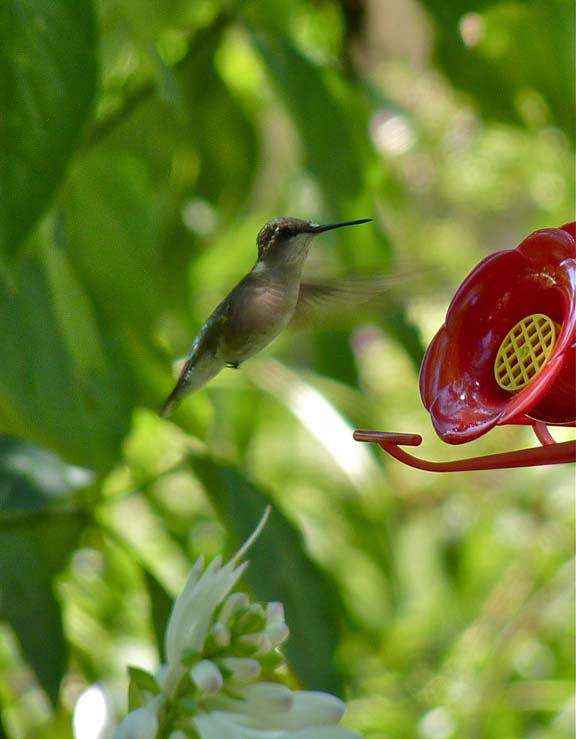
Female Ruby-throated HummingbirdFemale Ruby-throated Hummingbird

In the morning I would find Buckeyes, Question Marks, and Red-spotted Purples drinking salts and minerals from moist patches in the driveway. Hungry families of Ruby-throated Hummingbirds were noisily nectaring from the flowers and feeders; one feeder is sited beneath the peach tree and the other about twenty feet away, under the lilacs, a hummingbird superhighway of sorts, with inviting nectar flowers along the route. The male and female hummingbirds are both territorial and, when encountering anything out of the ordinary (my camera and I, for example) will threaten by whizzing  and whirling, albeit harmlessly, close to your head.

Common Buckeye ButterflyCommon Buckeye

By mid-day the hummingbird and butterfly scene was full underway. Spicebush Swallowtails at the Rose-of-Sharon, tiger swallowtails, yellow sulphurs, Eastern Tailed-Blues, Monarchs, checkerspots, and angelwings nectaring at the zinnia patch, phlox, and lobelia, and most remarkable of all, were the number of butterflies that were drawn to the pungent lure of rotting peaches. By late afternoon dozens of Hackberry Emperors, Red-spotted Purples, Question Marks, and Red Admirals were to be found intently imbibing from the fermenting peaches, and by day’s end, I believe they were drunken butterflies, making extraordinarily easy subjects to photograph. I would be down on my hands and knees with the lens held so closely it was nearly touching them, and several times that did happen as they fluttered or hopped onto the camera’s lens. In the lingering remnants of late day’s light, the hummingbirds were there again at the feeders and flowers, and all manner of swallowtails in the wildflower meadow were nectaring from the New York Ironweed.

Spicebush Swallowtail at Rose of SharonSpicebush Swallowtail Nectaring at Rose of Sharon


Pipevine Swallowtail Butterfly Pipevine Swallowtail Nectaring at Phlox

Red-spotted Purple ButterflyRed-spotted Purple

The three different species of butterflies in the above group of photographs have a unique relationship. The Red-spotted Purple and Spicebush Swallowtail (both palatable to predatory birds) are thought to have evolved to mimic the Pipevine Swallowtail (center photograph), which is highly toxic and foul tasting.

I was sad to say goodbye to my sister-in-law but glad to return home to my family. My unexpected yet welcome encounter with the butterflies of Southwest Ohio reminded me once again that butterflies are a symbol of transformation, joy, and beauty throughout cultures the world over. Perhaps Amy’s butterflies mirror the transformative journey to which she has embarked.

Eastern Tailed-Blue ButterfliesEastern Tailed-Blues

Red Admiral ButterflyRed Admiral Mimicking Peach Tree Bark

Milkweed and IronweedIronweed and Milkweed

 Tiger Swallowtail at IronweedTiger Swallowtail Nectaring at Ironweed

Cicada lying in waitMale Cicada Disguised Amongst Rose of Sharon Buds

Ohio Vegetable gardenVegetable Garden

Farmhouse road