Dear Gardening Friends,
Category Archives: Antennae for Design
Chrysanthemum ‘Emperor of China’ and Korean Daisies
Exquisite Flora in Autumn
Green leaves ignite, transformed by a kaleidoscope of incinerating colors—devil-red, burnt tangerine, caramelized amber, searing saffron, and smoldering crimson-purple. The air is impregnated with the aromatic perfume of orchard fruits ripening in the fleeting flush of the sun’s warm light. Hazy, slanting rays gild the late season glory in the garden. Surrounded by flowers of dissipating beauty and juxtaposed against the dazzling brilliance of autumn foliage, we are urged to spend every possible moment savoring our gardens before the onset of winter.
American Lady Nectaring at Korean Daisy
Blossoms thrown in autumn, as opposed to those of spring and summer, are perhaps the most keenly appreciated. Our rambling ‘Aloha’ rose embowering the front entryway abounds in blooms in June, flowering again and again throughout the summer. With a twinge of melancholy, I cherish most Aloha’s lingering remontant rose—inhaling deeply the sensuous fragrance when approaching or upon leaving our home, knowing all will be dormant in only a few short weeks. Manifold members of the composite family hold their flowers well into fall. Forming a substantial clump (four feet wide and equally as tall) is a passalong from a generous friend. From a few cuttings of this heirloom chrysanthemum (Chrysanthemum ‘Single Apricot Korean’), with apricot pink-tinted, daisy-like single flowers, we now have a patch of our own to share with friends. Arrayed with a single row of ray flowers encircling the nectar-rich cadmium yellow disk florets, the Korean daisy is host to sundry late on-the-wing pollinators, including butterflies, bees, and beetles. The form is loose and lovely; opposite in appearance to that of the ubiquitous blobs of mums commonly seen in autumn.
Chrysanthemum ‘Emperor of China’ begins its lovely tableau in mid-fall and continues to bloom through the first hard frost. Plum rose with silvery highlights, the quills shade paler toward the outer margins. When the plant is in full bloom, the rich green foliage shifts colors to vibrant hues of bronze and scarlet red. The ‘Emperor of China’ exudes a delicious lemon-spice fragrance noticeable from some distance.
As with asters, it is helpful to pinch the tips of each shoot to encourage branching and more blossoms. Repeat this process at each four- to six- inch stage of new growth until the middle of July, or when the buds begin to develop. ‘Emperor of China’ is hardy through zone six and thrives in full sun to light shade in well-drained soil. This cultivar forms a 2 and 1/2′ mound in only a few years. Give the plant a top dressing of compost and mulch after the first hard frost.
An ancient variety of chrysanthemum originating from China, the ‘Emperor of China’ resembles and is thought to be the chrysanthemum depicted in early Chinese paintings. Chrysanthemums are also grown for their medicinal properties, and their purported magic juices were an important ingredient in the life-prolonging elixir of the Daoist. Fragrant chrysanthemum tea was considered good for the health, and tonic wine was brewed from an infusion of their petals.
Chrysanthemum Tea
Chrysanthemum tea is a tisane made from dried chrysanthemum flowers. The flowers are steeped in boiling water for several minutes, and rock sugar or honey is often added to heighten the sweet aroma. Popular throughout East Asia, chrysanthemum tea is usually served with a meal. In the tradition of Chinese medicine, the tisane is a “cooling” herb and is recommended for a variety of ailments including influenza, circulatory disorders, sore throats, and fever.
Chrysanthemum ‘Emperor of China’
Although thought to be rich in healing properties and lovely in form, a more modest well-being was conferred by the vigorous blossoming of the chrysanthemum. Perhaps the late flowering chrysanthemum suggests their connection to a long life, for other plants have finished flowering just as the chrysanthemums begin.
The techniques for learning to paint the orchid, bamboo, plum blossom, and chrysanthemum comprise the basis of Chinese flower and bird painting. They are referred to as “The Four Gentlemen” and are thought to symbolize great intellectual ideas. The orchid is serene and peaceful, though sophisticated and reserved from the world. Bamboo is vigorous and survives throughout the seasons, forever growing upright. The plum blossom expresses yin-yang dualities of delicate and hardy, blooming through snow and ice to herald the arrival of spring. Chrysanthemums continue to flower after a frost, are self-sufficient, and require no assistance in propagating themselves.
China owes its astonishing wealth of plant life to a combination of geographical incidents. The mountains escaped the ravages of the great ice caps and unlike much of Europe and North America, where many plants were wiped out, plant species in China continued to evolve. Additionally, the foothills of the Himalayas are moistened by soft winds from the south, creating an ideal climate for alpine plants. In this warm and moderate environment three different floras– that of the colder, drier north; that of the sub-tropical south; and that of the alpine species—all mingled and crossed freely for thousands of years.
Ernest Wilson, one of the world’s greatest plant hunters, was not the first collector to explore this botanical paradise, but his determined efforts to push through to remote areas led him to the “richest temperate flora of the world.” From 1899 to 1911, Ernest “Chinese” Wilson sent the seeds of more than 1,500 different plants to the United States and England. Altogether his collection numbered 65,000 plants, representing about 5,000 species, all gathered from the wild. Through his exploration, and the work of the nurseries for which he collected, more than a thousand plants were established for Western cultivation. Despite the wealth of flora collected by Ernest Wilson and his fellow plant hunters, Chinese gardens remained wholly unaffected. Although shiploads of plants were sent to London, St. Petersburg, Paris, and Cambridge, Massachusetts, Chinese horticulturists continued to develop plants their ancestors had loved and that had long since been domesticated. The tradition of conferring qualities of morality to plants and plants’ allegorical to intellectual ideas made the newly collected wild plants unsuitable for the Chinese garden.
The love of flowers was and continues to be a passion among the Chinese. Trees and plants are genuinely loved as living creatures.
Enjoying flowers with tea is the best, enjoying them with conversation the second and enjoying them with wine the least. Feasts and all sorts of vulgar language are most deeply detested and resented by the spirit of the flowers. It is better to keep the mouth shut and sit still than to offend the flowers. —from a Ming Dynasty treatise on flowers Walters Art Museum
The idea that flowers can be offended by bad manners reflects the belief that the world we inhabit is an organism in which all phenomena interrelate. By the same reasoning, someone who drinks tea from a peach-shaped pot will live longer (peaches symbolize longevity), and someone who dips his writing brush in a peony-shaped bowl will have good fortune, as the peony is a metaphor for success and wealth.
Several passages from above were excerpted from Oh Garden of Fresh Possibilities! (David R. Godine, Publisher).
Romantic Gardens: Nature, Art, and Landscape Design
“…There is a secret charm which binds us to these haunts of the water spirits. The spot is filled with the music of the falling water. Its echoes pervade the air, and beget a kind of dreamy revery…” —Andrew Jackson Downing
Book Review: Romantic Gardens: Nature, Art, and Landscape Design
I was more than delighted to receive a copy of the exquisite book Romantic Gardens: Nature, Art, and Landscape Design from Sue Ramin, the publicist at my publisher, David R. Godine. Richly illuminated with drawings, watercolors, and engravings, Godine has joined with the Morgan Library and Museum and the Foundation for Landscape Studies to produce this sweeping and superbly researched survey of the development of the Romantic movement in landscape design in Europe and America. This beautiful and beautifully written scholarly, yet accessible, book will become a highly valued resource for landscape designers, architects, landscape architects, historians and students of the Romantic movement. And, as do all Godine books, Romantic Gardens makes for a treasured and thoughtful gift. The book was written to accompany the exhibition Romantic Gardens: Nature, Art, and Landscape Design held at the Morgan Library and Museum during the summer of 2010. The authors Elizabeth Barlow Rogers, Elizabeth Eustis, and John Bidwell co-curated the exhibit.
Drawn from the Morgan’s holdings of manuscripts, drawings, and rare books, from the collections of the authors Rogers and Eustis, and from collections across the nation, Romantic Gardens: Nature, Art, and Landscape Design features approximately one hundred and fifty texts, outstanding works of art, plan drawings, and photographs providing an overview of ideas championed by the Romantics and also actualized by them in private estates and public parks in Europe and the United States. Notable are the plan drawing and early photographs of Olmstead and Vaux’s winning Entry No. 33 of Central Park, a J.W. Winder photograph of Adolphe Strauch’s Spring Grove Cemetery, located in Cincinnati, Ohio, and several Frederic Edwin Church landscape vistas in oil, including a view of Olana, Church’s estate overlooking the Hudson River. Elizabeth Eustis writes about Church’s Eden, “…Olana was truly envisioned by Church. Three decades of his devotion resulted in an environmental version of the Romantic Gesamtkunstwerk, integrating architecture, decoration, and landscape to fully engage the senses, emotion, and spirit. Church opened the view, set the house in an expansive lawn, and laid out more than five miles of drives curving through the estate.” By 1860 Church had become the most famous painter in America and with his Olana he could …“make more and better landscapes in this way than by tampering with canvas and paint in the studio.” Eustis writes, “He resisted the gaudy flower beds and subtropical foliage plantings that by this time had come to rival the divinized nature garden aesthetic and instead planted thousands of trees.”
So that you may share a bit more in the experience of the exquisite writing found in Romantic Gardens, the following is a brief excerpt from the conclusion of Roger’s erudite introductory essay “The Genius of the Place” The Romantic Landscape, 1700-1900.
“The fact that space and time are unbounded and infinite is still difficult for the human mind to comprehend. Romanticism can therefore be seen as the search for the divine in the boundlessness of the firmament and belief in nature as eternal and God-ordained, a bulwark against despair over the darkness-bracketed transience of life.
“…. In Romantic painting the landscape itself became the subject, not merely the background or the setting. The works of Turner, Friedrich, and Church bespeak the sublimity of sky and distant horizon. By such means Romantic art elevates the mind and heart to something approaching joy, peace, and an intuitive appreciation of the divine in the face of the unfathomable immensity and mystery of the universe.
“Nature as both place and space is the medium and the compass in Romantic landscape design. Revealing the “genius of the place” accords nature particularity and personality. The eighteenth-century Romantic designers did not treat space as a tabula rasa, a neutral ground plane on which to plant vegetation in geometric shapes and alignments, as was the case in the seventeenth century. Because of its more practical objectives and domestic sphere of activity, landscape design, unlike painting and poetry, cannot incorporate rugged peaks, vertiginous deeps, or crashing waterfalls—hallmarks of the Sublime. Nevertheless, landscape design is Romantic in its mood-evoking treatment of space, allying itself with nature, obscuring boundaries, and reaching for what lies beyond. We can therefore appreciate Central Park’s seemingly unbounded acres of green spaciousness not only as playing fields, but also as Olmstead intended, an illusion of unrestricted nature fostering a relaxed dreaminess and democratic sociability.”
Elizabeth Barlow Rogers is a scholar, educator, author, and was the founding president of the Central Park Conservatory. She is currently the president of the Foundation for Landscape Studies, which publishes the journal Site/Lines. Elizabeth Eustis is an author, adjunct curator at the New York Botanical Garden library, and teaches at the Landscape Institute at the Boston Architectural College. John Bidwell is Astor Curator and department head of Printed Books and Bindings at the Morgan Library.
A note about Andrew Jackson Downing (see above): Considered the first Romantic hero of American horticulture, Downing was a nurseryman and horticulturist from Newburgh, New York. As editor of The Horticulturist, he became the leading advocate for home gardening, village improvement societies, agricultural education, public parks (including a central park in New York City and a national park in Washington, D.C.). In the above quote from Romantic Gardens (page 157), Downing is describing the Ravine Walk at Blithewood in the The Horticulturist (1847), with illustrations by Alexander Jackson Davis.
Romantic Gardens, Nature, Art, and Landscape Design
Elizabeth Barlow Rogers, Elizabeth Eustis, John Bidwell
David R. Godine, Publisher
ISBN: 978 1 56792 404 6
Available through your local bookseller, David R. Godine, and Amazon.
Gesamtkunstwerk
Definition of Gesamtkunstwerk from wiki: (translated as total work of art, ideal work of art, universal artwork, synthesis of the arts, comprehensive artwork, all-embracing art form, or total artwork) is a work of art that makes use of all or many art forms or strives to do so. The term is a German word, which has come to be accepted in English.The term was first used by the writer and philosopher K.F.E. Trahndorff in an essay in 1827. The German opera compose Richard Wagnerr used the term in an 1849 essay. It is unclear whether Wagner knew of Trahndorff’s essay. The word has become particularly associated with Wagner’s aesthetic ideals.
Definition of Gesamtkunstwerk from Artnet: [Ger.: complete, unified or total work of art].Term first used by Richard Wagner in Das Kunstwerk der Zukunft (1849) to describe his concept of a work of art for the stage, based on the ideal of ancient Greek tragedy, to which all the individual arts would contribute under the direction of a single creative mind in order to express one overriding idea. However, the term is applied retrospectively to projects in which several art forms are combined to achieve a unified effect, for example Roman fora, Gothic cathedrals and some Baroque churches and palazzi.
Monarch Butterfly Migration
Update: Monarch Butterfly Migration Late Summer 2010
Magical Seaside Goldenrod Meadow
Dear Gardening Friends,
So many have telephoned or emailed inquiring about the status of the annual Monarch butterfly migration through our region. This past summer I have observed umpteen Monarch butterflies and caterpillars in cultivated gardens, wildflower meadows, and along the shoreline; however, I did not see the great numbers in great heaps roosting in any one particular place that I have in some years past. Rather I would find a small passel here and a small passel there—perhaps several dozen at a time—roosting in the wild black cherry trees (Prunus serotina) at Eastern Point, awakening in the early morning and nectaring at the Seaside Goldenrod in the meadow below.
Monarchs Mimic Withering Foliage of Black Cherry Tree
Although the Monarchs are guided genetically, using their internal sun-compass navigation and circadian clock, each year the annual southward migration takes a different form that depends on many variables, primarily the weather conditions in their overwintering site in Michoacán, Mexico as well as weather patterns in their US and Canadian breeding grounds. Because Cape Ann is located at approximately 43 degrees latitude north, our peak migration pattern is estimated at around September 11, but I modify this pattern because of the strong winds and storms we often experience in the late summer living along the coastline.
I have read reports of fantastic migrations that are taking place this year, from Long Island, south to Cape May, and west to Virginia—some saying it is the best they have seen in decades! I continue to remain on the look out because the air temperatures were atypically warmer this summer, creating a longer breeding season than usual, which would indicate that there may be newly emerging Monarchs on the scene. While photographing during this year’s migration, I encountered a pair of Monarchs mating, a very unusual occurrence at this time of year. The “Methuselah” Monarchs that we see in late summer and early autumn are generally speaking sexually immature and do not mate until next year, after they journey south and after they overwinter and awaken in Mexico.
Monarchs Mating Amidst the Goldenrod
Monarchs observed in late summer and early autumn are intent on nectaring and not easily distracted. This later generation of Methuselah Monarchs is feeding aggressively to increase and store their lipid reserves for the long journey south. We provide plenty of nectar-rich blossoms to help the Monarchs in their exhaustive migration, taking cues from marsh and meadow. Blooming freely at this time of year are copious members of the Composite family—goldenrods, asters, pearly everlasting, zinnias, ironweed, Mexican sunflowers, and Korean daisies. If one diligently deadheads the butterfly bushes and Verbena bonariences, they too will be available for the migrating Monarchs.
My favorite goldenrod is Seaside Goldenrod (Solidago sempervirens), which blooms from August to November. Seaside Goldenrod is the gorgeous brilliant golden wildflower we see growing and glowing along the edge of the sea. It is easily differentiated from other New England goldenrods in that the flowerheads are comparatively larger and the leaves are thicker and fleshier, with a waxy feel, an adaptation to the drying effect of salty sea spray. Seaside Goldenrod grows prolifically in rich, moisture retentive soil, less so in drier conditions.
Although I strongly discourage digging plants from local marsh and meadow, perfectly acceptable is the practice of collecting ripened seed stalks and shaking them about. That is just how we obtained our Smooth Asters (Aster laevis). With cheery one-inch button-shaped flowers borne along the lengths of the stalks, the pale-hued lavender-blue ray flowers and yellow disk florets of Smooth Asters are attractive to bees and butterflies. We have observed Common Sulphers, Pink-fringed Sulphurs, Monarchs, American Ladies, Red Admirals, and Cabbage Whites nectaring simultaneously on a clump growing in the sheltered border along our fragrant path. Pinch back the developing growth tips during the early part of the growing season (until roughly July fourth) to encourage a bushier and more compact plant. Asters provides nourishing sustenance for transitory butterflies when many nectar-rich plants have finished blooming for the season. Not particularly fussy in regard to soil conditions, Smooth Aster grows and flowers profusely in full sun to light shade. Smooth Aster and Purple-stemmed Aster (Aster puniceus) are the asters we see blooming along the backshore at this time of year. With golden yellow florets at the center of their ray flowers, asters and goldenrods create a convenient landing pad for nectaring Lepidoptera. Flowering alongside ripening red berries and surrounded by changing autumnal leaf color, goldenrods and asters transform the seasonal tapestry.
While photographing the Monarchs, I couldn’t help but notice two noisy Mockingbird fledglings, who were going at each other for over a half hour.
North American Butterfly Association
The most recent issue of Butterfly Gardener magazine features my photo on the back cover of an American Lady (Vanessa virginiensis) butterfly nectaring at Korean daisies. The North American Butterfly Association, or NABA as it is more commonly known, is a worthy organization to support. As a member of NABA four times a year you will receive two magazine subscriptions. I eagerly anticipate the arrival of both magazines. American Butterflies is edited by the world renowned lepidopterist Jeffrey Glassberg and is brimming with stories and species accounts of butterflies found throughout America. Butterfly Gardener, is chock-full of useful information about gardening for butterflies. I enjoy editor Karen Hillson’s missives and asides and find especially useful Lenora Larson’s quarterly column on caterpillar food plants.
Mr.Glassberg writes in a recent issue of American Butterflies about why he believes butterflies are an ideal portal to the natural world “…once one becomes interested in butterflies, one almost certainly becomes interested in plants, in other components of nature–in the whole web of life. To find adult butterflies one must soon learn the important nectar plants in one’s area and especially the caterpillar foodplants. And the captivating transfomation of caterpillars into adult butterflies brings a very high percentage of butterfliers to a deeper appreciation of life histories and the larger ecological picture.” To learn more about NABA and how to become a member visit their website at www.naba.org (membership fees are very reasonable).
American Lady Butterfly (Vanessa virginiensis) Nectaring at Korean Daisy
Welcome Oh Great Spangled Fritillary!
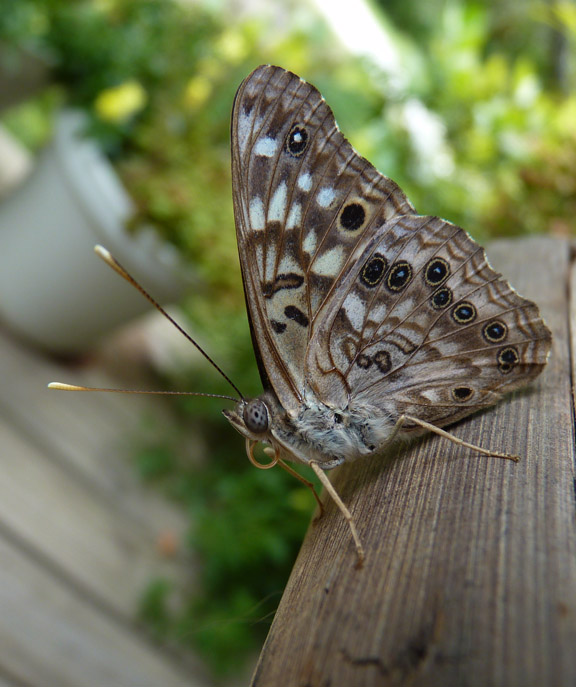
Singularly beautiful—large and rounded with tawny orange wings checkered with black dots and dashes—when observed from above. When wings are folded, this fritillary shows a striking underwing pattern of spangled spots, bordered by a wide yellow band and outlined in iridescent crescents. Perhaps the Great Spangled Fritillary has graced your garden. I had never encountered this creature of extraordinary beauty until the summer after we planted violets dug from a wildly unkempt cemetery. They were native common violets (Viola sororia). I don’t recommend the common violet for a small garden, unless you desire a garden composed entirely of common violets. Please don’t misunderstand; I do not regret planting V. sororia because otherwise I may never have encountered the Great Spangled Fritillary (Speyeria cybele). No, I am glad to have welcomed this beauty to our garden. There are, however, far better behaved violets that are of equal importance to the fritillary caterpillars and they would be a far better choice for the garden. Both native wildflowers Labrador violet (Viola labradorica) and Canada violet (Viola canadensis) naturalize readily, making rulier groundcovers than common violets, and are lovely when in bloom and when not in flower.
O wind, where have you been,
That you blow so sweet?
Among the violets
Which blossom at your feet.
The honeysuckle waits
For Summer and for heat
But violets in the chilly Spring
Make the turf so sweet.
—Christina Rossetti (1830—1894)
The Great Spangled Fritillary is found throughout New England and its range extends from southern British Columbia and central Alberta, east across southern Canada and the central US to the Atlantic seaboard. It is one of three Greater Fritillaries found in our region, along with the Aphrodite and Atlantis Fritillaries. The wingspan of the Great Spangled Fritillary measures approximately three inches, compared to that of several of the smaller fritillaries found in our area, the Silver-bordered Fritillary and Meadow Fritillary, which measure about half as much. Its habitat is woodland openings, meadows, prairies, and other open habitats where violets and nectar plants such as common milkweed (Asclepias syriaca), spotted Joe-pye weed, and ox-eye daisy are found.
Kingdom: Anilmalia (Animal)
Phylum: Arthropoda (Arthropods)
Class: Insecta (Insects)
Order: Lepidoptera (Butterflies, skippers, and moths)
Superfamily: Papilionoidea (Butterflies, excluding skippers)
Family: Nymphalidae (Brush-footed butterflies)
Subfamily: Heliconians
Genus: Speyeria
Species: cybele
Ancient cultures valued violets for their medicinal and aromatic properties. In art and literature they symbolize a widely varying range of human experiences from new life in spring to death and dying, young love, and frailty. The genus Viola comprises some 400 to 500 species, distributed around the world. Viola, often called pansies, violets, and heartsease, have been traditionally used to create perfumes, dyes, insecticides, soaps, expectorants, and analgesics for labor pain. The flowers and leaves of the violet plant make a delicious and nutritious addition to a garden salad; the leaves are rich in a variety of powerful chemicals including flavenoids, saponins, and glycosides.
The Greater Fritillaries have a unique and highly evolved association with violet plants. In late summer or early fall, the female oviposits eggs close to the ground on twigs or foliage near to, not necessarily on, a clump of violet plants. Newly emerged caterpillars crawl to the nearby hostplant. Rather than feed on the foliage, they nestle into the leaf litter at the base of the plant and enter diapause. For northern butterflies this behavior is thought to be an adaptation to cold weather since undigested food particles in the gut of a diapausing caterpillar would form ice crystals, thereby killing the larvae (Cech and Tudor). Diapause in insects is a physiological state of dormancy in response to predictable periods of adverse environmental conditions—winter in the case of the Greater Fritillaries.
In early spring, the awakening caterpillars, which are black with black protruding spines dotted red at the base, feed on freshly emerging violet shoots. The caterpillars pupate, and after metamorphosis, in late spring or early summer, the male Greater Fritillary butterflies begin to emerge, well before the females. Active courtship ensues once the females emerge. The females typically mate once, after which the males die off. The females live on during the summer in a temporary state of reproductive diapause, until ovipositing eggs in the late summer or early fall. Typically the Great Spangled Fritillaries that we encounter at this time of year are the females.
While photographing Great Spangled Fritillaries at high noon I noticed that the iridescence was quite apparent, although only showing for a fraction of a second. The photo below illustrates clearly the structural iridescent scales (or “spangles”). What the photo does not show is that the large whitish-looking spots also have iridescent hues of pearly pinkish-bluish-greenish.
Iridescence in Butterfly Wings
Butterflies, moths, and skippers are members of the insect order Lepidoptera; the name is derived from Greek lepidos for “scales” and ptera for “wings.” Their scaled wings distinguish them as a group from all other insects. Unrivalled in the living world, their wings are adorned with myriad patterns and solid colors in the full spectrum of the rainbow, as well as pure iridescent hues of blue, green, and violet.
The foundation of the Lepidoptera wing consists of a colorless, translucent membrane supported by a framework of tubular veins, radiating from the base of the wing to the outer margin. They are covered with thousands of overlapping scales, arranged very much like overlapping shingles on a roof. Like miniature canoe paddles, the scales are attached to the wings by their “handles.” So small that they feel like and are a similar size to the silky granules of face powder, their purpose is multi-fold. Scales protect and act as an aid to the aerodynamics of the entire wing structure, help regulate Lepidoptera temperature, and are the cells from which color and patterns originate. This color and patterning are used for sexual signaling and as a means of eluding birds and other would-be predators.
There are two fundamental mechanisms by which color is produced on the wings of Lepidoptera. Ordinary color is due to organic pigments present that absorb certain wavelengths and reflect others. Extraordinary iridescence on butterfly wings is caused by the interference of light waves due to multiple reflections within the physical structure of the individual scales. Iridescent scales are composed of many microscopic thin layers; each scale has its own color, from pigment present and from the diffraction of light on the surface (the surface of iridescent scales are intricately corrugated and grooved). The iridescent effect is created much like a prism and is called structural coloration. When viewed under a microscope, the iridescent scales of some species of butterflies have a similar appearance to that of the tiered layers of a pine tree. Sometimes structural color and pigmented color occur simultaneously and a secondary color is created in the usual way color is added. For example, when blue iridescent color is produced from the structure of a scale that also contains yellow pigment, the resulting color is iridescent green.
When Lepidoptera with iridescent scales fly, the surface of their wings continually change from brilliant hues to the underlying relatively duller scales of the wings, as the angle of light striking the wing changes. The ability of the Lepidoptera to rapidly change colors and patterns is one of their defense mechanisms against predators. Along with their undulating pattern of flight and the figure-eight movement of their wings, the effect is of ethereal flashes of light disappearing and reappearing.
Excerpt from Oh Garden of Fresh Possibilities! Chapter 15 ~ Flowers of the Air, pages 130-131.
Butterflies of Ohio
A BUTTERFLY BONANZA!
Recently I returned from a trip to southwestern Ohio to visit my sister-in-law Amy, who is recovering from hip replacement surgery. She is mending beautifully and determined to get back on her feet —only a few days after returning home from the hospital the visiting nurse said she was doing as well as their typical patient at three weeks out!
While Amy was resting I would grab my camera and head into her garden and the surrounding fields because here was a Butterfly and Hummingbird Bonanza! I encountered dozens of Ruby-throated Hummingbirds, typically feeding and frolicking in groups of threes and fours, and many differing species of butterflies. For the most part, the butterflies that I photographed are the same species of butterflies that are found on Cape Ann and throughout New England. Having no expectation of encountering myriad butterflies, in both range of species and in legions of each, I had not planned accordingly and only packed my Panasonic Lumix. I love this camera, but like all cameras it does have certain limitations. Lesson learned—that is to say—always travel prepared for anything to happen!
Male Spicebush Swallowtail Dusted with Pollen
Amy is a working architect and, as time and her work schedule have permitted, she has (along with her recently deceased dear husband Tim) redesigned and restored her lovely old farmhouse and gardens. There are several cozy porches and a deck under construction in which to sit and observe the wildlife dramas that play out almost daily.
What makes Amy’s garden so inviting to the pollinators? The old farmhouse is approached by traveling down a crushed limestone driveway. On either side of the drive are fields, either overgrown with wildflowers, or maintained as mowed grass. The fields meet the forest edge. There are several neighboring houses along the drive but privacy is afforded because the houses are sited a fair distance apart and because there are naturalized arrangements of native trees and shrubs. Flower borders are planted in close proximity to her home and also further afield. Beyond the flower borders is a large vegetable garden, approximately twenty feet deep by sixty feet long, with a row of sunflowers bordering the back length and a cheerful patch of zinnias running along the fore edge. Beyond the vegetable garden is a vigorous crop of blackberries and beyond that is a clump of wildflowers, including common milkweed (Asclepias syriaca), which were covered in Monarch caterpillars, and the tall growing New York Ironweed (Veronia noveboracensis), which was in full bloom. All of these elements provide clues as to why Amy’s garden is a haven for the butterflies and hummingbirds. Additionally, adjacent to the house is an old peach tree, which bears great quantities of fruit. Because Amy has been under the weather from her hip injury she was not able to maintain the peach tree this past season. The peaches were falling to the ground and rotting—not really a bad thing as you will soon see—imagine the not intolerable odor of vinegary peach juice.
The combination of the atypically lengthy stretch of hot, sultry weather, punctuated by soaking rain storms, along with the salt and mineral-rich limestone driveway, flowering plants, wildflowers, surrounding woodlands that provide shelter and larval food for caterpillars, hummingbird feeders, and rotting peaches—all work in tandem to create a paradise for the pollinators—bees, butterflies, and hummingbirds.
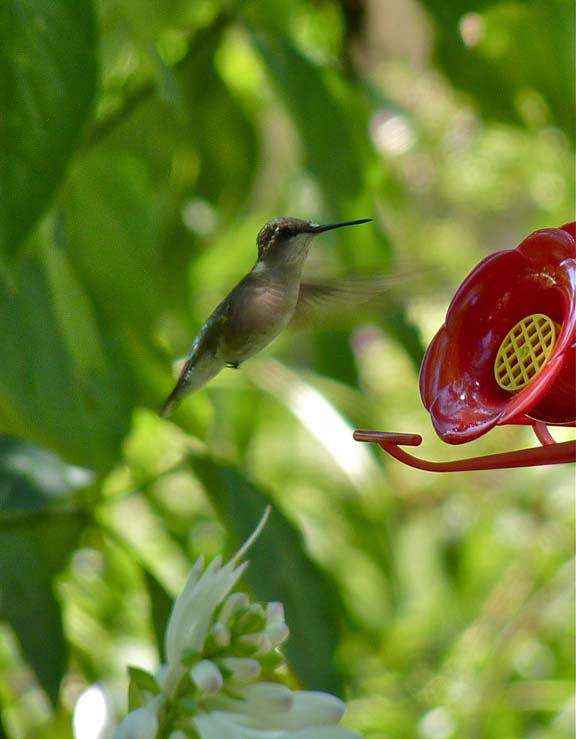
Female Ruby-throated Hummingbird
In the morning I would find Buckeyes, Question Marks, and Red-spotted Purples drinking salts and minerals from moist patches in the driveway. Hungry families of Ruby-throated Hummingbirds were noisily nectaring from the flowers and feeders; one feeder is sited beneath the peach tree and the other about twenty feet away, under the lilacs, a hummingbird superhighway of sorts, with inviting nectar flowers along the route. The male and female hummingbirds are both territorial and, when encountering anything out of the ordinary (my camera and I, for example) will threaten by whizzing and whirling, albeit harmlessly, close to your head.
By mid-day the hummingbird and butterfly scene was full underway. Spicebush Swallowtails at the Rose-of-Sharon, tiger swallowtails, yellow sulphurs, Eastern Tailed-Blues, Monarchs, checkerspots, and angelwings nectaring at the zinnia patch, phlox, and lobelia, and most remarkable of all, were the number of butterflies that were drawn to the pungent lure of rotting peaches. By late afternoon dozens of Hackberry Emperors, Red-spotted Purples, Question Marks, and Red Admirals were to be found intently imbibing from the fermenting peaches, and by day’s end, I believe they were drunken butterflies, making extraordinarily easy subjects to photograph. I would be down on my hands and knees with the lens held so closely it was nearly touching them, and several times that did happen as they fluttered or hopped onto the camera’s lens. In the lingering remnants of late day’s light, the hummingbirds were there again at the feeders and flowers, and all manner of swallowtails in the wildflower meadow were nectaring from the New York Ironweed.
Spicebush Swallowtail Nectaring at Rose of Sharon
Pipevine Swallowtail Nectaring at Phlox
The three different species of butterflies in the above group of photographs have a unique relationship. The Red-spotted Purple and Spicebush Swallowtail (both palatable to predatory birds) are thought to have evolved to mimic the Pipevine Swallowtail (center photograph), which is highly toxic and foul tasting.
I was sad to say goodbye to my sister-in-law but glad to return home to my family. My unexpected yet welcome encounter with the butterflies of Southwest Ohio reminded me once again that butterflies are a symbol of transformation, joy, and beauty throughout cultures the world over. Perhaps Amy’s butterflies mirror the transformative journey to which she has embarked.
Red Admiral Mimicking Peach Tree Bark
Tiger Swallowtail Nectaring at Ironweed
Male Cicada Disguised Amongst Rose of Sharon Buds
A Tale of Two Tigers
Dear Gardening Friends,
I have received many emails in the past several weeks from people wondering what is the large, yellow butterfly that they are seeing perusing their gardens and neighborhoods. I imagine they are observing a tiger swallowtail–either an Eastern Tiger Swallowtail or a Canadian Tiger Swallowtail. They may not recognize it as either species because tiger swallowtails are highly palatable. Their delicate tails, and then some, may have been sheered away by hungry birds snipping. The first two photos below show a newly emerged tiger swallowtail with tails intact and a swallowtail without tails.
I wrote the following column several winters ago after having recently read A Tale of Two Cities. If you can bear to read about winter storms during this delicious stretch of warm weather, you will find information that will be helpful in identifying whether visiting your garden is a Canadian Tiger or an Eastern Tiger Swallowtail. Additional identifying photos are at the end of the column.
A Tale of Two Tigers
Recalled to Life
As seed and plant catalogues pile ever higher in my ever-shrinking office, I am culling all for sources of delicious vegetables and herbs, native plants, fragrant cultivars, and plants that will expand the Lepidoptera and songbird habitat. With inviting descriptions accompanied by enticing photographs, it is difficult to exercise restraint. Absorbed in thoughts of new life in spring, I am reminded of an incident that occurred at about this same time last year.
My husband and I had returned home from a venture along the backshore to witness the waves cresting in the aftermath of a late-winter storm. With great gusts blowing up from the south, the storm was tropical in temperature, but not in degree of ferocity. Drenched to bare skin, we came in through the cellar to remove our soaked clothing, where, to our dismay, we encountered a newly emerged tiger swallowtail butterfly, unable to fly, with its wings dragging along the cold stone cellar floor. I carefully picked it up by holding the butterfly along the sturdy leading wing margin, and brought it into the warm kitchen. Its wings had not fully unfurled and the butterfly was in distress. We provided a twig for it to crawl upon, which would have allowed its wings to hang down, and then, perhaps, fully expand. That was unsuccessful and the butterfly preferred instead to simply rest in my hands. We offered it a Q-tip soaked in sugar water and I cupped my hands and held it there for a long time, hoping the warmth would recall it to life.
Within the brief moment of time a butterfly emerges, if just one of the steps in the complicated dance goes awry, the creature will likely fail. The crimpled, wet wings are tightly compacted within the chrysalis. The butterfly pushes head first through the pupa case and upon emerging, with its crochet hook-like feet (tarsi) grasps at nearby surfaces. Body fluids are drained from the swollen abdomen and pumped through tubular wing veins (called struts) to the very outer margins of the wings. The butterfly’s double drinking straw (proboscis) must zip together, or it will be unable to nectar. For several hours after eclosing, it remains in a stationary state, the most vulnerable of positions, to allow its wet wings to dry thoroughly. The mystery of how the tiger swallowtail came to be in our basement, and why it eclosed in early March, prompted me to learn more about this magnificent species of butterfly.
The Golden Thread
Tiger swallowtails are recognized by their four rows of tiger-like yellow and black stripes and thin black tails extending from each lower wing. Canadian Tiger swallowtails are found in all provinces and territories of Canada, northern New England, and eastern New York. Eastern Tiger Swallowtails are more common from southern New England and south to Florida. We are fortunate in Massachusetts to be located where overlapping of both species occurs. Canadian and Eastern Tiger Swallowtails are closely related and were not recognized as separate species until 1991. The clearest way to see the difference is to compare wingspan. The Canadian is smaller, with a wingspan of just under 3 inches; the wingspan of the average Eastern is 4.5 to almost 5 inches— the southern female ranks as the largest butterfly of the East Coast. Canadian Tiger Swallowtails are generally a paler yellow and the darker border next to the body is thicker. When the wings are folded, the yellow sub-marginal band on the fore wings is largely continuous, not interrupted by black wing veins. Tiger swallowtails are highly palatable and, as a defense against predators, have evolved with rapid wing movements and erratic flight patterns, which make these differences between the two species difficult to discern without side-by-side specimens or photos.
Kingdom: Animalia
Phylum: Arthropoda
Class: Insecta
Order: Lepidoptera
Family: Papilionidae
Genus: Papilio
Species: glaucus ~ Eastern Tiger Swallowtail
Species: canadensis ~ Canadian Tiger Swallowtail
The purpose of identifying the different species is relevant when planting to encourage tiger swallowtails caterpillars to colonize your garden. Host trees for Canadian Tiger Swallowtail caterpillars include native species of birch (Betula), black cherry (Prunus), and aspen (Populus). The Eastern Tiger Swallowtail caterpillars have adapted to a wide range of host trees from multiple families, especially wild cherries (Prunus sp., Prunus virginiana), tuliptree (Liriodendron tulipfera), ash (Fraxinus), and sweetbay magnolia (Magnolia virginiana) in the Deep South. Both species are generalist when nectaring. I most often observe tiger swallowtails nectaring at plants with clusters and panicles of small florets, for example, native buttonbush (Cephalanthus occidentalis), Joe-pye weed (Eupatorium purpureum), common milkweed (Asclepias syriaca), butterfly bush (Buddleia davidii), and Verbena bonariensis.
Adding to the challenge to accurately identify whether Canadian or Eastern, female Eastern Tiger Swallowtails may exhibit sexual dichromatism, a dark-phase that mimics the highly unpalatable and toxic blue/black coloration of the Pipevine Swallowtail. The yellow form of the females is more typically seen in our region and is similar to the males, except that the hindwings above the black margin are covered in beautiful blue iridescent scales. Iridescence in wing scales is an example of how Lepidoptera have evolved with structural color that is disorienting to predators. The flashes of light created by the iridescent scales, combined with undulating wing beats caught in sunlight, causes hungry birds to be confused. The characteristic “tails” that lend swallowtails their common name are significant aerodynamically. Airflow is directed over the wings, enabling extended glides at higher angles, whereas Lepidoptera with more broadly cut wings would normally stall.
We look for tiger swallowtails eggs on the topside of host tree leaves. The spherical, green, pinhead-sized singular eggs are not easy to see amongst the surrounding foliage. The first instars are dark brown with white markings, which resemble bird droppings (another defense against birds). Later stages become luminous light green, with yellow and black thoracic “eyespots” that mimic the eyes of small snakes. Tiger swallowtail caterpillars have yet another defense against predators. When threatened, they will evert their osmeterium (a unique horn-like appendage that resembles a snake’s forked tongue), which emits a smelly secretion.
Most tiger swallowtail caterpillars feed at night, spending the day in a rolled-up leaf mat bound with spun silk. When ready to pupate, the caterpillar turns chocolate-brown and spins a silk girdle, a “thread of life” that supports it in an upright position as it begins to pupate. The chrysalis resembles a twig, or knob of wood jutting from the trunk, and the thread holding it in place is as fine as a strand of golden thread. In the case of the chrysalis formed in late summer, the pupa enters a state of diapause and the adult emerges in spring. The same thread of life girdling chrysalis to branch will keep the pupa secure through winter snow, sleet, and ice, and during violent spring thunderstorms and nor’easters.
The Track of the Storm
Artfully mimicking the twiggy growth and withered leaves of the lantana (Lantana camara) standards we winter-over, it became clear how a tiger swallowtail chrysalis could find its way into our cellar. Prior to bringing plants indoors, we now thoroughly examine all for signs of Lepidoptera pupa. The unsolved mystery is why. The eerie atmosphere created by the tropical storm in winter, coupled with the unsettling early emergence of the butterfly is haunting still. Perhaps the electric energy and unusual balmy temperature carried by the storm caused the butterfly to eclose several months too early. Whatever the reason, I return to the not unpleasant task at hand—catalogues beckoning with plants to enhance the songbird and Lepidoptera landscape—anon to be engaged in the garden of possibilities.
It was the best of times, it was the worst of times, it was the age of wisdom, it was the age of foolishness, it was the epoch of belief, it was the epoch of incredulity, it was the season of Light, it was the season of Darkness, it was the spring of hope, it was the winter of despair, we had everything before us, we had nothing before us, we were all going direct to Heaven, we were all going direct the other way . . . ~ A Tale of Two Cities by Charles Dickens
Beautiful Red-spotted Admiral Butterflies (Limenitis arthemis)
Red-spotted Purple Nectaring at Marsh Milkweed (Asclepias incarnata)
One of the most elegant butterflies to grace our garden, the Red-spotted Purple (Limenitis arthemis astyanax), is one of two races that comprise the Red-spotted Admirals, the other being the White Admiral (Limenitis arthemis arthemis). Red-spotted Admirals should not be confused with Red Admirals, which are a member of the Vanessa genus. I hope you are not totally confused at this point, but if you look at the binominal nomenclature, or scientific name (see below), it will help you see that, although distinctively different in appearance, both the White Admiral and the Red-spotted Purple are members of the same genus and species. For many years zoologists thought they were two distinct species. It is a wonder of biology that a single species has such different appearances for its survival strategies. With this delightful stretch of warm weather, almost daily, I catch a glimpse, or two, of this most richly hued and unusual of butterflies.
The average wingspan of the Red-spotted Admiral is approximately three inches. The White Admiral has a distinctive wide white band on both the forward and hind wings, and on both the dorsal (upperwing) and ventral (underwing) surface. In the Red-spotted Purple, the white band is replaced with a band of iridescent lapis lazuli blue scales. It has evolved to mimic the highly distasteful Pipevine Swallowtail. Red-spotted Purples are found in greater numbers than White Admirals in the eastern part of Massachusetts. The opposite holds true for the western part of the state.
Purportedly, Red-spotted Purples are seen feeding primarily on rotting fruit, sap, and dung— infrequently at flowers—however, I see them nectaring often, and for long periods of time, at flowers. They are particularly fond of butterfly bushes, meadowsweet, Marsh Milkweed (Asclepias incarnata), and Joe Pye-weed.
Hostplants for the Red-spotted Admirals are extremely varied. Both races use cherries, including Chokecherry (Prunus virginiaina), Wild Black Cherry (Prunus serotina), Pin Cherry (Prunus pennsylvanica), plum (Prunus), apple (Malus), poplars, cottonwood, aspens, willows (Salix), birches, (Betula), hawthorn (Cratageous), basswood (Tilia), Deerberry (Vaccinium stamineum), and serviceberry (Amelanchier). The female oviposits a single egg on the upper surface at the tip of a fresh hostplant leaf. Our postage-tamp of a garden is much too small for the aforementioned larger trees, and too shady to grow healthy Prunus and Malus, so I am experimenting with a multi-stemmed Shadbush (Amelanchier canadensis), which I plan to keep pruned to a manageable shrub-size.
Amelanchier’s common names of Shadbush, or Shadblow, are derived from the fact that they bloom at the same time of year as the annual spawning migration of the shad fish. One of the most beautiful sights of early spring is the lacey white blooms of the Shadblow dotting woodland and roadside. Amelenchier canandensis is also called Canada Serviceberry, because of its delectably sweet blueberry-sized berries. You would be lucky to actually sample a berry. In our garden, the bluejays, catbirds, and mockingbirds are first in line. Naturally occurring in moist woodlands, shadblow is highly adaptable to a variety of soils. It can tolerate some dry conditions, but only when once established. Keep very well-hydrated until very well-established.
I am off to Tanglewood, which is located in western Massachusetts, to visit our daughter. With camera in tow, I am hoping to see a White Admiral!
P.S. Although while in Tanglewood we did not spot a White Admiral , we did observe a Viceroy in a wildflower meadow. The Viceroy (Limenitis archippus) is one of four North American species of admirals in the genus Limenitis.
Red-spotted Admirals
Kingdom: Anilmalia (Animal)
Phylum: Arthropoda (Arthropods)
Class: Insecta (Insects)
Order: Lepidoptera (Butterflies, skippers, and moths)
Superfamily: Papilionoidea (Butterflies, excluding skippers)
Family: Nymphalidae (Brush-footed butterflies)
Subfamily: Limenitidinae (Admirals and Kin)
Genus: Limenitis
Species: White Admiral: arthemis arthemis
Species: Red-spotted Purple: arthemis astyanax
End Note: I am organizing a new show for Cape Ann TV and will be appearing on the Cape Ann Report with Heidi Dallin on Wednesday, August 4th at 6:00 pm to talk about it. More information will be forthcoming. Kim Smith Designs is my interior and garden design firm. I am happy to respond to questions and comments.
Happy Summer!
Dear Gardening Friends
Butterfly Days are Here! This gorgeous stretch of warm weather has allowed myriad species of butterflies to thrive. Yesterday in our garden I filmed a Red-spotted Purple, Black Swallowtail, Eastern Tiger Swallowtail, two male Monarchs, a Question Mark, Pearly Crescentspot, Red Admirals, Painted Ladies, many clearwing moths, and, at dusk, a female hummingbird. This is highly unusual to have so many and I will be posting photos to help you identify what you may be seeing in your gardens.
Our daughter Olivia was home from Tanglewood for the day last Sunday. We celebrated her 22nd birthday with fabulous lobsters fresh from Captain Joe’s. She was here with her friend and accompanist, Michael Sherman. While they were rehearsing for the beautiful concert they gave later that evening, I was videotaping a male Monarch in the garden. You can hear Michael in the background playing Maurice Ravel’s Jeux d’eau. I peaked in and captured Liv and Michael rehearsing Mozart’s Exultate jubilate.
Lastly, I am creating a new show for Cape Ann TV, about butterflies, gardening, gardening for the pollinators—I haven’t decided what to call it. Any and all suggestions would be greatly appreciated. Gardening for People and Pollinators, something like that. Donna Gacek, the director at Cape Ann TV suggested the series and I think it is a great idea. The beauty that surrounds here on Cape Ann has provided me with a million ideas. I will be writing, editing, filming, photographing, interviewing. What I need help with is finding one or two people, who on a regular basis, can help video tape the parts that I am in—the introduction to each segment as well as interviews on location. Please pass the word around if you know of someone who has this skill, or who would be interested in learning. More information will be forthcoming and we will be talking about it with Heidi Dallin on the Cape Ann Report, which airs August 4th at 6:00pm.
Happy Summer!
Little Wood-satyr (Megisto cymela cymela)
Dear Gardening Friends,
Although it may seem as though I have been unplugged as of late, I am actually becoming more plugged-in than ever (is this a good thing?) as I am in the process of teaching myself how to edit and combine my video clips and photos. To be sure, editing videos is easy for my techno savvy friends, but I find it time consuming beyond measure. The net result is that I will be able to passalong more good information. For example, the video below shows the ventral (underside) and dorsal (topside) of the Little Wood-satyr, as well as its light brown and tan forms. Hopefully, this will help us to better identify, and provide sustenance for, the beautiful pollinators that are attracted to our habitat gardens.
The fearless Little Wood-Satyr seen in the video stayed for several days. While photographing, he alighted on my camera and then onto my hand. As you can see, there wasn’t much remaining of his left wing.
Little Wood-satrys are found throughout the eastern United States (except northern New England) and southeastern Canada, Nova Scotia to Florida, west to Texas and eastern Wyoming, and north to Saskatchewan. The first of its kind to arrive in our garden, we more typically observe the Little Wood-satyr along the wooded edge of clearings and quarries. The body color varies from light brown to tan. The following photos show the light brown version and were taken at a quarry in Rockport where I noticed both tan and light brown forms. Little Wood-satrys are on the wing in the northeast from May through July. The females land on a blade of grass and walk down to the base where she deposits a single egg. The caterpillars feed at night on various grasses including Orchard Grass (Dactylis glomerata), Kentucky Bluegrass (Poa pratensis), Centipede Grass (Eremochloa ophiuroides), and St. Augustine Grass (Stenotaphrum secundatum) (Cech and Tudor).
Kingdom: Anilmalia (Animal)
Phylum: Arthropoda (Arthropods)
Class: Insecta (Insects)
Order: Lepidoptera (Butteflies, skippers, and moths)
Superfamily: Papilionoidea (Butterflies, excluding skippers)
Family: Nymphalidae (Brush-footed butterflies)
Subfamily: Satryinae (Nymphs, Satyrs, and Arctic butterflies)
Genus: Megisto
Species: cymela
Happy Butterfly Days!
Creating Summer Magic
Common Milkweed ~ Asclepias syriaca
Recently a friend inquired that if I had to choose one native New England plant to grow to attract butterflies to the garden, which would it be, and why. It was a challenging question because butterflies are typically drawn to the garden planted with a rich and varied, yet very specific, combination of species. A successful Lepidoptera habitat is comprised of many elements all working in tandem. Sunny and protected areas in which to warm their wings, trees and shrubs that provide shelter, and a host of nectar plants for the adults, as well as specific caterpillar food plants, create the successful Lepidoptera garden.
Perhaps if I had to choose a favorite butterfly and therefore a favorite plant to grow to drawthis butterfly to my garden it would have to be common milkweed (Asclepias syriaca), which is both a larval host plant and nectar plant for the elegant Monarch butterfly. People often speak unkindly about common milkweed, rather I think it deserves applause for it is plant without rue and thrives wherever found—in the cracks of city sidewalks and along country roadsides, highly-trafficked soccer fields, and in the most neglected of neighborhoods. Whether in the garden, along the shoreline, or local meadow, it is on the foliage of common milkweed that we find the vast majority of Monarch eggs and caterpillars. Noteworthy also is that we observe many different species of butterflies and skippers nectaring at common milkweed—sulphurs, swallowtails, and fritillaries, to name but a few. In our garden we grow common milkweed alongside marsh milkweed (Asclepias incarnata); marsh milkweed blooms slightly earlier than common milkweed as it is sited in a sunnier locale. Both species attract a wide variety of winged pollinators. Male and female Monarchs nectar from the blossoms, while the males simultaneously patrol for females. The females utilize the foliage of both species to oviposit their eggs. Typically we observe females freely flitting alternatively between our common and marsh milkweed, depositing their eggs on the choicest leaves and buds, while pausing frequently to nectar.
Monarch Butterfly Egg on Common Milkweed Leaf
The milky sap that flows through milkweed veins lends the genus its common name. Monarch butterflies and their caterpillars have evolved to withstand the toxic milk, but not the predatory bird that attempts to eat one. The adult Monarch’s unique wing pattern and caterpillar’s striped suit warn of its dreadful taste and lethal toxins. A bird that is tempted becomes sick and may even die, and if it survives, remembers never again to try to eat a Monarch. “The larvae sequester cardiac glycosides from the milkweed leaves that they consume. Concentrations of these heart toxins in their bodies may be several times higher than those occurring in milkweed leaves. The glycosides consumed by the caterpillars are carried forward both into the chrysalis and adult stages, affording them protection as well.” (Caterpillars of North America David L. Wagner).
Common milkweed is highly adaptable and grows in nearly any soil. The size of the developing colonies and individual plants reflect the conditions in which it is grown. Planted in a rich, moist soil, protected from the wind and where it receives some light shade, it will grow six to seven feet. I use it extensively in my butterfly garden designs, planting in rich, average, and dry conditions, and find it especially appealing and useful for shoreline gardens. In sandy soil, sand dunes, and meadows, where it is exposed to wind and/or salt spray, common milkweed is equally as vigorous, but of a much shorter stature, typically obtaining the height of two to three feet.
A. syriaca thrives in full sun to light shade. In a moist, protected area, plant in the back of the border. In a more exposed site, plant in the mid-ground. Because of its ability to spread readily and rapidly, use in an informal, natural setting as opposed to planting in formal beds.
Common milkweed is highly fragrant and is the most richly scented of the species of milkweeds found in Massachusetts (A. incarnata, A. syriaca, A. quadrifolia, A. tuberosa, A. amplexicaulis, A. exaltata, A. pupurascens, and A. verticillata), with a complex wild flower honey fragrance. I have heard it described as similar to the scent of lilacs, but find lilacs have a much sweeter fragrance than common milkweed. Fragrance is highly mutable and subjective.
One- to two-year-old plants are easier to transplant than established plants. Common milkweed takes approximately three years to flower from seed. The method in which I have had the greatest success in propagating Asclepias syriaca, best attempted in early summer, is to dig up a rhizome, found at the base of a plant with newly emerging shoots. The rhizome would ideally be obtained from a friend’s garden. If collected in the wild, be sure to dig from an area where there are many shoots present. You need a fairly large chunk, at least a half-foot, with both roots and new shoots present. Replant the rhizome at the same depth. Water throughout the summer. Towards the end of the growing season you will be rewarded with newly emerging shoots. Common milkweed self-seeds readily, but spreads primarily (and rambunctiously) by its rhizomatic root structure.
Milkweed in general, and in particular, common milkweed, attracts a host of pollinators—bees, wasps, butterflies, and purportedly hummingbirds. I have yet to see the Ruby-throated hummingbird nectar from common milkweed, but it may also be the case that they are attracted to the plant for the multitude of tiny insect populations frequenting the flowers (over ninety percent of a Ruby-throated hummingbird’s diet is comprised of insects). We typically findMonarch eggs and caterpillars on milkweed plants during the months of July and August.
Buddleia davidii ’Nanho Blue,’ with blue-violet racemes, melds beautifully with the muted lavender rose florets of the softly drooping flower heads of common milkweed. The brilliant white of native Phlox davidii and vivid purple-pink of Liatris ligulistylus attractively offsets both. All are famously attractive to Monarchs (and myriad other species of Lepidoptera) and will provide a long season of nectar-rich blossoms and Monarch caterpillar food.
Monarch Butterflies Mating on Common Milkweed Leaves
A note about the video: Monarch butterflies deposit eggs on common milkweed (Asclepias syriaca) and marsh milkweed (Asclepias incarnata) in eastern Massachusetts. The chrysalis in this video was attached to a marsh milkweed stem. For a wealth of information on butterfly gardening, read Oh Garden of Fresh Possibilities!
Flowers of the Air
This beautiful Summer Azure butterfly (Celastrina ladon ‘neglecta’), seen in our Gloucester garden, is ovipositing eggs amongst the buds of native meadowsweet (Spirea latifolia).
She tightly curls her abdomen in a c-shape and deposits her eggs amongst the unopened flower buds, while pausing every now and then to drink nectar from the opened florets. Just as many species of milkweed plants (Asclepias) are utilized by Monarch butterflies, to both take nectar from the florets and as a larval host plant for their caterpillars, the blossoms of meadowsweet provide nectar and the foliage is a food plant for the caterpillars of the Summer Azure butterfly.
Plant native meadowsweet near to where you will enjoy their delicately shaded rose-pink blossoms and the insects attracted. We grow ours along a sunny path and also grow a patch in the dappled shade cast by our pear trees. The plants sited in sun bear far more blossoms. The shrub grows fairly quickly, three to four feet high and equally as wide, and is easily divided. To create a tidy shape, prune lightly, in very early spring. Playing host to the azures, long season of blossoms, and lovely bright green and finely-cut foliage, meadowsweet is a fabulous native shrub for the ‘wild’ garden.
Ravishing Rhododendrons
Tales of the Rose Tree
Ravishing Rhododendrons and Their Travels Around the World
Tales of the Rose Tree (written by Jane Brown) was sent to me by the lovely Sue Ramin from my publisher’s office (David R. Godine). Beautifully written and amply illustrated with paintings, photographs, and botanical illustrations, Jane Brown’s Tales of the Rose Tree achieves what she set out to do, and then some—“to construct a history of the genus Rhododendron that pays tribute to the mystery and majesty of these plants.” Every lover of gardens and garden history will want to own Brown’s richly researched and sumptuous celebration of a genus that, in some form or another, nearly everyone grows in their backyard, but about which most know very little.
Jane Brown, the English garden writer whose works include Gardens of a Golden Afternoon (the story of the partnership of Edward Lutyens and Gertrude Jekyll), Lutyens and the Edwardians, and biographies of Vita Sackville-West and Beatrix Farrand, writes that “Rhododendrons are a race of giants on a global scale, at home in the snows of the Himalayas and the swamps of Carolina, in the jungles of Borneo and the island inlets of Japan. They are too complex a genus of single truths, and many of the 1,025 species that we know are of a manageable size, for all azaleas are rhododendrons…”
The first rhododendrons came into Western gardens during the working life of Carl von Linné, the Swedish naturalist we know as Linnaeus, who conjured the genus name from Greek rhodon (rose) and dendron (tree) to create rhododendron. China claims as natives over half the species; her southwestern provinces of Sichuan and Yunnan and the Autonomous Region of Tibet are especially rich in rhododendrons. “That some species are given geographical names—sinogrande, bhutanese, afghanicum, caucasicum, ponticum, or dauricum—reveals that they have evolved especially in response to their particular habits, and yet these names string a necklace of rhododendrons across Eurasia. Others can be added, carolinianum, californicum, canadense, japonicum, to extend the necklet around the earth.”
Brown asks for what reason the similarities? It was the American botanist Asa Gray (1810 -1888) who, in frequent correspondence with Charles Darwin, suggested an answer. In 1859 Gray published his conclusions on the similarities between the flora of Japan and eastern North America, suggesting “before the glacial epoch the flora of the North Temperate Zone had been relatively homogenous, extending in a more or less undisrupted belt across North America and Eurasia.” Rhododendrons, being tough survivors of some 50 million years, had happily circled the globe during this time. Gray further proposed that with the advances of the glaciers, temperate flora was pushed southwards; when the ice finally retreated other complications—“mountain building in particular”—made life difficult for the rhododendrons trying to regain their former territory. Remaining communities found they had to adapt and recolonise, or die. But in eastern North America and eastern Asia (including the great Plain of China), Gray further suggested the ancient flora had survived or was able to recolonise without drastic change: “thus the similar flora in the two regions today constitutes relics of the preglacial flora that once encircled the globe.”
Native to the east coast of the United States, the Marydel Coast Azalea (Rhododendron atlanticum ‘Marydel’), seen here growing in our Gloucester garden, has a fabulous fragrance of sweetness and of spice.
In a thoroughly entertaining and often humorous manner, Brown tells numerous stories, including tales of Quaker John Bartram (1699-1777), the first native-born American to devote his entire life to the study of nature, along with his son William’s (1739-1823) rhododendron collecting and travels of thousands of miles with native American Indians as their hosts in the floral wonderland that was America. Brown’s beautiful book brings to light the curious history of Westerners and rhododendrons as one of swashbuckling plant collectors and visionary gardeners, colonial violence and ecological destruction, stunning botanical successes and bitter business disappointments.
In Tales of the Rose Tree, Jane Brown lists Heritage Plantation in Sandwich as one of the best places in America to find rhododendrons. I am more intrigued than ever to see their collection, and would add too that the Arnold Arboretum in Jamaica Plain has a stunning collection of species rhododendrons from temperate regions around the globe, including many North American species of rhododendrons.
Cape Cod Rhododendron Festival
Heritage Museums & Gardens and The Thornton Burgess Society co-present the Cape Cod Rhododendron Festival on June 4 & 5 from 10am until 4pm each day.
This two-day celebration of rhododendrons features private garden visits, hybridizing rhododendron demonstrations, a rare rhododendron auction, exhibits, authors & book signings, plant sale, horticulture lectures by Kim Smith, Sharon Ackland, Mal Condon, Irwin Ehrenreich, Paul Miskovsky and Larry Pannell and so much more!
For more information or to purchase tickets, please contact Arlene Hoxie at (508) 888-3300 ext. 111 or email at ahoxie@heritagemuseums.org.
The Dreaded Red Lily Beetle
Last weekend after giving my talk on gardening for fragrance at the Wenhmam Museum, Elizabeth Hourihan from Carpenter and MacNeille, Yvonne of Yvonne Blacker Interiors, Pat and Leon from Finn-Martens Design, and I walked across the street to the charming Wenham Teahouse. The company was as enjoyable as was the lunch delicious!
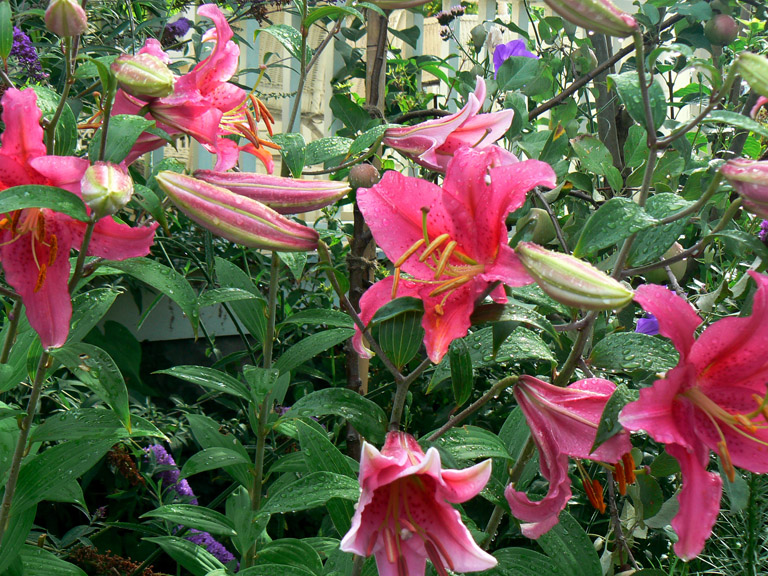
The front walkway leading to the Teahouse is bordered by flowering perennials and seasonal blooms. Unfortunately, the Oriental lilies, which I imagine were planted for their welcoming fragrance, were in the process of being decimated by the red lily leaf devil. I began to hand pick the beetles, but then thought better of it…I didn’t want my friends to think I was over-the-top obsessed nor to walk into the dining establishment with squished red lily beetle all over my hands. If you do not vigilantly destroy the adult beetle, their larvae, and eggs, the red lily beetle will destroy all the leaves and buds of your favorite lilies. To my utter dismay, just last week, I saw one on the leaf of my beautiful native Turk’s-cap lily (Lilium superbum).
While at a local nursery, a woman came in asking the salesperson what poison to purchase to spray to rid her garden of the red lily beetle. I never tire of bending people’s ears to let them know that when you spray pesticides in the garden, pesticides of any kind, you are killing not only the pest, but all the beneficial insects as well. With early hand monitoring of red lily beetles, Japanese beetles, aphids, and what-not, you will not have to resort to spraying pesticides. I wrote the following information nearly seven years ago and am only too happy to pass along:
This past growing season the dreaded red lily beetle attacked our lilies. I had heard innumerable reports from fellow gardeners of this nasty import with its voracious appetite for lily foliage and wasn’t too surprised when evidence of them began appearing on several choice Oriental lilies. The adults chew noticeable round holes in the foliage. The growing larvae decimate the leaves and the flower buds. About 3/8-inch in length, the beetles are bright cadmium red with thin black legs. Because they have no known predators in North America and because of their extended egg-laying season, from spring through summer, they are difficult to control. As soon as you see signs of the beetle (be on the lookout as early as the first of April), monitor the plants daily. Squash any beetles that are visible. They are quick, and you have to be quicker. Next check the undersides of the leaves for the following three signs: glistening, miniscule reddish orangish eggs (usually, arrayed in a tiny line), their vile black, gloppy excrement, under which is concealed a growing larger larvae, and hiding adult beetles. Destroy the leaves that are hosting the larvae. The only way to maintain attractive lilies throughout the season is by constant vigilance, handpicking the beetles and their larvae in all stages. (Pages 155-156 Oh Garden of Fresh Possibilities! David R. Godine, Publisher).
Adult Red Lily Leaf Beetle (Lilioceris lilii)
I would add to the preceeding, that, with early monitoring, you will make a dramatic impact on the life cycle of the red lily beetle, and controlling them therefore does become easier as the season unfolds–but don’t let your guard down–especially if you have, as do we, lilies that come into bloom throughout the summer. When I say “they are quick, so you must be quicker;” the beetles are very devilish and will easily slip out of your hands before you have a chance to squish them. Approach the beetle cautiously (fortunately so, you will often capture two at once, because they are constantly mating). Place one hand under the leaf to catch it, before it falls into the leaf debris at the base of the plant. Once the beetle falls to the ground, it displays its black underside and is very difficult to see to retrieve.
The Fragrant Garden
The Fragrant Garden
Part Two
Located on the southeast side of our home is the primary pathway, which we walk up and down many times in the course of the day. We built the path using bricks from a pile of discarded chimney bricks. Ordinarily I would not recommend chimney bricks, as they are fired differently from paving bricks and are therefore less sturdy. We laid the brick in a herring bone pattern and luckily they have held without cracking and splitting. The warm red tones of the brick complement the creamy yellow clapboards of the house. A tightly woven brick path is a practical choice for a primary path as it helps keep mud out of the home.
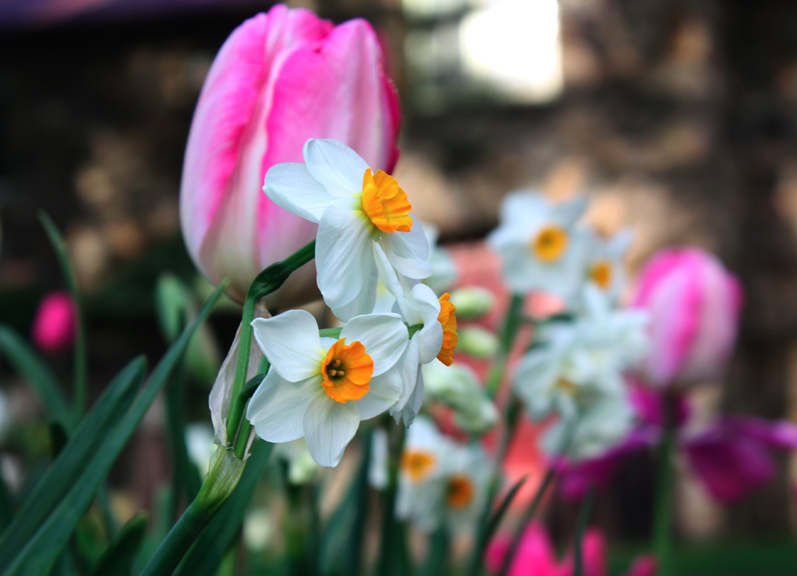
Planted alongside the house walls and on the opposing side of the path, in close proximity to our neighbor’s fence, are the larger plantings of Magnolia virginiana, ‘Dragon Lady hollies,’ Syringa, Philadelphus, and semi-dwarf fruiting trees, Prunus and Malus. Weaving through the background tapestry of foliage and flowers are fragrant flowering vines and rambling roses. These include the most richly scented cultivars of honeysuckle and Bourbon roses. Viburnum carlcephalum, butterfly bushes, meadowsweet, New Jersey tea, and Paeonia rockii comprise a collection of mid-size shrubs. They, along with perennials, bulbs, and annuals—narcissus, tulips, iris, herbaceous peonies, lavender, Russian sage, lilies, and chrysanthemums —are perfect examples of fragrant plants growing at mid-level. Closer to the ground is a carpet of scented herbs, full and abundant and spilling onto the brick walkway. The length of our pathway is lined with aromatic alpine strawberries, thyme, and sweet alyssum. This most sunny area in our garden permits us to grow a variety of kitchen herbs. The foliage of the herbs releases their scents when brushed against. Including herbs in the flower borders provides an attractive and practical addition to the fragrant garden.
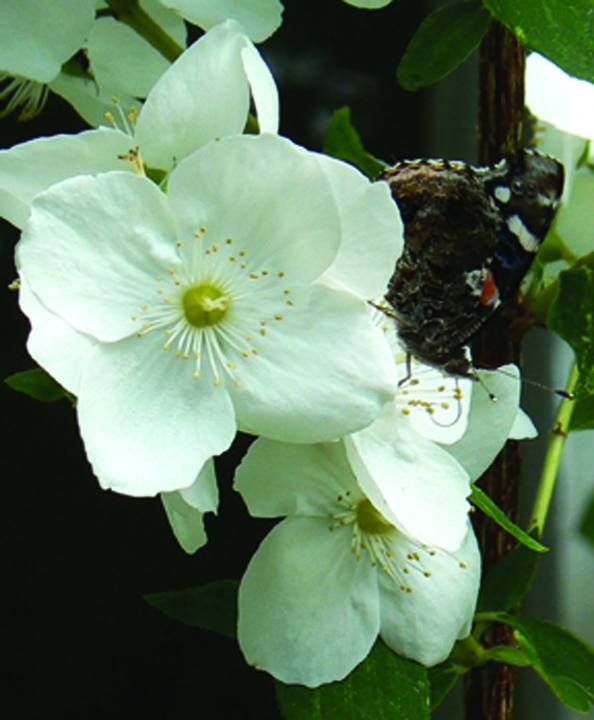
Mock Orange (Philadelphus ‘Innocence’) and the Friendly Red Admiral Butterfly
The fragrances are held within by the house and neighboring fence and the living perfumes of flowers and foliage are noticeable throughout the growing season. All the plants are immediately available to see, touch, and smell. The intimate aspects of the garden are revealed by the close proximity of plantings along a much-used garden path.
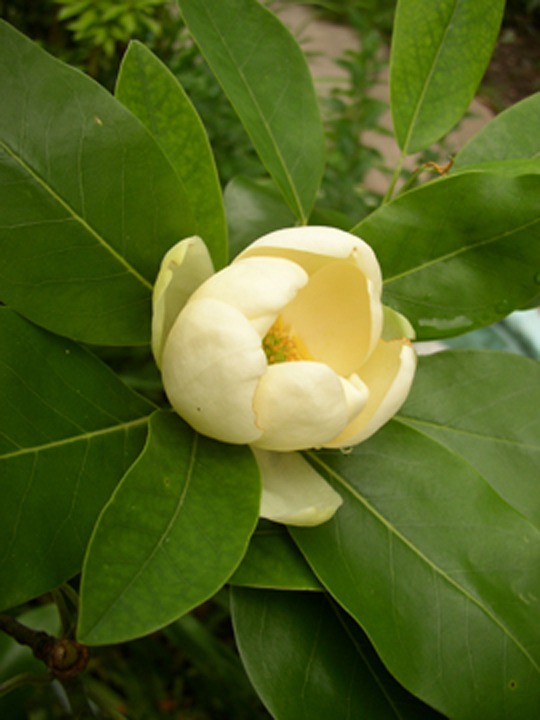
Native Sweetbay Magnolia (Magnolia virginiana)
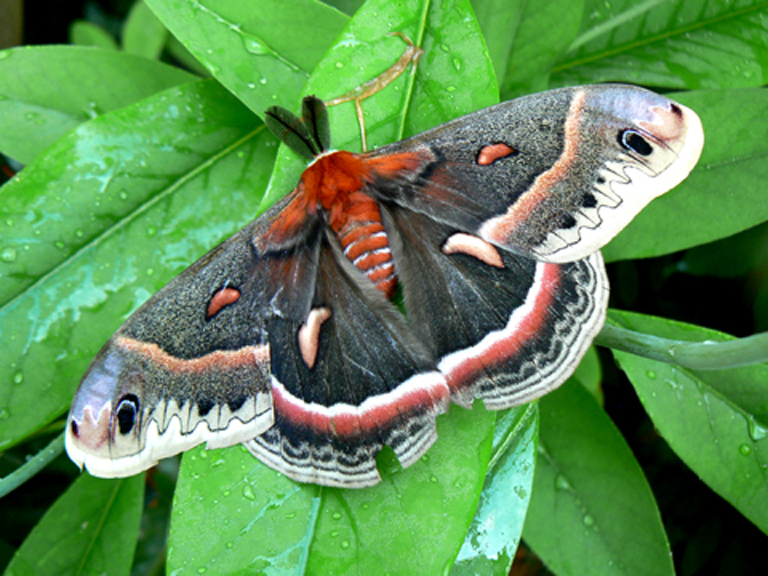
Male Cecropia Moth on Sweetbay Foliage
When selecting plants for a fragrant garden, it is not wise to assume that just because your Mom had sublimely scented peonies growing in her garden, all peonies will be as such. This simply is not the case. Take the time to investigate nurseries and arboretums during plants’ blooming period and read as much literature as possible. There is an abundance of information to be gleaned and sifted through to find the most richly scented version of a plant. When seeking a fragrant cultivar, one may find that it is usually an older variety, one that has not had scent replaced for an improbable color, convenient size, or double blossoms by a well-meaning hybridizer. And despite our best effort to find the most richly scented version, there will be disappointments along the way, as fragrance is highly mutable. Soil conditions and climate play their role, and some plants simply don’t perform as advertised.
A well-thought-out pathway looks inviting when seen from the street and the fragrance beckons the visitor to enter. The interwoven scents emanating from an array of sequentially blooming flowers and aromatic foliage create a welcoming atmosphere. Have you noticed your garden is more fragrant after a warm summer shower or on a day when the morning fog has lifted? Scented flowers are sweetest when the air is temperate and full of moisture. Plant your garden of fragrance to reflect the time of year when you will most often be in the garden to enjoy your hard work.
There are few modern gardens planted purely for fragrance. Maybe this is because there is now a tremendous variety of appealing plant material, offered by growers to eager gardeners ready to purchase what is visually enticing, by color and by size. Perhaps it is so because in the past fragrant plantings served the function of disguising unpleasant odors from outhouses and farmyards, and we no longer have to address these concerns. But the pendulum has begun to swing (albeit slowly) toward planting a garden designed for fragrance. Scent, along with rhythm, scale, harmony in color, and form, should ideally be an equal component in garden design. Plant scented flowering shrubs under windows and close to and around the porch. Plant fragrant vines to climb up the walls near window sashes that will be open in the summertime. Plant scented white flowering plants near to where you might brush against them while dining al fresco or to embower a favorite garden spot designed for rest and rejuvenation.
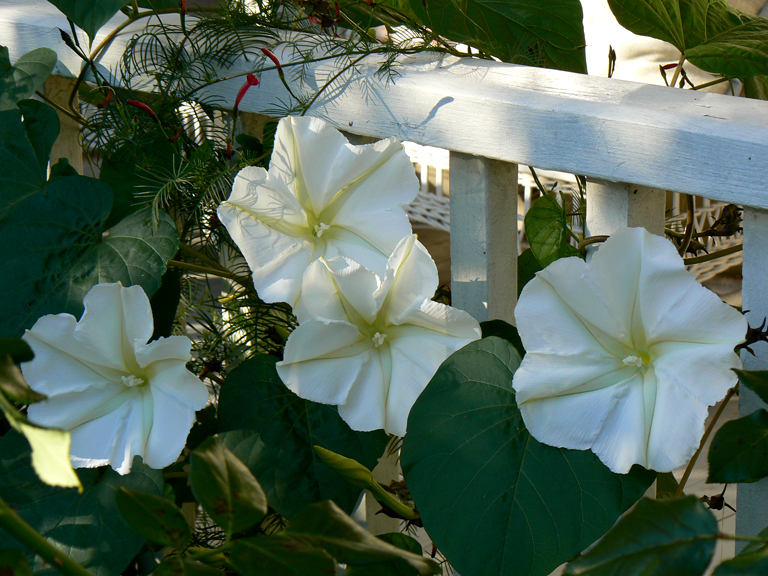
“True vespertine flowers are those that withhold their sweetness from day and give it freely at night. “(Louise Beebe Wilder). Imagine the dreamlike enchantment of the fragrant path through the night garden. The vibrantly colored flowers have vanished. All that you will see are the white and palest shades of pink, yellow, and lavender flowers reflecting the moonlight. Perhaps you will have the breathtaking experience of an encounter with a Lunar moth. Syringa vulgaris ‘Beauty of Moscow,’ Madonna lily, Philadelphus, Japanese honeysuckle, Lilium regale, Nicotianna alata, Oriental lily, tuberose, night phlox, peacock orchid, Stephanotis floribunda, gardenia, Jasminum sambac, Angel’s trumpet, and moonflowers are but a few of the white flowers with exotic night-scents for an entrancing sleeping garden.
A thing of beauty is a joy for ever:
Its loveliness increases; it will never
Pass into nothingness; but still will keep
A bower quiet for us, and a sleep
Full of sweet dreams, and health, and quiet breathing.
— J o h n K e a t s ( 1 7 9 5 – 1 8 2 1 )
Excerpt from Oh Garden of Fresh Possibilities! (David R. Godine, Publisher)
The most sweetly scented flowers…
“Scent is the oxidation of essential oils of flowers and leaves. The most intensely scented flowers, lily of-the-valley, orange blossoms, gardenia, Stephanotis floribunda, and tuberose, for example, have thick, velvet-like petals that retain their fragrance by preventing the essential oils from evaporating.
The greater the amount of essential oil produced, the lesser degree of pigmentation in a flower. The oil is the result of the transformation of chlorophyll into tannoid compounds (or pigments), which is in inverseratio to the amount of pigment in a flower. Plants with blue, orange, and red flowers have a high degree of pigmentation and usually generate little or no scent. Pure white flowers release the strongest perfume, followed by creamy white, pale pink, pale yellow, yellow, purple-pink and purple. As color pigment is hybridized and intensified in flowers, fragrance is usually lost or compromised.” –Oh Garden of Fresh Possibilities!
J’adore New York
My friend and fellow writer Isabelle Laflèche, along with her charming boyfriend Patrice, stopped by on her return to Montreal Sunday afternoon. She presented me with a copy of her dazzling debut book, J’adore New York. I simply could not put it down last night, and am suffering greatly today from lack of sleep. J’adore New York is semi-autobiographical; Isabelle draws upon her experiences as a corporate lawyer for a large Manhattan firm, and from her love of all things stylish.
Isabelle’s story revolves around the brilliant and très chic French transplant Catherine Lambert. Our heroine is poised to make partner, and between juggling the loneliness of working long hours in a lamentable job, office politics, and her desire to explore New York, she longs to find romantic love. Think Audrey Hepburn in Roman Holiday, but with a modern twist. The princess is now the high-powered career woman, longing for the beautiful life of personal and professional fulfillment. In Catherine, Isabelle has created a woman of many dimensions—feistily determined to succeed, yet occasionally insecure, trusting and sagacious, sensual, sexual, and down-to-earth. Captivating and a page tuner, I highly recommend J’adore Dior to anyone looking for a wonderful summer escape, especially if you have ever felt trapped in a tortuous job.
I have both the French and English editions of J’adore New York and both jackets are equally as beautiful, don’t you think?
Moon Vine
It was my joy to give the lecture, held at the Wenham Museum’s North Shore Design Show, on gardening for fragrance. Thank you to Lindsay, Yvonne, Leon, Pauline, Elizabeth, Julie, Lisa, Sandra, Polly, Eliza, and everyone else whose name I did not get, for your interest and great questions.
No garden planted for fragrance would be complete without growing moon vine. Plant moonflowers and cypress vines in late May and early June for September blossoms. Moon vine will give you dreamily-scented late summer nights and cardinal climber will provide nectar for southward migrating Ruby-throated hummingbirds
Our moon vine-embowered porch in September
“You can tell in the afternoon which buds will open that night. In the South, where I used to live, it was the custom to keep an eye on the moon vine, and when sixty or so buds showed they would open that night, to ask people over to watch them. Unfortunately, people in the country talk so much that I cannot recall seeing the buds open very often. They tremble and vibrate when they open. Usually someonewould say “the flowers are out,” and everyone would run over to admire them, then back to jabbering.
Equally festive is the night-blooming cereus. In our neighborhood there lived an old cereus in a tub. It was ninety-seven years old, the last time I saw it, and produced 120 flowers open at once. When it bloomed (and you can tell by afternoon which buds will open) its proud owner would phone round the neighbors and there would be punch or champagne (rather dangerous in hot weather) and cucumber sandwiches for refined persons, and ham and potato salad for mere mortals. These parties, once such a feature of the American summer, were always spontaneous, since you only had a few hours to plan them and invite people. It was always astonishing to see how many people could come at the last minute.”
— Henry Mitchell ~ The Essential Earthman
Perhaps this is the summer we will have our first moon vine party–and I will provide tea sandwiches for my refined friends and ham and potato salad for we mere mortals. What fun to imagine. Grow cardinal climber and moon vine together for a delightful combination of delicately toothed and bold heart-shaped leaves–day flowering red trumpets for the hummingbirds and night blooming sweetly scented blossoms for you.
*Logees Greenhouse carries night-blooming cereus (Epiphyllum oxypetalum).
North Shore Design Show: Favorite Spaces
Dear Gardening Friends,
Please join me Saturday May 22nd at 11 am at the Wenham Museum where I will be presenting my latest talk, with photographs, titled “The Fragrant Path.” The Wenham Museum is offering a week-long program of special events, lectures, and presentations in conjunction with their 2010 Spring Benefit North Shore Design Show: Favorite Spaces. Last year’s show was a fabulous success and this year’s has been greatly expanded, with a longer running date and more programs. Not to be missed are two of my favorite designers, Elizabeth Hourihan of Carpenter & MacNeille and Yvonne Blacker. The theme of last year’s show centered around recreating favorite scenes from childhood tales. Elizabeth’s exhibit featured custom built cabinetry highlighting the beautiful workmanship of Carpenter & MacNeille and the children’s book author and Gloucester’s own, Virginia Lee Burton, including original textiles by Burton’s Folly Cove Design Studio. Yvonne’s exhibit was an utterly delightful woodland teaparty. I cannot wait to see what they have come up with this year!
Warmest wishes,
Kim
Garden Tour of the Foyer of Charity
My friend Jon Hogan designs and maintains these beautiful gardens on this former estate in Situate. Horticulturists will be on hand to answer questions and a selection of rare and unusual plants will be available for sale. Complimentary refreshments will be served. Not only is Jon a fabulous designer, he also whips up the most delicious refreshments for NELDHA events–this tour promises to be wonderful!
Lily of-the-valley
Lily of-the-valley
No flower amid the garden fairer grows
Than the sweet lily of the lowly vale,
The queen of flowers. — John Keats (1795-1821)
With its incomparable perfume and snow-white flowers issuing forth in the bright hopeful season of spring, the lily of-the-valley has long been associated in literature with sweetness and the return of happiness.
The lily of-the-valley, known also as May lily and May bells, is native to northern Europe, the Allegheny Mountains of North America, and the British Isles. Between a pair of unfurling new-green leaves emerges a diminutive arching scape, covered in dangling pure white chubby bells. Their fabulous fragrance floats freely throughout the garden, unusual for a plant that grows close to the ground.
Beloved wherever it is grown, for its ineffable scent and sweet flowers, the lily of-the-valley is used extensively for perfumes, soaps, and toilet water, nowhere more so than in Europe. The French translation is muguet des bois (of the wood), the German trans-lation is mit Maiglockchen, the Italian al mughetto, the Spanish say lirio del valle, the Finnish translation is lehmakielo, and the Swedish say liljekonvalj.
Convallaria majalis is the native species of northern Europe. The name Convallaria is from two Latin words meaning “with” and “valley,” having reference to its habit of growing on mountain slopes. C. majuscula is the species indigenous to North America. Convallaria majuscula is found growing in remote woodland locations, along the mountainsides and ridges of Virginia, West Virginia, and south to Georgia. C. majuscula is nearly identical to C. majalis, with slightly smaller though equally fragrant flowers.
Lily of-the-valley is a vigorous perennial ground cover with a rhizomatic root structure that grows and spreads quickly. Thriving in nearly every light condition save full sun, lily of-the-valley never disappoints. Light, fertile, and preferably damp soil is the preferred growing medium of C. majalis. Provided with an annual mulch of compost or decaying leaves, lily of-the-valley multiplies rapidly. With its cold hardiness, ability to spread readily, and pervasively fragrant blossoms it is incomparable as a ground cover. The one drawback of lily of-the-valley is that, come late August, the foliage browns and becomes tattered. Grow with late season blooming perennials and bulbs, Japanese anemones and peacock orchids, for example, to draw your eye up and away from the messy foliage.
Set the pips, or bulblets, three inches deep and about four inches apart in a well-prepared bed. Water during dry periods and fertilize with fish fertilizer throughout the first season after planting to encourage strong root development. After it has become well established, the plant is easily propagated. A freshly dug clump, as a whole unit, can either be transferred and replanted in a newly dug and well-prepared location, or the bulblets can be carefully divided and spread more judiciously, allowing for a small section of roots for each one or two pips. Plunge a serrated-edge knife deeply into the ground. Cut out a plug six to eight inches in diameter. Refill the hole created by digging the clump with compost. Lily of-the-valley will soon recover and fill out the spot. Early spring and mid-fall are the best times of year to divide C. majalis, although they are not that fussy. If the plant has to be divided in the summer, water regularly to prevent the new division from drying out while becoming established in its new home. With regular thinning and transplanting, one’s extra efforts will be rewarded with an ever-increasing treasure of scented flowers and sea of green groundcover, with many gifts to pass along to friends.
Not to be forgotten is the noteworthy Convallaria majalis var. rosea. Characteristic in form to the white lily of-the-vale, rosea has delicate, pendulous bells washed in shades of rosy pink. We have found it to be somewhat less hardy than Convallaria majalis.
A cautionary note is in order regarding Convallaria. All parts of the plant are highly poisonous. In old herbal guides, lily of-the-valley was recommended as a heart stimulant, and was used medicinally in ways similar to digitalis. The eyecatching, plump vermilion berries may be dangerously attractive to young children and can cause paralysis and severe respiratory disorders if ingested.
What a find this weekend!–a sweet handblown bud vase, perfect for lily of-the-valley, found amongst a tumble of dusty old perfume bottles at an antique shop in Essex. So dear –the fragrance of lily of-the valley brings delicious childhood memories of picking handfuls with my Mom at my grandmother’s garden. Happy Mother’s Day Mom!
The Fragrant Garden
Dear Gardening Friends,
I hope you can participate in my upcoming gardening lectures and classes. My spring schedule is posted on the Events page.
Life is full—our daughter Olivia is graduating from Boston University next weekend, our son is working hard in school and at the job he so loves, and Tom and I both have as much work and projects as we can possibly manage—no small feat in this economy. And we have a new puppy–a tulip eating puppy! More about Miss Rosie Money Penny will be posted.
The foillowing is an excerpt from the chapter on gardening for fragrance from my book Oh Garden of Fresh Possibilities!, to coincide with the lecture I will be presenting at the North Shore Design Show “Favorite Spaces” exhibit, at 11:00 am on Saturday morning, May 22 at the Wenham Museum. For more information about the North Shore Design Show and to see their full calendar of events, follow this link: 2010 Spring Benefit.
A note about ‘Geranium’: Sweetly scented, ‘Geranium’ narcissus reliably returns year after year. For a list of fabulously fragrant jonquils and narcissus see pages 178-179 in Oh Garden of Fresh Possibilities!
The Fragrant Garden
Part One
A garden, a small garden especially, is made more intimate when planted with an abundance of fragrant blooms and foliage. The air impregnated with the scents of flowers and foliage imbues a memorable atmosphere in the garden, playing the subtle, and sometimes not so subtle, role of strengthening the ambiance we wish to create. Fragrance, elusive, emotionally colored, and so entirely related to experience, welcomes us as we walk through the pathways of our garden.
The idea of creating a fragrant garden is deeply rooted in ancient history. One of the earliest aromatic gardens was the Hanging Gardens of Babylon, built in the 6th century b.c. by King Nebuchadnezzar for his wife Amytes, daughter of the King of the Medes. The Greeks described these resplendent gardens, supported by stone columns with irrigated terraces. The most potently fragrant plants were grown here, and the terraces, which bloomed with lilies and roses, were favored by Queen Amytes for her walks.
The countries of the Middle East abound with an array of scented trees and plants. From historical records dating back to 2500 b.c. we know that the enclosed courtyards of the Persian palaces were planted with jasmine, fruit trees (especially oranges), hyacinth, myrtle, and jonquils. But above all other flowering plants, the rose was held in the highest esteem. The Damask rose grew in nearly every garden in Syria. The country takes its name from the word Suri (a delicate rose), hence Suristan (the land of roses).
From tomb paintings and bas-reliefs we learn of gardens and the use of plants in ancient Egypt. The verdant, fertile flood plain created by the annual rise and fall of the Nile, coupled with the Egyptians’ skill in engineering and irrigation, allowed a wealth of indigenous and imported fruiting trees, vines, and flora to grow in abundance. One of the earliest botanic collections was that of plants and seeds brought back from Syria in approximately 1450 b.c. The images of the plants were carved on the walls of the temple of Thothmes II in Karnak. The Egyptian Papyrus Ebers (written about 1552 b.c.) describes scented plants and remedies and their methods of use. The gardens, enclosed by mud walls, were planted with aromatics and medicinal herbs. Some of the plants described include frankincense, myrrh, saffron crocus, Madonna lily (Lilium candidum), cinnamon, and orchards of pomegranates. The Egyptians were among the earliest peoples to show an appreciation for perfume. Incense and perfume were used extensively for religious and funeral rites. Fragrant oils were used to massage their bodies and concoctions of scented herbs were taken to sweeten the breath. Priests performed the daily ritual of burning fragrant woods as offerings to the gods. The wood was burnt on alters in the temples. The word “perfume,” from the Latin per, “through,” and fumun “smoke,” shows that the origin of the word lay in the burning of incense, both to ‘offer up’ the gratitude of the people to the gods for favors received, and to ask for their blessings in time of trouble. The Egyptians believed their prayers would reach the gods more quickly when wafted by the blue smoke that slowly ascended to heaven.
The Egyptians’ reverence for nature is noteworthy in their use of floral motifs in decorative ornamentation. The lotus and papyrus were by far the most prevalent, together with the daisy, palm, convolvulus, and grape vine. The ‘Blue Lotus of the Nile’ (Nymphaea stellata coerulea), a member of the water lily family, is the lotus flower depicted in ancient Egyptian decorative ornamentation. The fragrance emanating from the lotus creates an intoxicating atmosphere; they have a scent similar to hyacinths. The flowers are star-shaped and sky-blue with brilliant golden centers and stand several inches above the water. The lotus had an inexhaustible symbolism in ancient Egypt, Daoism, Buddhism, and Hinduism alike.
The lotus is significant as it was the symbol of Upper Egypt. When used in ornamentation with the papyrus it symbolized the union of Upper and Lower Egypt, whose symbol was the papyrus. A well-known example of this is the soaring twin pillars that tower over the ruins at Karnak. One capital is decorated with the lotus and the other with papyrus.
The ‘Blue Lotus of the Nile’ had a deeper religious significance. Because the lotus blooms each day, withdraws under the water at sunset, and reemerges the following morning, it was closely linked to the daily rhythm of the rising and setting of the sun and thus to the story of the sun god, creation, and rebirth. The blue petals represented the sky and the golden center the emerging sun. The lotus motif was used to decorate pottery, jewelry, clothing, and appears extensively in the decoration of the capitals of pillars and columns. A wide variety of designs using the lotus flower were employed, in repeating border patterns and in alternating patterns with lotus buds or bunches of grapes. The buds fit harmoniously into the curves between the flowers. During the reign of Akhenaten (New Kingdom, 18th Dynasty) the lotus designs become less stylized and more freely expressed.
When thinking about the history of garden design in the context of our own gardens, we are free to determine our own personal preferences while drawing inspiration from what has come before. By following one’s intuitive powers and adhering to nature’s contours specific to an existing site, the inherent beauty of the garden can be realized. In describing our fragrant path, rather than draw for you a picture of what to grow precisely, as each individual garden setting is unique, the following are suggestions of plants for a well-orchestrated sequence of fragrant flowering plants. The underlying framework would ideally be composed of as many fragrant flowering and fruiting trees and shrubs as are reasonable, including an abundance of aromatic and healthful herbs. And the garden overflowing with scented blossoms provides you with armfuls of flowers to cut and bring indoors to scent the rooms of your home.
Part Two will be posted next week.
North Shore Design Show
Support the Wenham Museum in this week long event of beautiful “favorite spaces” created by north of Boston designers, along with lectures presented by Kim Smith, Jerry Arcari, and Kevin O’Connor. To see the full calendar of events, follow this link 2010 Spring Benefit.