 Limonaia at Tower Hill Botanic Garden
As the orangerie, orangery, or orange house is to the French, the limonaia, lemonary, and lemon house is to the Italians.

Limonaia at Tower Hill Botanic Garden
As the orangerie, orangery, or orange house is to the French, the limonaia, lemonary, and lemon house is to the Italians.

Our gorgeous orchid cactus (Epiphyllum) has thrown us a bloom, just in time for Valentines Day! Last year, this newly propagated treasure gave us one dinner plate-sized blossom. This year, she possesses eleven ruby red buds from which are opening the most gorgeously hued and fabulously fragrant flowers. Blue-violet tinged electric orange-magenta outer petals surround Schiaparelli shocking pink inner petals, shading to a lime green throat, and highlighted by creamy yellow anthers and starry stigma. The flowers stay open for several days, unlike her relative the Night-blooming Cereus (Epiphyllum oxypetalum, whose blossoms last only a single night before wilting by dawn), and one in bloom scents an entire room, or several rooms.
A garden club plant sale special, I know not the name of this brilliant beauty. Her description does not wholly match the orchid cactus cultivars found on the internet and not a one mentions her fabulous fragrance. I purchased this very young plant several years ago at the Community Center in Rockport, at what I believe was the Rockport Garden Club’s annual plant sale. If any of my Rockport readers recognize the plant from the photo and know the name of this cultivar, or who has the parent plant, please email me.
* Shocking pink was fashion designer Elsa Schiaparelli’s (1890- 19730) signature color and she described it as “life-giving, like all the light and the birds and the fish in the world put together, a color of China and Peru but not of the West.”
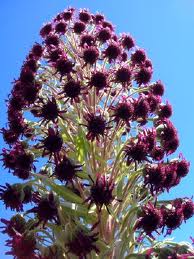
Photos Courtesy of Forest and Kim Starr
Director’s Series at the Arnold Arboretum ~ Last night I had the pleasure of attending Robert Robichaux’s splendid lecture Restoring Hawaii’s Marvels of Evolution, presented at the Hunnewell Building of the Arnold Arboretum. Especially fascinating are examples of adaptive radiation, in which a singular North American mainland plant arrived on the islands and evolved into an array of different species, exhibiting fantastic variation in form and habitat.
See related post What is Adaptive Radiation?
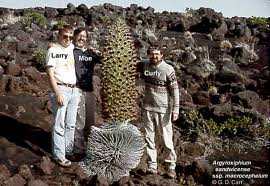
Mr. Robchauxi gave detailed information on the restoration efforts of the Haleakalā Silversword (Argyroxiphium sandwicense subsp. macrocephalum), perhaps Hawaii’s most famous native flowering plant, along with providng examples of other silversword species and lobeliads.
|
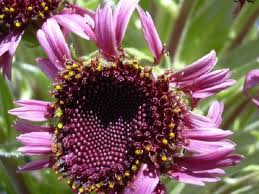
A relative of the sunflower, Haleakalā Silversword may live for several decades, however it is monocarpic, meaning once-flowering, after which it dies. Flowering usually occurs from June through October and the single stalk may contain as many as 600 heads with up to 40 ray flowers surrounding approximately 600 disk florets. Haleakalā Silversword is found only on the island of Maui. The plant’s common name is derived from the genera’s numerous sword-like succulent leaves, which are covered with silver hairs. Since May of 1992, the Haleakalā Silversword has been considered a threatened species by the U.S. Fish and Wildlife Service. The silversword alliance refers to an adaptive radiation of over 5o Hawaiian species in the composite or sunflower family, Asteraceae, Tribe: Madieae (genera Dubautia, Wilkesia, and Agyroxiphium), and also to the Hawaiian Silversword Alliance Project (HSA), an adaptive evolution study project that is a collaborative effort among scientists at multiple public, private, and government institutions. Kingdom: Plantae Order: Asterales Family: Asteraceae Genus: Argyroxiphium Species: A. sandwicense Subspecies: A. s. subs. macrocephalum |
|---|
One of the most striking evolutionary patterns observed is called adaptive radiation. To radiate means to spread outward; not in the sense of speading out physically, but referring to a species that diversifies (“spreads out”) and generates multiple daughter species.
From Biology Online: When Charles Darwin was in the Galapagos islands, one of the first things he noticed is the variety of finches that existed on each of the islands. All in all, there were many different species of finch that differed in beak shape and overall size. This is adaptive radiation and natural selection at work.
These finches, better known as ‘Darwin’s Finches’ illustrated adaptive radiation. This is where species all deriving from a common ancestor have over time successfully adapted to their environment via natural selection.
Previously, the finches occupied the South American mainland, but somehow managed to occupy the Galapagos islands, over 600 miles away. They occupied an ecological niche with little competition.
As the population began to flourish in these advantageous conditions, intraspecific competition became a factor, and resources on the islands were squeezed and could not sustain the population of the finches for long.
Due to the mechanisms of natural selection, and changes in the gene pool, the finches became more adapted to the environment, illustrated by the diagram below.

As competition grew, the finches managed to find new ecological niches, that would present less competition and allow them, and their genome to be continued.
As indicated by the diagram above, the finches adapted to take advantage of the various food sources available on the island, which were being used by other species. Over the long term, the original finch species may have disappeared, but by diversifying, would stand a better chance of survival.
All in all, the finches had adapted to their environment via natural selection, which in turn, has allowed the species to survive in the longer term, the prime directive of any species.
See related post Silversword Alliance.
Follow this link to read more about rapid adaptive radiation in the species rich Heliconius butterflies (longwings or passion-flower butterflies).
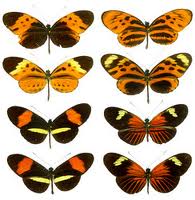
In anticipation of spring and your spring planting plans (and as I am sorting through mountains of photos, film footage, and text for the butterfly gardening show), I am planning a little series here on the blog. The focus is all about sharing information and photos about individual plant species that provide sustenance and shelter for the pollinators that grace our gardens.
 Trumpet Creeper (Campsis radicans)
Two of our very favorite native plant species for attracting Ruby-throated Hummingbirds are the blossoms of the northern catalpa tree (Catalpa speciosa) and trumpet creeper (Campsis radicans), both of which belong to the Bignonia family. Catalpa trees bear white flowers with violet nectar guides and, despite their color differences, Catalpa blossoms and the red-orange flowers of trumpet creeper reveal several similarities, The reproductive structures are positioned inside at the top lip of the opening, surrounded by five asymmetrically shaped petals fused together. As the hummingbird pokes its head deep inside the trumpet-shaped blossom to extract nectar, the pollen-bearing sticky stamens and pistils attach to its forehead and transfer pollen from one blossom to the next.
Nectar volume influences the blossoms’ attractiveness to the Ruby-throated Hummingbird. The small florets of plants such as those of butterfly bushes and zinnias offer nectar, though they require many visits to make it worthwhile. Our native Campsis radicans produces one of the highest known volumes of floral nectar per flower. Hummingbird fledglings quickly learn from their mothers the blossoms that contain the most nectar.
Campsis radicans is found growing throughout much of the eastern half of the country. Unable to support itself vertically, it trails along the ground until it reaches a tree. Tiny aerial rootlets are formed to adhere itself to the surface of the tree to then allow it to climb skyward towards the sunlight. Unlike vines such as Chinese wisteria and bittersweet, which gird and then strangle a tree, trumpet creeper clings tightly. Campsis radicans is a very fast growing and top-heavy vine. It is unsuitable for anything but the strongest structure. As it blooms on the current year’s growth, it can be grown along a solid fence and cut back very vigorously in early spring.
For the intimate garden or garden room, where a less rampant (but no less hardy) grower is a more suitable choice, there are several hybrids of C. radicans with flowers that are as equally attractive to the hummingbirds. ‘Madame Galen’ (Campsis radicans x tagliabuana) flowers in lovely shades of apricot-orange. The newer cultivar ‘Indian Summer’ is described with the less persistent and dense growth characteristics similar to that of ‘Madame Galen’ and beautiful blossoms of apricot-orange with a deeper red eye.
The extended period of florescence of C. radicans corresponds to the span of time in which ruby-throated hummingbirds are living in their northern range. Like Chinese wisteria, trumpet creeper can take six years or more to flower from seed. Plant the largest specimen one’s budget will allow.
| Kingdom | Plantae – Plants |
| Subkingdom | Tracheobionta – Vascular plants |
| Superdivision | Spermatophyta – Seed plants |
| Division | Magnoliophyta – Flowering plants |
| Class | Magnoliopsida – Dicotyledons |
| Subclass | Asteridae |
| Order | Scrophulariales |
| Family | Bignoniaceae – Trumpet-creeper family |
| Genus | Campsis Lour. – campsis |
| Species | Campsis radicans |
See more vintage chandeliers at our daughter Liv’s blog: Dessert or Disaster

 Keeping Up Appearances
The gorgeous work of Elizabeth Alexander has been recognized by the Massachusetts Cultural Council, with their highest fellowship award in the amount of $7,500, in the category of Sculpture/Installation. Congratulations Elizabeth! View photos of Alexander’s “reinterpretation of space and material, a blurring of memory and imagination” at her website elizabethalexander.com
Artist’s Statement: “I am motivated by discovery, both in my studio as well as a means to captivate a viewer. As a child I searched for magic everywhere, believing that soon I too would be living the life of a fairy princess, finding enchantment at every turn. I have since realized that I am not destined for royalty but I still feel the need to create enchanted interventions with the everyday. The familiar standards of objects and space are represented but manipulated in a way that changes one’s perception from normalcy to fancy.
I use embellishment as a transformative tool, in the same way that adornment and artificiality is issued for all tales of “rags to riches.” If the shoe fits, does it really matter that the toe was severed to make it so? Beauty acts as a veil of stability and calm over the distress I allude to; pattern, color, materiality, and texture are used to seduce the viewer to appreciate something as unappealing as a flood or destroyed car. I employ decorative arts and formal aesthetics as vehicles to evoke desire, prosperity, and escapism in places typically lacking those characteristics. The final result is a reinterpretation of space and material, a blurring of reality, memory, and imagination.”
Contact Elizabeth: 
elizabeth.z.alexander@gmail.com
Studio:129 Prospect Street Gloucester, MA 01930
 American native tulip tree on the front lawn of the Hunnewell Building at the Arnold Arboretum
A Darwinian Look at Darwin’s Evolutionist Ancestors
Last night I had the pleasure of hearing Ned Friedman, the new Director at the Arnold Arboretum, speak about the early history of evolutuonary thought. Well-spoken, passionate, and comprehensive in his presentaion, Friedman answers the question “Is Darwin truly deserving of his place in history?” Although approximately fifty naturalists, horticulturalists, arborists, theologians, philosophers, poets, and medical practitoners had advanced evolutionary concepts for the diversification of life, it was Darwin who wrote about and developed the concept most exhaustively and comprehensively (most notably, On the Origins of Species, 1859) and conclusively, and it was Darwin who convinced the rest of the scientific world. Interestingly, we learn that Charles Darwin’s grandfather, the physician and naturalist Erasmus Darwin (a great friend of our forefather Benjamin Franklin– are you listening tea party creationists?) most certainly planted the seed and devolped the foundation for his grandson’s theories on evolution, through his own writing Zoonomia (or the Laws of Organic Life, 1794).
Erasmus Darwin writes “Would it be too bold to imagine, that in the great length of time, since the earth began to exist, perhaps millions of ages before the commencement of the history of mankind, would it be too bold to imagine, that all warm-blooded animals have arisen from one living filament, which THE GREAT FIRST CAUSE endued with animality, with the power of acquiring new parts, attended with new propensities, directed by irritations, sensations, volitions, and associations; and thus possessing the faculty of continuing to improve by its own inherent activity, and of delivering down those improvements by generation to its posterity, world without end!”
It is not easy leaving my cozy home on a frigid New England evenning. I usually have to depart a full two to two and half hours prior to any event in the city when it is scheduled anywhere near rush hour. This makes for a very long evening, however, I find all the progams that the Arnold Arboretum has to offer entirely worth my while and last night’s presentaion was no exception. I am very much looking forward to the upcoming lecture topic Restoring Hawaii’s Marvels of Evolution, presented by Robert Robichaux, scheduled for Monday, February 7 at 6:30.
All programs in the Directors Lecture series are free but you must register ahead of time online or call 617.384.5277.
Tulip tree (Lirodendron tulipfera). Lirodendron is a genus of only two species of trees in the Magnoliaceae; both are known under the common name tulip tree. Lirodendron tulipfera is native to eastern North America, while Lirodendron chinese is native to China and Vietnam.
 Magnolia ‘Betty’
In this new lecture series, nationally recognized experts will examine an array of contemporary topics related to Earth’s biodiversity and evolutionary history, the environment, conservation biology, and key social issues associated with current science. Opportunities to informally chat with the speaker will follow each lecture.
Lectures are free, but registration is required. All lectures held in the Hunnewell Building, Arnold Arboretum.
Register online or call 617.384.5277
A note about the photo above: I love taking photos at the Arnold Arboretum. Not only does every turn along the sweeping paths lead to a beautiful vista, with gorgeous and beautifully cared-for examples of individual plant specimens, but also because the garden is organized by plant family. As as example, surrounding the Hunnewell Building is a stunning collection of members of the Magnoliaceae, or Magnolia Family, both cultivars and species from around the globe. This allows you to more easily compare and comprehend some of the similarities and differences between, for instance, native sweetbay magnolia (Magnolia virginina), tulip tree (Liriodendron tulipifera), and hybrid ‘Magnolia ‘Elizabeth.’ When photographing at the Arnold I also take a photo of the identifying tag attached to the tree or shrub, which allows me to continue photographing without having to stop and write down the information. Later I can easily look up the plant to find out all I can.

A Darwinian Look at Darwin’s Evolutionist Ancestors
Ned Friedman, Director, Arnold Arboretum
NEW DATE ADDED: Monday, January 31, 6:30–8:30pm
For over a century before the publication of On the Origin of Species, naturalists, theologians, atheists, horticulturalists, medical practitioners, poets, and philosophers had advanced evolutionary concepts for the diversification of life through descent with modification. The early history of evolutionary thought will be examined through the lens of Charles Darwin’s highly personal views of his evolutionist ancestors. We will examine the question of what set Darwin apart from the dozens of advocates of evolution who preceded him. Is Darwin truly deserving of his place in history? Come find out!
Register online or call 617.384.5277
Restoring Hawaii’s Marvels of Evolution
Robert Robichaux, University of Arizona
Monday, February 7, 6:30–8:30pm
Evolving in splendid isolation over millions of years, Hawaii’s native plants exhibit patterns of diversity that are unrivaled elsewhere on Earth. Especially striking are the many examples of adaptive radiation, in which original immigrants to the islands evolved into dazzling arrays of plants exhibiting great variation in form and habitat preference. Yet Hawaii’s native plants face an uncertain future. Many native plants, such as the exquisitely beautiful silverswords and lobeliads, now teeter on the edge of extinction. Join botanist Robert Robichaux of the University of Arizona and the Hawaiian Silversword Foundation as he discusses recent efforts to restore Hawaii’s marvels of plant evolution.
Register online or call 617.384.5277
The Robin is the One
That interrupt the Morn
With hurried — few — express Reports
When March is scarcely on —
The Robin is the One
That overflow the Noon
With her cherubic quantity —
An April but begun —
The Robin is the One
That speechless from her Nest
Submit that Home — and Certainty
And Sanctity, are best – Emily Dickinson
 American Robin
They’re back this winter, and in legions! The Robins have returned to our garden to feast on the fruits of the ‘Dragon Lady’ hollies. For more information on the American Robin see older post: Round Robin Red-breast.

 Beautiful Tailfeathers!

 American Robin
“Hope” is the thing with feathers –
That perches in the soul –
And sings the tune without the words –
And never stops – at all –
And sweetest – in the Gale – is heard –
And sore must be the storm –
That could abash the little bird
That kept so many warm –
I’ve heard it in the chillest land –
And on the strangest Sea –
Yet, never, in Extremity,
It asked a crumb – of Me – Emily Dickinson
Dear Gardening Friends, Please forgive when I am slow to answer your kind and thoughtful letters. I am struggling with an elbow injury and have had to limit my writing and photography somewhat (with extreme reluctance!!!). I love to hear about your bird and butterfly encounters, so please, keep your letters coming–just know that I am slow! Warmest wishes, Kim
From Jeannette in Marblehead – Kim Happy New Year, So enjoy your emails. Walter and I were in Gloucester in November and drove by your home to try to peak at your garden but of course, it was the end of November and the gardens were sleeping. It looked enchanting with the little sparkling lights. A quick questions where does one find the Nyjer feeder and seeds. We have been so unsuccessful, all our bird feeders in the past have become squirrel feeders. I hope to come and see your gardens this Spring/Summer.
Dear Jeannette, We purchase Nyjer and safflower seeds from our local Essex Bird Shop and Pet Supply and I imagine most Mom and Pop type bird and pet supply shops stock both varieties of seeds as well as the Nyjer seed feeder. I like looking at the Duncraft website–they have quite a selection of Nyjer seed feeders. We have the very basic single tube feeders, but I lust after their three tube copper feeder. I wonder if they photoshopped all those finches!
From Judy in Gloucester –Thanks for the wonderful information, Kim. I have what I think is a sparrow that spends each evening tucked into the corner of the little porch over my side door facing your house. S/he is there reliably every late afternoon as soon as it is dark and leaves in the early morning. It was the same routine last year. I’m wondering if it’s the same bird every evening and perhaps even the same bird last year and this.
Dear Judy, I can’t say for sure without seeing a photo or the actual bird, however, House Finches and European House Sparrows are well known for their habit of nesting in the eaves. We have had several pairs of House Finches build their nests on top of the porch pillars that are tucked under the porch roof, as well as House Sparrows sleeping overnight in the same areas, just as you describe yours. I would think it is the same bird every evening and possibly from year to year. House Sparrows are year round residents on Cape Ann (and nearly everywhere else).
From Joan in Gloucester –Dear Kim, As always, I enjoy your email messages. We use Nyger seed for one feeder, as well as sunflower seed for another and sunflower hearts for the third. We happily feed whoever comes to eat‹birds (our preference), but the cleverness and ingenuity of squirrels as well as their acrobatic antics have brought us much laughter over the years. For a while we tried many different types of feeders guaranteed to defeat squirrels, but found that the squirrels almost always could find their way to defeat the feeder designers.
It turns out that we also feed a lot of pigeons, starlings and other (I consider) less than appealing species of birds, but in the end, we are feeding hungry creatures who are our neighbors (including a brown rat who lives in the marsh next to our yard).
I love watching the various eaters and how they perch on nearby trees or shrubs waiting their turn, having little spats, diving in to disrupt each other, chasing each other away and reflecting the behavior of the humans who occupy our world in many of the same ways.
Thanks for your always wonderful photographs and the information that is so interesting.
Gratefully, Joan
From Diane in Ipswich –Hi Kim,I so enjoy your e-mails! Today one of our “mystery birds” was identified in your e-mail! We have had Eastern Towhees in our yard the past couple of weeks. I could not find them in my Audubon book. I saw Eastern Towhee mentioned in the e-mail and googled it to see what that was and voila! There was our mystery bird!
We have also had many Pine Siskins lately. I did not know what they were called either!
I too delight in watching the birds. I have two sets of feeders and keep them well stocked with Nyger, woodpecker food, black oil sunflowers and suet. I also throw millet, sunflower and sometimes, as a treat, peanuts in the shell for the ground birds – and squirrels. Since I have been doing that the squirrels leave the feeders alone. Although watching their acrobatics on the feeders is very entertaining!
The birds I know the names of that are here in my Argilla Rd. Ipswich yard are chickadees, siskins, red & yellow finches, various sparrow like birds, a wren or two, towhees, titmouses, lots of juncos, two kinds of woodpeckers, mourning doves, blue jays and 3 or 4 pairs of cardinals. Sometimes the chickadees will eat out of my hand. What a feeling! Have a lovely day!
Dianne Fischbach
Ipswich Garden Club
CBR, CRS, GRI, Green
Broker / Owner
Coast & Country Real Estate
From the Byers in Gloucester – Thanks for your very interesting email on Pine Siskins! I have never been able to identify any on the feeders previously, but thanks to your excellent photo (which I printed & stuck in my bird book) I may now have a chance. We have all the rest of the gang, goldfinches, chickadees, 2 var of nuthatches, titmice, purple (or maybe house) finches, juncos (ours seem to be much darker than your photo shows) & of course, zillions of sparrows. So maybe we can now separate out those pine siskins. Thanks again!
A quick note on the subject of butterflies: if you haven’t seen it yet, you should, & I would say ASAP. The Library has, in their 1st display case on right as you go in the front, a fantastic display of tropical butterflies! The story Tom & I got from a couple of the librarians is that these display trays they have were seized by customs authorities for some malfeasance; & that customs has the option, instead of destroying the stuff, to “lend” it to educational, nonprofit, etc. institutions. I would suspect they will not be on display for long, & probably the fluorescent overhead lights would in any case be detrimental to the magnificent colors.
Best wishes & here’s to an EARLY spring! Ann (& Tom) Byers Western Ave., Gloucester
From Sally on the South Shore – Hi Kim — I just heard yesterday for squirrrel proof feeders, you hang a SLINKY at the top! Remember them? I guess a toy store would be the place to look. I am going to get 2 and can’t wait to see if it works. Love your column. Sally Goodrich
Hi Sally, let me know if slinkies do the trick!
 Pine Siskin ~ Carduelis pinus
We certainly weren’t expecting to see and hear a new-to-our garden species of birds flocking to the Nyjer seed feeder on a frigid mid-January day. American Goldfinch in size, the richly mottled plumage resembled something closer to a sparrow. Their delightful birdsong was new and fresh to my ears and sweetly cheering. Currently in residence is a flock of House Sparrows, with several Song and Savannah Sparrows tagging along, but I had no success with identifying this new entourage when thumbing through the sparrow section of Audubon’s books. Returning to the goldfinch pages, Pine Siskins are closely related to American Goldfinches (the two species comprise the subgenus Spinus), and information was readily available, once on the right track.
To be sure, I emailed a snapshot to Chris Leahy at Mass Audubon and he confirmed that this was indeed a flock of Pine Siskins and that they are having an “irruptive” year. In ecological terms, irrupt is defined as “to increase rapidly and irregularly in number.”
Pine Siskins are “classic,” or true finches—small to moderately large, with twelve tail feathers and nine primary feathers, and strong conical shaped beaks designed to both penetrate the hard external shells of seeds and delicately extract a morsel of food. Members of the genus Carduelis sensu lato feed their young on a highly nutritious and easily digested diet of partially regurgitated, milky cereal-like blend of seeds.
Kingdom: Animalia
Phylum: Chordata
Class: Aves
Order: Passeriformes
Family: Fringillidae
Genus: Carduelis
(Sub) Genus: Spinus
Species: pinus (Pine Siskin)
Species: tristis (American Goldfinch)
Pine Siskins are primarily a northern species, whose irruptive winter activity in the United States occurs in years when seed crops have failed in the boreal forests. Ornithologists believe the severity of winter weather in northern parts of the siskins’ range, as well as factors not completely understood, also contribute to their irruptive cycles. The siskins’ principal foods are the seeds of alder, cedar, birch, hemlock, and a variety of conifers. Occasionally, large flocks will appear as far south as Florida. Protecting coniferous forests will help protect the Pine Siskins.
Nimbly dangling upside down and every which way to feed, battling for a place at the feeder, and seemingly unafraid of my approach with camera in hand, the gregarious Pine Siskins are a fascinating species to observe. I am so glad I took a few snapshots when I did. Today it is snowing, again, and the temperatures are hovering around freezing. Perhaps they will stay (we keep the Nyjer seed feeder well stocked) or perhaps they will continue migrating further south.
Pine Siskins typically breed in coniferous forests. Although monogamous, they nest in both isolated pairs and loose colonies, and pairs may visit one another’s nests. The female constructs the nest on a horizontal branch of a conifer, well hidden and well away from the trunk.The nest resembles a large shallow basket, is watertight, and built of twigs, grass, rootlets, strips of bark, lichen, and leaves, and lined with moss, plant down, feathers, and hair. The female incubates the eggs for about two weeks, rarely leaving the nest. The male brings her food while she incubates and for the first few days after the young hatch. The fledglings leave the nest in approximately two weeks. The male and female continue to feed the young for several more weeks.
Because Pine Siskins forage in flocks and nest in loose colonies, they are particularly susceptible to salmonella. It is important to keep Nyjer seed feeders (all bird feeders) scrupulously clean. Scrub inside and out weekly with a solution of vinegar and water.
American Goldfinches display a dramatic example of sexual dichromatism in their plumage; during breeding season the males molt to brilliant cadmium yellow while the females maintain their olive hue year round. Pine Siskins show a more subtle form of sexual dichromatism. The male is typically identified by yellow patches in the wings and tail feathers. The female shows much less yellow. Sexual dichromatism is the systematic difference in color form between male and female in the same species (Greek, di meaning two, and chromatic relating to color). The yellow color of the pine siskins is not always clearly visible when perching and they are often mistaken for sparrows, with their similar brown, heavily streaked underparts.
Friday is my well-guarded, sacred day to paint, and I am currently finishing my illustrated book about butterflies. If I can’t manage to squeeze in any other time during the week to paint, at least I know I will have my Friday. My painting area is arranged beneath a northeast- facing window, ideal light for painting flora and fauna as the light coming through the left side evenly illuminates the subject placed on the table. Several of the bird feeders hang a mere ten feet from the window and are a wonderful source of distracting entertainment. Today at the bird feeders we observed the flock of Pine Siskins, a Dark-eyed Junco and his Song Sparrow friend (an oddly matched pair who always appear to come and go together), American Goldfinches, Blue Jays, Harrier Hawk, a pair of Northern Cardinals, one Carolina Wren, and the ubiquitous House Sparrows. A Northern Mockingbird, lately joined by an American Robin, comes daily to the winterberry and hollies, helping themselves to only a few berries, and then departing. The days are growing longer; we’re half past January, we only have February to get through, and soon we will be welcoming spring. I am looking forward to black earth revealed, new notes of fresh scents, and the chorus of courting songbirds.
 Dark-eyed Junco (Junco hyemalis)
The following note is from my friend Heidi Kost-Gross in Wellesley. Heidi reports many of the same species of songbirds flocking to her feeders as we attract further east on Cape Ann. She also sent information about the bee colony collaspe disorder (more re in upcoming post).
Hi Kim, Many thanks for the beautiful Cardinal pics. I, too, have a couple at my feeders. Wonderful companions. I also have three Blue Jays coming in the middle of the day scaring off the little birds but not the squirrels. What’s up with the Jays? Are they also mating for life? Yesterday counted 24 Juncos around three feeders having a fine time. Chicadees are ever-present and so are Titmice and Doves … counted 7 of them yesterday. House Finches and Gold Finches are steady customers as well. Seemed that Friday was feeding day all around. What do you feed your birds. We feed both sunflower seeds and kernels, as well as thistle seeds. Hugs and thanks for all; and all the best wishes for 2011. May we all stay well. Heidi
Dear Heidi,
For squirrel-proof bird feeding, we feed the songbirds only Nyjer seed and safflower seed.
We fill the platform-type feeder only with safflower seeds because it has been my experience, as well as friends who I have recomended this to, that squirrels do not like safflower seeds. I would rather provide the songbirds with a more varied selection, but every time I try to sneak black oil sunflower seeds into the mix, the squirrels detect it within a day or two. I imagine the birds find different types of seeds at neighboring feeders and, of course, from wild berries and seeds.
The Nyjer seed only goes in the Nyjer seed feeder, which has tiny ports that the squirrels cannot access. Nyjer seed is the small black seed that resembles grains of wild rice, and is often called thistle seed. Nyjer is rich in protein, with a high fat content, and is highly desirable not only to the American Goldfinch and Purple Finch, but to Black-capped Chicadee, Pine Siskin, Dark-eyed Junco, Song Sparrow, Mourning Dove, and Eastern Towhee. Nyjer seed is the the seed of the nyjer plant (Guizotia abyssinica) native to the highlands of Ethiopia. Purportedly, there is no need to worry about it spreading noxiously as the seed sold as bird seed in this country is now heated to prevent germination.
Thank you Heidi for all that you do, for NELDHA especially!


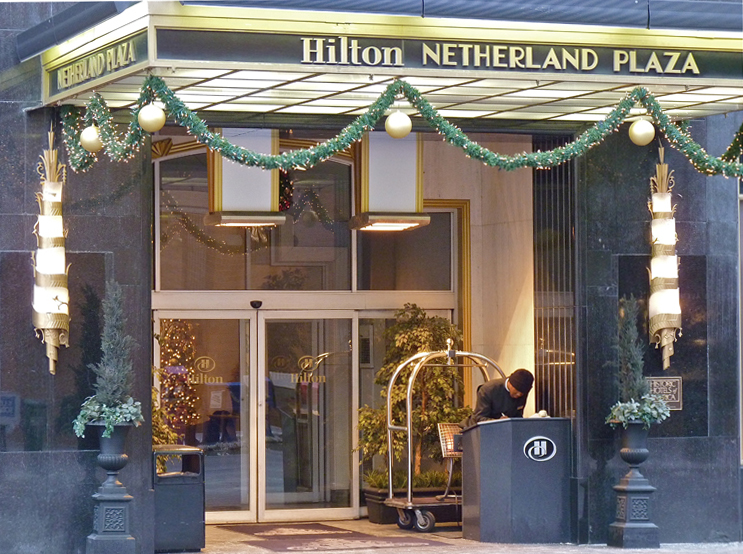 Race Street Entrance with Brass Torcheres Flanking the Porte-cochère.
Notes About the Cincinnati Netherland Hotel Plaza and Carew Tower
I find it extraordinary that the plans for the Carew Tower and Netherland Plaza Hotel were announced in August of 1929, the foundation begun in January of 1930 and the project completed by January, 1931, not only because of the lightning speed in which this opulent monument to Art Deco design was constructed, but because the Wall Street Crash of October 1929 occurred several months after the project was first announced.
The financing came from the Emery family, which had made its fortune in Cincinnati’s stockyards. John Emery hired designer Walter W. Ahlschlager and Colonel William Starrett of Starrett Bros. & Eken of New York. William Starrett at that time was arguably the standard bearer of building first class buildings. Starrett Bros. & Eken are most famously known today as the builders of New York City’s Empire State Building. (For more information about William Starrett see The Empire State Building: The Making of a Landmark by John Tauranac, Scribner, 1995).
The Carew Tower and Netherland Plaza were designed to be what Col. William Starrett termed a “city-within-a-city.” By the time Emery brought him to Cincinnati, Starrett had written of his urban vision in his seminal book Skyscrapers and the Men Who Build Them (Scribner, 1928). Due to traffic density, Cincinnati was ranked the third most congested city in the U.S. Part theoretical and part practical, Starrett’s solution to the increasing density and street level congestion in American cities was an untried, mixed-use skyscraper complex—a city-within-a-city. Although the concept was new at the time, Emery was willing to risk his fortune, believing that the combination of department store, shops, offices, and hotel would invite downtown residents, workers, and visitors. The Carew complex was the first experiment in the design, construction, and development of such a concept and it inspired other mixed-use complexes such as Rockefeller Center, which was completed in 1934.
Emery’s vision for Cincinnati led to bold financial moves. He had approached the bank to underwrite his city-within-a-city project but because the concept was so novel the bank declined. Emery sold all his stocks and securities. The plans and the financing for the building complex were in place when the stock market crashed. Had he left his stocks and securities tied up in the market, he would have lost everything. The construction project became one of Cincinnati’s largest employers during the years after the Great Crash, creating over one thousand jobs.
The Restaurants at Palm Court
The Palm Court was once the main lobby for the hotel. Egyptian, French, and Greek influences abound and are transmuted into an eclectic vision of Art Deco design. At the far end of the Palm Court is a ram’s-head fountain with a breche marble ziggurat-shaped surround, guarded by two strikingly handsome seahorses, crowned with lotus-shaped lights.


George Unger, a talented theatre designer during the 1920s and 1930s, is credited with the majority of the interior design work. Although myriad mythological figures are found throughout the hotel—the ram, dolphin, seahorse, and mermaid represent protection for travelers—the variety of Art Deco images and forms were adopted not so much for their for their symbolic attributes, but for their dramatic visual effect.
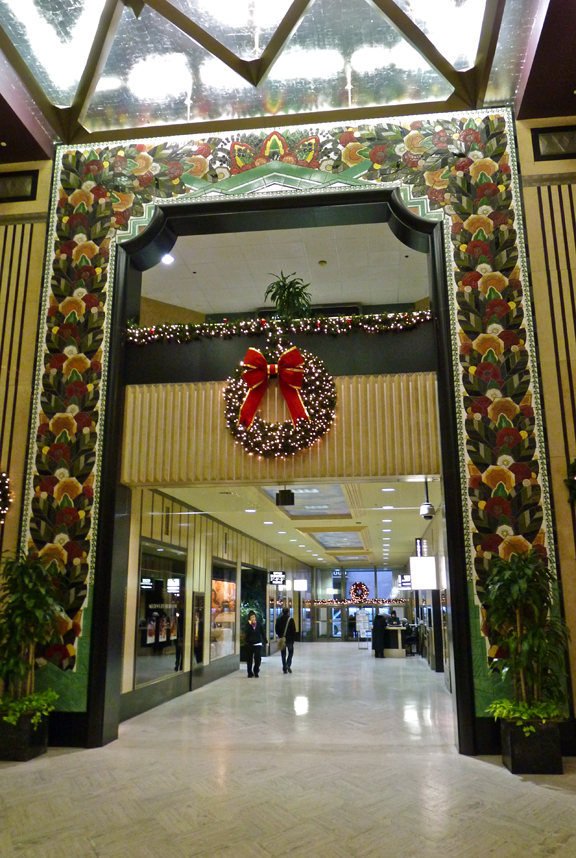 Carew Tower Ceramic Arches
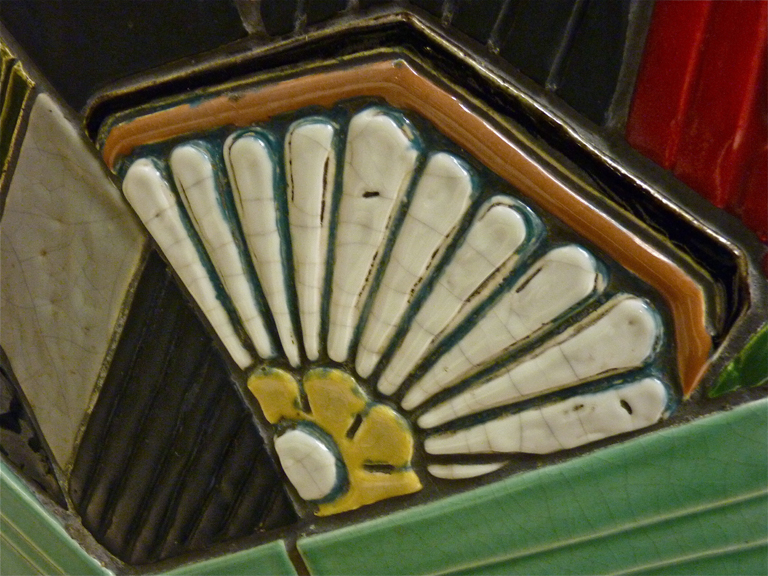
Detail of Ceramic Rookwood Art Tiles from the Carew Arcade Arches

The seahorse, fountain, and Carew Arcade ceramic tile arches were made at the world-renowned Rookwood Pottery studio located atop Mt. Adams, one of the seven hills surrounding Cincinnati. The magnificent floral arches are located on the east and west ends of the Carew Tower Arcade and are one of the largest installations of art pottery in the world. Because of their highly visible location they are one of the most publicly accessible. The tiles are the work of William E. Hentschel and are based on a repeating motif designed by the French metalsmith and armaments designer Edgar Brandt, establishing a link between Hentschel’s Arts and Crafts movement heritage and Brandt’s influence in the French Arts Décoratifs et Industrials Modernes of the mid-1920s. Although not ever directly acknowledged by the developer, builder, or architect, Brandt is considered the “decorative artist in absentia,” particularly of the Netherland Hotel. The appropriation of knock-offs of Brandt’s signature themes such as the frozen fountains, sunflower patterns, rams’ horns, and antelopes into the complex filled an immediate need for a decorative vocabulary in the massive building on the developer’s fast-track schedule.
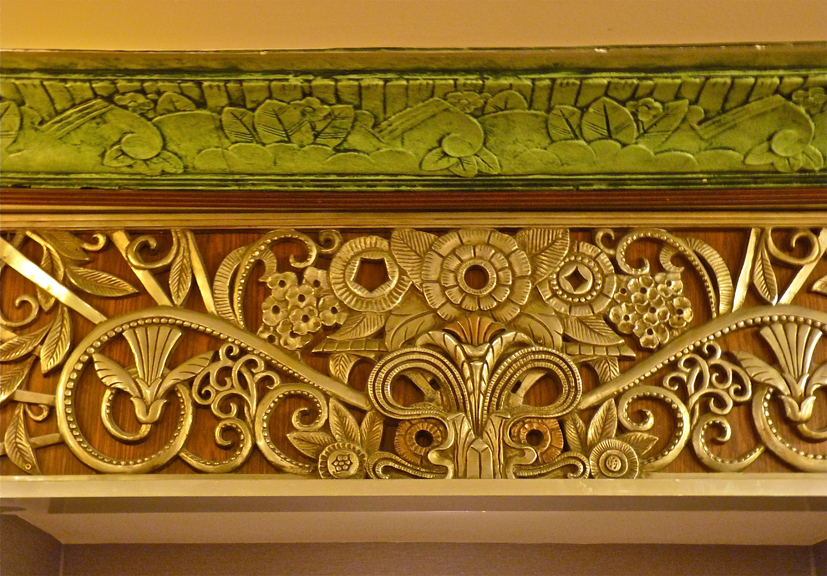
The wall lighting in the Netherland Plaza was considered ground breaking design because the light bulbs were not visible through the silver and nickel sconces.


 Lotus-shaped Light Crowning the Seahorse’s Coronet
Preparations Underway for the Grand Christmas Dinner Feast at the Palm Court!

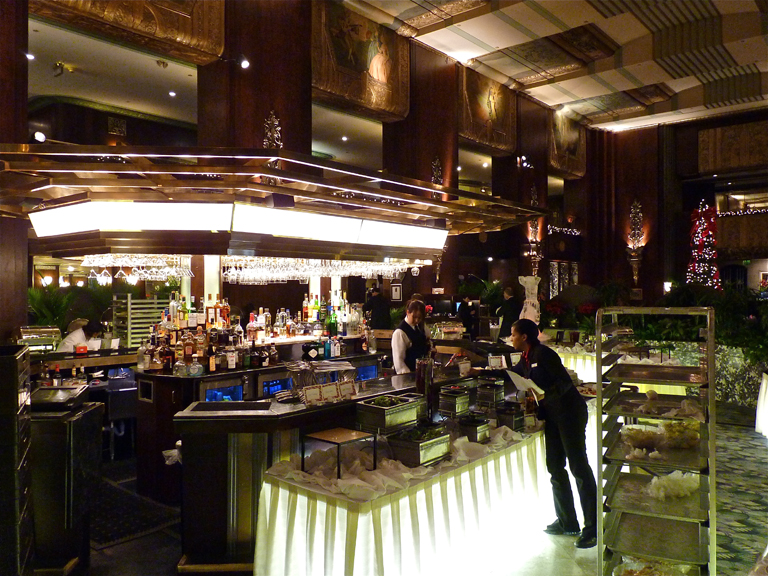
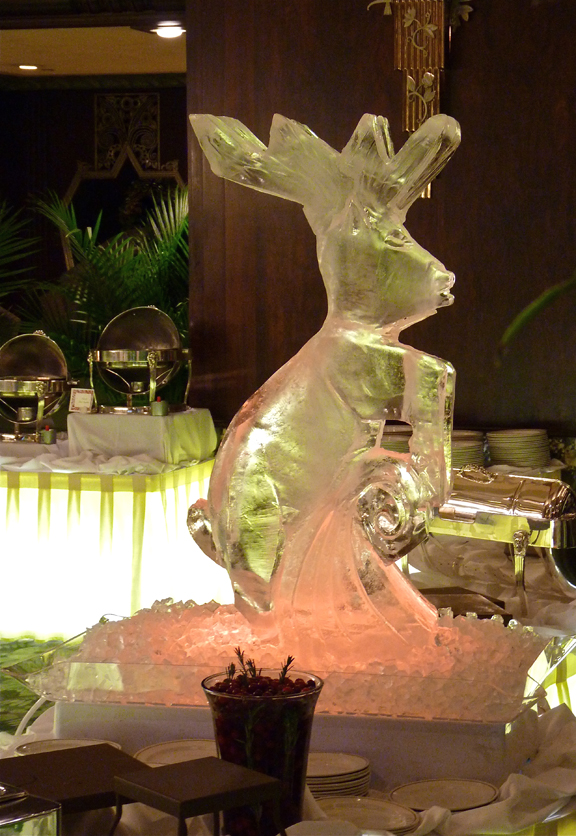

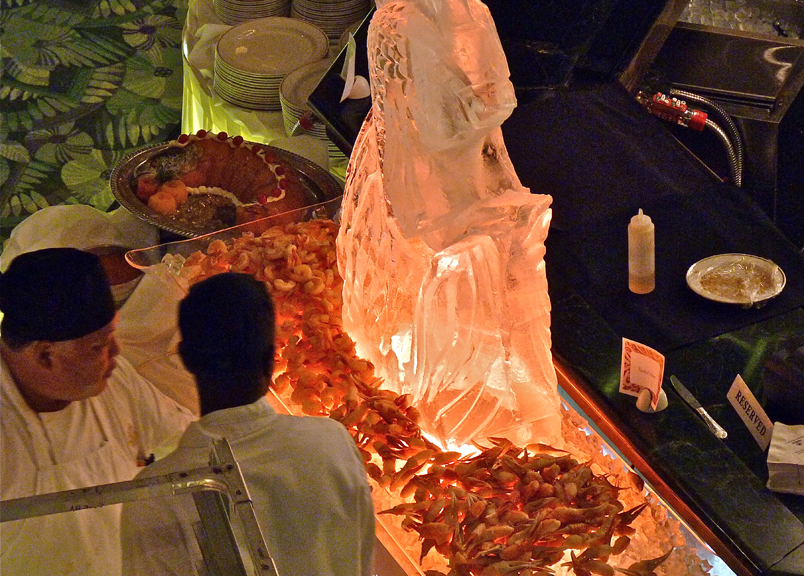

A quiet morning after…


 Confections created by hotel staff
The Hilton Cincinnati Netherland Plaza is an Historic Hotel of America and in 1985 earned National Historic Register and National Landmark Status.
End Note: Breche marbles are a category of marbles that are of similar composition: the pressure and distortions at the time of the geological formation of the stone created a marble with large elements. See photo below and photo of the ram’s head statue surround.


Last May my husband and I were delighted to discover a large flock of White-throated Sparrows (Zonotrichia albicolli) rumpusing about our garden. A chorus of choristers chortling My Sweet Canada, Canada, Canada or alternatively Old Sam Peabody, Peabody, Peabody, their clear, elegant notes were heard for several days and they were easily spotted rustling about in the hedge, dining on safflower seeds scattered on the ground below the bird feeder, and feasting on Winter Moth (Operophtera brumata) caterpillars in the trees. I believe it to be a fairly rare occurrence to observe a flock migrating this far east through Cape Ann. My East Gloucester neighbor Jen, who has a lovely garden even closer to the easternmost edges of the peninsula, reported same. Her flock also stayed for several days enjoying the winter moth caterpillar banquet found in her yard. Rather than walk or run, White-throated Sparrows hop, and we delighted in our all too brief encounter with this beautiful and entertaining “Whistler of the North.”

White-throated Sparrow Eating Winter Moth Larvae
Kingdom: Animalia (Animal)
Phylum: Chordata (Vertebrates)
Class: Aves (Birds)
Order: Passeriformes (Perching birds)
Suborder: Passeri (Songbird)
Family: Emberizidae (Seed-eating birds with a distinctively shaped bill)
Genus: Zonotrichia
Species: Z. albicollis
White-throated Sparrows breed from Mackenzie, central Quebec, and Newfoundland south to North Dakota, Wisconsin, and Pennsylvania. They spend winters in much of the southeastern U.S. and in small numbers in southwestern states. Frequent visitors to back yard feeders, White-throated Sparrows build their nests toward the ground in shrubby thickets or semi-open mixed woods, wood lots, scrub lands, gardens, and backyards. Of note, the sparrow comes in two distinct color forms: white-crowned and tan-crowned. The two color morphs are unique among birds. Individuals almost always mate with a bird of the opposite morph. “Normally, a single brood is raised each season, with the female remaining with the fledged young even after they have left the nesting territory” (Mass Audubon Breeding Bird Atlas). After the breeding season ends, the adults molt and attain their winter plumage.
 White-throated Sparrow Tan-crowned Morph
Last year I wrote an article, “Looking to the Future,” which was about Alain Baraton, the charismatic head gardener of the Palace of Versailles. Mr. Baraton has made it his mission to transform the 2,000-acre traditional landscape into a model of sustainable gardening, and in prohibiting the use of pesticides at the Palace of Versailles, the songbirds have returned in prodigious numbers. I thought of Monsieur Baraton in relation to our visiting White-throated Sparrows. From sunrise to sunset the sparrows could be found in our garden devouring the one-inch green winter moth larvae that were devastating our fruit trees. In hopes of mitigating the damage done by Winter Moths, several times throughout the winter we spray our trees with dormant oil. However, our neighbor does not tend to her dying tree. When the caterpillars grow to about one inch, they descend from her long suffering cherry tree and begin to devour our pear trees. The dilemma is that I do not want to spray with anything stronger than dormant oil and the reasons are manifold. Nuthatches store nuts and seeds in the chinks of bark of our pear trees, myriad species of bees are on the wing and in close proximity, and countless Lepidoptera larvae would also most certainly be adversely affected. As the winter moth expands its territory, logical too would be the assumption that migrating species of birds would find fortification in a diet of winter moth larvae and perhaps their range and population will also increase.
 Adult Winter Moth ~ Operophtera brumata

Walking along a wooded lane last weekend, I couldn’t help but notice the lack of songbirds. One singular, startled robin, that was all, poking about a hedge of scraggly privet. The time of day was late afternoon, which is the same time of day our yard is typically host to a chorus of songsters. Eerily disquieted, I paused for a moment and closed my eyes, imagining what this same lane would look like if found growing there were winterberry and summersweet, blueberry and chokecherry, juniper and holly, and the chattering collection of songbirds these fruit-bearing plantings would surely attract. Perhaps there was a disappointing lack of songbirds because invasive species such as privet has engulfed both sides of the road, or perhaps because the road abutted a golf course, which is regularly doused with insecticides intended to kill every living insect, the songbird’s primary source of food.
 Winterberry (Ilex verticillata)
 Dragon Lady Holly (Ilex x meserveae)
 Sarent’s Crabapple (Malus sargentii)
A friend forwarded an article, posted from the Guardian U.K., about the charismatic head gardener Alain Baraton, of the Palace of Versailles. Appointed in 1976, Mr. Baraton has made it his mission to transform the 2,000-acre traditional landscape into a model of sustainable gardening. Climate change has affected Versailles in ways Baraton never imagined. Because the chestnut trees are flowering twice a year, they are losing their glorious autumnal hues. Pine trees that have lined the park’s avenues since the reign of Louis XIV are dying in gross numbers. The previous year saw so little rainfall that the lawns did not have to be mowed. It is imperative, Baraton says, to move with the times. “The gardener always has to look to the future,” he explains. “We are witnessing an enormous change in climate.”

Baraton saw in the changing environment an opportunity to reform the long-standing use of pesticides. Realizing the futility of applying chemicals to rid the gardens of bugs, which would only return and in greater numbers with warmer temperatures, insecticides were the first to go and he declared a blanket ban. No matter how tiny, Baraton believes every living creature deserves a place in his garden. Enticed by the prospect of plump, juicy insects to feast on, the birds returned to Versailles in prodigious numbers.
 Pine Siskin (Carduelis pinus)
Trees and shrubs have benefited tremendously under Baraton’s guiding hand. Long gone is the tradition of planting the same species in neat ordered avenues. The gardeners vary the plantings to prevent major loss in case any one species becomes diseased.
If the most formal of public gardens, scrutinized under the demanding microscope of an international audience, can afford to forgo the use of insecticides, is there any possible justification for the use of insecticides and herbicides in the individual, business, and public suburban and urban landscape?
Our Dragon Lady hollies have grown tall and the winterberry is flourishing, and because of that, for the past several years we have been graced with a flock of robins in early February (Round Robin Red-Breast). The first winter the robins arrived I noticed that, after they had devoured every morsel of red berry—the winterberry, holly, and crabapple—they moved to a neighboring privet hedge. My first thought was, well at least that’s one good thing about privet–perhaps the robins will eat the overly abundant and plain little blue-black berry of the privet. Not so, the robins did not care too much for it and the flock soon departed our neighborhood.
When we first moved to our property we immediately removed a privet-tree that had seeded itself, growing smack-dab in the sunniest center of our yard. We cut down the trunk and limbs and spent laboriously long hours digging out the root mass. We continually find privet seedlings sprouting in our flower borders. Privet is tedious, and if one has the misfortune to inherit an established hedge, very challenging to remove. On the other hand, a natural arrangement generally requires a modicum of once-yearly maintenance, a light hand with the pruning sheers, to shape or remove dead wood. Imagine if all the suburban privet hedges were replaced with welcoming avenues of flowering and fruiting shrubs that provided nourishment and shelter for the songbirds.

Excerpt from Oh Garden of Fresh Possibilities! ~ The idea of a garden planted in harmony with nature is to create a loosely mixed arrangement of beauty combining native and ornamental fowering trees and shrubs. This informal style of a woodland border or bucolic country hedge is not new and is what the French call a haie champêtre. Perhaps the country hedge evolved because it was comprised of easily propagated, or dispersed by wildlife, native species of plants and perhaps as a revolt against the neatly manicured boxed hedges of formal European gardens. The country hedge is used, as is any hedge, to create a physical and visual boundary, but rather than forming the backdrop for ornamental plants, it is the living tapestry of foliage, owers, fruit and fauna. Working and living in our garden we are enchanted by the creatures drawn to the sheltering boughs, blossoms, and berries.
Looking to the Future was first published Winter 2009.

Chinese glazed porcelain openwork tile, with beautiful green glaze on both sides, for exterior or interior use. Late 19th or early 20th century… on my Christmas wish list…
Round Robin Redbreast
What’s that you say? A flock of robins, in winter?
Yes, yes! Sweetly singing liquid notes. A flock in my garden!
What does a hungry round robin find to eat in a winter garden?
Red, red winterberries and holly, rime-sweetend crabapples, and orchard fruits.
And how does a winter robin keep warm?
Why, blanketed together with air-puffed fluffed feathers.
How long will they stay, how long can they last in the frost?
Only as there are fruits on the bough and berries on the bush.
Round robin red breast, silhouette in bare limb,
Calling away winter, cheer, cheerio, and cheer-up!
– Kim Smith

The widely distributed and beloved American Robin (Turdus migratorius) hardly needs an introduction. The American Robin is the largest member of the thrush family—thrushes are known for their liquid birdsongs and the robin is no exception. Their unmistakable presence is made known when, by early spring, the flocks have dispersed and we see individual robins strutting about the landscape with fat worms dangling. Unmistakable, too, is the male’s beautiful birdsongs, signaling to competing males to establish their territory, as well as to entice prospective females.
The boundaries of the American Robin winter migration areas are not clearly defined. The robin’s winter range covers southern Canada to Guatemala, compared to their summer nesting range, which extends from the tree limit of Canada to southern Mexico. Robins that nest in Massachusetts, for the most part, migrate further south. Robins nesting in northern Canada migrate to their tropic-of-New England get-away.
During the winter months Cape Ann often becomes home to large flocks of robins and we have had the joy of hosting numerous numbers in late afternoon and early morning. I can’t help but notice their arrival to our garden. Their shadows descend, crisscrossing the window light, followed by a wild rumpus in the ‘Dragon Lady’ hollies. This pair of hollies is planted on opposing sides of the garden path, alongside my home office. I have learned to stealthily sneak up to a window, as any sudden activity inside startles birds that are investigating our garden, and they quickly disperse. Dining not only on berries of the ‘Dragon Ladies’, but also the ‘Blue Princess’ Meserve holly and winterberry bushes, are generally speaking dozens of noisy, hungry robins. These winter nomads flock to trees and shrubs that hold their fruit through winter, feasting on red cedar, American holly, Meserve hollies, chokecherries, crabapples, and juniper. Robins traveling near the sea will comb the shoreline for mollusks and go belly-deep for fish fry. Depleting their food supply, they move onto the next location. Gardens rife with fruiting shrubs and trees make an ideal destination for our migrating friends.
The garden designed to attract pairs of summer resident robins as well as flocks of winter travelers would be comprised of trees and shrubs for nest building, plants that bear fruit and berries that are edible during the summer and fall, and plants that bear fruits that persist through the winter months. Suburban gardens and agricultural areas provide the ideal habitat, with open fields and lawns for foraging insects as well as trees and hedgerows in which to build their nests.
Robins in New England breed from April through July, often bearing three clutches. Nests are built in the crotch of trees and dense bushes, five to fifteen feet above ground, and some are occasionally made on the ground or built on protruding ledges of homes. The female robin weaves a cup-shaped foundation of coarse grass, twigs, paper and feathers, and then lines the bowl with mud she smears and packs firmly with her breast. Later she adds soft fibers such as fine grass and downy feathers to cushion the egg. The first nest is usually placed in an evergreen tree or shrub; for each subsequent clutch a new nest is built and generally placed in a deciduous tree.
The following plants, suggested with robins in mind, will also attract legions of songbirds (and Lepidoptera). The list is comprised primarily of indigenous species with a few non-native, but not invasive plants included.
Trees for nesting ~ American Holly (Ilex opaca), Eastern Red Cedar (Juniperus virginiana), Red Maple (Acer rubrum), Sugar Maple (Acer saccharum), Flowering Dogwood (Cornus florida).
Summer and autumn fruit bearing trees, shrubs and vines for robins ~ Black Cherry (Prunus serotina), Blackberry (Rubus spp.), Flowering Dogwood (Cornus florida), Gray Dogwood (C. racemosa), Red-osier Dogwood (C. sericea), Silky Dogwood (C. amomum), Elderberry (Sambucus canadensis), Apple (Malus pumila), Virginia Rose (Rosa virginiana), Highbush Blueberry (Vaccinium corymbosum), Lowbush Blueberry (Vaccinium angustifolium), Wild Grape (Vitis spp.).
Trees and shrubs with fruits persisting through winter ~ Winterberry (Ilex verticillata), Mountain Ash (Sorbus americana), Crabapple (Malus spp.), Sargent’s Crabapple (Malus sargentii), American Holly (Ilex opaca), Meserve Hollies (Ilex x meserveae), Eastern Red Cedar (Juniperus virginiana), Common Juniper (Juniperus communis), Chokecherry (Prunus virginiana), Smooth Sumac (Rhus glabra), Staghorn Sumac (Rhus typhina).


 nt]
nt]Music to my Ears: The following note is from my dear friend Kate Hines who built a beautiful home on a lovely piece of property—former farmland that borders the lush and fertile Rhode Island coastline. Thank you Kate for sharing!
“I was so inspired reading the section you wrote on hollies in Oh Garden of Fresh Possibilities! that I went to the local nursery and ordered 2 – a female 6′ and a male 5.’ Now they are mixed in with the evergreen grove to the north of the house. They were costly, a big project but soooooo satisfying! Ill send pix.”
XOXO KH

Oh Garden of Fresh Possibilities! makes for a very useful gift for the gardener (and loved-ones dreaming of creating a garden) on your holiday gift giving list. Last year at this time Carol Stocker, the Boston Globe garden columnist wrote the following about Oh Garden:
Oh Garden of Fresh Possibilities!
Boston Globe Best of 2009
For Armchair Gardeners Pining for Spring
“Bleak and snowy outside? These lush reads will have you dreaming green. January and February are the reading months for gardeners trapped indoors. Here are some of the best garden books from 2009. “Oh Garden of Fresh Possibilities! Notes From a Gloucester Garden,’’ written and illustrated by Kim Smith (David R. Godine, Publisher), is a treasure, and perhaps the best garden gift book. Why? Both dream-like and practical, it captures the rapture of a gardener’s journey through her own evolving quarter acre by integrating Smith’s personal essays, hands-on advice, and paintings. I was charmed by her listing of specific scents of favorite peony varieties accompanied by a painted sample of their petal colors…”
Oh Garden of Fresh Possibilities! Written and Illustrated by Kim Smith. Available through your local bookseller, David R. Godine, Publisher, and Amazon.
 Amaryllis ‘Ambiance’
Dear Gardening Friends,
We have been blessed with a delightfully warm autumn, which has made these last few weeks in the garden a delight. As I am preparing gardens for their winter rest, my thoughts turn to the upcoming holidays and the winter blooms that will make the season all that much brighter. I hope you don’t mind—the following is from the chapter on Coaxing Winter Blooms, excerpted from Oh Garden of Fresh Possibilities! With our son’s soccer team headed to the state finals, I haven’t had the ability to focus, spare time to write, or accomplish much of anything besides work. We’re all on pins and needles in anticipation of the Big Game!
Warmest wishes and Season’s Greetings, Kim
P.S. Results of Sunday ‘s game: CONGRATULATIONS VIKINGS, the new Division Three North Massachusetts State Champions!!!!!!!!!!!!!!!!!!! Rockport Vikings 1, St.Mary’s, Lynn 0. Wednesday’s game against the winning southern region state champs will be held in Quincy at 5:00pm. GO VIKINGS!
A Note about Amaryllis
Living in New England the year round, with our tiresomely long winter stretching miles before us, and then a typically late and fugitive, fleeting spring, we can become easily wrapped in those winter-blues. Fortunately for garden-makers, our thoughts give way to winter scapes of bare limbs and berries, Gold Finches and Cardinals, and plant cat-alogues to peruse. If you love to paint and write about flowers as do I, winter is a splendid time of year for both, as there is hardly any time devoted to the garden during colder months. I believe if we cared for a garden very much larger than ours, I would accomplish little of either writing or painting, for maintaining it would require just that much more time and energy.
Coaxing winter blooms is yet another way to circumvent those late winter doldrums. Most of us are familiar with the ease in which amaryllis (Hippeastrum) bulbs will bloom indoors. Placed in a pot with enough soil to come to the halfway point of the bulb, and set on a warm radiator, in several week’s time one will be cheered by the sight of a spring-green, pointed-tipped flower stalk poking through the inner layers of the plump brown bulbs. The emerging scapes provide a welcome promise with their warm-hued blossoms, a striking contrast against the cool light of winter.
Perhaps the popularity of the amaryllis is due both to their ease in cultivation and also for their ability to dazzle with colors of sizzling orange, clear reds and apple blossom pink. My aunt has a friend whose family has successfully cultivated the same bulb for decades. For continued success with an amaryllis, place the pot in the garden as soon as the weather is steadily warm. Allow the plant to grow through the summer, watering and fertilizing regularly. In the late summer or early fall and before the first frost, separate the bulb from the soil and store the bulb, on its side, in a cool dry spot—an unheated basement for example. The bulb should feel firm and fat again, not at all mushy. After a six-week rest, the amaryllis bulb is ready to re-pot and begin its blooming cycle again. Excerpt Oh Garden of Fresh Possibilities! ~ Coaxing Winter Blooms
 Amaryllis ‘Orange Sovereign’


Pictured above are cascading mounds of Korean daisies blooming in the autocourt at Willowdale Estate, located in Topsfield, Massachusetts. Korean daisies will continue to bloom through several light frosts and support myriad late-on-the-wing pollinators. This photograph was taken on Veteran’s Day, November 11, 2010.
