The Cape Ann Monarch Milkweed Project was positively a resounding success. Thank you to everyone who ordered and picked up your milkweed plants. Thank you to Joe Ciaramitaro from Good Morning Gloucester who turned my small seed of an idea into a fabulous community-wide project and who also very kindly offered Captain Joe and Sons for mug up and pick up. Thank you to all my GMG fellow contributors and all the FOBs for coming, and for everyone’s enthusiasm in the project.
And, most importantly, the Monarchs thank you!!!
We have exactly fourteen plants remaining and all fourteen are spoken for. After all the plants are picked up and the money totaled, we will have enough to make a donation to the Rocky Neck Cultural Center. So thank you again. I am very inspired by the success of the program and plan to later in the summer have a Cape Ann Monarch Aster and Goldenrod Program.
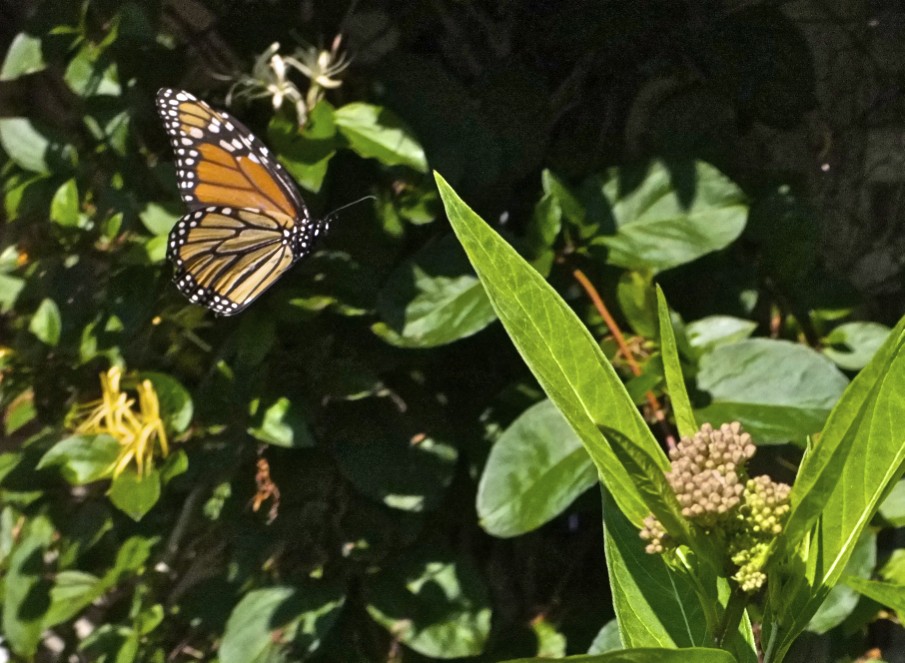
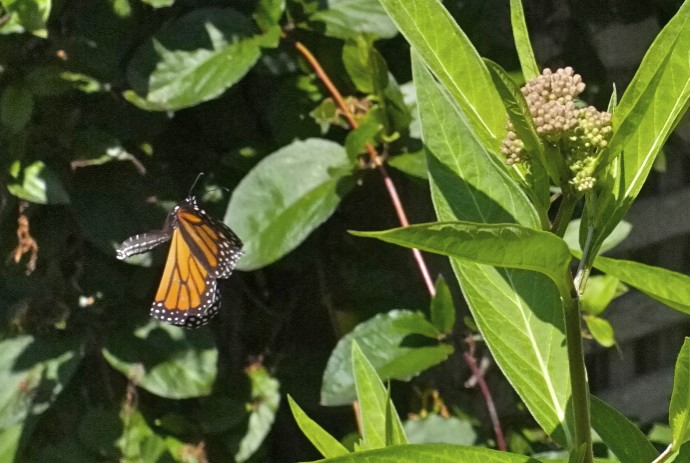
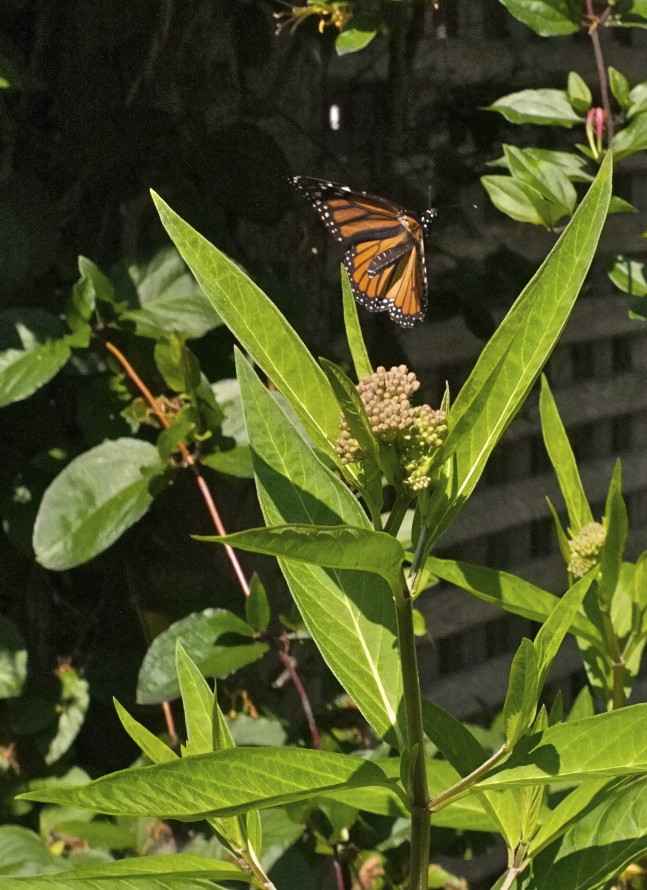
Monarch Butterflies at Eastern Point
How to Plant and Care for Your Milkweed Plants
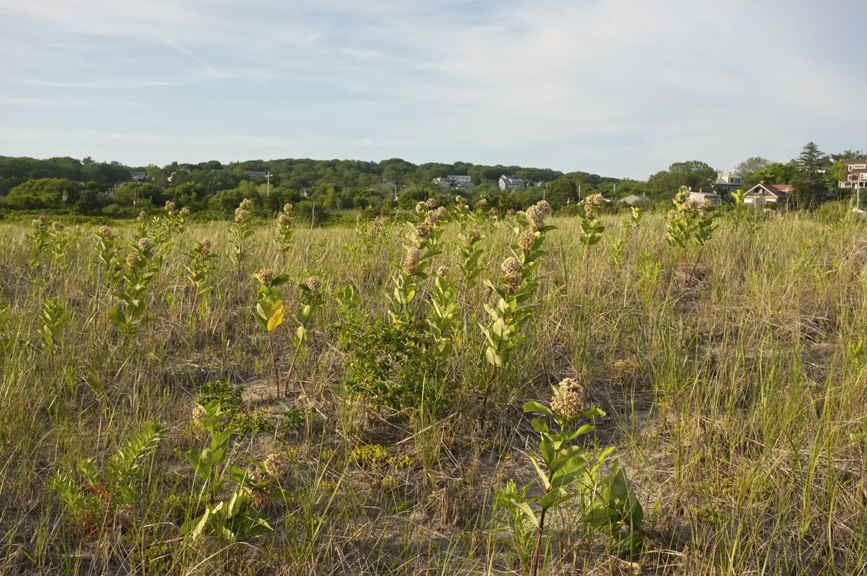
Common Milkweed (Asclepias syriaca) has a taproot. Plants with taproots do not like to be disturbed once established so it is best to plant your Common Milkweed seedlings as soon as possible. Common Milkweed is not too fussy about soil and is the milkweed we see growing in fields, roadsides, dunes, and meadows. It can reach up to six-feet in height, but more commonly grows two- to four-feet. Common Milkweed spreads by underground shoots and by seed dispersal.
The Marsh Milkweed (Asclepias incarnata) are well-rooted year-old plants and can be planted in the garden now, or within the next month or so. Marsh Milkweed grows best in good garden soil and/or moist areas. Marsh Milkweed is clump forming and does not spread by underground shoots.
Both milkweed species prefer full sun, but will take some slight shade. Plant with the soil line equal to the soil line in the pot. Place a stake nearby so that you do not step on your little milkweed seedling. Water gently. Check frequently on your milkweed plant until it is fully established. Water when dry, but do not over water. Monitor for milkweed aphids. Milkweed aphids are tiny soft-bodied orange insects. If you do see any aphids, gently wash them away with water; no soap or strong pesticides needed!
Hooray–our milkweed plants shipped from Missouri Monday and should arrive to Gloucester by Thursday!!!
Plants will be available for pick up at Captain Joe and Sons, 95 East Main Street, Saturday morning at 9:00am and we will be there all morning until noon. Felicia is helping and we will have coffee for everyone. Written instructions will be provided on how to take care of your plants. Looking forward to seeing you all at the first ever Monarch~Milkweed Mug Up!
I did not collect the funds ahead of time. Please everybody, if you ordered plants, be sure to pick-up Saturday morning. I am counting on you!! If the project is successful, we will do this again later in the season, with Seaside Goldenrod and New England Asters, but we can only have another plant sale if everyone honors their commitment. Thank you!!
For more detailed information, see previous posts:
Thank you to everyone participating in the Cape Ann Milkweed Project!
Monarch Butterfly Nectaring at Common Milkweed ~ Good Harbor Beach
Milkweed may not be for everyone’s garden; even if you did not order plants, you are welcome to come on down to the dock Saturday morning, the 18th of May, and learn more about the Monarch-milkweed connection. The plants are being shipped on Monday the 13th and I will keep you updated on their progress.
Tonight I am placing the order for the milkweed plants. Please get your orders in.
Thank you, thank you to Everyone participating in our Cape Ann Milkweed Project!!!
Newly Emerged Monarch Butterflies. I called these two butterflies the” Twins,” because they completed every stage of their life cycle within moments of each other, including pupating and emerging from their chrysalides.
Everyone who wrote in yesterday and placed an order has been recorded. Anyone interested in ordering either Common or Marsh Milkweed today, please place your order in the comment section of this post or yesterday’s post, which explains the project, and includes all details. Don’t forget to specify whether you are interested in Common or Marsh Milkweed and how many plants you would like.
Thank you so much to everyone who is participating. Keep the orders coming!
Monarch Caterpillars Feeding on Milkweed in the Summer…
In March I shared an article about bringing back the Monarch Butterflies. Great interest in planting milkweed was expressed by many. The way to bring as many Monarchs as possible to our region is to help recreate the butterfly’s habitat in our own gardens. The number one way to do this is by planting native wildflowers, milkweed for the summer caterpillars, and asters and goldenrod for the fall migrants. Number two is to make a commitment not to use pesticides, which will indiscriminately kill all the creatures that your milkweed plants invite to your garden.
Monarch Eggs on Common Milkweed ~ see the tiny yellow pinhead-sized dots on the top of the upper leaves of the milkweed plants (click to view larger)
Milkweed is the only food plant of the Monarch caterpillar and the flower is a fantastic source of nectar for myriad species of bees and butterflies.
So many readers wrote in requesting milkweed plants that my friend Joey from Good Morning Gloucester blog has very generously offered his place of business—Captain Joe and Sons—as our go-to-place for picking up plants!! It’s going to be a super fun morning–stop by with your coffee, visit, learn about milkweed and Monarchs, and pick up your order.
Please place your order today or tomorrow. I am not pre-collecting the money and am fronting the funds to purchase plants. I don’t want to have dozens of homeless plants, so I am asking everyone to please be on the honor system.
We are ordering two types of milkweed. The cost is 7.00 per plant, which will come in a 3.5 inch square pot. The plants are on the smallish side however, that is the ideal size for shipping and transplanting milkweed. I am writing instructions for planting and they will be provided at the time of purchase.
Monarch Caterpillars J-Shape on Common Milkweed Getting Ready to Turn into a Chrysalis
Common Milkweed (Asclepias syriaca) is the milkweed we see most typically growing in our dunes, meadows, roadsides, and fields. It grows quickly and spreads vigorously by underground runners. This is a great plant if you have an area of your garden that you want to devote entirely to milkweed. It prefers full sun, will tolerate some shade, and will grow in nearly any type of soil. The flowers are dusty mauve pink and have a wonderful honey-hay sweet scent.
Marsh Milkweed (Aclepias incarnata) is more commonly found in marshy areas, but it grows beautifully in gardens. It does not care for dry conditions. These plants are very well-behaved and are more clump forming, rather than spreading by underground roots. The flowers are typically a brighter pink than Common Milkweed.
Monarchs deposit their eggs readily on both types of milkweed and in my garden I grow Common Milweed and Marsh Milkweed side-by-side.
The cost of the plants includes shipping from Missouri. Hopefully everyone will be good and if they place an order, will honor their commitment. If there is any money beyond what was spent on plants and shipping we will donate it to the ongoing fundraising drive for the Rocky Neck Cultural Center purchase of the beautiful center on Wonson Street.
Plant pick-up is at Captain Joe and Sons, 95 East Main Street, Gloucester, on Saturday, May 18th from 9:00am to 12noon. If you cannot pick up your plants at that time, please ask a friend.
My order to the nursery is being placed on Tuesday night, so please get your orders in asap. Place Your Milkweed Order in the comment section of this post. Be sure to indicate which type of milkweed, Common or Marsh, and number of plants.
Our deepest thanks to everyone who is participating.
Female and Male Monarch Butterfly on Marsh Milkweed (Asclepias incarnata)
Rain date pick up: Sunday, May 19th from 9am to 12noon.
I am going to look into purchasing a large quanity of milkweed seedlings at wholesale prices for anyone in our community interested in cultivating milkweed. If interested, please leave a comment in the comment section, which will help give me an idea, very approximately, on how many plants to order. You can also wait until the fall and sow ripened milkweed seedpods. (Note: Please do not dig up any wild milkweed).
The following timely news release was in my inbox this morning!
MONARCH WATCH ANNOUNCES
‘BRING BACK THE MONARCHS’ CAMPAIGN
“In real estate it’s location, location, location and for monarchs and other wildlife it’s habitat, habitat, habitat”, said Chip Taylor, Director of Monarch Watch. Monarch Watch (www.MonarchWatch.org) started in 1992 as an outreach program dedicated to engaging the public in studies of monarchs and is now concentrating its efforts on monarch conservation. “We have a lot of habitat in this country but we are losing it at a rapid pace. Development is consuming 6,000 acres a day, a loss of 2.2 million acres per year. Further, the overuse of herbicides along roadsides and elsewhere is turning diverse areas that support monarchs, pollinators, and other wildlife into grass-filled landscapes that support few species. The adoption of genetically modified soybeans and corn have further reduced monarch habitat. If these trends continue, monarchs are certain to decline, threatening the very existence of their magnificent migration”, said Taylor.
To address these changes and restore habitats for monarchs, pollinators, and other wildlife, Monarch Watch is initiating a nationwide landscape restoration program called “Bring Back The Monarchs.” The goals of this program are to restore 20 milkweed species, used by monarch caterpillars as food, to their native ranges throughout the United States and to encourage the planting of nectar-producing native flowers that support adult monarchs and other pollinators.
This program is an outgrowth of the Monarch Waystation Program started by Monarch Watch in 2005. There are now over 5,000 certified Monarch Waystations – mostly habitats created in home gardens, schoolyards, parks, and commercial landscaping. “While these sites contribute to monarch conservation, it is clear that to save the monarch migration we need to do more,” Taylor said. “ We need to think on a bigger scale and we need to think ahead, to anticipate how things are going to change as a result of population growth, development, changes in agriculture, and most of all, changes in the climate,” said Taylor.
According to Taylor we need a comprehensive plan on how to manage the fragmented edges and marginal areas created by development and agriculture since it is these edges that support monarchs, many of our pollinators, and the many forms of wildlife that are sustained by the seeds, fruits, nuts, berries, and foliage that result from pollination. “In effect,” Taylor argues, “we need a new conservation ethic, one dealing with edges and marginal areas that addresses the changes of the recent past and anticipates those of the future.”
The above photo of a male (right) and female (left) Monarch Butterflies on Marsh Milkweed is part of the GMG/Cape Ann Giclee photography show, currently on view at Cape Ann Giclee.
Registration is still open however, my close-up photography workshop, Nature in Focus, is nearly full. The workshop will be will beheld at the Arnold Arboretum of Harvard, at the Hunnewell Building, on Sunday September 3oth, at 9:00 am. I especially love teaching at the Arnold Arboretum. The facilities are beautiful, the staff wonderfully helpful, and September is a particularly gorgeous month to visit the gardens of the Arboretum. I hope you can join me!
Nature in Focus: Taking Great Close-ups Kim Smith, Photographer and Filmmaker1 Session: Sunday, September 30, 9:00am–NoonLocation: Hunnewell BuildingLearn tips for taking great close-up photographs from celebrated butterfly and garden photographer Kim Smith. Through slides and hands on demonstrations, Kim will guide you in capturing the beauty of the flora and fauna found in nature. Bring your camera and questions, and a tripod if you have one. You will gain more from the class if first you familiarize yourself with your camera’s manual. (Note: This is not a macro-photography class.) See examples of Kim’s great images.
Last summer the Ciaramitaro girls stopped by our garden to see a newly emerged Monarch butterfly. After releasing the butterfly, Eloise wanted to learn more about the Monarchs, and butterflies in general. This year she remembered from their visit the previous year that the Monarch caterpillar food plant is milkweed. Eloise, who I am convinced is a budding naturalist and artist, is an avid gardener (just ask her about her vegetable patch!), so I promised her milkweed plants. We scouted out a sunny a corner of the family’s yard and, after mom Jill helped dig up the sod, we planted a petite butterfly garden, with Common Milkweed for the Monarchs, parsley and fennel for the Black Swallowtails, and marigolds to attract the nectaring insects. We’re looking forward to their first butterfly sightings!
Views from Eastern Point and Raymond’s Beach with wildflowers Smooth Aster, Common Milkweed, and Seaside Goldenrod. Time lapse of Seven Seas Navigator cruise ship turning in the harbor.
Click on panorama and horizontal photo to see full photo. WordPress distorts horizontally oriented images.
Recently a design colleague wrote inquiring as to the best time to mow her client’s fields as she was concerned about disrupting the breeding cycle of the Monarch butterfly. I am often asked this question and it is well worth considering, not only for the sake of the Monarchs, but for the survival of the myriad species of butterflies, bees, and other pollinating and beneficial insects that find food and shelter in untilled fields.
Newly Emerged Monarch Butterfly
Dear Laurel,
I generally advise my readers and design clients that own similar untilled fields to alternately mow in stages–half a field at a time. The Monarch is a large, charismatic butterfly with an easily observed life cycle. The typical field comprised of native (and introduced) wildflowers and grasses creates a rich biodiversity, supporting innumerable species of butterflies and beneficial insects. It is hard to know when exactly to mow for each different species and when to mow for even one single species because, from year to year, depending on many variables including temperature and air currents, the insects breeding times are somewhat variable. For example, this year I have had three broods each of both Monarchs and Black Swallowtails, when in a more typical year I may only have two broods.
Monarch Butterfly Caterpillars Attached to Milkweed (Asclepias syriaca)
I think of not too long ago when we were primarily an agrarian society. Farmers then would have mowed different fields at different times during the growing season. A woman in our community, whose field is rife with common milkweed, always mows in late June or early July. Initially I thought that this was perhaps not good practice for the Monarchs, but the thing with Common Milkweed (Asclepias syriaca) is that when mown to the ground in early summer, it shoots right back up again. By the time the late July, early August Monarchs have arrived and are breeding in our region, her milkweed has re-sprouted, grown at least a foot, is lush and green, and flowering.
That your client is interested in caring for the flora and fauna that abounds in her fields is wonderful! We want weeds (wildflowers) growing in our fields–they provide food and shelter for benefiel insects and wildlife and also help to retain moisture in the soil.
The single greatest threat to the Monarch butterfly is the use of Monsanto’s Roundup Ready genetically modified corn and soy bean seed, which are designed to tolerate potent does of Monsanto’s herbicide Roundup, however, Roundup kills all other surrounding plants and all beneficials insects and their larvae. Additional threats include the extreme weather condiitons caused by climate change, overdevelopment in the US, which has led to loss of habitat, and the unrelenting poverty in rural Mexican villages, which is leading to the deforestation of the butterflies habitat in Michoacán
Monarch Butterfly Chrysalids
At a lecture I attended presented by Doug Tallamy, Professor and Chair of Entomology and Wildlife Ecology at the University of Delaware, he also suggested mowing fields in alternate stages, so we are in good company!
An additional suggestion is to give a corner of your field or garden over to a patch of milkweed, which would then insure a steady supply for the Monarchs. We grow both Common Milkweed and Mash Milkweed (Asclepias incarnata) side-by-side. The marsh flowers slightly earlier, attracting earlier Monarchs. The males intently patrol the milkweed patch and after mating, the females flit from flower to leaf, alternatively depositing eggs on both species of milkweeds, while taking sips of nectar from whichever milkweed is in flower.
Kind regards,
Kim
Note form Laurel:
Hello Kim,
I have a new client who has both cultivated ornamental gardens, which I am caring for, and open meadows, which she has mown once or twice per season. There is lots of milkweed in the field, with some seedlings sprouting in the garden. We pulled the seedlings and brought them home to later place in a field near where I live. We had them in jars in water and were surprised and delighted when a few days later we discovered 7 tiny Monarch larvae. We have raised them to the butterfly stage and released them. Fascinating! During the process I did some reading about the Monarch and learned that there are 4 or 5 generations each season, with the final butterflies, in September, making the trek to Mexico for the winter, and then flying north in the spring to start the cycle over again. My question is about the timing of the mowing of the fields. If it is mown at any time during the breeding season (May – September?), isn’t the current generation almost or completely wiped out? Do you know when the best time is to mow for the butterflies? I assume it is late fall, but since the mowing of meadows has been happening for centuries, is it perhaps ok to mow during the season? (or perhaps this is one contributing reason for the demise of these lovely creatures….) Thank you in advance for any info!
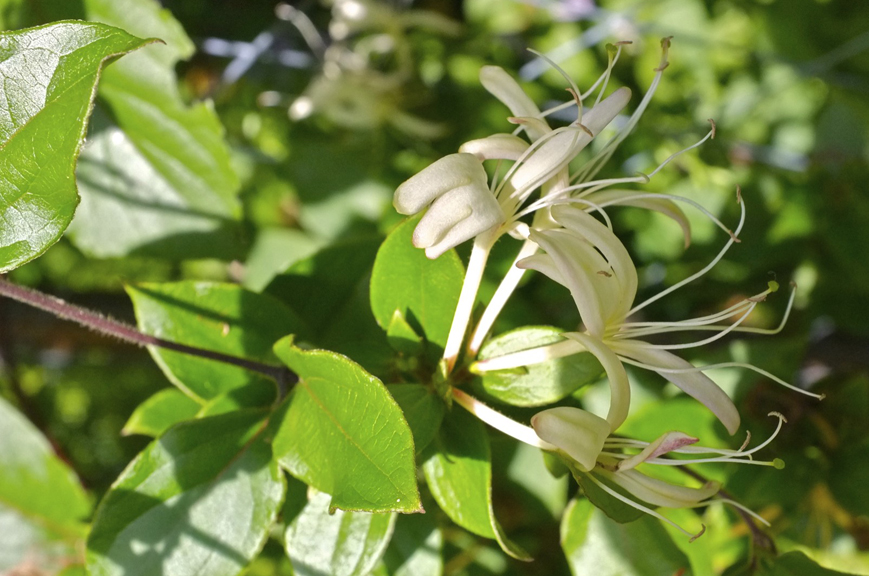
While snapping a photo of the divinely scented honeysuckle embowering the outside shower…
I spotted our first female Monarch butterfly of the season.
She’s arrived a bit earlier than usual this year, or more accurately, the milkweeds in our garden are slightly behind in blossoming time-Marsh Milkweed won’t bloom for another half-week and Common Milkweed won’t flower for another two weeks (both milkweed patches are growing nearby the shower enclosure). However, she did not have nectaring in mind.
Pausing at the emerging buds and foliage of the Marsh Milkweed, then to the Common Milkweed, then back to Marsh, and curling her abdomen to the underside, one by one she oviposited golden egg after golden egg.
Typically, she searches for the uppermost, freshly emerging foliage in which to deposit her eggs. Click the above photo to make it larger. The newly deposited egg, no larger than the size of a pinhead, is a visible pale yellow dot adjacent to her abdomen.
After ovipositing an egg on the Marsh Milkweed, she next deposited several on the Common.
Click the above photo. Five eggs are visible, two on the upper leaf of the plant to the left and three on the upper leaf of the plant to the right.
I never tire of watching butterflies, especially Monarchs, whether in our garden or further afield, and eagerly anticipate their arrival each year. Monarchs are particularly gratifying to observe and record because they are one of the larger butterflies that grace our region. Oftentimes when I am photographing a smaller butterfly such as a Summer Azure, with a mere one-inch wingspan, I don’t know what I have captured through the camera’s lens until returning to the computer to download and edit. Monarchs, with their big and bold wing patterning and approachableness (is that a word?) are a joy to photograph. Because of their extraordinary migration, I believe the Monarch butterflies are one of the natural wonders of the world. We are so blessed to live in a community that plays host to such great numbers. PLANT MILKWEED and you, too, will have Monarchs! I guarentee it!
Common Milkweed in full bloom at Good Harbor Beach this week.
Common Milkweed (Asclepias syriaca) found along the shoreline grows in sandy soil and is exposed daily to windy seaside conditions. In these rough and tumble conditions it typically grows two- to two and a half -feet tall. Conversely, where in our garden it grows in fertile, friable soil and lives in a sheltered corner protected from wind, Common Milkweed often grows six to seven feet tall.
Walking along the boardwalk I often catch the sweet honey-hay fragrance of the Common Milkweed when in full bloom. Marsh Milkweed has little to no fragrance. Several Monarchs were seen while photographing this patch of milkweed.
Blooming along the pathway leading to the outdoor shower is the magnificent hummingbird attractant Torch Lily (Kniphofia uvaria) and bee magnet Helenium, commonly called Sneezeweed or Dog Tooth Daisy.
The foliage of the diminutive Mexican marigolds (Tagetes tenuifolia), commonly referred to by the Mexican people as “flowers of the dead,” bears a fabulous spicy citrus fragrance. Flowers and foliage are edible and add both a tangy color and taste. I grow it in a pot, keeping it sometimes near the shower and sometimes moving it to the dining area.
The female Monarch stayed the morning and I have not seen her since. Lucky us, though. I found fifteen eggs, without really trying too hard, and will now have lots of caterpillars and chyrsalids for upcoming butterfly programs!
End Note regarding Japanese honeysuckle: The variety discussed here is a purple-stemmed variant and I have seen it written as Lonicera japonica var. repens and Lonicera japonica ‘Purpurea.’ In our zone 6 garden, I have found it to be well-behaved, neither bearing fruit nor sending runners. I do not recommend planting in zones 7 and above. Lonicera ‘Purpurea is highly attractive to all manner of bees. As richly scented as the species, the blossoming time of L. ‘Purpurea’ lasts well over six weeks, equating weeks of showering while enwrapped in the spellbinding sweet scent of honeysuckle.
Lonicera japonica var. repens or Lonicera japonica ‘Purpurea’
In organizing my Monarch book proposal to send to a friend, who has a friend who publishes children’s books, I am sorting through my illustrations. This painting was completed at the end of summer last and illustrates a male Monarch (above) and female (below) ascending towards a maple tree during their mating flight. He carries her and together they stay joined, abdomen to abdomen, for several hours–truly a beautiful thing to observe.
I lay down on the ground under a neighboring maple tree and sketched while looking up into the canopy. This is what I imagine the leaf net canopy looks like to the Monarchs as they ascend into the trees.
PLANT MILKWEED AND YOU, TOO, WILL HAVE MONARCHS MATING IN YOUR GARDEN!!
Milkweed is the food plant of the Monarch caterpillars. I often observe females drinking nectar from the milkweed blossoms one moment and the very next, depositing an egg on the underside of a freshly unfurled leaf, near the top of the plant. We observe the greatest numbers of caterpillars on the foliage of Common Milkweed (Asclepias syriaca) and Marsh Milkweed (Asclepias incarnata).
Recently I returned from a trip to southwestern Ohio to visit my sister-in-law Amy, who is recovering from hip replacement surgery. She is mending beautifully and determined to get back on her feet —only a few days after returning home from the hospital the visiting nurse said she was doing as well as their typical patient at three weeks out!
While Amy was resting I would grab my camera and head into her garden and the surrounding fields because here was a Butterfly and Hummingbird Bonanza! I encountered dozens of Ruby-throated Hummingbirds, typically feeding and frolicking in groups of threes and fours, and many differing species of butterflies. For the most part, the butterflies that I photographed are the same species of butterflies that are found on Cape Ann and throughout New England. Having no expectation of encountering myriad butterflies, in both range of species and in legions of each, I had not planned accordingly and only packed my Panasonic Lumix. I love this camera, but like all cameras it does have certain limitations. Lesson learned—that is to say—always travel prepared for anything to happen!
Male Spicebush Swallowtail Dusted with Pollen
Amy is a working architect and, as time and her work schedule have permitted, she has (along with her recently deceased dear husband Tim) redesigned and restored her lovely old farmhouse and gardens. There are several cozy porches and a deck under construction in which to sit and observe the wildlife dramas that play out almost daily.
What makes Amy’s garden so inviting to the pollinators? The old farmhouse is approached by traveling down a crushed limestone driveway. On either side of the drive are fields, either overgrown with wildflowers, or maintained as mowed grass. The fields meet the forest edge. There are several neighboring houses along the drive but privacy is afforded because the houses are sited a fair distance apart and because there are naturalized arrangements of native trees and shrubs. Flower borders are planted in close proximity to her home and also further afield. Beyond the flower borders is a large vegetable garden, approximately twenty feet deep by sixty feet long, with a row of sunflowers bordering the back length and a cheerful patch of zinnias running along the fore edge. Beyond the vegetable garden is a vigorous crop of blackberries and beyond that is a clump of wildflowers, including common milkweed (Asclepias syriaca), which were covered in Monarch caterpillars, and the tall growing New York Ironweed (Veronia noveboracensis), which was in full bloom. All of these elements provide clues as to why Amy’s garden is a haven for the butterflies and hummingbirds. Additionally, adjacent to the house is an old peach tree, which bears great quantities of fruit. Because Amy has been under the weather from her hip injury she was not able to maintain the peach tree this past season. The peaches were falling to the ground and rotting—not really a bad thing as you will soon see—imagine the not intolerable odor of vinegary peach juice.
Yellow Sulphur
The combination of the atypically lengthy stretch of hot, sultry weather, punctuated by soaking rain storms, along with the salt and mineral-rich limestone driveway, flowering plants, wildflowers, surrounding woodlands that provide shelter and larval food for caterpillars, hummingbird feeders, and rotting peaches—all work in tandem to create a paradise for the pollinators—bees, butterflies, and hummingbirds.
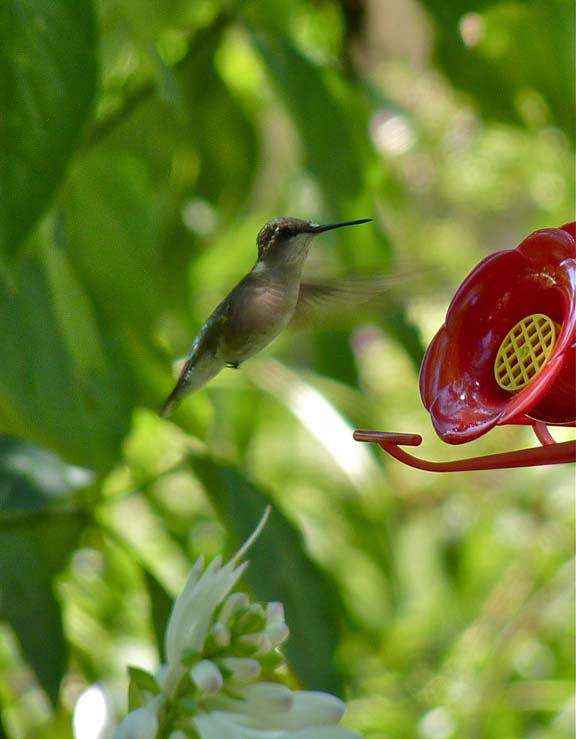
Female Ruby-throated Hummingbird
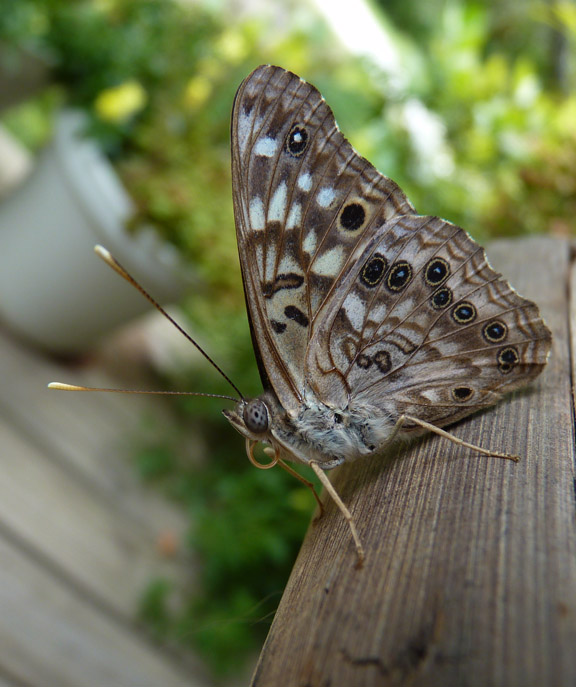
In the morning I would find Buckeyes, Question Marks, and Red-spotted Purples drinking salts and minerals from moist patches in the driveway. Hungry families of Ruby-throated Hummingbirds were noisily nectaring from the flowers and feeders; one feeder is sited beneath the peach tree and the other about twenty feet away, under the lilacs, a hummingbird superhighway of sorts, with inviting nectar flowers along the route. The male and female hummingbirds are both territorial and, when encountering anything out of the ordinary (my camera and I, for example) will threaten by whizzing and whirling, albeit harmlessly, close to your head.
Common Buckeye
By mid-day the hummingbird and butterfly scene was full underway. Spicebush Swallowtails at the Rose-of-Sharon, tiger swallowtails, yellow sulphurs, Eastern Tailed-Blues, Monarchs, checkerspots, and angelwings nectaring at the zinnia patch, phlox, and lobelia, and most remarkable of all, were the number of butterflies that were drawn to the pungent lure of rotting peaches. By late afternoon dozens of Hackberry Emperors, Red-spotted Purples, Question Marks, and Red Admirals were to be found intently imbibing from the fermenting peaches, and by day’s end, I believe they were drunken butterflies, making extraordinarily easy subjects to photograph. I would be down on my hands and knees with the lens held so closely it was nearly touching them, and several times that did happen as they fluttered or hopped onto the camera’s lens. In the lingering remnants of late day’s light, the hummingbirds were there again at the feeders and flowers, and all manner of swallowtails in the wildflower meadow were nectaring from the New York Ironweed.
Spicebush Swallowtail Nectaring at Rose of Sharon
Pipevine Swallowtail Nectaring at Phlox
Red-spotted Purple
The three different species of butterflies in the above group of photographs have a unique relationship. The Red-spotted Purple and Spicebush Swallowtail (both palatable to predatory birds) are thought to have evolved to mimic the Pipevine Swallowtail (center photograph), which is highly toxic and foul tasting.
I was sad to say goodbye to my sister-in-law but glad to return home to my family. My unexpected yet welcome encounter with the butterflies of Southwest Ohio reminded me once again that butterflies are a symbol of transformation, joy, and beauty throughout cultures the world over. Perhaps Amy’s butterflies mirror the transformative journey to which she has embarked.
I’ve updated the article on common milkweed (see below). The second video of the caterpillar pupating goes a bit dark in the beginning because I was trying to capture the caterpillar’s exoskeleton splitting apart, just below the head.
My husband, Tom Hauck, was quoted on Sound Off in this week’s issue of Time Magazine. His quote can also be found here (scroll down).
Looking at our thriving patch of common milkweed, I am eagerly anticipating the arrival of the Monarch butterflies to our garden in Gloucester. It is difficult to reconcile the enjoyment we derive from life’s simple pleasures when looking into the faces of the victims struck by the unfolding tragedy in the Gulf Coast region—a tragedy for the nation. I hope and pray that the net result of this catastrophe will be a wake up call, and that we will all come together to fully realize the potential of non-polluting alternatives to our unsustainable use of fossil fuels.
Best wishes, Kim
The pair of Monarch caterpillars, hanging in the characteristic J-shape, are attached to the underside ribs of common milkweed (Asclepais syriaca). They were filmed at approximately 7:30 am on August 22, 2009, one hour prior to pupation. The “twins” pupated within six minutes of each other. “Twin #2” is pupating in the video.
Inside a moment’s time, the exoskeleton behind the caterpillar’s head splits apart. With undulating wave-like contractions the developing green chrysalis is revealed as the exoskeleton shrivels. With rhythmical repetitious revolutions, twirling first left, then right, and back again, he throws off his last striped suit. More gyrating rotations and he fastens himself securely to the pad of silk with his newly formed cremaster.
Recently a friend inquired that if I had to choose one native New England plant to grow to attract butterflies to the garden, which would it be, and why. It was a challenging question because butterflies are typically drawn to the garden planted with a rich and varied, yet very specific, combination of species. A successful Lepidoptera habitat is comprised of many elements all working in tandem. Sunny and protected areas in which to warm their wings, trees and shrubs that provide shelter, and a host of nectar plants for the adults, as well as specific caterpillar food plants, create the successful Lepidoptera garden.
Perhaps if I had to choose a favorite butterfly and therefore a favorite plant to grow to drawthis butterfly to my garden it would have to be common milkweed (Asclepias syriaca), which is both a larval host plant and nectar plant for the elegant Monarch butterfly. People often speak unkindly about common milkweed, rather I think it deserves applause for it is plant without rue and thrives wherever found—in the cracks of city sidewalks and along country roadsides, highly-trafficked soccer fields, and in the most neglected of neighborhoods. Whether in the garden, along the shoreline, or local meadow, it is on the foliage of common milkweed that we find the vast majority of Monarch eggs and caterpillars. Noteworthy also is that we observe many different species of butterflies and skippers nectaring at common milkweed—sulphurs, swallowtails, and fritillaries, to name but a few. In our garden we grow common milkweed alongside marsh milkweed (Asclepias incarnata); marsh milkweed blooms slightly earlier than common milkweed as it is sited in a sunnier locale. Both species attract a wide variety of winged pollinators. Male and female Monarchs nectar from the blossoms, while the males simultaneously patrol for females. The females utilize the foliage of both species to oviposit their eggs. Typically we observe females freely flitting alternatively between our common and marsh milkweed, depositing their eggs on the choicest leaves and buds, while pausing frequently to nectar.
Monarch Butterfly Egg on Common Milkweed Leaf
The milky sap that flows through milkweed veins lends the genus its common name. Monarch butterflies and their caterpillars have evolved to withstand the toxic milk, but not the predatory bird that attempts to eat one. The adult Monarch’s unique wing pattern and caterpillar’s striped suit warn of its dreadful taste and lethal toxins. A bird that is tempted becomes sick and may even die, and if it survives, remembers never again to try to eat a Monarch. “The larvae sequester cardiac glycosides from the milkweed leaves that they consume. Concentrations of these heart toxins in their bodies may be several times higher than those occurring in milkweed leaves. The glycosides consumed by the caterpillars are carried forward both into the chrysalis and adult stages, affording them protection as well.” (Caterpillars of North America David L. Wagner).
Common milkweed is highly adaptable and grows in nearly any soil. The size of the developing colonies and individual plants reflect the conditions in which it is grown. Planted in a rich, moist soil, protected from the wind and where it receives some light shade, it will grow six to seven feet. I use it extensively in my butterfly garden designs, planting in rich, average, and dry conditions, and find it especially appealing and useful for shoreline gardens. In sandy soil, sand dunes, and meadows, where it is exposed to wind and/or salt spray, common milkweed is equally as vigorous, but of a much shorter stature, typically obtaining the height of two to three feet.
A. syriaca thrives in full sun to light shade. In a moist, protected area, plant in the back of the border. In a more exposed site, plant in the mid-ground. Because of its ability to spread readily and rapidly, use in an informal, natural setting as opposed to planting in formal beds.
Common milkweed is highly fragrant and is the most richly scented of the species of milkweeds found in Massachusetts (A. incarnata, A. syriaca, A. quadrifolia, A. tuberosa, A. amplexicaulis, A. exaltata, A. pupurascens, and A. verticillata), with a complex wild flower honey fragrance. I have heard it described as similar to the scent of lilacs, but find lilacs have a much sweeter fragrance than common milkweed. Fragrance is highly mutable and subjective.
One- to two-year-old plants are easier to transplant than established plants. Common milkweed takes approximately three years to flower from seed. The method in which I have had the greatest success in propagating Asclepias syriaca, best attempted in early summer, is to dig up a rhizome, found at the base of a plant with newly emerging shoots. The rhizome would ideally be obtained from a friend’s garden. If collected in the wild, be sure to dig from an area where there are many shoots present. You need a fairly large chunk, at least a half-foot, with both roots and new shoots present. Replant the rhizome at the same depth. Water throughout the summer. Towards the end of the growing season you will be rewarded with newly emerging shoots. Common milkweed self-seeds readily, but spreads primarily (and rambunctiously) by its rhizomatic root structure.
Milkweed in general, and in particular, common milkweed, attracts a host of pollinators—bees, wasps, butterflies, and purportedly hummingbirds. I have yet to see the Ruby-throated hummingbird nectar from common milkweed, but it may also be the case that they are attracted to the plant for the multitude of tiny insect populations frequenting the flowers (over ninety percent of a Ruby-throated hummingbird’s diet is comprised of insects). We typically findMonarch eggs and caterpillars on milkweed plants during the months of July and August.
Buddleia davidii ’Nanho Blue,’ with blue-violet racemes, melds beautifully with the muted lavender rose florets of the softly drooping flower heads of common milkweed. The brilliant white of native Phlox davidii and vivid purple-pink of Liatris ligulistylus attractively offsets both. All are famously attractive to Monarchs (and myriad other species of Lepidoptera) and will provide a long season of nectar-rich blossoms and Monarch caterpillar food.
Monarch Butterflies Mating on Common Milkweed Leaves
A note about the video: Monarch butterflies deposit eggs on common milkweed (Asclepias syriaca) and marsh milkweed (Asclepias incarnata) in eastern Massachusetts. The chrysalis in this video was attached to a marsh milkweed stem. For a wealth of information on butterfly gardening, read Oh Garden of Fresh Possibilities!