Tag Archives: Asclepias syriaca

Monarch Butterfly Ovipositing Egg on Marsh Milkweed: NINETEEN SIBLINGS READYING TO EMERGE

All nineteen eggs hatched and became caterpillars. They have pupated and are nearing the end of metamorphosis. You can see the developing butterflies within the chrysalis case. I wonder if they will all eclose (emerge) on the same day??

Several readers have written to ask how do I manage to have so many Monarch Butterfly caterpillars and chrysalises. The answer is very simple–because we have planted a wonderful little milkweed patch! We grow both Common Milkweed (Asclepias syriaca) and Marsh Milkweed (Asclepias incarnata) side-by-side. Our milkweed patch is planted near our kitchen. When washing the dishes, I can look out the window and observe all the pollinators and fabulous activity that takes place at the milkweed patch.

Several weeks ago, a Mama Monarch arrived and I watched as she gently floated from leaf to leaf, and bud to bud, ovipositing one golden egg at a time. She went back and forth between the Common and Marsh, depositing eggs on both the tender upper foliage as well as the more sturdy lower leaves. I waited for her to leave, but not too long (because the eggs are quickly eaten by spiders) and collected the sprigs with the eggs. I thought I had scooped up about eight eggs and you can imagine our surprise when 19 caterpillars hatched, all within the same day! Female Monarchs like to deposit eggs around the tiny buds of Marsh Milkweed and many of the eggs were hidden within the buds.

Here’s a video of a Mama depositing eggs on Marsh Milkweed buds. Charlotte was with me that day and we were dancing to the song “There She Goes” as the butterfly was depositing her eggs and it was too perfect not to include in the video clip.

Our garden is postage stamp size, but I have managed to fill it with a wide variety of songbird, butterfly, bee, and hummingbird attractants. The great majority of plants are North American native wildflowers and shrubs, and we also include a few nectar-rich, non-native, but non-invasive, flowering plants. Plant, and they will come 🙂

THANK YOU TO COURTNEY RICHARDSON AND THE CAPE ANN MUSEUM KIDS!

We had a super fun morning at the Cape Ann Museum Kids program. Courtney Richardson and her assistants Sarah and Nick set up a long table in the auditorium where the caterpillars, art supplies, plants, and pods were arranged. The kids were wonderfully curious, as were the adults. Many thanks to Jan Crandall for supplying the caterpillars. Thank you to Courtney and to the Museum for the opportunity to share about Cape Ann Monarchs!

Monarch Madness!

Four Monarchs eclosing and nineteen caterpillars pupating, all in a day! And we have a new batch of caterpillars, just in time for my program tomorrow morning at the Cape Ann Museum. I hope to see you there!

Many thanks to my friend Jan Crandall for the caterpillars. She has a gorgeous butterfly garden and this morning there were dozens and dozens of caterpillars on her Common Milkweed plants.

Velvet wings drying in the morning sun.

Monarch Conference

https://www.instagram.com/p/BnWjaQjnipZ/

https://www.instagram.com/p/BnWkKo9HEz2/

CATERPILLAR CONDO

Caterpillar Condo

Several readers have written to ask how do I manage to have so many Monarch Butterfly caterpillars and chrysalises. The answer is very simple–because we have planted a wonderful little milkweed patch!

We grow both Common Milkweed (Asclepias syriaca) and Marsh Milkweed (Asclepias incarnata) side-by-side. Our milkweed patch is planted near our kitchen. When washing the dishes, I can look out the window and watch all the pollinators and fabulous activity that takes place at the milkweed patch.

Several weeks ago, a Mama Monarch arrived and I watched as she gently floated from leaf to leaf, and bud to bud, ovipositing one golden egg at a time. She went back and forth between the Common and Marsh, depositing eggs on both the tender upper foliage as well as the more sturdy lower leaves. I waited for her to leave, but not too long (because the eggs are quickly eaten by spiders) and collected the sprigs with the eggs. I thought I had scooped up about eight eggs and you can imagine our surprise when 19 caterpillars hatched, all within the same day! Female Monarchs like to deposit eggs around the tiny buds of Marsh Milkweed and many of the eggs were hidden within the buds.

Here’s a video of a Mama depositing eggs on Marsh Milkweed buds. Charlotte was with me that day and we were dancing to the song “There She Goes” as the butterfly was depositing her eggs and it was too perfect not to leave in the video.

Our garden is postage stamp size, but I have managed to fill it with a wide variety of songbird, butterfly, bee, and hummingbird attractants. The great majority of plants are North American native wildflowers and shrubs, and we also include a few nectar-rich, non-native, but non-invasive, flowering plants. Plant, and they will come 🙂

I am super excited to give my children’s program at the Cape Ann Museum on Saturday morning. The program is free and open to the public. I hope to see you there!

KEEP THOSE MONARCH BABIES COMING!


Several days ago, while a Mama Monarch was busy ovipositing several dozen eggs on the Marsh Milkweed growing in our garden, facebook friend Amy T shared a photo of three Monarch caterpillars munching on her Marsh Milkweed. It’s been a banner year on Cape Ann for Monarch butterflies and caterpillars – let’s hope they all make it to Mexico!

SNAPSHOTS FROM PATTI PAPOW’S MAGICAL BUTTERFLY GARDEN

Photos from a recent visit to friend and East Gloucester resident Patti Papows delightful in-every-way butterfly and pollinator garden

Snowberry Clearwing Moth

Although I was only able to visit for a few hours, it was wonderful to see all that she has planted for the pollinators, and as a result, all the pollinators drawn to her garden. You could spend a week in Patti’s garden and not see everything. The afternoon I was there, the deep magenta red butterfly bush was in full glorious bloom and was the star pollinator attractant of the day. Snowberry Clearwing Moths, Tiger Swallowtails, Monarchs, Catbirds, Robins, Bumble Bees, Honey Bees, and every other winged creature in the neighborhood was enjoying sweet nectar and the fruits from Patti’s blossoms. Bees and butterflies love variety and in a garden as richly planted as Patti’s, everyday is a party for the pollinators!

I am looking forward to returning to Patti’s garden when the Morning Glories are in full bloom 🙂

MONARCH BUTTERFLY EGGS AND CATERPILLAR ALERT!

Monarch butterflies, caterpillars, and eggs, here there and everywhere!

This morning I went out to my garden to collect more milkweed leaves for our current batch of caterpillars. A female was flitting about and in addition to finding half a dozen newly laid eggs, these two beautiful freshly molted third instar caterpillars were forgaing around on the milkweed foliage. We are having at least a second brood of Monarchs this summer, helped greatly but the current warm stretch of hot humid weather. If you have been raising Monarchs and think you are done for the summer, look again on your milkweed plants because you may very well have a second batch coming along.

https://www.instagram.com/p/Bmovi9QH47C/

THANKS TO A CANADIAN CHEMICAL ENGINEER, A VERMONT ACADEMIC AGRONOMIST, RISK-TAKING FARMERS, AND VISIONARY CLOTHING COMPANY FOR A FABULOUS NEW USE FOR MILKWEED

What’s old is new again!

Common Milkweed (Ascleipias syriaca) is the essential food plant for populations of the Northeastern and Atlantic coast Monarchs. During Colonial times, the silky floss found in the dried seed heads was used to stuff quilts and pillows. In the 1860s, in Salem Massachusetts, Common Milkweed silk was used as a mattress filling.

During WWII, Common Milkweed became the substitute for kapok, a soft cottony material from the kapok tree that was the preferred filling for life vests. Japan cut off the supply of kapok from Java, the main source of the material, and part of the wartime effort included children sent to fields to gather millions of pounds of Milkweed seed heads for the armed services.

“What is a weed? A plant whose virtues have not been discovered.” ~ Ralph Waldo Emerson

An innovative Canadian clothing manufacturer, the Quartz Company and Altitude Sports, has created the first modern insulated jacket using milkweed silk. Hundreds of acres of Common Milkweed have been planted in Vermont and Quebec. Particularly noteworthy is that the fields of Milkweed are not harvested until after the Monarchs have left.

READ THE STORY HERE  

Milkweed Silk and Monarch Butterfly Chrysalis

WWII Common Milkweed photos courtesy Google image search.

LOOK WHAT PATTI PAPOWS MADE FOR SUNDAY’S MILKWEED SEED DISTRIBUTION EVENT!!

Thank you to Patti Papows for putting together these utterly charming pouches of milkweed seeds for our event tomorrow. We also have loads of milkweed pods and Joe-Pye seeds to distribute so come on down to Captain Joe’s dock Sunday morning from 10:30 to noon. We hope to see you there!

Captain Joes is located at 95 East Main Street, Gloucester.

To donate toward the completion of my documentary film Beauty on the Wing: Life Story of the Monarch Butterfly, please visit the film’s website at www.monarchbutterflyfilm.com

COMMUNITY MILKWEED SEED POD PROJECT FOR THE POLLINATORS!

MILKWEED SEED COLLECTION AND DISTRIBUTION PROJECT SUNDAY OCTOBER 15TH

Collect ripe milkweed seed pods (only Common Milkweed and Marsh Milkweed please). Place in a paper bag, not plastic, as plastic can cause the seed pods to become damp and moldy.

Bring seedpods to Captain Joe and Sons on Sunday morning between 10:30 and noon. Captain Joes is located at 95 East Main Street, East Gloucester.

If you’d like to distribute seeds, meet at the dock between 10:30 and noon and I will show you what to do.

NOTE: It is easy to tell when milkweed seedpods are ripe. The seeds inside turn brown. Do not collect the pods when the seeds are white or green. If you pick them too soon, they will never be viable. You can check the seed pods by slitting the pod a tiny bit and peeking inside.

Any questions, please comment in the comment section or email me at kimsmithdesigns@hotmail.com. Thank you and I hope to see you Sunday morning!

To learn more about how you can help fund the documentary Beauty on the Wing and the Monarch Butterfly Film Online Fundraising event, please visit the film’s website at monarchbutterflyfilm.com.

KIM SMITH POLLINATOR GARDEN PROGRAM FREE AND OPEN TO THE PUBLIC THURSDAY EVENING

Please join me Thursday evening, August 10th, at 7:00pm, at the Peabody Institute Library, South Branch. I will be giving my talk about how to create a garden to benefit a host of pollinators and screening several short films. I hope to see you there! 

The day we planted blueberries, is the day the Catbirds moved in. Many species of songbirds are pollinators, too!

Painted Lady nectaring at wildflower Joe-pye, Good Harbor Beach

https://www.instagram.com/p/BW7wfw-F5o9/


#POLLINATORHERO

Bees and butterflies, as we all know, pollinate flowers, but did you know that bats, songbirds, hummingbirds, wasps, beetles, moths, flies, midges, and even nasty mosquitoes also deliver pollen from plant to plant?

Flower pollinating Green-eyed Wasp drinking nectar from Common Milkweed florets.

The eyes of the male Green-eyed Wasp are larger than the females, all the better to see her, and predators. Green-eyed Wasps are also known as sand wasps because females excavate burrowing nests in sand (as well as soil).

Male Monarch Butterfly flitting about our garden and drinking nectar from the Marsh Milkweed florets.

Notice the mass of orange Milkweed Aphids in the background. Lady Beetles are another pollinator super hero because they help milkweed plants by eating aphids.

https://www.instagram.com/p/BXTNYD9F_We/

Down the Garden Path

monarch-new-england-aster-coneflower-copyright-kim-smithThe New England Asters and Quilled Coneflowers blooming in our garden during the months of September and October were planted to provide sustenance for migrating Monarchs. Although both are native wildflowers, the bees and butterflies visiting gardens at this time of year are much more interested in nectaring at the New England Asters.

Plant the following four native beauties and I guarantee, the pollinators will come!

New England Aster (Aster novae-angliae)

Seaside Goldenrod (Solidago sempervirens)

Marsh Milkweed (Asclepias incarnata)

Common Milkweed (Asclepias syriaca)

monarch-butterfly-depositing-egg-milkweed-copyright-kim-smithFemale Monarch curling her abdomen to the underside and depositing eggs on Marsh Milkweed foliage.

COMMON MILKWEED ABLOOM, HERE, THERE, AND EVERYWHERE!

Common Milkweed and Bee Asclepias syriaca ©Kim Smith 2015A patch of Common Milkweed (Asclepias syriaca) in bloom has a wonderfully sweet honey-hay scent. Look for it growing along the sand dunes, roadside edges, fields, meadows, and where ever there is a neglected patch. And keep your eyes peeled for Monarchs; the earliest arrivals (for the most part) are synchronized to the flowering of Common Milkweed.

https://instagram.com/p/4opJl6DyjS/

Friend me on Facebook and follow me on TwitterInstagram, and Vine. You can also subscribe to my design website at Kim Smith Designs, and film’s websites at Beauty on the Wing ~ Life Story of the Monarch Butterfly, Gloucester’s Feast of Saint Joseph Community Film Project, and Life Story of the Black Swallowtail Butterfly.

Please Don’t Weed the Milkweed

Common Milweed Asclepias syriaca ©Kim Smith 2014Once established, native Common Milkweed grows vigorously and rambunctiously, making itself known even in the thinnest of sidewalk cracks. Here’s a patch growing along East Main Street. I think it beautiful! What do you think?

*    *    *

If you caught Tom Ashbrook’s On Point broadcast on NPR yesterday morning you heard Doctor Lincoln Brower, Karen Oberhausser, and Rick Mikula, three of the world’s leading butterfly experts, speaking about the disappearance of the Monarch and the main reason why–most notably because of the sterilization of the American landscape through the use Monsanto’s Roundup and GMO corn and soybean crops.

The following is a list of a few suggestions on ways in which we can all help turn the tide:

Plant milkweed and wildflowers. Teach members of your family and friends what milkweed looks like and why we don’t want to weed it out of the garden. The above patch of milkweed is growing next to a shop on East Main Street. About a month ago, I went into the store and, very, very politely inquired as to whether or not they knew that the plant growing outside their doorway was a terrific patch of milkweed. They had no idea. I explained what the benefits were to the Monarchs and have since noticed that the milkweed patch is still growing beautifully!

Ban GMO crops. Genetically modified seeds have been altered to withstand megadoses of Roundup. Millions and millions of tons of herbicides are poured onto Roundup Ready fields of crops, preventing any other plant that has not been genetically altered from growing (in other words, wildflowers). The application of Monsanto’s deadly destructive herbicide Roundup is creating vast sterilized agricultural wastelands, which will, over time, only need heavier and heavier does of their lethal chemicals to continue to be viable.

Don’t apply herbicides and pesticides in your own gardens.

Create wildflower corridors in backyards and highways.

Reduce salt wherever possible (and where it wouldn’t cause harm to human life). Large amounts of road salt, as was needed during this past snowiest of winters, is detrimental to wildlife habitats.

Thank You to Everyone Who Participated in This Year’s Cape Ann Milkweed Project!!!

Monarch Butterflies Pink New England Aster ©Kim Smith 2012Monarch Butterflies Nectaring at Pink New Enlgand Aster, Gloucester

Thank you so much to our most awesome community for participating in the Cape Ann Monarch Milkweed and Aster Project. Today was a huge and wonderful success and we were non-stop with folks dropping in to pick up their seeds and learn more about how they can help the Monarchs. Thank you, thank you, thank you!!!

And my most heartfelt thanks to Joey. He nudged me into doing the sale again this year by inquiring just about a month ago if we were planning a repeat of last year’s plant sale. Joey’s hospitality and interest in everyone who stops by makes Captain Joe’s a wonderfully fun place to have a community event!

Note to anyone who could not pick up their seeds or who was planning to have them sent via a self-addressed stamped envelope: You will recieve an email with information on where to send the check and order amount total. Thanks again to everyone!

Monarch Butterfly fur ©Kim Smith 2012Fun fact about butterflies: Butterflies do not grow fur. The fur-like structures that you see on butterflies are many single cells conjoined to form one long string.

*     *     *

In case you misplace the instructions on how to prepare your milkweed seeds for spring planting ~

How to Vernalize Milkweed Seeds for Spring Planting

Seeds of most temperate plants need to be vernalized—in other words, exposed to cold temperatures. The best way to vernalize is by stratification, which means subjecting seeds to a cold and moist environment for a short period of time. By stratifying, the seed’s natural break of dormancy that occurs when the seed spends the winter in the ground is simulated.

#1 Method of Stratifying Milkweed

Open the bag of seeds and place them between very slightly moistened paper towels in a plastic bag in the refrigerator. After vernalizing for 3-6 weeks, the seeds can be planted out in the garden in warm 70º soil.

#2 Method of Stratifying Milkweed

Place ¼ cup of sand mixed with ¼ tsp. of water in a plastic bag. Add the seeds and mix again. Store in plastic bag in the refrigerator. After vernalizing for 3-6 weeks, the seeds can be planted out in the garden in warm 70º soil.

Prepare the planting bed in a sunny location. Scatter seeds, or plant in rows, and cover with no more than ¼ inch of soil.

For natural vernalization, sow collected seeds directly into a prepared bed in the fall and the seed will germinate the following spring.

Monarch Caterpillars Common Milkweed ©Kim Smith 2012Monarch Butterfly Caterpillars Munching on Milkweed

Reminder: Monarch Milkweed and Aster Seed Pickup and Information Day is Next Sunday, May 18th, from 9:30 to Noon

male-female-monarch-butterfly-marsh-milkweed-2-c2a9kim-smith-2012-copyMale and Female Monarch Butterfly on Marsh Milkweed (Asclepias incarnata)

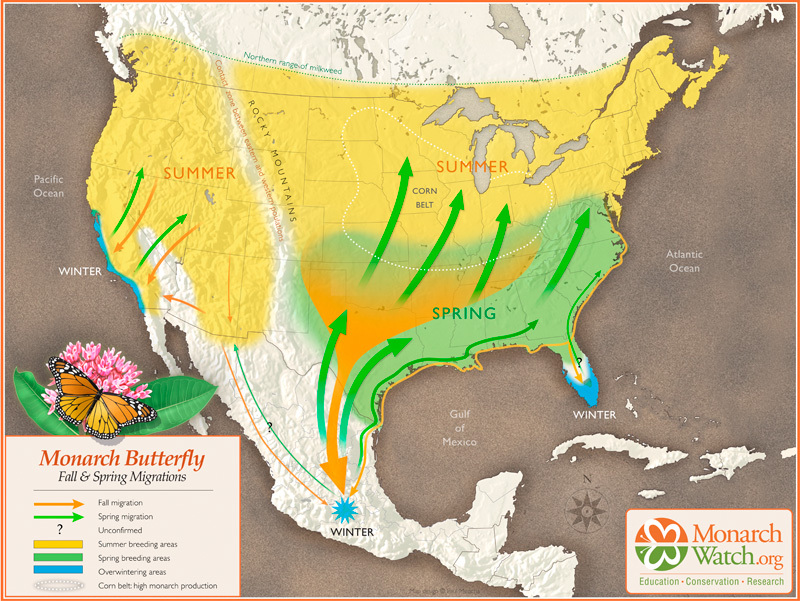
Where are the Monarchs today in their northward migration? They have spread throughout the Great Plains and Southern States. Some have already been sighted as far north as Michigan and Wisconsin!

Monarch Migration Map

Our Milkweed and New England Aster seed pickup day is next Sunday from 9:30 to noon at Captain Joe and Sons. Captain Joe’s is located at 95 East Main Street and you can find directions posted on their website here. Thank you so much to Joey for offering to host the event at the dock. See You There!

monarch-new-england-aster-c2a9kim-smith-2013Monarch Butterfly and New England Aster

Top Native Bee Friendly Plants

Obedient Plant and Bee Physostegia virginiana ©Kim Smith 2013Obedient Plant (Physostegia virginiana)

Below is a list of some favorite nectar- and pollen-rich bee-friendly North American wildflowers for attracting native bees and honey bees to your gardens. They are listed in order of bloom time, from spring through late summer, to provide your foragers with nourishment all growing season long.

Mexican Sunflower © Kim Smith 2013Mexican Sunflower (Tithonia rotundifolia)

Wild strawberry (Fragaria viginiana)

Wild Blue Lupine (Lupinus perennis)

Common Milkweed (Asclepias syriaca)

Marsh Milkweed (Asclepias incarnata)

Black-eyed Susan (Rudbeckia hirta)

Sunflower (Helianthus annus)

Obedient Plant (Physostegia virginiana)

Seaside Goldenrod (Solidago sempervirens)

Great Blue Lobelia (Lobelia siphilitica)

Joe-pye Weed (Eupatorium purpureum)

New York Ironweed (Veronia noveboracensis)

New England Aster (Aster novae-angliae)

Sailor Stan sunflower and bee ©Kim Smith 2011Sailor Stan Sunflower (Helianthius annus)

Eupatorium and Bee ©Kim Smith 2012Joe-pye Weed (Eupatorium purpureum)

Ironweed Bee ©KIm Smith 2011New York Ironweed (Veronia noveboracensis)

ORDER YOUR MILKWEED SEEDS TODAY!

Monarch Caterpillars Eating Common Milkweed ©Kim Smith 2012JPGMonarch Caterpillars Munching on Milkweed

Ordering information:

Please note that the milkweed seeds are available in two different species and two different quantities. Please place your order amounts in the comment section of this post as follows:

Your Name, Your Email Address (optional), and Seed Type and Quantity.

For Example:

Pippi Longstocking, villavillakula@gmail.com

1 Packet Common Milkweed 3.50

1 oz. Marsh Milkweed 15.00

2 Packets Pink New England Aster @ 3.50 ea. = 7.00

My order total: $25.50

We are not collecting money ahead of time for the seeds. The orders are placed entirely by the honor system. Last year we did not have a single stiff and I will accept cash or check at the time of pick up. Seed pick up and information day will be Sunday, May 18th, from 9:30 to noon, at Captain Joe and Sons.

The packets of milkweed seeds (200-300 seeds) are perfect for a relatively smallish patch.

The larger ounce quantity is ideal for planting larger areas. On average, plan on 50 seeds per square foot. If your patch is 10 feet x 10 feet, that equals 100 square feet, and would require approximately 5,000 seeds.

Additionally, we are also offering pink and purple New England aster seeds. I’ve never grown New England asters from seed, but have read that they are relatively easy to start (although slow to germinate). New England asters make a beautiful border and will not only offer sustenance to southward migrating Monarchs, but in late summer also provide nectar for myriad species of bees and butterflies.

SEEDS

Common Milkweed (Asclepias syriaca)

Seed Packet (300 seeds) 3.50

1 ounce (4900 seeds) 12.00


Marsh Milkweed (Asclepias incarnata)

Seed packet (200 seeds) 3.50

1 oz. (5,200 seeds) 15.00


Pink New England Aster (Aster novae-angliae variation)

Seed Packet (1000 seeds) 3.50


Purple New England Aster (Aster novae angliae)

Seed Packet (1750seeds) 3.50

*    *    *

Why is it so important to plant milkweed for the Monarchs? Milkweed is the only food plant of the Monarch butterfly caterpillar. The Monarch butterfly migration is in serious peril due to loss of habitat in the United States by the use of Monsanto’s genetically modified Roundup Ready corn, soybean, and sorghum crops. Global climate change is also a factor in the weakening migration. We can all help mitigate some of the destruction by planting milkweed and nectar-rich wildflowers.

Common Milkweed (Asclepias syriaca) is the milkweed we see most typically growing in our dunes, meadows, roadsides, and fields. It grows quickly and spreads vigorously by underground runners. This is a great plant if you have an area of your garden that you want to devote entirely to milkweed. It prefers full sun, will tolerate some shade, and will grow in nearly any type of soil. The flowers are dusty mauve pink and have a wonderful honey-hay sweet scent.

monarch-caterpillars-common-milkweed-c2a9kim-smith-2011Common Milkweed and Monarch Caterpillars J-shape

Marsh Milkweed (Aclepias incarnata) is more commonly found in marshy areas, but grows beautifully in gardens. It does not care for dry conditions. These plants are very well-behaved and are more clump forming, rather than spreading by underground roots. The flowers are typically a brighter pink than Common Milkweed.

Monarch Butterfly marsh Milkweed ©Kim Smith 2012Marsh Milkweed and Monarch Butterfly

New England Aster (Aster novae-angliae) is a hardy late summer perennial that grows approximately 36 inches to 60 inches. New England asters prefer wet to medium soil, grow well in full sun, and will tolerate part shade.

New England Aster and Monarch Butterfly ©Kim Smith 2014Monarch Butterfly Nectaring at New England Aster

Cape Ann Milkweed Project Continues ~ Plant Milkweed Seeds to Save the Monarchs!

Monarch Butterfly Common Milkweed Asclepias syriaca Honey Bee©Kim Smith 2013Good Harbor Beach Common Milkweed

Last year was the beginning of our first and wonderfully successful Cape Ann Milkweed Project. My friend Joe Ciaramitaro from Good Morning Gloucester generously offered to hold the plant sale at Captain Joe and Sons, which is very conveniently located on East Main Street, and we had a fantastic turnout. This year I am thinking about doing things a little differently. Rather than shipping and handling live small plants, I am planning to purchase milkweed seeds in bulk. My question is, and this is not the official order form, but just to get a sense of participation, does anyone have an interest in planting milkweed from seed in their gardens, meadows, and/or abandoned areas around our community?

I think I can get good quantities of seed of Marsh Milkweed, Common Milkweed, and Prairie Milkweed. All three are very easy to grow from seed and take about 14 days to germinate. I will provide complete information and tips on growing milkweed from seed.

Please answer in the comment section if you are interested in growing milkweed from seed.

monarch-butterfly-overwintering-graph-journey-northWhy is it so important to plant milkweed for the Monarchs? I’ve written much about that and at the end of the post, please find a list of posts previously published about the importance of milkweed. In a nutshell, milkweed is the only caterpillar food plant of the Monarch Butterfly. The Monarch Butterfly migration is in serious peril One way we can all take action to is to plant milkweed to help mitigate the loss of habitat, partly due to global climate change and primarily due to the use of Monsanto’s GMO Roundup Ready corn, soybean, and sorghum seed along with the massive use of their herbicide Roundup.

Cape Ann Milkweed Project

News Release: MONARCH WATCH ANNOUNCES ‘BRING BACK THE MONARCHS’ CAMPAIGN

How Exactly is Monsanto’s Roundup Ravaging the Monarch Butterfly Population?

Where Are All the Monarchs?


Monarch Butterfly Marsh Milkweed ©Kim Smith 2012

Request for Help and Monarch Film Update

Header Good FINAL FINALFor the past three years I have been filming the life story of the Monarch Butterfly in backyards and along the shores of Cape Ann. My original intent was to tell the story of the butterflies primarily as it relates to their northern breeding grounds and specifically here in our community. Prior to filming, I wrote a children’s story about the Monarchs and during this entire time I have had an ongoing inner debate as to whether or not to travel to Mexico. While editing the film these past few months, I determined that capturing the butterfly’s story in their winter sleeping grounds as they are awakening in Mexico would only add to the film’s depth and beauty. To film in Mexico would be a dream come true.

In February I am going to Mexico to film the Monarchs!!! This all has come about very quickly! I have to practice walking five miles a day, recall how to ride a horse, and learn enough Spanish so that if I am separated from my group or kidnapped by bandits, I can at least inquire as to where is the bathroom.

Does anyone know of a local outfit that gives lessons in trail riding? And does anyone have experience with a Spanish language lesson CD (basic)? If so, can you please recommend in the comment section. Thank  you!!!!!!!

Stay tuned for adventures from Mexico! Beauty on the Wing ~ Life Story of the Monarch Butterfly will premiere  in the summer of 2014.

Rather than wait until the film was complete, this weekend I made a new website for the film-in-progress. When you have a moment, I hope you’ll visit my website and read more about Beauty on the Wing here.

monarch-butterfly-milkweed-good-harbor-beach-c2a9kim-smith-2011Monarch Butterfly Nectaring at Common Milkweed ~ Good Harbor Beach, Gloucester

Beauty on the Wing celebrates the poetry and majesty of the uniquely North American phenomenon of the Monarch butterfly and its migration. There are no other butterflies the world over that travel this distance and it is a fascinating ecological link that connects Mexico with nearly every geographic region within the United States and Canada. How well the forested habitats of Michoacán are taken care of is as of equal importance to the Monarchs as how we in Gloucester conserve our habitats.

Setting the Table for a Regal Butterfly Comeback, With Milkweed

Monarch Caterpillar Milkweed ©Kim Smith 2013Monarch Caterpillar Eating the Foliage of Common Milkweed (Asclepias syriaca)

Thank you readers and Monarch Butterfly friends for forwarding the following article from the NY Times!

By Michael Wines

Published December 20th, 2013

CEDAR FALLS, Iowa — Bounding out of a silver Ford pickup into the single-digit wind-flogged flatness that is Iowa in December, Laura Jackson strode to a thicket of desiccated sticks and plucked a paisley-shaped prize.

It was a pod that, after a gentle squeeze, burst with chocolate brown buttons: seeds of milkweed, the favored — indeed, the only — food of the monarch butterfly caterpillar.

Once wild and common, milkweed has diminished as cropland expansion has drastically cut grasslands and conservation lands. Diminished too is the iconic monarch.

Dr. Jackson, a University of Northern Iowa biologist and director of its Tallgrass Prairie Center, is part of a growing effort to rescue the monarch. Her prairie center not only grows milkweed seeds for the state’s natural resources department, which spreads them in parks and other government lands, but has helped seed thousands of acres statewide with milkweed and other native plants in a broader effort to revive the flora and fauna that once blanketed more than four-fifths of the state.Monarch Caterpillar milkweed -2 © Kim Smith 2012Monarch caterpillar hanging from a Marsh Milkweed (Asclepias incarnata) leaf rib, in the characteristic J-shape, readying to pupate.

Nationwide, organizations are working to increase the monarchs’ flagging numbers. At the University of Minnesota, a coalition of nonprofits and government agencies called Monarch Joint Venture is funding research and conservation efforts. At the University of Kansas, Monarch Watch has enlisted supporters to create nearly 7,450 so-called way stations, milkweed-rich backyards and other feeding and breeding spots along migration routes on the East and West Coasts and the Midwest.

But it remains an uphill struggle. The number of monarchs that completed the largest and most arduous migration this fall, from the northern United States and Canada to a mountainside forest in Mexico, dropped precipitously, apparently to the lowest level yet recorded. In 2010 at the University of Northern Iowa, a summertime count in some 100 acres of prairie grasses and flowers turned up 176 monarchs; this year, there were 11.

Read the story here

The Year the Monarch Didn’t Appear

Many, many friends have forwarded the following article from the New York Times, “The Year the Monarch Didn’t Appear.” 

Female Monarch Egg Marsh Milkweed ©Kim Smith 2013JPGFemale Monarch Depositing an Egg

In the above photo, the female Monarch Butterfly is curling her abdomen around to the underside of the Marsh Milkweed plant. She chooses the most tender foliage toward the top of the plant on which to deposit her eggs.

Begin New York Times article, published November 22, 2013 ~

ON the first of November, when Mexicans celebrate a holiday called the Day of the Dead, some also celebrate the millions of monarch butterflies that, without fail, fly to the mountainous fir forests of central Mexico on that day. They are believed to be souls of the dead, returned.

This year, for or the first time in memory, the monarch butterflies didn’t come, at least not on the Day of the Dead. They began to straggle in a week later than usual, in record-low numbers. Last year’s low of 60 million now seems great compared with the fewer than three million that have shown up so far this year. Some experts fear that the spectacular migration could be near collapse.

“It does not look good,” said Lincoln P. Brower, a monarch expert at Sweet Briar College.

It is only the latest bad news about the dramatic decline of insect populations.

Another insect in serious trouble is the wild bee, which has thousands of species. Nicotine-based pesticides called neonicotinoids are implicated in their decline, but even if they were no longer used, experts say, bees, monarchs and many other species of insect would still be in serious trouble.

That’s because of another major factor that has not been widely recognized: the precipitous loss of native vegetation across the United States.

“There’s no question that the loss of habitat is huge,” said Douglas Tallamy, a professor of entomology at the University of Delaware, who has long warned of the perils of disappearing insects. “We notice the monarch and bees because they are iconic insects,” he said. “But what do you think is happening to everything else?”

A big part of it is the way the United States farms. As the price of corn has soared in recent years, driven by federal subsidies for biofuels, farmers have expanded their fields. That has meant plowing every scrap of earth that can grow a corn plant, including millions of acres of land once reserved in a federal program for conservation purposes.

Another major cause is farming with Roundup, a herbicide that kills virtually all plants except crops that are genetically modified to survive it.

As a result, millions of acres of native plants, especially milkweed, an important source of nectar for many species, and vital for monarch butterfly larvae, have been wiped out. One study showed that Iowa has lost almost 60 percent of its milkweed, and another found 90 percent was gone. “The agricultural landscape has been sterilized,” said Dr. Brower.

The loss of bugs is no small matter. Insects help stitch together the web of life with essential services, breaking plants down into organic matter, for example, and dispersing seeds. They are a prime source of food for birds. Critically, some 80 percent of our food crops are pollinated by insects, primarily the 4,000 or so species of the flying dust mops called bees. “All of them are in trouble,” said Marla Spivak, a professor of apiculture at the University of Minnesota.

Farm fields are not the only problem. Around the world people have replaced diverse natural habitat with the biological deserts that are roads, parking lots and bluegrass lawns. Meanwhile, the plants people choose for their yards are appealing for showy colors or shapes, not for their ecological role. Studies show that native oak trees in the mid-Atlantic states host as many as 537 species of caterpillars, which are important food for birds and other insects. Willows come in second with 456 species. Ginkgo, on the other hand, which is not native, supports three species, and zelkova, an exotic plant used to replace elm trees that died from disease, supports none. So the shelves are nearly bare for bugs and birds.

Native trees are not only grocery stores, but insect pharmacies as well. Trees and other plants have beneficial chemicals essential to the health of bugs. Some monarchs, when afflicted with parasites, seek out more toxic types of milkweed because they kill the parasites. Bees use medicinal resins from aspen and willow trees that are antifungal, antimicrobial and antiviral, to line their nests and to fight infection and diseases. “Bees scrape off the resins from the leaves, which is kind of awesome, stick them on their back legs and take them home,” said Dr. Spivak.

Besides pesticides and lack of habitat, the other big problem bees face is disease. But these problems are not separate. “Say you have a bee with viruses,” and they are run-down, Dr. Spivak said. “And they are in a food desert and have to fly a long distance, and when you find food it has complicated neurotoxins and the immune system just goes ‘uh-uh.’ Or they become disoriented and can’t find their way home. It’s too many stressors all at once.”

There are numerous organizations and individuals dedicated to rebuilding native plant communities one sterile lawn and farm field at a time. Dr. Tallamy, a longtime evangelizer for native plants, and the author of one of the movement’s manuals, “Bringing Nature Home,” says it’s a cause everyone with a garden or yard can serve. And he says it needs to happen quickly to slow down the worsening crisis in biodiversity.

When the Florida Department of Transportation last year mowed down roadside wildflowers where monarch butterflies fed on their epic migratory journey, “there was a huge outcry,” said Eleanor Dietrich, a wildflower activist in Florida. So much so, transportation officials created a new policy that left critical insect habitat un-mowed.

That means reversing the hegemony of chemically green lawns. “If you’ve got just lawn grass, you’ve got nothing,” said Mace Vaughan of the Xerces Society, a leading organization in insect conservation. “But as soon as you create a front yard wildflower meadow you go from an occasional honeybee to a lawn that might be full of 20 or 30 species of bees and butterflies and monarchs.”

First and foremost, said Dr. Tallamy, a home for bugs is a matter of food security. “If the bees were to truly disappear, we would lose 80 percent of the plants,” he said. “That is not an option. That’s a huge problem for mankind.”

Jim Robbins is a frequent contributor to The New York Times and the author of “The Man Who Planted Trees.”
 *  *  *

My note about milkweeds ~

Common Milkweed (Asclepias syriaca) is the milkweed we see most typically growing in our dunes, meadows, roadsides, and fields. It grows quickly and spreads vigorously by underground runners. This is a great plant if you have an area of your garden that you want to devote entirely to milkweed. It prefers full sun, will tolerate some shade, and will grow in nearly any type of soil. The flowers are dusty mauve pink and have a wonderful honey-hay sweet scent.

Marsh Milkweed (Aclepias incarnata) is more commonly found in marshy areas, but it grows beautifully in gardens. It does not care for dry conditions. These plants are very well-behaved and are more clump forming, rather than spreading by underground roots. The flowers are typically a brighter pink than Common Milkweed.

Easiest Method on How to Grow Milkweed From Seed

Easiest Method on How to Grow Milkweed From Seed

Milkweed Eastern PointCommon Milkweed Patch Eastern Point

Now is the perfect time of year to collect and to plant milkweed seeds, either from pods that are just splitting open or from pods that have already split and are showing their silky fluff.

There are several different methods of propagating milkweed and the following is by far the simplest. Gather milkweed seeds and store in a paper bag. At the location in your garden where you are planning a milkweed patch, lightly scratch the soil with a rake. Scatter the seeds over the soil. Sprinkle a thin layer of soil over the seeds, just enough to keep them from blowing away. That’s it! Next spring, by mid-May, you will have a patch of milkweed seedlings. This super simple method works for Common Milkweed (Asclepias syriaca) and Marsh Milkweed (Asclpeias incarnata).

Note ~ when collecting seeds from wildflowers, never remove the plant from its location, and never take all the seeds.

Monarch Butterfly Marsh Milkweed ©Kim Smith 2011

If you’d like to learn more about this beautiful plant species, and how growing milkweed in your own garden directly benefits the Monarch Butterfly, there are over several dozen posts covering milkweed on Good Morning Gloucester; too numerous to list here. Type milkweed in the search box in the upper right hand corner of my home page to see all.

Monarch Caterpillars Feeding on Common Milkweed ©Kim Smith 2011Monarch caterpillars eating Common Milkweed leaves

Where Are All the Monarchs?

Cape Ann Milkweed Project

How Exactly is Monsanto’s Roundup Ravaging the Monarch Butterfly Population?

Marsh Milkweed Seeds Asclepias incarnata

Where Are All the Monarchs?

Monarchs usually arrive in our region by the first week in July and go through several brood cycles. This year, barely any arrived. The Monarch’s sensitivity to temperature and dependence on milkweed make it vulnerable to environmental changes. Since 1994, U.S. and Mexican researchers have recorded a steady decline in the Monarch population in their overwintering grounds, with 2012-2013 being the lowest recorded to date.

Monarch butterflies daybreak willow tree ©Kim Smith 2012

Temperature change and habitat loss affect breeding success and longevity. Dr. Chip Taylor, a leading Monarch researcher at the University of Kansas reports that the widespread adoption of GMO corn and soybean crops resistant to herbicides, along with with intensive herbicide use, coupled with the federal government’s incentivized expansion of corn and soy acreage for the production of biofuels have caused a significant drop in milkweed throughout the heart of the Monarch’s range. Lack of milkweed equals no Monarchs. “Monarch/milkweed habitat has declined significantly in parallel with the rapid adoption of glyphosate-tolerant corn and soybeans and, since 2006, the rapid expansion of corn and soy acreage to accommodate the production of biofuels,” Taylor wrote on May 29.

Monarch Butterfly Nectaring at Seaside Goldenrod ©Kim Smith 2011Monarchs Nectaring at Seaside Goldenrod

What can we do? Encourage conservation organizations that conserve Monarch habitat, plant milkweed, plant nectar plants, and raise caterpillars. Hopefully the weather next spring and early summer will be more conducive to the Monarch’s northward migration and breeding success, and if and when the Monarchs arrive, they will find our milkweed plants.

Monarch Butterflies New england Aster ©Kim Smith 2012Monarch Butterflies Nectaring at New England Asters

If anyone sees a Monarch, please email me at kimsmithdesigns@hotmail.com or leave a comment in the comment section.

Update: For more information, see previous GMG posts on Monarchs and Milkweed:

How Exactly is Monsanto’s Roundup Ravaging the Monarch Butterfly Population?

News Release: MONARCH WATCH ANNOUNCES ‘BRING BACK THE MONARCHS’ CAMPAIGN

Cape Ann Milkweed Project

GloucesterCast Podcast 4/25/13 With Guest Kim Smith