Category Archives: Monarch Butterfly Migration

Thank you Anna and James Eaves for Hosting the First Ever GMG–FOB–Cape Ann Gilcee Photography Show!

GMG-Cape Ann Giclee ©Kim Smith 2013

Snapshots from last night’s fabulously fun opening at Cape Ann Giclee.

Madeline and Joey GMG-Cape Ann Giclee ©Kim Smith 2013Eaves Family GMG-Cape Ann Giclee ©Kim Smith 2013

Eaves Family left to right ~ Yianni, Anna, Dimitri, and James

Thank you Anna and James Eaves for hosting the First Ever Good Morning Gloucester/FOB/Cape Ann Gilcee photography show, running now through April 7th. The quality of work in the show is simply outstanding. Come on over and have a look, meet Anna and James, and learn about the services Cape Ann Giclee provides for all your photography and fine art reproduction needs. Cape Ann Giclee is open Monday through Friday from 10am to 5pm. While the GMG show is up through April 7th, they are also open on Saturdays from 10am to 5pm.

Atticus and Meadow GMG-Cape Ann Giclee ©Kim Smith 2013

Craig and Joey GMG-Cape Ann Giclee ©Kim Smith 2013Craig and Joey

Atticus and Meadow butterfly GMG-Cape Ann Giclee ©Kim Smith 2013Atticus and Meadow

News Release: MONARCH WATCH ANNOUNCES ‘BRING BACK THE MONARCHS’ CAMPAIGN

I am going to look into purchasing a large quanity of milkweed seedlings at wholesale prices for anyone in our community interested in cultivating milkweed. If interested, please leave a comment in the comment section, which will help give me an idea, very approximately, on how many plants to order. You can also wait until the fall and sow ripened milkweed seedpods. (Note: Please do not dig up any wild milkweed).

The following timely news release was in my inbox this morning!

MONARCH WATCH ANNOUNCES
‘BRING BACK THE MONARCHS’ CAMPAIGN

“In real estate it’s location, location, location and for monarchs and other wildlife it’s habitat, habitat, habitat”, said Chip Taylor, Director of Monarch Watch. Monarch Watch (www.MonarchWatch.org) started in 1992 as an outreach program dedicated to engaging the public in studies of monarchs and is now concentrating its efforts on monarch conservation. “We have a lot of habitat in this country but we are losing it at a rapid pace. Development is consuming 6,000 acres a day, a loss of 2.2 million acres per year. Further, the overuse of herbicides along roadsides and elsewhere is turning diverse areas that support monarchs, pollinators, and other wildlife into grass-filled landscapes that support few species. The adoption of genetically modified soybeans and corn have further reduced monarch habitat. If these trends continue, monarchs are certain to decline, threatening the very existence of their magnificent migration”, said Taylor.

To address these changes and restore habitats for monarchs, pollinators, and other wildlife, Monarch Watch is initiating a nationwide landscape restoration program called “Bring Back The Monarchs.” The goals of this program are to restore 20 milkweed species, used by monarch caterpillars as food, to their native ranges throughout the United States and to encourage the planting of nectar-producing native flowers that support adult monarchs and other pollinators.

This program is an outgrowth of the Monarch Waystation Program started by Monarch Watch in 2005. There are now over 5,000 certified Monarch Waystations – mostly habitats created in home gardens, schoolyards, parks, and commercial landscaping. “While these sites contribute to monarch conservation, it is clear that to save the monarch migration we need to do more,” Taylor said. “ We need to think on a bigger scale and we need to think ahead, to anticipate how things are going to change as a result of population growth, development, changes in agriculture, and most of all, changes in the climate,” said Taylor.

According to Taylor we need a comprehensive plan on how to manage the fragmented edges and marginal areas created by development and agriculture since it is these edges that support monarchs, many of our pollinators, and the many forms of wildlife that are sustained by the seeds, fruits, nuts, berries, and foliage that result from pollination. “In effect,” Taylor argues, “we need a new conservation ethic, one dealing with edges and marginal areas that addresses the changes of the recent past and anticipates those of the future.”

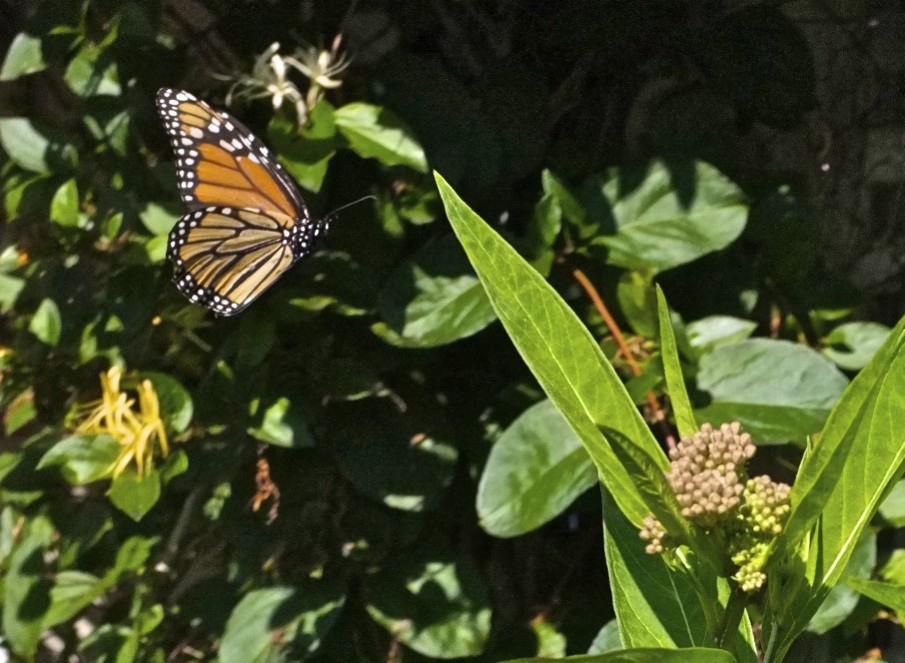
Monarch Butterfiles Female left Male right Milkweed ©Kim Smith 2012

The above photo of a male (right) and female (left) Monarch Butterflies on Marsh Milkweed is part of the GMG/Cape Ann Giclee photography show, currently on view at Cape Ann Giclee.

How Exactly is Monsanto’s Roundup Ravaging the Monarch Butterfly Population?

Monarch Butterfiles Female left Male right Milkweed ©Kim Smith 2012

The above photo of a male (right) and female (left) Monarch Butterflies on Marsh Milkweed is part of the GMG/Cape Ann Giclee Photography show, opening tonight, Friday. Hope to see you there!

I am often asked the following question at my butterfly  and pollinator garden design lectures. How exactly are Monsanto’s products ravaging the Monarch Butterfly population?

First, it is important to understand that all butterfly caterpillars rely on plant foods specific to each species of butterfly. For example, Monarch caterpillars only eat members of the milkweed family, Black Swallowtail caterpillars eat plants in the carrot family, and Heliconian butterflies eat plants in the passionflower family. Some caterpillars, like the larvae of the Eastern Tiger Swallowtail eat plants from a wide range of plant families. That being said, it is worth repeating that Monarch caterpillars only survive on members of the milkweed family.

Imagine a farm with row upon row of corn. Growing amongst and around the edges of the cornfields are wildflowers of all sorts, including milkweed. The wildflowers draw to the fields myriad pollinators such as bees, butterflies, and birds.

Monsanto has genetically modified the seed of corn and soybeans so that it will withstand extremely heavy doses of its herbicide, called Roundup. Monsanto’s corn and soybean seed is actually called Roundup Ready. Roundup Ready plants can withstand massive doses of the herbicide Roundup, but the milkweed and other wildflowers growing in the corn and soybean fields cannot.

Each year massive amounts of Roundup are sprayed on the corn and soybean fields, killing everything in sight, except the Roundup Ready corn and soybean. Additionally, Monsanto’s Roundup contains the active ingredient glyphosate, which has been tied to more health and environmental problems than you can possibly imagine.

Now imagine you are a Monarch Butterfly, having flown hundreds of miles northward towards breeding grounds of milkweed. But there is no milkweed to deposit your eggs. The circle in the chain of life is broken.

Since the use of genetically modified Roundup Ready began, milkweed has disappeared from over 100 million acres of row crops, or a roughly 58 percent decrease. Milkweed is not only the Monarch caterpillar host (or food) plant, the nectar-rich florets provide nourishment for hundreds of species of bees and other Lepidoptera.

The Monarch Butterfly migration is one of the great migrations of the world. Climate change and the loss of habitat are also factors in the decrease of butterflies. The Mexican government and the people of Mexico have enacted policies to help protect from logging the remaining oyamel fur trees in the Monarchs winter habitat.

There are several steps that we in the United States can undertake. 1) Avoid as much as possible genetically modified food, especially corn and soybean products. 2) If you own shares of Monsanto stock, get rid of it (Monsanto also developed Agent Orange). Thirdly, we need to start a national movement to cultivate milkweed and to create awareness about the important role wildflowers play in our ecosystem.

Calling Everyone: Plant Milkweed! No matter how small or large your garden, give a spot over to milkweed and watch your garden come to life!

http://onlinelibrary.wiley.com/doi/10.1111/j.1752-4598.2011.00142.x/full

Filming B-roll for My Monarch Documentary

Stills from my B-roll. Click images to view larger.

Niles Pond October Sunrise

One of the most gorgeous, interesting, and enjoyable aspects of filmmaking I find is shooting B-roll. I am swamped with design work, organizing lecture programs, and hoping to finish the edits on my Black Swallowtail film very soon, but there is no better time of year to shoot B-roll for my Monarch film than autumn in Gloucester; the light is simply stunning, and what I like to refer to as “atmospheric.”

Niles Pond September Sunrise

B-roll further tells the story in a beautifully subtle, and alternatively not so subtle, manner and gives the project a sense of place. While filming and waiting, for example, for birds to take flight (whether swans or homies) I have my still camera readily available.

Salt Island Sunrise

The most extraordinarily beautiful things occur spontaneously. I feel so very fortunate to see, and in turn share, the natural world through the camera lens.  Only several weeks ago while filming a spider’s web in a tree, capturing the filaments of silky webbing dancing in the light of the setting sun (with the pinky schooner Ardelle and the Dog Bar Breakwater in the background!), the web’s maker came cavorting through the scene, with a capture of her own!

Eastern Point

From Germany to Logan to Gloucester, for Monarchs

I sent the following to my friend Joe a few days ago (Joe is the creator and Editor-in-Chief of the blog for which I am a daily contributor, Good Morning Gloucester): Thought you would like to know–Several days ago, at sunset, I was filming B roll at the Eastern Point Lighthouse. A German couple was there, with binoculars, and they had just arrived from Germany. I asked what they were looking for and they said, “Monarchs,” because they had seen all my butterfly postings on Good Morning Gloucester. Sometimes I think I am posting TMI about butterflies, but I thought you would think this pretty funny, and amazing; straight away from Germany to Logan to Gloucester, for butterflies!

To the lovely couple from Germany that was at the Lighthouse yesterday: Come on down to the dock to get your Good Morning Gloucester sticker and meet Joey C, the creator of Good Morning Gloucester. He’d love to meet you!  Captain Joe and Sons is located at 95 East Main Street.

Farewell Monarchs

Inquiring minds want to know, “Where do the Monarchs go?” I am often asked this question, not by children, but by adults. Most children have studied, or are studying, the butterfly life cycle and the have some degree of knowledge about the Monarch migration. The reason the majority of adults never learned about the Monarch butterfly migration is because the great mystery of their winter destination was only discovered as recently as 1975! The Monarchs that are journeying through Gloucester at this time of year travel approximately 2,000 miles to the transvolcanic mountaintops of  south central Mexico, near the town of Angangueo. I have the National Geographic issue from 1975 that tells the tale of one man’s determination, including all the scientific intrigue that goes with great discoveries, and I will try to post more about this fascinating story in the coming weeks.

As everyone who reads my blog probably knows by now, I am in the midst of shooting my Monarch film. What you may not know is that I have written and illustrated a book that tells the story of this most exquisite of creatures and its extraordinary journey. I am hoping to find a publisher. Just putting this out there ~ If anyone knows a friend of a friend of a friend, or has a suggestion for a very high quality publisher or top-notch agent, please let me know. Thank you.

Monarch Flakes

Click the photo to view larger and you will see the little Monarch flakes heading into the cherry tree. The clustering Monarchs are well-camoflouged by the autumn foliage nonetheless, their silhouettes are clearly visible in the setting sun.

Another passel of Monarchs poured onto the Point Thursday at dusk, carried in by the warm southerly breeze. Overnight the wind shifted, coming in from the northeast, and by day break Friday morning, the Monarchs had flown from the trees, carried to shores further south by the blustery tailwind.

My Close-up Photography Workshop at the Arnold Arboretum


Registration is still open however, my close-up photography workshop, Nature in Focus, is nearly full. The workshop will be will beheld at the Arnold Arboretum of Harvard, at the Hunnewell Building, on Sunday September 3oth, at 9:00 am.  I especially love teaching at the Arnold Arboretum. The facilities are beautiful, the staff wonderfully helpful, and September is a particularly gorgeous month to visit the gardens of the Arboretum. I hope you can join me!

Nature in Focus: Taking Great Close-ups  Kim Smith, Photographer and Filmmaker1 Session: Sunday, September 30, 9:00am–NoonLocation: Hunnewell BuildingLearn tips for taking great close-up photographs from celebrated butterfly and garden photographer Kim Smith. Through slides and hands on demonstrations, Kim will guide you in capturing the beauty of the flora and fauna found in nature. Bring your camera and questions, and a tripod if you have one. You will gain more from the class if first you familiarize yourself with your camera’s manual. (Note: This is not a macro-photography class.) See examples of Kim’s great images.

Fee $40 member, $55 nonmemb

Giving Credit Where Credit is Due (and Monarchs)

Dear Friends,

Recently I attended a lecture given by an expert in a field to which I am passionately involved. I was really looking forward to this lecture and I have on many occasions actively promoted this lecturer. To get to the point, I was stunned to recognize that the third photo into the slideshow was one of my own photos, and it was presented without acknowledgement. I sat stupefied listening to the rest of the lecture. I hoped that no other photos of mine were part of the presentation. Unfortunately that was not the case. One of the last photos presented was one of my best selling photographs and the audience was audibly moved by the photo. It would have been so simple at that point to say something like, “Thanks to Kim Smith, the photographer, who is here with us this evening.”

The following morning I wrote the lecturer a very polite email stating that I don’t mind sharing my work. I simply requested that he use any one of several photos that I attached for him, with my name discreetly added in the lower right corner. In reply I received a curt and condescending note from the lecturer stating he would delete my photos from his presentation and from his files.

I spent three freezing hours before a long workday in a windy wet field hoping to get that shot that the lecturer was using as part of his presentation. Taking credit, either by claiming it as your own, or by lack of acknowledgement is unethical, at the very least. I really empathize with people who experience more extreme cases of appropriation. Some may find this case to be relatively minor; I found it totally unnerving.

I love to share information and photos about wildflowers and butterflies—as my new friend Hannah says, “You am working for the butterflies.” I blame myself for not watermarking the photos, although I believe very sincerely that most people are honest, have integrity, and give credit when credit is due. For example, when Maggie Harper, the producer from the television show Chronicle, borrowed my Greasy Pole footage, they not only ran my name across the top of the footage, they also provided a link to my blog on the Chronicle website. Maggie had seen the footage on Good Morning Gloucester and contacted Joey, who graciously provided her with my contact information. From the Chronicle link, I received many thousands of hits on my own blog. As another example, when a non-profit national wildflower organization wanted to use several photos for their publication, I gladly said yes, and only requested that I receive a photo credit, which they did provide. I am honored and touched beyond measure that people enjoy my photos and films. My policy is the same as many artists in that I request that if someone wishes to use my work for presentation, that they would please let me know, prior to use.

Enough with all that. Many have written requesting information about this year’s Monarch Butterfly migration. I have been shooting daily hours and hours of video and still photos and will be sharing all. I have figured out how to add a watermark in photo shop, but am hoping to find a more efficient and faster method of adding a signature.

Kim Smith PhotoMonarch Butterfly Migration Gloucester Massachusetts 2012

Happy Last Days of Summer!

Many more photos from this year’s migration to come.

Call for Wildflower Locations

While I am finishing editing my Black Swallowtail film, I am also shooting footage for my film about the Monarch butterflies. I am looking for scenes of wildflower meadows and drifts–milkweed, asters, and goldenrod, for example. If you have a favorite place and know of such a scene on Cape Ann (accessible to the public) or are willing to allow me to come film and photograph on your property, please let me know. There is no extensive equipment involved, just me and my camera and tripod. Please feel free to email me directly at kimsmithdesigns1@gmail.com. Thank you.

Eastern Point Gloucester Seaside Goldenrod

Newly Molted Caterpillar

Butterfly caterpillars molt four or five times as they grow. Each different caterpillar stage is called an instar.

In the photo below you can see the caterpillar’s crumpled discarded exoskeleton.

Molting Monarch Caterpillar

The caterpillar first grows a new skin under its old skin. Then the caterpillar draws its head out of its head capsule. Occasionally it will need to use its front legs to help remove the head capsule. Next the caterpillar crawls out of its old skin. This is called molting. After the molt and while the new skin is soft and pliable the caterpillar swallows a lot of air, which expands the body. As the new exoskeleton hardens it lets out the air to allow room to grow.

Molting takes a great deal of energy and after each molt, the caterpillar rests quietly for a brief period before then eating its discarded exoskeleton.

Free Marsh Milkweed Seeds

Available while supplies last!

Plant this,

which will lead to this,

which will give you this!

Monarch Butterfly Nectaring at Marsh Milkweed (Asclepias incarnata) 

Monarch Butterfly Nectaring at Smooth Aster Fall 2011

Upcoming Programs

Happy Columbus Day!

The gorgeous weather coinciding with the long weekend is a gift and I am trying to enjoy every spare moment, spending time with my family along with taking advantage of the added opportunity to film more “B” roll for video projects. While photographing at Good Harbor Beach late in the day yesterday afternoon two Monarchs heading south flew past. There is a little passel traveling through Gloucester this weekend, along with a host of yellow sulphurs. Look for the butterflies on asters and seaside goldenrod.

I am delighted to tell you about several of my upcoming fall programs:

Wednesday, October12th, 6:30 Lexington Field and Garden Club  Annual Meeting at the National Heritage Museum ~  The Pollinator Garden

Thursday, November 3rd, 10:30 Amherst , NH Garden Club ~ Butterfly Gardening

Guests are welcome to attend!

Getting ready to make the fabulous Ken Duckworth’s Lobster Risotto!

Warmest wishes,

Kim

Fresh off the boat lobsters from Captain Joe and Sons

Releasing Monarch Butterfly

Eloise and Madeline Send Monarch to Mexico

The Ciaramitaro family graciously agreed to pose for me for a video project. On the way to the beach to film, the girls stopped by our home to give a send off to a newly eclosed male Monarch, our last butterfly of the season to emerge from its chrysalis. Farewell Monarch ~ Safe Journey to Mexico!

Thank you Ciaramitaros!

When to Mow Fields for Butterflies and Beneficial Insects

Recently a design colleague wrote inquiring as to the best time to mow her client’s fields as she was concerned about disrupting the breeding cycle of the Monarch butterfly. I am often asked this question and it is well worth considering, not only for the sake of the Monarchs, but for the survival of the myriad species of butterflies, bees, and other pollinating and beneficial insects that find food and shelter in untilled fields.

Newly Emerged Monarch Butterfly

Dear Laurel,

I generally advise my readers and design clients that own similar untilled fields to alternately mow in stages–half a field at a time. The Monarch is a large, charismatic butterfly with an easily observed life cycle.  The typical field comprised of native (and introduced) wildflowers and grasses creates a rich biodiversity, supporting innumerable species of butterflies and beneficial insects. It is hard to know when exactly to mow for each different species and when to mow for even one single species because, from year to year, depending on many variables including temperature and air currents, the insects breeding times are somewhat variable. For example, this year I have had three broods each of both Monarchs and Black Swallowtails, when in a more typical year I may only have two broods.
Monarch Butterfly Caterpillars Attached to Milkweed (Asclepias syriaca)
I think of not too long ago when we were primarily an agrarian society. Farmers then would have mowed different fields at different times during the growing season. A woman in our community, whose field is rife with common milkweed, always mows in late June or early July. Initially I thought that this was perhaps not good practice for the Monarchs, but the thing with Common Milkweed (Asclepias syriaca) is that when mown to the ground in early summer, it shoots right back up again. By the time the late July, early August Monarchs have arrived and are breeding in our region, her milkweed has re-sprouted, grown at least a foot, is lush and green, and flowering.
That your client is interested in caring for the flora and fauna that abounds in her fields is wonderful! We want weeds (wildflowers) growing in our fields–they provide food and shelter for benefiel insects and wildlife and also help to retain moisture in the soil.
The single greatest threat to the Monarch butterfly is the use of Monsanto’s Roundup Ready genetically modified corn and soy bean seed, which are designed to tolerate potent does of Monsanto’s herbicide Roundup, however, Roundup kills all other surrounding plants and all beneficials insects and their larvae. Additional threats include the extreme weather condiitons caused by climate change, overdevelopment in the US, which has led to loss of habitat, and the unrelenting poverty in rural Mexican villages, which is leading to the deforestation of the butterflies habitat in Michoacán
Monarch Butterfly Chrysalids
At a lecture I attended presented by Doug Tallamy, Professor and Chair of Entomology and Wildlife Ecology at the University of Delaware, he also suggested mowing fields in alternate stages, so we are in good company!
An additional suggestion is to give a corner of your field or garden over to a patch of milkweed, which would then insure a steady supply for the Monarchs. We grow both Common Milkweed and Mash Milkweed (Asclepias incarnata) side-by-side. The marsh flowers slightly earlier, attracting earlier Monarchs. The males intently patrol the milkweed patch and after mating, the females flit from flower to leaf, alternatively depositing eggs on both species of milkweeds, while taking sips of nectar from whichever milkweed is in flower.
Kind regards,
Kim
Note form Laurel:
Hello Kim,
I have a new client who has both cultivated ornamental gardens, which I am caring for, and open meadows, which she has mown once or twice per season. There is lots of milkweed in the field, with some seedlings sprouting in the garden. We pulled the seedlings and brought them home to later place in a field near where I live. We had them in jars in water and were surprised and delighted when a few days later we discovered 7 tiny Monarch larvae. We have raised them to the butterfly stage and released them. Fascinating! During the process I did some reading about the Monarch and learned that there are 4 or 5 generations each season, with the final butterflies, in September, making the trek to Mexico for the winter, and then flying north in the spring to start the cycle over again. My question is about the timing of the mowing of the fields. If it is mown at any time during the breeding season (May – September?), isn’t the current generation almost or completely wiped out? Do you  know when the best time is to mow for the butterflies? I assume it is late fall, but since the mowing of meadows has been happening for centuries, is it perhaps ok to mow during the season? (or perhaps this is one contributing reason for the demise of these lovely creatures….) Thank you in advance for any info!

Merry Summer Days!

Dear Gardening Friends,

At this time every year readers write in to inquire about the mysterious and startling “furry shrimp” flying in their gardens. Perhaps you have a Hummingbird Clearwing Moth I write back? They are often seen nectaring at our North American native wildflowers bee balm (Monarda didyma) and white flowering summer phlox ‘David’ (Phlox paniculata), as well as the butterfly bushes and Verbena bonariensis.  Scroll down through several posts to see article..

I find August and September are the very best months for butterflies in our region. Only three days into August and this year is not disappointing. And then there is the resplendent light that surrounds here on Cape Ann. Gorgeous, warm, luminous light–I find, too, that August and September are some of the best months for photographing the natural beauty found on Cape Ann.
We had a wonderful turnout at the Sawyer Free Library for my children’s program Butterflies of the World. Not only did we show and tell about the library’s new collection of Neotropic butterflies, but I (very fortunately) had a batch of a dozen or so Black Swallowtail caterpillars, eggs, and chrysalis to share with the children and Moms. I met some fantastic kids–junior naturalists–and parents. Many thanks to Christy Rosso, the Children’s Librarian for all her help!
To Merry Summer Days!
Warmest wishes,
Kim

Monarch Butterfly Program Presented to the Cape Ann Garden Club

This morning I had the pleasure of presenting my Monarch butterfly program to the Cape Ann Garden Club. The meeting was held at the charming and beautifully maintained Annisquam Village Hall, located in the very heart of Annisquam. Thank you Cape Ann Garden Club members for your enthusiasm and for your interest–it was my joy!

Cape Ann Garden Club Annisquam Village Hall Fujifilm x100

These lovely arrangements are created by the members and then gathered up at the end of the meeting to be distributed to nearby nursing homes.

Cape Ann Garden Club Annisquam Village Hall Fujifilm x100

Cape Ann Garden Club Annisquam Village Hall Fujifilm x100Notice the bare spots on the walls of the Hall. The Margaret Fitzhugh Browne portraits of local villagers are temporarily on loan to the Cape Ann Museum.

Cape Ann Garden Club Annisquam Village Hall fujifilm x100.jpgCarolyn Stewart’s peonies from her garden in Vermont–imagine, fresh peonies in July!

Northward Migrating Monarch Butterflies Arrive to Good Harbor Beach and to Our Garden!

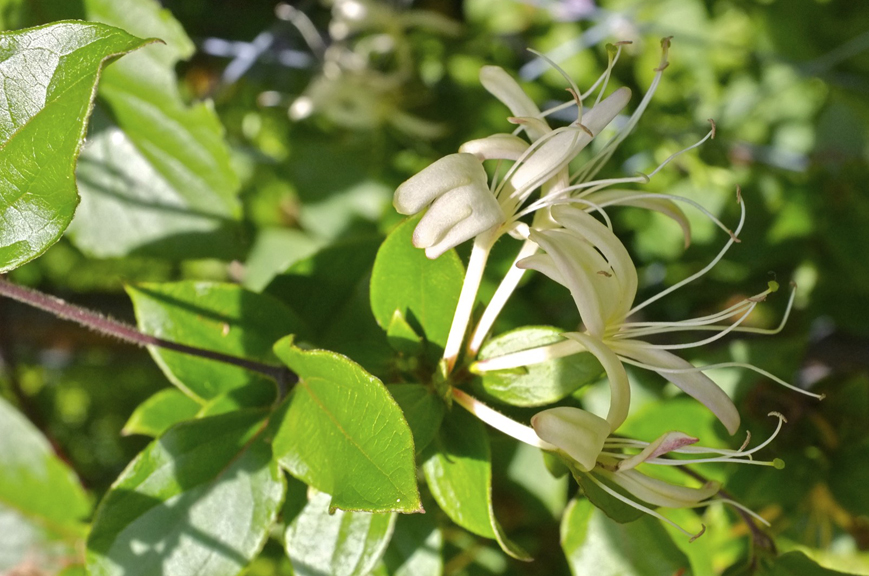
While snapping a photo of the divinely scented honeysuckle embowering the outside shower…
Honeysuckle embowered shower enclosure Lonicera japonica 'Purpurea'

I spotted our first female Monarch butterfly of the season.

Monarch Butterfly Marsh MilkweedShe’s arrived a bit earlier than usual this year, or more accurately, the milkweeds in our garden are slightly behind in blossoming time-Marsh Milkweed won’t bloom for another half-week and Common Milkweed won’t flower for another two weeks (both milkweed patches are growing nearby the shower enclosure). However, she did not have nectaring in mind.
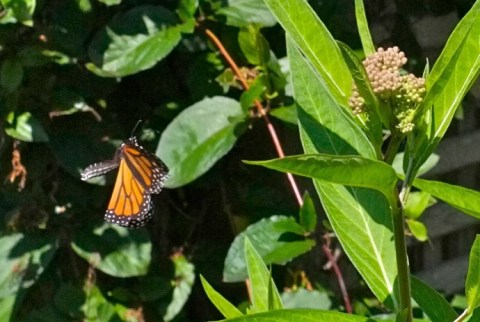
Monarch Butterfly Marsh MilkweedPausing at the emerging buds and foliage of the Marsh Milkweed, then to the Common Milkweed, then back to Marsh, and curling her abdomen to the underside, one by one she oviposited golden egg after golden egg.

Monarch Butterfly depositing egg on Marsh Milkweed

Monarch Butterfly depositing egg on Marsh Milkweed

Typically, she searches for the uppermost, freshly emerging foliage in which to deposit her eggs. Click the above photo to make it larger. The newly deposited egg, no larger than the size of a pinhead, is a visible pale yellow dot adjacent to her abdomen.

Monarch Butterfly Marsh MilkweedAfter ovipositing an egg on the Marsh Milkweed, she next deposited several on the Common.

Common Milkweed Asclepias syriaca Monarch Butterfly Eggs

Click the above photo. Five eggs are visible, two on the upper leaf of the plant to the left and three on the upper leaf of the plant to the right.

I never tire of watching butterflies, especially Monarchs, whether in our garden or further afield, and eagerly anticipate their arrival each year. Monarchs are particularly gratifying to observe and record because they are one of the larger butterflies that grace our region. Oftentimes when I am photographing a smaller butterfly such as a Summer Azure, with a mere one-inch wingspan, I don’t know what I have captured through the camera’s lens until returning to the computer to download and edit. Monarchs, with their big and bold wing patterning and approachableness (is that a word?) are a joy to photograph. Because of their extraordinary migration, I believe the Monarch butterflies are one of the natural wonders of the world. We are so blessed to live in a community that plays host to such great numbers. PLANT MILKWEED and you, too, will have Monarchs! I guarentee it!

ommon Milkweed Asclepias syriaca Good Harbor Beach GloucesterCommon Milkweed in full bloom at Good Harbor Beach this week.

ommon Milkweed Asclepias syriaca Good Harbor Beach Gloucester

Common Milkweed (Asclepias syriaca) found along the shoreline grows in sandy soil and is exposed daily to windy seaside conditions. In these rough and tumble conditions it typically grows two- to two and a half -feet tall. Conversely, where in our garden it grows in fertile, friable soil and lives in a sheltered corner protected from wind, Common Milkweed often grows six to seven feet tall.

Walking along the boardwalk I often catch the sweet honey-hay fragrance of the Common Milkweed when in full bloom. Marsh Milkweed has little to no fragrance. Several Monarchs were seen while photographing this patch of milkweed.

ommon Milkweed Asclepias syriaca Good Harbor Beach Gloucester

Torch Lily (Kniphofia uvaria)Blooming along the pathway leading to the outdoor shower is the magnificent hummingbird attractant Torch Lily (Kniphofia uvaria) and bee magnet Helenium, commonly called Sneezeweed or Dog Tooth Daisy.

Helenium Sneezeweed Dog Tooth Daisy Mexican marigolds Tagetes tenuifolia

The foliage of the diminutive Mexican marigolds (Tagetes tenuifolia), commonly referred to by the Mexican people as “flowers of the dead,” bears a fabulous spicy citrus fragrance. Flowers and foliage are edible and add both a tangy color and taste. I grow it in a pot, keeping it sometimes near the shower and sometimes moving it to the dining area.

The female Monarch stayed the morning and I have not seen her since. Lucky us, though. I found fifteen eggs, without really trying too hard, and will now have lots of caterpillars and chyrsalids for upcoming butterfly programs!

End Note regarding Japanese honeysuckle: The variety discussed here is a purple-stemmed variant and I have seen it written as Lonicera japonica var. repens and Lonicera japonica ‘Purpurea.’ In our zone 6 garden, I have found it to be well-behaved, neither bearing fruit nor sending runners. I do not recommend planting in zones 7 and above.  Lonicera ‘Purpurea is highly attractive to all manner of bees. As richly scented as the species, the blossoming time of L. ‘Purpurea’ lasts well over six weeks, equating weeks of showering while enwrapped in the spellbinding sweet scent of honeysuckle.

Lonicera japonica var. repens or Lonicera japonica 'Purpurea'Lonicera japonica var. repens or Lonicera japonica ‘Purpurea’

Monarch Butterflies Mating

In organizing my Monarch book proposal to send to a friend, who has a friend who publishes children’s books, I am sorting through my illustrations. This painting was completed at the end of summer last and illustrates a male Monarch (above) and female (below) ascending towards a maple tree during their mating flight. He carries her and together they stay joined, abdomen to abdomen, for several hours–truly a beautiful thing to observe.

Monarch butterflies mating Ascending - Pages 22-23

I lay down on the ground under a neighboring maple tree and sketched while looking up into the canopy. This is what I imagine the leaf net canopy looks like to the Monarchs as they ascend into the trees.

PLANT MILKWEED AND YOU, TOO, WILL HAVE MONARCHS MATING IN YOUR GARDEN!!

Milkweed is the food plant of the Monarch caterpillars. I often observe females drinking nectar from the milkweed blossoms one moment and the very next, depositing an egg on the underside of a freshly unfurled leaf, near the top of the plant. We observe the greatest numbers of caterpillars on the foliage of Common Milkweed (Asclepias syriaca) and  Marsh Milkweed (Asclepias incarnata).

My Workshop at Tower Hill Botanic Garden this Sunday, May Day

Come join me this Sunday at 1:00 at the Tower Hill Botanic Garden in Worcester for the perfect May Day event–How to Create a Butterfly Garden. Pre-registration is required:

Monarch Butterflies Nectaring at Smooth AstersMonarch Butterflies Nectaring at Smooth Aster

I will be presenting the necessary elements to help you create a beautiful and welcoming haven for butterflies. Once you begin to think about your garden as food source and shelter, it will influence all your horticultural decisions. Native and well-behaved non-native plants, along with examples of architectural features, will be discussed based on their value to attracting specific butterflies. This lecture and slide presentation will help you gain a deeper understanding of the interconnected world that we human beings share with plants and butterflies and how to translate that information to your own garden. Butterfly gardening plant list included with workshop.

From wiki: The Floralia, also known as the Florifertum, was an ancient Roman Festival dedicated to Flora the goddess of flowers and vegetation. It was held on the IV Calends of May, April 27 to May 3, and symbolized the renewal of the cycle of life, marked with dancing, drinking, and flowers. While flowers decked the temples, Roman citizens wore colorful clothing instead of the usual white, and offerings were made of milk and honey to Flora.

Maurice Prendergast May Day Central Park 1901Maurice Prendergast May Day Celebration Central Park 1901

AND

May Day is synonymous with International Worker’s Day and Labour Day. Read Howard Fast’s May Day – 1947, well-worth revisiting with the continued and increasing efforts to destroy organized labor.

Howard Fast May Day 1947 Rockwell KentRockwell Kent

Gloucester Garden Club

Beauty on the Wing ~ Life Story of the Monarch Butterfly

In preparing for my upcoming presentation to the Gloucester Garden Club, Wednesday, April 13th, I am discovering new images shot last summer. The photo shows a freshly emerged Monarch clinging to its chrysalis, with crumpled wet wings yet to fully expand. Butterflies Days can’t get here soon enough! Later in the afternoon we will be attending Ellen Lefavour’s art opening and book signing for Did you Know at Alchemy of Art Gallery. I hope to see you there.

Monarch Emerging from ChrysalisMonarch Butterfly Newly Emerged from Chrysalis

Monarch Butterfly Migration

Update: Monarch Butterfly Migration Late Summer 2010

Monarch butterfly migration seaside goldenrodMagical Seaside Goldenrod Meadow

Monarch butterfly migration seaside goldenrod

Dear Gardening Friends,

So many have telephoned or emailed inquiring about the status of the annual Monarch butterfly migration through our region. This past summer I have observed umpteen Monarch butterflies and caterpillars in cultivated gardens, wildflower meadows, and along the shoreline; however, I did not see the great numbers in great heaps roosting in any one particular place that I have in some years past. Rather I would find a small passel here and a small passel there—perhaps several dozen at a time—roosting in the wild black cherry trees (Prunus serotina) at Eastern Point, awakening in the early morning and nectaring at the Seaside Goldenrod in the meadow below.

Monarch butterfly migration Monarchs Mimic Withering Foliage of Black Cherry Tree

Although the Monarchs are guided genetically, using their internal sun-compass navigation and circadian clock, each year the annual southward migration takes a different form that depends on many  variables, primarily the weather conditions in their overwintering site in Michoacán, Mexico as well as weather patterns in their US and Canadian breeding grounds. Because Cape Ann is located at approximately 43 degrees latitude north, our peak migration pattern is estimated at around September 11, but I modify this pattern because of the strong winds and storms we often experience in the late summer living along the coastline.

I have read reports of fantastic migrations that are taking place this year, from Long Island, south to Cape May, and west to Virginia—some saying it is the best they have seen in decades! I continue to remain on the look out because the air temperatures were atypically warmer this summer, creating a longer breeding season than usual, which would indicate that there may be newly emerging Monarchs on the scene. While photographing during this year’s migration, I encountered a pair of Monarchs mating, a very unusual occurrence at this time of year. The “Methuselah” Monarchs that we see in late summer and early autumn are generally speaking sexually immature and do not mate until next year, after they journey south and after they overwinter and awaken in Mexico.

Monarch butterfly migration monarchs mating seaside goldenrodMonarchs Mating Amidst the Goldenrod

Monarchs observed in late summer and early autumn are intent on nectaring and not easily distracted. This later generation of Methuselah Monarchs is feeding aggressively to increase and store their lipid reserves for the long journey south. We provide plenty of nectar-rich blossoms to help the Monarchs in their exhaustive migration, taking cues from marsh and meadow. Blooming freely at this time of year are copious members of the Composite family—goldenrods, asters, pearly everlasting, zinnias, ironweed, Mexican sunflowers, and Korean daisies. If one diligently deadheads the butterfly bushes and Verbena bonariences, they too will be available for the migrating Monarchs.

My favorite goldenrod is Seaside Goldenrod (Solidago sempervirens), which blooms from August to November. Seaside Goldenrod is the gorgeous brilliant golden wildflower we see growing and glowing along the edge of the sea. It is easily differentiated from other New England goldenrods in that the flowerheads are comparatively larger and the leaves are thicker and fleshier, with a waxy feel, an adaptation to the drying effect of salty sea spray. Seaside Goldenrod grows prolifically in rich, moisture retentive soil, less so in drier conditions.

Although I strongly discourage digging plants from local marsh and meadow, perfectly acceptable is the practice of collecting ripened seed stalks and shaking them about. That is just how we obtained our Smooth Asters (Aster laevis). With cheery one-inch button-shaped flowers borne along the lengths of the stalks, the pale-hued lavender-blue ray flowers and yellow disk florets of Smooth Asters are attractive to bees and butterflies. We have observed Common Sulphers, Pink-fringed Sulphurs, Monarchs, American Ladies, Red Admirals, and Cabbage Whites nectaring simultaneously on a clump growing in the sheltered border along our fragrant path. Pinch back the developing growth tips during the early part of the growing season (until roughly July fourth) to encourage a bushier and more compact plant. Asters provides nourishing sustenance for transitory butterflies when many nectar-rich plants have finished blooming for the season. Not particularly fussy in regard to soil conditions, Smooth Aster grows and flowers profusely in full sun to light shade. Smooth Aster and Purple-stemmed Aster (Aster puniceus) are the asters we see blooming along the backshore at this time of year. With golden yellow florets at the center of their ray flowers, asters and goldenrods create a convenient landing pad for nectaring Lepidoptera. Flowering alongside ripening red berries and surrounded by changing autumnal leaf color, goldenrods and asters transform the seasonal tapestry.
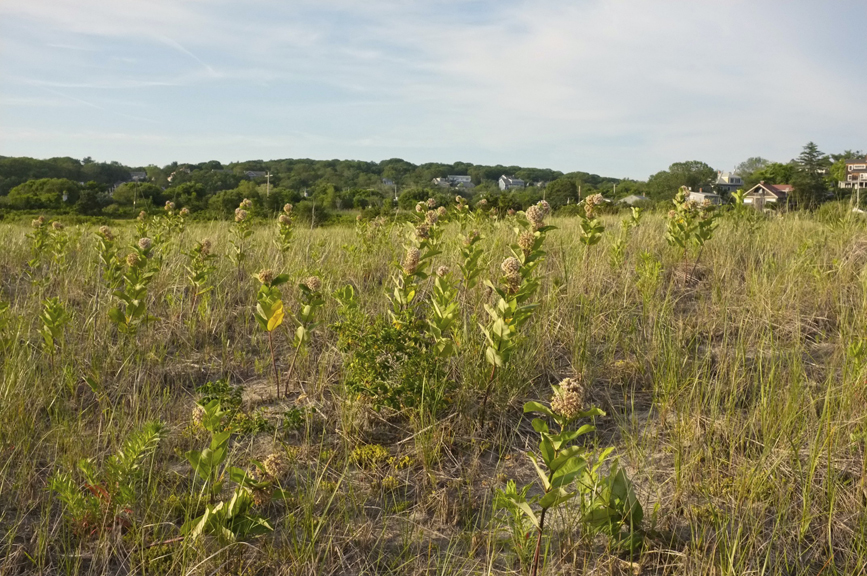
Monarch butterfly migration

Monarch butterfly migration seaside goldenrodPollen-dusted Male Monarch

Mockingbird fledglingsWhile photographing the Monarchs, I couldn’t help but notice two noisy Mockingbird fledglings, who were going at each other for over a half hour.

North American Butterfly Association

The most recent issue of Butterfly Gardener magazine features my photo on the back cover of an American Lady (Vanessa virginiensis) butterfly nectaring at Korean daisies. The North American Butterfly Association, or NABA as it is more commonly known, is a worthy organization to support. As a member of NABA four times a year you will receive two magazine subscriptions. I eagerly anticipate the arrival of both magazines. American Butterflies is edited by the world renowned lepidopterist Jeffrey Glassberg and is brimming with stories and species accounts of butterflies found throughout America. Butterfly Gardener, is chock-full of useful information about gardening for butterflies. I enjoy editor Karen Hillson’s missives and asides and find especially useful Lenora Larson’s quarterly column on caterpillar food plants.

Mr.Glassberg writes in a recent issue of American Butterflies about why he believes butterflies are an ideal portal to the natural world “…once one becomes interested in butterflies, one almost certainly becomes interested in plants, in other components of nature–in the whole web of life. To find adult butterflies one must soon learn the important nectar plants in one’s area and especially the caterpillar foodplants. And the captivating transfomation of caterpillars into adult butterflies brings a very high percentage of butterfliers to a deeper appreciation of life histories and the larger ecological picture.”  To learn more about NABA and how to become a member visit their website at www.naba.org (membership fees are very reasonable).

American Lady Butterfly Vanessa virginiensisAmerican Lady Butterfly (Vanessa virginiensis) Nectaring at Korean Daisy

Monarch Butterfly’s First Sips of Nectar

This female Monarch emerged from her chrysalis late yesterday afternoon. She stayed hidden under foliage overnight. Mid-morning she alighted onto my hand and I placed her on a fresh blossom of the butterfly bush ‘Nanho Blue.’ She is easily recognized as female because her wing venation is thicker and smokier than that of a males wings, and because she does not have the two small black pockets of pheromones on each hind wing.

Female Monarch Butterfly


Male Monarch Butterfly (left) and Female Monarch Butterfly (right).

Monarch Caterpillars on Common Milkweed Leaves

Dear Gardening Friends,

I’ve updated the article on common milkweed (see below). The second video of the caterpillar pupating goes a bit dark in the beginning because I was trying to capture the caterpillar’s exoskeleton splitting apart, just below the head.

My husband, Tom Hauck, was quoted on Sound Off in this week’s issue of Time Magazine. His quote can also be found here (scroll down).

Looking at our thriving patch of common milkweed, I am eagerly anticipating the arrival of the Monarch butterflies to our garden in Gloucester. It is difficult to reconcile the enjoyment we derive from life’s simple pleasures when looking into the faces of the victims struck by the unfolding tragedy in the Gulf Coast region—a tragedy for the nation. I hope and pray that the net result of this catastrophe will be a wake up call, and that we will all come together to fully realize the potential of non-polluting alternatives to our unsustainable use of fossil fuels.

Best wishes, Kim

The pair of Monarch caterpillars, hanging in the characteristic J-shape, are attached to the underside ribs of common milkweed (Asclepais syriaca). They were filmed at approximately 7:30 am on August 22, 2009, one hour prior to pupation. The “twins” pupated within six minutes of each other. “Twin #2” is pupating in the video.