Category Archives: shorebirds

HANDICAPPED MOM AND DAD HAVE A NEST OF THREE! #ploverjoyed

Wonderful news for our handicapped Mom and Dad pair at #3. The eggs are safely ensconced in an exclosure, and the pair are brooding a nest of three!

Dad on the nest in the exclosure <3

Our deepest thanks and gratitude to Dave Rimmer, Director of Land Stewardship at Greenbelt for installing the exclosure and for his ongoing assistance with Cape Ann’s Plovers.  If you feel so inclined, please think about making a donation to Greenbelt in Dave’s name to thank Greenbelt for their strictly volunteer assistance over the past seven years. Donate page of Greenbelt here.

Handicapped Mom

Thank you to Everyone for your suggestions regarding Pollution, Urination, and the Underage Drinking Crisis at Good Harbor Beach. Thank you to Andrea Holbrook and Ethan Forman for “Gloucester Beaches Bustling Weekend Before Memorial Day” article in the Gloucester Daily Times for the coverage.

I have to say, we were collectively dismayed by the City’s sugar coated response to the issues at Good Harbor Beach as reported in the Times.

We have written to the Mayor’s office, all City Councilors, and Chief Conley. We have heard back from City Councilor Jeff Worthley. On Saturday, Jeff went from person to person at GHB to let them know that the Creek was contaminated and on Sunday had signs posted by the board of health. During the 1990s, Jeff worked at Good Harbor Beach for five summers and that first summer, when he was only 19 years old, made a list of 25 suggestions on how to improve GHB. Two of those suggestions included opening earlier in the year and dune restoration! We are very much looking forward to meeting with Jeff.

OUR BEAUTIFUL MOM HAS LOST HER FOOT

A story of patience, fidelity, resilience, and hope 

You may recall that last year our Piping Plover Mom’s foot became entangled in what appeared to be both dried seaweed and monofilament. Mom visibly struggled with her foot entanglement. Although initially she could still thermoregulate the chicks and stayed nearby, we began to see less and less of her. Much of the parenting of chicks was left to Dad as she was infrequently seen lying low in the tall beach grass. We wondered if she even made it through the summer.

Mom’s very painful looking injury caused her to behave as though she was trying to adapt to the awkwardness of carrying a ball and chain. Sometimes the chicks would get caught in the seaweed and monofilament entanglement and she was continuously pulling at it, trying to remove.

Fast forward to April of this year. For a month we have had a new pair of Plovers attempting to nest, first at area #3, the original pair of Plover’s original nesting site (beginning in 2016), and then I believe shifting further north up the beach, toward Salt Island. I checked on that pair on Wednesday morning, the fifth, just before leaving for Ohio and despite the unseasonably cool temperatures and rough winds, everything was as it should be in Ploverville.

Upon our return Monday morning all had turned upside down in the world of Plover nesting. It took me a day to understand what had taken place.  Miraculously, our original Mom and Dad have returned to #3. We are overjoyed to see them both, Mom especially, but the bittersweet of it is that she has lost her foot.

Dad is clearly eager to mate but, for lack of a better word, is being extraordinarily patient with Mom. She spent the first few days after arriving quietly lying in the grass, so much so we were becoming concerned. But Mom has rallied and is showing interest in Dad and his nest scrapes. He is very attentive, staying nearby and defending her against real and imagined intruders. We all got a laugh when Assistant Library Director Beth Pocock’s commented, “Not very Darwinian of him.”

Dad in one of his nest scrapes

The pair are approximately five weeks later in arriving than the past several years.  It’s not entirely unexpected that Mom’s foot has been amputated by the monofilament and seaweed wrapped so tightly that it was cutting off her circulation. Plovers historically have survived with one foot/leg. One of the most common reasons for loss of foot or leg is when debris becomes caught in a leg band on Plovers that have been banded. The thing is, it is taking double the amount of effort for Mom to do things that Plovers ordinarily do daily. Her gait step is twice as many steps as compared to Dad’s. She is spending a good amount of time lying down, rather than standing.

Piping Plovers show tremendous fidelity to each other and to their nesting site. Our Good Harbor Beach Original Plovers are fantastically resilient — recalling just one of their many trials and adventures — the year they nested in the parking lot, driven to this measure by the plethora of dogs allowed off leash by their owners; dogs running and  prancing through the  Plover’s roped off area disrupting their nesting.

Will Mom be able to breed and take care of chicks this summer? Only time will tell. But because  she is now “handicapped,” it’s imperative that we eliminate all disturbances.

Mom is able to use her peg leg to scratch an itch

On Saturday, we had a serious problem with several very large groups of teens drinking, creating a mountain of trash, playing in the nesting area, and running through the area to use the dunes as their bathroom. Their complete disregard of the clearly marked off area destroyed the Plover’s nest scrapes, which are the potential possible sites for eggs. The police were called. The officers were very patient with the teens. One girl in particular was extremely rude to the officers, barely coherent and nearly falling down drunk.  It took more patience than you can possibly imagine for the officers to de-escalate as they did.  It wasn’t until the police appeared that the teens began attempting to clean up their trash, which without the officer’s insistence that they clean up, surely would have resulted in the more than one huge trash bag that I filled this morning.

These were not local kids but we have to do better than this as a community. There must be a way to have some authority figure patrol the beach on warm spring and summer afternoons. These teens were completely smashed and the amount of trash from alcoholic beverages was astounding. As soon as the officers appeared on the beach, the teens began to clean up their behavior, language, and garbage. But I don’t believe it should have gotten to this point.

We’ll keep an eye on the weather and we Ambassadors will mobilize on the next warm beach day but frankly, we have very little authority. None of us feel safe approaching a group of 30 or 40 unruly and intoxicated (and foul mouthed as was the case Saturday) teens. Truly, the ideal solution is to assign an officer or ranger to patrol the beach on warm afternoons and evenings.

If anyone sees people rough housing in, playing in, or repeatedly entering the roped off areas, please call the police and explain what you are seeing. If a nest with eggs or an adult or a chick is harmed in any way or killed by this kind of behavior, that is considered a “take” by both state and federal regulations. The City and the individuals responsible are liable for thousands of dollars in fines and potential closure of Good Harbor Beach. Our mission is to keep our beautiful GHB open for everyone and to keep our Plovers safe.From Saturday – how people treat our beautiful beach – trash on the beach brings crows and gulls, which eat Plover eggs and chicks


THANK YOU SAWYER FREE LIBRARY AND GUESTS! AND COINCIDENTALLY, TODAY IS WORLD MIGRATORY BIRD DAY!

Thank you to Jennifer Santomauro, Beth Pocock, and Linda Bossleman at the Sawyer Free Library and to everyone who came to the Piping Plover program this afternoon. Despite the gorgeous weather and protest marches nationwide, we had a wonderful group of interested attendees. It’s the first in-person presentation I’ve given in several years and I just want to thank everyone so much for coming.

World Migratory Bird Day is held annually on the second Saturday of May (May 14th in 2022).This year’s WMBD focuses on the impact of light pollution on migratory birds.

“Most birds migrate at night. They have been doing this for eons, as a night sky typically means calmer air space and fewer predators. Nocturnally migrating birds include ducks and geese, plovers and sandpipers, and songbirds of all kinds. These birds may travel thousands of miles between their breeding and non-breeding grounds.

However, the night sky is under threat. Artificial light is increasing globally by at least two percent a year, presenting a problem for birds. Light pollution from homes, businesses, and other infrastructure attracts and disorients migrating birds, making them more likely to land in dangerous areas where they are more vulnerable to collisions and predation. Artificial light also impacts birds in the breeding and winter seasons, disrupting feeding and other vital behaviors.

In 2022, the impact of light pollution is the focus of World Migratory Bird Day, an annual global campaign that celebrates the migration of birds across countries and continents. Throughout the year we will spread the message to “dim the lights for birds at night” and highlight the steps that individuals, communities, and governments can take to reduce the impact of light pollution on our shared birds.”

One of the featured species in WMBD 2022 is the Baltimore Oriole (as seen in the above illustration)!


Baltimore Oriole (Icterus galbula)

Length: 8.3” (21.1cm)

Wingspan: 11.5” (29.2cm)

Weight: 1.2oz (34g)

You may find this colorful member of the blackbird family in open woodlands, parks, or even your backyard. It eats a lot of insects, especially caterpillars, as well as fruit and nectar. Baltimore Orioles and many other songbirds need dark skies to safely migrate—you can help by reducing the amount of light outside your home at night.

Conservation Status: Low Concern

WHAT IS WORLD MIGRATORY BIRD DAY?

In 1993, the Smithsonian Migratory Bird Center created International Migratory Bird Day (IMBD). This educational campaign focused on the Western Hemisphere celebrated its 25th year in 2018. Since 2007, IMBD has been coordinated by Environment for the Americas (EFTA), a non-profit organization that strives to connect people to bird conservation.

In 2018, EFTA joined the Convention on Migratory Species (CMS) and the Agreement on the Conservation of African-Eurasian Migratory Waterbirds (AEWA) to create a single, global bird conservation education campaign, World Migratory Bird Day (WMBD). Continuing our tradition with IMBD, WMBD celebrates and brings attention to one of the most important and spectacular events in the Americas – bird migration.

This new alliance furthers migratory bird conservation around the globe by creating a worldwide campaign organized around the planet’s major migratory bird corridors, the African-Eurasian flyway, the East Asian-Australasian flyway, and the Americas flyway. By promoting the same event name, annual conservation theme, and messaging, we combine our voices into a global chorus to boost the urgent need for migratory bird conservation.

EFTA will continue to focus its efforts on the flyways in the Americas to highlight the need to conserve migratory birds and protect their habitats, and will continue to coordinate events, programs, and activities in Canada, the United States, Mexico, Central and South America, and the Caribbean at protected areas, refuges, parks, museums, schools, zoos, and more. As many as 700 events and programs are hosted annually to introduce the public to migratory birds and ways to conserve them.

READ MORE HERE

PIPING PLOVER UPDATE AND PLEASE JOIN ME SATURDAY FOR A FREE IN-PERSON PIPL PRESENTATION

Good afternoon PiPl Friends!

We returned Monday from a trip to visit my husband’s dear family in Ohio. If you can imagine, we were celebrating my father-in-law’s 97th birthday!! He is simply amazing and boasts his doctor told him he has the legs of a 70 year-old! We also squeezed in a trip to the butterfly exhibit at the Krohn Conservatory, the Cincinnati Zoo, and visited the old homestead located at the Hauck Botanical Gardens. And had the BEST BBQ at Eli’s Riverside. The Hauck Botanical Gardens, set in downtown Cincinnati, is a relatively small public park created decades ago by my father-in-law’s father (husband’s grandfather) and is richly planted with a collection of rare and North American native trees. Photos coming in a future post 🙂

A week away from Cape Ann’s Plovers and much has been taking place. The GHB PiPls are getting off to a slow start nesting this year and three solid days of fierce wind from the northeast is not helping matters. Yesterday morning there was a great deal of flying and piping at each other, but the funny thing was, they would take periodic breaks from skirmishing and huddle close to each other to get out of the wind.

The Cape Hedge Plover pair are settling in and I will have more on the CHB family towards the end of the week. The photo of the CHB Dad was taken Tuesday. He spent the better part of the time Charlotte and I were there trying to distract dogs that were running off leash.

Please join me Saturday at the Sawyer Free for a presentation about the Plovers (see below). Please feel free to wear a mask and please practice social distancing. Covid cases are on the rise in Gloucester (and everywhere) and I think I will be wearing a mask when not speaking.

I hope to see you there.
Warmest wishes,
Kim

Please join me at the Sawyer Free Library on Saturday, May 14th, at 2pm for a FREE in-person all ages presentation about the life story of the Piping Plover –

Why Give a Peep for Plovers?

The Piping Plover is one of only a handful of birds that nests on North Atlantic beaches. By learning about this tiny but most resilient of shorebirds, we gain a deeper understanding on how best to protect Piping Plovers and our shared coastal habitat.

Told through the lens of Kim Smith’s photo journal work, the Piping Plover’s life story is presented from migration to nesting to fledging. We’ll also cover the current status of the bird’s population, learn about where Piping Plovers spend the winter, and how communities and conservation organizations can work together to help Piping Plovers flourish for generations to come.

If you are new to or have ever considered joining our Piping Plover Ambassador group, this presentation is a great way to become introduced to Piping Plovers. Please come and learn more about these most lovable and charismatic shorebirds.

We hope to see you there!

WHY GIVE A PEEP FOR PLOVERS? SAVE THE DATE – PIPING PLOVER PRESENTATION AT THE SAWYER FREE LIBRARY!

Please join me at the Sawyer Free Library on Saturday, May 14th, at 2pm for a FREE in-person all ages presentation about the life story of the Piping Plover –

Why Give a Peep for Plovers?

The Piping Plover is one of only a handful of birds that nests on North Atlantic beaches. By learning about this tiny but most resilient of shorebirds, we gain a deeper understanding on how best to protect Piping Plovers and our shared coastal habitat.

Told through the lens of Kim Smith’s photo journal work, the Piping Plover’s life story is presented from migration to nesting to fledging. We’ll also cover the current status of the bird’s population, learn about where Piping Plovers spend the winter, and how communities and conservation organizations can work together to help Piping Plovers flourish for generations to come.

If you are new to or have ever considered joining our Piping Plover Ambassador group, this presentation is a great way to become introduced to Piping Plovers. Please come and learn more about these most lovable and charismatic shorebirds.

We hope to see you there!

GOOD HARBOR BEACH PIPING PLOVER UPDATE

Our GHB Mom and Dad have, for the most part, been lying low during this recent cold snap. However, given the warming temps over the past few days, the pair has resumed courting. And our pair at Cape Hedge continues to spotted regularly. More PiPls will likely be arriving soon. I am so looking forward to the magical month of May in Massachusetts for the magnificent peak migration that takes place all along our shores.

Courtship has resumed!

Willets at Good Harbor Beach

Our beloved Good Harbor Beach is yet another reason to protect shorebirds. Where ever conservation measures have been put in place to help shorebirds, these same actions have had a profoundly positive impact on helping to protect coastlines.


HAPPY EARTH DAY ON THIS MOST BEAUTIFUL OF EARTH DAYS!!

“There is symbolic as well as actual beauty in the migration of the birds, the ebb and flow of the tides, the folded bud ready for the spring. There is something infinitely healing in the repeated refrains of nature – the assurance that dawn comes after night, and spring after the winter.” –Rachel Carson

Dear Friends,

It’s glorious outdoors today and I hope you have a chance to get outside.  See below for photos from my morning Earth Day walk, although I can’t bear to sit at my computer all day when it’s so gorgeous out and will head back out this afternoon to see what we see.

For Earth Day this past week I gave several screenings of Beauty on the Wing (thank you once again most generous community for all your help funding BotWing!) along with presenting “The Hummingbird Habitat Garden” to the Massachusetts Horticultural Society. For over twenty years I have been giving programs on how to create pollinator habitats. People are hungry for real information on how to connect to wildlife and wild habitats and each year the interest grows and grows. It’s truly a joy to witness!

Last night it was especially rewarding to bring Beauty on the Wing to Connecticut’s Sherman Conservation Commission attendees. We had a lively Q and A following the screening with many thoughtful questions and comments. My gratitude and thanks to Michelle MacKinnon for creating the event. She saw the film on PBS and wanted to bring it to her conservation organization. Please let me know if you are interested in hosting a Beauty on the Wing screening

Monarchs are on the move! The leading edge in the central part of the country is at 39 degrees latitude in Illinois and Kansas: the leading edge along the Atlantic Coast is also at 39 degrees latitude; Monarchs have been spotted in both Maryland and New Jersey. Cape Ann is located at 43 degrees — it won’t be long!

Monarchs are heading north! Female Monarch depositing egg on Common Milkweed

Hummingbirds have been seen in Mashpee this past week (41 degrees latitude). Don’t forget to  put out your hummingbird feeders. Dust them off and give a good cleaning with vinegar and water. Fill with sugar water and clean regularly once installed. The sugar water recipe is one part sugar to four parts water; never replace the sugar with honey, and never use red food coloring.

Happy Glorious Earth Day!

Female Ruby-throated Hummingbird

Super surprised to see this mystery duck asleep on a rock. I was so curious and kept hoping he would wake up so as to identify. He at last lifted his head for all of ten seconds and then promptly tucked back in and went back to sleep. I’ve only ever seen Surf Scoters bobbing around far off shore in the distance. Skunk bird- what a cutie!

American Kestrel, male, too far away to get a good photo but a joy to see!

Beautiful, beautiful Great Egret preening its luxurious spray of feathers. An egret’s spray of feathers is also referred to as aigrette.

No Earth Day post would be complete without our dear PiPls – Mom and Dad foraging at the wrack line this am, finding lots of insects for breakfast.

A seal’s life


PRETTY SILVERY WAVES AND PIPING PLOVER AFTER STORM UPDATE

The howling winds of the April 18th overnight storm brought super high tides, downed trees, downed power lines and poles. We lost one of our beautiful ‘Dragon Lady’ hollies, one of a pair planted when we first moved to our home, and a tree that gave the birds many tree-fruits over the years.

The wind also carried in a somewhat befuddled Great Egret, clinging to a shrub and still trying to gain his bearings when photographed at mid-day.

Super high tide to the base of the dunes

Mom and Dad foraging in the intertidal zone

Mom

Dad

The highest tide during the storm went up and a bit past the base of the dunes. Our nesting pair of Plovers appeared relatively unfazed and, despite the continued high winds at day’s end, were busy courting and foraging at the newly washed over beach scape.

Churned-up

#savesaltisland CONSERVATION MEETING POSTPONED ONCE AGAIN

Save Salt Island Friends Jayne and Andy write,

Hello protectors of Salt Island,

The agenda for the Conservation Commission meeting tonight, Wednesday April 20th, has been updated and the proponents of RDA-1703 Salt Island have requested a continuance to May 4, 2022.  The administrative record for this application has also been moved from April 20, 2022 to May 4, 2022.

Andy and I are still planning to attend to observe the vote of the request for continuation, but based on all of the past meetings, it will likely pass.  We are letting you know since your time is valuable and it would be unfortunate to have you attend unnecessarily.  Of course, if you still want to attend… GREAT!  We will continue to watch for any changes to the application between now and May 5th.

Thank you again for your patience and perseverance.

Warm regards,

Jayne and Andy

Martignetti’s plan drawing for Salt Island McMansion (Martignetti Family now called Salt Island LLC)


HAPPY EASTER, HAPPY PASSOVER, JOYFUL SPRING!

Wishing dear friends and readers Happy Easter, Happy Passover, and a Joy-filled Spring 

Beauty everywhere you turn in these first few weeks of spring – the return of songbirds, shorebirds, and Osprey, blossoming trees, beach bunnies, and garden helpers.

Beach bunny, Piping Plovers courting, neighbor Melissa’s flowering plum tree, Charlotte, Osprey, Killdeer eggs, Piping Plover eggs, Cedar Waxwings courting, and male Eastern Bluebird wing waving

THANK YOU MAYOR VERGA, AC OFFICERS JAMIE AND TEAGAN, MARK COLE, JOE LUCIDO, AND THE GLOUCESTER DPW CREW!

Speaking on behalf of the Piping Plover Ambassadors, we would like to thank Mayor Verga, Mark Cole, Joe Lucido, and the Gloucester DPW Crew, and Animal Control Officers Jamie and Teagan for helping to protect our Cape Ann Plovers. We are grateful and so appreciate their very timely efforts.

The many recent actions we are grateful for –

All the roping is now in place at areas #1, #2, and #3. Hooray!! Why is this action so important? It gives the Plovers safe space to court and to nest. Plovers will rebuild their nest up to five times. If they have safe spaces from the get go, chances are they will nest earlier in the season and be on their way before the beach gets crazy busy with people enjoying the beach.

DPW Crew installing the symbolically roped off area on Wednesday, April 13th

We are grateful that Officers Teagan Dolan and Jamie Eastman are daily patrolling the beach  at varying times. For the same reason the roping needs to go up early, the earlier in the season the dogs are off the beach, the safer it is for Plovers, along with the many shorebirds stopping over at Good Harbor Beach on their annual northward migration.

We are so appreciative of the signs now in place, both the endangered species signs on the cordoned off areas and the No Dogs signs at entrances to the beach and parking lots.

If you are heading to Good Harbor Beach, you can’t help but notice the blinking sign in the road near the intersection of Beach and Nautilus Roads. The sign will greatly help the AC Officers who often hear, “I didn’t know”, or “I didn’t’ see the (large screaming yellow) sign at the footbridge. The fine is $300.00 for each dog off leash and doubled if the dog charges through the clearly marked nesting area. Why the hefty fine? Because the City will be held accountable by state and federal agencies for any threatened or endangered bird that is killed or injured at Good Harbor Beach. A fine of $25,000.00 or more could be levied against the community if a bird listed as threatened or endangered is killed by a dog, person, or stray ball.

Again, we can’t thank enough Mayor Verga, Mark Cole, Joe Lucido, Gloucester’s ACOs, and entire DPW crew for their consideration and kind help protecting the Plovers!

Piping Plover love stories update –

The very pale female that was the first to arrive only stayed for a few days. She was followed by the Three Bachelors. A Bachelorette joined the scene over the weekend and paired up with Bachelor #3.

We now have one sweet couple attentively courting and nest scraping.

We’ve temporarily lost sight of Bachelors #1 and #2 but the precocious and Interfering Sanderling is still on the scene. The situation is fluid and we expect more PiPls will be arriving in the coming days. 

If you would like to be a Piping Plover Ambassador, please contact me by either leaving a comment or emailing at kimsmithdesigns@hotmail.com.

Today’s Pea Soup Fog

Beach House construction underway – don’t you think this dried grass will add greatly to the decor honey?


CALLING ALL BACHELORETTES!

Good afternoon PiPl Friends,

Currently we have three male Piping Plovers positioned for action at Good Harbor Beach at respective territories. The bachelors are eagerly awaiting the arrival of the bachelorettes, marking their turf with nest scraping and the calls for which Piping Plovers are so well known, all accomplished with chests a-puff.

 Meet the three candidates-Bachelor #1  

Bachelor #2  

Bachelor #3

#1 chasing #2 off his turf

The head count can change on a dime overnight. Let’s hope the ladies will soon be arriving.

If you would like to be a Piping Plover Ambassador, please contact me by either leaving a comment or emailing at kimsmithdesigns@hotmail.com.

Exciting news, we have three new wonderful recruits! We’ll have an informational meeting later this spring, once we have an actively nesting pair. I am so looking forward to working with you all, both our super experienced and dedicated volunteers, along with our new members!

Jennie and Deb, I received your requests to continue in your last year’s time slots and we will also work on getting more coverage at peak times.

xxKim

WONDERFUL PIPING PLOVER NEWS!

Good Morning PiPl Friends,

Happy news to share – the first of our little friends arrived overnight Friday. We found him/her feeding with great gusto at the intertidal zone Saturday morning. After foraging she moved to the roped off area at #3 to find shelter from the wind. Not sure yet if it is a male or female and we’ll know once courtship starts, but I am leaning towards female.

And, a reader shared that she saw several PiPls Sunday!

Finding mini mollusks in the intertidal zone

Please, If you see Plovers, stay a good distance away and give them some space as they are very worn out from their journeys (from where I wish we knew.)

We are looking for volunteer Plover Ambassadors. The volunteer season begins when the Plovers chicks are close to hatching, which is not for approximately another two months. We are a wonderfully dedicated group and if you are interested in joining, please leave a comment in the comment section or email me at kimsmithdesigns@hotmail.com. I look forward to hearing from you!

Happy Spring!

xxKim

Windy, windy morning

PEEP IN A CLAMSHELL

Is a Sanderling a sandpiper? The short answer is yes.

Sanderlings are a species in the genus Calidris, which also includes locally seen Semipalmated Sandpipers and Least Sandpipers. All three are called sandpipers, with the sweet nickname “peeps.”Pretty Sanderling in a clamshell

PIPING PLOVERS SOMERSAULTING!

For the first time, as far as anyone can recollect, a pair of Piping Plovers nested at Cape Hedge Beach in Rockport during the summer of 2021. The family was not observed until after the chicks had hatched but we can make a fairly educated guess as to where the nest was hidden. I think, too, based on comparing many photos and film footage that the pair at Cape Hedge had nested originally at the Salt Island end of Good Harbor Beach. That nest of three eggs was washed away by a storm surge during the King Tide.  There was a great deal of competition for nesting territory at Good Harbor during this time period and it is logical the SI pair would have moved north one beach. I imagine that to a Plover’s way of thinking, from Cape Hedge to Good Harbor is one long continuous beach.

One of the most fascinating aspects observed about the Cape Hedge Piping Plover family was the very young chick’s ability to navigate the popples. They used the larger rocks as slides, leapt from rock to rock, occasionally got stuck and, especially when they were very teeny, did mini somersaults.

Why did the Plovers go up and down the steep bank of popples countless times a day? Better camouflage was afforded at the top of the bank while food was more plentiful in the tidal flats. Insects could be had amongst the rocks, but super nourishing mini mollusks and sea worms can only be found in the intertidal zone.

I am currently in the midst of the daunting task of organizing six years of PiPl footage and photographs, from 2016 through 2021. I’ll be posting snippets from time to time. See below for some PiPl acrobatics and a somersault in slow motion 🙂

MASSACHUSETTS WANDERING WOOD STORK UPDATE

The beautiful young Wood Stork appears to have departed the shores of Cape Ann. As far as I am aware, no further sightings have been reported. A week ago, Tuesday the 23rd of November, the weather turned much cooler with early morning temps dipping in the low thirties. I observed the young WS foraging and swooping across the marsh at daybreak before heading to work. At the end of Tuesday, I didn’t see him, nor the following morning when temps were in the low twenties. Daily checks in all his hotspots have resulted in no sightings. Possibly the cold weather prompted a movement southward. Many of the Great Blue Herons that were also feeding in the marsh have also moved on. Perhaps most have gotten the message that it’s time to get out of here!

The Wood Stork has been on Cape Ann for over a month. I first caught site of him swooping over the marsh and into a tall deciduous tree along Route 128. The site of the WS in flight took my breath away. Several times I circled around trying to catch a second glimpse, but did not see. Over the course of the next month, many sightings were reported and by the mid-November, the WS had settled into the marsh near the railroad tracks.

Fortunately, I did manage to capture some footage of the Wood Stork foraging at dusk and am working on a short video. Most of its time spent feeding on Cape Ann, the WS was crouched down low with only torso visible. I really lucked out because the Wood Stork flew to an opening in a marsh tidal pool where I could see his legs and feet in action. This great gawky bird does an elegant dance shaking its feet in the mud to stir up edible creatures. At one point that you can clearly see in the footage, he does a delightful backward turn whilst foraging.

Elegant dance of the Wood Stork

In reading abut Wood Stork sightings in Massachusetts (see story here, of an elusive juvenile Wood Stork on Cape Cod in 2019),  I learned the Wood Stork is rather tolerant of people, which would explain why Cape Ann’s Wood Stork appeared relatively unfazed by the large crowds he attracted:

Mike Faherty, NPR, “I connect with Wood Storks, and not just because we are both bald. They remind me of my younger days doing bird research in the Everglades, where the Wood Stork is one of those birds that, although federally Endangered, could be seen in roadside ditches next to strip malls. Such is birding in South Florida, where the birds are tame and abundant even in the unlikeliest of places. Wood Stork populations crashed from 15,000 pairs to 500 pairs when the Everglades were ditched and drained in the early 20th century, but populations have stabilized enough recently to upgrade them from Endangered to Threatened.

Read More Here: WANDERING WOOD STORK IN MASSACHUSETTS (VERY RARE)

#ploverjoyed FOR A BIT OF PLOVER FLOUFERY!

Over the weekend a mini flock of a half dozen Semipalmated Plovers arrived on Eastern Point, basking in the warm sun and partaking of an abundance of sea worms. I had to take a second look because at this time of year, Semipalmated Plovers look very similar to Piping Plovers. The SemiPs fade from rich chocolate brown and black plumage to hues of weathered driftwood and sandy shores, very closely resembling their cousins.

SemiPs bathe just as do PiPls. They cautiously approach the water, making sure there are no predators before plunging. Repeatedly dipping and diving, then springing from the water with  outstretched wings in a hopping flourish, they then take some quiet moments to flouf and to pouf.

Thank you to our PiPl friend Todd Pover for sharing the hashtag #ploverjoyed!


Semipalmated Plover in summer breeding plumage

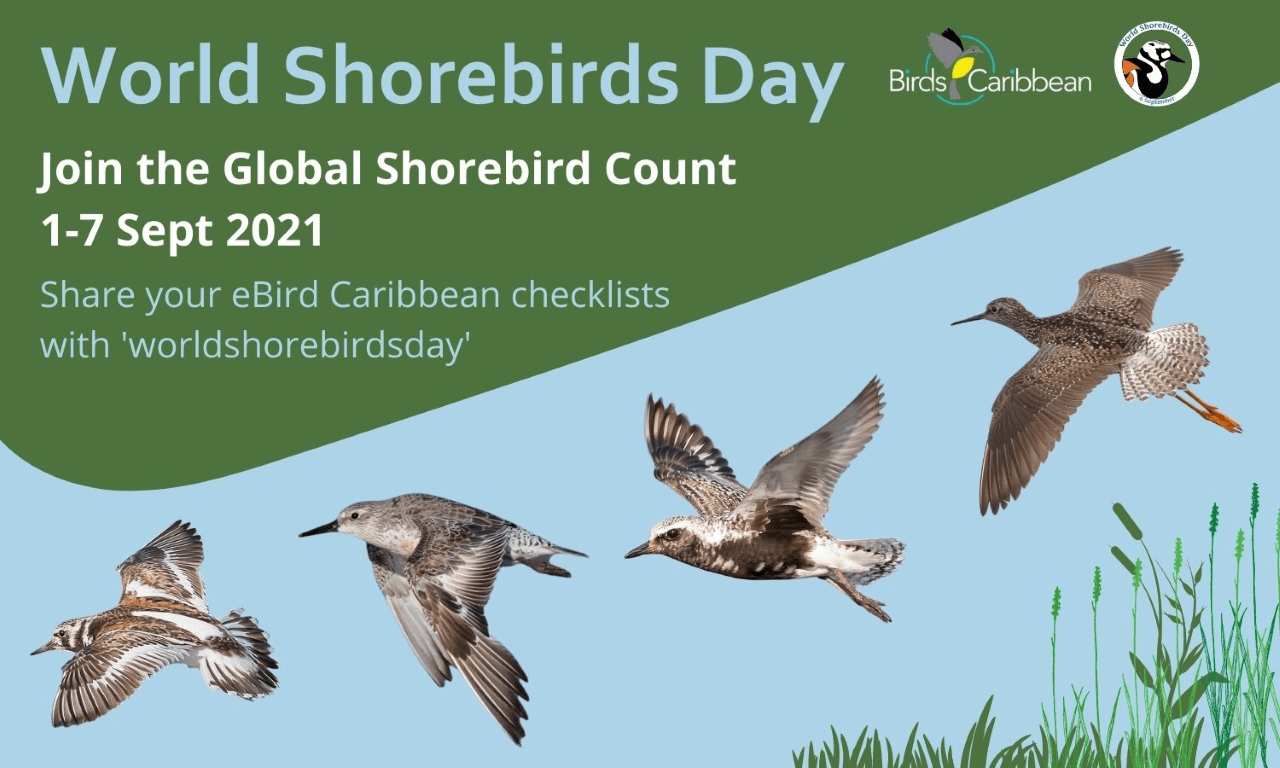
MONDAY SEPTEMBER 6TH IS WORLD SHOREBIRDS DAY!

Discover Caribbean Shorebirds this World Shorebirds Day

World Shorebirds Day, on Monday, September 6, is just around the bend. In honor of this annual global event, BirdsCaribbean created a new video to celebrate Caribbean shorebirds. From plump plovers to wave-catching Sanderlings to stately Stilt Sandpipers, shorebirds are delightful birds to get to know and love. Enjoy our short video and learn more about how you can help to conserve these treasures of our beaches and wetlands.

It is prime time to learn about and celebrate the diversity of shorebirds in the Caribbean. During late summer and early fall, our resident shorebirds, like the Killdeer and Wilson’s Plover, are joined by long-distance migrants, such as the Lesser Yellowlegs, Willet, Spotted Sandpiper, and many more. These migratory birds have just completed their breeding seasons, hopefully with much success, in the northern U.S. and Canada. Now, many are passing through the Caribbean, stopping to rest and feed as they travel to wintering areas further south. Other bird arrivals may stay with us for the entire winter.

Shorebirds are a diverse group of wading birds that live close to water—you can find them on our beaches, mangroves, marshes, salt ponds, and mudflats. Many can be easily identified by their long legs or unique bills, which are especially adapted to their diet and habitat. For example, the long, thin, probing bill of the Black-necked Stilt is ideal for plucking worms and crabs from sticky mud; while the Ruddy Turnstone, with his short, stubby bill, is adept at flipping over stones and shells to find tasty insects on the beach.

Migratory shorebirds make amazing journeys of thousands of kilometres! Beforehand, they need to store enough energy in the form of fat reserves to migrate. These small birds will eat until they are about double their normal weight. You may think that flying at their top weight would slow shorebirds down, but they are the marathon-winners of flight. Incredibly, this group of birds does not do any soaring, they are physically flapping the entire way!

Sadly, shorebird numbers have declined by roughly forty percent  over the last 50 years, due to a number of threats. An increase in developments and various types of pollution have resulted in their habitats being degraded or even lost altogether. Human disturbance, hunting, and climate change…All these factors threaten shorebirds. Please join us this World Shorebirds Day to learn more about these fascinating birds and what you can do to help protect them.

Join the Global Shorebird Count, September 1 to 7 – every shorebird counts!

One of the main activities of World Shorebirds Day is the Global Shorebird Count. We encourage bird enthusiasts in the region to go out and count shorebirds from the 1st to 7th September 2021.

Your counts will help us to understand which species (and how many) are stopping to rest and feed in the Caribbean. This allows us to assess the health of populations and to determine whether they are increasing, decreasing, or stable. The data you collect will also help scientists to coordinate follow-up research and conservation actions, such as protecting important sites – or even taking immediate action to reduce threats to shorebirds and their environments, if necessary.

READ MORE HERE


PIPING PLOVER GREAT NEWS UPDATE AND NEW SHORT FILM!

Good morning dear PiPl Friends!

I hope everyone is doing well and enjoying these beautiful dog days of August. I sure miss you all!

Last week I had the joy to attend the Coastal Waterbird Conservation Cooperators meeting. Next year we are all hoping for in person but for the past two years, the organizers have done  a fantastic job creating an interesting and engaging online event.

The meeting is held annually to bring together people and organizations that are involved with population monitoring and conservation efforts on behalf of coastal waterbirds. Threatened and endangered species, which include Least Terns, Piping Plovers, Roseate Terns, and American Oystercatchers, are given the greatest attention.

Nahant Beach chicks hatch day

Participants were invited by Carolyn Mostello, Mass Wildlife Coastal Waterbird Biologist and the event organizer, to submit to the “Strange and Unusual” part of the program. I created a short film about the Nahant Piping Plovers. It was extraordinary to observe the Nahant PiPl Dad valiantly try to rescue an egg after the king tides of Memorial Day weekend. You can see the video here:

Conservation organizations from all seven Massachusetts coastal regions participated, as well as conservationists from nearby New England states, including representatives from Maine, Rhode Island, Connecticut, and New Hampshire. To name just some of the local organizations presenting at the meeting were Mass Wildlife, Trustees of Reservations, Essex Greenbelt, Massachusetts Department of Conservation and Recreation (DCR), Mass Audubon, and US Fish and Wildlife.

In the morning, each region gave the 2021 population census report for nesting birds as well as providing information about problems and solutions. We all share similar challenges with predation from crows and gulls, uncontrolled dogs, enforcement, extremely high tides, storm washout, and habitat loss and it was very interesting to learn about how neighboring communities are managing problems and issues.

Unfortunately because of a doctor’s appointment, I had to miss the first part during which Trustees of Reservations Coastal Ecologist Jeff Denoncour presented on behalf of the North of Boston region, of which Gloucester and Rockport are a part.

I am hoping to get the stats from the part of the meeting that I missed and will share those as soon as they are available.

The absolutely tremendous news is that New England is doing fantastically well, particularly when compared to other regions. The policies of New England conservation organizations are extremely successful and are truly making an impactful difference, as you can see from the graph.

As Massachusetts citizens, we can give ourselves a collective pat on the back for the great work our state is accomplishing. The strides being made in Massachusetts are because of the dynamic partnerships between conservation organizations, towns, citizen scientists, volunteers, and ambassadors, just like ourselves, all working together!

Above two screenshots courtesy Coastal Waterbird Conservation Cooperators event.

Super PiPl Ambassador Jonathan Golding sent a photo of two Piping Plovers at Good Harbor Beach. I can’t get down to the Creek bed but I stood on the footbridge Saturday morning and took several snapshots of two Plovers that were way down the Creek. The pair were foraging together when suddenly they began piping their beautiful melodic peeps and off they flew together down the Creek.

If folks are wondering if the Plovers at the Creek are the Salt Island Dad and chick that went missing, these two are not them. Our Salt Island chick  would be about 31 days and would look more like this 33 day old chick from 2019. And it would not be flying as well as the Plovers seen in the photos from Saturday morning.

Have a great rest of your weekend!

xxKim


33 day old PiPl chick, from 2019

Plovers at the Creek Saturday morning –

Pair of Piping Plovers a Good Harbor Beach, August 7

Nahant hatch day chick, June 1, 2021


Good Morning from Good Harbor and Cape Hedge Beaches!

Dear PiPl Friends,

Thank you so much for all your wonderful stories!

This week our fledglings/chicks have reached important milestones. Junior is 44 days old, the Cape Hedge chicks are about 35 days old, and our Littlest is two weeks and a day! The Cape Hedge chicks are doing the wonderfly flippy-floppy-fly-thing, and the Littlest is growing roundly, making magnificent treks up and down the beach.

Thank you everyone for your watchful eyes, diplomacy, eagerness to share with the public, and big hearts. You are all creating a wonderfully positive image for shorebirds everywhere and a super positive image for Cape Ann as well!!!

Skittles has been found! He was only about a block away from where he went missing, and sunning himself in a neighbor’s backyard. As Scott said, he was only waiting for the sun to come out 🙂

Have a great day!
xxKim

Happiness is a tail feather snuggle with Mom

HELLO SUNSHINE! Update on Piping Plover signs and lost Iguana Skittles

Good morning PiPl Friends,

What a gorgeous SUNNY morning! And it’s not humid 🙂

Thank you so much to Denten Crews for the addition of signs at the concession stand and at the Witham Street entrance!

The GHB and CHB PiPls are foraging night and day, as they should be. My biologist friends who are monitoring beaches north of Boston share that they are getting an influx of fledglings and adults from area beaches as they are departing their nesting grounds.

Like shorebirds everywhere, the newly arrived Piping Plovers are intently foraging at tidal flats in preparation for their southward migration. My friends also shared many success stories, but also great challenges including terrible predation of PiPl eggs and chicks by Crows, and a colony of Least Terns wiped out by a skunk.

Skunks eat shorebird eggs and their presence can cause an entire colony to vacate a location. Gulls have taken over many coastal islands, leaving many of the smaller shorebirds to nest in less than desirable locations such as urban beaches. There is the potential for far greater disturbance at popular town and city beaches than at island locations due to cats, dogs, skunks, and people.

Here’s ambassador Jonathan Golding from the lifeguard watch tower

Nothing to do with Plovers, but especially for our Rockport readers and Ambassadors, please keep your eyes posted for a lost Iguana that goes by the adorable name Skittles. The Fitch family writes that they have had Skittles for eight years and he’s a beloved member of their family. He was lost in the Cape Ann Motor Inn area and is most likely in a tree. Iguanas are strictly vegetarians so he may also be in someone’s garden. Skittles is about five feet long.  Don’t approach but contact Rockport ACO Diane Corliss at 978-546-9488 or you can call me, I have the family’s phone number.

Have a great day!
xxKim

SALT ISLAND UPDATE and we have the swimmingest Plovers ever at Good Harbor Beach!

Good morning dear lovers of all things PiPl!

I hope everyone is doing well. I sure miss seeing you at the beaches.

Salt Island Update (thank you to our Ward One Councilor Scott Memhard for the information) – the Salt Island hearing has been postponed upon Mr. Martignetti’s request. The hearing will be rescheduled for August.

In the meantime we can add Adrienne Lennon, the Conservation Commission clerk to the people who we should be sending our emails to –

alennon@gloucester-ma.gov

Please also send an email to Robert Gulla, the Conservation Commission co-chair  –

rgulla@robertgulla.com.

You can find a list of all members of the Conservation Commission here: https://gloucester-ma.gov/1027/Conservation-Commission, where their snail mail only addresses are provided

Several years ago, in 2019 I believe, our GHB PiPls began swimming daily across the Creek to forage on the other side. This year Junior was observed swimming, and now our littlest is also swimming.

PiPl Ambassador Deb writes, “Here’s the story. Dad and chick were feeding in different spots along the creek, then stopped to take a rest at the end of the creek. When they got back to work, Dad flew to the other side of the creek; chick dabbled her feet in the water, then swam over to the other side. At that point the creek was only about three feet wide.”
Deb sent a video but I am having trouble uploading. Thank you Deb for sharing! Here is the video from 2019 – Gloucester Plovers Go swimming

Have a great day!

xoKim


EVERYONE’S HELP IS NEEDED TO SAVE SALT ISLAND FROM DEVELOPMENT AND FROM GOAT INVASION!!! YOU CAN TAKE ACTION!

The entire community’s help is needed. Salt Island is one of Gloucester’s most beautiful natural treasures and a vibrant part of our coastal ecosystem. Martignetti’s proposed future dream house for Salt Island

Why goats are a terrible idea for a coastal ecosystem

Goats used to control vegetation in places like Central Park and cemeteries have had some success however, these locations are not fragile coastal ecosystems. Goats are not discriminating and will eat everything in their path. To eradicate PI, you must dig it up by the roots.

Salt Island is an oasis of native plants and shrubs. Natural, largely undisturbed habitats, like Salt Island, provide refuge and food for resident and migrating birds alike.  Note in the photo below, which was taken at the time of installing the fence posts, the beautiful native vegetation growing at the Island.

We need to point out that the fallacy stated by Mr. Matignetti at the Conservation Committee meeting,”Poison Ivy is an invasive species,”  is incorrect. Poison Ivy is a native North America plant and is known for its value to wildlife. Poison Ivy flowers bloom early in the spring, providing nectar to myraid species of bees and other pollinators. The fruit of Poison Ivy is consumed by dozens and dozens of songbird species. The berries provide much needed sustenance in the late summer, fall, and winter. These are just some of the birds that eat PI fruits: Northern Flicker, Bobwhite. Quail, Eastern Phoebe, Cedar Waxwing, woodpeckers, Tufted Titmouse, and American Robin.

Granted, Poison Ivy is not a plant you want to become entangled with but the entire Island does not need the vegetation eradicated under the guise of removing PI. 

There are shorebirds, ducks, and gulls nesting at Salt Island, along with a highly productive shellfish bed. Lobsters are caught off the shores of Salt Island and baby lobsters need fresh, uncontaminated water. We do not want goat feces and goat worms contaminating this vibrant coastal ecosystem!

Typical fencing used for goat vegetation control is three feet tall livestock fencing-

unlike the fence posts that have been installed at Salt Island, which are permanently bolted into the granite rocks.Fence posts permanently bolted to the granite at Salt Island

Notice how far the fence posts go down on the left. This is not a “keep in the goats” fence line, but a “keep out the people fence line.”

ACTIONS YOU CAN TAKE:

Please email our City Councilors. We learned that when trying to change the dog ordinance to protect Piping Plovers that the more people that write to the Councilors, the better chance our voices will be heard. There is power in numbers. Please write in your own words, or copy paste the following –

Dear Councilor,

Please help us save Salt Island from future development, goats, and all destructive and detrimental activities to this vibrant coastal ecosystem. Thank you.

Attend the virtual Conservation Committee meeting on Wednesday evening at 6pm.

https://gloucester-ma-gov.zoom.us/j/85146365487

Councilors email addresses:

Ward 1 Salt Island Councilor Scott Memhard smemhard@gloucester-ma.gov

Melissa Cox mcox@gloucester-ma.gov

John McCarthy jmccarthy@gloucester-ma.gov

Jamie O’Hara johara@gloucester-ma.gov

Barry Pett bpett@gloucester-ma.gov

Steven LeBlanc sleblanc@gloucester-ma.gov

Valerie Gilman vgilman@gloucester-ma.gov

Sean Nolan snolan@gloucester-ma.gov

Jen Holmgren jholmgren@gloucester-ma.gov

Joanne Senos City Clerk jsenos@gloucester-ma.gov

Join the Save Salt Island Facebook page to keep updated on the latest developments.

Join the CapeAnn MA Facebook page, which also provides updates on the latest developments.

Share this post

Photos of fence post installation May 12, 2021 –

Exploring fun at Salt Island

HAPPY TEN DAY OLD MILESTONE LITTLE CREEK BABY!

Good morning PiPL Friends,

Sunday marked the late nest little chick’s ten-day-old milestone. Thank you to all our GHB and CHB ambassadors for your wonderfully watchful eyes and updates. And thank you Deb and Duncan for the late day/ early evening misty sightings.

Susan Pollack writes from her morning shift,

“Good morning all,

On this drizzly morning I found the new dad and chick all the way down the beach, foraging at the water’s edge. It was high tide, no time to be at the creek.

The dad was as protective ever, chasing off sanderlings skittering at the tideline and piping at walkers to keep their distance. In quieter moments he and the chick, as lively as ever, resorted to some thermo-snuggling.

When Jane arrived at 8, I headed west to look for Handsome and the fledgling. I found them  with Mom, who seems to have lost a leg, and a plover I assume is the mother of the new chick. All four birds were resting contentedly in the sand, their bodies cocked into the wind. No other birds were in sight, a peaceful scene.”

and Jennie shares a haiku for Heidi,

Heavy cloud day—
refuge for chick and dad
at river’s bend.

A brief update from Dave Rimmer – although there were PiPls at Coffins Beach, for the first time in a long while, there were no nests. The good news is that there are three chicks in Beverly!! Thanks so much to Dave for sharing the 411.

Jill, please let me know if you touch base with Joe regarding the monofilament bin. Thank you 🙂

Have a great day!
xxKim

Some photos of our little ten-day-old chick and family

From a nest of three eggs, two hatched

The egg that didn’t

First daysThe tiny one-day-old chick that perished

Salt Island Dad puffed out, making himself look larger while defending the littlest chick from Handsome

DRONES AND GREAT BLUE HERONS AT GOOD HARBOR BEACH

Good morning PiPl Friends,

Eventful day for our PiPls and our Ambassadors was yesterday!

Thank you Jennie and Ann for being on top of the drone issue. The City’s website only says 50 feet but I am not sure if that follows federal and state guidelines. I thought the distance was 200 meters (650 feet, or approximately two football fields as my husband pointed out), which is what I wrote on the informational one sheets. We can find out from Carolyn where specifically it is written and exactly what is the distance. Either distance, causing a disturbance to the Plovers is considered harassment and is fineable.

Last summer I watched a drone hovering over a Plover family with only one-day-old chicks. It was mortifying to see how terrified the adults were and it took hours for them to settle down. Later that summer, I observed a drone chase a Great Blue Heron from treetop to treetop. These drone operators were there intentionally to film the birds. It was difficult to observe how oblivious they were to the bird’s responses. I reported the PiPl drone incident to the DCR biologists, but the man had left the area.

Thankfully the two guys yesterday at GHB stopped after some talking to by Jennie, and the Plovers were not their focus. Thank you Jennie and Ann for seeing the issue through and staying until they packed up.

Regarding the Great Blue Herons at Good Harbor yesterday, GBH are frequent visitors to GHB, both in the marsh, at the Creek, and along the front of the beach, too. They eat everything, including adult Plovers and chicks 🙁 As much as I love them, I keep a close watch.

Sue Winslow has been by to check on the GHB PiPls. She hasn’t yet seen them but can hear peeps in the marsh. Hopefully all survived the unrelenting deluge this early am. High tide was at 6:07, precisely when the storm was at its worse.

Udate, the parent and chick have been spotted down the Creek.

Thank you so very much again to everyone for your kind well wishes and offers to help. I have an appointment with a specialist tomorrow afternoon and will know then whether an operation is needed.

Have a lovely Sunday, funday!
xoKim

Although I made this video over eight years ago its still fun to see the Great Blue Heron at GHB eating an eel.

HOW DO WE KNOW HOW OLD THE CAPE HEDGE CHICKS ARE?

Good Morning dear PiPl Friends,

Thank you all so very much for the updates and great insights. And for all your watchful eyes over our Cape Ann PiPls!

Many thanks again to Denton Crews for installing the posters, to Jonathan for organizing the printing and laminating, and to Duncan Todd for designing. What a tremendous contribution! Thanks to Jonathan for providing the photos, it’s so nice to see!

Thank you Deb and Sally for pointing out the Least Terns. Both Least and Common Terns were here last summer at this time. I wonder if they are nesting on Salt Island? Wouldn’ that be exciting!

A note about the age of the Cape Hedge chicks, which are approximately four weeks old as of last Thursday. The first sighting was reported on Friday June 18th and was confirmed by Sue Catalogna on June 26th. The chicks were teenie tiny on the 18th so I am assuming their hatch date was roughly Thursday the 17th, which would make them approximately four weeks old last Thursday, the 15th of July.

They look smaller than our GHB chicks at the same age, due largely I think to their diet at Cape Hedge. Chicks develop at different rates, depending on the availability and quality of food.

The sun is shining now, but it looks as though the rest of the weekend may be another overcast and quietly perfect day for chick rearing 🙂

Have a super weekend!

xoKim