Category Archives: Native Plants

Miss Featherton and Winterberries

A happy pair, our native ‘Winter Red’ Winterberry (Ilex verticilatta) and Miss Featherton, our resident American Robin. If you plan to grow winterberry in your native plants garden, be sure to also grow a male, like ‘Southern Gentleman.’ Although he doesn’t bear fruit, his flowers are needed for cross pollination. There is a newer female cultivar that I would love to try. She has the sweet name of ‘Berry Poppins,’ reportedly growing only only 3 to 4 feet in height.

Why We Love Pokeberry (and so do Scissor-tailed Flycatchers!)

Dear Friends,

Taking a break from thinking about the heart-rending reality of our national politics to talk about a native plant that you may want to encourage to grow in your wildflower garden. Pokeberry is a large, gangly native plant that goes by many names: American Pokeweed, Dragonberry, Pigeonberry, and Inkberry, to name but a few. Although all parts of the plant can be toxic to livestock, the berries are much beloved by a variety of songbirds including Mockingbirds, Yellow-bellied Sapsuckers, Cardinals, Brown Thrashers, Cedar Waxwings, Bluebirds, and many more.

Pokeberry was one of several fruiting plants favored by the exquisite (and rarely seen in the Northeast) Scissor-tailed Flycatcher that was visiting the Spencer-Pierce-Little Farm. The Pokeberry was growing in the pigpen and around the edges of the farm fields. If you plan to grow it in your garden, know that Pokeberry can reach five to six feet and is a good candidate for the back of a border or along property edges.

In our own garden, we never had Yellow-bellied Sapsuckers until I let a volunteer Pokeberry grow where a bird had deposited a seed. Now we have a tribe of YBS stopping over during spring and autumn migration, a male, a female, and even a  juvenile. This past autumn, our “pet” Yellow-bellied Sapsucker, as Charlotte likes to call the male who comes daily, was with us from October through December. He was mostly focused on procuring  sap from our tree garden but I don’t think it would be here unless it had been initially attracted to the beautiful deep purple berries of the Pokeberry plant.

Grow Native and They Will Come!

P.S. Ruby-throated Hummingbirds drink nectar from the tiny white Pokeberry flowers.

Winged Wonders – Dark-eyed Juncos, the ‘Snowbird’

You may have noticed an influx of sparrow-like birds foraging on the ground. They seem to be gathering along every lane and woodland edge. The Juncos blend in easily enough, until disturbed, and then all alight at once, softly twittering while heading for the nearest tree or bush.

Dark-eyed Juncos bear the nickname ‘Snowbird’ as they often signal the onset of the coming cold weather. The ones we are seeing in our neighborhoods at this time off year are feathered in lovely shades of charcoal gray to Mourning Dove brown, as you can see in the video and photos. This little flock was eating the tiniest seeds, grass seeds I think, and also foraging around the small cones of this very spectacular Red Spruce. I think of this native tree as spectacular, not only because of its majestic beauty, but because of the wonderful array of wildlife supported by its cones and resin.

Please write and let me know if you are seeing Dark-eyed Juncos in your area.


The Fabulous Four Plants for Monarchs (and Bees)!


Plant goldenrods, asters, and milkweeds to provide Monarchs (and as you can see, many other pollinators) all the sustenance they will need during their breeding season and southward migration.

Wildflowers in order of appearance:

Seaside Goldenrod (Solidago sempervirens)

Smooth Aster (Symphyotrichum laeve)

New England Aster (Symphyotrichum novae-angliae)

Common Milkweed (Asclepias syriaca)

The Piping Plovers of Moonlight Bay comes to Canada x 2

Dear PiPl Friends,

I am delighted to share two good things. The Piping Plovers of Moonlight Bay has been accepted to the Brampton Canada International Film Festival, which is a relatively new festival based in Ontario, and we are having a film screening in December at the City Cinema, sponsored by the Island Nature Trust, which is located at Prince Edward Island. We love our neighbors to the north and I am deeply honored. Thank you BCIFF and Island Nature Trust. We are so very grateful for the opportunity to share our documentary with Canadians.

Recently I attended a great talk given by the entomologist and conservationist Doug Tallamy, which was sponsored by a fantastic local organization, 400 Trees Gloucester and hosted by the Annisquam Village Church.  Please read more about local efforts to grow native here.

Winged wonders continue to migrate across our shores, with Little Blue Herons the most recently departed. I posted photos of LBHerons and Snowy Egrets, along with a short video of a dragonfly run-in with a Little Blue here.Monarch Butterflies and native wildflower Seaside Goldenrod (Solidago sempervirens)

We had another wave of migrating Super Monarchs, the third this season however, the wind conditions have kept the butterflies moving and that is why we are not seeing many in our gardens during this year’s migration. Continue to keep on the lookout. Goldenrods are winding down their blooming period but asters, especially New England Asters and Smooth Asters, are still flowering.

Please continue to share what creatures you are seeing in your neighborhoods. Thank you 🙂 This morning I saw a tiny little member of the weasel family, a Short-tailed Weasel, also called an Ermine or a Stout. She was only about six inches in length, with chocolate brown fur and a bright white belly. She was so fast and darted between rocks before I could take a photo, but we did have a few seconds of startled eye to eye contact. Just adorable!

Thinking about Jane Goodall – her beautiful, thoughtful spirit and the extraordinary gift she left, inspiring all to protect our planet.

xxKim

Gombe, Tanzania – Jane Goodall and infant chimpanzee reach out to touch each other’s hands. (National Geographic Creative/ Hugo Van Lawick)

Homegrown National Parks Coming to Cape Ann!

What are Homegrown National Parks?   HNP is an exciting movement that raises awareness and urgently inspires EVERYONE to address the biodiversity crisis. How can we as individuals and organizations do this? By adding native plants and removing invasives where we live, work, learn, pray, and play.

We all know that wildlife populations are crashing the world over. The statistics are staggering, with approximately one-third of our breeding birds lost since 1970, or about 3 billion birds, and 40 percent of our insects (bird food!) in the past 40 years. HNP is showing people how we can address this crisis, backyard by backyard.

Sunday evening, Doug Tallamy, the esteemed entomologist, author, and co-founder of Homegrown National Parks, presented “The Power of Plants.” The event was hosted by 400 Trees and the Annisquam Village Church, and was followed the next morning by an informal idea-sharing discussion at our newly renovated gorgeous library. The presentation was rich with imagery and case studies of what can be accomplished in our own backyards, from teeny urban lots to suburban homes to substantial acreage. The group discussion was especially thoughtful and interesting, providing a wonderful opportunity to meet people in our community with similar interests, missions, and goals, Many, many thanks to Peter Lawrence and Sara Remsen for organizing the Tallamy talk and discussion.

Visit the Homegrown National Parks website. It is overflowing with super helpful information to get you started on your native plants journey. You can also listen to several of his excellent talks right there on the website. I have been teaching people how to grow pollinator gardens and documenting the wildlife supported by native trees, shrubs, wildflowers, and ground covers for over twenty years now. Not a day goes by where I don’t observe and learn some new, vital and fascinating information about the beautiful ecosystems created in a native plant’s habitat. When you plant native they will come!

Join the Movement Now!

1. Plant Native

2. Remove Invasives

3. Get on the Map

Where Shall We Start?

Images courtesy Doug Tallamy “The Power of Plants”

Identify the most productive plants. How to find native plants keystone species –

Native Plant Finder from the National Wildlife Federation: go to the following website and type in your zip code for an extensive list of highly valuable native trees, shrubs, wildflowers, and ground covers specifically beneficial to wildlife in your region. https://nativeplantfinder.nwf.org/

I was listening to Doug’s talk via Zoom in my office, which is also Charlotte’s art room. Charlotte is illustrating a book she is working on, all about the history of Gloucester’s monsters. It’s very imaginative and even includes mini side bars of illustrations of the eggs unique to each monster, along with the monster’s baby pictures (Nessie is well-represented). She was also enjoying glancing over at all the fascinating caterpillar images in Doug’s slideshow, when she overheard the expression ‘keystone species.’ She commented, “just like oysters are a keystone species for the ocean.” We had been to the Seacoast Science Center a week earlier where she had learned about the importance of keystone species in an ecosystem. I just thought how wonderful for her to connect the two and how much like mental sponges are these beautiful curious-minded children of the up and coming generation. I surely never learned at eight years old what a keystone species is, but how easy it was for her to understand the concept. If for no other reason, our beautiful children, and our children’s children, are why we simply can not leave to them a barren, diversity-less world.


Winged Wonders Migration!

The great North to Central to South American magnificent southward migration of wildlife is fully underway. These beautiful creatures do not see borders, religion, nor ethnicities and bind us together in myriad meaningful ways. As birds are taking to the skies by the hundreds of thousands, we are seeing the beginnings of the Monarch migration as well. During these first weeks of September local meadows and gardens are  graced with newly emerged Monarchs. At this time of year, these recently eclosed butterflies are nicknamed the “Super” Monarchs.

You can see the above Monarch has just emerged from his chrysalis as his wing cells are still a bit crumpled. 

A tell tale sign of a male Super Monarch, also called a Methuselah Monarch, is that they are not at all interested in finding a mate. A male Monarch that is not migrating stops only briefly to nectar. For the most part he ceaselessly patrols the milkweed looking for a female and chases away any other winged pollinator. He has evolved with the main objective of reproducing; whereas a Methuselah Monarch takes its time sucking up nectar and is very tolerant of other butterflies it encounters.

Methuselah Monarchs emerge in a state of sexual immaturity, called diapause. They evolved to drink lots and lots of nectar to build their fat reserves for the long journey south and to sustain them through the winter. This super generation of Monarchs are oftentimes larger but will lose some of their body weight by the time they reach the trans-Mexican volcanic forests

The Monarchs rest through the winter, then will break diapause next spring when they begin their journey north.

To help all of our winged friends during the spectacular southward migration please remember Lights Out for Birds

To learn more about the magnificent Monarch migration see our documentary Beauty on the Wing: Life Story of the Monarch Butterfly streaming on PBS Passport. To arrange a screening and QandA for your organization, please contact me at kimsmithdesigns@hotmail.com or leave a comment in the comment section.

I hope you enjoy these last glowing days of summer,

xxKim

Female (left) and male Monarch Butterflies, Stone Harbor Point NJ

Strangely Beautiful Ghost Pipe Plant

On a mini neighborhood nature walk this morning with Liv and Charlotte we happened upon the evocative Ghost Pipe (Monotropa uniflora), not a plant often seen growing on the side of the road. Ghost Pipe prefers rich woodsy conditions and can even grow in almost complete darkness. The diminutive wildflower is only about four to six inches tall. The flowers, stems, and leaves of the Ghost Pipe are white, occasionally flushed pink or may have black flecks on the leaves as in the photo below. The bell-shaped flowers remind me of blueberry flowers and the plant was once considered a member of the Ericaceae , or Blueberry Family. Ghost Pipe typically blooms June through September.

How does the Ghost Pipe grow without the green pigment chlorophyll? Chlorophyll harnesses the suns energy to produce carbohydrates (food) for the plant; the process known as photosynthesis. Instead, Ghost Pipes sap nutrients from tree roots through an intermediate source, myccorhizal fungi.


You can read more about Ghost Pipes here –

https://www.fs.usda.gov/wildflowers/beauty/mycotrophic/monotropa_uniflora.shtml

https://botit.botany.wisc.edu/toms_fungi/oct2002.html

One of our favorite poet’s, Emily Dickinson, favorite flowers


Outphloxed by Our Phlox!

Look how lovey our patch of Summer Phlox has grown. I wish I could say it was my genius garden design skills but alas, this is all nature’s doing!

Where this border is growing I originally had only planted the mildew resistant and pure white Phlox paniculata ‘David.’ Some distance away, we planted the striking P. paniculata ‘Bright Eyes,’ a light pink with deep magenta centers and adjacent to ‘Bright Eyes,’ a pretty lavender called ‘Franz Shubert. ‘

Several years have gone by and we now have a patch of volunteers blooming in beautiful shades of pink, lavender, and magenta. I think this may have happened because the plants have cross-pollinated and are allowed to reseed. We don’t deadhead and don’t mulch and that encourages little seedlings to take hold and spread far and wide in our garden.

Phlox paniculata is native to the eastern US and grows in a range of conditions. The location in our garden where it is thriving is partially shaded by the Magnolia grandiflora. This beautiful, beautiful wildflower is also wonderfully fragrant, with a heady floral scent especially potent in the early morning and late in the day. I have on occasion seen Ruby-throated Hummingbirds and Eastern Tiger Swallowtails drinking nectar from the blossoms but mostly the blooms are especially attractive to Bumblebees.

Pollen-dusted Bumblebee

Did I mention that P. paniculata blooms for many weeks??

Plant this native beauty. I promise, you will be delighted for many years to come.

Ruby-throated Hummingbirds, Jewelweed, and Canna Lily

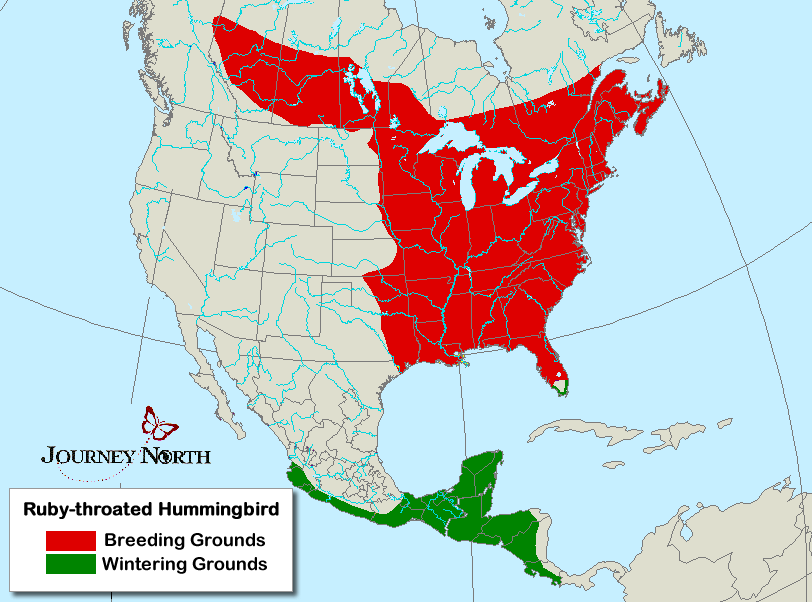
I loved filming Ruby-throated Hummingbirds on the beautiful bold flowering stalks of Canna Lilies (Canna indica) and just as much, I love seeing them drinking nectar from our North American native wildflower Jewelweed (Impatiens capensis). Even though not native to North Ameirca, it makes perfect sense that RTH forage from Canna Lilies as they grow natively in the Tropical Americas, the birds winter home!

Some fun things to know about Jewelweed:

Jewelweed has long been used in Native American medicine. Apply the watery sap topically to relieve itching and pain from Poison Ivy, Stinging Nettle, and hives.

The fruit of Jewelweed is an elongated capsule and at the slightest touch will burst open and send a little seed popper some distance, a fun activity to do with children and adults alike 🙂

You can grow Jewelweed in your native plant’s garden provided it is in a somewhat shaded and somewhat moist location. The Ruby-throated Hummingbirds, bees, and butterflies will thank you!

Ruby-throated Hummingbird Range Map courtesy Journey North

Finding Monarch Cats in the Garden!

We’ve been graced with Monarchs and fat healthy caterpillars this summer. Please write and let me know if you are seeing Monarchs (or not) in your garden <3

Milkweed is the Bees Knees!

This vibrantly hued milkweed is most commonly known as Butterflyweed (Asclepias tuberosa). Orange Milkweed, Pleurisy Root, Chigger Flower, and Chiggerweed are a few of its other common names.

Butterflyweed blooms in a range of hot colors from buttery yellow to Spanish orange to fire orange red and is a welcome source of nectar for butterflies and bees.

Thank you Miss Ladybug!

In the garden experimenting with my new camera and I came across Ladybugs devouring aphids on our Common Milkweed (Asclepias syriaca) buds.

What a love and we so appreciate your appetite for all things aphids <3


Azure Blue Butterfly in the Garden!

Good morning sweet Spring Azure! Look for these tiny one-inch wide wingspan butterflies drinking nectar from the flowers of crabapple, Common Milkweed, blackberry, dandelion, violet and many more spring bloomers.

The female deposits her eggs on a variety of woody shrubs and trees including dogwood (native Cornus florida, not the non-native Korean Kousa), viburnum, blueberry, sumac, and cherry. In our garden, the females mostly oviposit eggs around the pale pink buds of our native Meadowsweet (Spirea alba var. latifolia).

National Learn About Butterflies Day

In recent years, March 14th has been designated National Learn About Butterflies Day. Butterfly populations, as are many species of insects, plummeting around the globe. Climate change, loss of habitat, and the use of pesticides are at the top of the list as to why we are losing our insects.

What can we do as individuals, and collectively with like-minded friends? I have been writing about the plight of butterflies for nearly 30 years and at the risk of sounding repetitive, the following are easy to follow guidelines:

Refrain from Using ALL Pesticides and Herbicides. 

Do Not Spring Into Spring Cleaning!

For the sake of all pollinators, and many songbirds, do not do a spring garden clean up too early. When is a good time? Wait until your grass is growing tall and needs to be mowed and ideally, apple and pear trees in your area have finished blooming. You can also clean-up some spots and leave others unkempt for an even later season clean-up.

Grow Native and Not Invasively

Plant native species of trees, shrubs, vines, wildflowers, and ground covers. Only plant non-native species (such as tulips and zinnias for example) that do not spread outside the area in which you wish them to grow.

American Copper, Bee, and native aster

Provide Continuous Blooms from Early Spring Through November 1st

Create a landscape that provides nourishment for pollinators and songbirds, from the earliest days of spring though the last hard frost. Include colorful nectar plants and equally as important, grow native larval host plants for butterfly caterpillars.

Although these lovely pink Korean Daisies are not native, they are not invasive and bloom until the first hard frost. They are especially welcome to late migrating scragglers such as the Monarch pictured here.

Plant in Clumps and Drifts  Whenever Possible.

Butterflies and bees love to drink nectar at a buffet where they can flit easily from one floret to the next. Allow perennials to spread into drifts and clumps. Panicle-shaped flower heads (think goldenrods) and aster-type flowers, with their ray flowers conveniently arrayed around a center disk of florets, provide a convenient landing pad onto which butterflies can land while they are sipping nectar.

Monarchs and Seaside Goldenrod

Plant and They Will Come!


Hello Rainbow Wood Duck!

Feeling thankful that our Charlotte got to see this male Wood Duck on a sunny morning. And, that he was swimming towards us, not away, as Wood Ducks are want to do. She dubbed him Rainbow Boy.

Wood Ducks are named as such because they are one of the very few ducks that perch and nest in trees. Unlike most ducks, Wood Ducks have sharp claws that allows them to perch.

Wood Ducks are another conservation success story; a direct result of the passage of the Migratory Bird Treaty  Act of 1918. By protecting woodland and marsh habitat, enforcing hunting regulations, and erecting nesting boxes, Wood Duck populations have rebounded. Another reason why the population is growing is because of the return of the North American Beaver. Beavers create the ideal forested wetland habitat for Wood Ducks!

You really need to see iridescence in strong sunlight, otherwise the creature’s features just look muddy.

For comparison sake, in the above photo, the female is in the foreground and the male in the background.  The male Wood Duck in this photo is in ‘eclipse,’ or mid-molt.

Thank you Beavers!

Turkey Towns – A Conservation Success Story!

Dear Friends,

I hope this Thanksgiving finds you well. Hopefully you have a joyful weekend ahead.

I was speaking over the phone with a dear friend who hasn’t visited New England in many years and misses it very much. I mentioned to her how the Wild Turkeys in our neighborhood look so comical when they take off to roost for the night onto tree branches.  She said wait, what, Turkeys in your neighborhood? I said yes, of course, they are everywhere, not remembering that when she lived here there was none. She has never seen a single Wild Turkey nonchalantly perusing a city street, let alone gobbling gangs.

Eastern Wild Turkeys were once widespread. An estimated 10 million Wild Turkeys roamed North America, from southern Canada, throughout the continental US to Mexico. As the nation became colonized, the settlers cut down forests as they went. New England was particularly hard hit. The birds lost not only their food supply of acorns and chestnuts, but also their protective cover. Turkeys became extirpated from Massachusetts (no longer living in the state); the last Massachusetts native Wild Turkey was killed in 1851.

As Turkeys became scarcer and scarcer nationwide, many states tried to reintroduce the birds to their historic habitats. According to Mass Wildlife, between 1911 and 1967, at least 9 unsuccessful attempts were made to restore Turkeys to Massachusetts. At first, they tried to release farm Turkeys, not wild ones, but those birds did not survive. “In 1937, the Federal Aid in Wildlife Restoration Act, also known as the Pittman-Robertson Act, provided much-needed funding for wildlife studies and restoration. With the additional resources, wildlife management methods improved and new capture techniques provided a safe and effective means for live-capture of birds (Wild Turkeys) for translocating to new areas.”

Biologists like Jim Carodoza, who led the Turkey Game and Upland Game Project at Mass Wildlife during the 1970s, began to explore the idea of live-trapping Wild Turkeys from southwestern New York. They would sit in their trucks for hours waiting for the Wild Turkeys to follow a trail of cracked corn, oats, and wheat to an open pasture. Once a gaggle of 20 or so had gathered, the biologists fired an enormous 2600 square foot net to capture the Turkeys.

By the early 1970s, 37 Wild Turkeys had been live trapped in the Adirondacks and released in Berkshire County. By autumn of 1978, the Massachusetts Turkey population had grown to about 1,000 birds. Mass Wildlife biologists and volunteers began live-trapping Turkeys from the growing flocks, transporting them to other areas of the state with suitable habitat. A total of 26 releases of 561 birds made in 10 counties took place between 1979 and 1996.

In just over fifty years, the Turkey population of Massachusetts has grown from that first 37 introduced birds to an estimated 30,000 to 35,000 Turkeys!

Turkey was served at the first Thanksgiving although, according to the journals of Pilgrims, it was one of many game birds served that day.

Aren’t the young ones beautiful! Newly hatched baby Turkeys are called poults, juvenile males called jakes, and juvenile females, jennies.

Happy Thanksgiving and travel safely <3

xxKim


Our Beautifully Industrious Yellow-bellied Sapsucker Has Returned!

Last spring I wrote about a female Yellow-bellied Sapsucker that stayed in our garden for over a month. We were fascinated watching her daily activities; so much so  that I was inspired to write a poem and Charlotte nicknamed her Miss Featherton. We are excited beyond measure to see the return of our beautiful YBSS. Just as she did in the spring, Miss Featherton perches in the Dragon Lady Holly throughout the day.  She cautiously guards, and continues to maintain, the sap wells that she so pertinaciously dug. The sap is not flowing as vigorously as during the spring months but there is enough for her to take in a bunch of licks and the wells continue to attract insects. This morning I filmed her snatching a Yellowjacket that had stopped by to investigate the sweet sap.

We read that YBSS drill holes in unhealthy trees and were concerned our tree may beginning to decline. No need to worry though as you can see in the film clip, the holly is absolutely loaded with plump cadmium red berries.

My Yellow-bellied Sapsucker poem –

Sap-licker

Startled songbird silently flings
from approaching steps.

Behavior not usually seen by the insouciant
feathered friends that call our garden home.

Why so timorous?

Neatly arranged squares and holes
riddle the bark of the Dragon Lady Holly.

The masterfully drilled, cambium pierced checkered grid is glistening
in the sun – with deep wells and narrow streamlets of sweetness.

A sap-lick!

I wait to see her, half hidden and as
quiet as the owl after a long night

Weary and bedraggled, the Sapsucker returns
An arduous migration, no doubt.

She pauses guardedly
No one must know of her creation
with its treasured life fluid seeping down branches.

Her soft yellow belly and stippled feather patterning
Mirrors the spotty bark.

Her camouflage is not blown. She dives in with tender gusto
Delicately excavating the holes with brush tongue.

Wind rustles through leaves and she flings off
Only to return again and again and again
To her life-giving channels of gold flowing through tree veins.

YBSS are the only woodpeckers that are completely migratory. They breed further north and west of eastern Massachusetts and spend the winter months in warmer climates; some females traveling as far south as Panama. I wonder if we will see the return of the male this fall as well. It was just a year ago in December that we had our first ever Yellow-bellied Sapsucker, a male, and he was eating the fruits of the Pokeberry bush. It was also the first year with a Pokeberry. The plant is rather ungainly and I had some trepidation about allowing it to take hold but if a bit of awkwardness is the price to pay for a garden inviting Yellow-bellied Sapsuckers and Ruby-throated Hummingbirds, I’ll take it!

Male Yellow-bellied Sapsucker and Pokeberry – note the male has a red chin as well as a red cap.

Timeline of Yellow-bellied Sapsucker and Pokeberry –

Summer 2023 – Newly seeded Pokeberry bush grows six feet first summer (most likely the seed was deposited by a bird).

December 2023 – First ever male YBSS. Stays for several days eating Pokeberries.

March – May 2024 –  Female YBSS created striking grid pattern of sap wells on both the Holly and Magnolia trees, concentrating her efforts much more on the Holly. She spends many weeks drinking the sap, digging more wells, and eating insects attracted to the sap flows. Ruby-throated Hummingbirds discover the sap wells.

Summer 2024 – Ruby-throated Hummingbirds daily drink nectar from the small pinkish whiteish flowers of the Pokeweed.

October 2024 – Female Yellow-bellied Sapsucker returns, with daily visits into November. How long will she stay?

Grow native and they will come!

Beautiful Autumn

Autumn scenes from around Cape Ann


Vote for Ruby-throated Hummingbirds!

Your Vote matters to the tiniest among us!

Note those teeny weeny toes 🙂

CALLING ALL GARDENERS – MONARCHS NEED OUR HELP!

Please don’t tidy up your garden just yet. The Monarch migration is really lagging compared to other years. The weather has not been cooperating and they have been waiting for the winds to shift from the northwest. Finally, it happened and yesterday and we saw our first signs of the migration with several small passels. The issues are that because the migration is later than normal and because of the drought, many wildflowers have passed peak. In other words, the Monarch migration is out of sync with the blooming time of the most nectar-rich native wildflowers.

Monarchs and Seaside Goldenrods back in September

How can gardeners help? If we must tidy up, please at least wait until the end of the October. Leave your sunflowers, asters, goldenrods, dahlias, verbenas, cosmos, Mexican sunflowers, zinnias, butterfly bushes, and Montauk Daisies in place. Even if they appear a bit unruly, in many instances, the butterflies are still able to extract some nectar.

Monarchs migrating in October need our garden stalwarts, such as Zinnias

Tracking the migration overnight roost population numbers from Journey North, you can see that by October 10th, 2024, so far, the Atlantic Flyway population is way, way down.

The northwest winds are predicted for the next several days. Please write and share any Monarch sightings. Thank you!

Monarch and Mexican Sunflowers – safe travels Monarca!

Blue Jay Caching Acorn!

What a treat to observe the half dozen or so Blue Jays zooming around the garden, caching acorns for the winter.  They’d perch with nut in beak, carefully eyeing  the ground for an ideal spot. Once located, the Jay would swoop down. I didn’t want to move from my perch and risk being noticed so I couldn’t see exactly how they were hiding the acorn but when they resurfaced, no nut!

Some interesting notes about Blue Jays – Research has shown Blue Jays making over 1,000 trips in one day to hide food. They mainly select undamaged nuts that are viable, meaning if the bird does not recover the nut, it will grow. The record a Blue jay traveled to hide food is 2.5 miles. This behavior has greatly helped helped the the range of expansion of oak trees and now over 11 species of oaks are dependent upon Blue Jay dispersal of acorns.  The rapid expansion of oaks after the ice age may be a result of the northern transport of acorns by Blue Jays.


Are Beavers Tool Users?

In thinking about the happy outcome for Nibi the orphaned Beaver, Massachusetts newest wildlife ambassador, I was reminded of some footage I took of a Beaver over the summer (for the full story about Nibi, visit the Newhouse Wildlife Rescue Facebook page here).

The Beaver dove down to retrieve some kind of vegetative tuber or rhizome, a behavior I have seen countless times. He/she resurfaced, ate half, and then proceeded to use the half eaten rhizome to scrub his face. Okay that’s interesting but perhaps just a fluke. A few minutes later, the Beaver dove again and returned with a fresh rhizome, this time with his left side facing the camera. After munching away for a few moments, he then groomed the left side of his face with the rhizome in his left paw. Wow, so thorough to scrub both sides, and with a “tool!”

The video footage is longer than the usual post but he’s so cute at the end I had to include that, too. You can see his long orange tooth at about 1 minute 20 seconds in.

I wondered, are Beavers considered “tool users?” They build their lodges by cutting down and arranging trees, packing all with mud and that may or may not be called tool use, but to use vegetable matter to groom his face? That certainly seems as though it would qualify as tool use.


Welcome to the Garden of Dissipating Beauty

The seeds of both Zinnias and Sunflowers are Goldfinch favorites. No dead-heading in this garden!

Katy-did-did-did

Love moments in the garden with Charlotte and her eagle eyes! The fabulously camouflaged  Fork-tailed Bush Katydid seen here was poised on a Common Milkweed leaf. Katydids mostly eat foliage, but they also eat dead bugs and insect eggs (was he planing on eating the freshly deposited Monarch eggs?).One quick, easy way to distinguish katydids from grasshoppers when out in a field is by looking at their antennae. A katydid’s antenna is super long and seemingly very delicate, sometimes as long, and possibly longer, than its body. Grasshoppers antennae are shorter and thicker.

Differentail Grasshopper

Fork-tailed Bush Katydid