EVERYONE’S HELP IS NEEDED TO SAVE SALT ISLAND FROM DEVELOPMENT AND FROM GOAT INVASION!!! YOU CAN TAKE ACTION!

The entire community’s help is needed. Salt Island is one of Gloucester’s most beautiful natural treasures and a vibrant part of our coastal ecosystem. Martignetti’s proposed future dream house for Salt Island

Why goats are a terrible idea for a coastal ecosystem

Goats used to control vegetation in places like Central Park and cemeteries have had some success however, these locations are not fragile coastal ecosystems. Goats are not discriminating and will eat everything in their path. To eradicate PI, you must dig it up by the roots.

Salt Island is an oasis of native plants and shrubs. Natural, largely undisturbed habitats, like Salt Island, provide refuge and food for resident and migrating birds alike.  Note in the photo below, which was taken at the time of installing the fence posts, the beautiful native vegetation growing at the Island.

We need to point out that the fallacy stated by Mr. Matignetti at the Conservation Committee meeting,”Poison Ivy is an invasive species,”  is incorrect. Poison Ivy is a native North America plant and is known for its value to wildlife. Poison Ivy flowers bloom early in the spring, providing nectar to myraid species of bees and other pollinators. The fruit of Poison Ivy is consumed by dozens and dozens of songbird species. The berries provide much needed sustenance in the late summer, fall, and winter. These are just some of the birds that eat PI fruits: Northern Flicker, Bobwhite. Quail, Eastern Phoebe, Cedar Waxwing, woodpeckers, Tufted Titmouse, and American Robin.

Granted, Poison Ivy is not a plant you want to become entangled with but the entire Island does not need the vegetation eradicated under the guise of removing PI. 

There are shorebirds, ducks, and gulls nesting at Salt Island, along with a highly productive shellfish bed. Lobsters are caught off the shores of Salt Island and baby lobsters need fresh, uncontaminated water. We do not want goat feces and goat worms contaminating this vibrant coastal ecosystem!

Typical fencing used for goat vegetation control is three feet tall livestock fencing-

unlike the fence posts that have been installed at Salt Island, which are permanently bolted into the granite rocks.Fence posts permanently bolted to the granite at Salt Island

Notice how far the fence posts go down on the left. This is not a “keep in the goats” fence line, but a “keep out the people fence line.”

ACTIONS YOU CAN TAKE:

Please email our City Councilors. We learned that when trying to change the dog ordinance to protect Piping Plovers that the more people that write to the Councilors, the better chance our voices will be heard. There is power in numbers. Please write in your own words, or copy paste the following –

Dear Councilor,

Please help us save Salt Island from future development, goats, and all destructive and detrimental activities to this vibrant coastal ecosystem. Thank you.

Attend the virtual Conservation Committee meeting on Wednesday evening at 6pm.

https://gloucester-ma-gov.zoom.us/j/85146365487

Councilors email addresses:

Ward 1 Salt Island Councilor Scott Memhard smemhard@gloucester-ma.gov

Melissa Cox mcox@gloucester-ma.gov

John McCarthy jmccarthy@gloucester-ma.gov

Jamie O’Hara johara@gloucester-ma.gov

Barry Pett bpett@gloucester-ma.gov

Steven LeBlanc sleblanc@gloucester-ma.gov

Valerie Gilman vgilman@gloucester-ma.gov

Sean Nolan snolan@gloucester-ma.gov

Jen Holmgren jholmgren@gloucester-ma.gov

Joanne Senos City Clerk jsenos@gloucester-ma.gov

Join the Save Salt Island Facebook page to keep updated on the latest developments.

Join the CapeAnn MA Facebook page, which also provides updates on the latest developments.

Share this post

Photos of fence post installation May 12, 2021 –

Exploring fun at Salt Island

HAPPY TEN DAY OLD MILESTONE LITTLE CREEK BABY!

Good morning PiPL Friends,

Sunday marked the late nest little chick’s ten-day-old milestone. Thank you to all our GHB and CHB ambassadors for your wonderfully watchful eyes and updates. And thank you Deb and Duncan for the late day/ early evening misty sightings.

Susan Pollack writes from her morning shift,

“Good morning all,

On this drizzly morning I found the new dad and chick all the way down the beach, foraging at the water’s edge. It was high tide, no time to be at the creek.

The dad was as protective ever, chasing off sanderlings skittering at the tideline and piping at walkers to keep their distance. In quieter moments he and the chick, as lively as ever, resorted to some thermo-snuggling.

When Jane arrived at 8, I headed west to look for Handsome and the fledgling. I found them  with Mom, who seems to have lost a leg, and a plover I assume is the mother of the new chick. All four birds were resting contentedly in the sand, their bodies cocked into the wind. No other birds were in sight, a peaceful scene.”

and Jennie shares a haiku for Heidi,

Heavy cloud day—
refuge for chick and dad
at river’s bend.

A brief update from Dave Rimmer – although there were PiPls at Coffins Beach, for the first time in a long while, there were no nests. The good news is that there are three chicks in Beverly!! Thanks so much to Dave for sharing the 411.

Jill, please let me know if you touch base with Joe regarding the monofilament bin. Thank you 🙂

Have a great day!
xxKim

Some photos of our little ten-day-old chick and family

From a nest of three eggs, two hatched

The egg that didn’t

First daysThe tiny one-day-old chick that perished

Salt Island Dad puffed out, making himself look larger while defending the littlest chick from Handsome

DRONES AND GREAT BLUE HERONS AT GOOD HARBOR BEACH

Good morning PiPl Friends,

Eventful day for our PiPls and our Ambassadors was yesterday!

Thank you Jennie and Ann for being on top of the drone issue. The City’s website only says 50 feet but I am not sure if that follows federal and state guidelines. I thought the distance was 200 meters (650 feet, or approximately two football fields as my husband pointed out), which is what I wrote on the informational one sheets. We can find out from Carolyn where specifically it is written and exactly what is the distance. Either distance, causing a disturbance to the Plovers is considered harassment and is fineable.

Last summer I watched a drone hovering over a Plover family with only one-day-old chicks. It was mortifying to see how terrified the adults were and it took hours for them to settle down. Later that summer, I observed a drone chase a Great Blue Heron from treetop to treetop. These drone operators were there intentionally to film the birds. It was difficult to observe how oblivious they were to the bird’s responses. I reported the PiPl drone incident to the DCR biologists, but the man had left the area.

Thankfully the two guys yesterday at GHB stopped after some talking to by Jennie, and the Plovers were not their focus. Thank you Jennie and Ann for seeing the issue through and staying until they packed up.

Regarding the Great Blue Herons at Good Harbor yesterday, GBH are frequent visitors to GHB, both in the marsh, at the Creek, and along the front of the beach, too. They eat everything, including adult Plovers and chicks 🙁 As much as I love them, I keep a close watch.

Sue Winslow has been by to check on the GHB PiPls. She hasn’t yet seen them but can hear peeps in the marsh. Hopefully all survived the unrelenting deluge this early am. High tide was at 6:07, precisely when the storm was at its worse.

Udate, the parent and chick have been spotted down the Creek.

Thank you so very much again to everyone for your kind well wishes and offers to help. I have an appointment with a specialist tomorrow afternoon and will know then whether an operation is needed.

Have a lovely Sunday, funday!
xoKim

Although I made this video over eight years ago its still fun to see the Great Blue Heron at GHB eating an eel.

HOW DO WE KNOW HOW OLD THE CAPE HEDGE CHICKS ARE?

Good Morning dear PiPl Friends,

Thank you all so very much for the updates and great insights. And for all your watchful eyes over our Cape Ann PiPls!

Many thanks again to Denton Crews for installing the posters, to Jonathan for organizing the printing and laminating, and to Duncan Todd for designing. What a tremendous contribution! Thanks to Jonathan for providing the photos, it’s so nice to see!

Thank you Deb and Sally for pointing out the Least Terns. Both Least and Common Terns were here last summer at this time. I wonder if they are nesting on Salt Island? Wouldn’ that be exciting!

A note about the age of the Cape Hedge chicks, which are approximately four weeks old as of last Thursday. The first sighting was reported on Friday June 18th and was confirmed by Sue Catalogna on June 26th. The chicks were teenie tiny on the 18th so I am assuming their hatch date was roughly Thursday the 17th, which would make them approximately four weeks old last Thursday, the 15th of July.

They look smaller than our GHB chicks at the same age, due largely I think to their diet at Cape Hedge. Chicks develop at different rates, depending on the availability and quality of food.

The sun is shining now, but it looks as though the rest of the weekend may be another overcast and quietly perfect day for chick rearing 🙂

Have a super weekend!

xoKim

HAPPY BIRTHDAY TO ALL OUR CAPE ANN PIPING PLOVERS!

Hello dear PiPl Friends!

All good news to share about our Cape Ann PiPl families!

Happy Birthday to our oldest chick/fledgling who reached the five week/36 day old milestone today!

Happy Birthday to our Cape Hedge chicks who we think are 28 days, or four weeks old, approximately today!

And last, but not least, Happy Birthday to our littlest Salt Island chick, who turned one week old today!Dad and chicks, it’s not easy to spot the Cape Hedge Family in the fog and popples!

Wonderful sightings about all three families are being shared by our great team of Piping Plover Ambassadors. They are keeping excellent watch over Cape Ann’s Plovers but it hasn’t been easy, trying to locate these beautifully well-camouflaged chicks in the super dense fog of recent days.

Hello and a haiku from ambassador Heidi Wakeman this morning:

Fledgling, Dad at bridge,
Teeny, Dad,thermosnuggling
Up the creek, all’s well!

Later in the morning, ambassador Duncan adds this haiku

On this misty morning
Where are the miracle birds?
Ah…see?… right… here.

The Plover informational posters are being installed at the Good Harbor Beach kiosks either today or tomorrow. With gratitude and deep appreciation to Duncan Todd for creating the posters, to Jonathan and Sally for printing and laminating, and to Denton Crews for installing in the kiosks. Hooray Team Plover!

Keep your eyes peeled for interesting shorebirds visiting our beaches. The summer southward migration has begun!  Today ambassador Maggie spotted two Semipalmated Sandpipers and several days ago, a Dowitcher was seen at Brace Cove. Both species are returning from their northern breeding grounds at the Arctic tundra.Dowitchers at Good Harbor last spring on their northward migration

Spotted Sandpiper, left, Semipalmated Sandpiper, right


MAKING A BEELINE FOR THE MILKWEED! and save the date for my children’s programs at the Sawyer Free Library

Dear Monarch Friends,

A joyful sight to see so many Monarchs in the dunes and in our gardens over the weekend! A female flew in and left us with another dozen or so eggs, deposited on the Common Milkweed. She briefly inspected the Whorled Milkweed (Asclepias verticillata) and Butterflyweed (Asclepias tuberosa), but as usual, opted to only lay a batch on leaves and buds of the Common Milkweed.

Early Sunday morning on PiPl watch, several Monarchs flew in from across the bay and later that day, dozens and dozens were spotted drinking nectar and depositing eggs at the Common Milkweed growing at the Good Harbor Beach dunes. The milkweed has been blooming for over a month now and all this rain has kept the blossoms fresh and inviting.

Beeline for the Milkweed!

Save the dates to share Monarchs with the youngest members of your family. I have created a short film for Cape Ann young people for the Sawyer Free Library about the Magnificent Monarch – here is the link and more information: August 3rd – August 6th, Tuesday through Friday, 10:00 to 10:30. Children’s Services Summer Reading Program “Tails and Tales” presents Monarch Butterflies with Kim Smith! Kim creates a short film and virtual presentation to share these beautiful creatures with children and families, and see how Gloucester is a part of their amazing migration journey! Register here and we will send you the link to enjoy this presentation throughout the week starting Tuesday August 3rd.

My deepest gratitude and thanks to all who are contributing to the second phase of launching Beauty on the Wing: Life Story of  the Monarch Butterfly out into the world, the world of Public Television. To date we have raised over $17,500.00 toward our $51,000.00 goal. Thank you so very much to all these kind contributors:

Lauren Mercadante, Jonathan and Sally Golding, James Masciarelli, Pete and Bobbi Kovner, Karrie Klaus (Boston), Sally Jackson, Marion Frost (Ipswich), Joy Van Buskirk (Florida), Lillian and Craig Olmstead, Suki and Fil Agusti (Rockport), Janis Bell, Nina Groppo, Nubar Alexanian, Marguerite Matera, Claudia Bermudez, Thomas Hauck, Judith Foley (Woburn), Jane Paznik-Bondarin (New York), Paul Vassallo (Beverly), Stella Martin, Liv Hauck (California), Julia Williams Robinson (Minnesota), Cynthia Dunn, Diane Gustin, Heidi Shiver (Pennsylvania), John Ronan, Karen Maslow, Fernando Arriaga (Mexico City), Holly Nipperus (Arizona), Kristina Gale (California), Maggie Debbie, Kate and Peter Van Demark (Rockport), Mia Nehme (Beverly), Chicki Hollet, Alice Gardner (Beverly), Therese Desmarais (Rockport), Jennie Meyer, Kathy Gerdon Archer (Beverly), Melissa Weigand (Salem), Duncan Todd (Lexington), Catherine Ryan, Linda Bouchard (Danvers), Elaine Mosesian, Paul Wegzyn (Ipswich)

If you are interested in contributing to Beauty on the Wing: Life Story of the Monarch Butterfly, please find more information here.

DONATE HERE


SUPER RAINY MORNING UPDATE FROM GOOD HARBOR BEACH

Good morning PiPl Friends,

I am so sorry to write that we lost one of the teeny weeinies yesterday afternoon. Mid-morning, the family made the trek from #1 to the Creek, which I think is at least half a mile. This is a tremendous journey for three-day-old chicks and proved to be too much for the one that was a little more sleepy-eyed and not as strong as its sibling. It was difficult to observe how torn the parents were between sheltering the weak and dying chic and defending the mobile, healthy chick.

The #1 family spent the entire day at the Creek. There weren’t too many people however, the greatest disturbances were from fellow Plovers. A tremendous battle for territory is underway. For six years, the Creek has been the original Dad’s territory and is now being impinged upon by the new family. This behavior we predicted, I just didn’t realize the fighting would last an entire day, into the early evening. Piping Plovers display this same ferocity when establishing their nesting territory in early spring. Unfortunately, when territorial disputes take place around chicks, they often become targeted.

Piping Plover Smackdown

On a brighter note, this early rainy morning found Mom and Dad and the little one at the Creek contentedly foraging in the rain undisturbed.

Both Handsome and Junior were at #3 stuffing themselves in this year’s very excellent wrack!

Thank you to everyone who could for coming to the meeting. We were able to welcome our newest member of team Plover, Ann Cortissoz. She has been following along with our Plover chronicles and is going to take the impossible-to-fill two to four shift!!!! So nice to meet Ann, and so many thanks for lending a hand.

Our Ward One City Councilor Scott Memhard stopped by to say hello. Scott is running for re-election, so please sign his nomination papers when you see him. Thanks so much to Scott for being a super early supporter of the Plovers!

Unless the rain lets up, please take a much deserved day off. I’ll send the new schedule and phone numbers later this afternoon.

Have a great fun rainy-splash-in-the-puddles-sort-of-day (at least that is how I am presenting the day to Charlotte) 🙂

xoKim

THOUSANDS OF MOON SNAIL BABY EGGS IN COLLARS AT CAPE HEDGE BEACH!

Saturday morning’s low tide revealed dozens of Northern Moon Snail sand collars on the flats at Cape Hedge Beach. Perhaps the storm released the collars from the ocean floor.

There are hundreds of species of moon snails, so named because they are round like the Moon. The sand collars we see locally and all along the northern Atlantic Coast are made by the beautiful Northern Moon Snail (Euspira heros).

Moon snails are marine gastropods that live in the intertidal zone. We often find their shells washed ashore but rarely see living ones. When you find a clam or mussel shell,  or even another moon snail shell, with a perfectly drilled hole, chances are it was eaten by a moon snail.

Moon snail drill holes – Liv Hauck photo

Piping Plover chick and Northern Moon Snail

The beautiful sculptural sand collars at Cape Hedge Beach are Northern Moon Snail egg cases. When you find a collar, and it is soft, and flexible, it is comprised of thousand eggs. Please don’t remove the collar from the beach. Toss it back into the water, which will also help prevent other folks from collecting.

How the female Moon Snail constructs the egg collar is nothing short of spectacular. When a female is ready to lay her eggs, at low tide,  she begins preparing her egg collar by secreting mucus. During high tide, she digs down to begin forming the collar with mucus and sand. She spreads out the front part of her foot (the propodium) so that it covers her shell.  She collects grains of sand with tiny cilia that cover her foot. Creating a sort of egg “sand”- wich, she combines a layer of mucus with thousands (and even hundreds of thousands) of released eggs and then cements all with another layer of mucus to form the flexible egg case.

The snail lies at the center of the collar as she creates it, so the hole in center of the collar gives an indication of the size of the mother snail. When finished building the collar she has to escape from her egg case sitting on the ocean floor. She digs straight down using her foot and burrows away from the collar.

The collars are pushed to the surface and, during low tide, are visible on the beach. The egg cases stay on the beach as the water from the incoming tide washes over them.

The eggs hatch before the collar falls apart. so while it is still flexible and rubbery there are thousands of tiny Northern Moon Snail larvae swimming in the mucus matrix of the collar.

Within a week or so, the mucus breaks down and the collar begins to disintegrate, freeing the larvae.

Piping Plover chick and Northern Moon Snail collar

Daughter Liv loves collecting beautiful Northern Moon Snails – Liv photos

PIPING PLOVER SUNDAY MORNING UPDATE FROM GOOD HARBOR AND CAPE HEDGE BEACHES

Good morning PiPl Friends,

Beautiful, beautiful morning! Early morning at GHB and the three day old teenie weenies were actively foraging between #1 and #2. Heidi noted Handsome (Sally’s name for Dad) and 32 day old plumping were spotted between #2 and #3. One of the pluses about #1 is that there is a Mockingbird nest in the vicinity. The Mockingbirds are unrelenting in chasing away the Crows 🙂

Lying low in the foxholes, waiting for dad to return

CHB between 7 and 7:30 found all four–the two chicks, and Mom and Dad–feeding in the flats. Mom caught a super fat juicy seaworm and the chicks were foraging nonstop, with foot tamping expertly executed.

Yesterday I found a dozen sand collars at CHB and this morning, none. Posting a story about sand collars later today. Such an amazing creation!

Hoping so much the cloudy weather predicted will help keep beachgoers to a minimum.

Have a super day!

xxKim

Brief update – we may have lost a chick at Cape Hedge

Good Morning PiPl Friends,

I could only locate two chicks at Cape Hedge Beach. Perhaps one is off foraging on his own. Hopefully he will be spotted later today. I am so sorry to say though that it is not unusual for chicks to become separated from their family during a storm (or fireworks!).

Cape Hedge chicks

Our two-day-old pair of chicks at Good Harbor are doing wonderfully and spent the early morning foraging and thermosnuggling. One still has his little egg tooth, which typically falls off after the first or second day. The parents are awesome and going after very gull and crow in their ever changing territory. I didn’t see little fledgling and Handsome down by #3, but spent most of the morning with the new teeny tinies.

Jane shares that she and Maggie spotted a deer at GHB this morning, how wonderful!!

Today we are celebrating Charlotte’s fourth birthday so I will be home but tied up with family.

Thank you so very much to everyone for your continued dedication and big hearts.
xoKim

Good Harbor Beach one day old chicks

MAGICAL MISTY MORNING FROM CAPE HEDGE AND GOOD HARBOR BEACHES

Good morning PiPl Friends!

The one day old and two newest members of the Cape Ann PiPls club are doing beautifully. Mom, Dad, and the teeny tinies were foraging in the wrack. Dad and Mom both went after a Herring Gull that flew in a little too close for comfort. Despite the parent’s best efforts to incubate, the last egg will not hatch and that is not entirely unusual, especially for a nest this late in the season.

Our beautiful plumpling-almost-fledged-30-day-old chick, and Dad, were running along the length of the beach and too, finding lots to eat in the wrack.

Cape Hedge chicks were also enjoying the beautiful peace and quiet of a misty morning beach. Too wet to bring cameras today, but here is a sequence of one of the Cape Hedge chicks capturing a large insect several days ago.

Enjoy this perfect for shorebird chick rearing weather. Hopefully the worst of Elsa will stay off shore.
xoKim


WONDERFUL NEWS FROM GOOD HARBOR AND CAPE HEDGE BEACHES!

Good Morning PiPl Friends!

Lots to share – Heidi wrote that she watched our GHB chick take flight for several feet. Hooray! Many, many thanks to Susan for filling in for Heidi, who did a wonderful job and is a joy to talk with, and it’s so nice to have Heidi back. Heidi remarked what a difference a week makes in growth and development.

Proud Dad and 30 day old fledgling

The chicks are hatching at the Salt Island end of the beach!!! This is phenomenal, to have two successful nests at Good Harbor Beach.

It’s going to be a tough situation at this end of the beach and we have myriad questions, namely will the family try to make the super long trek to the Creek on hot, busy beach days to forage?

Mom and Dad are taking turns snuggling the two chicks that have hatched. The third egg has yet to hatch. We’ll check back at the end of the day.

I met several lovely couples and families at Cape Hedge this morning. Everyone is super interested in the Plovers, just as they are at GHB. All three chicks there are thriving, foraging in the tidal flats and between the popples, running for the shelter of the rocks when the occasional dog comes near, and staying relatively close to each other. A smart little one completely flattened in the sand as the Barn Swallows swooped low across the flats.

Two of the three Cape Hedge chicks navigating the popples

I was hoping the Ambassadors would have a little break between looking out for the Nautilus Road chicks and the Salt Island chicks. We are losing several Ambassadors during this flux. I have either a very rotten summer cold or the flu and am not able to take on extra shifts this week. Please email if you would like to be a Piping Plover Ambassador – kimsmithdesigns@hotmail.com. You will meet the nicest, most kind hearted group of people.

Thank you to our Cape Ann community and Ambassadors. It’s going to take a village to fledge all these chicks!

xoKim

Happiness is when Mom steps on your head

WE LOST ANOTHER CHICK TO A GREAT BLACK-BACKED GULL

Good morning PiPl Friends,

Only one chick and Dad were feeding in the flats this morning. The take happened yesterday when Jill was watching the chicks and Dad up by the dune beach grass. A Great Black-backed, quickly joined by a flock, swooped in and appeared to be fighting over a bag of chips when the GBB Gull grabbed the chick. Dad tried once again valiantly to rescue his chick but was unsuccessful.

Our GHB chicks have been growing right on schedule and are finding good foraging at the Creek and in the flats. It is incredibly heartbreaking to lose chicks at any age, but especially these older stronger chicks, one at 22 days and now one at 27 days.

No ambassador should feel responsible in any way. Everyone of you is doing a fantastic job and your dedication of time and energy is so very much appreciated and worthwhile. Takes can happen on anyone’s shift and as I said before it is tremendous for the collective knowledge of PiPls to know how these takes happen and why their numbers are dwindling.

Would these two deaths have occurred if Mom had not been injured? It’s very hard to know because up until a few days ago, she appeared to be managing her injury, while both supervising and defending her chicks, and feeding herself.

What we do know is that American Crows and Great Black-backed Gulls are wreaking havoc on Piping Plover populations on the North Shore. For example, Crows have eaten every egg and chick on Revere Beach (with the exception of one nest still intact) and gulls are eating nearly fully fledged birds.

Herring and Great Black-backed Gulls are relatively new breeders to the Massachusetts coastline. Up until 1912, they were primarily winter visitors. The first Herring Gull nest ever recorded was in 1912 and the first Great Black-backed Gull nest in 1930. Because of easy access to food, they are thriving. Gulls are colonial breeders. They have pushed terns off islands (traditional tern nesting areas), forcing the terns to breed in less desirable locations. I think until we can somehow manage the gull population, the threatened and endangered Massachusetts shorebird species will continue to struggle greatly and recovery will be painstakingly slow..

This weekend I watched a couple dump all the remains of their picnic in front of a gull in the GHB parking lot. The two laughed as an enormous flock suddenly appeared, dining and squabbling over on the garbage. Humans feeding gulls and crows is exacerbating the problem tenfold and dogs running on the beach, which forces the PiPl parents to stop tending nests and chicks to chase after the dogs, leaves the babies vulnerable to gull and crow takes.

Area #3 Dad and one remaining chick, 28 days old

On a brighter note, the three Cape Hedge chicks are all present and accounted for on this beautiful July morning. I am estimating they are twenty days old, not based on their size, but because of the first sighting submitted. The family was joined by two Great Blue Herons, until a photographer frightened the herons off the beach, which may be just as well because GBH eat Plovers, too.

Sally witnessed a most beautiful PiPl parenting moment last night, and it is one of the reasons why we all continue to work so hard for these tender tiny creatures. She writes, ” I found Dad and one chick at the Creek. Dad showed off his flying skills to the baby and then encouraged his chick to cross the creek from the island to the mainland. It was a wonderful experience to watch the communications between the two of them and to see the little one paddle across the creek.”

Thank you PiPl Ambassadors for all you are doing to help grow Cape Ann’s Plover population.

xoKim

Chick conference, 20 day old chicks

CAPE HEDGE PIPING PLOVER CHICK REUNITED WITH FAMILY!!!

Good Morning PiPl Friends,

Happy news to share!

Yesterday we received a call from Rockport ACO Diane Corliss and Cape Hedge neighbor Bethany that there was a chick stranded near the ramp.

Sure enough, a teeny was isolated from the family and heading up the ramp to the lookout and parking area. I scoured the beach and quickly found Mom and Dad and one chick, then ran back to the little lost one, scooped him up, and holding him securely in my hands, we then ran back to the parents.

As I approached, the Mom piped a single warning pipe that we were too close. Hearing Mom pipe, that little tiny chick in my hands called out the loudest, sharpest, PEEP you have ever heard from a chick. Hearing the little guy peep, Mom and Dad both began fluttering and piping. Knowing all were aware of each other’s presence, I gently placed the chick in the sand, backed out cautiously, and within seconds, Dad was snuggling the tiny displaced bird.

The Cape Hedge chick that became separated from its Mom and Dad  and siblings after the fireworks has been reunited and all three chicks were thremosnuggling and foraging this morning!

As my Rockport friend and wonderful conservationist Eric Hutchins wrote, this year at Cape Hedge is more triage than planning. Next year there will be a managed plan in place, possibly headed by Eric and friends, and we are looking forward to helping in any way.

I am sharing this story because we all need to be aware of the nesting shorebird’s presence on the beach however, no one should ever, ever touch a chick and could receive a vey hefty fine from the federal government by doing so. The chicks wander far and wide on the beach, but in this case, where the chick had been sepeartated from Mom and Dad for many hours, we felt it was urgent to get the family back together again The beachgoers did the right thing, initiating a call to their town’s ACO, in this instance, Diane Corliss.

GOOD MORNING FROM GOOD HARBOR AND CAPE HEDGE BEACHES

Good morning PiPl Friends,
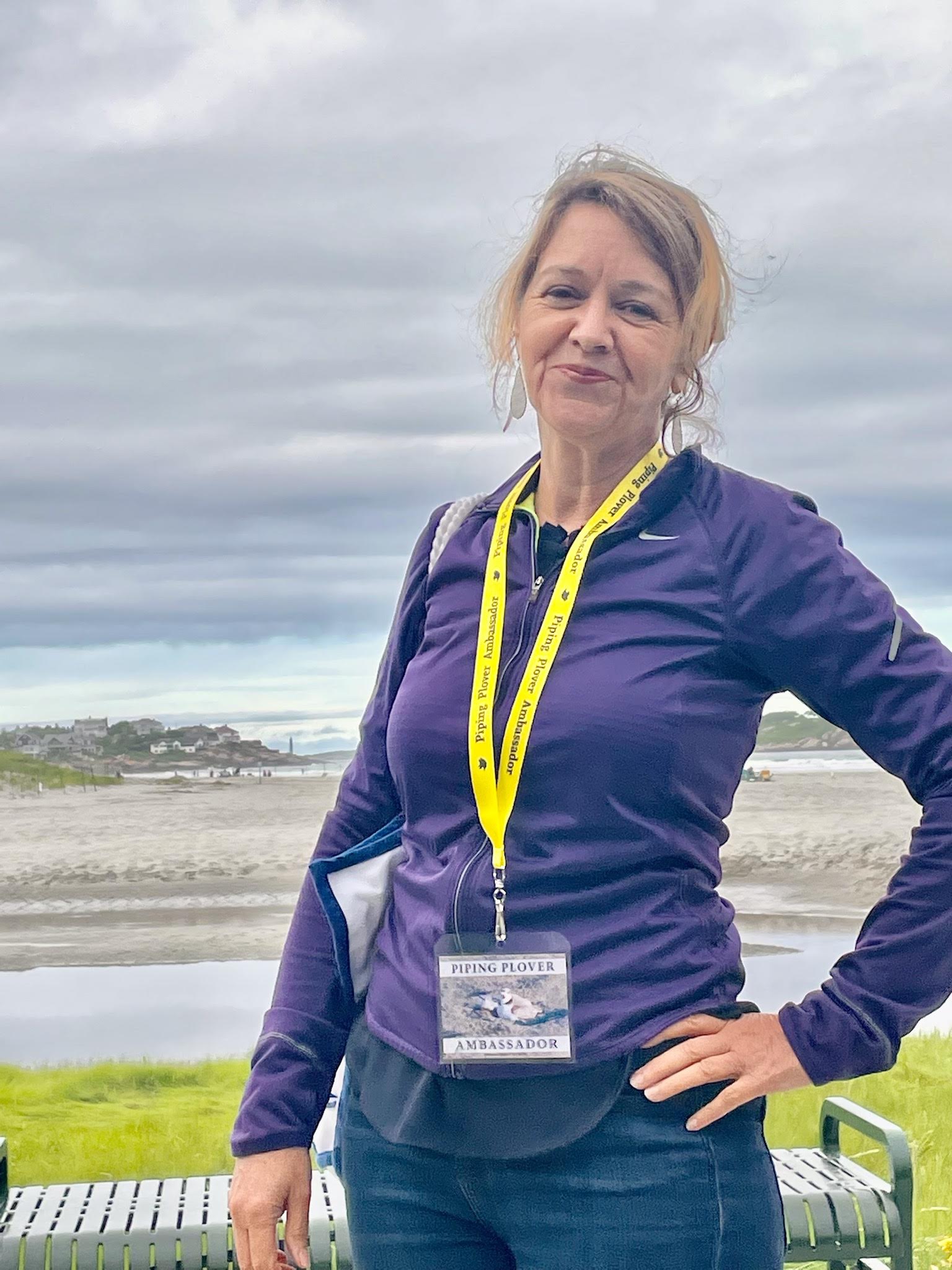
Lots to talk about this morning. First a huge shout out to Jonathan for the fantastic new ambassador lanyards – here’s beautiful Sally modeling – you can practically see these from a mile away. Many, many thanks to Jonathan – the green ones were awesome but these yellow and orange customized ones are fantabulous!! and I love the little bird 🙂Sally and our new custom ambassador lanyards!

Super Valliant Mom, Dad, and the two 26 day old chicks are all present and accounted for. Mom is not putting any weight on her bad leg. But she is foraging and doing a tremendous job supervising the chicks. I want to prepare everyone that Mom may very well lose her leg. This occasionally happens to shorebirds when there is a filament tightly wrapped. They do survive, and often go on with nicknames such as peg-leg (I don’t think I could bring myself to call our Mom that). We really hope this does not happen, but I just want to let everyone know.

It appears there was only one area where fireworks had been detonated at GHB; much, much improved over last year where fireworks were detonated next to, and within, the PiPl roped off refuge.

Good Harbor Beach 26 day old Piping Plovers

The nest at the Salt Island end of the beach is doing perfectly as expected. Dad was brooding and Mom was foraging at the incoming tide. To clarify, the nest is not on Salt Island, but at the Salt Island end of the beach, in area #1. No evidence of fireworks there.

Fireworks debris Cape Hedge

I could only find two chicks and Mom and Dad at Cape Hedge Beach this morning. If anyone sees the third, please write.

Sadly, the beach was littered with fireworks debris. It is not unusual to lose chicks, and adults, after a night of fireworks, especially as these were being detonated within feet of where the PiPls like to snuggle.

Cape Hedge Beach Dad thermosnuggling two chicks

Fireworks are illegal in Massachusetts. I wish towns would enforce this, especially where there are nesting Plovers. We are going to be more proactive on this front next year. Community, please, if you see people detonating fireworks at GHB or CHB, please call the police.

Last night I stopped in to check on ambassador Barbara and there were five dogs in the space of the twenty minutes that I was there. Three leashed and two not on leashes. Everytime the PiPls went to the shore to forage, they ran back in terror to the roped off refuge. Early morning and evening are ideal times for the PiPls to forage as there are fewer people on the beach. Very little foraging was taking place while much running away in fear was happening.

Barbara and dog owner – the dog owner was lovely and departed, not all are so kind

The problem is worse this year than last year. Last year we had the bold yellow signs in the parking lot and at the Witham Street end and we are still working on getting those reinstalled. Not everyone knows the rules, especially out of towners, air b and bers (is that a word), house guests, and hotel guests. The yellow signs really help, or at least compared to last year when we had the signs up, there were fewer dogs after hours.

Free wheeling pup in front of the PiPl refuge. Where was the owner?

I haven’t had time to read everyone’s emails from yesterday but will this afternoon. If there was anything pressing, please write again.

Jill, I can’t recall if you said you were covering the 11-12 and 2-4 times today as well as the weekend? It’s tough to tell if this is going to be a typical holiday beach day, but if anyone has some free time, please stop by in case, especially during mid-day. Thank you! Hurrying to write this as the youngest member of Team Plover is getting dropped off shortly.

Again, many thanks to Jonathan for the brilliant lanyards!!

xoKimBeautiful Dawn July 5, 2021

FOURTH OF JULY PLOVER LOVE STORY

Good Morning PiPl Friends,

Thank you Susan, Maggie, and Jane for the morning update. Adding to update that the CHB chicklets (all three) were snuggled in when I left Cape Hedge.

Sharing a sweet short story – For six years, since our PiPl Dad and Mom first arrived, I have also been filming and photographing a Killdeer Mom and Dad. I am pretty certain they are the same pair from year to year because they nearly always make their nests in the exact same spot in the dunes, with the exception of one year when there was a particular person allowing her dog to run through the dunes every night, and the pair moved to the perimeter of the parking lot.

Killdeer Chicks hatching, 1st brood

Killdeers are very similar in many ways to Piping Plovers. They lay four speckled eggs (although darker and larger), do not begin brooding until all four have been laid, defend their territory, nests, and chicks in a variety of ways including the broken wing thing. We have all seen the incessant battles over foraging rights at the Creek between the Killdeers and Plovers. Killdeers are larger and nest in a wider variety of habitats than do PiPl and that may be just two of many reasons why there are many more Killdeers than Plovers.

First brood

The Good Harbor Beach pair of Killdeers are wonderfully successful parents. This year they had a very early nest and all four eggs hatched.The amazing thing was that when the chicks were only a few days old, and without much fanfare (nothing like the PiPl courtship dance), they mated!

Killdeer mating with day old chicks

I lost track of exactly when the eggs from the second nest hatched but several days ago, I caught a glimpse of the family, Mom, Dad and three younger chicks zooming around the marsh, foraging, and thermoregulating.

Second brood eggs

Second brood July 4th weekend

Happy Fourth of July!
xoKim


Killdeer nest scrape

Broken wing distraction display behavior


Chilly Saturday July 4th Piping Plover weekend update

Good Morning PiPl Friends!

Thank you Susan and Maggie for your early morning reports. Great weather for the chick’s growth and fattening up! I am so sorry Mom still has the filament on her foot.

All three chicklets at Cape Hedge Beach are doing the same, feeding and snuggling, taking turns beneath Mom and Dad.

New ambassador Sue Catalogna and I met at Cape Hedge Beach this morning and we went over our goals as ambassadors. Sue is one of the Rockport residents who first alerted us to the chick’s presence at CHB. She described seeing the chicks for the first time and how astonishing it was to watch the teeny birds scrambling over the rocks and down to the beach.

Sue lives at Cape Hedge and showed me her wonderful pollinator garden. She has offered to assist in any emergencies as well.

I am going to share our phone numbers with the new ambassadors (see attached). Any new ambassadors, if you would like your phone number added please send.

Atlantic Flyway Shorebird Initiative shared the following wonderfully informational videos with us:


Have a great wet chilly rainy day!
xoKim

WE LOST A CHICK AT GOOD HARBOR BEACH

Good morning PiPl Friends,

We lost a chick yesterday afternoon. Super Piping Plover Ambasador Jennie witnessed the encounter, where a gull swooped in from behind and carried off the chick. Dad did his best, latching onto the gulls wings and trying to bite the gull but was unsuccessful in saving the chick.

We think Mom left yesterday morning to begin her southward journey. Seeing the two remaining chicks to fledgling is all on Dad now. It is not uncommon for the females to depart earlier, and the GHB Mom usually does depart sooner than the Dad and fledglings. We still have two more weeks to go before the chicks are considered fledged. Dads can do this! I am documenting a PiPl family where several years ago, the Mom left two chicks with Dad when the chicks were only ten days old.

Although I am sure it was devastating to witness, thank you Jennie for being there. Our chicks are so closely monitored and I think it really helps for the collective knowledge of Piping Plovers to know exactly how a chick is killed. I am surprised the gull took a twenty-two day old chick. The time I witnessed a similar take, the chick was only a week old. We now know, the PiPls are not safe from the gulls at any stage of development.There are so many Crows and seagulls on beaches today. They are scavengers and when the beach is empty because of bad weather, I think they are especially hungry without their usual diet of chips and junkfood. Seagulls need to relearn how to forage!

Waiting for the rain to subside a bit, this morning I put together the informational one sheets attached, one for each beach. I’ve been thinking about it for some time and Rockport Ambassador Eric Hutchins wondered if we had something like this to laminate and show to beachgoers. I think this answers most of the FAQs we are asked. I wish it could be longer. Please read over and let me know your thoughts. Thank you!

Being a PiPl Ambassador is wonderfully rewarding and you meet the nicest people, but it has its low moments, too. Thank you everyone for your good work and kind and caring ways.

Have a super day,
xoKim


GOOD MORNING FROM CAPE ANN PLOVER CENTRAL!

Hello PiPl Friends!

It’s so nice to write “Cape Ann Plover Central” as I feel this nest on Cape Hedge Beach is an indication that the Pover population may be expanding further throughout our region. You can’t really make a judgement based on one family of Plovers, but with two at GHB and now one at CHB, I think the Cape Ann community as a team is doing our part to help restore this beautiful tender species.

All three chicks, plus Dad, were at GHB feeding in the flats, running nearly the entire length of the beach. I was there at 5am, and then again at 7:30 to say hello to Susan, and did not spot Mom this morning. If anyone sees all five together today, please write.

The Cape Hedge Beach family are thriving, too. One teeny tiny nearly got washed away by a wave this morning. It made me think, what if that actually happens, and a chicklet doesn’t right itself after a wave crashes over its head. I guess we’ll just jump in and try to find it!

Dad at Salt Island was sitting proudly on his nest, chest a-puff, and looking pretty pleased with himself. Perhaps we should call these two Salty and Izzie, rather than Dad and Mom one and two. On that note, Footie and Bridgette for our No.3 family, but I like Sally’s name for Dad, which is Handsome 🙂

Several of our Ambassadors have reminded me that over the Fourth of July weekend, people have been letting off fireworks near the Plovers at Good Harbor Beach. Next email is to Mayor Sefatia and Chief Conley. I am sure the GPD is super, super busy on the night of the Fourth, but I am wondering how Good Harbor Beach will be patrolled knowing it has become a hotspot for fireworks. There are crazy amounts of fireworks going off at Long Beach so I am also wondering, what happens at Cape Hedge and will email Susan C, who lives there and is a new Ambassador.

The GHB chicks were about 15 days old when this clip was shot. Often after thermosnuggling, the chicks pop up and stretch their developing wing muscles. The clip is extra fun because you don’t often see all three stretching as they run off, or if they do stretch, they do it some distance from where they were regulating. A lucky shot for the filmmaker 🙂

Thank goodness for yesterday’s blessed rain! Have a wonderfully cool and comfortable day.
xxKim


FIVE IN THE FLATS – AND HAPPY THREE WEEK OLD BIRTHDAY LITTLE PEEPS!

Good morning PiPl Friends,

The GHB family of five were all in the flats this morning, foraging like nobody’s business. Both parents were very relaxed around the early morning beach walkers and joggers. The CHB three little chicklets are all doing beautifully as well. Leslie placed a double sided sign up by where this little family heads when the beach is crowded. Thank you so very much to Sally and Barbara for sharing tips and advice with Leslie!!

On Monday morning, Todd Pover, who is the senior wildlife biologist for the Conserve Wildlife Foundation of New Jersey visited us at Good Harbor Beach. We are so honored to have Todd come to GHB. We were hoping to have a visit earlier in the season and I was planning to have a group of us meet Todd. But as it goes, this was last minute however, Todd did get to meet Ambassadors Maggie and Kai!

Todd heads the CWFNJ beach nesting bird project and has been involved with nesting shorebirds for nearly thirty years. Todd also leads CWFNJ Bahamas PiPl wintering grounds initiative. Years ago, Todd had a dream to restore early successional habitat at New Jersey’s Barnegat Light, habitat ideal for nesting shorebirds. Please watch this video and see how Todd’s beautiful dream project came to fruition.

Todd has recently returned from a site visit to check on Chicago’s Monty and Rose PiPls and it was interesting to get his insights on our similarities/differences. As they are at Good Harbor Beach, battles between Killdeers and PiPls are a regular occurrence at Chicago’s Michigan Lake shorebird habitat. Todd loves our signs and especially our new badges (thanking Jonathan, Duncan, and Ducan, once again a million times over for the badges). We had a great meeting and I am just so sorry it was so brief. After checking at GHB, Todd was headed over to Parker River NWR and was possibly going to stop at Cape Hedge Beach. Many thanks to Todd for taking an interest in our Cape Ann Piping Plovers!

Todd, Maggie, Nancy beachgoer, and Charlotte

Here is an image of one of the birthday chicks grabbing a Mayfly for breakfast. When I googled Mayfly-Massachusetts-beach, hoping to id what species of Mayfly, the first thing that popped up is a website on how to kill them. It’s no wonder why insect species around the world are in sharp decline, and becoming extinct at an unprecedented rate.

Anglers love Mayflies, and so do Plovers!

Last day of the heat wave. Please take care everyone.
xoKim

Mayfly life cycle -from nymph to adult, a wide range of invertebrates and vertebrates consume Mayflies

GOOD MORNING FROM PLOVER CENTRAL!

Good Morning PiPl Friends,

All three 20 day old chicks at GHB are doing beautifully, all three eggs at Salt Island are a okay, and all three Rockport chicklets are present and accounted for. No sign of Mom at GHB this morning but that is not entirely unusual. She may leave earlier than the family, just to let our new Ambassadors know, that is somewhat normal for our Mom.

Please forgive this very hurried update and after tomorrow, Wednesday, I think things won’t be quite so hectic. We had a very special site visit yesterday by Todd Pover, Senior Wildlife Biologist for Conserve Wildlife Foundation of New Jersey, and I am eager to share more about Todd and the incredible work he does for CWFNJ but will have to wait until tomorrow.

The amazing Eric Hutchins, a Rockport resident and marine habitat specialist for NOAA, is helping with the Rockport PiPls!! Many thanks to Eric, he is a rock star of Cape Ann conservation! More about Eric tomorrow as well.

If I am slow to respond to emails, tomorrow will catch up with all! Thank you for understanding.

Here is the link to register to my Monarch and climate change presentation tonight.

And in case you missed the information, the link to why the Creek is closed to recreation.

And link to the Mass for saint Peter at Saint Ann Church, held Saturday.

Have a great day, drink tons of water, and try to stay cool.
xoKim

Cape Hedge Chicklets

GHB chick wrestling with a mini mollusk

WHY IS THE CREEK AT GOOD HARBOR BEACH CLOSED TO SWIMMING AND RECREATION?

Bad times as Good Harbor Creek closed by high bacteria levels

Ipswich Local News

John P. Muldon

GLOUCESTER— The Gloucester Health Department has said that the creek at Good Harbor Beach will stay closed for “the foreseeable future, due to high bacteria levels.”

“The closure is restricted to the creek only; Good Harbor Beach itself remains open and swimming can safely continue,” the department said in an update on Monday afternoon.

Good Harbor Beach and its creek are tested weekly to ensure water quality and safety. Recent testing shows higher-than-safe levels of enterococci bacteria in the creek, which can cause infections, bacteremia, and endocarditis.

“Enterococci are bacteria that live in the intestinal tracts of warm-blooded animals, including humans, and therefore indicate possible contamination of streams and rivers by fecal waste,” according to the federal EPA’s website.

“These pathogens can sicken swimmers and others who use rivers and streams for recreation or eat raw shellfish or fish,” it said.

“Other potential health effects can include diseases of the skin, eyes, ears, and respiratory tract. Eating fish or shellfish harvested from waters with fecal contamination can also result in human illness,” the EPA said.

“Important clinical infections caused by Enterococcus include urinary tract infections, bacteremia, bacterial endocarditis, diverticulitis, meningitis, and spontaneous bacterial peritonitis,” Wikipedia said.

The creek was initially closed for the day — “out of an abundance of caution” — on June 3, then temporarily on June 10 and 11, and was closed for the foreseeable future on June 17, the health department said.

“A preliminary survey of the shoreline upstream from the creek has revealed no obvious signs of pollution,” it added.

The city will sample water upstream to narrow the possible source(s) of the problem. Results will be shared with the state Division of Marine Fisheries, which also conducts sampling in the area due to active seasonal shellfish beds at the north end of Good Harbor.

Signs will be posted along the creek informing the public about the ban.

THE MONARCH BUTTERFLY AND CLIMATE CHANGE KIM SMITH PRESENTATION

Dear Monarch Friends,

Tomorrow evening I am giving a presentation on how climate change is impacting Monarchs for Cape Ann Climate Change Coalition. I am looking forward to presenting. Please join us if you can! RSVP with Zoom link to the meeting is on the Cape Ann Climate Change Coalition’s website on the ‘NEWS/EVENTS’ page. www.capeannclimatecoaltion.org

Thank you so very much to everyone who is donating to our online fundraiser to bring Beauty on the Wing to American Public Television. To date, we have raised over $17,000.00. To learn more about the fundraiser, please visit my website at kimsmithfilms.com and donate here.

Today Charlotte spotted the first Monarch in our garden and we saw the first in the dunes at Good Harbor Beach today as well. Both were depositing eggs on Common Milkweed! My friend Patti shares she saw one flitting about in her (fabulous) butterfly garden today, too. They are here and butterflies love this warm weather. Plant milkweed and they will come!

Warmest wishes,
Kim
Do you live on Cape Ann and are concerned about climate change? Come to our quarterly meeting on Tuesday, June 29 at 7-9pm and see what we are doing about it on a local level. We have action groups working on: Carbon Sequestration; Climate Arts; Community Building & Education; Energy Efficiency; Renewable Energy; and Vision, Policy & Legislation.
The Meeting will also include: “The Monarch Butterfly and Climate Change”
A Presentation by Kim Smith- There is no more urgently needed time than the present to learn about how we can all help protect the Monarch Butterfly.
“Electrifying Everything!” And what this means for local city and town governments and us individually. A Presentation by Jennifer Wallace Brodeur of VEIC
RSVP with Zoom link to the meeting is on our website on the ‘NEWS/EVENTS’ page. http://www.capeannclimatecoaltion.org

LINK TO BEAUTIFUL MASS TO SAINT PETER AT SAINT ANN CHURCH

Saturday afternoon I had the joy to film the mass to Saint Peter at Saint Ann Church. A heartfelt thanks to Mayor Sefatia and Father Jim for the invitation. It was a joyful celebration and they would like to share the mass with the public. Hopefully we can celebrate Saint Peter’s Fiesta next year.

Viva San Pietro! 

Here is the link – Mass to Saint Peter

ROCKPORT’S FIRST PIPING PLOVER FAMILY IN MORE THAN ONE HUNDRED YEARS!

Dear PiPl Friends,

This morning a new family of Piping Plovers was located at Cape Hedge Beach. The three chicks appear to be about ten days old. Over the years there have been PiPl sightings at Cape Hedge but I believe these to be the first chicks hatched in Rockport in over a century. Thank you to Susan C, Susan H, and all the people who have written to let us know.

PiPl Ambassador Heidi Wakeman put Leslie Whelan and I in touch; Leslie is Rockport’s Board of Health commissioner and we will try our best to help them get organized with some protections. The chicks are in an extremely vulnerable location. People don’t understand how much space they need. They are coming within three feet to take photos and selfies with the chicks. I have thought for a while we would be seeing chicks at Rockport beaches and have been sharing Piping Plover posts with Rockport Stuff, the town’s public facebook page, to show folks a window into the future. I just didn’t realize it would be this soon!

If we can get a mini Rockport volunteer group together I am hoping we can give them some of our badges. I have an extra sign in my car and Leslie is going to contact Seaside Graphics about using our file that they have on hand to make a few more signs. Dave Rimmer is aware of the situation and we are hoping to get some symbolic fencing up to provide them with some sort of refuge on these busy, busy beach days.

Parking at Cape Hedge is for Rockport residents only. Any Rockporters that are interested in helping please contact Leslie at lesliemwhelan@gmail.com or me at kimsithdesigns@hotmail.com. Especially, especially during these first weeks, the chicks are at their most vulnerable and most likely to die. Any help given will be most appreciated.

Our chicks are doing beautifully and have spent much of the day down at the Creek, which is still closed to the public for swimming because of high levels of bacteria. Dave installed an exclosure at the Salt Island refuge this morning.

Thank you to all our Ambassadors braving the heat. It’s totally understandable if you have to leave your shift. Just do your best, as you always do <3

xoKim

P.S. More super exciting PiPl news to share but today’s a Charlotte day and will fill you in tomorrow.