Category Archives: #sharetheshore

DEER DID NOT GET THE 411 TO STAY OUT OF THE PLOVER AREA :)

Good Morning PiPl Friends,

All four chicks and Mom and Dad peacefully foraging at #3.

The footbridge end of the beach is far more active so I did not get down to #1, but Mom and Dad and two chicks were there last evening. I observed as Duncan H expertly escorted the four down the length of the very busy beach. Susan is walking that way when she leaves her shift at 8 today so hopefully, a happy report from #1 will be forthcoming. I am headed back down at 9:30 to cover Marty’s shift so will have a look then if they have not been spotted.

Jonathan joined me on my shift this morning. Thank you Jonathan! He met several of the morning PiPl well wishers including Pat and Delores, long-time Pover fans. Jan Bell was there this morning, too. It’s lovely to have these wonderful members of the community also looking out for the PiPls!

Attached is the latest holiday weekend schedule. Many, many thanks to Jill for taking the 1 to 2pm slot and for also volunteering to check in during the evening on the fireworks situation.

The deer did not get the 411 to stay out of the roped off area!

SIX PIPING PLOVER CHICKS AT GOOD HARBOR BEACH! #ploverjoyed

Good Morning PiPl Friends,

We have wonderful news to share. Four chicks have hatched at Good Harbor Beach at the area we call #3! Today they are one week old, a milestone in a PiPl chick’s life. All four are doing beautifully on this their one week old anniversary. At the north end of the beach, the Salt Island side, we have a pair of four day old chicks, also thriving. This pair came from a re-nest of four eggs. We know three eggs hatched but the third chick, the one that hatched late, did not make it.

I don’t think we have ever had six chicks at GHB and it shows that when a community works together, amazing, beautiful things can happen. The adage,’it takes a village’ rings true when raising Piping Plovers to fledge. We hope with all our hearts all six chicks will survive to adulthood but also recognize that isn’t always the case.

We could not have had this year’s early success without the help of Gloucester’s DPW crew, Animal Control Officers Jamie Eastman and Teagan Dolan, City government especially Councilors Jeff Worthley and Scott Memhard, and the Gloucester Police Department.

We have simply the best Piping Plover Ambassador team imaginable. They are all extraordinarily kind, creative, and helpful individuals devoted to the well being of the tiniest members of our community. With heartfelt thanks and gratitude to our devoted daily monitors Deb Brown, Jennie Meyer, Sally and Jonathan Golding, Susan Pollack, Paula and Alexa Niziak, Jill Ortiz, Sharen Hansen, Marty Coleman, and Mary Keys. Thank you to our outstanding crew of substitutes including Barbara Boudreau, Ann Cortissoz, Duncan Holloman, Peter Van Demark, Linda Bouchard, Karen Thompson, Duncan Todd, and Sue Winslow.

Please, if you go to GHB to see the Plover chicks give them lots and lots of space.  When the parents are concerned you are too close, they will pipe loudly at you to warn the chicks are underfoot. I emphasize underfoot because they are scurrying around all over the beach.

What can you do to help the Piping Plovers? Here are five simple things we can all do to protect the Plovers.

1) Give them them space, lots and lots of space, to forage and to rest. 

2) Do not linger near the Piping Plovers or their nests. Activity around the Plovers  attracts gulls and crows.

3) Do not feed gulls and crows. Gulls eat chicks in all stages of development and crows eat eggs.

4) Don’t leave behind or bury trash or food on the beach. All garbage attracts predators such as crows, seagulls, foxes, and coyotes, and all four of these creatures eat plover eggs and chicks.

5) Respect the fenced off areas that are created to protect the Plovers.

Thank you!


REMINDER: PIPING PLOVER INFORMATIONAL MEETING THURSDAY JUNE 16TH AT 5:45PM

Good Morning PiPl Friends,

A reminder of our Piping Plover informational meeting this Thursday the 16th, at 5:45 pm, at area #3. For new PiPl friends, park in the lot at the far end, near Boardwalk #3. Walk down the boardwalk and turn right towards the footbridge. You will see the symbolically roped off area and we will meet there. I am looking forward to seeing everyone, old and new <3

We are looking for more volunteers. If you know someone who would like to help, please feel free to bring them to the meeting and please share my email.

Mini-update on our GHB nesting pairs. Both Moms were on the nests this morning while both Dads were foraging at the tidal flats and in the wrack. Everyone looks healthy and ready for chicks! There was hardly any trash on the beach, which was wonderful to see. Thank you Gloucester’s DPW beach crew!

#3 Dad eating a Painted Lady Butterfly

#3 Mom on the nest, well-camouflaged in beach grass

There are many tracks in Area #2 and I am hoping perhaps, if Cape Hedge Mom is still alive, we will have a renest there, but there are no nest scrapes, only footprints. We’ll keep checking.

Thank you to all our PiPl friends, old and new. We’ll see you Thursday!
Warmest wishes,
xxKim

#1 Mom on the nest, next to a shoot of Sea Rocket

#1 Dad preening

THE FINAL GRAND TOTAL OF PIPING PLOVER EGGS!

Dear PiPl Friends,
Happy Memorial Day. I hope you are spending the day with family and friends <3

We have a whopping new grand total of Piping Plover eggs for Cape Ann’s eastern shore and it is an even dozen! This morning when I stopped by for PiPl check in, Salt Island Dad popped off the nest to reveal a fourth egg. All three Cape Ann PiPl families are brooding nests with four eggs in each. We are so blessed to see their beautiful life story unfold!

An added note about the nesting pair at #1, the Salt Island side of Good Harbor Beach – The pair first had a nest of three eggs up in the dune grass. We think it was predated, possibly by a seagull. There were no tracks near the nest and the only evidence found was one crushed egg.

#1 Salt Island original nest

After the first clutch of eggs disappeared, the pair immediately began setting up house away from the grass and closer to the wrack line. Piping Plovers will attempt to re-nest up to five times. The pair eventually settled on a scrape behind a mini mound of dried seaweed, albeit a more vulnerable location than the first.

Salt Island renest

As of today, the Salt Island pair have a nest of four, for a total of seven eggs laid over the past several weeks. Egg laying takes a toll on the Mom. At Good Harbor we now have handicapped Mom at #3 and over extended Mom at #1. When you see Plovers on the beach resting and foraging, please give them lots and lots of space and let them be to do their thing. Thank you!

Tired Mama at #1

Handicapped Mom at #3

GRAND TOTAL CAPE ANN PIPING PLOVER EGGS IN NEST COUNT

Good Morning PiPl Friends,

Joyful update to share from Cape Ann PiPl nest check-up this morning –

Cape Hedge

The Cape Hedge Plover parent’s are doing an excellent job guarding their clutch of four eggs, the most well-camouflaged nest in Massachusetts, as our state coastal waterbird biologist Carolyn Mostello refers to the nest. There was a Coyote scavenging around the wrack line near the nest but Mom and Dad went into full protective mode trying to distract. The “broken wing” display wasn’t too necessary though as the second the Coyote saw me, he/she hightailed into the marsh.

Area #1 Salt Island

Essex Greenbelt’s Dave Rimmer installed the exclosure at #1 (Salt Island end of the beach) yesterday afternoon and there are now three eggs in the nest! The Salt Island pair are not yet brooding full time and still continuing to mate. Quite possibly, we’ll have a fourth egg at #1. This little Mama has up to this point laid a total of six eggs, three in the first nest, which we think was predated, and three currently.

Area #3 Saratoga CreeK

In saving the best for last, our amazing handicapped Mom and ever vigilant Super Dad at #3 now have FOUR eggs in the nest. Mom popped off for a brief moment and I was “ploverjoyed” to see a fourth egg. I am not sure when this last egg was laid. It’s going to be a challenge to gauge when is the hatch date but I am working on that this weekend. *Borrowing the expression #ploverjoyed from our PiPl friends at Conserve Wildlife New Jersey 🙂

GHB #3 Mom well-camouflaged on the nest this foggy, foggy morning

Cape Ann’s current grand total of eggs in nests is Eleven (with a possibility of one more).

Yesterday morning, City Councilor Jeff Worthley and I met at Good Harbor Beach. He was very interested in learning about the Plovers and their history at GHB. Jeff agreed that Martha’s idea to speak before the next City Council meeting was a good plan; the next full council meeting is June 14th. He also suggested we do a brief presentation before City Council. The presentation has to be pre-planned and approved by City council president, Valerie Gilman. I don’t know if it’s either/or, or if we would be able to do both. What are your thoughts, PiPl friends? I think also we should definitely plan a “lessons learned” meeting at the end of the season, per Jonathan’s suggestion.

The Good Harbor Beach pre-reservation parking system goes into effect today. Some of the issues will be alleviated with the DPW and parking crew present, restrooms open, and end-of-the school-year high school senior parties behind us. We will still have issues with intoxicated persons tromping through the protected nesting area, but not the sheer numbers as the past two weeks, and hopefully we will see stepped up police enforcement on the beach.

A very brief Monarch update – Monarchs are here (first sightings by friends MJ on the 21st and Patti on May 23rd!) We see them in gardens, meadows, and dunes. Many other species of butterflies, too, have been sighted, including Tiger Swallowtails, Painted Ladies, American Coppers, Common Ringlets, and Spring Azures. May 23rd is early in the season for Monarchs. About every ten years or so we have an extra wonderful year with butterflies. The last was 2012. We are due and perhaps 2022 will be one of those years 🙂

Beauty on the Wing: Life Story of the Monarch Butterfly has been invited to screen at the Essex National Heritage Pollinator Week Program on the evening of June 22nd. For more information go here. Also, Beauty on the Wing is an official selection at the Santa Barbara Film Awards.

If anyone stops by GHB or CHB this weekend, please let us know. I feel fairly confident that the nests at GHB are safe, ensconced in their exclosures, but we like to check regularly nonetheless.

Have a wonderful Memorial Day weekend with friends and family,
xoKim

Pair of Snow Egrets at Saratoga Creek

HANDICAPPED MOM AND DAD HAVE A NEST OF THREE! #ploverjoyed

Wonderful news for our handicapped Mom and Dad pair at #3. The eggs are safely ensconced in an exclosure, and the pair are brooding a nest of three!

Dad on the nest in the exclosure <3

Our deepest thanks and gratitude to Dave Rimmer, Director of Land Stewardship at Greenbelt for installing the exclosure and for his ongoing assistance with Cape Ann’s Plovers.  If you feel so inclined, please think about making a donation to Greenbelt in Dave’s name to thank Greenbelt for their strictly volunteer assistance over the past seven years. Donate page of Greenbelt here.

Handicapped Mom

Thank you to Everyone for your suggestions regarding Pollution, Urination, and the Underage Drinking Crisis at Good Harbor Beach. Thank you to Andrea Holbrook and Ethan Forman for “Gloucester Beaches Bustling Weekend Before Memorial Day” article in the Gloucester Daily Times for the coverage.

I have to say, we were collectively dismayed by the City’s sugar coated response to the issues at Good Harbor Beach as reported in the Times.

We have written to the Mayor’s office, all City Councilors, and Chief Conley. We have heard back from City Councilor Jeff Worthley. On Saturday, Jeff went from person to person at GHB to let them know that the Creek was contaminated and on Sunday had signs posted by the board of health. During the 1990s, Jeff worked at Good Harbor Beach for five summers and that first summer, when he was only 19 years old, made a list of 25 suggestions on how to improve GHB. Two of those suggestions included opening earlier in the year and dune restoration! We are very much looking forward to meeting with Jeff.

PLOVERS IN THE POPPLES MOST EXQUISITELY CAMOUFLAGED NEST!

Our Cape Hedge “Plovers in the Popples” pair have a nest of four eggs! It’s extraordinarily beautiful in how well the eggs blend with the surrounding popples.

Popple Camo!

Tuesday morning the symbolically roped off area was installed by Mass Fish and Wildlife. For friends new to Plover protections, the roping is placed around the nesting area to keep people and pets away from the nest. Signs will be going up shortly. If you are on the beach, please do not stand right up next to, or hover around the roping. We would have liked to have made the area ten feet deeper, but because of the high tide line, it wasn’t possible. Please, please give the birds lots and lots of space. Thank you!

The fantastic thing about the roping installed by Mass Wildlife is that it is four heights of rope, from several inches off the ground to waist height, which really helps keep pets and little persons from slipping through.

Many, many thanks to Carolyn Mostello, the Massachusetts Coastal Waterbird Biologist for coordinating the installation, to Mass Wildlife technicians Joshua and Derek, and special thanks to Rockport resident and Cape Hedge neighbor Sue Catalogna for her great communication with the Cape Hedge plovers <3

Joshua and Derek

Mom and Dad taking turns on the nest

Can you spot the nest?

OUR BEAUTIFUL MOM HAS LOST HER FOOT

A story of patience, fidelity, resilience, and hope 

You may recall that last year our Piping Plover Mom’s foot became entangled in what appeared to be both dried seaweed and monofilament. Mom visibly struggled with her foot entanglement. Although initially she could still thermoregulate the chicks and stayed nearby, we began to see less and less of her. Much of the parenting of chicks was left to Dad as she was infrequently seen lying low in the tall beach grass. We wondered if she even made it through the summer.

Mom’s very painful looking injury caused her to behave as though she was trying to adapt to the awkwardness of carrying a ball and chain. Sometimes the chicks would get caught in the seaweed and monofilament entanglement and she was continuously pulling at it, trying to remove.

Fast forward to April of this year. For a month we have had a new pair of Plovers attempting to nest, first at area #3, the original pair of Plover’s original nesting site (beginning in 2016), and then I believe shifting further north up the beach, toward Salt Island. I checked on that pair on Wednesday morning, the fifth, just before leaving for Ohio and despite the unseasonably cool temperatures and rough winds, everything was as it should be in Ploverville.

Upon our return Monday morning all had turned upside down in the world of Plover nesting. It took me a day to understand what had taken place.  Miraculously, our original Mom and Dad have returned to #3. We are overjoyed to see them both, Mom especially, but the bittersweet of it is that she has lost her foot.

Dad is clearly eager to mate but, for lack of a better word, is being extraordinarily patient with Mom. She spent the first few days after arriving quietly lying in the grass, so much so we were becoming concerned. But Mom has rallied and is showing interest in Dad and his nest scrapes. He is very attentive, staying nearby and defending her against real and imagined intruders. We all got a laugh when Assistant Library Director Beth Pocock’s commented, “Not very Darwinian of him.”

Dad in one of his nest scrapes

The pair are approximately five weeks later in arriving than the past several years.  It’s not entirely unexpected that Mom’s foot has been amputated by the monofilament and seaweed wrapped so tightly that it was cutting off her circulation. Plovers historically have survived with one foot/leg. One of the most common reasons for loss of foot or leg is when debris becomes caught in a leg band on Plovers that have been banded. The thing is, it is taking double the amount of effort for Mom to do things that Plovers ordinarily do daily. Her gait step is twice as many steps as compared to Dad’s. She is spending a good amount of time lying down, rather than standing.

Piping Plovers show tremendous fidelity to each other and to their nesting site. Our Good Harbor Beach Original Plovers are fantastically resilient — recalling just one of their many trials and adventures — the year they nested in the parking lot, driven to this measure by the plethora of dogs allowed off leash by their owners; dogs running and  prancing through the  Plover’s roped off area disrupting their nesting.

Will Mom be able to breed and take care of chicks this summer? Only time will tell. But because  she is now “handicapped,” it’s imperative that we eliminate all disturbances.
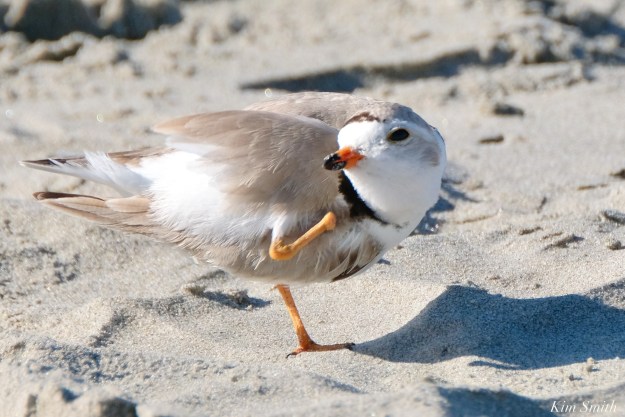
Mom is able to use her peg leg to scratch an itch

On Saturday, we had a serious problem with several very large groups of teens drinking, creating a mountain of trash, playing in the nesting area, and running through the area to use the dunes as their bathroom. Their complete disregard of the clearly marked off area destroyed the Plover’s nest scrapes, which are the potential possible sites for eggs. The police were called. The officers were very patient with the teens. One girl in particular was extremely rude to the officers, barely coherent and nearly falling down drunk.  It took more patience than you can possibly imagine for the officers to de-escalate as they did.  It wasn’t until the police appeared that the teens began attempting to clean up their trash, which without the officer’s insistence that they clean up, surely would have resulted in the more than one huge trash bag that I filled this morning.

These were not local kids but we have to do better than this as a community. There must be a way to have some authority figure patrol the beach on warm spring and summer afternoons. These teens were completely smashed and the amount of trash from alcoholic beverages was astounding. As soon as the officers appeared on the beach, the teens began to clean up their behavior, language, and garbage. But I don’t believe it should have gotten to this point.

We’ll keep an eye on the weather and we Ambassadors will mobilize on the next warm beach day but frankly, we have very little authority. None of us feel safe approaching a group of 30 or 40 unruly and intoxicated (and foul mouthed as was the case Saturday) teens. Truly, the ideal solution is to assign an officer or ranger to patrol the beach on warm afternoons and evenings.

If anyone sees people rough housing in, playing in, or repeatedly entering the roped off areas, please call the police and explain what you are seeing. If a nest with eggs or an adult or a chick is harmed in any way or killed by this kind of behavior, that is considered a “take” by both state and federal regulations. The City and the individuals responsible are liable for thousands of dollars in fines and potential closure of Good Harbor Beach. Our mission is to keep our beautiful GHB open for everyone and to keep our Plovers safe.From Saturday – how people treat our beautiful beach – trash on the beach brings crows and gulls, which eat Plover eggs and chicks
 

THANK YOU SAWYER FREE LIBRARY AND GUESTS! AND COINCIDENTALLY, TODAY IS WORLD MIGRATORY BIRD DAY!

Thank you to Jennifer Santomauro, Beth Pocock, and Linda Bossleman at the Sawyer Free Library and to everyone who came to the Piping Plover program this afternoon. Despite the gorgeous weather and protest marches nationwide, we had a wonderful group of interested attendees. It’s the first in-person presentation I’ve given in several years and I just want to thank everyone so much for coming.

World Migratory Bird Day is held annually on the second Saturday of May (May 14th in 2022).This year’s WMBD focuses on the impact of light pollution on migratory birds.

“Most birds migrate at night. They have been doing this for eons, as a night sky typically means calmer air space and fewer predators. Nocturnally migrating birds include ducks and geese, plovers and sandpipers, and songbirds of all kinds. These birds may travel thousands of miles between their breeding and non-breeding grounds.

However, the night sky is under threat. Artificial light is increasing globally by at least two percent a year, presenting a problem for birds. Light pollution from homes, businesses, and other infrastructure attracts and disorients migrating birds, making them more likely to land in dangerous areas where they are more vulnerable to collisions and predation. Artificial light also impacts birds in the breeding and winter seasons, disrupting feeding and other vital behaviors.

In 2022, the impact of light pollution is the focus of World Migratory Bird Day, an annual global campaign that celebrates the migration of birds across countries and continents. Throughout the year we will spread the message to “dim the lights for birds at night” and highlight the steps that individuals, communities, and governments can take to reduce the impact of light pollution on our shared birds.”

One of the featured species in WMBD 2022 is the Baltimore Oriole (as seen in the above illustration)!


Baltimore Oriole (Icterus galbula)

Length: 8.3” (21.1cm)

Wingspan: 11.5” (29.2cm)

Weight: 1.2oz (34g)

You may find this colorful member of the blackbird family in open woodlands, parks, or even your backyard. It eats a lot of insects, especially caterpillars, as well as fruit and nectar. Baltimore Orioles and many other songbirds need dark skies to safely migrate—you can help by reducing the amount of light outside your home at night.

Conservation Status: Low Concern

WHAT IS WORLD MIGRATORY BIRD DAY?

In 1993, the Smithsonian Migratory Bird Center created International Migratory Bird Day (IMBD). This educational campaign focused on the Western Hemisphere celebrated its 25th year in 2018. Since 2007, IMBD has been coordinated by Environment for the Americas (EFTA), a non-profit organization that strives to connect people to bird conservation.

In 2018, EFTA joined the Convention on Migratory Species (CMS) and the Agreement on the Conservation of African-Eurasian Migratory Waterbirds (AEWA) to create a single, global bird conservation education campaign, World Migratory Bird Day (WMBD). Continuing our tradition with IMBD, WMBD celebrates and brings attention to one of the most important and spectacular events in the Americas – bird migration.

This new alliance furthers migratory bird conservation around the globe by creating a worldwide campaign organized around the planet’s major migratory bird corridors, the African-Eurasian flyway, the East Asian-Australasian flyway, and the Americas flyway. By promoting the same event name, annual conservation theme, and messaging, we combine our voices into a global chorus to boost the urgent need for migratory bird conservation.

EFTA will continue to focus its efforts on the flyways in the Americas to highlight the need to conserve migratory birds and protect their habitats, and will continue to coordinate events, programs, and activities in Canada, the United States, Mexico, Central and South America, and the Caribbean at protected areas, refuges, parks, museums, schools, zoos, and more. As many as 700 events and programs are hosted annually to introduce the public to migratory birds and ways to conserve them.

READ MORE HERE

BEAUTIFUL ORIOLE ALERT- BOTH ORCHARD AND BALTIMORE ORIOLES!!

Time to put out orange slices (and hummingbird feeders, if you haven’t already done so.) Orioles are nectar feeders and follow the blooming times of fruit trees on their northward migration along the East Coast. My friend Sally Jackson spotted a Baltimore Oriole at her hummingbird feeder several days ago, and they are delighting in our pear tree blossoms and orange halves we have placed in the garden.

Baltimore Oriole male

Recently while recording audio in a field, I was delightfully surprised by an Orchard Oriole, a species new to my eyes. Orchard Orioles are slightly smaller than Baltimore Orioles and their plumage is more rusty red rather than vivid orange. Nonetheless, they sing a characteristically beautiful bird song and it was a joy to hear the chorister from across the meadow.

Orchard Oriole male

You can see from the photos that orioles have evolved with long pointed bills, ideal for extracting nectar from fruit blossoms. Their toes, too, are especially well adapted to forging for tree fruits and nectar as they are long and flexible, allowing the birds to dangle every which way while clinging to the branches.

Ancient Crabapple tree, where the Orchard Oriole was spotted

*    *    *

Please join me at the Sawyer Free Library on Saturday, May 14th, at 2pm for a FREE in-person all ages presentation about the life story of the Piping Plover –

Why Give a Peep for Plovers?

The Piping Plover is one of only a handful of birds that nests on North Atlantic beaches. By learning about this tiny but most resilient of shorebirds, we gain a deeper understanding on how best to protect Piping Plovers and our shared coastal habitat.

Told through the lens of Kim Smith’s photo journal work, the Piping Plover’s life story is presented from migration to nesting to fledging. We’ll also cover the current status of the bird’s population, learn about where Piping Plovers spend the winter, and how communities and conservation organizations can work together to help Piping Plovers flourish for generations to come.

If you are new to or have ever considered joining our Piping Plover Ambassador group, this presentation is a great way to become introduced to Piping Plovers. Please come and learn more about these most lovable and charismatic shorebirds.

We hope to see you there!

PIPING PLOVER UPDATE AND PLEASE JOIN ME SATURDAY FOR A FREE IN-PERSON PIPL PRESENTATION

Good afternoon PiPl Friends!

We returned Monday from a trip to visit my husband’s dear family in Ohio. If you can imagine, we were celebrating my father-in-law’s 97th birthday!! He is simply amazing and boasts his doctor told him he has the legs of a 70 year-old! We also squeezed in a trip to the butterfly exhibit at the Krohn Conservatory, the Cincinnati Zoo, and visited the old homestead located at the Hauck Botanical Gardens. And had the BEST BBQ at Eli’s Riverside. The Hauck Botanical Gardens, set in downtown Cincinnati, is a relatively small public park created decades ago by my father-in-law’s father (husband’s grandfather) and is richly planted with a collection of rare and North American native trees. Photos coming in a future post 🙂

A week away from Cape Ann’s Plovers and much has been taking place. The GHB PiPls are getting off to a slow start nesting this year and three solid days of fierce wind from the northeast is not helping matters. Yesterday morning there was a great deal of flying and piping at each other, but the funny thing was, they would take periodic breaks from skirmishing and huddle close to each other to get out of the wind.

The Cape Hedge Plover pair are settling in and I will have more on the CHB family towards the end of the week. The photo of the CHB Dad was taken Tuesday. He spent the better part of the time Charlotte and I were there trying to distract dogs that were running off leash.

Please join me Saturday at the Sawyer Free for a presentation about the Plovers (see below). Please feel free to wear a mask and please practice social distancing. Covid cases are on the rise in Gloucester (and everywhere) and I think I will be wearing a mask when not speaking.

I hope to see you there.
Warmest wishes,
Kim

Please join me at the Sawyer Free Library on Saturday, May 14th, at 2pm for a FREE in-person all ages presentation about the life story of the Piping Plover –

Why Give a Peep for Plovers?

The Piping Plover is one of only a handful of birds that nests on North Atlantic beaches. By learning about this tiny but most resilient of shorebirds, we gain a deeper understanding on how best to protect Piping Plovers and our shared coastal habitat.

Told through the lens of Kim Smith’s photo journal work, the Piping Plover’s life story is presented from migration to nesting to fledging. We’ll also cover the current status of the bird’s population, learn about where Piping Plovers spend the winter, and how communities and conservation organizations can work together to help Piping Plovers flourish for generations to come.

If you are new to or have ever considered joining our Piping Plover Ambassador group, this presentation is a great way to become introduced to Piping Plovers. Please come and learn more about these most lovable and charismatic shorebirds.

We hope to see you there!

WHY GIVE A PEEP FOR PLOVERS? SAVE THE DATE – PIPING PLOVER PRESENTATION AT THE SAWYER FREE LIBRARY!

Please join me at the Sawyer Free Library on Saturday, May 14th, at 2pm for a FREE in-person all ages presentation about the life story of the Piping Plover –

Why Give a Peep for Plovers?

The Piping Plover is one of only a handful of birds that nests on North Atlantic beaches. By learning about this tiny but most resilient of shorebirds, we gain a deeper understanding on how best to protect Piping Plovers and our shared coastal habitat.

Told through the lens of Kim Smith’s photo journal work, the Piping Plover’s life story is presented from migration to nesting to fledging. We’ll also cover the current status of the bird’s population, learn about where Piping Plovers spend the winter, and how communities and conservation organizations can work together to help Piping Plovers flourish for generations to come.

If you are new to or have ever considered joining our Piping Plover Ambassador group, this presentation is a great way to become introduced to Piping Plovers. Please come and learn more about these most lovable and charismatic shorebirds.

We hope to see you there!

GOOD HARBOR BEACH PIPING PLOVER UPDATE

Our GHB Mom and Dad have, for the most part, been lying low during this recent cold snap. However, given the warming temps over the past few days, the pair has resumed courting. And our pair at Cape Hedge continues to spotted regularly. More PiPls will likely be arriving soon. I am so looking forward to the magical month of May in Massachusetts for the magnificent peak migration that takes place all along our shores.

Courtship has resumed!

Willets at Good Harbor Beach

Our beloved Good Harbor Beach is yet another reason to protect shorebirds. Where ever conservation measures have been put in place to help shorebirds, these same actions have had a profoundly positive impact on helping to protect coastlines.


HAPPY EARTH DAY ON THIS MOST BEAUTIFUL OF EARTH DAYS!!

“There is symbolic as well as actual beauty in the migration of the birds, the ebb and flow of the tides, the folded bud ready for the spring. There is something infinitely healing in the repeated refrains of nature – the assurance that dawn comes after night, and spring after the winter.” –Rachel Carson

Dear Friends,

It’s glorious outdoors today and I hope you have a chance to get outside.  See below for photos from my morning Earth Day walk, although I can’t bear to sit at my computer all day when it’s so gorgeous out and will head back out this afternoon to see what we see.

For Earth Day this past week I gave several screenings of Beauty on the Wing (thank you once again most generous community for all your help funding BotWing!) along with presenting “The Hummingbird Habitat Garden” to the Massachusetts Horticultural Society. For over twenty years I have been giving programs on how to create pollinator habitats. People are hungry for real information on how to connect to wildlife and wild habitats and each year the interest grows and grows. It’s truly a joy to witness!

Last night it was especially rewarding to bring Beauty on the Wing to Connecticut’s Sherman Conservation Commission attendees. We had a lively Q and A following the screening with many thoughtful questions and comments. My gratitude and thanks to Michelle MacKinnon for creating the event. She saw the film on PBS and wanted to bring it to her conservation organization. Please let me know if you are interested in hosting a Beauty on the Wing screening. 

Monarchs are on the move! The leading edge in the central part of the country is at 39 degrees latitude in Illinois and Kansas: the leading edge along the Atlantic Coast is also at 39 degrees latitude; Monarchs have been spotted in both Maryland and New Jersey. Cape Ann is located at 43 degrees — it won’t be long!

Monarchs are heading north! Female Monarch depositing egg on Common Milkweed

Hummingbirds have been seen in Mashpee this past week (41 degrees latitude). Don’t forget to  put out your hummingbird feeders. Dust them off and give a good cleaning with vinegar and water. Fill with sugar water and clean regularly once installed. The sugar water recipe is one part sugar to four parts water; never replace the sugar with honey, and never use red food coloring.

Happy Glorious Earth Day!

Female Ruby-throated Hummingbird

Super surprised to see this mystery duck asleep on a rock. I was so curious and kept hoping he would wake up so as to identify. He at last lifted his head for all of ten seconds and then promptly tucked back in and went back to sleep. I’ve only ever seen Surf Scoters bobbing around far off shore in the distance. Skunk bird- what a cutie!

American Kestrel, male, too far away to get a good photo but a joy to see!

Beautiful, beautiful Great Egret preening its luxurious spray of feathers. An egret’s spray of feathers is also referred to as aigrette.

No Earth Day post would be complete without our dear PiPls – Mom and Dad foraging at the wrack line this am, finding lots of insects for breakfast.

A seal’s life


PRETTY SILVERY WAVES AND PIPING PLOVER AFTER STORM UPDATE

The howling winds of the April 18th overnight storm brought super high tides, downed trees, downed power lines and poles. We lost one of our beautiful ‘Dragon Lady’ hollies, one of a pair planted when we first moved to our home, and a tree that gave the birds many tree-fruits over the years.

The wind also carried in a somewhat befuddled Great Egret, clinging to a shrub and still trying to gain his bearings when photographed at mid-day.

Super high tide to the base of the dunes

Mom and Dad foraging in the intertidal zone

Mom

Dad

The highest tide during the storm went up and a bit past the base of the dunes. Our nesting pair of Plovers appeared relatively unfazed and, despite the continued high winds at day’s end, were busy courting and foraging at the newly washed over beach scape.

Churned-up

#savesaltisland CONSERVATION MEETING POSTPONED ONCE AGAIN

Save Salt Island Friends Jayne and Andy write,

Hello protectors of Salt Island,

The agenda for the Conservation Commission meeting tonight, Wednesday April 20th, has been updated and the proponents of RDA-1703 Salt Island have requested a continuance to May 4, 2022.  The administrative record for this application has also been moved from April 20, 2022 to May 4, 2022.

Andy and I are still planning to attend to observe the vote of the request for continuation, but based on all of the past meetings, it will likely pass.  We are letting you know since your time is valuable and it would be unfortunate to have you attend unnecessarily.  Of course, if you still want to attend… GREAT!  We will continue to watch for any changes to the application between now and May 5th.

Thank you again for your patience and perseverance.

Warm regards,

Jayne and Andy

Martignetti’s plan drawing for Salt Island McMansion (Martignetti Family now called Salt Island LLC)


EASTER SUNRISE

Easter sunrise over Good Harbor Beach Salt Island

THANK YOU MAYOR VERGA, AC OFFICERS JAMIE AND TEAGAN, MARK COLE, JOE LUCIDO, AND THE GLOUCESTER DPW CREW!

Speaking on behalf of the Piping Plover Ambassadors, we would like to thank Mayor Verga, Mark Cole, Joe Lucido, and the Gloucester DPW Crew, and Animal Control Officers Jamie and Teagan for helping to protect our Cape Ann Plovers. We are grateful and so appreciate their very timely efforts.

The many recent actions we are grateful for –

All the roping is now in place at areas #1, #2, and #3. Hooray!! Why is this action so important? It gives the Plovers safe space to court and to nest. Plovers will rebuild their nest up to five times. If they have safe spaces from the get go, chances are they will nest earlier in the season and be on their way before the beach gets crazy busy with people enjoying the beach.

DPW Crew installing the symbolically roped off area on Wednesday, April 13th

We are grateful that Officers Teagan Dolan and Jamie Eastman are daily patrolling the beach  at varying times. For the same reason the roping needs to go up early, the earlier in the season the dogs are off the beach, the safer it is for Plovers, along with the many shorebirds stopping over at Good Harbor Beach on their annual northward migration.

We are so appreciative of the signs now in place, both the endangered species signs on the cordoned off areas and the No Dogs signs at entrances to the beach and parking lots.

If you are heading to Good Harbor Beach, you can’t help but notice the blinking sign in the road near the intersection of Beach and Nautilus Roads. The sign will greatly help the AC Officers who often hear, “I didn’t know”, or “I didn’t’ see the (large screaming yellow) sign at the footbridge. The fine is $300.00 for each dog off leash and doubled if the dog charges through the clearly marked nesting area. Why the hefty fine? Because the City will be held accountable by state and federal agencies for any threatened or endangered bird that is killed or injured at Good Harbor Beach. A fine of $25,000.00 or more could be levied against the community if a bird listed as threatened or endangered is killed by a dog, person, or stray ball.

Again, we can’t thank enough Mayor Verga, Mark Cole, Joe Lucido, Gloucester’s ACOs, and entire DPW crew for their consideration and kind help protecting the Plovers!

Piping Plover love stories update –

The very pale female that was the first to arrive only stayed for a few days. She was followed by the Three Bachelors. A Bachelorette joined the scene over the weekend and paired up with Bachelor #3.

We now have one sweet couple attentively courting and nest scraping.

We’ve temporarily lost sight of Bachelors #1 and #2 but the precocious and Interfering Sanderling is still on the scene. The situation is fluid and we expect more PiPls will be arriving in the coming days. 

If you would like to be a Piping Plover Ambassador, please contact me by either leaving a comment or emailing at kimsmithdesigns@hotmail.com.

Today’s Pea Soup Fog

Beach House construction underway – don’t you think this dried grass will add greatly to the decor honey?


CALLING ALL BACHELORETTES!

Good afternoon PiPl Friends,

Currently we have three male Piping Plovers positioned for action at Good Harbor Beach at respective territories. The bachelors are eagerly awaiting the arrival of the bachelorettes, marking their turf with nest scraping and the calls for which Piping Plovers are so well known, all accomplished with chests a-puff.

 Meet the three candidates-Bachelor #1  

Bachelor #2  

Bachelor #3

#1 chasing #2 off his turf

The head count can change on a dime overnight. Let’s hope the ladies will soon be arriving.

If you would like to be a Piping Plover Ambassador, please contact me by either leaving a comment or emailing at kimsmithdesigns@hotmail.com.

Exciting news, we have three new wonderful recruits! We’ll have an informational meeting later this spring, once we have an actively nesting pair. I am so looking forward to working with you all, both our super experienced and dedicated volunteers, along with our new members!

Jennie and Deb, I received your requests to continue in your last year’s time slots and we will also work on getting more coverage at peak times.

xxKim

OH JOYOUS SPRING!

Happy Spring dear Friends!

Please forgive me if I am slow to respond to your notes, emails, and kind comments. I am so sorry about that but am spending every spare minute on the Piping Plover film project, creating the first rough cut while converting six plus years of footage. And uncovering wonderful clips of these extraordinary creatures, some I am just seeing for the first time since shooting! Not an easy task but I am so inspired and full of joy for this project, trying not to become overwhelmed, and taking it one chunk at a time, literally “bird by bird,” as Anne Lamott would say.

From daily walks, a mini migration update –

Gadwall female

Gadwall and American Wigeon pairs abound. Both in the genus Mareca, they share similar foraging habits when here on our shores and can often be seen dabbling for sea vegetation together.  The Orange-crowned Warbler was still with us as of mid-week last, as well as the trio of American Pipits. The very first of the Great Egrets have been spotted and Killdeers are coming in strong. The first Ruby-throated Hummingbirds will be here any day now; at the time of this writing they have migrated as far north as North Carolina

Have you noticed the Weeping Willows branches are turning bright yellow? In the next phase they will become chartreuse. For me it it one of the earliest, earliest indicators that trees are starting to emerge from dormancy. And our magnolia buds are beginning to swell, too. Please write with your favorite early signs of spring and I’ll make a post of them.

xxKim

Male and Female Gadwalls, American Wigeons, Black Ducks, and Buffleheads foraging for aquatic vegetation

More spring scenes

Eastern Screech Owl in camo, possibly brown morph 

Owl on the prowl

White-tailed Deer at Dusk

Orange-crowned Warbler

Orange-crowned Warbler preening

EGADS, GADWALL LOVEBIRDS!

The male and female pair of dabbling Gadwalls pictured here have been enjoying the aquatic vegetation, salt water invertebrates, and relative quietude of Cape Ann’s cove beaches. They’ll soon be heading north and west to breed.

Gadwalls are “seasonally monogamous,” and almost always pair up during the fall migration. Seasonally monogamous– a new term to my ears–and one I find rather funny.

Black butt feathers

With understated, yet beautifully intricate feather patterning, look for the males black rear end feathers.

Exquisite feather pattern

PEEP IN A CLAMSHELL

Is a Sanderling a sandpiper? The short answer is yes.

Sanderlings are a species in the genus Calidris, which also includes locally seen Semipalmated Sandpipers and Least Sandpipers. All three are called sandpipers, with the sweet nickname “peeps.”Pretty Sanderling in a clamshell

SNOW BUNTING SNOWBIRD SNOWFLAKES AND WHAT DOES BEACH HABITAT RESTORATION LOOK LIKE IN WINTER TIME?

One of the most beautiful creatures of the snowy landscape has to be the Snow Bunting.  Also known as Snowflakes, Snow Buntings light up winter scapes with swirls of flight and highly animated foraging habits.

During the breeding season in the high Arctic, Snow Buntings eat a protein rich insect diet but while here during the winter months in the relatively milder climate of Massachusetts, they forage on tiny grass seeds and must constantly eat. Although their feeding habits are highly entertaining to the human observer, it’s really a matter of life or death for these cold weather warriors.

Standing on tiptoes for breakfast

Snow Buntings have several methods for extracting seeds. Sometimes they vigorously shake a wildflower or stalk of grass at the base of the plant. Other times they alight on a single blade of dried beach grass and slide their beaks along, shredding the stalk and releasing teeny seeds. They may stay alit and eat their foraged treasure, but more often than not, they shake the blade while perched and release the seeds to the ground. The Snow Bunting’s fellow flock member will seize upon the shower of released seeds and try to gobble them up. Herein lies the the conflict and disputes occur non stop while a flock is feeding. Typically one will readily retreat while the other dines, but occasionally a nasty battle ensues.

The wonderfully rich beach grass habitat where the Snow Buntings flock was formerly a barren scape that persistently washed away after every storm. Beach grass was planted, temporary dune fencing installed, and small rocks were added. After only several seasons, this habitat restoration project began attracting butterflies, songbirds, and nesting shorebirds during the spring and summer months, along with glorious creatures such as the beautiful Snow Bunting during the winter months.

I plan to find out exactly what this species of beach grass is that the Snow Buntings find so appealing because there are several locations on Cape Ann where habitat restoration is badly needed and I think this precise species of grass would surely be at the top of the list for stabilizing shoreline conservation projects.

Snow Bunting tracks

See Snow Bunting previous posts:

WHEN SNOW BUNTINGS FILL THE SKIES

BEAUTIFUL SNOWSHOEING AND SNOW SLEDDING SNOW BUNTING SNOWFLAKES

FLIGHT OF THE SNOW BUNTINGS


PIPING PLOVERS SOMERSAULTING!

For the first time, as far as anyone can recollect, a pair of Piping Plovers nested at Cape Hedge Beach in Rockport during the summer of 2021. The family was not observed until after the chicks had hatched but we can make a fairly educated guess as to where the nest was hidden. I think, too, based on comparing many photos and film footage that the pair at Cape Hedge had nested originally at the Salt Island end of Good Harbor Beach. That nest of three eggs was washed away by a storm surge during the King Tide.  There was a great deal of competition for nesting territory at Good Harbor during this time period and it is logical the SI pair would have moved north one beach. I imagine that to a Plover’s way of thinking, from Cape Hedge to Good Harbor is one long continuous beach.

One of the most fascinating aspects observed about the Cape Hedge Piping Plover family was the very young chick’s ability to navigate the popples. They used the larger rocks as slides, leapt from rock to rock, occasionally got stuck and, especially when they were very teeny, did mini somersaults.

Why did the Plovers go up and down the steep bank of popples countless times a day? Better camouflage was afforded at the top of the bank while food was more plentiful in the tidal flats. Insects could be had amongst the rocks, but super nourishing mini mollusks and sea worms can only be found in the intertidal zone.

I am currently in the midst of the daunting task of organizing six years of PiPl footage and photographs, from 2016 through 2021. I’ll be posting snippets from time to time. See below for some PiPl acrobatics and a somersault in slow motion 🙂

2021 WILD CREATURES REVIEW! PART TWO

Cape Ann Wildlife – a year in pictures and stories

July through December continued from part one

July 2021

Conserve Wildlife NJ senior biologist Todd Pover makes a site visit to Cape Ann beaches, summer long updates from “Plover Central,” GHB Killdeer dune family raise a second brood of chicks,  Cape Hedge chick lost after fireworks disturbance and then reunited with Fam, Great Black-backed Gulls are eating our Plover chicks, thousands of Moon Snail collars at Cape Hedge,  Monarchs abound, #savesaltisland, missing Iguana Skittles, and Earwig eating Cecropia Moth cats.

August 2021

New short film for the Sawyer Free Library The Marvelous Magnificent Migrating Monarch!, Coastal Waterbird Conservation Cooperators meeting new short Piping Plover film, Ruby-throated Hummingbirds in the garden, why we love Joe-pye and other wildflowers, butterfly friends, Monarch cats in the garden, what is the purpose of the gold dots found on Monarch chrysalides?,Black Beauty came calling, Tigers in the garden, School Street sunflowers, Hoverflies, luminescent Sea Salps return to Cape Ann beaches, Petal Dancers and lemony Yellow Sulphurs on the wing.


September 2021

Flower Fairies, irruptive Green Darner migration, mini glossary of late summer butterflies, what to do if you find a tagged Monarch, Painted Ladies, White-tailed Deer family, Monarchs mating, Tangerine Butterflies,  yellow fellow in the hood, and Beauty on the Wing first ever live screening at the Shalin Liu.

October 2021

Bee-sized butterfly the American Copper, Monarch conga line, Thunder and Cloud, abandoned Piping Plover egg, School Street Sunflowers, Monarchs migrating, quotidian splendor, Monarch fundraiser updates, collecting milkweed seeds, the Differential Grasshopper, Cooper’s Hawk – a conservation success story,  #ploverjoyed, and nor’easter from the EP Lighthouse.

November 2021

Bridges between life and death, ancient oak tree uprooted, autumn harvest for feathered friends, Monarch migration update, we have achieved our fundraising goal!, Harbor Seal pup hauled out,  flight of the Snow Buntings, and a very rare for these parts wandering Wood Stork calls Cape Ann home for a month.

December 2021

New short film Wandering Wood Stork, tiny tender screech owl suffering from rat poison under the care of Cape Ann Wildlife Inc., Praying Mantis in the autumn garden, masked bandits in the hood, short film The Majestic Buck and Beautiful Doe Courtship Frolic, Snowy Owl boy in the dunes, short film Cedar Waxwing vocalization, the story of the Steller’s Sea-Eagle’s foray to Massachusetts, and Harbor Seal Pig Pile.


SEE PART ONE, JANUARY THROUGH JUNE, HERE


BEAUTY ON THE WING: LIFE STORY OF THE MONARCH BUTTERFLY COMING SOON (FEBRUARY 2022) TO A PBS STATION NEAR YOU!


2021 WILD CREATURES REVIEW!

Wishing you peace, love and the best of health in 2022 – Happy New Year dear Friends. I am so grateful for blog, Facebook, and Instagram friendships, new and old. Thank you for your kind comments throughout the year.

I would like to thank our wonderfully dedicated volunteer crew of Piping Plover Ambassadors, who provide round-the-day protections to one of Cape Ann’s most tender and threatened species.

I wish also to thank you for your kind support and contributions to our Monarch documentary, Beauty on the Wing: Life Story of the Monarch Butterfly. 2021 was a fantastic year for the film, winning many awards, including honors at both environmental festivals and awards at family-oriented film festivals, We also had a very successful fundraiser that allowed us to re-edit the film, and to distribute Beauty on the Wing through American Public in order to bring to the widest television audience possible.

Please stay healthy in the coming year. Wishing all your dreams come true. To peace, love, and great health in 2022. <3


Cape Ann Wildlife – a year in pictures and stories

Thinking about the wonderful wildlife stories that unfolded before us this past year I believe helps provide balance to the daily drone of the terrible pandemic. 2021 has been an extraordinarily beautiful and exciting year for our local wildlife. Several are truly stand out events including the three pairs of Piping Plovers that nested on Cape Ann’s eastern edge, the most ever! The summer of  2021 also brought a tremendous up take in Monarch numbers, both breeding and migrating, and in autumn a rare wandering Wood Stork made its home on Cape Ann for nearly a month. The following are just some of the photographs, short films, and stories. Scroll through this website and you will see many more!

January 2021

A rarely seen in these parts Black-headed Gull (in winter plumage), a Horned Lark, American Pipits, Red Fox kit all grown up, and an illusive Snowy Owl living at Gloucester Harbor.

February 2021

A red and gray morph pair of Eastern Screech Owls, flocks of winter Robins, and snowshoeing and snow sledding Snow Buntings grace our shores. 


March 2021

Bluebirds return to declare their nesting sites, the raptors delight in songbirds’ returning, American Wigeon lovebirds, signs of spring abound, and the Good Harbor Beach Piping Plovers return on March 26th, right on schedule! Gratefully so, Gloucester’s DPW Joe Lucido and crew install PiPl fencing on March 29th!

April 2021

Ospreys mating, Cedar waxwing lovebirds, Ruby-throated Hummingbirds return, and the Plovers are nest scraping and courting. The early spring storms also brought a dead Minke Whale to the shores of Folly Cove. 

May 2021

The Good Harbor Beach Killdeer family hatches four chicks, beautiful new PiPl on the block, many PiPl smackdowns with three pairs vying for territory, eggs in the nest at Area #3!, warblers and whatnots migrating, Make way for Ducklings – Cape Ann Style, the Salt Island PiPls have a nest with eggs but it is washed away by the King Tide of May 29th, and Cecropia Moths mating and egg laying.

June 2021

Piping Plover ambassadors first meeting of the season, on June 9th the Boardwalk #3 PiPls hatch four chicks, one chick perishes, Super Mom has a foot injury, Horseshoe Crabs at Good Harbor Beach, Piping Plover Ambassador badges from Jonathan and Duncan, a second nest is discovered at Salt Island with a new pair of parents (the first was washed away in the storm surge during the May King Tide), and for the first time, Piping Plovers are nesting at Cape Hedge Beach.

SEE PART TWO, JULY – DECEMBER, TOMORROW!