Category Archives: Sea Creatures

Looking to 2026

Dear Friends,

I hope you are finding renewed hope in the new year.  As we turn the page away from 2025, one thought burns so brightly in my mind and that is to Power On. We’re all in this together and as we become united, we will be empowered to right the wrongs.

This last photo of 2025​, from the 31st, is​ of a Wild Turkey taken in the Wolf Moon a few days before it was completely full. Charlotte and I watched in wonderment as the turkeys took flight at twilight. It takes a good amount of energy for their ungainly bodies to become aloft and ​turkey flying comes with much noisy whooshing and vigorous wing flapping. They sleep in trees for protection from mammalian predators and even young poults learn to fly and roost on low branches, at the ​very tender age of only a week or two.

I have been meaning to share this video of Gray Seals singing. For about ten years or so I have been watching the growing population of seals at Brace Cove, which isn’t really very long in the grand scheme of things. When I first began to notice the congregation there, it seemed as though it was all Harbor Seals. More and more Gray Seals seem to be coming each year. One day in November I counted 14 Gray Seals hanging out together in the water, not on the rocks. Another day, there were 34 all told, both Harbor and Gray, in the water and on the rocks. There possibly may have been many more as they move around the cove and are often emerging from underwater.

The first clips are of a chorus of Gray Seal bull songsters; the last two clips happened several days later when two were behaving very affectionately towards one another. Notice how the more active the males became, the more anxious the small seal in the center of it all became before giving up its spot on the rock. Turn up the volume to hear the full chorus! Gray Seal mating season is happening now and the singing can be either amorous or territorial. Mating takes place underwater but I wonder if the clips where they are behaving affectionately is a form of courtship. Everything I have read states mating is violent but watching the seals playfully rub each other and dive together for fifteen plus minutes makes me think perhaps there is another side to Gray Seal breeding.

Power On Friends,

xxKim


Baby Sea Otters and Other Notes

Dear PiPl Friends,

Perhaps many of you are also deliberating over how to share joyful stories in these terribly turbulent times. Does it seem tone deaf to share creature stories when so many people in our country are experiencing so much pain and instability. I wonder if it is even wanted, to write about the beauty of the wild creatures and their habitats when there are countless people who are living through heartbreaking and wholly unplanned challenges in their everyday lives.

We take care of a seven-year-old child, our granddaughter. I imagine how the dismantling of so many worthwhile government institutions will impact her over her lifetime. Putting an anti-vaccine zealot in charge of the Department of Health, freezing funding for medical research and for soft power programs like USAID, the elimination of Diversity, Equity, and Inclusion policies, destroying the relationship between our closest neighbors and allies, gutting environmental protections, and the dismantling of the Department of Education are at the top of my list. Two days ago, it was announced 12  million in federal funding to feed school children and support local farmers in Massachusetts will be cut. The funds were to be used locally to provide healthy food to child care programs and schools and to create new procurement relationships with local farmers and small businesses. How immeasurably deadly and hypocritical to claim the aim is to make ‘America Healthy Again,’ while simultaneously cutting off food assistance programs. What is healthy about parading a child cancer survivor before Congress while at the same time, eliminating funding for childhood cancer research. When is it going to end? Can it end when half of the Congress are without courage and two thirds of the Supreme Court consistently vote along extreme hard right partisan lines? Who can stop the madness when two of the three branches of our three part checks and balances democratic system have simply gone supine in the face of the insatiable greed of a few madmen?

How will the firing and hiring freeze impact the National Park Service and US Fish and Wildlife Service ability to protect wildlife at treasured places like the Cape Cod National Seashore and Parker River National Wildlife Refuge? The cuts in staffing will have a devastating effect on important research projects that conserve wildlife. And how will the cuts impact the day to day operations? “Outdoor recreation is a $1.2-trillion business sector where public-private partnerships create an outsized return on investment and boost local economies—every federal dollar invested in NPS generates fifteen dollars of economic activity—so there is nothing effective nor efficient about attacking our parks. ” – Massachusetts Senator Ed Markey.

I was very inspired during my recent trip to California to visit our daughter. She and I visited a number of wildlife habitat “hotspots,” and at all these special places, there were volunteer  docents explaining to people the animal behaviors they were witnessing. The Elephant Seal docent even had a large photo book of the seal’s behaviors and there are docents at Snowy Plover breeding sites twelve hours a day!

We are bracing for the devastation to wildlife during the upcoming breeding season. As I am writing this, it occurred to me that we can look at this mess as a call to action. Even though it may only seem like a drop in the bucket, one meaningful way to help is to become an ambassador for wildlife.  I am not suggesting that volunteering replaces staffing but that during this national crisis, can we think about where else help may be needed?

It will soon be nesting and breeding season here in the north east. This past week we have seen an influx of a true harbinger of spring, the boldly beautiful male Red-winged Blackbirds announcing their arrival. The females will be along, seeming to always arrive after the males. The winter resident ducks have begun departing our shores and in these last weeks here have been pairing off with a chorus of varied courtship whistles and squeaks. The beloved sound of Spring Peepers will soon join the chorus, too. Our penny whistle Piping Plovers will begin returning by the end of the month. We are keeping our hopes up that handicapped Mom and Super Dad will make the arduous journey north for a tenth season. If not them, they have left us with new generations of PiPls to care for.

While in California, we were very fortunate to see signs of spring’s arrival all along the Pacific Coast, from wildflowers blooming  to mother and baby Sea Otters. I plan to write more about the story of the extraordinarily positive impact the conservation measures enacted to protect endangered Sea Otters has had on the California coastal ecosystems, not only restoring the dying kelp forests, but also helping to revitalize the very unhealthy Pacific coast salt marshes.

Over the course of the several days that we were able to see Sea Otters, four moms and their pups were swimming quite close to shore. The females are exquisitely nurturing, spending the first six months with their pups (and in some instances, up to a year), and teaching them everything they know. Each mom has different strategies for foraging, passing these behaviors down from one generation to the next. We filmed some really adorable imitative behavior, including a pup pretending to whack open a mollusk to extract seafood, just like Mom.

Keeping hope alive.

xxKim

P.S. Please email me or leave a comment if you would like to join our volunteer Plover Ambassador program this summer. And please join us Sunday, March 23rd, for a screening of The Piping Plovers of Moonlight Bay at MAGMA.

Even though the mother’s milk is super rich in fat, about 20 to 25 percent, the pups need to nurse throughout the day. They alternate between the two nipples located on her lower abdomen. The pups also begin eating solid food soon after birth but are not weaned until about six months of age. The Moms are very relaxed during nursing, grooming both their own forepaws and the pup’s wide webbed feet (that look more like flippers).

WONDERFUL WILD CREATURES 2023 YEAR IN REVIEW!

Saying goodbye to 2023 with a look back at just some of the magnificent creatures and scenes we see all around our beautiful North Shore.

The slide show begins with January and runs through December. When clicking through, you can see the photos are captioned and dated. If you would like more information, all the photos are from posts written throughout the year, and most of the posts have short videos featuring the animal.

Some of the highlights were a Northern Lapwing blown far off course, Barred Owls, flocks of Snow Buntings, successful Gray Seal rescue by Seacoast Science Center, the return of handicapped Super Mom and Super Dad to Good Harbor Beach, Great Blue Herons nesting, Rick Roth from Cape Ann Vernal Pond team helping me find frog’s eggs for my pond ecology film, Bald Eagle pair mating, Earth Day Good Harbor Beach clean-up, Osprey nesting,Creative Commons Collective native plantings at Blackburn Circle, mesmerizing encounter with a Fisher, Mama Dross Humpback and her calf, Beth Swan creating PiPl logo, PiPl chicks and Least Terns hatching, Pipevine Swallowtail pupa, PiPl t-shirts and decals selling at Alexandra’s Bread, rare Nighthawk, Spring Peepers, chicks fledging, trips to Felix’ Family Farm with Charlotte, Monarchs in the garden, Merlin, juvenile Glossy Ibis, and a  flock of Horned Larks.

Perhaps the very most memorable moment was a wonderfully close (and extended) encounter with a Fisher. Read more about that here: Lightning in a Bottle


Happy New Year Friends. We’ll see what 2024 brings our way <3

EVERYONE’S HELP IS NEEDED TO SAVE SALT ISLAND FROM DEVELOPMENT AND FROM GOAT INVASION!!! YOU CAN TAKE ACTION!

The entire community’s help is needed. Salt Island is one of Gloucester’s most beautiful natural treasures and a vibrant part of our coastal ecosystem. Martignetti’s proposed future dream house for Salt Island

Why goats are a terrible idea for a coastal ecosystem

Goats used to control vegetation in places like Central Park and cemeteries have had some success however, these locations are not fragile coastal ecosystems. Goats are not discriminating and will eat everything in their path. To eradicate PI, you must dig it up by the roots.

Salt Island is an oasis of native plants and shrubs. Natural, largely undisturbed habitats, like Salt Island, provide refuge and food for resident and migrating birds alike.  Note in the photo below, which was taken at the time of installing the fence posts, the beautiful native vegetation growing at the Island.

We need to point out that the fallacy stated by Mr. Matignetti at the Conservation Committee meeting,”Poison Ivy is an invasive species,”  is incorrect. Poison Ivy is a native North America plant and is known for its value to wildlife. Poison Ivy flowers bloom early in the spring, providing nectar to myraid species of bees and other pollinators. The fruit of Poison Ivy is consumed by dozens and dozens of songbird species. The berries provide much needed sustenance in the late summer, fall, and winter. These are just some of the birds that eat PI fruits: Northern Flicker, Bobwhite. Quail, Eastern Phoebe, Cedar Waxwing, woodpeckers, Tufted Titmouse, and American Robin.

Granted, Poison Ivy is not a plant you want to become entangled with but the entire Island does not need the vegetation eradicated under the guise of removing PI. 

There are shorebirds, ducks, and gulls nesting at Salt Island, along with a highly productive shellfish bed. Lobsters are caught off the shores of Salt Island and baby lobsters need fresh, uncontaminated water. We do not want goat feces and goat worms contaminating this vibrant coastal ecosystem!

Typical fencing used for goat vegetation control is three feet tall livestock fencing-

unlike the fence posts that have been installed at Salt Island, which are permanently bolted into the granite rocks.Fence posts permanently bolted to the granite at Salt Island

Notice how far the fence posts go down on the left. This is not a “keep in the goats” fence line, but a “keep out the people fence line.”

ACTIONS YOU CAN TAKE:

Please email our City Councilors. We learned that when trying to change the dog ordinance to protect Piping Plovers that the more people that write to the Councilors, the better chance our voices will be heard. There is power in numbers. Please write in your own words, or copy paste the following –

Dear Councilor,

Please help us save Salt Island from future development, goats, and all destructive and detrimental activities to this vibrant coastal ecosystem. Thank you.

Attend the virtual Conservation Committee meeting on Wednesday evening at 6pm.

https://gloucester-ma-gov.zoom.us/j/85146365487

Councilors email addresses:

Ward 1 Salt Island Councilor Scott Memhard smemhard@gloucester-ma.gov

Melissa Cox mcox@gloucester-ma.gov

John McCarthy jmccarthy@gloucester-ma.gov

Jamie O’Hara johara@gloucester-ma.gov

Barry Pett bpett@gloucester-ma.gov

Steven LeBlanc sleblanc@gloucester-ma.gov

Valerie Gilman vgilman@gloucester-ma.gov

Sean Nolan snolan@gloucester-ma.gov

Jen Holmgren jholmgren@gloucester-ma.gov

Joanne Senos City Clerk jsenos@gloucester-ma.gov

Join the Save Salt Island Facebook page to keep updated on the latest developments.

Join the CapeAnn MA Facebook page, which also provides updates on the latest developments.

Share this post

Photos of fence post installation May 12, 2021 –

Exploring fun at Salt Island

Video: The Good Harbor Seal ~ What to do if you find a seal on the beach

The beautiful juvenile Harbor Seal was found on a foggy morning in midsummer. The seal was beached at the high tide line and its breathing was heavy and labored. It had no interest in returning to the water and needed only to remain at rest.

For the next six hours the seal struggled to survive the world of curious humans.

Learn what to do if you find a seal on the beach.

Written, produced, edited, cinematography, and narration by Kim Smith.

The Good Harbor Beach Seal PSA was created because of the lack of understanding on the part of my my fellow beachgoers on how to mangae a seal encounter. Please help get the word out and please forward the link to friends and neighbors in other communities, whether or not the community is located by the sea. It was the folks from out of town that did not understand that the seal needed simply to be left alone. Thank you!

Although the Good Harbor Seal was not injured, help was needed with the gathering crowd. I called our local police, who in turn sent Lieutenant Roger Thurlow from the Environmental Police. Has anyone had experience with a marine stranding, and if so, is the following the best number to call: Northeast Region Marine Mammal and Sea Turtle Stranding and Entanglement Hotline ~ 866-755-6622? I will post your hotline recommendations here.

Technical note–The video was filmed without a tripod because I was afraid the tripod would look like a gun and didn’t want to further stress the seal. After reading more about Harbor Seals, I learned that their big brown eyes are particularly adapted to sight in murky water (i.e. harbor waters), but that their eyesight is not that good on land. In retrospect, I don’t think that the seal would have associated the tripod with a weapon. Also, I filmed at a distance much further away than my camera’s capabilities, which caused much vignetting around the edges of many of the clips. I didn’t want to stand close to the seal and be the filmmaker-who-becomes-part-of-the-problem, and not the solution.

Breaking News: Good Harbor Beach Seal Survives


How to Help a Seal on the Beach

Several mornings ago I went for an early morning walk at Good Harbor and discovered this beautiful baby Harbor Seal stranded at the high water mark. Over the next six hours it struggled to survive the world of curious humans. Fortunately, all ended well and the seal returned to the sea. I’ll post a PSA video later in the week because a great many of the beach goers today seemed completely clueless to the fact that stranded baby seals must be left alone. I had to call the environmental police (thank you Lieutenant Roger Thurlow) to prevent this one man from actually touching the seal, despite the fact that the seal’s breathing was obviously very labored and it was terrified. Later in the morning a lifeguard appeared and kept the crowd under control. I asked for her name but the lifeguards have been instructed not to speak to the media. I hope the lifeguard sees this post because I would like to thank her–she did an absolutely awesome job keeping people from getting too close to the seal–and it wasn’t easy.

Good Harbor Beach Harbor Seal ©Kim Smith 2013Click photo to view larger

Stranded Marine Animals

Mendy Garron and her team from NOAA handle the Maine to Virginia corridor for stranded marine animals She recommends contacting the first responders for our region at the Whale Center hotline, 978.281.6351.

Atlantic White-sided Dolphin Lagenorhyncus acutus

Migration of the Atlantic White-sided Dolphin from the Convention on Migratory Species website: “There may be inshore-offshore movements with the seasons in some areas (Carwardine, 1995). Selzer and Payne (1988) suggested that L. acutus moves south along the continental shelf edge in winter and spring, in association with the relatively cold, less saline Gulf of Maine water flowing southwards through Northeast Channel during these seasons. Seasonal variation in sea-surface temperature and salinity and local nutrient upwelling in areas of high sea floor relief may affect preferred prey abundances, which in turn may affect dolphin distribution. The occurrence of Atlantic white-sided dolphins off Newfoundland seems also to be seasonal, mainly from July to October (Reeves et al. 1999). Data from one satellite-monitored dolphin indicated an ability to travel long distances at a speed of at least 14 km/hr (Mate et al. 1994).”

Distribution Map of the Atlantic White-sided Dolphin (Lagenorhyncus acutus)Distribution Map of the Atlantic White-sided Dolphin (Lagenorhyncus acutus)

Map courtesy of the Convention on Migratory Species

Dead Dolphin Washed Ashore on Niles Beach

I beleive this is a juvenile Atlantic White-sided Dolphin, found washed ashore on Niles beach at 8:00 this morning. I am not sure who to call. If any of my readers know please email and in the meantime I will try to get ahold of someone at the New England Aquarium and check in with Good Morning Gloucester blog; perhaps they know.

Dead Atlantic White-sided Dolphin Lagenorhyncus acutus

Dolphin or Porpoise?

Over at the very excellent Good Morning Gloucester blog, much has been written recently on the topic of Harbor Porpoise and Atlantic White-sided Dolphin sightings in Gloucester Harbor. And coverage of the seven harbor porpoises washed ashore on Massachusetts beaches, six dead and one rescued (recovering), have been well-covered in the print media. Purportedly, mortality amongst juvenile Harbor Porpoises is not atypical at this time of year, however the high number in one week is exceptional. These sightings reminded me of an adventure experienced while visiting my grandmother on Cape Cod and I thought what better time to share my favorite story, told so often to our children that they can surely recite it word for word.

Common Bottlenose Dolphin Tursiops truncatusCommon Bottlenose Dolphin (Tursiops truncatus)

Atlantic White-sided Dolphin Lagenorhyncus acutusAtlantic White-sided Dolphin (Lagenorhyncus acutus)


Harbor Porpoise (Phocoena phocoena

While living in Boston and attending art school, I would often visit my grandmother Mimi at her summer home in Dennis—a lovely cottage it was, perched high on a bluff overlooking Cape Cod Bay, shingled and shuttered, with a picket fence garden—and built my grandfather. Many of my fondest memories are of those spent with my grandmother and I loved her dearly. She was a paragon of creativity, wonderful teacher, and gave of herself fully to her family.

By late October, she (my grandfather had passed away many years earlier) would be there alone and readying the cottage for winter. Porch furniture needed painting, gardens laid to rest, and furnishings tucked away and draped in old sheets. And, gratefully so, long walks on windswept deserted beaches, a welcome respite from a hectic work and school schedule. As I was walking along the shore on an overcast afternoon I distinctly heard what sounded like a baby crying. A friend working on one of the cottages above saw me and dropped down to say hello before leaving for the day. While talking I asked him several times if he, too heard a baby crying.” He just shrugged and, and I think, thought I was a little crazy. We said good day and I continued on my walk, which very quickly turned into a sprint as the sound of the crying baby became more clearly audible, apparently coming from the tangled lump ahead. I raced towards the shape and discovered a very large and beautiful Bottlenose Dolphin washed upon the shoreline, and it was crying. He had, what appeared to be only a small cut, and after stroking and fruitlessly trying to console, I tore back to my grandmother’s and called the Cape Cod Museum of Natural History, which I knew to have an aquarium. Fortunately, my grandmother’s phone had not yet been turned off for the season in this pre-cell phone era. I told the gentleman on the other end of the line that there was a porpoise washed ashore and where we were located. He said he would be there shortly with a rescue truck and in the mean time, to keep the porpoise wet with towels soaked in seawater.

I ran back and did as instructed. It was getting late and dark and I was soaked through and very cold and the truck seemed to take forever. When finally help arrived I was dismayed to see just one driver and he was doubly dismayed to see a Bottlenose Dolphin, because I, in my ignorance, had told him it was a porpoise. He took one look at my then 110 pound frame and said what the &*^%, and that everyone else had left the aquarium for the day, and how were the two of us going to lift a dolphin onto the stretcher and into his truck?

Little did I know then that the male Bottlenose Dolphin (typically larger than the female) weighs between 330 and 1,400 pounds as opposed to the Harbor Porpoise, whose maximum weight is 168 pounds! After much struggling (and more of his cursing) the two of us did manage to roll the dolphin onto a stretcher and then lift onto the truck bed. His parting comment to me, “Well you’re skinny but you sure are mighty strong!”

I later learned that my dolphin was a juvenile male weighing only approximately 750 pounds instead of his potential 1400 pounds. The folks at the aquarium named him Smitty. His cut healed and he survived the winter beautifully. He was released the following spring, coinciding with the time of year when he would most likely find a pod to join.

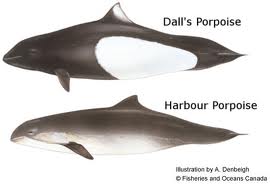
After reading about the sightings of the Harbor Porpoise and Atlantic White-sided Dolphin I am struck again how essential it is for we who live at the edge of the sea to learn all we can about the creatures that dwell along the shoreline and ocean deep. When learning about and identifying plants and animals and trying to distinguish between species, I find it helpful to compare side-by-side pictures. The illustrations posted above don’t however portray accurately the difference in scale. I find graphics, like these found on wiki, come in handy and provide yet another clue in discerning differences.


Harbor Porpoise Phocoena phocoena

Harbor Porpoise (Phocoena phocoena)

Atlantic White-side Dolphin (Lagenorhynchus acutus)Atlantic White-side Dolphin (Lagenorhynchus acutus)

Common Bottlenose Dolphin Tursiops truncatusCommon Bottlenose Dolphin (Tursiops truncatus)

Sea Squirts

Beautiful Industry Monkey Balls

From Joey at Good Morning Gloucester:

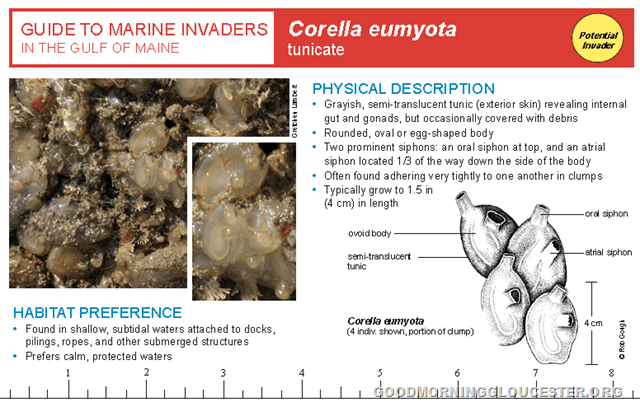
Our fishermen call them Monkey Balls but they are more commonly referred to by marine biologists as “Sea Squirts”. Sea Squirt is a pretty apt description as every time one gets squished they seem to find a way to squirt you right in the eye. I took these photos Saturday morning just as they came out of the water.

See more of Joey’s great photos, an informative and comprehensive series by Kathleen Valentine titled How to Publish Your Book (or Not) and all the good things going on over at Good Morning Gloucester.

Seahorses at the Newport Aquarium

Lined Seahorse (Hippocampus erectus) at the Newport Aquarium of Greater Cincinnati.

Notice the rapidly fluttering dorsal fin and the tiny pectoral fins, which are located above the eyes; seahorses have no caudal fin. Seahorses suck up food through their long snouts, and similarly to chameleons, their eyes can move independently of each other.

Habitat: Atlantic coastal waters from Nova Scotia to Uruguay. Diet: Small shrimp, other small crustacean, plankton, and tiny fish. The female seahorse deposits eggs in the male “brood pouch.” The male carries the eggs until the fry emerge. He expels fully developed miniature seahorses into the water.

“Hippocampus” comes from the Ancient Greek hippos meaning “horse” and kampos meaning “sea monster”.

Beautiful Pale Blue Albino Lobster

Check out the beautiful pale blue lobster landed at Captain Joe and Sons. I also learned how to tell the difference between a male and female lobster. If you want to know about anything and everything that is happening in Gloucester, subscribe to Joe’s fabulous Good Morning Gloucester blog.