Category Archives: #plantandtheywillcome

helllo and thank you!

Dear Friends,

I hope you are doing well. We are all in this together and I just know we will get through these difficult times. I am so proud of my community for the way organizations and individuals are pulling together to help the food insecure, especially The Open Door and Common Crow.

Wildlife stories and dramas continue despite all and I am grateful for that. I’ve only touched very lightly on posting about the amazing fall migration still underway. Look for upcoming stories about a tiny bird with the outsized name, Golden-crowned Kinglet, a pair of sweet Pectoral Sandpipers that stayed for a one-day stopover on their supreme 17,000 -20,000 mile round trip migration, a three woodpecker sighting day, and much more. Aren’t these atmospheric months of September, October, and November wonderful! Stormy weather and high winds sometimes bring not often seen creatures to our shores, only needing a brief respite, before resuming their extraordinary journeys.A male Pectoral Sandpiper – you can see he is a male because males have an inflatable air sac in his chest that he also utilizes to puff out his feathers during mating displays

I don’t think I shared the video about the fabulous four plants for pollinators – The Fab Four Plants for Monarchs (and Bees)! There are still a few Monarchs straggling along, some still even in Ontario. The latest I have ever seen a Monarch in our area was November 4th. It was memorable because it was also the year Barack Obama was first elected president. A note about the Fab Four plants. Common Milkweed can be substituted with Marsh Milkweed, Seaside Goldenrod with Canada Goldenrod or Tall Goldenrod, and Smooth Aster with either New York or Purple-stemmed Asters. The idea is sturdy nectar-rich plants that also provide a convenient landing pad and that bloom late in the season.

I was nominated for the City of Gloucester’s Kindness Campaign by our Ward One City Councilman Scott Memhard, and accepted the award on behalf of our wonderful team of dedicated and kind Plover ambassadors and friends. Please read more here.

November 1st and 2nd are the days Dia de Muertos is celebrated. One of the most evocative locations we were invited to film at during the making of Beauty on the Wing was a small family cemetery in Macheros, a remote village at the base of Cerro Pelon Monarch Butterfly Biosphere Reserve.

Honoring our loved ones with offerings on this beautiful Dia de Muertos.
xxKim

The Fabulous Four Plants for Monarchs (and Bees)!


Plant goldenrods, asters, and milkweeds to provide Monarchs (and as you can see, many other pollinators) all the sustenance they will need during their breeding season and southward migration.

Wildflowers in order of appearance:

Seaside Goldenrod (Solidago sempervirens)

Smooth Aster (Symphyotrichum laeve)

New England Aster (Symphyotrichum novae-angliae)

Common Milkweed (Asclepias syriaca)

Homegrown National Parks Coming to Cape Ann!

What are Homegrown National Parks?   HNP is an exciting movement that raises awareness and urgently inspires EVERYONE to address the biodiversity crisis. How can we as individuals and organizations do this? By adding native plants and removing invasives where we live, work, learn, pray, and play.

We all know that wildlife populations are crashing the world over. The statistics are staggering, with approximately one-third of our breeding birds lost since 1970, or about 3 billion birds, and 40 percent of our insects (bird food!) in the past 40 years. HNP is showing people how we can address this crisis, backyard by backyard.

Sunday evening, Doug Tallamy, the esteemed entomologist, author, and co-founder of Homegrown National Parks, presented “The Power of Plants.” The event was hosted by 400 Trees and the Annisquam Village Church, and was followed the next morning by an informal idea-sharing discussion at our newly renovated gorgeous library. The presentation was rich with imagery and case studies of what can be accomplished in our own backyards, from teeny urban lots to suburban homes to substantial acreage. The group discussion was especially thoughtful and interesting, providing a wonderful opportunity to meet people in our community with similar interests, missions, and goals, Many, many thanks to Peter Lawrence and Sara Remsen for organizing the Tallamy talk and discussion.

Visit the Homegrown National Parks website. It is overflowing with super helpful information to get you started on your native plants journey. You can also listen to several of his excellent talks right there on the website. I have been teaching people how to grow pollinator gardens and documenting the wildlife supported by native trees, shrubs, wildflowers, and ground covers for over twenty years now. Not a day goes by where I don’t observe and learn some new, vital and fascinating information about the beautiful ecosystems created in a native plant’s habitat. When you plant native they will come!

Join the Movement Now!

1. Plant Native

2. Remove Invasives

3. Get on the Map

Where Shall We Start?

Images courtesy Doug Tallamy “The Power of Plants”

Identify the most productive plants. How to find native plants keystone species –

Native Plant Finder from the National Wildlife Federation: go to the following website and type in your zip code for an extensive list of highly valuable native trees, shrubs, wildflowers, and ground covers specifically beneficial to wildlife in your region. https://nativeplantfinder.nwf.org/

I was listening to Doug’s talk via Zoom in my office, which is also Charlotte’s art room. Charlotte is illustrating a book she is working on, all about the history of Gloucester’s monsters. It’s very imaginative and even includes mini side bars of illustrations of the eggs unique to each monster, along with the monster’s baby pictures (Nessie is well-represented). She was also enjoying glancing over at all the fascinating caterpillar images in Doug’s slideshow, when she overheard the expression ‘keystone species.’ She commented, “just like oysters are a keystone species for the ocean.” We had been to the Seacoast Science Center a week earlier where she had learned about the importance of keystone species in an ecosystem. I just thought how wonderful for her to connect the two and how much like mental sponges are these beautiful curious-minded children of the up and coming generation. I surely never learned at eight years old what a keystone species is, but how easy it was for her to understand the concept. If for no other reason, our beautiful children, and our children’s children, are why we simply can not leave to them a barren, diversity-less world.


Seahorses, Bunnies, Sunflowers, and Charlotte

Lucky us that Charlotte and I were able to spend the day together on primary election day, Tuesday. When asked what she wanted to do she instantly said the  Seacoast Science Center, and to visit the bunnies and pick flowers for her Mom’s birthday at my friend Paul Wegzyn’s sunflower farm, Felix’s Family Farm.

As always the Seacoast Science Center was super interesting and educational with its touch tanks, displays about local marine habitats, and highly knowledgeable staff of young biologists. The highlights were seahorse feeding time and when Raspberry, the endangered Box Turtle, was brought out of his pen to sun himself outdoors. The five seahorses currently at the aquarium are Lined Seahorses (Hippocampus erectus) and they can be found all along the Atlantic coast, from Nova Scotia to Uruguay. They are considered a slow moving fish and that is one of the reasons why seahorses are endangered. Because they are relatively easy to catch, Lined Seahorses are also easily exploited for ornamental display, the aquarium trade, and Chinese medicine.

Paul Wegzyn, Sr. and son Paul Wegzyn Felix’s Family Farm

In these last lingering days of summer and first days of autumn, don’t miss taking your family to Paul’s flower fields. The sunflowers currently blooming are a gorgeous fresh new batch and his exquisite dahlia fields are at peak. As you can see in the photos, for Charlotte, the highlight of the day is bunnies. You can never get too much bunny love and all of Paul’s rabbits are sweet, friendly, and wonderfully pet-able. The favorite of the favorites is Ryan the Rabbit, a breed called a Mini Rex, and he is the softest, sweetest creature you can imagine. He was wholly engaged with Charlotte and she was wondering if it is because of her flowered dress.

Felix’s Family Farm is located at 20 Lowes Lane, Ipswich, and is open everyday for the next two weeks, until  September 28th however, as we get closer to October, be sure to call for hours (978-229-1071).

Winged Wonders Migration!

The great North to Central to South American magnificent southward migration of wildlife is fully underway. These beautiful creatures do not see borders, religion, nor ethnicities and bind us together in myriad meaningful ways. As birds are taking to the skies by the hundreds of thousands, we are seeing the beginnings of the Monarch migration as well. During these first weeks of September local meadows and gardens are  graced with newly emerged Monarchs. At this time of year, these recently eclosed butterflies are nicknamed the “Super” Monarchs.

You can see the above Monarch has just emerged from his chrysalis as his wing cells are still a bit crumpled. 

A tell tale sign of a male Super Monarch, also called a Methuselah Monarch, is that they are not at all interested in finding a mate. A male Monarch that is not migrating stops only briefly to nectar. For the most part he ceaselessly patrols the milkweed looking for a female and chases away any other winged pollinator. He has evolved with the main objective of reproducing; whereas a Methuselah Monarch takes its time sucking up nectar and is very tolerant of other butterflies it encounters.

Methuselah Monarchs emerge in a state of sexual immaturity, called diapause. They evolved to drink lots and lots of nectar to build their fat reserves for the long journey south and to sustain them through the winter. This super generation of Monarchs are oftentimes larger but will lose some of their body weight by the time they reach the trans-Mexican volcanic forests

The Monarchs rest through the winter, then will break diapause next spring when they begin their journey north.

To help all of our winged friends during the spectacular southward migration please remember Lights Out for Birds

To learn more about the magnificent Monarch migration see our documentary Beauty on the Wing: Life Story of the Monarch Butterfly streaming on PBS Passport. To arrange a screening and QandA for your organization, please contact me at kimsmithdesigns@hotmail.com or leave a comment in the comment section.

I hope you enjoy these last glowing days of summer,

xxKim

Female (left) and male Monarch Butterflies, Stone Harbor Point NJ

Love, Love Felix’s Family Farm!

Unable are the loved to die, for love is immortality

Paul Wegzyn and his family have created a most magical family friendly farm event. The theme this season is LOVE and beautiful quotes are placed throughout the fields.

Every season Paul develops new and wonderful experiences for people and this year is no exception. If you do, as do we, have a bunny- and goat-loving youngster in your family, they will be utterly delighted with the very pet-able, softest bunnies and sweetest goats around!

He has created a lovely butterfly garden with Mexican Sunflowers, Zinnias, and Cleome and you can PYO all the flowers on the farm, including Paul’s beautiful dahlias.

A new crop of lavender is almost ready to pick as is a freshly opening field of orange sunflowers with dark centers, which I can not wait to see.

Felix’s Family Farm is open everyday from now until about the third week in September, or as long as the flowers last.

Felix’s Family Farm

20 Lowes Lane, Ipswich, MA

978-229-1071

The following is a list of even more activities Felix’s Family Farm has to offer. To learn more, please go here.

  • Baby Goat Yoga
  • Alpaca Yoga
  • Yoga Yurt with a variety of classes and events
  • Luxury Glamping Experience on The Farm
  • The Ability To Host Private Parties and Events
  • Honey From The Farm
  • Professional Cow Photoshoots
  • Picnics on The Farm

Outphloxed by Our Phlox!

Look how lovey our patch of Summer Phlox has grown. I wish I could say it was my genius garden design skills but alas, this is all nature’s doing!

Where this border is growing I originally had only planted the mildew resistant and pure white Phlox paniculata ‘David.’ Some distance away, we planted the striking P. paniculata ‘Bright Eyes,’ a light pink with deep magenta centers and adjacent to ‘Bright Eyes,’ a pretty lavender called ‘Franz Shubert. ‘

Several years have gone by and we now have a patch of volunteers blooming in beautiful shades of pink, lavender, and magenta. I think this may have happened because the plants have cross-pollinated and are allowed to reseed. We don’t deadhead and don’t mulch and that encourages little seedlings to take hold and spread far and wide in our garden.

Phlox paniculata is native to the eastern US and grows in a range of conditions. The location in our garden where it is thriving is partially shaded by the Magnolia grandiflora. This beautiful, beautiful wildflower is also wonderfully fragrant, with a heady floral scent especially potent in the early morning and late in the day. I have on occasion seen Ruby-throated Hummingbirds and Eastern Tiger Swallowtails drinking nectar from the blossoms but mostly the blooms are especially attractive to Bumblebees.

Pollen-dusted Bumblebee

Did I mention that P. paniculata blooms for many weeks??

Plant this native beauty. I promise, you will be delighted for many years to come.

Ruby-throated Hummingbirds, Jewelweed, and Canna Lily

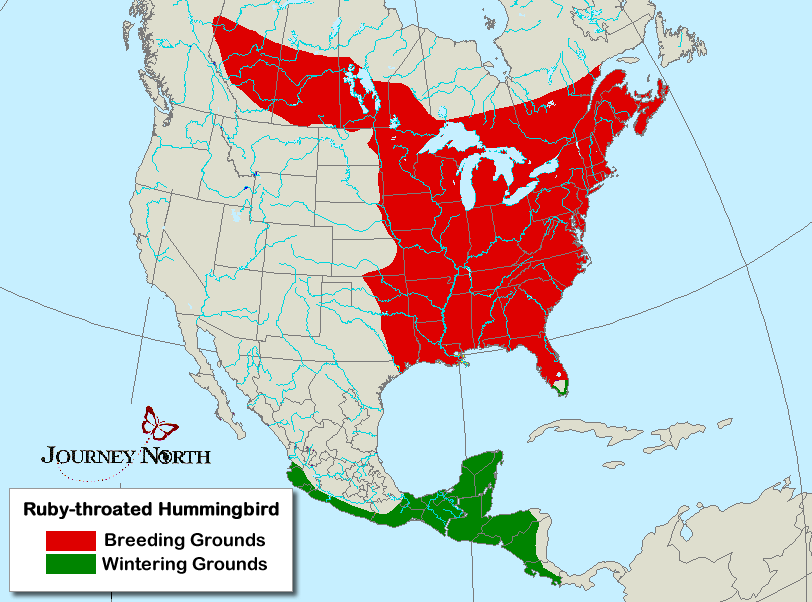
I loved filming Ruby-throated Hummingbirds on the beautiful bold flowering stalks of Canna Lilies (Canna indica) and just as much, I love seeing them drinking nectar from our North American native wildflower Jewelweed (Impatiens capensis). Even though not native to North Ameirca, it makes perfect sense that RTH forage from Canna Lilies as they grow natively in the Tropical Americas, the birds winter home!

Some fun things to know about Jewelweed:

Jewelweed has long been used in Native American medicine. Apply the watery sap topically to relieve itching and pain from Poison Ivy, Stinging Nettle, and hives.

The fruit of Jewelweed is an elongated capsule and at the slightest touch will burst open and send a little seed popper some distance, a fun activity to do with children and adults alike 🙂

You can grow Jewelweed in your native plant’s garden provided it is in a somewhat shaded and somewhat moist location. The Ruby-throated Hummingbirds, bees, and butterflies will thank you!

Ruby-throated Hummingbird Range Map courtesy Journey North

Wing warming

A newly emerged male Monarch warms his wings before take-off.


Finding Monarch Cats in the Garden!

We’ve been graced with Monarchs and fat healthy caterpillars this summer. Please write and let me know if you are seeing Monarchs (or not) in your garden <3

Milkweed is the Bees Knees!

This vibrantly hued milkweed is most commonly known as Butterflyweed (Asclepias tuberosa). Orange Milkweed, Pleurisy Root, Chigger Flower, and Chiggerweed are a few of its other common names.

Butterflyweed blooms in a range of hot colors from buttery yellow to Spanish orange to fire orange red and is a welcome source of nectar for butterflies and bees.

Thank you Miss Ladybug!

In the garden experimenting with my new camera and I came across Ladybugs devouring aphids on our Common Milkweed (Asclepias syriaca) buds.

What a love and we so appreciate your appetite for all things aphids <3


Thoughts About Leaf Blowers and How We Can Possibly Find a Solution Working Together :)

Whether or not to ban gas-powered leaf blowers sure is creating a maelstrom of divisiveness in our communities. Everyone who has an opinion feels strongly, very strongly, that their viewpoint is the correct pov. Let’s think of the pros and cons and perhaps there is a solution. If I missed a pro or con, please feel free to write so we can include your point of view.

PROS of Gas Powered Leaf Blowers

Landscapers and homeowners appreciate the lower cost associated with gas-powered leaf blowers.

GPs are more powerful than electric, saving time and money.

Many landscapers and homeowners already own gas powered blowers.

CONS of Gas Powered Leaf Blowers

Gas powered leaf blowers are very loud particularly when multiple blowers are in use simultaneously.  The noise pollution is disruptive and unpleasant to neighbors.

GP blowers emit a strong odor of gas fumes, harmful to the environment and to the person operating the leaf blower.

Some observations – our home is located in a middle class neighborhood where leaf blowing does not occur regularly, if at all, whether gas or electric. I do however have clients in more affluent neighborhoods where the use of leaf blowers is much more prevalent. People are correct, the noise level is extremely loud. A crew of men, typically Latino, will disembark from company pick-up trucks, with gas powered blowers strapped to their backs and ear phones snugly wrapped over their ears. The crew of half dozen or so will spend a good part of an hour blowing the leaves off a driveway that won’t even be driven on again until the summer resident homeowner returns the following year. Not only does it seem like an utter waste of time, it concerns me that the employees are breathing the fumes. This is also the same crew that I see spraying pesticides around the base of the homeowner’s foundations, also not wearing protective covering. I am wondering if protective masks and clothing can be provided to the employees that are required to use gas-powered leaf blowers and pesticides.

Do homeowners need half a dozen men blowing leaves off driveways and the street in front of their homes? Perhaps with less demand for an immaculate leaf-be-gone landscape, one gentleman wearing a mask, as opposed to six maskless men, could do the work. If a homeowner is having considerable work done and a leaf blower is needed to assist in clean-up, that seems to me like a reasonable use. Or if a pathway is covered with wet leaves creating an unsafe situation for an elderly person, that too seems like a reasonable use.

In my own landscape design firm, I encourage clients and friends not to remove leaves and the expired stalks of flowering plants. To my way of thinking, leaves on lawns and in flower beds is a beautiful thing! Not only are the decaying leaves providing a protective layer and adding nutrients to the soil, leaves also provide habitat for all manner of insects. I think at this point in our shared awareness about the environment, we all understand that insect populations the world over have plummeted.  We homeowners and landscapers can help insect populations by leaving leaf litter in our gardens. The most delightful benefit of a garden that supports insects, is that the insects attract a host of beautiful songbirds that in turn conveniently eat the insects <3

For the benefit of insects, especially native bees, we also do not cut down the expired stalks of flowers until the end of April. In the late summer and early fall, native bees and other insects burrow into the stalks. When we do eventually cut down the stalks, we leave them in a pile for several weeks before discarding, hoping our little pollinator friends have wiggled out of their winter home.

Perhaps if we can change people’s mindsets about what constitutes a healthy landscape, the fashion of blowing leaves will become mush less problematic.

The song of a Carolina Wren chortling from a treetop has to be one of the sweetest songs you can imagine hearing in you garden. They love to rumple about in the leaf litter, foraging for insects. Insects are an important part of a songbird’s diet, especially during the breeding season when the females are producing eggs.

Carolina Wren nest with eggs tucked under our porch eaves – 

Later in the season, a Carolina Wren fledgling is perched on the back fence. She was made fat and healthy from a diet rich in your average garden variety insects – 


Return of the Yellow-bellied Sapsucker(s)!

For well over a year, our garden has been graced with the fascinating Yellow-bellied Sapsucker. The visits began with a male eating Pokeberries in December of 2023 and have continued intermittently through today.

A female was here for a day last week however, we have had so many Cedar Waxwings in the Dragon Lady Holly, they may have frightened her off. For the past three days, a male YBSS has been industriously revitalizing the sap wells created by the female last year. He is also meowing!! That’s right, the appropriately named bird for a cartoon (or a proper insult), makes a crinkly mewing sound!

Listen for the mews-


Photos to Help ID Male, Female, or Juvenile Yellow-bellied Sapsucker

Male YBSS – Red cap and red throat

Female YBSS – note that she does not have a red throat

Juvenile YBSS -softly mottled brown

Male Sapsucker in the rain yesterday


Yellow-bellied Sapsucker Timeline

Summer 2023 – Newly seeded Pokeberry bush grows six feet first summer (most likely the seed was deposited by a bird).

December 2023 – First ever male YBSS. Stays for several days eating Pokeberries.

March – May 2024 –  Female YBSS created striking grid pattern of sap wells on both the Dragon Lady Holly and Magnolia soulangeana trees, concentrating her efforts much more on the Holly. She spends many weeks drinking the sap, digging more wells, and eating insects attracted to the sap flows. Ruby-throated Hummingbirds discover the sap wells.

Summer 2024 – Ruby-throated Hummingbirds daily drink nectar from the small pinkish whiteish flowers of the Pokeweed.

October -November 2024 – Female Yellow-bellied Sapsucker returns. She is drinking nectar and eating insects attracted to the sap wells every day, through November 17th.

November 12, 2024 – Both a juvenile and female at the DLHolly saplicks.

March 26, 2025 – female YBSS at the Holly tree. Flock of Cedar Waxwings may have frightened her off.

April 3rd, 4th, and 5th – Male Yellow-bellied Sapsucker drumming and drilling at the Dragon Lady Holly, crabapple, and Magnolia soulangeana. Mewing frequently.

National Learn About Butterflies Day

In recent years, March 14th has been designated National Learn About Butterflies Day. Butterfly populations, as are many species of insects, plummeting around the globe. Climate change, loss of habitat, and the use of pesticides are at the top of the list as to why we are losing our insects.

What can we do as individuals, and collectively with like-minded friends? I have been writing about the plight of butterflies for nearly 30 years and at the risk of sounding repetitive, the following are easy to follow guidelines:

Refrain from Using ALL Pesticides and Herbicides. 

Do Not Spring Into Spring Cleaning!

For the sake of all pollinators, and many songbirds, do not do a spring garden clean up too early. When is a good time? Wait until your grass is growing tall and needs to be mowed and ideally, apple and pear trees in your area have finished blooming. You can also clean-up some spots and leave others unkempt for an even later season clean-up.

Grow Native and Not Invasively

Plant native species of trees, shrubs, vines, wildflowers, and ground covers. Only plant non-native species (such as tulips and zinnias for example) that do not spread outside the area in which you wish them to grow.

American Copper, Bee, and native aster

Provide Continuous Blooms from Early Spring Through November 1st

Create a landscape that provides nourishment for pollinators and songbirds, from the earliest days of spring though the last hard frost. Include colorful nectar plants and equally as important, grow native larval host plants for butterfly caterpillars.

Although these lovely pink Korean Daisies are not native, they are not invasive and bloom until the first hard frost. They are especially welcome to late migrating scragglers such as the Monarch pictured here.

Plant in Clumps and Drifts  Whenever Possible.

Butterflies and bees love to drink nectar at a buffet where they can flit easily from one floret to the next. Allow perennials to spread into drifts and clumps. Panicle-shaped flower heads (think goldenrods) and aster-type flowers, with their ray flowers conveniently arrayed around a center disk of florets, provide a convenient landing pad onto which butterflies can land while they are sipping nectar.

Monarchs and Seaside Goldenrod

Plant and They Will Come!


Winter Robins in the Neighborhood!

We so look forward to the return each winter of flocks of American Robins and Cedar Waxwings. Currently on our shores we have a mixed flock traveling also with three beautiful Bluebirds and several juvenile Cedar Waxwings!

Juvenile Cedar Waxwing

The Robin photographed here reached on tiptoes to get at the crabapple tree fruit, brandished his wings while almost losing his balance, and then success 🙂 If you have planted your garden with any of the following, including hollies, winterberries, crabapples, Chokecherry, cedars or junipers, you will most definitely be graced with the beautiful winter Robins.

I wrote the following post 10 years ago and it is still very relevant to attracting Robins to your garden –

Birds of New England: The American Robin and Bird Food!

During the winter months Cape Ann often becomes home to large flocks of robins, and we have had the joy of hosting numerous numbers in our garden. I can’t help but notice their arrival. Their shadows descend, crisscrossing the window light, followed by a wild rumpus in the ‘Dragon Lady’ hollies. This pair of hollies is planted on opposing sides of the garden path, alongside my home office. I have learned to stealthily sneak up to a window, as any sudden activity inside startles birds that are investigating our garden, and they quickly disperse. Dining not only on berries of the ‘Dragon Ladies’, but also the ‘Blue Princess’ Meserve holly and winterberry bushes, I find dozens of noisy, hungry robins.

These winter nomads flock to trees and shrubs that hold their fruit through December, January, and February, feasting on red cedar, American holly, Meserve hollies, chokecherries, crabapples, and juniper. Robins traveling along the shores of Cape Ann also comb the shoreline for mollusks, and go belly-deep for fish fry. Depleting their food supply, they move onto the next location. Gardens rife with fruiting shrubs and trees make an ideal destination for our migrating friends.

Winterberry (Ilex verticillata)

Habitat Gardening Tip:

The garden designed to attract nesting pairs of summer resident robins, as well as flocks of winter travelers, would be comprised of trees and shrubs for nest building, plants that bear fruit and berries that are edible during the summer and fall, and plants that bear fruits that persist through the winter months. Suburban gardens and agricultural areas provide the ideal habitat, with open fields and lawns for foraging insects as well as trees and hedgerows in which to build their nests.

The following plants, suggested with robins in mind, will also attract legions of songbirds and Lepidoptera. The list is comprised primarily of indigenous species with a few non-native, but not invasive, plants included.

Trees for nesting ~ American Holly (Ilex opaca), Eastern Red Cedar (Juniperus virginiana), Red Maple (Acer rubrum), Sugar Maple (Acer saccharum), Flowering Dogwood (Cornus florida).

Summer and autumn fruit bearing trees, shrubs and vines for robins ~ Black Cherry (Prunus serotina), Blackberry (Rubus spp.), Flowering Dogwood (Cornus florida), Gray Dogwood (C. racemosa), Red-osier Dogwood (C. sericea), Silky Dogwood (C. amomum), Elderberry (Sambucus canadensis), Apple (Malus pumila), Virginia Rose (Rosa virginiana), Highbush Blueberry (Vaccinium corymbosum), Lowbush Blueberry (Vaccinium angustifolium), Wild Grape (Vitis spp.).

Trees and shrubs with fruits persisting through winter ~ Winterberry (Ilex verticillata), Mountain Ash (Sorbus americana), Crabapple (Malus spp.)Sargent’s Crabapple (Malus sargentii), American Holly (Ilex opaca), Meserve Hollies (Ilex meserveae), Eastern Red Cedar (Juniperus virginiana), Common Juniper (Juniperus communis), Chokecherry (Prunus virginiana), Smooth Sumac (Rhus glabra), Staghorn Sumac (Rhus typhina).

CALLING ALL GARDENERS – MONARCHS NEED OUR HELP!

Please don’t tidy up your garden just yet. The Monarch migration is really lagging compared to other years. The weather has not been cooperating and they have been waiting for the winds to shift from the northwest. Finally, it happened and yesterday and we saw our first signs of the migration with several small passels. The issues are that because the migration is later than normal and because of the drought, many wildflowers have passed peak. In other words, the Monarch migration is out of sync with the blooming time of the most nectar-rich native wildflowers.

Monarchs and Seaside Goldenrods back in September

How can gardeners help? If we must tidy up, please at least wait until the end of the October. Leave your sunflowers, asters, goldenrods, dahlias, verbenas, cosmos, Mexican sunflowers, zinnias, butterfly bushes, and Montauk Daisies in place. Even if they appear a bit unruly, in many instances, the butterflies are still able to extract some nectar.

Monarchs migrating in October need our garden stalwarts, such as Zinnias

Tracking the migration overnight roost population numbers from Journey North, you can see that by October 10th, 2024, so far, the Atlantic Flyway population is way, way down.

The northwest winds are predicted for the next several days. Please write and share any Monarch sightings. Thank you!

Monarch and Mexican Sunflowers – safe travels Monarca!

Blue Jay Caching Acorn!

What a treat to observe the half dozen or so Blue Jays zooming around the garden, caching acorns for the winter.  They’d perch with nut in beak, carefully eyeing  the ground for an ideal spot. Once located, the Jay would swoop down. I didn’t want to move from my perch and risk being noticed so I couldn’t see exactly how they were hiding the acorn but when they resurfaced, no nut!

Some interesting notes about Blue Jays – Research has shown Blue Jays making over 1,000 trips in one day to hide food. They mainly select undamaged nuts that are viable, meaning if the bird does not recover the nut, it will grow. The record a Blue jay traveled to hide food is 2.5 miles. This behavior has greatly helped helped the the range of expansion of oak trees and now over 11 species of oaks are dependent upon Blue Jay dispersal of acorns.  The rapid expansion of oaks after the ice age may be a result of the northern transport of acorns by Blue Jays.


Welcome to the Garden of Dissipating Beauty

The seeds of both Zinnias and Sunflowers are Goldfinch favorites. No dead-heading in this garden!

WOWZA! Doing a Victory Dance for Mama Pipevine!

The stunning Pipevine Swallowtail that you see in the video is depositing a clutch of several dozen eggs. Her gift represents a success for me of sorts. Years ago, we had a Pipevine Swallowtail in our garden, a male, and he was investigating the heart shaped leaves of our Moonvine. I made a promise to the Pipevine Butterflies that the next time they made it this far north, I would have a Pipevine growing in the garden on which a traveling female could deposit her eggs. I can’t resist but to add – not a “pipe dream after all!”

You see, Dutchman’s Pipevine is one of the few caterpillar food plants of the Pipevine Swallowtail that grows well in northern climates. Like the Moonvine, the leaves of the Dutchman’s Pipevine are large and heart-shaped.

A hundred years or so ago, Pipevine Swallowtails regularly occurred in New England because people planted Dutchman’s Pipevine to embower their porches. In one season, the vine can grow two stories high and equally as wide, providing lush green cooling shade on a hot summer afternoon. When you look at old photographs of porches in New England, most often it’s Pipevine climbing up the porch pillars and along the roof. With the advent of air conditioning, folks no longer needed to plant Dutchman’s Pipevine to cool their homes The vine, and the butterflies, were forgotten.

Julia Lane, later Julia Wheeler, posed for Alice M. Curtis on August 12th, 1915, in Gloucester. Photo courtesy Fred Bodin.

Our visiting Mama Pipevine cautiously investigated the entire plant from top to bottom, fluttering in and out of the large leaves before deciding on this tiny tender leaf to deposit her treasure trove. We had a female come to our garden about ten years after the vine was planted. She deposited a clutch of eggs however, a tiny spider ate them all, every single one. I am not taking any chances this time and placed  the stem with the eggs in a terrarium, covering the terrarium with several layers of cheesecloth, and a wire screen, in hopes of keeping the spiders out.

If you would like to attract the exquisite Pipevine Swallowtail to your garden, plant Dutchman’s Pipevine. It’s an enthusiastic grower, but no need to worry, you can cut it all down to the bare ground after the first frost and it will come back just as beautifully and plush the following spring.

From an older post – Plant! and They Will Come

Nearly five years ago, in late September 2007, I photographed a male Pipevine Swallowtail Butterfly (Battus philenor) nectaring in my garden. I found mesmerizing its dark beauty, with black wings punctuated by brilliant orange spots and shimmering iridescence. The wings flashed electric blue in the fading late day sunlight and I became completely captivated!

Although the Pipevine Swallowtail is not rare in its southern range, this exotic looking butterfly is an unusual occurrence in the northeast, and even more rarely found on the eastern outer reaches of Cape Ann. Mine was a stray, carried in on a southerly breeze. I imagined that if a male can drift into our garden, so can a female. And if a visiting female found in my garden her caterpillar food plant, she would deposit her eggs. The following spring we planted the Dutchman’s Pipevine (Aristolochia macrophylla) Read more here

A ZABULOUS ZABULON ENGAGEMENT!

These tiny pretty skippers in our garden were in an amorous way. After much wing shimmering and nudging, the pair flew off together where they were not seen again until later in the day.

I believe they are Zabulon Skippers. I just love saying that name, Zabulon. Doesn’t it sound enchanting? When the wings of the Zabulon Skipper are fully spread, they only measure a mere one to one and a half inches!

Skippers are butterflies in the family Hesperidae and are named for their super quick darting flight habit; when these two were spotted seeming in repose, I turned my zooming camera’s eye to see what would happen next. While vibrating their wings in turns, the male moved in closer and then repeatedly placed his head between her hind wings.


Skippers differ in a number of ways from other families of butterflies. Several ways to tell the difference when out in the field are that skippers have antennae with clubs at the tip that hook backwards, similar to a crochet hook. All other butterflies have knob-like tips to their antennae. Skippers also have stockier, more robust bodies

According to the Massachusetts Butterfly website, Zabulon Skipper caterpillar food plants “include Tridens flava (purpletop) and Eragrostis spp. (lovegrass). They deposit their eggs on a wide variety of grasses in the wild, and its full range of host plants has not been fully investigated, especially in Massachusetts.” The adults nectar from a number of flowering plants; the day they were courting in our garden, the male was drinking nectar from the bell-shaped blue blossoms of our Clematis ‘Betty Corning’ and they were zipping around the Zinnia patch.

Zabulon Skipper – male

Wall of Fragrance

Walking around Niles Pond at this time of year you can’t helped but be knocked out by the fabulous combined scent of the blooming Summersweet (Clethra alnifolia)  and Rosa rugosa. Summersweet, also know as Honeysweet and Sweet Pepperbush, is the large shrub that densely lines both sides of Niles Pond Road. With racemes that look like bottlebrushes, the many florets provide nectar for dozens of species of pollinators, of all sizes. The tiniest winged wonders attracted to the panicles provide sustenance to hummingbirds and I often see them zipping in and out of the Clethra blossoms, too.

The Summersweet shrubs growing so closely together creates a “Wall of Fragrance,” which always reminds me of Phil Spector’s “Wall of Sound,”  where his musical arrangements called for multi tracking multiple instruments, creating “symphonic saturation.” Niles Pond right now is a symphonic saturation of sweet summer scents – GO!

The following is an excerpt from a book that I wrote back in 2004-2007, which was published by David R. Godine in 2009. The book is about designing landscape habitats for wild creatures and for people, titled Oh Garden of Fresh Possibilities: Notes from a Gloucester Garden, and all that I wrote then, still holds true to day.

“Summersweet is a native shrub that bears small white florets held on racemes, and depending on the cultivar may be shaded with varying hues of pink to rose-red. The tapering spires of fragrant blossoms appear in mid to late summer. Clethra has a sweet and spicy though somewhat pungent aroma, and when the summer air is sultry and humid, the fragrance permeates the garden, Summersweet is a nectar food attractive to bees and a wide variety of butterflies, notably the Silver-spotted Skipper.” See more at Oh Garden

Myriad species of bees and butterflies, along with Ruby-throated Hummingbirds, are attracted to Clethra for its sweet nectar, while American Robins, Goldfinches and warblers dine on Summersweet’s ripened berries.

Beach Rose (Rosa rugosa)

Red-spotted Purple and the Brilliant Blue Iridescence Found in Butterfly Wings

Little flashes of blue iridescence flitting through the garden quickly caught my attention.

A number of black butterflies sport blue iridescence in their wing scales, including the Pipevine Swallowtail, female Eastern Black Swallowtail, Red-spotted Purple, and the Spicebush Swallowtail. Which one was gracing our garden today?

The newly emerged beauty was a Red-spotted Purple, which I had not seen for several years! The much tastier (to birds) Red-spotted Purple Butterflies are thought to have evolved to mimic the foul tasting and toxic Pipevine Swallowtail. Red-spotted Purple caterpillars eat non-toxic leaves of Serviceberry, oaks, Black Cherry, aspens, birches, Eastern Cottonwood, and hawthorns, which would make both the caterpillars and adults appetizing to birds. By mimicking the Pipevine Swallowtail, which eats toxic foliage of plants in the genus Aristolochia, the mimics–Red-spotted Purple, Spicebush Swallowtail, and female Eastern Black Swallowtail–find some protection, to a certain degree.

Under wing, or ventral wing pattern

Upper wing, or dorsal, wing pattern

The beautiful blue iridescence in butterfly wings is created from the microscopic ridges, cross-ribs, and other structural layers of the individual scales, which play with light waves to reflect brilliant blues and speckles.

We had just watered the garden and I think the Red-spotted Purple was drinking up droplets of water. Perhaps there was salt or some necessary nutrients in the droplets when mixed with the foliage.

How to Grow Fresh Flowers All Season! (with a take-home plantng guide)

Message from my friend Elise at Cedar Rock Gardens –

Planting a cut flower garden: How to have fresh blooms all season with a take home planting guide.

Hello!

As the season winds down on the seedling side of our business – the field and greenhouse crops really start to ramp up. We are currently harvesting cucumbers, eggplant, kale, chard, cherry tomatoes, jalapeno peppers, many greens, onions, herbs and flowers among other things. I am hoping you are all having success with your gardens also despite the blistering heat we have had lately. Heres to hoping this next forecasted rain will actually amount to something??

Most of you know this already but Tucker and I started Cedar Rock Gardens initially as a cut flower farm back in 2014. We had success in that venture but it slowly turned into what it is today which is a robust seedling operation alongside a diversified vegetable, herb and flower farm. The flowers have not been lost on us though. I still find my creative outlet each week lies happily with the small amount of bouquets I get to make for our wholesale accounts and for my own kitchen table. We were selling cut flowers to the Boston Flower exchange as well as to many florists locally and even dabbled in wedding arrangements for a short time. It was a labor of love for a while and then we decided to move in a different direction to focus on edible crops.

Alas, flowers still have my heart and I am very excited to share my knowledge with you. Join me this Thursday evening at Cedar Rock Gardens for a cut flower course sponsored by Gloucester SaLT. We will cover some tried and true varieties from seed to bouquet visiting on succession planting and planting layout. This course is specifically designed for home gardeners who want to make the most out of limited space. You will be able to take home a plating guide and I will do my best to answer any questions you have. The course is free and I am happily donating my time – if you get something out of it or just feel generous you can donate to SaLT Here.

Please respond to this email if you do plan to attend so I can have a better idea on how much I need to psych myself up to speak to a crowd. I also need a general count for hand-outs.

Currently we are open:
Thursday to Saturday 8 am to 4 pm

Hope you are having a wonderful summer!

We will continue to be set up at the Farmer’s Market at Burnhams Field in Gloucester every Wednesday from 2:30 to 6:30 selling our produce.

All the best,

Elise Smith
CedarRockGardens@gmail.com

Mama Monarchs!

Have you noticed how lush our gardens are this year? Perhaps it’s because we never had a sudden deep, deep freeze this past winter but whatever the reason, the blossoms and growth of flowering and fruiting trees, hydrangeas, roses, lilacs, milkweed, and butterfly bushes (to name a few) haven’t looked this grand in a number of years. And our wildflower meadows are also simply spectacular with blossoms. For the past month while looking after the Plovers, we have been delighted with the rich honey-hay smell wafting down to the beach from the Common Milkweed blooming widely across the dunes.

We’ve had a bunch of Mama Monarchs flitting through our milkweed patches and ovipositing a treasure trove of golden drops over the past several weeks. She gently curls her abdomen, ovipositing one egg at a time, while simultaneously, each egg attaches with a quick drying sticky glue. I was showing a friend how to look for the eggs and she was amazed at how teeny they are. Only about the size of a pinhead, we most often find them on the tender new growth emerging in the center of the plant or on the leaves more towards the top of the plant. Wild Monarchs deposit one egg at a time. You can see in the pairs of photos the egg she deposited after carefully inspecting each leaf.

Monarchs held in captivity in breeding cages and tents are observed dumping quantities of eggs in large clusters (not one at a time) on milkweed plants as they are not free to travel around to investigate foliage. This is one reason why Monarch diseases are on the rise. Captive reared Lepidoptera also diminish genetic diversity, weakening a species. If you would like to raise Monarchs, it is highly recommended by organizations such as Monarch Watch and The Xerces Society to raise in small batches, only ten or so at a time, from eggs collected in your garden, not purchased over the internet and from butterfly farms.