The always elegant lily-flowered tulips, with scented daffodils, from our front dooryard garden 
SPRING BOUQUET
Leave a reply

The always elegant lily-flowered tulips, with scented daffodils, from our front dooryard garden

On the afternoon of 25th, we had just refilled our newest hummingbird feeder when while cooking dinner a little whirr appeared at the window. He made several trips around the garden, alternately sipping sweetened sugar water at the feeders and nectar from the Japanese flowering quince ‘Toyo-nishiki.’ Like clockwork, for the past several years the Ruby-throated Hummingbirds have arrived to our garden in April, while the quince is in bloom.
Hummingbird feeder recipe: To one cup warm water add 1/4 cup pure cane sugar (4 parts to1 part). Dissolve thoroughly. Please don’t put up feeders if you don’t have the time to change the water frequently, and even more frequently in warmer weather.
Over the past few days there has been a burst of Hummingbird sightings coming from around the state. Hang your feeders if you haven’t already done so and remember to change the sugar water often, every few days. Hummingbird feeders are a terrible idea if you are not willing to provide fresh water frequently. Hummingbirds get a fatal fungal infection on their tongue, called hummers candidiasis when folks don’t change the water, or when honey, or any sweetener other than pure white cane sugar is used. And never add red food coloring. The bird’s tongue becomes terribly swollen, they can’t retract it, and without medical attention will starve to death.
 Japanese flowering quince ‘Toyo-nishiki.’
I love this newest feeder and purchased it with Charlotte in mind. It’s positioned at her eye level and suction cupped to the window she likes to stand at to look into the garden. The small feeder was modestly priced and bought at Smiths Hardware in Rockport.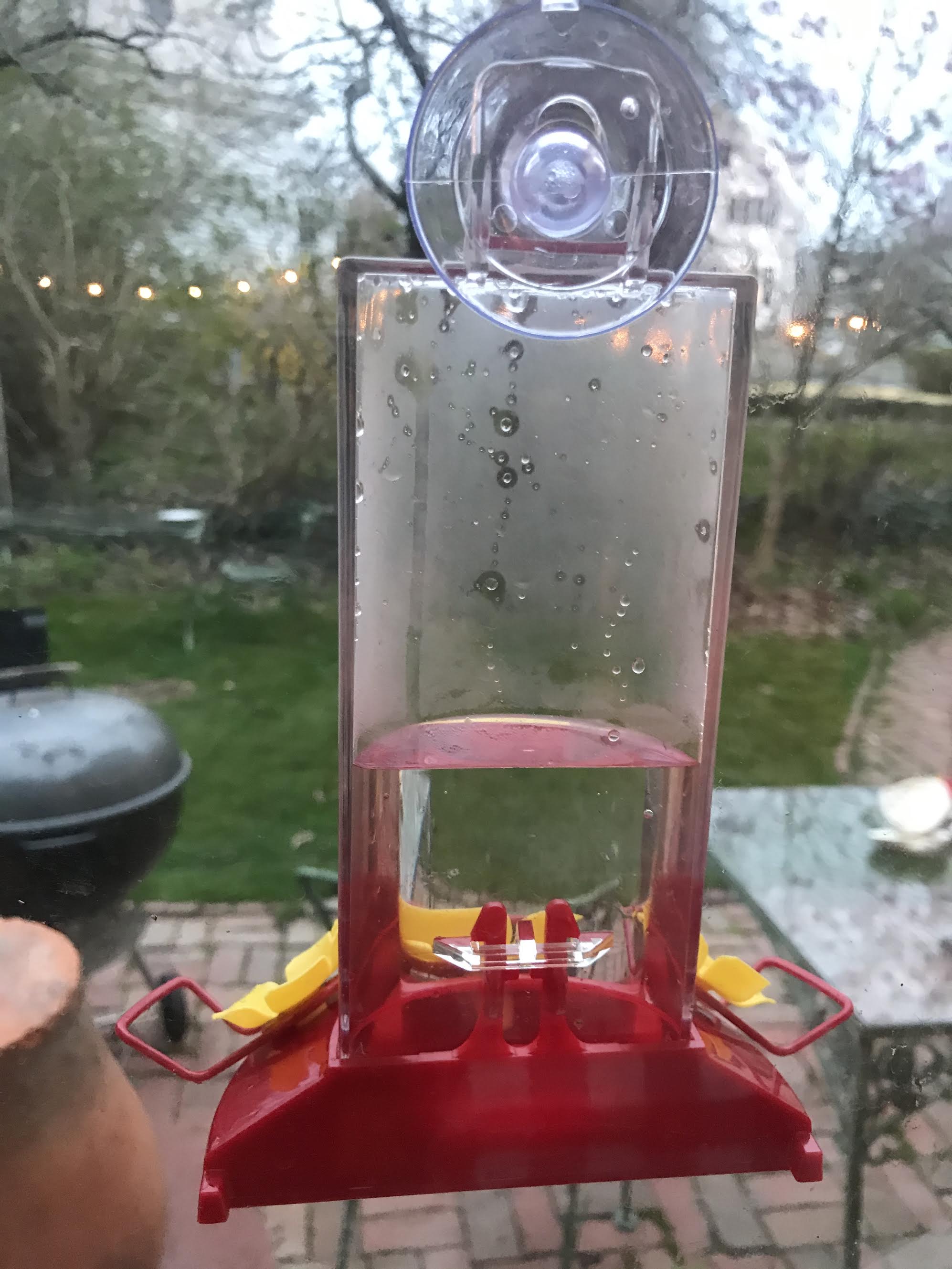
Hummingbird feeders serve the purpose of providing sustenance especially during the time of year when there is a lull in blooms however, the very best gift you can give hummers is to provide their favorite plants, and there are many, including trees, shrubs, vines, perennials and annuals.

Happy Earth Day dear friends!
I hope you are doing well on this blustery morning, with temperatures hovering around 32 degrees and wind chill at 19. I imagined these temperatures were behind us and am worried about that one little PiPl egg. Will it be viable after this cold snap??
This morning in my inbox there was yet another awesome email from Greenbelt, this time featuring Greenbelt’s commitment to conserving farmland, with a short video of the Grant Family Farm at Brown Spring.
Chris Grant was able to purchase the farm at Brown Springs because of Greenbelt’s Land Trust program and great use of West Newbury’s Community Preservation Act funds (CPA). The land can never be developed and will stay a working farm forever through Chris and Greenbelt’s diligent work to put it under an Agricultural Preservation Restriction.
I am so looking forward to visiting the farm stand when open in June! For the latest updates from the Grant Family Farm, visit their Facebook page here and website here.
I can’t mention Greenbelt without giving thanks to Gloucester’s Piping Plover advisor-in-chief Dave Rimmer, director of land stewardship at Greenbelt. Greenbelt does not, nor has ever, requested a fee from the City for their Piping Plover assistance. As you may recall, Dave is also Greenbelt’s Osprey program director – so there you have it, a multitude of reasons for supporting Greenbelt!!
EBSCO and the Law Office of Donald M. Greenough have generously offered to match, dollar for dollar, the first $5,000 raised in celebration of Earth Day.
To learn more about ECGA’s Earth Day fundraising go here.
To become a member of ECGA go here.


 A flock of what has to be one of North America’s most enchanting birds, the Cedar Waxwing, has magically, albeit temporarily, taken residence in our garden and neighbor’s gardens. Their lovely chattering arrival has become an annual event my family looks forward to, especially Charlotte and me.
What have they found to eat that makes them so delighted? Primarily, tiny black insects living on the twigs, stems, and buds of our neighbor’s maple trees. I believe they are Black Bean Aphids, or some type of scale. If you look closely at the photos, in some you can see the bugs. The Waxwings hang every which way pecking and plucking at the insects and have a technique, too, of rubbing their beaks sideways across the bark, which usually results in a tremendous mouthful.
I am overjoyed that our neighbors do not spray their trees with pesticides. By not killing insect pests, a natural balance is restored to the garden. Your gardening pest is a songbird’s dietary mainstay!


About fifteen years ago, the keeper of the historic Gardens at Versailles, Alain Baraton, was beyond dismayed that few if any birds resided in the garden. He ditched pesticides and began promoting native plants. Now nicely plump bugs infest nearly all of the trees, and the songbird’s have returned! Additionally, “Baraton also changed the practice of planting row after row of the same tree. Now Versailles varies the trees — beech, hawthorn, poplar, chestnut — to minimize losses from disease. This is important when your garden has 200,000 trees.”
If the gardener-in-chief of the world’s grandest garden does not use pesticides, I think we need never either.
 Trees at Versailles, image courtesy Google image search

Tip Top Tulips cutting field opens today! SEE MORE HERE


You may recall that I have written a number of times about my friend Paul Wegzyn and his stunning and enchanting School Street Sunflowers. Paul has created another magically enchanted flower experience for the community! This past autumn, Paul, and his Dad Paul, planted several hundred thousand tulips at two different fields.
 Early red tulips in bloom today!
The smaller field at 22 School Street, Ipswich, is opening on Sunday, April 18th. This field is planted for pick-your-own tulips. Charming wicker baskets are provided and the cost is $1.00 per stem.
The second field, named Tip Top Tulips (located at 71 Town Farm Road, Ipswich ), is going to be the show stopper. Rows and rows of beautiful multi-colored tulips, from early flowering varieties to late flowering cultivars will be blooming over the next two months. Tip Top Tulips is scheduled to tentatively open the following week, approximately April 24th, depending on the weather.

The theme this first year for Tip Top Tulips is Love, in honor of Paul’s Mom, and as with School Street Sunflowers, there will be beautiful photo vignettes positioned around the field.

Deanna Gallagher will have her adorable and friendly Shetland Sheep and cows at Tip Top field, providing even more fun and wonderful photo moments for the family. Charlotte had the best time with Deanna and her goats at School Street Sunflowers last summer and I cannot wait to take her to Tip Top Tulips this spring!


If you are looking to be inspired by creatures and colors of the upcoming season, and what to plant to make your garden a welcoming haven for wildlife, please join me tonight at 7pm. I am super excited to be presenting “The Pollinator Garden” for the Mass Pollinator Network. Because it is a Keynote presentation, I was able to add and collage many more photos. The presentation looks great and is chock full of ideas for your pollinator paradise. I hope to see you there!

Opening for the season:
April 14th, 2021!
Starting April 14th, we will be open for you to come shop the nursery for all the early spring – cold weather seedlings.
We have posted all the Flower, Herb and Vegetable varieties we are growing this year on our website for you to check out and get excited for!
We will be opening this season for you to come shop the nursery in person. We will be adhering to Covid safe policies with social distancing requirements while shopping. Please wear a mask while shopping with us at this time.
We will not be doing online orders the same way this season. We are however offering a few “Garden Kits” of pre-selected plant varieties that you can pre-order for pick up when we open. These kits are a basic collection of easy to grow varieties that are great for the early season garden and are also great for a beginner garden. These kits are not customizable – if you would like to pick your own plants or have certain varieties in mind please come shop with us during business hours.
If you can not shop in person due to health concerns please call or email and we will happily facilitate you. We will not be accepting pre orders, all orders must be for plants that are currently available.
-Thank you for understanding

Mark your Calendars: Warm Weather seedlings will begin to be available
May 12th!
This includes Tomatoes, Peppers, Eggplant, basil, loads of flowers and so much more!

Beautiful Robins in the garden this afternoon, filling their bellies with Winterberry, holly berries, and blueberries. I often get the sense that birds know when the weather is going to take a turn for the worse.


Posting a bunch of photos for my friend Paul’s Mom, Debbie Wegzyn. Paul, and his Dad Paul, own and operate School Street Sunflowers. I love photographing at their fields, not only because the fields and all the wildlife attracted to the fields are beautiful but because Paul and his Dad love sharing the beauty of the fields with their community.
The photos were taken in September and October. The hay was being harvested and the winter cover crop planted. Most of the sunflowers had been cut down to plant rye, but Paul left several rows standing. The sunflower seed heads were Mecca for every songbird in the neighborhood, including a beautiful flock of Red-winged Blackbirds, Goldfinches, Song Sparrows, Bobolinks, and Blue Jays.


Today, October 19th, our website will be open for ordering farm fresh produce and some sweet treats from Mayflour Confections. Orders must be in by Tuesday, October 20th @ 10 pm.
We’ll be assembling everyone’s order during the day Wednesday, then opening pick-ups on Thursday between 2 PM and 6 PM
We will be adding more produce and variety as it becomes available each week.
We are open for produce orders to be placed online and picked up curbside (Farm side). We have some wonderful items from Iron Ox Farm listed also and a wonderful sweet treat from Mayflour Confections. Check out our produce page here https://cedarrockgardens.com/fresh-produce
Please be wearing a mask when you arrive to pick up your order. Come to the farm, park in the designated parking area and walk to the big red barn to pick up your order. We will be opening our website for produce orders throughout the season and will alert you to such in these emails. We look forward to seeing you soon!

 Smiling Sunflowers – Paul W of School Street Sunflowers and local kids have been having fun with the sunflower seed heads.


Life at the Edge of the Sea – Cedar Waxwing Baby Masked Bandits
 For over a month I have been filming a flock of Cedar Waxwings. Exquisitely beautiful creatures, with their combination of soft buffy and brilliantly punctuated wing patterning, along with graceful agility, it’s been easy to fall in love with these birds and they have become a bit of an obsession.
I filmed some wonderful scenes and will share the photos and story as soon as there is time but in the meantime I wanted to share these photos of a juvenile Cedar Waxwing so you know what to look for. Waxwings are often found high up in the treetops. They are most easily seen on limbs bare of leaves. Their repetitious soft trilling song gives them away and if you learn the sound you will begin to see Cedar Waxwings everywhere. They have an extended breeding period in our region and because it is so late in the season, this juvenile may be one of a second brood.
While I was shooting for my short short story, the Waxwing flock was mostly on the ground in a wildflower patch devouring insects. Cedar Waxwings are more typically berry-eating frugivores. During the spring and summer they add insects to their diet and I think it may have to do with keeping the hatchling’s bellies filled. It wasn’t until they moved back up into the treetops that this little guy began appearing amongst the flock. He has the same masked face, but the breast is softly streaked. You can see the yellow feathers tips beginning to grow in.
 Juvenile Cedar Waxwing
 Adult Cedar Waxwing

 Migrating Monarchs and Seaside Goldenrod
So often I hear folks blaming goldenrod as the source of their allergy suffering, when they really mean to say ragweed. The three species of goldenrod that we most often see in our coastal north of Boston fields, meadows, woodland edges, and dunes are Seaside Goldenrod (Solidago sempervirens), Tall Goldenrod (Solidago altissima), and Canada Goldenrod (Solidago canadensis). All three have beautiful yellow flowers, Seaside blooming a bit after Canada and Tall, and all are fabulous pollinator plants, providing nectar for bees, butterflies, and migrating Monarchs.
In our region, we most often encounter Common Ragweed (Ambrosia artemisifolia), with Plain Jane tiny green flowers and raggedy looking foliage. Goldenrods and ragweeds both bloom at roughly the same time of year, in mid- to late-summer, but why is ragweed the culprit and goldenrods are not? The colorful showy flowers of goldenrods are attractive to pollinators and they are both insect and wind pollinated. The drops of goldenrod pollen are too large to fall far from the plant. Ragweed’s tiny flowers are not of interest to most pollinators and the plant has evolved to rely on the wind to disperse its pollen from plant to plant. Ragweed produces massive amounts of teeny, breathable pollen to travel widely on the wind.
 Cedar Waxwing foraging in weed patch with Common Ragweed
Although many of us are fortunate not to be bothered by ragweed, I completely empathize with friends who are. If it is any consolation, I recently learned two good uses for Common Ragweed. Shetland sheep love to eat it and it is good for their wool. And I have been following a flock of Cedar Waxwings for over a month. I often see in the morning the Waxwings descend on patches of mixed weeds, mostly Common Ragweed. Waxwings change their diet in summer to include insects and I think the birds are attracted to the plant for the host of insects it supports. So next time you are ragging on ragweed remember, it is a native plant and it does support a community of insects and birds.


 School Street Sunflowers has once again added a wonderful element to their ever expanding ideas about creating a joyfully fun nature experience for visitors. Paul has added three baby Belted Galloway cows and three of the sweetest, most friendly Shetland sheep imaginable. Our bright and curious three year old granddaughter Charlotte was thoroughly engaged with both the sheep and the baby cows but it was Deanna Gallagher’s adorable and super child friendly Shetland sheep that stole our hearts.
We have met the kindest people at School Street Sunflowers and Charlotte and I were completely taken with Deanna, owner of a flock of nine Shetland sheep. Her farm is just around the corner from School Street Sunflowers. Her three sheep that are currently at Paul’s sunflower field are Detective Jimmy Perez, Abu, and Alistair. Jimmy is the leader of the herd, funny, smart, and outgoing, and he is famous in Ipswich as an “escape mastermind. ” You can read about his most recent escapade here: Smart and determined, sheep on the lam knew exactly what they were doing
Shetland sheep are smaller than what you may typically think of as a sheep, more goat like in size. Deanna’s sheep love to be stroked and hand fed the weeds growing in and amongst the sunflowers, especially Common Ragweed. This is the second time over the past week I have learned of or seen Ragweed used in a great way. The first was earlier when I watched a flock of Cedar Waxwings hungrily descend on a patch of Ragweed, looking for tiny insects to devour.
When you go – the baby cows are at the field all day; the Shetland sheep are on the premises from approximately 9am to 1pm. The sunflower trail is one way, which is great for avoiding mashups on the pathway during the pandemic. Paul and his staff all wear masks, so please wear your mask as well. This year, the tractors are not available for playing on because they would need to be disinfected after each use. There are picnic tables and wonderful vignettes for family photos.
Website: www.schoolstreetsunflowers.com
Facebook: https://www.facebook.com/schoolstreetsunflowers
Instagram: https://www.instagram.com/schoolstreetsunflowers


Nature rarer uses yellow
Than another hue;
Saves she all of that for sunsets,—
Prodigal of blue,
Spending scarlet like a woman,
Yellow she affords
Only scantly and selectly,
Like a lover’s words.
Emily Dickinson
 Paul Wegzyn is the genius behind School Street Sunflowers
 With Paul’s Dad, Paul.
Sunflowers, freshly cut each morning, are for sale. Only $10.00 a half dozen and they last a very good long while.
When you go -the sunflower trail is one way, which is great for avoiding mashups on the trail during the pandemic. Paul and his staff all wear masks, so please wear your mask as well. This year, the tractors are not available for playing on because they would need to be disinfected after each use. There are picnic tables and wonderful vignettes for family photos. I went with three year old Charlotte on a sunny morning and she led the way through the winding trail. Last year, Charlotte only ventured a few feet into the field; this year it was “COMEON, hurry up Mimi!”
 Live in the Sunshine, Swim the Sea, Drink the Wild Air – Ralph Waldo Emerson
Website: www.schoolstreetsunflowers.com
Facebook: https://www.facebook.com/schoolstreetsunflowers
Instagram: https://www.instagram.com/schoolstreetsunflowers
 Live music with Paul’s friend and first year Berkeley College of Music student, Jade Hua

Sunflowers are heliotropic when they are young. By the time they mature, sunflowers generally face toward the East throughout the day. The scientific name for Common Sunflowers is Helianthus annus – helios for resembling the sun, anthos for flower, and annus for yearly.


By Kim Smith
Startled! is an apt description of the reaction most gardeners experience when first they encounter a clearwing moth. Hovering while nectaring, with wings whirring rapidly and audibly, is it a miniature hummingbird, enormous furry bee, flying lobster, or mutant new world creature? Hummingbird Clearwing Moth (Hemaris thysbe) nectaring at Verbena bonariensis
The family Sphingidae are easily identified in both their adult and caterpillar forms. The medium-to-large-sized sphinx, or hawk, moths have characteristic robust, chunky bodies tapering to a point, and slender wings, which are adapted for rapid and sustained flight. Often mistaken for hummingbirds, the Hummingbird Clearwing Moth (Hemaris thysbe), with green tufted body and ruby colored scales, suggesting the male hummingbird, and the Snowberry Clearwing Moth (Hemaris diffinis), with the gold and black striped color pattern similar to that of a fat bumble bee, mimic both the bees and birds they fly with during the day. The ability of certain Sphingids to hover in mid air while nectaring is unusual in nectar feeders and has evolved in only three species: Sphingids, bats, and hummingbirds. Sphinx moths also do an exceptionally unusual movement called swing-hovering,’ swinging from side to side while hovering, it is thought, in an effort to escape predators lying in wait amongst the flora.
 Snowberry Clearwing Moth (Hemaris diffinis), nectaring at Buddleia
Sphinx moths are grouped together because their caterpillars hold their head and thorax erect in a sphinx-like fashion. Most larvae have a horn protruding from their last segment. For this reason, they are often called hornworms. The adult sphinx moth is a powerful flier and usually has a long proboscis suitable for tubular-shaped flowers with a deep calyx, such as trumpet vine. The slender wings must beat rapidly to support their heavy bodies. The names of many sphinx or hawk moth species correlate to their caterpillar host plant, to name but a few examples: Catalpa Sphinx, Huckleberry Sphinx, Paw Paw Sphinx, Cherry Sphinx, and Elm Sphinx.
The order Lepidoptera is comprised of butterflies, moths and skippers. The name is derived from the Greek lepidos for scales and ptera for wings. Their scaled wings distinguish them as a group from all other insects. Shortly after the Hummingbird and Snowberry Clearwings emerge from their cocoons, they immediately begin to shed their wing scales, hence the common name clearwing moth. While nectaring, moths receive a dusting of pollen as they brush against the pollen-bearing anthers. Their fuzzy, fur-like scale-covered bodies are an excellent transporter of pollen. Because moths are on the wing primarily at night, moth-pollinated flowers are often white and pale, pastel-hued and tend to be sweetly scented. White flowers are more easily distinguished in the evening light, whereas colorful flowers disappear. Adult clearwing moths are diurnal (day flying) and nectar at a variety of flowers. In our garden, they are most often spotted at our native Phlox ‘David,’ bee balm (Monarda didyma), purple-top Verbena bonariensis, and butterfly bushes with blue and white flowers. The larvae of Hummingbird Clearwings feed primarily on viburnum, honeysuckle, and snowberry (all Caprifoliaceae), and less commonly on hawthorn, cherry, and plum (Rosaceae). Snowberry larvae feed on honeysuckle and snowberry.
 Hummingbird Clearwing Moth nectaring at native Phlox paniculata ‘David’
(Click photo to see full size image)
For the most part, Sphinx moths are on the wing at night, although the beautiful White-lined Sphinx (Hyles lineata) is often seen at dusk. The forward wings are dark olive brown streaked with white. The hind wings are black with a vivid band of rose-pink. Found throughout North America, both larvae and adults are consummate generalists. The caterpillars feed on the foliage of apple trees, four-o’clocks, evening primrose, elm, grape, and tomato. The adults nectar at a wide variety of flowers including larkspur, gaura, columbine, petunia, moonflower, lilac, bouncing bet, clover, Jimson weed, and thistle. White-lined Sphinxes are drawn to lights and those that remain in the garden the next morning are quite subdued, and may come to your finger.
Snowberry Clearwing
Orchids often have a symbiotic relation to very specific sphinx moths. The starry white, six-petalled Comet Orchid (the French common name, “Etoile de Madagascar” means “Star of Madagascar”) produces nectar at the bottom of an extremely long corolla, nearly a foot in length. Star of Madagascar (Angraecum sesquipedale) was predicted by Charles Darwin to have a highly specialized moth pollinator with a proboscis at least that long. “Angraecum sesquipedale has nectaries eleven and a half inches long, with only the lower half filled with very sweet nectar…it is, however, surprising, that any insect should be able to reach the nectar: our English sphinxes have probosces as long as their bodies; but in Madagascar there must be moths with probosces capable of extension to a length of between ten and twelve inches!” (Darwin). The giant hawk moth Xanthopan morganii praedicta (“the predicted one”) was named appropriately upon its discovery, after Darwin’s death.
Etoile de Madagascar and Hawk Moth Xanthopan morganii praedicta
Image courtesy wiki commons media
Co-evolution, the specialized biological embrace of two species, bears both benefits and risks. Each partner benefits in that no energy is wasted on finding ways to reproduce. The risk lies in becoming too dependent on a single species. If one half of the co-evolved partnership perishes, the other will surely become extinct as well.
This article was first published on August 3, 2011 and was subsequently republished by the New England Wildflower Society.

In thinking about where have all the butterflies gone, I am reminded of the poignant song written by Pete Seeger “Where Have All the Flowers Gone,” which although a song about the futility of war, sums up much about the environmental impact of habitat loss. Without wildflower habitat, there will be no pollinators of any sort.
Where have all the flowers gone?
Long time passing
Where have all the flowers gone?
Long time ago.
Buckeye and Seaside Goldenrod
Where have all the butterflies gone? Different species of butterfly populations fluctuate from year to year. For example, some years you may see far greater numbers of Buckeyes, the next year not so much. That same year you may hardly see any Tiger Swallowtails but will the following.
That being said,, everyone must realize that every year there are fewer butterflies than the year before. Butterflies thrive in meadows, the very same topography that is the easiest to build upon. Every time a new house or shopping mall is built on a meadow, we decrease not just butterfly habitat, but a whole community of wildlife habitat.
 In the above photo you can see a Monarch with a Black Swallowtail flying overhead. This stunning patch of wildflowers and nectar plants was sited in Gloucester at a prime spot for Monarchs to rest and refuel after migrating across Massachusetts Bay. The new home owners ripped out most of the wildflowers and planted the site in a more formal style, with non-native perennials and shrubs. At this location, I would often see Monarchs, Tiger Swallowtails, Black Swallowtails, Painted and American Ladies, Sulphurs, and many other species. That is no longer true.
 Tiger Swallowtail drinking nectar from Joe Pye-weed at the same wildflower patch, no longer in existence.
Butterfly and bee populations are declining overall, not only because of habitat loss, but because of the unbridled use of herbicides and pesticides in agriculture and home lawn care.
Butterflies are especially sensitive to fluctuations in weather, and also to overall climate change. This year we had a long, cold wet spring. The inclement weather is continuing, too, from a butterflies perspective, because although we are seeing some warmer temperatures the past few days, it has mostly been rainy, foggy, or overcast. Butterflies thrive during long stretches of sunny, hot weather. Their wings don’t work very well in the damp and cold. Because of global climate change, we have seen a seven percent increase in precipitation worldwide.
One of the best years I have ever seen for dozens and dozens of species of butterflies, including Monarchs, in the Northeast, was the summer and fall of 2012. That year, we had a warm winter followed by a warm spring, then a warm, dry summer, and a long, warm Indian summer. It was butterfly bonanza that summer and autumn! Adding to people’s concern is the fact that last year, there was an abundance of spring rain that in turn created an extraordinary wildflower bloom in Texas, which got all the butterflies off to a good start. In 2019, we were seeing Monarchs as early as early June, which was very unusual for Cape Ann. Folks are comparing this year to that of 2019, however, 2019 was not an average year.
Monarchs are a case unto themselves. Their spring and summer numbers depend upon a variety of additional conditions, including how successful was the previous year’s autumn migration, whether or not there were nectar providing wildflowers on their northward and southward migrations, and wind and weather conditions from Canada to Mexico.
 Note the bar graph in that the eastern population of the Monarchs plummeted by half, according to this year’s spring count by the World Wildlife Fund Mexico.
Particularly in the northeast, the wind patterns during the Monarchs spring northward migration matter tremendously. My friend Charmaine at Point Pelee, in southern Ontario, which is 49 degrees latitude (we are 43 degrees latitude) has been raising and releasing Monarchs for over a month now, while most of us on Cape Ann have only seen a smattering. The Monarchs moved this year in a straight northward trajectory. If the wind does not blow from west to east during some part of their northward migration, far fewer will end up along the eastern shores. Monarchs and Seaside Goldenrod
All is not lost. I am 90 percent certain we will soon be seeing some of our migratory and non-migratory local populations, we just need some good weather. They are later than usual, but not gone entirely.
For so many more reasons, I am hopeful for the future of wildlife and their habitats and see such tremendous, positive change. Despite the current administration’ s extremely harmful stance against the environment, many, many individuals and organizations are gaining a deeper appreciation about the importance of habitats and taking positive action. Many have made it their life’s work. These individuals and organizations are creating wildlife sanctuaries and conserving existing habitats. If the Monarch is declared an endangered species, that will surely bring an added awarenesses and increased federal spending for protecting and creating habitats.
How can you help the Monarchs, which in turn will help myriad species of other butterflies and pollinators? Plant wildflowers! Both Marsh and Common Milkweed for their northward migration, and lots of nectar-rich later summer blooming wildflowers for their southward migration, including New England Aster, Smooth Aster, Purple-stemmed Aster, Seaside Goldenrod, and Canada Goldenrod. Monarchs and New England Aster

Did you know that there are over two hundred species of milkweed (Asclepias) found around the world? Seventy different species are native to North America.
Milkweeds, as most know, are the host plant for Monarch Butterflies. A host plant is another way of saying caterpillar food plant.
Monarchs deposit eggs on milkweed plants. Some milkweeds are more productive than other species. For the Northeast region, the most productive milkweed is Common Milkweed (Asclepias syriaca). The second most productive is *Marsh Milkweed (Asclepias incarnata). What is meant by productive? When given a choice, the females choose these plants over other species of milkweed and the caterpillars have the greatest success rate. In our own butterfly garden and at at my client’s habitat gardens, I grow both side-by-side. The females flit from one plant to the next, freely depositing eggs on both species.
This fun chart shows some of the most common species of milkweeds found in North America. *Swamp Milkweed is another common name for Marsh Milkweed.

Uggh, it’s tough. Get the vaccine if you can. I had tried several times but it was never in stock and then I would lose track. Today is the first day trying to go without the pain medication. Practically anything is better than feeling ditzy all the time. It’s worse at the end of the day.
I’ve been home so much this spring and don’t usually get to enjoy our roses. Charlotte and I have been loving sitting in her tent having tea parties and reading storybooks and you can smell the roses while we are reading, it’s really so sweet <3 


Singing the praises of Cape Ann’s winged aerialists
Families are invited to join some of our favorite local naturalists and authors — John Nelson, Kim Smith and Martin Ray — for a fun hour talking about the many birds and natural habitats found on Cape Ann. Wildlife biologist Eric Hutchins will moderate this-one hour conversation.
Zoom in this coming Friday, June 19, at 6:30 p.m. for an hour of fun as you celebrate the long-awaited summer solstice. See and hear birds, ask questions, learn some birdwatching tips and discover ways to document your bird sightings using your camera, notebook, blog or sketch pad.
This event is brought to you by Literary Cape Ann, a nonprofit group that provides information and events that support and reinforce the value and importance of the literary arts. LCA commemorates Toad Hall bookstore’s 45 years of service on Cape Ann. LCA’s generous sponsors include: SUN Engineering in Danvers, Bach Builders in Gloucester and The Institution for Savings.
Use this link next Friday:
https://us02web.zoom.us/j/81423552319?pwd=VU5LU21Ga09wVE5QYWpsRnlhRCtFUT09
Order books by our guest authors at The Bookstore of Gloucester. For those interested, bird books make great Father’s Day gifts. Further down in this newsletter, you’ll find lots of great information about books and birdwatching organizations.
Thank you, Kim Smith and Martin Ray, for providing us with some of your beautiful photography to help promote this event. And thank you, John Nelson, for the annotated lists of books and birding organizations.
Meet our panel!
|
|
|
|
|
|

Cedar Rock Gardens retail shop is now open. Tucker and Elise have created a super safe shopping experience. All customers and employees wear masks.  Elise’s parents, Juile and Jim Jilson, are lending a helping hand during the pandemic.
 The checkout area is protected by plexiglass.
Cedar Rock Gardens is located in West Gloucester at 299 Concord Street.


Although Monarchs have been sited as far north as 46 degrees, it is still very early for us even though we are at 43 degrees latitude because we are so far east. Please write if you see one in your garden. And feel free to send a photo. I will post photos here. Thank you so much!
Keep your eyes peeled, especially on emerging milkweed shoots. In the photos below, Monarchs are drinking nectar from, depositing eggs on, and also mating on the milkweed plants. Common Milkweed (Asclepias syriaca) and Marsh Milkweed (Asclepias incarnata) are the two most productive milkweeds for the Northeast region.


Not only are the blossoms enormous and stunning, the sweetly delicious fragrance of a single Rock’s Tree Peony will fill an entire room with its potent scent. Our Rock’s Peony has taken quite a few years to become happily established because unfortunately it had to transplanted awhile back. At last, our treasured beauty is throwing us more than one or two blooms a year. This spring we have had Five!


Timelapse Sunrise Twin Lighthouses at Thacher Island
To clarify about My Blog. Several friends have written with confused questions re my blog. I have been writing, filming, designing, photographing, and painting all my life. I started my own blog long before I began contributing to a local community blog. I both wrote and illustrated a book on garden design, Oh Garden of Fresh Possibilities!, which was published by David R. Godine, and have written many articles for numerous publications including a weekly column on habitat gardening. Here is a link to my blog and to my book, Oh Garden of Fresh Possibilities! Notes from a Gloucester Garden.
Baltimore Orioles arrive when the pears and crabapples come into bloom in our garden. Great idea for an Oriole feeder from friend Robin!
Shadblow (Amelanchier canadensis) question from Morgan Faulds Pike
Caffe Sicilia reopening May 20, Wednesday. What are you going to order?
Castaways Vintage Cafe
Piping Plover Smackdowns
Still no threatened/endangered species signage. Please write to your councilor.


 Piping Plover Smackdown


