Category Archives: Good News!

HAPPY NEWS TO SHARE -TWO PIPING PLOVER EGGS AT GOOD HARBOR BEACH AND THANK YOU ONCE AGAIN DAVE RIMMER AND GREENBELT FOR YOUR KIND ASSISTANCE!

Oh Happy Day! Our amazing Mom and Dad Plover have done it once again. Despite raging wave and wind storms that brought super high tides all the way to the base of the dunes, along with cold wet weather, we have a nest with two beautiful eggs!!!

The pair nesting at area #3 are our original Mom and Dad; the two have nested in nearly exactly the same spot for six years. They are super experienced parents and because it is not too late in the season and if all goes well, the chicks will be approximately 2 to 3 weeks old by July 4th, which will increase their odds of surviving exponentially.

Over the course of the next several days, we hope the pair will lay two more eggs. They will continue to mate during the egg laying period. Please do not hover by the edges of the roped off area; this only serves to disrupt the Plovers reproductive behavior and attracts gulls and crows. Thank you!This morning Dave Rimmer, Essex County Greenbelt’s director of land stewardship, along with his assistant Adam Phippen, placed the wire exclosure around the nest. Encircling the nest with an exclosure is a simple, yet extremely effective way to help protect eggs from predators, including gulls, crows, and small mammals such as skunks and foxes. The spacing between the wires of the exclosure is just large enough for PiPl parents to run in and out, but too small for most other creatures.

Papa feigning a broken wig

I was so proud of our Papa Plover during the installation. After six years of nesting at GHB, he’s familiar with the routine, but installing the exclosure is still a dramatic event for a Plover parent. Papa piped vigorously and valiantly did his broken wing display, trying  with all his tiny self to distract. At one point he fearlessly stood right next to Dave!

Within less than sixty seconds of Dave and Adam walking away from the completed installation, Papa was back on the nest!

We owe tremendous thanks to Dave and to Greenbelt. This is the sixth year in a row he and his Greenbelt crew have installed the exclosures and provided expert advice and assistance to the City of Gloucester and Piping Plover Ambassadors. Greenbelt gives this assistance absolutely free of charge!

Would you like to volunteer to be a Piping Plover Ambassador? The shifts are one hour long, seven days a week, for approximately five weeks, from the day the chicks hatch til they fledge completely. We have a great team of Ambassadors and would love to have you join. Please email me at kimsmithdesigns@hotmail.com if you would like to volunteer. We are looking for people to commit to cover the 1 to 2pm, 2 to 3pm, and 3 to 4pm shifts. Thank you 🙂

Papa Plover back on the nest in record time!


BEAUTY ON THE WING WINS ENVIRONMENTAL AWARD!

We are overjoyed to share Beauty on the Wing: Life Story of the Monarch Butterfly wins an environmental award at the Toronto International Women Film Festival!

Last week we were accepted to the Montreal Independent Film Festival. It’s very meaningful to me that audiences in Toronto and Montreal are finding Beauty relevant as southeastern Canada is an important breeding area for the Monarchs.

I hope so much you will consider making a tax-deductible donation. We are seeking $51,000.00 to cover the cost of distribution and only have a few short months to raise the funds. We are looking for underwriters and donors for the next phase, to distribute Beauty to a national public television audience. All contributions, large and small, will be listed on the film’s website and on American Public Television’s website. For more information, please go here:

SUPER, SUPER, SUPER EXCITING NEWS FOR BEAUTY ON THE WING -COMING TO YOUR LIVING ROOM! AND PLEASE CONSIDER A TAX DEDUCTIBLE DONATION

DONATE HERE

Underwriters, those donating substantial sums, will be featured at the beginning and end of the film. For more information about underwriting, please email me at kimsmithdesigns@hotmail.com

Thursday I am super excited to be presenting Beauty on the Wing to the Spanish students at O’Maley Innovation Middle School. This program was organized by Heidi Wakeman. I plan to do more of these screenings and QandAs with young people and will let you know how it goes!

SUPER, SUPER, SUPER EXCITING NEWS FOR BEAUTY ON THE WING -COMING TO YOUR LIVING ROOM! AND PLEASE CONSIDER A TAX DEDUCTIBLE DONATION

Dear Monarch Friends!

I have the most wonderful, exciting news to share. Our documentary Beauty on the Wing: Life Story of the Monarch Butterfly has been accepted for distribution by the American Public Television Exchange market, which means that within the year, you will be watching Beauty from your living room, on your local public television station!

American Public Television Exchange is the largest source of free programming to US public television stations, covering virtually every market in the country (nearly 350 stations). APT writes that they expect the documentary “to engage and delight public television viewers of all ages who are interested in nature, conservation, and our planet’s amazing ecosystems.”

What happens next? Beauty on the Wing needs underwriters and donors! The total distribution cost to bring the documentary to public television is just over $51,000.00. We only have several months to raise the funds. Please consider donating to the distribution of Beauty through my tax deductible online fundraiser at Network for Good. The link is here.

If you have donated previously to the fundraiser for the post-productions costs, I am so grateful for your generosity. Because of your kind contribution, Beauty on the Wing is doing exceptionally well at film festivals and has received a number of awards. If the distribution phase of the project is of interest, please consider a second donation.

Film screenings and awards to date include:

Winner Best Documentary  Boston International Kid’s Film Festival

Winner Best Feature Film Providence International Children’s Film Festival

Environment Award Toronto International Women Film Festival

Outstanding Excellence Nature Without Borders Documentary Film Festival

Outstanding Excellence Women’s International Film Festival

New Haven Documentary Film Festival

Montreal Independent Film Festival

Flicker’s Rhode Island International Film Festival

Docs Without Borders International Film Festival

The names of supporters contributing $10,000.00 and over will be promoted in the film’s underwriting credit pod. What does it mean to be an underwriter? As an example, when you watch a show on public television and the announcer says, “This show was brought to you by Katherine and Charles Cassidy, by The Fairweather Foundation, by Lillian B. Anderson, and by The Arnhold Family, in Memory of Clarisse Arnhold,” that’s where your name, or the name of your foundation, will appear. APT allows for up to 30 seconds per film and your name or promo will appear at both the beginning and at the end of the film.

Please write and let me know if you would like more information about underwriting, including a complete budget, along with APT’s underwriting guidelines. Email at kimsmithdesigns@hotmail.com.

All donors, no matter how large or small the donation, will be listed on the film’s website and on APT’s website. Any amount contributed is tremendously appreciated!

Thank you for being part of launching Beauty on the Wing: Life Story of the Monarch Butterfly onto the national television stage!

With gratitude,

Kim

A brief overview of the film – Beauty on the Wing: Life Story of the Monarch Butterfly is a 56-minute narrated documentary film that takes place along the shores of Cape Ann and in the heart of Mexico’s forested volcanic mountains. Filmed in Gloucester, Massachusetts and the Monarch Butterfly Biosphere Reserves at Estado de México and Michoacán, the film illuminates how two regions, separated by thousands of miles, are ecologically interconnected. See more at monarchbutterflyfilm.com

PIPING PLOVER UPDATE FROM GLORIOUS GOOD HARBOR BEACH – AND ADDRESSING SENIOR SKIP DAY

There appear to be two pairs of Piping Plovers at Good Harbor however, after another week of super highs tides, powerful winds and heavy rain, our Piping Plover nest scrapes have all but disappeared. Saturday afternoon all four were foraging in the outgoing tide. Two are our original pair, a third is a bossy territorial male, and the fourth wasn’t on the scene long enough to tell. Late Sunday afternoon found all four huddled together behind mini hummocks and divots escaping the whipping wind.

The highest tide of the spring (on the night of April 16), the one that brought in the heap of ghost fishing gear to GHB and a dead Minke Whale to Folly Cove, went straight away up to the base of the dune.  That tide washed away all active nest scrapes.

Storm tide night of April 16th brought ghost gear to GHB and a Minke Whale to Folly Cove

The high tide on the night of April 29th , although not quite as high as the tide two weeks earlier in April, again washed away all active nest scrapes. Hopefully, the Good Harbor Beach Piping Plovers will catch some better weather in May!

Note- the above update was written Sunday evening. On this mild Monday morning, I found Mama and Papa back to courting and nest scraping! 

At several of the other beaches that I am filming at, the nests and scrapes have not been disturbed by the tides. Here you can see this beautiful nest with three eggs as it was thankfully spared.

Senior Skip Days This past week there was reportedly a tremendous gathering of kids on Good Harbor Beach, for senior skip day. Thursday morning I was on the beach when about twenty or so arrived. We had several friendly conversations. They are good kids and were there simply to enjoy a fun day with their friends, something that we did not see much of last year because of the pandemic.

I was not in the least concerned for the safety of the Plovers. Because of the super high tides and as of this writing, there are currently no nests scrapes, no nests, and no chicks on the beach. Adult Plovers fly away if a person gets too close.

Later that afternoon, after reading the reports of hundreds of kids trashing the beach I stopped by again at GHB. There were again only about twenty kids. It had become so unpleasantly windy I didn’t stay long and can’t imagine the kids stayed much later. The following morning after another high tide there was only a smattering of cans and bottles half buried in the sand. I have to say, we see much, much worse harmful plastic pollution and garbage left behind on the beach by adults and families, especially after sporting events and parties, and of course, there is the ever present dog poop in plastic.

Party remnants after kid’s senior skip day – not great but we’ve all seen much, much worse…

such as the adult’s dog poop mess left at Wingaersheek Beach, May 1, 2021 

Our community has done a fantastic job in restricting pets from GHB, beginning April 1st, which makes the beach safer and cleaner for all. Joe Lucido and the Gloucester DPW are amazing in installing the symbolic roping to coincide with the Plovers arrival. These actions are the two most essential in helping Piping Plovers get off to a good start.

We are still in the midst of a global pandemic. So many of us have been isolated from our friends and family for many, many months. There will be tens of thousands of visitors to our shores this summer enjoying summer fun. People flock to Good Harbor Beach because they recognize it is a very special place. From daybreak til day’s end, everything about Good Harbor Beach is magnificent! The way the tides and wind change the landscape daily, the most glorious sunrises and rosy pink sunsets, views of the Twin Lighthouses, families strolling, sunbathing, surfing, kite flying, picnicking, volleyball playing, hikes to Salt Island, swimming (especially kids in the tidal creek!), dunes teaming with life, and the wild creatures attracted.

Once the chicks hatch, Plover Ambassadors will be on the beach throughout the day offering insights about the Plovers. I know we can all be tolerant and respectful towards each other and the wild creatures that find safe harbor at Good Harbor. I think it’s going to be a fantastic summer!

Piping Plover Ambassadors 2020

HUMMINGBIRDS HAVE ARRIVED IN MASSACHUSETTS!

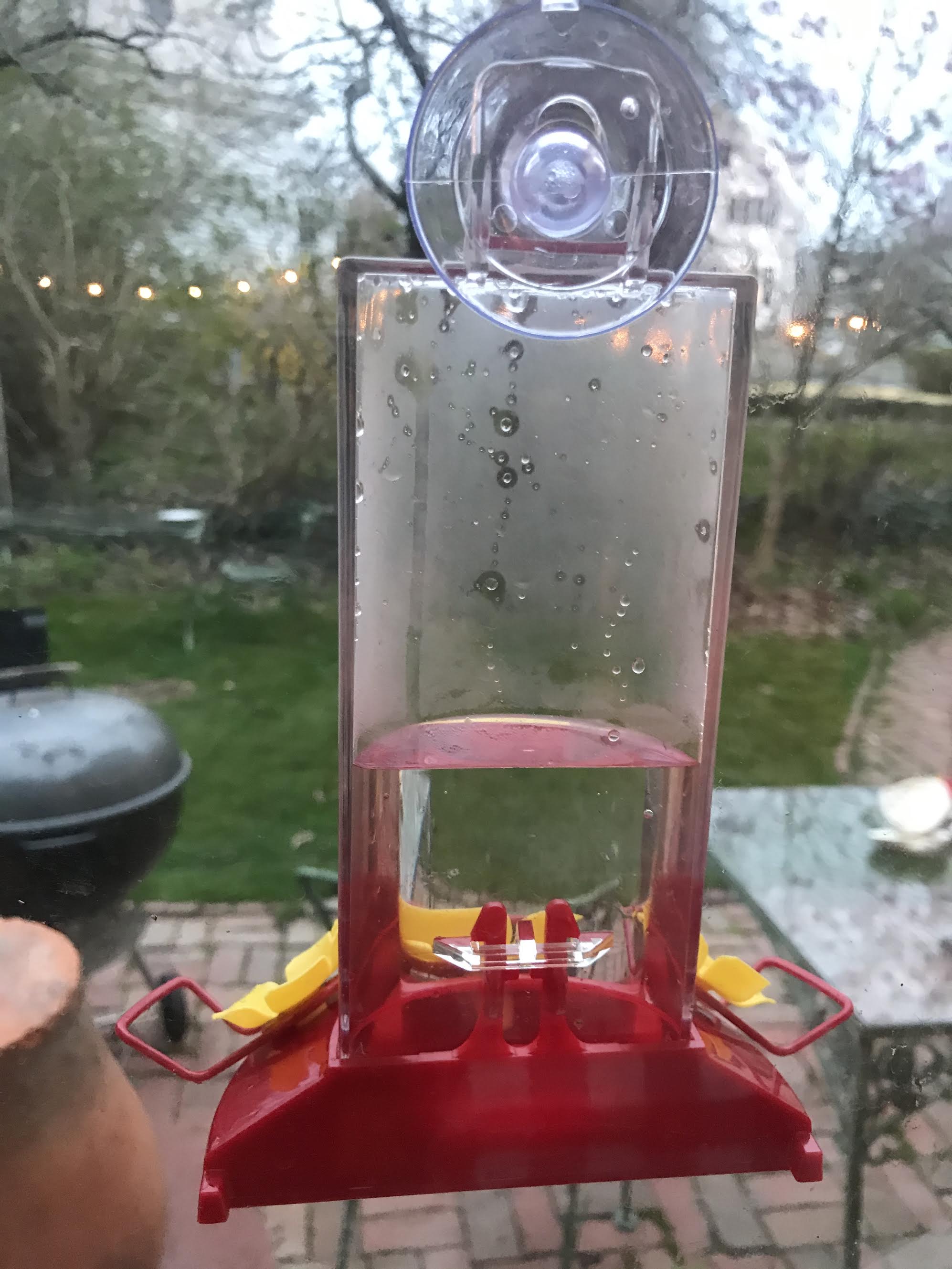
On the afternoon of 25th, we had just refilled our newest hummingbird feeder when while cooking dinner a little whirr appeared at the window. He made several trips around the garden, alternately sipping sweetened sugar water at the feeders and nectar from the Japanese flowering quince ‘Toyo-nishiki.’  Like clockwork, for the past several years the Ruby-throated Hummingbirds have arrived to our garden in April, while the quince is in bloom.

Hummingbird feeder recipe: To one cup warm water add 1/4 cup pure cane sugar (4 parts to1 part). Dissolve thoroughly. Please don’t put up feeders if you don’t have the time to change the water frequently, and even more frequently in warmer weather.

Over the past few days there has been a burst of Hummingbird sightings coming from around the state. Hang your feeders if you haven’t already done so and remember to change the sugar water often, every few days. Hummingbird feeders are a terrible idea if you are not willing to provide fresh water frequently. Hummingbirds get a fatal fungal infection on their tongue, called hummers candidiasis when folks don’t change the water, or when honey, or any sweetener other than pure white cane sugar is used. And never add red food coloring. The bird’s tongue becomes terribly swollen, they can’t retract it, and without medical attention will starve to death.

Japanese flowering quince ‘Toyo-nishiki.’

I love this newest feeder and purchased it with Charlotte in mind. It’s positioned at her eye level and suction cupped to the window she likes to stand at to look into the garden. The small feeder was modestly priced and bought at Smiths Hardware in Rockport.

Hummingbird feeders serve the purpose of providing sustenance especially during the time of year when there is a lull in blooms however, the very best gift you can give hummers is to provide their favorite plants, and there are many, including trees, shrubs, vines, perennials and annuals.

HOW TO ATTRACT HUMMINGBIRDS (AND KEEP THEM COMING) TO YOUR GARDEN

https://vimeo.com/281869646

PIPL WEEKLY UPDATE AND HOW TO TELL THE DIFFERENCE BETWEEN A SANDERLING AND A PIPING PLOVER

Earlier in the week, our PiPl pair were zooming  up and down the beach nest scraping hither and thither. They appear to be a bit calmer the past few days. Perhaps they are settling on a nesting location?? Wouldn’t that be wonderful!

Dad taking a much needed siesta

Our hope is Mom and Dad will have an early nest, which will give their babies the greatest chance of surviving. A second family of Plovers that I am documenting this year has laid their second egg. This pair arrived in Massachusetts the same day as did our GHB pair. It will be interesting to compare and contrast as the season progresses.

Please note – The eggs pictured are NOT at Good Harbor Beach, just making sure everyone understand this 🙂

Sanderlings are migrating northward and there are many currently foraging along our local beaches. Folks often confuse Sanderlings with Piping Plovers. The above sanderling is in non-breeding plumage, with somewhat similar coloring to Piping Plovers. You can faintly see some of the rusty breeding plumage coming in. Sanderlings have much longer bills and both bills and legs are black.Piping Plovers in breeding plumage have stout, orange bills that are tipped black, striking black collar and neck bands, a yellow orange ring around the eye, and orangish legs. As the PiPls plumage fades later in the season, from a distance especially it can be hard for people to to tell the two apart.

Sanderlings foraging

PIPING PLOVER STORMY WEATHER WEEKLY UPDATE

Dear Friends of Cape Ann’s Plovers,

Again this past week, our dynamic duo has been busily bonding, nest scraping, and mating up and down the full length of the beach. However, the extremely high tide that rose to the base of the dunes washed out the pair’s nest scrapes and temporarily put the kibosh on all things romantic. The two disappeared for a full day after the storm departed, with no spottings anywhere, not even tell tale PiPl tracks.

Super high tide through the spray zone

My heart always skips a beat after a day or two of no “eyes on the PiPls,” but I am happy to report Mom and Dad are back to the business of beginning a new family, seemingly unfazed. The storm and super high tide left in its wake lots of great bits of dried seaweed and sea grass which will in turn attract tons of insects, one of the PiPls dietary mainstays. There is a silver lining to every storm cloud 🙂

Just a friendly reminder if you would please, if you see the PiPls at the edge of the symbolic rope line or foraging in the tide pools, please do not hover. Hovering will distract the Plovers and delay courtship. And hovering attracts gulls and crows to the scene. Step back at least 50 to 60 feet and give them some space. Bring binoculars or a strong lens if you would like to observe the PiPls from a comfortable distance, comfortable to them that is. Thank you much!

Take care and Happy Spring!

xxKim

Mom’s also dig out the nest scrapes

High stepping Dad, courting Mom

Nest scrape

Dad taking a moment to preen after courting


EARLY SIGNS OF BEAUTIFUL SPRING SURROUND

Blessedly warmer weather has made it all that much more enjoyable to spend time outdoors. Beautiful birds are arriving on our shores, some to rest and refuel for their journey further north and some will call Cape Ann home for the spring and summer nesting season.

Gadwall

A lone Gadwall, along with several American Wigeons, are hungrily consuming great quantities of sea lettuce to feast upon before embarking on the next leg of their migration. Black-crowned Night Herons flew in over the weekend, the Killdeers arrived over week ago, and the American Pipits have returned.

Killdeer

Black-crowned Night Herons

Resident Cardinals and Song Sparrows are chortling from the tip tops of budding Pussy Willows and Bluebirds are moving into their nesting boxes and tree holes. The woods are alive with rat-a-tat-tat, rat-a-tat-tat – Downy, Red-bellied, and Northern Flicker are drumming their woodpecker rhythms.

Crocuses, squill, fiddleheads, and snow bulbs- the Snowdrops and Snow Glories -are poking through slowly awakening soil. My friend DB wrote to say she noticed a Mourning Cloak butterfly over the weekend. Mourning Cloaks are typically the earliest butterflies on the wing because they winter over as adults, safely tucked in the cracks and crevices of tree bark. Mourning Cloaks generally do not drink nectar but feed on tree sap in the spring and rotting fruit in autumn. The females will soon be depositing their eggs on leaves of deciduous trees including hackberry, willow, elm, poplar, rose, birch, aspen, cottonwood, and mulberry.

Oh Happy Spring!

“BEAUTY ON THE WING: LIFE STORY OF THE MONARCH BUTTERFLY” WINS BEST FEATURE FILM AT THE PROVIDENCE CHILDREN’S FILM FESTIVAL!

Dear Friends,

I am overjoyed to share that Beauty on the Wing received the Best Feature Film award at the Providence Children’s Film Festival. Thank you friends for voting!  I am so appreciative of your ongoing support. Thank you for taking the time to watch and to vote. 

It is not easy to host a film festival during the pandemic. Without doubt, it takes enormous amounts of work and professionalism. Festival organizer Eric Bilodeau created a fantastic event, and managed to do all with grace and a wonderful sense of humor. I looked forward to Eric’s communications, for instance, when he requested stills from the film, I sent a batch of photos. He wrote back, did I have anything more colorful? I was taken aback at first before realizing he was kidding. And when he announced Beauty had won, writing -“the Monarch is King!” I think I will use that in the future 🙂

I was able to view many of the films and they were wonderfully interesting and inspiring. I am so proud Beauty on the Wing was a part of the Providence Children’s Film Festival! This was mentioned previously but two of my favorites were Microplastic Madness and The Last Lightkeepers. I hope you have a chance to see if you haven’t already done so.

Thank you so very much again for your kind support.

Take care and stay well.

Warmest wishes,
Kim

GOOD MORNING! BROUGHT TO YOU BY GOOD HARBOR BEACH GLORIOUS PAINT BOX SUNRISE

Today, February 5th, 2021

HAPPY NEWS TO SHARE FOR BEAUTY ON THE WING

Dear Friends,

I hope you are well and staying safe. The happiest of news is that a vaccine is on the way. I am praying with all my heart that you all stay healthy between now and when we will be protected by the vaccine’s herd immunity.

On a lighter note, I am delighted to share that Beauty on the Wing received an Outstanding Excellence award from the Nature Without Border’s Film Festival, and even more excited to share that we are an official selection to the Providence Children’s Film Festival. The Providence Children’s Film Festival takes place in mid-February (I don’t yet have the dates to share). The best news is that the film is geo-blocked to Rhode Island, Connecticut, and Massachusetts, which means film friends in Massachusetts will be able to participate in the screening. More information to follow, as soon as the schedule is made public.

I am overjoyed that Beauty on the Wing is finding acceptance at both children’s and conservation festivals; that jurors see it as it was meant to be, a conservation film for people of all ages.

A request for help from my graphic design readers/photoshop experts -does anyone know how to remove a background from a .png file. The laurels that the Providence Children’s Film Festival sent over have a white background and I need to turn it into a transparent background to add to the film’s poster. The other laurels sent from other festivals had a transparent background, which I was able to easily add to the poster. Thank you if you have any tips on how to do this <3

Edited note – many, many thanks to Linda Bouchard from Snow Harbor Graphics for removing the background!!

Take care dear Friends and stay well. Happy Holidays in this hardest of times. Better days are sure to come.


“BEAUTY ON THE WING” AWARDED BEST DOCUMENTARY AT THE BOSTON INTERNATIONAL KIDS FILM FESTIVAL

Dear Friends,

I hope you are doing well. Just a quick note to let you know that the awards for the Boston International Kids Film Festival were announced today and Beauty on the Wing was given Best Documentary. Simply overjoyed !! 🙂

The festival went very, very well. The organizers, Laura Azevedo and Natalia Morgan from Filmmakers Collaborative, working with WGBH, did an extraordinary and outstanding job producing an online film festival, no easy feat, but especially during a global pandemic! I was able to view many of the films and they were wonderfully entertaining and inspiring. I am so proud Beauty on the Wing was a part of the BIKFF 2020!

Wishing you a Happy Thanksgiving, wherever that may be during these most challenging of days.

Warmest wishes,
Kim

Boston International Kids Film Festival 2020

Best Documentary
Winner: Beauty on the Wing: The Life Story of the Monarch Butterfly

Best Foreign Language Film
Winner: Kapaemahu

Best Animated Short Film
Winner: The Magical Forest and the Things

Best Live Action Short Film
Winner: Esme Gets a Job.

The Peggy Charren Award for Excellence
Winner: All American Kids

Best Student Narrative Film
Winner: First Dances! What Could Possibly Go Wrong?

Best Student Documentary Film
Winner: DACAmented

New short, with clips from Beauty on the WingMonarch Dreams 2, “Afternoon at Saties.,” by Jesse Cook.

TONIGHT FIRST LOCAL ZOOM FILM SCREENING OF BEAUTY ON THE WING!

Tonight I am presenting a Zoom screening/presentation of Beauty on the Wing to a private group. The screening was scheduled a year ago, before covid, and was planed to be live. The organizers have been super throughout the planning changes. This is the first time doing a screening not through a film festival and I am on pins and needles. I hope they love the film and that there are no technical glitches! If all goes well, I would love to do more of these and will let you know. <3

For information on how to see Beauty on the Wing via WGHB and the Boston International Kids Film Festival on Saturday, November 21st, please follow this link here.


HOPE IS THE THING WITH FEATHERS – VOTE FOR PIPING PLOVER PROTECTIONS!

Look for a surprising number of chicks in this clip 🙂

Baby chicks need safe habitat. Please share and Vote the Blue Wave to continue protections afforded under the Endangered Species Act.


“Hope” is the thing with feathers –

That perches in the soul –

And sings the tune without the words –

And never stops – at all –

And sweetest – in the Gale – is heard –

And sore must be the storm –

That could abash the little Bird

That kept so many warm –

I’ve heard it in the chillest land –

And on the strangest Sea –

Yet – never – in Extremity,

It asked a crumb – of me.

 -Emily Dickinson


VOTE FOR BUTTERFLIES!

For all our winged wonders,

For the birds, the butterflies, the bees,

And mostly

For the future of the littlest human wonders that we so cherish.

Excerpt from Beauty on the Wing: Life Story of the Monarch Butterfly

Music by Jesse Cook “Fields of Blue.”

VOTE the Blue Wave –

Vote for Science

Vote for the Environment

Vote for Racial Justice

Vote for a Woman’s Right to Choose

Vote for Wildlife

Vote for an Economy that Works for All

Vote for Fiscal Responsibility

Vote to End Voter Suppression

Vote to Educate All

Vote for Jobs

Vote for Infrastructure

Butterflies for Biden!


MONARCH BUTTERFLY MIGRATION ALERT FOR CAPE ANN, NEWBURY, IPSWICH, PLUM ISLAND!

Monarchs are currently migrating, albeit in small numbers, throughout the North Shore. The butterflies arrived several days ago and because of the rainy weather, they are in a holding pattern. When the sun reappears, look for Monarchs on any still-blooming  garden favorites such as zinnias, as well as wildflowers. Please send an email or comment in the comment section if you see Monarchs in your garden or while outdoors over the weekend and upcoming week. Thank you!

Many species of asters and goldenrods have finished flowering; instead the Monarchs are fortifying for the long journey by drinking nectar at Black Mustard flowers, and even Dandelions.

Although not native to North America, Black Mustard (Brassica nigra) is beneficial to bees and butterflies for late season sustenance. Don’t you love its lemony golden beauty in the autumn sunlight?

Black Mustard is not the easiest nor most efficient plant for Monarchs to draw nectar from. I never see the butterflies on Black Mustard unless it is very late in the migration and there are few other choices available.

The ray flowers of asters provide a convenient landing pad for butterflies. Panicle-shaped flowering plant, such as goldenrods, also provide a convenient landing pad while supplying a smorgasbord of nectar rich florets. Black Mustard provides neither. You can see in several photos in an upcoming post that the Monarchs are nectaring with their legs gripped tightly around the base of the flower.

Black Mustard is an annual plant native to Eurasia and North Africa. Cultivated widely as a condiment, medicinally, and vegetable, it came to North America via the early colonists. The plant is in bloom from May through October, or until the first hard frost, and grows well in disturbed man-made sites.

Black Mustard is a member of the Brassicaceae, also classically called the Cruciferae (Latin, meaning ‘cross-bearing’) in reference to its four ‘crossed petals’, which is commonly known as the mustard family. Black Mustard is related to cabbage, broccoli, Brussel sprouts, kohlrabi, kale, turnips, and watercress.

Good News to Share!

Dear Friends of Beauty on the Wing,

I hope you are all doing well and fortunate enough to have good health.

After a brief cold snap we are having a beautiful Indian Summer here on Cape Ann. I hope you have the opportunity to get outdoors today and enjoy nature. Bird and butterfly migrations are well underway. At Parker River National Wildlife Refuge, rangers shared that they have never seen a migration such as this year’s, with over 180 species sited at the refuge this past week. The birds appear to have benefitted from decreased human activity over the past seven months. On the other hand, the Atlantic Coast Monarch migration seems stalled or nonexistent. Perhaps we will have a late, great migration as we did several years ago. And there are some positive signs for the butterflies, especially through the Mississippi Flyway as Monarch Waystations further north, such as the one at Point Pelee have been reporting that the Monarch migration is doing well. I’ve seen Monarchs migrating through Cape Ann in good numbers as late as the second week of October, so we’ll be ever hopeful.

Good news to share -the page for Beauty on the Wing is up on American Public Television World Wide! Here is the link, including information with a link on how to license Beauty. The page looks great and the line-up of films, stellar. We are so honored to be included in this fine catalogue of Science, Health, and Nature Programming!

And more super good news to share – Beauty on the Wing has been accepted to the Boston International Kids Film Festival! This is an outstanding festival for kids, by kids, and about kids and is organized by a dynamic group of women: Laura Azevedo, Kathleen Shugrue, and Natalia Morgan. A complete list of films for the 2020 BIKFF will be posted in the upcoming days, along with information on how the festival will be organized for safe viewing during the pandemic.

I have been following (or become enchanted is a more accurate description) a small flock of Bobolinks. Click here to read a story posted on my website: Bobolinks Amongst the Sunflowers. While reading about Bobolinks, I came across a link to The Bobolink Project, a truly worthwhile organization. The Bobolink Project habitat conservation plan not only helps Bobolinks, but many species of declining grassland birds.

The sun is coming out and the temperature still summery. Stay well and enjoy the day!

Warmest wishes,
Kim

BABY CEDAR WAXWINGS IN THE HOOD!

Life at the Edge of the Sea – Cedar Waxwing Baby Masked Bandits

For over a month I have been filming a flock of Cedar Waxwings. Exquisitely beautiful creatures, with their combination of soft buffy and brilliantly punctuated wing patterning, along with graceful agility, it’s been easy to fall in love with these birds and they have become a bit of an obsession. 

I filmed some wonderful scenes and will share the photos and story as soon as there is time but in the meantime I wanted to share these photos of a juvenile Cedar Waxwing so you know what to look for. Waxwings are often found high up in the treetops. They are most easily seen on limbs bare of leaves. Their repetitious soft trilling song gives them away and if you learn the sound you will begin to see Cedar Waxwings everywhere. They have an extended breeding period in our region and because it is so late in the season, this juvenile may be one of a second brood.

While I was shooting for my short short story, the Waxwing flock was mostly on the ground in a wildflower patch devouring insects. Cedar Waxwings are more typically berry-eating frugivores. During the spring and summer they add insects to their diet and I think it may have to do with keeping the hatchling’s bellies filled. It wasn’t until they moved back up into the treetops that this little guy began appearing amongst the flock. He has the same masked face, but the breast is softly streaked. You can see the yellow feathers tips beginning to grow in.

Juvenile Cedar Waxwing

Adult Cedar Waxwing

TREMENDOUS NEWS!!! Court Overturns Trump Administration Policy That Sharply Curtailed Protections for Migratory Birds

Just a few of the species of wildlife found on Cape Ann that are protected under the Migratory Bird Treat Act of 1918!

From the Center for Biological Diversity

NEW YORK— A federal court today overturned a Trump administration reinterpretation of the Migratory Bird Treaty Act that had upended decades of enforcement and let industry polluters entirely off the hook for killing birds.

The administration argued the law only applied to intentional killing of birds and not “incidental” killing from industrial activities, including oil spills, electrocutions on power lines, development and other activities that kill millions of birds every year.

The reinterpretation was first put in place in December 2017 through a legal opinion authored by the Solicitor of the Department of the Interior and former Koch Industries employee, Daniel Jorjani. This opinion was already allowing birds to be killed across the country.

Citing “To Kill a Mockingbird,” U.S. District Court Judge Valerie Caproni wrote that “if the Department of the Interior has its way, many mockingbirds and other migratory birds that delight people and support ecosystems throughout the country will be killed without legal consequence.”

In rejecting the Jorjani opinion, the court noted that the Migratory Bird Treaty Act makes it unlawful to kill birds “by any means whatever or in any manner” — thus the administration’s interpretation could not be squared with the plain language of the statute.

Had the Trump administration’s policy been in place at the time of the Deepwater Horizon oil spill in 2010, for example, British Petroleum would have avoided paying more than $100 million in fines to support wetland and migratory bird conservation to compensate for more than a million birds the accident was estimated to have killed.

The policy was put in place over objections from Canada, a co-signer of the treaty that led to the law. Scientists now estimate North American birds have declined by 29% overall since 1970, amounting to roughly 3 billion fewer birds.

Since the Jorjani opinion, snowy owls and other raptors have been electrocuted by perching on uninsulated power lines in Delaware, Maryland, Tennessee and North Dakota – with no consequences for the responsible utilities. Oil spills in Massachusetts, Idaho and Washington, all of which caused the subsequent deaths of many birds, did not prompt any penalties. Landscapers in San Diego were reported to have thrown live mourning dove chicks into a tree shredder, prompting a U.S. Fish and Wildlife Services agent to go undercover to investigate. But the case was closed with no action taken due to the changed policy.

“The Trump administration’s policy was nothing more than a cruel, bird-killing gift to polluters and we’re elated it has been vacated,” said Noah Greenwald, endangered species director at the Center for Biological Diversity. “Birds are in real trouble across the United States. We must do everything we can to ensure they continue to brighten our skies and sing to us in the morning, for which they ask nothing in return.”

“The court’s decision is a ringing victory for conservationists who have fought to sustain the historical interpretation of the Migratory Bird Treaty Act to protect migratory birds from industrial harms,” said Jamie Rappaport Clark, president and CEO of Defenders of Wildlife. “The Department of the Interior’s wrong-head reinterpretation would have left the fate of more than 1,000 species of birds in the hands of industry. At a time when our nation’s migratory birds are under escalating threats, we should be creating a reasonable permit program to ensure effective conservation and compliance, rather than stripping needed protections for birds.”

“This decision confirms that Interior’s utter failure to uphold the conservation mandate of the U.S. Fish and Wildlife Service simply cannot stand up in a court of law,” said Katie Umekubo, senior attorney at NRDC (Natural Resources Defense Council). “The MBTA protects millions of birds and the Trump administration’s reckless efforts to rollback bird protections to benefit polluters don’t fool anyone.”

“Today’s commonsense ruling is a much-needed win for migratory birds and the millions of Americans who cherish them,” said Mike Parr, president of American Bird Conservancy. “The Migratory Bird Treaty Act is one of our nation’s most important environmental laws, and has spurred industry innovation to protect birds, such as screening off toxic waste pits and marking power lines to reduce collisions. This decision represents the next vital step on the path to restoring our nation’s declining bird populations and is a major victory for birds and the environment.”

“Like the clear crisp notes of the wood thrush, today’s court decision cuts through all the noise and confusion to unequivocally uphold the most effective bird conservation law on the books–the Migratory Bird Treaty Act,” said Sarah Greenberger, interim chief conservation officer for the National Audubon Society. “This is a huge victory for birds and it comes at a critical time. Science tells us that we’ve lost 3 billion birds in less than a human lifetime and that two-thirds of North American birds are at risk of extinction due to climate change.”

“Migratory birds are once again protected in the United States from industrial and other threats, thanks to a court ruling rejecting the Administration’s blatant misinterpretation of protections Congress put in the Migratory Bird Treaty Act,” said Mike Leahy, director of wildlife, hunting and fishing policy at the National Wildlife federation. “Common-sense measures to protect birds like the snowy egret, wood duck and greater sandhill crane have been restored, and bird advocates, affected industries, and Congress can now focus on developing a permit program to reduce harms to birds and impacts to businesses through best management practices.”

The Center for Biological Diversity is a national, nonprofit conservation organization with more than 1.7 million members and online activists dedicated to the protection of endangered species and wild places.

Defenders of Wildlife is dedicated to the protection of all native animals and plants in their natural communities. With over 1.8 million members and activists, Defenders of Wildlife is a leading advocate for innovative solutions to safeguard our wildlife heritage for generations to come. For more information, visit Defenders.org/newsroom and follow us on Twitter @Defenders.

The Natural Resources Defense Council (NRDC) is an international nonprofit environmental organization with more than 3 million members and online activists. Since 1970, our lawyers, scientists, and other environmental specialists have worked to protect the world’s natural resources, public health, and the environment. NRDC has offices in New York City, Washington, D.C., Los Angeles, San Francisco, Chicago, Bozeman, MT, and Beijing. Visit us at http://www.nrdc.org and follow us on Twitter @NRDC.​

The National Audubon Society protects birds and the places they need, today and tomorrow. Audubon works throughout the Americas using science, advocacy, education, and on-the-ground conservation. State programs, nature centers, chapters, and partners give Audubon an unparalleled wingspan that reaches millions of people each year to inform, inspire, and unite diverse communities in conservation action. A nonprofit conservation organization since 1905, Audubon believes in a world in which people and wildlife thrive. Learn more at http://www.audubon.org and on Facebook, Twitter and Instagram @audubonsociety.

American Bird Conservancy is a nonprofit organization dedicated to conserving birds and their habitats throughout the Americas. With an emphasis on achieving results and working in partnership, we take on the greatest problems facing birds today, innovating and building on rapid advancements in science to halt extinctions, protect habitats, eliminate threats, and build capacity for bird conservation. Find us on abcbirds.org, Facebook, Instagram, and Twitter (@ABCbirds).

The National Wildlife Federation is America’s largest conservation organization, uniting all Americans to ensure wildlife thrive in a rapidly changing world. Follow us on Facebook, Twitter, and Instagram.


HAPPY THREE WEEKS OLD LITTLE MARSHMALLOW!

Good Morning PiPl Ambassadors!

Dad and Marshmallow were so peaceful and well-camouflaged that I didn’t see them for nearly the first hour, which gave me a chance to tidy up the beach. I was just about ready to check on the Creek when they both came scooting across the center of the protected area, heading to the water’s edge.

Three weeks marks a tremendous milestone. Thank you Everyone for your dedication during this craziest of busy beach weekends. Thank you for staying long, long extra hours and keeping your eyes on our PiPl family. Little Marshmallow is growing visibly plumper and stronger by the day, thanks largely to our group’s collective effort to keep him safe and protected, especially while he is foraging at the Creek, his most important job.

Today was Heidi Wakeman’s first morning and within her first five minutes, Marshmallow flew across the sand about a six or seven foot distance, about four or five inches off the ground. This wasn’t a funny flutter-hop, but a true little test run. So exciting to see these first flights!!!

Thunderstorms predicted later today, so please don’t stay if it happens on your shift.

Thank you!
xxKimGood Harbor Beach during coronavirus pandemic July 12, 2020

HAPPY FOURTH! AND OUR LITTLE CHICK AND DAD SURVIVED DYNAMITE AND FIREWORKS

It’s the Wild West at Good Harbor Beach in the evening, even more so this year with coronavirus. Last night we heard an explosion so loud I didn’t believe it was fireworks. This morning at the entrance to the footbridge there was evidence of fireworks but I don’t know if this is what caused that extraordinary boom.

As are many wild and domesticated animals, Piping Plovers are extremely frightened by fireworks and I was just praying both would still be in their protected area. To make matters worse, there were remains of fireworks surrounding their home base area.

Gratefully so, both Dad and Little Chick were present and just fine. The pair made a beeline for the Creek as soon as they heard the raking machine. Our PiPls have caught a tiny bit of a break with the overcast Fourth of July weather, hopefully cloudy skies will continue throughout the weekend.

Do you think someone actually carted the lifeguard chair down to the Beach Club or did the tide carry it?

ONE WEEK MILESTONE FOR OUR LITTLE CHICK!!!

Good Morning PiPl Friends!

Whether the chick hatched last Monday afternoon or Tuesday morning, today marks the one week milestone. His chance of survival improves exponentially. That is not to say we aren’t needed as much, just that the chick is getting better at listening to the adult’s piping voice commands and growing smarter and more savvy everyday.

Sue and Jonathan – I don’t recall the protective exclosure being removed this close to hatching in past years but will try to find out why.

Did not see the beach raker this morning before leaving, but did clean the PiPl and Creek side of the beach and it looks good- I am getting a break with the amount of trash left behind because the rain is keeping folks away 🙂

This morning I arrived later than usual and while crossing the footbridge, one of our GHB Red Foxes ran through the roped off area. Even though far off, I could hear an adult piping the danger call very loudly and saw a flash of feathers trying to lead the Fox away from their home base. Then the Fox stopped to eat something? Thankfully it wasn’t one of our PiPls, but it took me another half hour to locate all three. There were no bones or feathers where he had been chowing down, and he ran off empty-mouthed, so I don’t have a clue as to what he was eating. Love our Red Fox family, but they sure are a worry as far as the PiPls are concerned!

Have a great day everyone and so thankful for all your help and interest!
xxKim

CAN YOU FIND THREE OF THE FOUR CHICKS IN THE PHOTO TAKEN THS MORNING?

It’s nearly impossible to see these two-day-old tiny cotton ball-sized PiPl chicks, especially on a foggy morning.

All four chicks are present and accounted for. One appears to have hatched within the past several hours so he’ll be the one who will always be a bit smaller.

The gulls are an issue, more so this year because the area is so much larger than in the past and it has become a safe haven for them as well. Also, I think because there are fewer people, which means less picnicking, which means less food for them, but still the same amount of beaks and bellies to fill. They were not acting predatory yesterday afternoon when I was watching them, just very distressing for the adults.

Yesterday morning I wrote Dave about the apparently abandoned Salt Island nest. No adults have been seen on that nest since Sunday. There are a multitude of reasons why that may be, but they were again not on the nest this morning. Just waiting to hear from Dave about what to do with the eggs and dismantling the exclosure.

Have a super day :
Thank you!
Kim

TONIGHT! TRY BACKYARD BIRDING – FAMILY ZOOM EVENT – SOME OF THE BEAUTIFUL WINGED WONDERS SEEN IN OUR GLOUCESTER NEIGHBORHOOD DURING THE SPRING OF 2020 including Red-neck Grebe, Cedar Waxwings, Northern Flicker, Dowitchers, Eagles, Palm Warbler, Kingbird, Long-tailed Ducks, Tree Swallows, Chickadees, Mockingbird, Robin, Catbird, Cardinal, Finches, Orioles, Egrets, Grackles, and Swan, Kildeer, Eider, PiPl Chicks, and More!!

Try Backyard Birding – Please join John Nelson, Martin Ray, and myself for a virtual zoom hour of fun talk about birding in your own backyard. We’ll be discussing a range of bird related topics and the event is oriented to be family friendly and hosted by Eric Hutchins.

I am a bit under the weather but nonetheless looking forward to sharing this wonderful event sponsored by Literary Cape Ann.

Singing the praises of Cape Ann’s winged aerialists

Families are invited to join some of our favorite local naturalists and authors —  John Nelson, Kim Smith and Martin Ray — for a fun hour talking about the many birds and natural habitats found on Cape Ann. Wildlife biologist Eric Hutchins will moderate this-one hour conversation.

Zoom in Friday, June 19, at 6:30 p.m. for an hour of fun as you celebrate the long-awaited summer solstice. See and hear birds, ask questions, learn some birdwatching tips and discover ways to document your bird sightings using your camera, notebook, blog or sketch pad.

This event is brought to you by Literary Cape Ann, a nonprofit group that provides information and events that support and reinforce the value and importance of the literary arts. LCA commemorates Toad Hall bookstore’s 45 years of service on Cape Ann. LCA’s generous sponsors include: SUN Engineering in Danvers, Bach Builders in Gloucester and The Institution for Savings.

Use this link: 
https://us02web.zoom.us/j/81423552319?pwd=VU5LU21Ga09wVE5QYWpsRnlhRCtFUT09


All the photos you see here were taken in my East Gloucester neighborhood this past spring, from March 17th to this morning. A few were taken at the Jodrey Fish Pier, but mostly around Eastern Point, Good Harbor Beach, and in our own backyard. The Tree Swallows photos were taken at Greenbelt’s Cox Reservation. Several of these photos I have posted previously this spring but most not.

I love sharing about the beautiful species we see in our neighborhood – just this morning I was photographing Mallard ducklings, an Eastern Cottontail that hopped right up to me and ate his breakfast of beach pea foliage only several feet away, a Killdeer family, a male Cedar Waxwing feeding a female, and a Black Crowned Night Heron perched on a rock. I was wonderfully startled when a second BCN flew in. The pair flew off and landed at a large boulder, well hidden along the marshy edge of the pond. They hung out together for a bit- maybe we’ll see some little Black Crowned Night Herons later this summer <3


OUR SALT ISLAND PIPING PLOVER FAM HAS A SECOND EGG IN THE NEST!

The most tenacious of Piping Plover pairs has a second egg in their nest!

For the next few days you may see them on and off the nest. The pair won’t start brooding full time until all the eggs are laid. The reason being is that the hatchlings are precocial, which means active from birth. The parents want the chicks to hatch as closely together as possible so the tiny rockets zooming around the beach are more easily managed. The difference in a PiPl day old hatchling and a PiPl week old chick in human years is like trying to look after a newborn and a precocious preteen simultaneously.

Salt Island Family Mom briefly on nest this morning.

SI Dad at the shoreline foraging at sunrise.

Piping Plovers take about a week to complete the nest and lay all their eggs (sometimes two eggs or three or five, but most often four eggs). If they started brooding one egg full time, that egg would hatch a week earlier than the last egg laid, which would spell disaster for a precocial chick. Observing PiPl chicks that had hatched twenty-four hours apart was hard enough on the parents, let alone a week apart!

If you stop by to see the PiPls on the beach, please bear in mind they are working hard at completing their nest and laying eggs. Please don’t hover around the roped off areas or when you see the birds on the shore. Trust me, hovering attracts gulls and crows. Both species are smart and I’ve seen over and over again how human interest in the PiPls  attracts these super predators to the nesting sites. Additionally, hovering around the adults off the nest stymies courtship and mating as well. Have a look with binoculars or take photo or two with a long lens and move on, especially when with more than one adult.

Thank you so much for your consideration!

Good Harbor Beach Salt Island Family Two Eggs June 16, 2020

Saratoga Creek Family Dad brooding this am

Sunrise and Crescent Moon rising today