Tag Archives: Osprey

NEW SHORT VIDEO – OSPREY FISHING!

The Osprey are finding the shallow water rich with fish. The fish hawk seen here had no luck the first try. After circling around and giving a signature call, he/she quickly made a second dive and had himself an excellent catch. The large fish pulled him back down toward the water for a few moments, but then he righted himself. I thought the Osprey was heading in the opposite direction of where I was standing, but then he flew almost directly over me. It was a thrill to see an Osprey so close up with a fish in its talons . Toward the end, he looks like he is surfing with the fish.

Osprey eat almost exclusively fish, yet despite that fact, every time an Osprey flies over our local beaches, all the shorebirds run for cover.  According to Cornell, captured fish measure on average form 6 to 13 inches long and weigh one-third to two-thirds of a pound, although the largest fish caught on record was 2.5 pounds.

BOBOLINKS, BLUEBIRDS, BLACKBIRDS, BUTTERFLIES AND MORE – MAGICAL WILDLIFE MOMENTS AT GREENBELT’S COX RESERVATION

This past week after enjoying a delicious lunch of clam chowder and fried clams at Woodman’s, Charlotte, my friend Claudia, and I stopped by Greenbelt’s Cox Reservation en route home. Claudia moved to CapeAnn a year ago and had never been. She was delighted to know about Cox Reservation for future beauty walks through meadow and marsh and of course Charlotte had a fantastic time as she always does when running about in nature. While there, we spied a Monarch depositing eggs on Common Milkweed shoots emerging in the grassland meadow.

I returned the following day to see if the female Monarch was still afield and to try also to capture an audio recording of the music where ‘seaside marsh meets grassland meadow.’

I found so much more. A photo tour for your Memorial Day weekend –

Bobolinks in the Chokecherry Tree (Prunus virginiana)

There are several fields at Cox Reservation that are maintained grassland habitat to help nesting birds such as Bobolinks; a beautiful songbird in steep decline.

We’re accustomed to hearing and seeing male Red-winged Blackbirds; it’s not often we see the females as they are usually on the nest. This pretty female flew into a tree, waved her wings, and stuck out her very showy cloaca. I wasn’t sure what she was up to and when a male came from nowhere and suddenly jumped on her back to mate, I was startled and unfortunately jerked the camera, but you get the idea.

Female Red-winged Blackbird

Male and Female Eastern Bluebirds feeding their brood


Common Ringlet

Yellow Warbler

American Copper

Osprey pair nesting in the far distant marsh

With deep appreciation and thanks to Essex County Greenbelt Association’s Director of Land Stewardship Dave Rimmer for his continued help with Cape Ann’s Piping Plovers. Dave has been providing free of charge guidance, along with exclosing the Plover nests, since 2016.

Allyn Cox Reservation is located at 82 Eastern Avenue, Essex, MA

2021 WILD CREATURES REVIEW!

Wishing you peace, love and the best of health in 2022 – Happy New Year dear Friends. I am so grateful for blog, Facebook, and Instagram friendships, new and old. Thank you for your kind comments throughout the year.

I would like to thank our wonderfully dedicated volunteer crew of Piping Plover Ambassadors, who provide round-the-day protections to one of Cape Ann’s most tender and threatened species.

I wish also to thank you for your kind support and contributions to our Monarch documentary, Beauty on the Wing: Life Story of the Monarch Butterfly. 2021 was a fantastic year for the film, winning many awards, including honors at both environmental festivals and awards at family-oriented film festivals, We also had a very successful fundraiser that allowed us to re-edit the film, and to distribute Beauty on the Wing through American Public in order to bring to the widest television audience possible.

Please stay healthy in the coming year. Wishing all your dreams come true. To peace, love, and great health in 2022. <3


Cape Ann Wildlife – a year in pictures and stories

Thinking about the wonderful wildlife stories that unfolded before us this past year I believe helps provide balance to the daily drone of the terrible pandemic. 2021 has been an extraordinarily beautiful and exciting year for our local wildlife. Several are truly stand out events including the three pairs of Piping Plovers that nested on Cape Ann’s eastern edge, the most ever! The summer of  2021 also brought a tremendous up take in Monarch numbers, both breeding and migrating, and in autumn a rare wandering Wood Stork made its home on Cape Ann for nearly a month. The following are just some of the photographs, short films, and stories. Scroll through this website and you will see many more!

January 2021

A rarely seen in these parts Black-headed Gull (in winter plumage), a Horned Lark, American Pipits, Red Fox kit all grown up, and an illusive Snowy Owl living at Gloucester Harbor.

February 2021

A red and gray morph pair of Eastern Screech Owls, flocks of winter Robins, and snowshoeing and snow sledding Snow Buntings grace our shores. 


March 2021

Bluebirds return to declare their nesting sites, the raptors delight in songbirds’ returning, American Wigeon lovebirds, signs of spring abound, and the Good Harbor Beach Piping Plovers return on March 26th, right on schedule! Gratefully so, Gloucester’s DPW Joe Lucido and crew install PiPl fencing on March 29th!

April 2021

Ospreys mating, Cedar waxwing lovebirds, Ruby-throated Hummingbirds return, and the Plovers are nest scraping and courting. The early spring storms also brought a dead Minke Whale to the shores of Folly Cove. 

May 2021

The Good Harbor Beach Killdeer family hatches four chicks, beautiful new PiPl on the block, many PiPl smackdowns with three pairs vying for territory, eggs in the nest at Area #3!, warblers and whatnots migrating, Make way for Ducklings – Cape Ann Style, the Salt Island PiPls have a nest with eggs but it is washed away by the King Tide of May 29th, and Cecropia Moths mating and egg laying.

June 2021

Piping Plover ambassadors first meeting of the season, on June 9th the Boardwalk #3 PiPls hatch four chicks, one chick perishes, Super Mom has a foot injury, Horseshoe Crabs at Good Harbor Beach, Piping Plover Ambassador badges from Jonathan and Duncan, a second nest is discovered at Salt Island with a new pair of parents (the first was washed away in the storm surge during the May King Tide), and for the first time, Piping Plovers are nesting at Cape Hedge Beach.

SEE PART TWO, JULY – DECEMBER, TOMORROW!


BEAUTIFUL BOY OSPREY IN THE MARSH

Dad Osprey taking a break from nesting duties

GREENBELT’S LIVE OPSREY CAM IS UP AND RUNNING!

Dave Rimmer, Osprey Program Director writes the following-

2021 Nesting Season Updates

Please send any questions to dwr@ecga.org)

Update Early April 2021 – Annie and Squam (at least we thought at first it was him) returned to the nest earlier this year – probably around April 5-7. The webcam went live on April 13 and new nesting materials had been brought to the nest. However, we have observed a banded Opsrey at the nest on April 13 and 14, which would not be Annie or Squam. So we will have to watch and wait to see what unfolds here.

Update April 15, 2021 – Watching the Osprey pair on the webcam now for the past few days, we have noticed that the male Osprey has a US Fish and Wildlife Service aluminum band on his right leg. I have banded over 200 Osprey chicks in the past 5-6 years and all on the right leg. Squam was not banded and it is highly unlikely he would have been banded during migration. Plus, this banded male is a large Osprey who appears almost equal in size to the female, who looks very much like and we believe is Annie. Squam was noticably smaller than Annie. About noontime today, the banded male attempted to copulate with Annie. Since then there has been a third Osprey around the nest and much commotion, including a lot of chasing and calling.

It will take more time to determine what is going on here. Are two males competing to be Annie’s mate. Did something happen to Squam or did this larger male just outcompete him? These are all possible scenarios that will unfold in the coming days. Stay tuned!

Don’t miss this TWIST OF EVENTS – READ THE MOST RECENT UPDATES HERE

SUPPORT THE OSPREY PROGRAM HERE

Greenbelt’s OspreyCam is located in Gloucester on Greenbelt salt marsh near LobstaLand Restaurant.

2020 OSPREY PRGRAM YEAR IN REVIEW

OSPREY LOVEBIRDS, OPSREYS MATING!

Beautiful Ospreys are returning to Massachusetts nesting sites. Annie and Squam, Cape Ann’s resident pair, are actively re-establishing their bond, arranging the nest and courting. Their nest is located in the marsh behind Lobstaland and when driving past, you can often catch sight of the pair’s nesting activity. Annie and Squam’s nest is managed by Essex Greenbelt’s director of land stewardship, Dave Rimmer.

Lobstaland Osprey nest

Osprey courtship is wonderfully fun to observe. Pairs typically mate for life and seem to simply enjoy hanging out together in the nest.  They return each year to an established nest site, which is always near water and may be at the top of a dead tree, cliff, rocky outcropping, or manmade structure including Osprey nesting platforms, telephone poles, channel markings, and even church rooftops (see last photos)! By reusing the same nest from year to year a ready-made nest allows for earlier egg laying, which generally leads to greater success. And if the first nest fails, there may be time to try again.

This past week I had the unexpected joy to observe close up a pair of Osprey reuniting. The two flew to a phone pole adjacent to their established nest after which the male took off, quickly returning with a large stick. He placed the stick on the phone pole near to where the female was perched, repeating this behavior half a dozen times. The pair called to each other frequently during the stick placement bonding, when they both suddenly flew to their nest and mated. Osprey mating is very brief, lasting only seconds. The female positions her self higher on the rim of the nest while the male jumps on her back. During this extraordinarily brief cloacal kiss, sperm is transferred. I have read pairs will mate frequently during the few days before she begins laying eggs, her most fertile time.

After mating, the lovebirds stayed in their nest for several hours, continuing to “talk” to each other, housekeeping, and what appeared to be simply doing nothing more than hanging out together.

I didn’t see the male delivering fish to the female or the Osprey’s famous courtship flight; hopefully another day 🙂

Goin’ to the chapel

How to tell the difference between male and female Osprey. The female of a pair is oftentimes, but not always, larger than the male, by as much as twenty percent in some instances. But unless you see them side-by-side from exactly the same angle, that can be difficult to compare. Females may also have a more prominent ” necklace,” sometimes referred to as “freckling,” around the neck. Her feather necklace patterning is usually more pronounced. You can see the difference in the photo below.

Female Osprey right, male Osprey left

Fun facts about Osprey

Osprey are one of the largest birds of prey, with a wingspan of five feet.

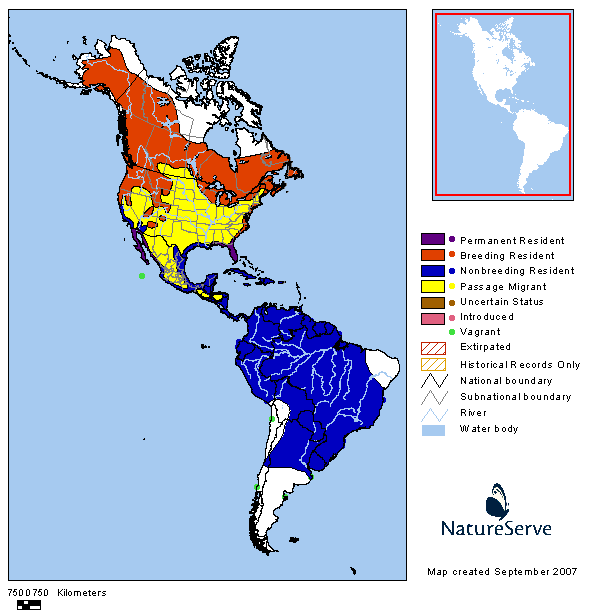
Osprey are found worldwide, in every continent except Antarctica.

The oldest Osprey lived to be 30 years old.

Osprey are recovering from the use of the pesticide DDT, which caused breeding failure from eggshell thinning. DDT was banned in 1972.

Ospreys are piscivorous, with fish comprising 99 percent of their diet.

When an Osprey catches a fish, it arranges the fish head first, reducing aerodynamic drag.

GREAT VIDEO OF CAPE ANN OSPREYS, FROM EGG TO FLEDGING!!!

Check out this fantastic video created by Dave Rimmer, Essex Greenbelt’s Director of Land Stewardship and Osprey Program. The footage was taken last summer from Greenbelt’s OspreyCam. Watch highlights of the 2020 Osprey season captured from Annie and Squam’s nest in Gloucester. Annie and Squam fledged three chicks, Vivi, Rusty, and Liz, and you can watch their development from egg to fledging.

CAPE ANN WILDLIFE 2020: THE YEAR IN PICTURES, MOVIES, AND STORIES

Several years ago my husband suggested I write a “year end” wildlife review about all the creatures seen over the preceding year. That first review was a joyful endeavor though daunting enough. Over the next several years the reviews became more lengthy as I tried to cover every beautiful, wonderful creature that was encountered on woodland hikes, beaches, dunes, marshes, ponds, and our own backyards and neighborhoods. 2020 has been a very different year. There were just as many local wildlife stories as in previous years however, the pandemic and political climate have had far reaching consequences across geographic regions around the world, touching every living creature in the interconnected web of life we call our ecosystems.

This first year of the global pandemic has had a profoundly negative impact on wildlife and their habitats. In urban areas in developed countries, perhaps the economic slowdown afforded wildlife a break, with less pollution, less air travel, and some wild animals even reclaiming territory. Though the true downside of Covid-19 is that the pandemic has had an extraordinarily harmful impact on wildlife in rural areas and in less developed countries People who are dependent upon tourism, along with people who have lost jobs in cities and are returning to rural areas, are placing increasing pressure on wildlife by poaching, illegal mining, and logging. As mining and logging destroy wildlife habitats, animals are forced into ever shrinking areas, causing them to become sick, stressed, and to starve to death. These same stressed wild animals come in contact with people and farm animals, creating an ever increasing potential to transmit horrifically deadly illness, diseases such as Covid-19.

There are many, many organizations working to protect wildlife and conserve their habitats. I am especially in awe of one particular grass roots non-profit organization located in Macheros, Mexico, previously featured here, Butterflies and Their People. Co-founded by Ellen Sharp and Joel Moreno Rojas, the work they are doing to both protect the butterfly’s winter habit and provide employment for the forest’s guardians is outstanding.

All the butterfly sanctuaries (their winter resting places), are closed this year due to the pandemic. Dozens of people in the tiny town of Macheros are wholly dependent upon the income received by the work they do protecting the butterfly trees from illegal logging, as well as income from the tourist industry.  Ellen, Joel, and their team of arborists have come up with a wonderfully creative way to bring the butterflies to you. For a modest fee, you can sign up to “Adopt a Colony” to receive monthly newsletters and video tours of the Monarchs at Cerro Pelon. The newsletters are written by Ellen, who writes beautifully and clearly about the month-by-month current state of the butterflies in their winter habitat, as well as human interest stories drawn from the community. To subscribe to “Adopt a Colony” from Butterflies and Their People, go here.

We can be hopeful in 2021 that with a new administration, a much greater focus will be paid by our federal government to stop the spread of the virus in the US as well as around the globe. Not only is there hope in regard to the course correction needed to battle the pandemic, but the Biden/Harris administration has made climate change and environmental justice a cornerstone of their platform, including measures such as stopping the environmental madness taking place along our southern border and reversing many of the previous administration’s mandates that are so harmful to wildlife and their habitats.

Around the globe, especially in less developed countries, the pandemic has set back environmental initiatives by years, if not decades. We are so fortunate in Essex County  to have conservation organizations such as Greenbelt, MassWildlife, The Trustees, and Mass Audubon; organizations that protect the sanctity of wildlife and recognize the importance of protecting habitats not only for wildlife but equally as important, for the health and safety of human inhabitants.

The following are just some of the local images and stories that make us deeply appreciate the beauty of wildlife and their habitats found on Cape Ann and all around Essex County. Each picture is only a brief window into the elusive, complex life of a creature. Every day and every encounter brings so much more to observe, to learn, to enjoy, and to love.

To read more, each image and story from the past year is Google searchable. Type in the name of the creature and my name and the link to the story and pictures posted on my website should come right up.

Some Beautiful Raptors of 2020 – Red-tailed Hawk, Short-eared Owl, American Bald Eagle, Cooper’s Hawk, Merlin, Sharp-shinned Hawk, Osprey, and Snowy Owls


Essex County Greenbelt’s Osprey pair, Annie and Squam, successfully fledged three chicks, Vivi, Rusty, and Liz (nestling photo courtesy ECGA)

Dave Rimmer video from the Osprey cam at Lobstaland

The Snowy Owl Film Project was completed in March, with the objective of providing pandemic- virtually schooled kids a window into the world of Snowy Owls in their winter habitat (see all five short films here).


Spunky Mute Swan Cygnets

Utterly captivated by the winsome Red Fox Family

A tiny sampling of the beautiful songbirds that graced our shores in 2020 – Cedar Waxwings, Baltimore Orioles, Catbirds, American Robins, Tree Swallows, Barn Swallows, Snow Buntings, American Pipits, Horned Larks, and Eastern Bluebirds


A new favorite place to film is at my friend Paul’s wonderfully fun sunflower field in Ipswich, School Street Sunflowers. Beautiful Bobolinks, Common Yellowthroat Warblers, and Bluejays were just some of the songbirds seen feasting on the expiring seedheads  of sunflowers and wildflowers growing amongst the rows of flowers.

Graceful White-tailed Deer herd of adult females and youngsters

Snowy Egrets, Great Blue Herons, Great Egrets, and juvenile Little Blue Herons delight with their elegance, beauty, and stealth hunting skills. Included in the montage is a juvenile Black-crowned Night Heron that spent the winter at Niles Pond

A fraction of the different species of Shorebirds and Gulls seen on Cape Ann this past year – Dowitchers, Killdeers, Black-bellied Plovers, Common Tern, Least Tern, Laughing Gulls, Bonaparte’s Gulls, Glaucus Gull, and rarely seen Dovekie, or”Little Auk.”

Cecropia Moth life cycle unfolding in our garden, from mating, to egg laying, to caterpillar, to adult.


Dozens and dozens of orb spider webs draped a small patch of wildflowers. The dream catchers were attracting Cedar Waxwings to feast on the insects caught in the webs. The following day I returned after a rainstorm. The webs had melted away in the downpour and the Waxwings had vanished into the treetops.

Harbor and Gray Seals hauled out on the rocks at Brace Cove, as many as 28 were counted on a winter’s day!

Piping Plovers and Marshmallow Montage

In 2020, our Good Harbor Beach Piping Plover pair fledged one chick, nicknamed Marshmallow. Despite the global pandemic, a group of super dedicated Piping Plover Ambassadors worked tirelessly from sunrise until sunset to help ensure the safety of the Piping Plover family and to help educate beachgoers about the beautiful life story of the Plovers unfolding on Gloucester’s most popular beach destination. We worked with Essex Greenbelt’s Dave Rimmer, the Gloucester DPW, and Gloucester City Councilor Scot Memhard, with much appreciated advice from Mass Wildlife Coastal Waterbird Biologist Carolyn Mostello.

Read more about Marshmallow, the Ambassadors, and the Piping Plover Film Project here.

Piping Plover Marshmallow Montage, from egg to thirty-eight days old. Filmed at Good Harbor Beach, Gloucester, Massachusetts.

MONARCHS!

It has been a wonderful, exhilarating, infinitely educational, and beautifully challenging journey creating my documentary, Beauty on the Wing: Life Story of the Monarch Butterflies. The film was released in February 2020, but because of the pandemic, was not seen by the public until August, when it premiered (virtually) at the New Haven Documentary Film Festival. Beauty on the Wing has gone on to win honors and awards at both environmental and children’s film festivals, including the tremendous honor of Best Documentary at the Boston International Kids Film Festival. I’ve just received the very attractive award in the mail and have not had time to post a photo yet.

Beauty on the Wing portrays Cape Ann in the most beautiful light and I think when we are ever able to have a live premiere in this area, local friends will be delighted at the outcome. Joyfully so, Beauty is now being distributed to schools, libraries, institutions, and the travel industry through American Public Television Worldwide.

Beauty on the Wing continues to be accepted to film festivals and I will keep you posted as some are geo-bloced to this area, including the upcoming Providence Children’s Film Festival.


Last but not least, our wonderfully wildy Charlotte, little adventurer and nature-loving companion throughout the year


WATCH GREENBELT’S LIVE OSPREY CAM NOW – MOM AND DAD FEEDING NEW BORN CHICKS A FISH!

Tune into Greenbelt’s live Osprey cam to see a pair (possibly a third) chick being fed right now by the adults Annie and Squam. One parent (Squam I think) flew in with a fresh caught fish and Annie is tearing it into bits and feeding each gaping wide little mouth. Squam is perched at the edge of the nest, looking so proud!

CLICK ON THE IMAGE

Greenbelt’s OspreyCam is located in Gloucester, MA on Greenbelt salt marsh near LobstaLand Restaurant.

History:  In 2017 a pair of young Osprey took up residence on the LobstaLand platform in July/August and made a small nest. In 2018 they returned in April, stayed until August and built a large nest but never laid eggs. We call this a “house-keeping pair”- almost always a young pair learning the ropes.

In 2019, the pair returned in April to the nest and produced a clutch of 3 eggs, all under the watchful eye of the newly installed webcam. The adults were named Annie and Squam. They hatched one egg, and eventually fledged one chick – named River. River was banded before he fledged. He left the nest for good in late summer.

2020 – Annie and Squam returned to the nest in mid-April, and since then they have been tending to the nest, preparing to produce a clutch of eggs. They have been very patient as we have been back and forth to the nest site many times getting the new webcam set up.

Update April 29, 2020 – The webcam is now live. We’re awaiting what this season will bring! We hope you enjoy it with us.

Update May 11, 2020 – All good news. Annie has laid 3 eggs, completing her clutch yesterday. So that would suggest the first egg might hatch around June 15. Squam has been busily catching mostly river herring these days, feeding himself and Annie a steady diet of fresh fish.

Update May 28, 2020 – Not much new to report. The incubation phase for Annie and Squam continues. Squam is still bringing in numerous fresh fish daily, mostly river herring but the occassional small striped bass as well. Once we roll into June the count down is on for hatching.

Osprey Chicks

Image courtesy BBC

ANNIE OR SQUAM?

Greenbelt’s Dave Rimmer shares all three eggs are still in the nest.

View the Osprey Cam Here

From ECGA website –

Update May 28, 2020 – Not much new to report. The incubation phase for Annie and Squam continues. Squam is still bringing in numerous fresh fish daily, mostly river herring but the occassional small striped bass as well. One we roll into June the count down is on for hatching.

Annie or Squam? One of the pair of Cape Ann’s resident Ospreys (hopefully a family soon).

GONE CRAB FISHIN’ FOR DINNER -SNOWY EGRET AT THE CREEK

Quietly slipping through the shallow creek water, the graceful Snowy Egret would stop every now and then to shake its leg. Stirring up the sandy flat in hopes of awakening a sleeping crab or fish, the elegant bird would then violently pierce the water with its dagger like beak, more often than not coming up empty billed.

Success!

Watching the brilliant yellow-footed Snowy Egret foraging at the creek for diner I was reminded of how Piping Plovers have a similar foraging technique, pattering their (much smaller) feet, also in hopes of disturbing unsuspecting prey.

Snowy Egrets are sometimes described as piscivorous (a diet that consist largely of fish), however they eat a wide variety aquatic foods such as jellyfish, crustaceans, mollusks, and aquatic insects. Ospreys are a better example of a piscivorous bird species.

The bird in the photos above is in full breeding plumage. Their stunning aigrettes are the reason they were nearly brought to extinction by plume hunters, and one of the main reasons for the creation and passing of the century old Migratory Bird Treaty Act of 1918.

How to tell the difference between a Showy Egret and Great Egret: Snowy Egrets have yellow feet and black bills, while Great Egrets have yellow bills and black feet. As the name suggests, Great Egrets are the larger of the two. Great Egrets

3 EGGS!! UPDATE ON ANNIE AND SQUAM – CAPE ANN’S NESTING OSPREY PAIR – AND LINK TO ESSEX COUNTY GREENBELT’S ANNUAL MEETING LIVE STREAMING

Update May 11, 2020 – All good news. Annie has laid 3 eggs, completing her clutch yesterday. So that would suggesting the first egg might hatch around June 15. Squam has been busily catching mostly river herring these days, feeding himself and Annie a steady diet of fresh fish.

3 Eggs – Photo from Greenbelt’s Osprey cam

GO HERE TO SEE GREENBELT’S LIVE OSPREY CAM

Essex County Greenbelt’s 2020 annual meeting will be live streamed this year on Thursday evening at 7pm.

Here is the link:

GREENBELT’S OSPREY CAM IS LIVE!

Was anyone watching just now?? The male jumped on the female’s back in an attempt to mate. The mating attempt was very brief. A male will land on a female’s back many times without the “cloacal kiss” accomplished.  Studies have shown only 30-40% of mating attempts are successful. Early copulations stimulate the growth of eggs within the female’s ovary and strengthen the pair bond. The last 3 or 4 days before eggs are laid are the most critical for fertilization.

CLICK HERE FOR LIVE OSPREY CAM

From Greenbelt’s live cam page:

Greenbelt’s OspreyCam is located in Gloucester, MA on Greenbelt salt marsh near LobstaLand Restaurant.

History:  In 2017 a pair of young Osprey took up residence on the LobstaLand platform in July/August and made a small nest. In 2018 they returned in April, stayed until August and built a large nest but never laid eggs. We call this a “house-keeping pair”- almost always a young pair learning the ropes.

In 2019, the pair returned in April to the nest and produced a clutch of 3 eggs, all under the watchful eye of the newly installed webcam. The adults were named Annie and Squam. They hatched one egg, and eventually fledged one chick – named River. River was banded before he fledged. He left the nest for good in late summer.

2020 – Annie and Squam returned to the nest in mid-April, and since then they have been tending to the nest, preparing to produce a clutch of eggs. They have been very patient as we have been back and forth to the nest site many times getting the new webcam set up.

Update April 29, 2020 – The webcam is now live. We’re awaiting what this season will bring! We hope you enjoy with us.Ospreys adding sticks to their nest

FIRST OPSREY SIGHTING!

Way, way off across the Great Marsh, and perched atop the tallest tree, could it be an Osprey this early in the season? Yes, I think it is! The photo is terrible and greatly cropped but good enough for an id. Spring is just around the corner!

Osprey are a species of hawk. Their nickname is Fish Hawk because that is their preferred diet. You will see them hunting over the water and pairs will soon be building their nests of sticks. Snapshots of what to look for –

HUMPBACK WHALE OFF GOOD HARBOR BEACH, AN OSPREY SWOOPS IN TO FEED, AND PIPL UPDATE

On my morning PiPl check, I met up with a super nice gentleman, Bill, who walks the beach every morning. He loves wildlife (including PiPls), is a Coast Guard veteran, was a fisherman, and grew up on a marsh. Bill pointed out the whale (or he thought possibly a large dolphin), breaching and blowing blow holes off in the distance. Bill mentioned there had been a crowd along the back shore earlier and that there is tons of good bait fish off the coast right now.

How exciting at see an Osprey swoop in and snatch up a large fish precisely where the whales were fishing. All were too far away to get some really fine shots, but you can at least get an idea from the photos.

PiPl Update- all three fledglings are doing beautifully on this, their 39th day 🙂 The three spent the hours of five to seven mostly foraging in the area front of the enclosure, and also preening within the enclosure. Papa was on the scene, too.

July 10, 2019 Good Harbor Beach Sunrise

Friend Joe Dasilva shares it’s pogies or menhadden that is bringing out the whales and the Osprey?

CAPE ANN WILDLIFE: A YEAR IN PICTURES 2017

CAPE ANN WILDLIFE: A YEAR IN PICTURES 2017

By Kim Smith

Cape Ann provides welcome habitat for a menagerie of creatures beautiful, from the tiniest winged wonder to our region’s top predator, the Eastern Coyote. Last year I posted a Cape Ann Wildlife Year in Pictures 2016 and I hope you will find the wildlife stories of 2017 equally as beautiful. Click on the image to find the name of each species.

WINTER

Winter: Only partially frozen ponds allowed for dabblers and divers such as Mallards, Mergansers, and Buffleheads to forage at the freshwater. Mr. Swan had his usual entourage of quwackers and daily heads to the other side of the pond to get away for his morning stretches. Sightings of Red-tailed Hawks and other raptors abounded. Although photographed in Newburyport, the owl photos are included, well, just because I like them. An Eastern Screech Owl (red-morph) was seen daily perched above a playground and Barred Owl sightings too were reported throughout the winter. Raptors live on Cape Ann all year round but are much easier to see in winter when the trees are bare of foliage.

The beautiful green eyes of the juvenile Double-crested Cormorants were seen wintering at both Niles Pond and Rockport Harbor. And during a warm February day on a snowless marsh a turkey bromance shindig commenced.

SPRING


In early spring, a male and female American Wigeon arrived on the scene making local ponds their home for several weeks. In the right light the male’s electric green feathers at the top of his head shine brightly and both the male and female have baby blue bills.

Meadow and marsh, dune and treetop were graced with the heralding harbingers of spring with photos of a Red-winged Blackbird, a pair of Cedar Waxwings, Northern Mockingbird, Brown Thrasher, Eastern Towhee, Eastern Kingbird, Tree Swallow, and Grackle included here.

The Great Swan Escape story made the news in Boston as Mr. Swan eluded captors for hours. He had re-injured his foot and someone took it upon themselves to call the animal rescuers, which would have surely meant death for our beloved 27-year old swan if he had been wrangled into captivity.

M is clearly for Migration through Massachusetts and the month-long arrivals and departures did not abate. Short-billed Dowitchers, winsome Willets, Yellow Legs, and Ruddy Turnstones are just some of the migrating shorebirds spied on Cape Ann beaches and marshes. The best news in May was the return of the Piping Plovers. Of the five or six that camped at Good Harbor Beach to investigate potential nesting sites, one pair bonded and built their nest mere yards from the nesting pair of last year. Could it be the same pair? The nesting Piping Plover story took up much of the spring and by early summer four little Piping Plover chicks hatched over Fiesta weekend. Hundreds of photos and hours of film footage are in the process of being organized with a children’s book and documentary in progress.

Piping Plover Courtship Dance

Piping Plover Nest


SUMMER


OctoPop

The survival of one Piping Plover chick was made possible by a wholesale community effort, with volunteers covering all hours of daylight, along with Mayor Sefatia and her team, Ken Whittaker from the conservation office, Chief McCarthy, and animal control officer Diane Corliss all lending a hand.

Sadly, several Northern Gannets came ashore to die on our Cape Ann beaches, struck by the same mysterious and deadly disease that is afflicting Northern Gannets in other regions. During the summer season they are typically at their North American breeding grounds, which are six well-established colonies, three in the Gulf of St. Lawrence, Quebec, and three in the North Atlantic, off the coast of Newfoundland.

An orphaned swan was introduced to Niles Pond, much to the dismay of Mr. Swan. Eastern Point residents Skip and Lyn kept watch over the two while they reluctantly became acquainted.

By mid-July many of us were seeing Monarchs in much greater numbers than recent years. Nearly every region within the continental United States experienced a fantastic Painted Lady irruption and butterflies of every stripe and polka dot were seen flitting about our meadows, fields, and gardens.

The tadpoles and froglets of American Bullfrogs and Green Frogs made for good eating for several families of resident otters, who are making their homes in abandoned beaver lodges. Little Blue Herons too, find plentiful frogs at our local ponds.

In early August we see the Tree Swallows begin to mass for their return migration. They find an abundance of fruits and insects in the dunes, headlands, and beaches. The Cedar Waxwings and Ruddy Trunstones were back again observed foraging on their southward journey, along with myriad species of songbird, shorebird, diver, and dabbler.

Tree Swallows Massing

FALL


The Late Great Monarch migration continued into the fall as we were treated to a wonderfully warm autumn. Waves and waves of Monarchs came ashore and more butterflies arrived on the scene including new batches of Painted Ladies, Clouded Sulphurs and Common Buckeyes (nothing common about these beauties!).

A pair of Northern Pintails called Cape Ann ponds and coves home for nearly a month while we seem to be seeing more and more raptors such as Red-tailed Hawks, Osprey, Bald Eagles, and Peregrine Falcons. Juvenile herons of every species that breeds on Cape Ann lingered long into the fall—Black-crowned Night Herons, Yellow-crowned Herons, Great Blue Herons, Snowy Egrets, Great Egrets, and Green Herons.

Just as Mr. Swan and the Young Swan appeared to be warming to each other, the Young Swan, who has yet to learn to fly, became trapped in the ice at Niles Pond. He was rescued by caretakers Lyn and Dan and is now spending the winter at a cozy sanctuary built by Lyn and friends.

Heart-wings Monarch

Thank you to all our readers for your kind comments of appreciation throughout the year for the beautiful wild creatures with which we share this gorgeous peninsula called Cape Ann. If you’d like to read more about a particular animal, type the name of the animal in the search box and the original post should come up

With its expansive marshes and dunes, bodies of fresh clear water, saltwater coves and inlets, and geographic location within the Atlantic Flyway, 2017 has been a banner year for Cape Ann’s wild and wonderful creatures. I can’t wait to see what awaits in 2018!

Snowy Owl “Hedwig” January 2018 Backshore Gloucester

Cape Ann Wildlife: A Year in Pictures

snowy-owl-gloucester-massachusetts-c2a9kim-smith-2015My husband Tom suggested that I write a year-end post about the wildlife that I had photographed around Cape Ann. Super idea I thought, that will be fun and easy. Not realizing how daunting and many hours later, the following is a collection of some favorite images from this past year, beginning with the male Snowy Owl photographed at Captain Joe’s dock last winter, to December’s Red-tailed Hawk huntress.
red-tailed-hawk-eating-prey-gloucester-massachusetts-21-copyright-kim-smith

Living along the great Atlantic Flyway, we have been graced with a bevy of birds. Perhaps the most exciting arrival of all occurred when early summer brought several pairs of nesting Piping Plovers to Gloucester’s most beloved (and most highly trafficked) of beaches, Good Harbor Beach. Their story is being documented on film.

piping-plovers-chicks-nestlings-babies-kim-smithWork on Mr. Swan’s film will also resume this January—the winters are simply not long enough for all I have planned!swan-outstretched-wings-niles-pond-coyright-kim-smith

While photographing and filming Red-winged Blackbirds this past spring, there was a face-to-face encounter with a hungry coyote, as well as several River Otter sightings.

female-red-winged-blackbird-copyright-kim-smitrhFemale Red-winged Blackbirdeastern-coyote-massachusetts-kim-smith

The summer’s drought brought Muskrats out from the reeds and into full view at a very dry Henry’s Pond, and a short film about a North American Beaver encounter at Langsford Pond. Numerous stories were heard from folks who have lived on Cape Ann far longer than I about the extraordinary number of egrets, both Snowy and Great, dwelling on our shores.
three-muskrat-family-massachusetts-copyright-kim-smithThree Muskrateers
female-monarch-depositing-eggs-1-copyright-kim-smithnewly-emerged-monarch-butterfly-copyright-kim-smith-jpgThere were few Monarch sightings, but the ones seen thankfully deposited eggs in our garden. Thank you to my new friend Christine who shared her Cecropia Silkmoth eggs with me and thank you to the countless readers who have extended an invitation to come by and photograph an exciting creature in their yard.

cecropia-moth-caterpillar-copyright-kim-smith

Pristine beaches, bodies of fresh water, and great swathes of protected marsh and woodland make for ideal wildlife habitat, and Cape Ann has it all. With global climate change pushing species further away from the Equator, I imagine we’ll be seeing even more creatures along our shores. Butterfly and bee populations are overall in decline, not only because of climate change and the use of pesticides, but also because of loss of habitat. As Massachusetts has become less agrarian and more greatly forested, fields of wildflowers are becoming increasingly rare. And too fields often make the best house lots. Farmers and property owners developing an awareness of the insects’ life cycle and planting and maintaining fields and gardens accordingly will truly help the butterflies and bees.
female-mallard-nine-ducklings-kim-smith

Thank you to all our readers for your kind comments of appreciation throughout the year for the beautiful wild creatures with which we share this gorgeous peninsula called Cape Ann.

The images are not arranged in any particular order. If you’d like to read more about a particular animal, type the name of the animal in the search box and the original post should come up.

I wonder what 2017 will bring?

nine-piping-plovers-napping-gloucester-copyright-kim-smith

sandpipers-copyright-kim-smith

Gloucester’s Littlest Osprey on the Annisquam Perishes

With regrets, I am sorry to report that the Osprey fledgling has died. Don, whose property the nest is located upon, shares that he observed the Osprey Dad toss the nestling out of the nest. Don went to investigate and found the baby’s lifeless body lying on the ground. He placed it in a box and brought it to Greenbelt. Judging by the condition of the body, it was determined that the young Osprey was most likely killed by an owl.

On a positive note, Don and Eleanor’s Osprey pair will more than likely return to the same nest site next year. They are also thought to be a young couple. Hopefully the pair will hone their parenting skills and, quite possibly, have more than one fledgling on their next attempt. The growing recovery of Osprey to our region means that many things are going right; the improving health of our coastal environment, for example. 

Many thanks again to Paul Morrison and sister Kathy, and to Don and Eleanor, for providing this brief window to see the Annisquam River Osprey family. I am looking forward to learning and sharing more next year. 

Osprey and fledgling Annisquam Essex County copyright Kim SmithRIP Little Osprey

More About Gloucester’s Splendid Ospreys on the Annisquam

Male female Osprey copyright Kim SmithThis morning I had the joy to meet Don and Eleanor. Don built the fantastic Osprey platform that you see in the photos. Several years ago, Don noticed that an Osprey pair were trying to construct a nest on a post by the train tracks; the post that houses the all important train signals. Understandably, railroad workers had to destroy the nest as it was interfering with train operations. After watching the Osprey pair attempt to build a nest two years in a row, Don decided to build and install an Osprey platform in the marsh adjacent to his home. With some advice from Greenbelt, Don installed the platform early this spring. Wonder of wonders, his plan worked! The young pair built a perfect nest and one egg hatched.

Male female Osprey -3 copyright Kim Smith

Thanks to citizen scientists like Don and Eleanor and the Essex County Greenbelt’s amazing Osprey program, the north of Boston region is rapidly being repopulated with Opsrey. Don is already building a second platform with hopes of installing it in the spring of 2017.

Male Female Osprey -4 copyright Kim SmithDon reports that since the Osprey have been on the scene, they are no longer bothered by pesky crows. He witnessed a pair of crows trying to rob the Osprey nest of its egg. The Osprey swooped in, snatched both crows, and beat them down into the marsh. The crows have yet to return!

Many thanks to Don and Eleanor for their warm hospitality and efforts to help the Osprey.

Osprey and fledgling Annisquam Essex County -1 copyright Kim Smith

Osprey nesting platform built by Don

To take some truly terrific closeups, a longer zoom lens is required than my own 400mm, but we can at least get a glimpse of the Osprey family with these photos.Male Osprey copyright Kim Smith

Gloucester’s Baby Osprey

So many thanks to GMG’s Paul Morrison for the excursion out to photograph the Osprey nest on the Annisquam. And thank you to Paul’s sister Kathy for the suggestion. We were there for only a short time when we began to see movement beneath the adult perched on the nest’s edge. After a few moments, the nestling’s shape became visible, but only for seconds, before it settled back deeper into the nest.

Osprey and fledgling Annisquam Essex County copyright Kim Smith

Some interesting facts about Ospreys:

Their population has rebounded following the ban on the pesticide DDT.

This hawk is easy to identify when flying over head as it has a whiter belly than other raptors.

The male gathers the nesting material while the female builds the nest. Osprey return to the same nesting sight and nest, building and rebuilding the nest up over a period of many generations. The man made nesting platforms that we see in Essex County are relatively new nests. Osprey nests that are built up over decades can reach 10 to 13 feet deep and 3-6 feet in diameter, large enough for an adult to sit in.

The osprey’s diet consists almost exclusively of fish, nearly 80 different species of fish are eaten by osprey. Sounds like a Gloucester sort of raptor!

Follow this link for more information about the Essex County Greenbelt’s exciting and highly successful osprey program.1024px-Ospreys_with_a_huge_nest

osprOsprey are found on every continent except Antarctica