At this time every year readers write in to inquire about the mysterious and startling “furry shrimp” flying in their gardens. Perhaps you have a Hummingbird Clearwing Moth I write back? They are often seen nectaring at our North American native wildflowers bee balm (Monarda didyma) and white flowering summer phlox ‘David’ (Phlox paniculata), as well as the butterfly bushes and Verbena bonariensis. Scroll down through several posts to see article..
Category Archives: Fujifilm x100
Summer Phlox and Towering Lilies
“At this point, it is the summer phlox and, above all, the towering lilies that are providing the scent in our garden in Milton. And very heady it is, too- especially on still, hot days.” – My friend David Godine writes of his beautiful garden in Milton, Massachusetts.
I am wonderfully fortunate that Mr. Godine is both my publisher and editor for my book Oh Garden of Fresh Possibilities!. Not only does David have a deep love for all things books, he is passionate for gardens and gardening.
Phlox paniculata ‘David’ and oriental lily, with Hummingbird Clearwing Moth, photographed at the butterfly garden at Willowdale Estate.
Cape Ann TV video tour of our garden
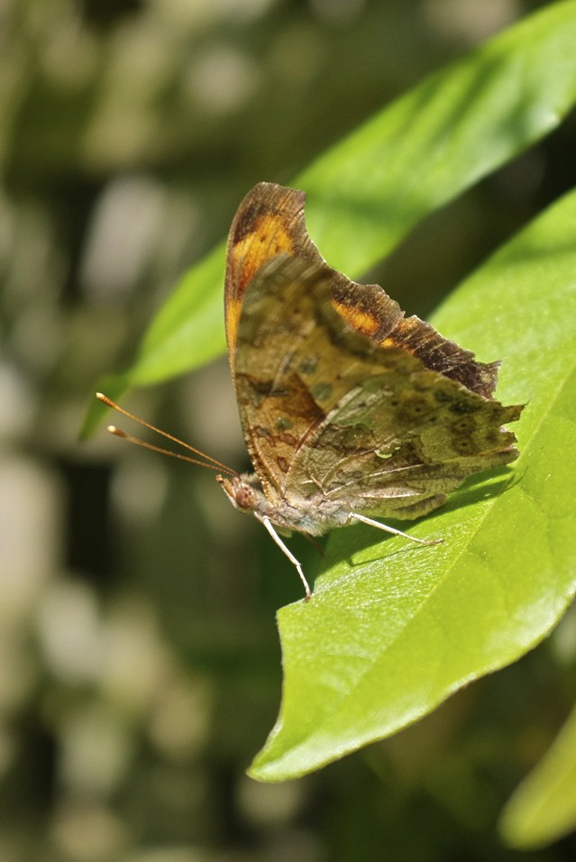
Quickly posting as I am under several deadlines and determined to get all fully underway. I believe I mentioned that this past week, Lisa Smith and her Cape Ann TV After-the Beach Teen Video Club stopped by for a tour of my garden. Here’s a short clip, with a wonderful surprise visit by the friendly Question Mark butterfly, who very conveniently, stole the show.
The teens and Lisa did a great job and all very much enjoyed the beautiful creatures that flew in and out of our story. It is not easy to focus on tiny subjects using a heavy camera attached to a tripod. The full video of the garden tour and interview will air in the near future and we will keep you posted.
Butterflies of Massachusetts
July Butterfly Update
Great Spangled Fritillary nectaring at native Coneflower (Echinacea purpurea)
Dear Friends,
Have you noticed the sheer numbers of our winged friends? Returning this evening from a swim at 6:45, I bumped into three Monarchs nectaring and a Red-spotted Purple (all in pristine, newly emerged condition). Early evening is an unusually late time of day for butterflies on the wing, especially when skies are slightly overcast. This, after a day of observing and shooting numerous numbers of butterflies, caterpillars and hummingbirds–and never leaving our garden. I work for a bit, but then the garden calls and I’m out the door with both video and still cameras. If this fabulously warm weather keeps up, I think we are in for another banner year with the butterflies, and skippers too.
Currently, we have 28 Monarchs, in various stages of development, residing in our kitchen, and seven Black Swallowtail caterpillars and chrysalids.
Black Swallowtail Caterpillar–note the fine “girdle” spun by the pupating caterpillar. Attached to the stem by both the girdle and a silky mat in which his last proleg is hooked, the caterpillar is securely latched. The proleg becomes the cremaster during pupation.
The darkening chyrsalis–perhaps it will emerge tomorrow! After ten days, the silky girdle and cremaster continue to perfectly support the pupa.
I am often asked why I collect butterfly eggs and don’t simply leave them in the garden. Butterfly larvae have a roughly one in ten chance of survival in the wild. In our kitchen, the odds increase exponentially, with a ten in ten rate of survival. For instance, I have learned, that after observing a butterfly deposit her eggs on a host plant, to gather them up quickly. If I become distracted and wait even only an hour, they often disappear, usually having been eaten or parasitized.
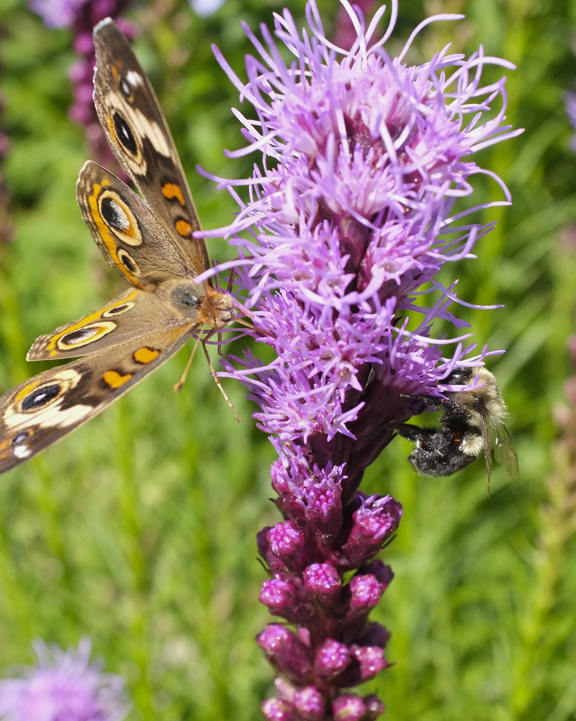
Common Buckeye and bee nectaring at native Gayfeather (Liatris spicata)
More detailed information on each species will be forthcoming. Much footage to edit…
Question Mark Butterfly and Patrice ~ My favorite photo of the season (click on the photo to see full size). Yesterday afternoon, Lisa Smith, one of the producers over at Cape Ann TV, with her After the Beach Video Club for Teens, were filming in the garden. While Patrice was interviewing me, this Question Mark alighted briefly on her shoulder several times. I was prepared the second time, with camera ready and adjusted to the appropriate settings. The Question Mark’s cooperation throughout the day’s shoot–nectaring, sunning itself, and taking long sips of sap through the chinks of bark in the weathered old pear tree–was very much appreciated by all; he was the true star of the day!
Oh Joyous July!
Yellow!
Dear Gardening Friends,
Good Harbor Beach Snowy Egret Feeding at Dawn
The Snowy Egret (Egretta thula) is easily distinguished from the Great Egret (Casmerodius albus) by its smaller size, plume of feathers atop its head, and bright, sunny yellow feet. The Snowy Egret is about 24 inches long and weighs approximately 13 ounces. The Great Egret is roughly 37-40 inches long and weighs about 35 ounces. Plume hunters for the millinery trade hunted both species of egrets to near extinction by the turn of the previous century. Under the Migratory Bird Treaty Act, the Snowy is protected by US law and the population has rebounded.
The Snowy Egret’s diet is diverse, consisting primarily of shrimps, snails, small fish, frogs, and aquatic insects. Snowys stalk prey in shallow water, and in the video, you can see it flushing prey into view by shaking and shuffling its feet. While filming (see last half minute of video), the Snowy stepped out of the water, turned gracefully towards the camera, and stood for a moment–providing more than a quick glimpse of it’s substantial, bright cadmium lemon feet.
No, that is not a Monarch caterpillar on your parsley plant.
I am often asked “why is that green, yellow, and black Monarch caterpillar eating my parsley”?
Chances are, you will never see a Monarch caterpillar on your parsley. By far and away it is more likely that you have the caterpillar of the gorgeous Black Swallowtail Butterfly (Papilio polyxenes).
Caterpillars that are actively feeding are usually only found on their larval host plant(s), the plant they have developed a distinctive coevolutionary relationship with over millennia. Monarch caterpillars do not eat parsley and Black Swallowtail caterpillars do not eat milkweed, and if either attempted, they would not survive. Black Swallowtails were in the past commonly referred to as the Parsnip Swallowtail as their caterpillar food plants belong to members of the Umbelliferae, or Carrot Family. The diet of the Black Swallowtail caterpillar includes the foliage and flowers of carrot plants, fennel, dill, parsley, Queen Anne’s lace, and parsnips.
The Monarch caterpillar is yellow, black, and white. The Black Swallowtail caterpillar is green, black, and yellow.
Please see my Life Story of the Black Swallowtail Butterfly film’s website for videos and more photos documenting the butterfly’s life cycle.
to this…
Black Swallowtail Butterfly (Papilio polyxenes)
See Life Story of the Black Swallowtail Butterfly film website for videos and more photos documenting the butterfly’s life cycle.
Monarch Butterfly Program Presented to the Cape Ann Garden Club
This morning I had the pleasure of presenting my Monarch butterfly program to the Cape Ann Garden Club. The meeting was held at the charming and beautifully maintained Annisquam Village Hall, located in the very heart of Annisquam. Thank you Cape Ann Garden Club members for your enthusiasm and for your interest–it was my joy!
These lovely arrangements are created by the members and then gathered up at the end of the meeting to be distributed to nearby nursing homes.
Notice the bare spots on the walls of the Hall. The Margaret Fitzhugh Browne portraits of local villagers are temporarily on loan to the Cape Ann Museum.
Carolyn Stewart’s peonies from her garden in Vermont–imagine, fresh peonies in July!
7th Wave Rockport
Sunday night my husband and I tried a new restaurant (new for us, that is), the 7th Wave in Rockport on Tuna Wharf. Our son Alex is cooking there this summer. The hostess was lovely and Talia, one of the owners, greeted us at the front desk. We had made a reservation for 7:00 and were seated immediately on the upper deck, with the stunning view of Rockport Harbor and beyond.
The atmosphere is lively, relaxed, and entirely kid-and family-friendly. The waitstaff was hardworking and alot of fun and our food came along very quickly, no waiting for anything, despite the fact that it was a full house.
Our son was working the grill, so we restricted ourselves to grilled items only. I had the surf (super delicious grilled shrimp) and turf (petite filet, cooked to perfection) and Tom, the fantastic grilled tuna. I am usually more of a chowder and lobster person and can’t wait to go again and try more items on the menu. The lobster rolls and lobster salads passing by our table were heaped high with lobster meat and the chowder looked creamy and hearty. Elaine, mother of Talia, and owner, stopped by our table to say hello and to chat. It’s a family-owned business and the restaurant is named the 7th Wave because of their seven family members. The Kahn family opened their doors in June 2009 and they had their busiest night ever, the Saturday night before we ate dinner there. It was great to hear about their thriving business and we are looking forward to many return visits! The menu and hours of operation are posted on their website. 7th Wave Restaurant, 7 Tuna Wharf, Rockport.
The pirate ship Formidable (a traditional square-rigged tall ship) was headed in for the evening and is docked at the end of Tuna Wharf.
The captain invited us aboard and then very kindly asked us if we would like to be his guests on a a future sunset sail–of course, we would be delighted we told him!
Northward Migrating Monarch Butterflies Arrive to Good Harbor Beach and to Our Garden!
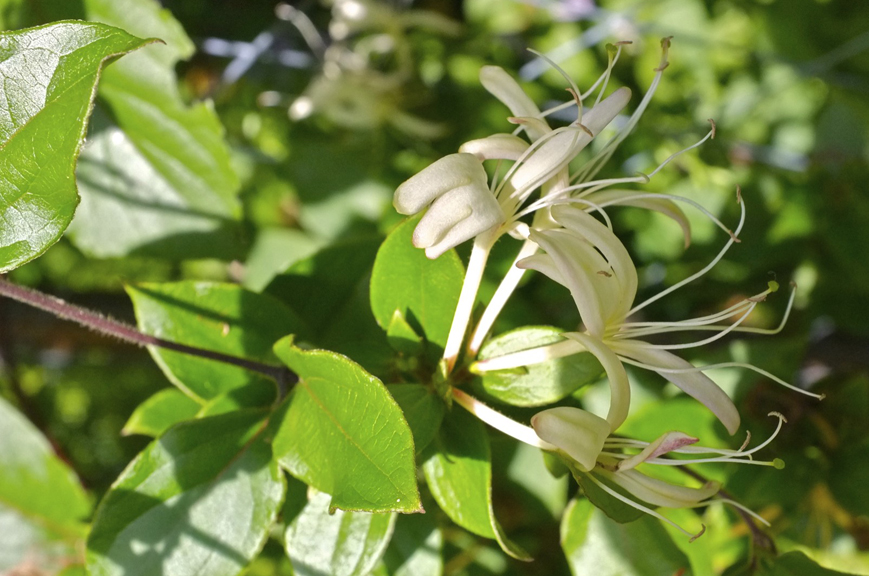
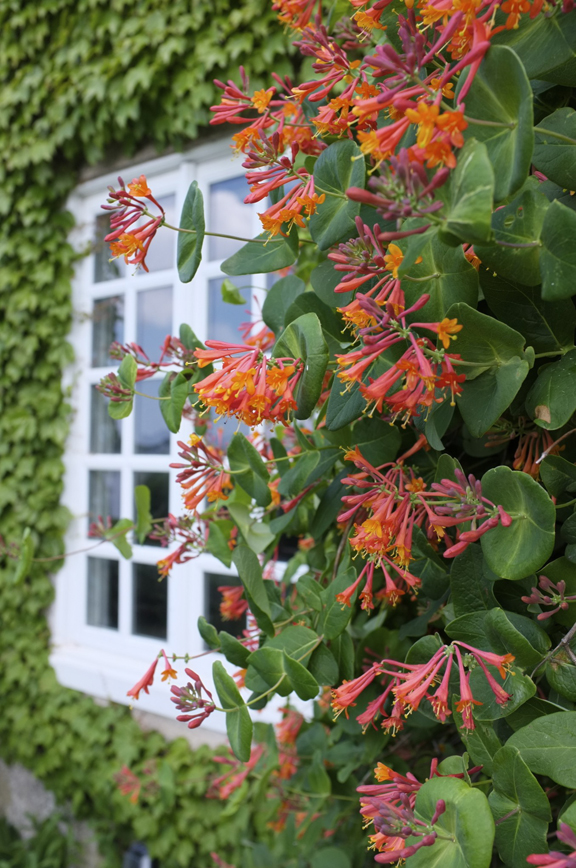
While snapping a photo of the divinely scented honeysuckle embowering the outside shower…

I spotted our first female Monarch butterfly of the season.
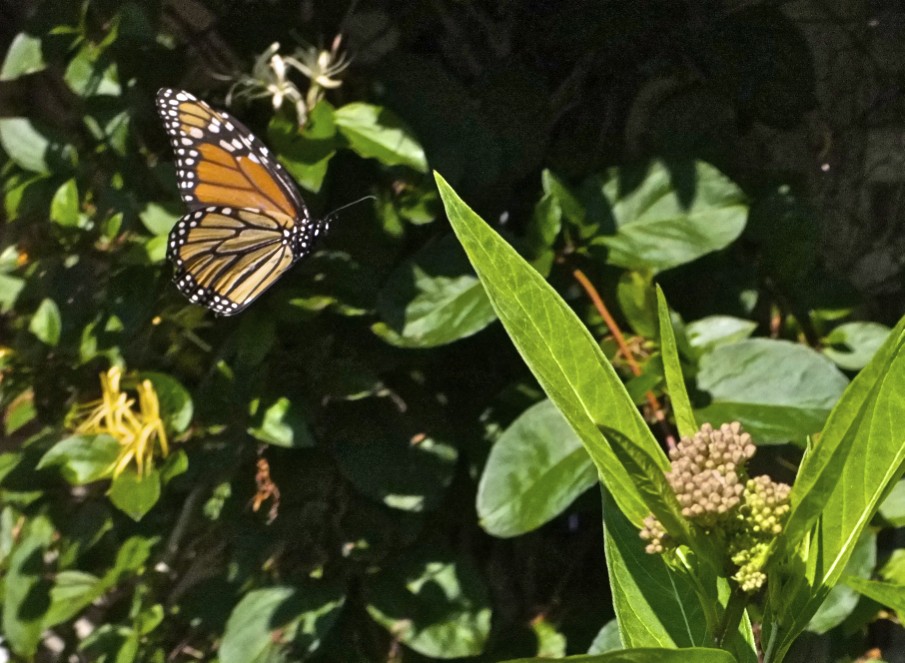
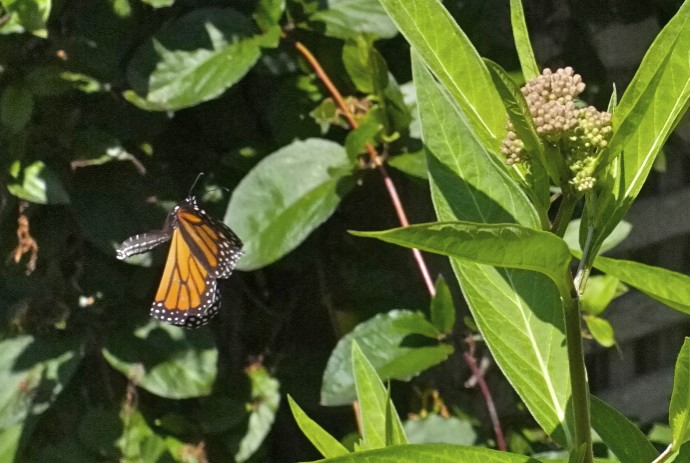
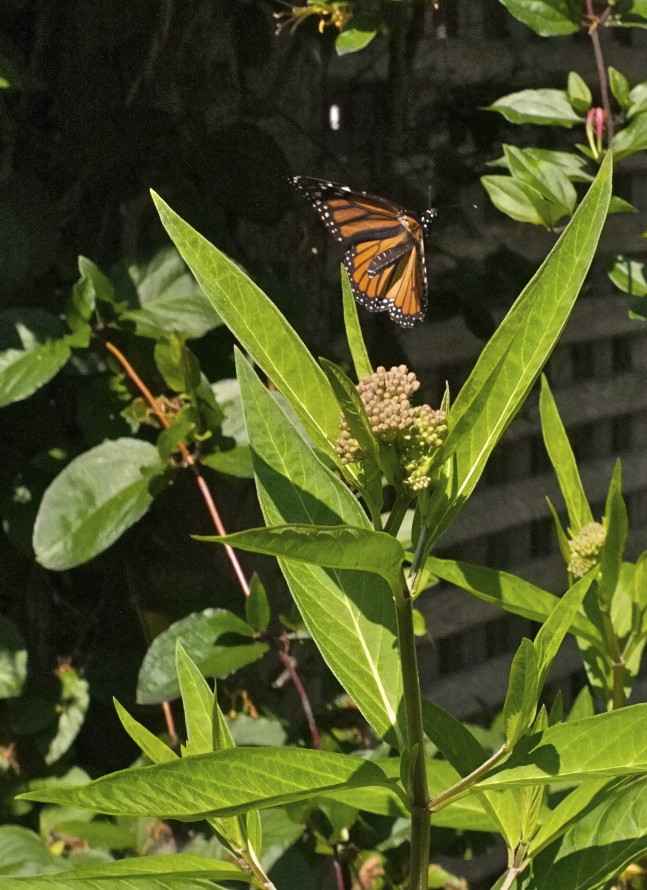
She’s arrived a bit earlier than usual this year, or more accurately, the milkweeds in our garden are slightly behind in blossoming time-Marsh Milkweed won’t bloom for another half-week and Common Milkweed won’t flower for another two weeks (both milkweed patches are growing nearby the shower enclosure). However, she did not have nectaring in mind.
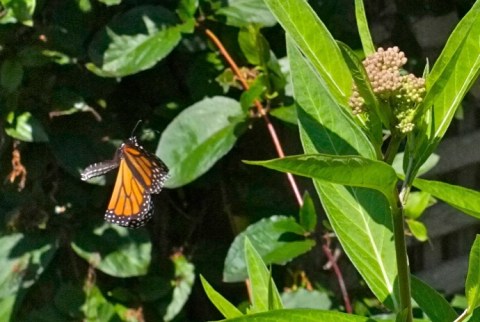
Pausing at the emerging buds and foliage of the Marsh Milkweed, then to the Common Milkweed, then back to Marsh, and curling her abdomen to the underside, one by one she oviposited golden egg after golden egg.
Typically, she searches for the uppermost, freshly emerging foliage in which to deposit her eggs. Click the above photo to make it larger. The newly deposited egg, no larger than the size of a pinhead, is a visible pale yellow dot adjacent to her abdomen.
After ovipositing an egg on the Marsh Milkweed, she next deposited several on the Common.
Click the above photo. Five eggs are visible, two on the upper leaf of the plant to the left and three on the upper leaf of the plant to the right.
I never tire of watching butterflies, especially Monarchs, whether in our garden or further afield, and eagerly anticipate their arrival each year. Monarchs are particularly gratifying to observe and record because they are one of the larger butterflies that grace our region. Oftentimes when I am photographing a smaller butterfly such as a Summer Azure, with a mere one-inch wingspan, I don’t know what I have captured through the camera’s lens until returning to the computer to download and edit. Monarchs, with their big and bold wing patterning and approachableness (is that a word?) are a joy to photograph. Because of their extraordinary migration, I believe the Monarch butterflies are one of the natural wonders of the world. We are so blessed to live in a community that plays host to such great numbers. PLANT MILKWEED and you, too, will have Monarchs! I guarentee it!
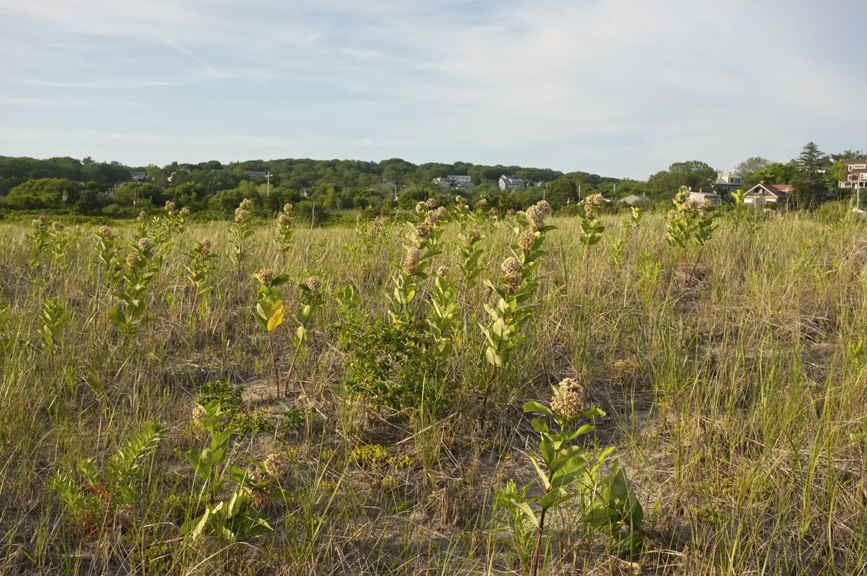
Common Milkweed in full bloom at Good Harbor Beach this week.
Common Milkweed (Asclepias syriaca) found along the shoreline grows in sandy soil and is exposed daily to windy seaside conditions. In these rough and tumble conditions it typically grows two- to two and a half -feet tall. Conversely, where in our garden it grows in fertile, friable soil and lives in a sheltered corner protected from wind, Common Milkweed often grows six to seven feet tall.
Walking along the boardwalk I often catch the sweet honey-hay fragrance of the Common Milkweed when in full bloom. Marsh Milkweed has little to no fragrance. Several Monarchs were seen while photographing this patch of milkweed.
Blooming along the pathway leading to the outdoor shower is the magnificent hummingbird attractant Torch Lily (Kniphofia uvaria) and bee magnet Helenium, commonly called Sneezeweed or Dog Tooth Daisy.
The foliage of the diminutive Mexican marigolds (Tagetes tenuifolia), commonly referred to by the Mexican people as “flowers of the dead,” bears a fabulous spicy citrus fragrance. Flowers and foliage are edible and add both a tangy color and taste. I grow it in a pot, keeping it sometimes near the shower and sometimes moving it to the dining area.
The female Monarch stayed the morning and I have not seen her since. Lucky us, though. I found fifteen eggs, without really trying too hard, and will now have lots of caterpillars and chyrsalids for upcoming butterfly programs!
End Note regarding Japanese honeysuckle: The variety discussed here is a purple-stemmed variant and I have seen it written as Lonicera japonica var. repens and Lonicera japonica ‘Purpurea.’ In our zone 6 garden, I have found it to be well-behaved, neither bearing fruit nor sending runners. I do not recommend planting in zones 7 and above. Lonicera ‘Purpurea is highly attractive to all manner of bees. As richly scented as the species, the blossoming time of L. ‘Purpurea’ lasts well over six weeks, equating weeks of showering while enwrapped in the spellbinding sweet scent of honeysuckle.
Lonicera japonica var. repens or Lonicera japonica ‘Purpurea’

Night Street Photography with Fujifilm x100 Fiesta Gloucester
Happy Independence Day!
Fujifilm x100 Ferris Wheel Fiesta
Fabulous Ferris Wheel, Gloucester Waterfront, St. Peter’s Fiesta
Thanks to husband Tom for helping me overcome my fear of heights. I so wanted to see the city from the top of the ferris wheel–stunning, fabulously fun, and all too brief–I didn’t want the ride to end!
Our Beautiful Native Sweet Bay Magnolia
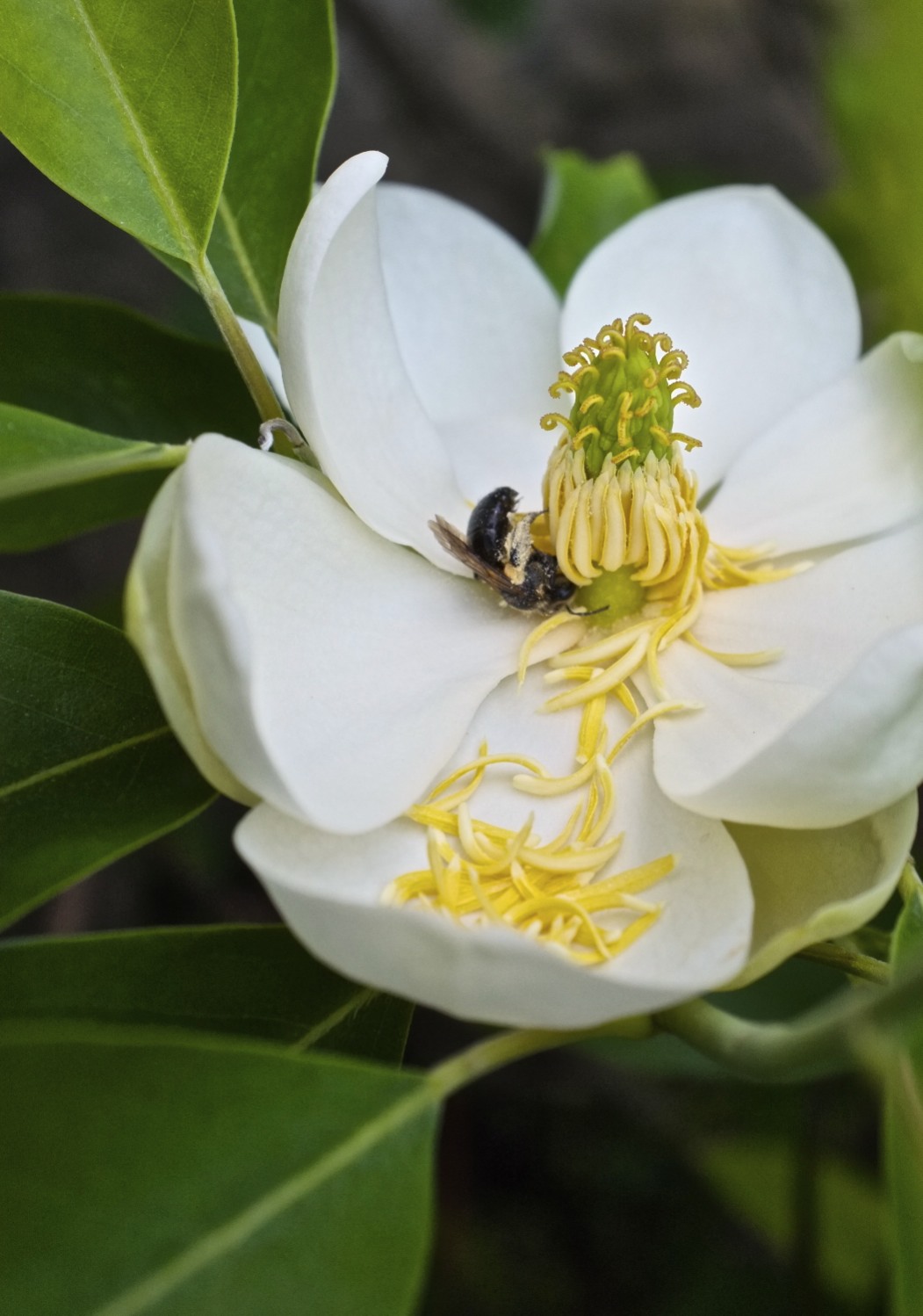
Magnolia virginiana ~ Sweet Bay Magnolia
Located in the heart of Ravenswood Park in Gloucester there is a stand of Magnolia virginiana growing in the Great Magnolia Swamp. It is the only population of Magnolia virginiana known to grow this far north. I took one look at the native sweet bay magnolia and breathed in the fresh lemon-honeysuckle scent of the blossoms, fell in love, and immediately set out to learn all I could about this graceful and captivating tree. Recently having returned from a trip to visit my family in northern Florida, I had tucked the bud of a Magnolia grandiflora into my suitcase. I was dreaming of someday having a garden large enough to accommodate a Magnolia grandiflora and was overjoyed to discover the similarities between M. virginiana and M. grandiflora. For those not familiar with the Southern magnolia, it is a grand, imposing specimen in the landscape, growing up to fifty feet in the cooler zones five and six, and one hundred feet plus in the southern states. M. grandiflora is the only native magnolia that is reliably evergreen in its northern range, flowering initially in the late spring and sporadically throughout the summer. The creamy white flowers, enormous and bowl-shaped (ten to twelve inches across), emit a delicious, heady sweet lemon fragrance.
In contrast, the flowers of the sweetbay magnolia are smaller, ivory white, water-lily cup shaped, and sweetly scented of citrus and honeysuckle. The leaves are similar in shape to the Magnolia grandiflora, ovate and glossy viridissimus green on the topside, though they are more delicate, and lack the leathery toughness of the Southern magnolia. The lustrous green above and the glaucous silvery green on the underside of the foliage creates a lovely ornamental bi-color effect as the leaves are caught in the seasonal breezes.
Magnolia virginiana is an ideal tree for a small garden in its northern range growing to roughly twenty feet compared to the more commanding height of a mature Southern magnolia. Sweet bay grows from Massachusetts to Florida in coastal freshwater wetland areas as an understory tree. The tree can be single- or multi-stemmed. Sweet bay is a stunning addition to the woodland garden with an open form, allowing a variety of part-shade loving flora to grow beneath the airy canopy. The leaves are a larval food for the Eastern Tiger Swallowtail butterfly. Almost immediately after planting we began to notice the swallowtails gliding from the sunny borders of the front dooryard, where an abundance of nectar-rich flowers are planted specifically to attract butterflies, around to the shady border in the rear yard where our sweet bay is located.
Our garden is continually evolving and part of our garden has given way to a limited version of a woodland garden, for the shady canopy created by the ever-growing ceiling of foliage of our neighbor’s trees has increasingly defined our landscape. We sited our Magnolia virginiana in our diminutive shaded woodland border where we can observe the tree from the kitchen window while standing at the kitchen sink. Gazing upon the tree bending and swaying gracefully in the wind, displaying its shifting bi-color leaves, provides a pleasant view when tending daily chores and the dreamy fragrance emitted from freshly opened blossoms make the chores all that less tiresome.
Excerpt from “Oh Garden of Fresh Possibilities!” Notes from a Gloucester Garden (David R. Godine Publisher), written and illustrated by Kim Smith.
Magnolia virginiana in Gloucester, Massachusetts
Magnolia virginiana in Massachusetts written by Peter Del Tredici.
History
The sweet bay magnolia swamp in Gloucester, Massachusetts has been a botanical shrine since its discovery in 1806. Early New England naturalists and botanists of all types, from Henry David Thoreau to Asa Gray, made pilgrimages to the site of this northern- most colony of Magnolza virginiana. The local residents of Gloucester were so impressed with a “southern”plant growing this far north that they changed the name oft he Kettle Cove section of the town to Magnolia in the mid-1800s. It is probably no coincidence that this name change occurred at the same time the area was starting up its tourist trade.
In addition to its isolation, the Gloucester Magnolia population was remarkable for having escaped notice until 1806 in an area that was settled in 1623. This fact has led at least one author to speculate that the colony was not wild but escaped from a cultivated plant (Anonymous, 1889). However, the overwhelming consensus of earlier botanists is that the population is, in fact, native. Whatever its origin, the swamp remains today the unique and mysterious place it has been for almost 200 years.
Very little has been written about the magnolia swamp in recent years. The latest, and best, article about it was wntten by Dr George Kennedy, and appeared in 1916 in Rhodora, the Journal of the New England Botanical Club. Dr. Kennedy summarized the history of the stand, and cleared up the confusion about who discovered it by publishing a letter he found, written by the Honorable Theophilus Parsons to the Reverend Manassah Cutler in 1806. The letter captures the emotion of the moment of discovery:
Reverend and Dear Sir:
In riding through the woods in Gloucester, that are between Kettle Cove and Fresh Water Cove I discovered a flower to me quite new and unexpected in our forests. This was last Tuesday week [July 22, 1806]. A shower approaching prevented my leaving the carriage for examination, but on my return, on Friday last, I collected several of the flowers, in different stages, with the branches and leaves, and on inspection it is unquestionably the Magnolia glauca Mr. Epes Sargent has traversed these woods for flowers and not having discovered it, supposes it could not have been there many years. It was unknown to the people of Gloucester and Manchester until I showed it to them. I think you have traversed the same woods herborizing. Did you dis-cover it? If not, how long has it been there? It grows in a swamp on the western or left side of the road as you go from Manchester to Gloucester, and before you come to a large hill over which the road formerly passed. It is so near the road as to be visible even to the careless eye of the traveler. Supposing the knowledge of this flower, growing so far north, might gratify you, I have made this hasty communication.
Your humble servant, Theoph. Parsons
To read Mr. Del Tredici’s fascinating article in full click here Magnolia virginiana in Massachusetts, including an excerpt from when Henry David Thoreau visited the swamp and wrote about it in his Journal.
Peter Del Tredici is a Senior Research Assistant at the Arnold Arboretum and Lecturer at Harvard Graduate School of Design. Peter writes the following for the Arnold Arboretum: “My research interests are wide ranging and mainly involve the interaction between woody plants and their environment. Over the course of thirty plus years at the Arnold Arboretum, I have worked with a number of plants, most notably Ginkgo biloba, conifers in the genera Tsuga and Sequoia, various magnolias, and several Stewartia species (family Theaceae). In all of my work, I attempt to integrate various aspects of the botany and ecology of a given species with the horticultural issues surrounding its propagation and cultivation. This fusion of science and practice has also formed the basis of my teaching at the Harvard Graduate School of Design (since 1992), especially as it relates to understanding the impacts of climate change and urbanization on plants in both native and designed landscapes. Most recently, the focus of my research has expanded to the subject of spontaneous urban vegetation which resulted in the publication of “Wild Urban Plants of the Northeast: A Field Guide” (Cornell University Press, 2010).”
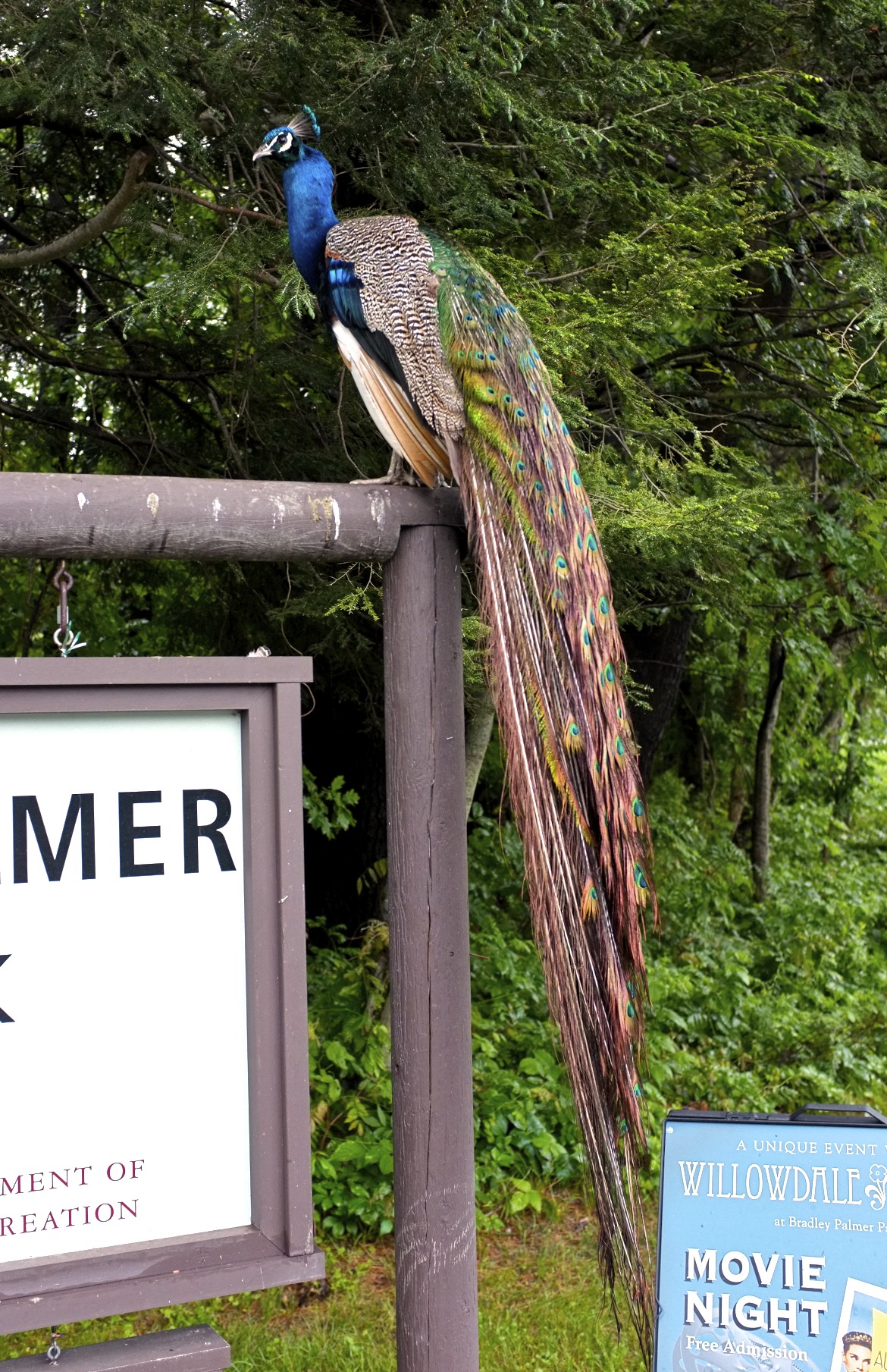
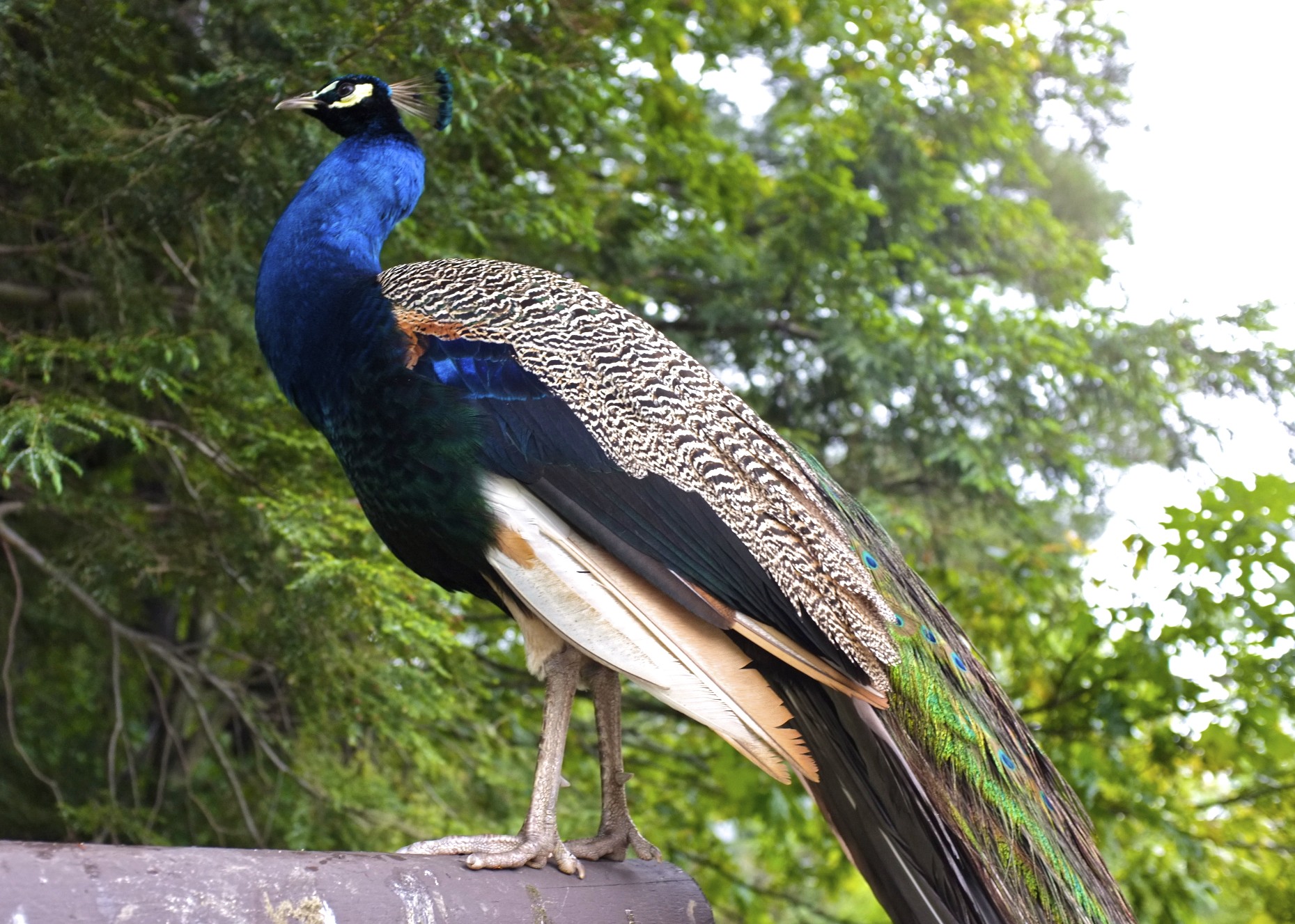
Willowdale Estate Peacock
Driving into Willowdale this morning I encountered our neighborhood Indian Blue Peacock. Daily sightings have been reported and the entryway sign is his choice perch. The Fujifilm x100 performed remarkably, despite the lack of sunlight and steady drizzle.
From wiki: Indian Peafowl, Pavo cristatus, a resident breeder in South Asia. The peacock is designated as the national bird of India and the provincial bird of the Punjab. The term peafowl can refer to the two species of bird in the genus Pavo of the pheasant family, Phasianidae. Peafowl are best known for the male’s extravagant tail, which it displays as part of courtship. The male is called a peacock, and the female a peahen. The female peafowl is brown or toned grey and brown.
More from Eastern Point Garden Tour
Snapshots from Eastern Point Yacht Club Garden Tour
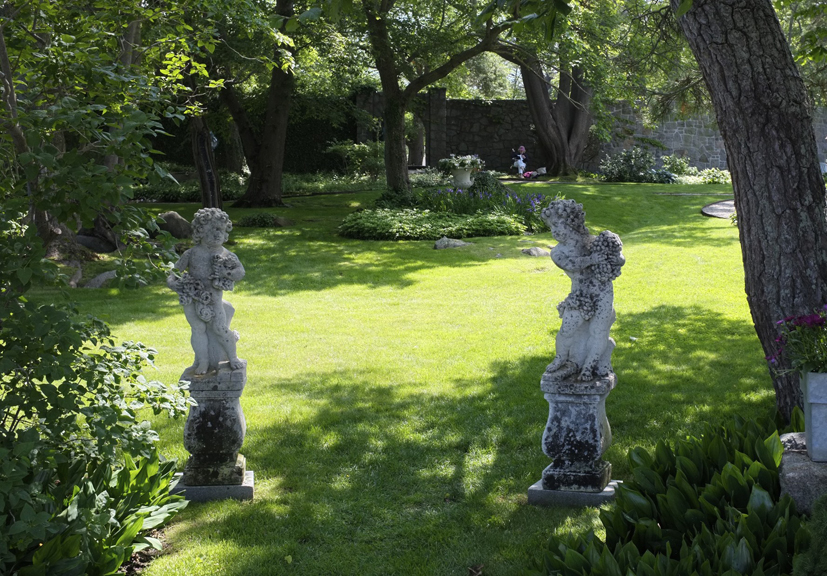
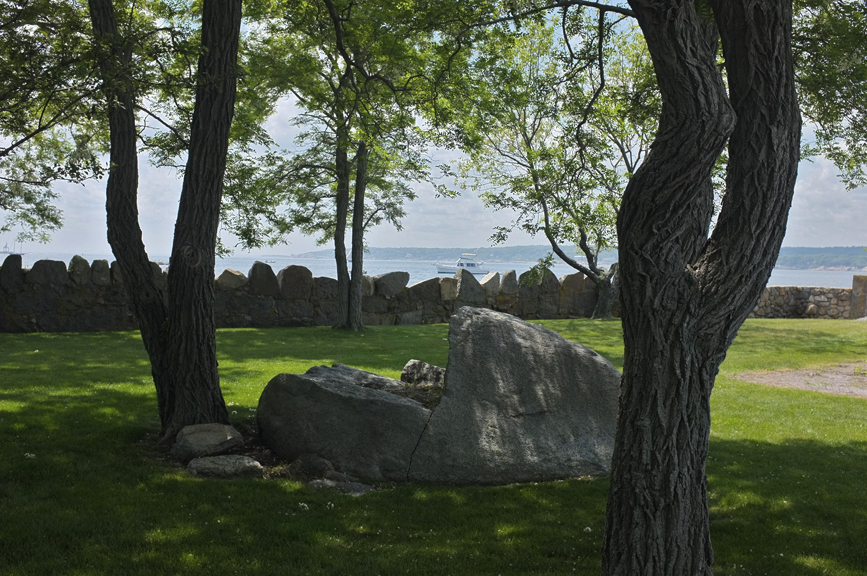
Thank you Good Morning Gloucester blog for posting the flyer for the Eastern Point Yacht Club Garden Tour. I am so wrapped up in work and would have missed it otherwise. I could only get away for the last several hours of the tour and did not get to see all. From what I did see, English cottage garden and English country manner is the dominant style, with a heavy reliance on plants originating from Europe and Asia. I am always on the look out for design inspiration, particularly a creative and natural use of native plants, however, all the gardens were lovely and beautifully maintained. Often put forth is the argument that older American homes need be planted with popular European and Asian plants in order to maintain historical accuracy. Many of the estates along Boston’s North Shore were built during the period of the late 1800’s through the first several decades of the 20th century, when in fact, a great passion for native plants and wildflowers, and their use in the landscape, developed amongst home owners and landscape professionals alike.
This beautifully growing and vigorous specimen of native Lonicera ‘Firecracker’ is a wonderful hummingbird magnet
Fujifilm x100 Butterflies!
I had planned to use my x100 for nearly everything–except butterflies and songbirds–what a pleasant surprise! Jpgs straight from the camera.
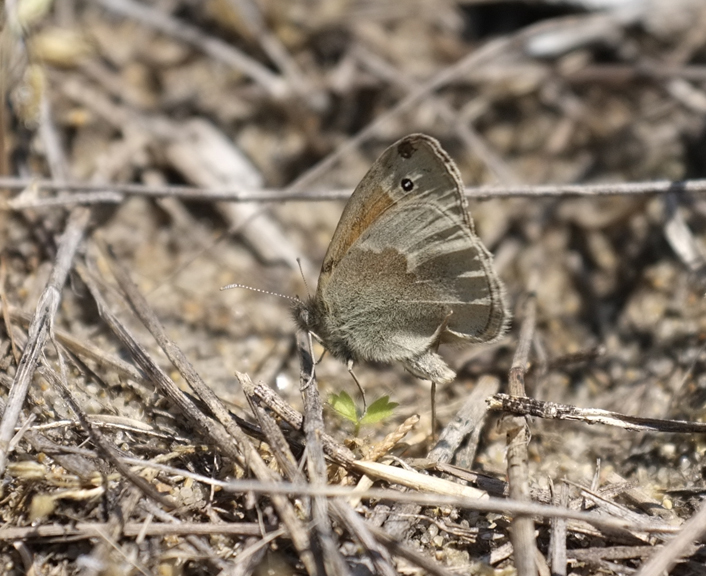
With an average wingspan of just under 1.5,” and because the butterfly was so well camouflaged in the leaf litter, the x100 struggled to focus, but I and it persevered and eventually got an acceptable identifying shot. This is a problem I have often encountered when photographing small butterflies on the wing, whether using my Canon DSLR or very fast Panasonic Lumix.
Common Ringlet (Coenonympha tullia) Shutter 200, Aperture f3/6, ISO 200
Question Mark (Polygonia interrogationis) Shutter 200, f3/2, ISO 400