Category Archives: Birds of New England

PSA: Dogs on Beaches

Why Can’t I Bring My Dog to the Beach?

According to the Gloucester City ordinance code, it is a $300.00 fine (doubled during the season) to bring a dog to Good Harbor Beach. For example, if you bring two dogs, that is 600. x 2 = $1200.

But stating the fines right off doesn’t explain why.

Health and Safety

Our beaches are wonderfully filled with beachgoers during the summer months. Can you imagine adding dogs, either on or off leash, to the mix? Dog ownership is at a record high, much greater than even a generation ago. In 2000 there were roughly 68 million pet dogs, today there are about 90 million dogs. What if everyone who owns a dog brought theirs to the beach?

Let’s face the facts, a great many dogs are not on voice command. We have dogs jumping on children, knocking over the young and old, biting people, and getting into dog fights and biting each other. That is not a safe scenario for any beachgoer.

But what if the law were changed to allow dogs on leash?

We would have half abiding by the leash law and half saying “I left my leash at home,” or “I thought it was okay to let my dog off leash after 5pm,” or “I thought it was okay before 8am,” etc. etc. How do we know this? Because we already hear these statements during the off leash/on leash days at Good Harbor Beach.Pile of poop at the Good Harbor Beach snack bar area

Dog Poop is a consequential environmental issue. During the season when dogs are allowed on the beach we see the gamut of poop-maintenance behaviors. Most people clean up after their pet. However, many people bury the poop in the sand or leave their poop bags behind. When someone leaves their bag by the footbridge, then other dog owners take it as a sign as a place to deposit their bag. The pile of dog poop in a rainbow color of bags grows and grows. Do we want beachgoers stepping in sand covered poop or being confronted with piles of dog poop? There is no poop cleaning fairy. It is left  to our awesome DPW or one of the very nice volunteers, like Chris Cefalo, his brother, and Michael Cook who regularly cleans GHB to remove garbage and also the bags of poop.

Good Harbor Beach footbridge

Keeping Dogs out of the Dunes During the Growing Season Helps Protect the Dune Ecosystem

If you regularly visit Good Harbor Beach during the off season, you can’t help but notice, the “Keep out of Dunes” signs are frequently ignored by pet owners. There are many who do respect this vital habitat, but also many who don’t. Dogs running and playing vigorously through the vegetation tears at the roots and weakens the plants. Vegetation holds the dune sand in place and without plants the dunes continually recede.

Over the past several years, you may also have noticed the vast improvement in the overall health of the dunes. There is a direct correlation to keeping the symbolically roped off areas up through out the summer season and into the fall because by preventing people and pets from recreating right up to the base of the dunes, it allows just that much more room for vegetation to take hold, and is one fantastic tool in the tool box against fighting erosion.

Dog going pooh within nesting area

Keeping Dogs off the Beach Helps Nesting Shorebirds Survive

Last, but not least, dogs on the beach are a well-known threat to shorebird nests and especially to young birds that can’t yet fly to escape danger.

How so you may wonder? “My dog is so sweet and would never harm a baby bird.”

When there are baby birds on the beach, the Plover parents do their absolute utmost best to keep the chicks safe. The parents exhibit all sorts of distraction behaviors including dragging and fluttering their wings on the ground to fake injury, thereby encouraging the predator to follow it and drawing the threat away from their most vulnerable chicks.

Plovers cannot tell the difference between a domestic dog, Fox, or Coyote. Dogs bound exuberantly on the beach through nesting areas and Coyotes and Fox dig in the sand for eggs and chicks. The ever vigilant Plover parent will  leave the nest and fly at any creature Canid. Often, both parents will fly away from the nest in a sort of tag team distraction method. But while they are busy defending the chicks from a member of the dog family, that is the perfect time for a gull, crow, hawk, or falcon to swoop in and snatch the eggs or eat the baby chicks. Crows focus on eggs and gulls not only eat the eggs, they also eat chicks at every stage of development, even fledglings that have grown as large as the parent. Coyotes eat both eggs and chicks.

Especially during pupping season, Red Fox scavenge the beach looking for shorebird eggs, small mammals, and birds to feed their growing family. Plovers cannot distinguish the difference between a Coyote, Fox, or domestic dog. 

Fierce Dad and FairFeathered Mom tag team distracting a Herring Gull

As I am writing this message, please know that we still have young birds at Good Harbor Beach that can’t yet fly well enough to escape predators. This is extremely late in the season and is due to the tremendous loss of nests during the May Nor-easter; losses all along the coast of Massachusetts. Many of the nesting birds eventually re-nested and we are seeing their offspring. Shorebird managers across Massachusetts  are contending with taking care of these late flying chicks.

Here are on Cape Ann we are blessed with many beautiful alternative locations to walk our dogs, including Crab Beach (adjacent to  the Boulevard), which is open year round to dogs and dog owners.

If you would like to see scenes of Plovers displaying their fascinating distraction techniques and learn more about predators on beaches, please watch our film The Piping Plovers of Moonlight Bay, which I created specifically for people to learn more about how we can all help protect shorebird wildlife and their habitats.  Our documentary is streaming on the PBS Passport AP 24/7. Anyone can become a member of PBS Passport by donating to PBS. It’s so worthwhile, especially for young children with curious minds.  What other streaming service can you get for $5.00 a month!!

As I first wrote, it is a $300.00 fine and doubled during the season to bring dogs to Good Harbor Beach, so please dog owners, for your sake, for the health of the beach ecosystem, and for the safety of growing shorebirds, please do not walk your dog at Good Harbor Beach or any beach where there is precious habitat and baby birds. Thank you!The No Dogs from April 1st through September 30th signs are boldly displayed at every entryway to Good Harbor Beach

Piping Plovers of Moonlight Bay at the New Hope Film Festival Monday!

I am very delighted to write that our Piping Plovers of Moonlight Bay is screening on Monday, August 18th at 6:00pm. We are sharing the billing with another animal welfare documentary, The Ramba Effect, about an Asian Elephant and her 2,550 mile journey to her new home at an elephant sanctuary. If you are in the New Hope area and would like to see The Piping Plovers of Moonlight Bay and The Rhamba Effect, please go here: https://www.goelevent.com/NewHopeFilmFestival/e/AnimalWelfareDocumentaries

Ruby-throated Hummingbirds, Jewelweed, and Canna Lily

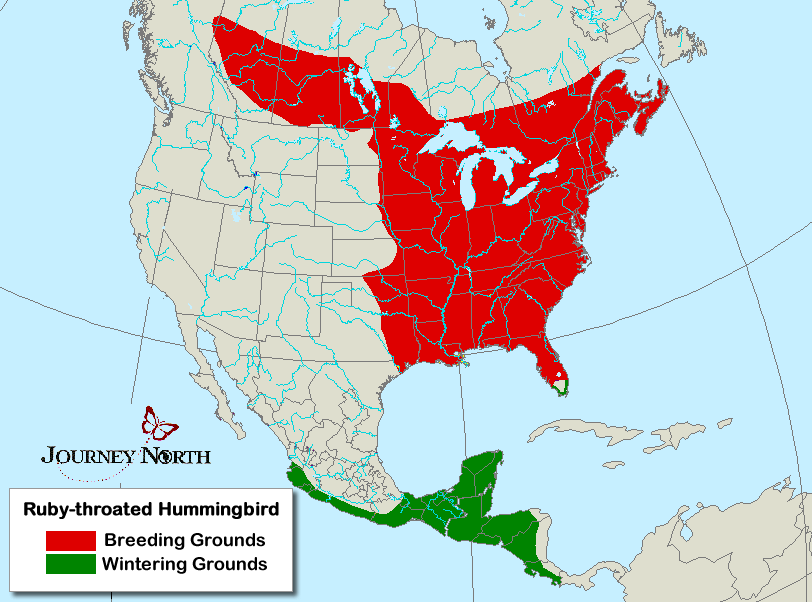
I loved filming Ruby-throated Hummingbirds on the beautiful bold flowering stalks of Canna Lilies (Canna indica) and just as much, I love seeing them drinking nectar from our North American native wildflower Jewelweed (Impatiens capensis). Even though not native to North Ameirca, it makes perfect sense that RTH forage from Canna Lilies as they grow natively in the Tropical Americas, the birds winter home!

Some fun things to know about Jewelweed:

Jewelweed has long been used in Native American medicine. Apply the watery sap topically to relieve itching and pain from Poison Ivy, Stinging Nettle, and hives.

The fruit of Jewelweed is an elongated capsule and at the slightest touch will burst open and send a little seed popper some distance, a fun activity to do with children and adults alike 🙂

You can grow Jewelweed in your native plant’s garden provided it is in a somewhat shaded and somewhat moist location. The Ruby-throated Hummingbirds, bees, and butterflies will thank you!

Ruby-throated Hummingbird Range Map courtesy Journey North

Massachusetts is Leading the Way in Piping Plover Recovery – Outstanding Coastal Waterbird Cooperators’ Meeting!

Carolyn Mostello, the Massachusetts Coastal Waterbird Biologist

Last week I has the opportunity to attend the Massachusetts Coastal Waterbird Cooperators’ Meeting. The meeting is held annually to bring together people and organizations that are involved with population monitoring and conservation efforts on behalf of coastal waterbirds.

Representatives from the seven Massachusetts coastal regions gather to share information, anecdotes, and data collected throughout the season. This year the meeting was held at Audubon’s stunning Barnstable Great Marsh Wildlife Sanctuary; hosted by Audubon staff and Carolyn Mostello, the Massachusetts Coastal Waterbird Biologist.

American Oystercatcher chicks

Threatened and endangered species such as Least Terns, Piping Plovers, Roseate Terns, and American Oystercatchers are given the greatest attention.

It’s fascinating to learn how we are all sharing similar experiences including egg predation by Crows, gulls, and Coyotes, disturbances of all shapes and kinds, low egg hatching, and storm washouts. Carolyn directs the event and she does an extraordinary job of weaving all the information together.

Reporting population numbers is followed by “Strange and Unusual,” a super fun section where field agents share funny/odd occurrences, photos, and videos. A special tribute was given to honor Shiloh Schulte, who perished in a tragic helicopter crash while studying shorebirds in Alaska. Shiloh Shulte was a beloved friend and mentor to shorebird conservationists every where and one of the  coordinators for the American Oystercatcher Recovery Program. You can read more about Shiloh and his work HERE.

The afternoon programs are especially interesting with presenters sharing experiments, projects, and best practices, including two of special interest to our region; one on launching in-depth data collection on fireworks, and best practice for engaging with landowners. All the programs are wonderfully educational.

Handicapped Mom and Super Dad’s second attempt at nesting

Despite an extremely challenging year, largely due to the fact that most of the nests around the State were washed out in a late spring storm, perhaps the most outstanding take-away is that this year again, Massachusetts is at the leading edge edge of Piping Plover recovery.  We should be super proud of our state. While many regions are seeing very little, none, or even worse, declining numbers, Massachusetts is leading the way in Piping Plover recovery!


Piping Plovers at the New Hope Film Festival!

Dear PiPl Friends,

I hope you are having a lovely summer. I am so looking forward to these last three weeks of August and then we go into the wonderfully atmospheric months of September and October. Is there anywhere in the north Atlantic region where these months aren’t sublime?

I have held off on writing about PiPls all summer because we have had some very late season nesters. I’ll share an extensive report about the Plovers when I feel its safe for them and they are well on their way to fledging. In the meantime, I am very delighted to write that our Piping Plovers of Moonlight Bay has been accepted to the New Hope Film Festival and is screening on Monday, August 18th at 6:00pm. We are sharing the billing with another animal welfare documentary, The Ramba Effect, about an Asian Elephant and her 2,550 mile journey to her new home at an elephant sanctuary. If you are in the New Hope area and would like to see The Piping Plovers of Moonlight Bay and The Rhamba Effect, please go here: https://www.goelevent.com/NewHopeFilmFestival/e/AnimalWelfareDocumentaries

For the NHFF official program guide, please go here: https://online.flippingbook.com/view/102134961/

We also have all new Plover Lover T-shirts in all sizes and a great color, a sort of light sea green. For fans of West Coast Snowy Plovers, these chicks could easily pass for Snowy Plovers too.  Please let me know if you like the new color. They are a beautiful quality, all cotton, unisex sizing from xs to xl. The Tees are 30.00 plus 5. shipping.

We have had some adorable “Butterballs” on the beach this summer. I define a Butterball as a fledgling that is so pudgy it looks nearly as big, if not bigger, than its parent and barely seems as though it can become airborne. Rest assured these Butterballs do fly, eventually <3

Common Tern fledgling squawking to parent, “Feed Me, Feed Me, I’m Starving!”

Happy Summer,
xxKim

Gull Trouble!

Great Black-backed and Herring Gulls are the species most commonly seen in our region. And both species pose a deadly, serious threat to Piping Plovers.

The gulls eat both Plover eggs and chicks. It’s not just tiny hatchlings they go after. We have seen Great Black-backed Gulls swoop in and take out a 25 day-old nearly-adult bird.

Plover parents employ several strategies for trying to prevent this from happening. They often call to their mate to come help and both will try to avert the gull’s attention. A Plover may drag its wing on the ground, faking injury in hopes of luring the gull away, or it may dive bomb the gull, or latch onto its tail feathers, and all the while making an angry, loud rattling call. Usually, the parents are successful, but not always.

In the above sequence you can see both parents left the chicks unattended in order to distract the gull. This tag teaming is usually very effective and the Herring Gull left after a short time.  Mom ran back to back to locate her babes, calling to the chicks to rejoin her, and soon the two chicks were thermo-snuggling beneath Mom’s protective wings.

Sometimes it takes a gull many minutes to lose interest and the chicks become increasingly vulnerable to predation. In our documentary, The Piping Plovers of Moonlight Bay, a Herring Gull swooped off with a chick. Despite the parents best attempts to save their offspring, the Gull mortally wounded both the adult male and the chick.

What is the Number 1 way you can help? – Please Don’t Litter

Prior to 1931, Herring and Great Black-backed Gulls did not breed in Massachusetts and were not present year round. Their populations increased significantly during the 20th century  because of the food resource available from landfills. They also prey on other birds and their eggs, and compete for nesting sites.

Great Black-backed and Herring Gulls are scavengers and thrive on the trash left behind on beaches. Never feed the gulls  on the beach. Please do not leave behind garbage and please do not bury trash. Gulls will find the garbage, as will the Crows, which are another species that is  equally as threatening to nesting shorebirds as are Herring and GBBGulls.

Plover Lovers Update!

Dear PiPl Friends,

I am behind in providing updates and I apologize for that. Frankly, with the scale of all that is so very dark currently taking place in our country, I struggle with focusing on what is positive and good in the world of wildlife. Fortunately for them they know none of this. Happy news to share is that our Good Harbor Beach Plovers are recovered from the very late season nor’easter and are back on track with nesting activities. Not only Gloucester Plovers, but Plovers all around the region are regaining their bearings after the catastrophic loss of nests and habitat.

Plovers will re-nest (in other words, lay another clutch of eggs) as much as 3 to 4 times and in some extreme cases, have been known to re-nest 7 times. We always hope the first clutch is successful for several reasons. The earlier in the season the chicks hatch, the earlier they will fledge and be off the beaches. It is also very taxing on the female to lay additional eggs. Conservation biologists are very protective of breeding pairs, in a way even more so than chicks, because pairs that are known to breed are the birds that will carry on the species.

Wonderful news for our documentary The Piping Plovers of Moonlight Bay, which has been accepted to the New Hope Film Festival, a truly stellar festival founded by a gentleman Doug Whipple, with the intention of highlighting independent filmmakers. New Hope sounds like a fun boho arts community and I am looking forward to attending this festival. The dates are August 15-24th and as we get closer to the event,  I’ll let you know more.

Rockport Middle Schoolers Cora and Juniper reached out to me for information about Piping Plovers for a project they were working on for their civics class. Don’t you love that Plovers are part of a civics discussion! I was delighted to help the girls with their project. They did an absolutely fantastic job and with permission, I am sharing the storyboard they put together for their presentation. Many thanks to Juniper and Cora for their interest in Plover conservation. I have been inspired by the two of them to create a shorter program for middle school kids as an hour long film presentation is suitable for high school, but the class periods are shorter in middle school from what I have learned.

My friend Jane in Nova Scotia shares an amazing ‘Plover Resiliency’ photo – the Plovers in her community are nesting at the TOP of the breakwater. The pair have found a tiny bit of grass and sand amidst the rocks. In case you were wondering, as was I, she reports that the tide never goes that high.

And my new Plover friend, Rhonda, in Ocean City, New Jersey, shares that their chicks have hatched and are doing well. Like Good Harbor Beach, the beach where their Plovers are nesting is also a highly trafficked location and has been consistently voted New Jersey’s most popular beach. Rhonda organized a screening of POMB with a virtual QandA at the Ocean City Public Library and the audience was so engaged. It was an utter joy to present to this very enthusiastic crowd. You can read more about the screening here: Ocean City Has Some Good Things to Say About The Piping Plovers of Moonlight Bay

That’s all the Plover news for now. Happy Sunday!
xxKim


Why Can’t I Fly My Drone Over Good Harbor Beach?

Fairly frequently when coming onto Good Harbor Beach to check on the Plovers, we find the birds off their nests and in utter panic. I have learned over time that there is only one reason why the birds along the one mile stretch of beach are frightened enough to leave their nests, in unison.  Sure enough, in a moment or two, you hear the drone’s whirring motor first and then observe as it passes over the protected areas of the beach. Usually not one go around, but the operators make repeated passes over the birds. Whether zooming at top speed or hovering, the Plovers are terrified by these modern day avian predator-like cameras.

It is illegal and considered harassment under the Migratory Bird Treaty Act to operate a drone over breeding areas. People are either unaware, feign ignorance, or even worse, are aware and simply don’t care. Countless times we have come onto our shifts to find all the birds in the area in complete meltdown mode. The birds think the drone is a predator that has come to eat their eggs, chicks, or themselves. There are even instances where a bird has flown after the drone and becomes injured. Today a man told me he was fully licensed to fly his drone over Good Harbor Beach. Drone operators need to understand that state, federal, and local ordinances supersede any licensing permit (see below for Good Harbor Beach regulations regarding drones).

There is accumulating evidence that the mere presence of drones causes direct harm to birds, not just during breeding season. The unfamiliarity and noise interrupts courtship, mating, and feeding. Entire tern and heron colonies have been abandoned due to drone disturbances.

Plover in crouched position, frightened by overhead drone, and off her nest

This past spring there was a political rally at Good Harbor Beach. We thought it tremendous that people were gathering in support of their views and the birds had absolutely no problem with the steady stream of people entering the beach from all directions. However, the representative’s organizers began preparing a sign that could be read only from an aerial pov, which meant they intended to fly a drone over the beach. We asked the organizers to please not fly the drone but they ignored our pleas and told us the drone was only going to fly over the water and the drone would only be on the beach for a few minutes. Of course we knew that would not be the case and sure enough the drone flew repeatedly over the dunes, disturbing every bird along the entire length of the beach. After fifteen minutes of sounding their alarm calls, all the birds on the beach flew off in unison. The drone was documented flying low over the beach for 45 minutes. Clearly, a beach with nesting birds is not the place to hold a rally if a drone is part of the equation, particularly when there are other locations as easily accessed.

Over millennia, nesting birds evolved with the constant threat of avian predators, including hawks, falcons, crows, gulls, and eagles. They have not adapted to understand that a drone is not a predator, no matter how much the drone operator protests that the birds are unbothered by the drone and have become used to its presence.

It is imperative for the safety of the birds that they have a healthy fear of drones. The last thing we want are nestlings thinking that hovering airborne shapes are nothing to be afraid of.

In our collective experiences monitoring the Plovers, we come across unethical behavior not only on the part of drone operators but also by fellow wildlife enthusiasts. We have seen photographers mashed up against the symbolically roped off areas, despite massively long telephoto lens, parking themselves for hours on end, and also following the birds relentlessly up and down the beach, despite the bird’s clear signals it is trying to get away and/or tend to its chicks. Early on in the pursuit of my dream to document wildlife, I was part of crowds that photographed owls. Observing how sensitive are owls, I no longer film owls in known locations. If I come across an owl or rare bird when out filming, I take a few photos and footage and go on my way. Crowds and hovering persons are also the reason why I no longer post specific locales and keep location information general.

To ethically document wildlife requires thought and is also a tremendous responsibility. We can all do our part to protect the beautiful creatures in our midst by being mindful and sensing their boundaries, especially, especially during the time of year when they are breeding.

Thank you for taking the time to read this information. I hope your question is answered, and why. Please share this post. Thank you 🙂

Nesting birds that are negatively impacted by drone operators include, but are not limited to, Bald Eagles, Great Blue Herons, American Oystercatchers, Least Terns, Little Blue Herons, and Piping Plovers

City of Gloucester Good Harbor Beach Regulations for Model Airplanes, Radio Controlled Aircraft, Drones

Good Harbor Beach Parking Lot

1. Permitted to fly only when beach parking lot is not in operation (no attendant on duty).

2. Restricted to times when pedestrian and vehicle traffic are at a minimum.

3. Not permitted before 8:30am.

4. Shall fly over the parking lot and marsh areas, not the road or beach.

5. Noise levels will be restricted to an acceptable level (non-flow thru, expansion chamber mufflers only).

6. Pilots shall fly in a safe and responsible manner at all times.

7. Pilots will be responsible and liable for their actions.

8. Pilots will abide by regulations in effect and maintain a safe environment.

9. Pilots will be considerate of wetlands and wildlife.

Piping Plovers of Moonlight Bay Free Virtual Screening!

Dear PiPl Friends,

Please join me Thursday at 6:30pm for a free virtual screening and QandA of The Piping Plovers of Moonlight Bay. My new Plover friend Rhonda, from Ocean City, New Jersey, has created this event. She is hosting the screening along with the Ocean City Free Public Library. They have very generously made the screening free and open to the public. To register, please go here:

https://oceancity.bibliocommons.com/events/681f62880537f314d2fd563e

Featuring Sweet Warblers and The Bird Collision Prevention Alliance

Dear PiPl Friends,

This lovely little Yellowthroat accompanied me on a recent early morning walk, or rather, we were both headed in the same direction. The warbler foraged all along the way, snatching insects as he darted from branch to branch before descending to the ground, where he found a rotting log rife with bugs.

His official name is Common Yellowthroat, but I don’t see anything common about the striking feather pattern of this petite bandited warbler.

According to Cornell, Common Yellowthroats are “resident to long-distance migrant. Most populations migrate; some go short distances and others journey all the way from northern Canada to Central America. Some populations in the southern United States and Mexico stay in place year-round.”

Speaking of bird migration, I met in person a new friend this week, Jane Alexander. Not exactly a new friend as Jane and I have been corresponding for many months over email. She stopped by with her son, Tony Sherin, on their road trip northward. What a joy to meet this extraordinary woman and her son. Jane is not only a gifted actress of stage and screen, but a passionate conservationist. And she has been an ardent social activist her entire adult life (The Great White Hope, Testament, Eleanor and Franklin). Her son is a documentary filmmaker and editor (and also a fellow Fujifilm camera lover) so we had lots and lots to talk about.  The time flew by and was much much too short.

Jane has been watching over Piping Plovers at her summer home for decades. She very kindly donated to our documentary The Piping Plovers of Moonlight Bay and I am so grateful for her generosity and for her true love of these valiant little birds. Amongst many of her projects, Jane has been involved in launching the Bird Collisions Prevention Alliance. Their brand new website is up and running with the tagline: More than 1 billion birds die in collisions with glass every year. The time to act is now! The website includes the reasons as to why birds hit glass, guidelines on solutions on how to help, and a call to action. Please visit the website to learn more more about how we can prevent a billion birds perishing every year.

Note the difference between the female and male Common Yellowthroat

One Night. One Building. 1,000 Dead Birds: A Simple Change Made a World of Difference

My friend Deborah shared this fantastic article. Please read 🙂

50 States, 50 Fixes

An Illinois Building Was a Bird Killer. A Simple Change Made a World of Difference.

Chicago is one of the most dangerous cities in the United States for migrating birds, and a glassy lakefront conference center was especially lethal.

The morning promised to be deadly.

High above Chicago, in the predawn dark, flew an airborne river of migratory birds. It was peak spring migration traffic, in late April, and the tiny travelers were arriving at one of the most perilous points along their journey.

These birds, inhabitants of forests and grasslands, do not perceive glass as solid and get confused by its reflections. Bright city lights seem to attract them, luring them into glassy canyons. The gleaming buildings of Chicago, curving along the shore of Lake Michigan, are especially lethal.

Palm Warbler


50 States, 50 Fixes is a series about local solutions to environmental problems. More to come this year.


A call went out to volunteers across the city: Be ready to hit the streets early to rescue the injured and document the dead.

But at the building that has long been the city’s most notorious bird killer, a sprawling lakefront conference venue that claimed almost a thousand birds on a single day in October 2023, new protections were in place.

Read more here

Yellow-rumped Warbler eating Poison Ivy berries

Glossy Ibis Catches a Frog!

I was amazed to watch a Glossy Ibis capture a large Bullfrog and had just assumed they were foraging on insects and other small invertebrates when probing about in fields. Subsequently I have learned that they eat a remarkable variety of food including leeches, earthworms, marine worms, dragonflies, crickets, grasshoppers, many species of beetles, soldierflies, crabs, shrimp, crayfish, mollusks, snails, fish, frogs, toads, newts, salamanders, snakes, lizards, and grains such as rice and sorghum.

Airborne Ibis!

What an unexpected gift to come across a very large flock of the gregarious Glossy Ibis foraging in a local field, then taking flight in unison. Glossy Ibis are found throughout the world and their population on Cape Ann has grown noticeably. According to Cornell, the North American population increased an estimated 4.25 percent between 1966 and 2015.

I think I captured one catching a frog! and will surely try to make time to post the footage.

Huge Shout Out to the Gloucester High School Gender Equity in STEM Club!!

Early this week I had the absolute joy of presenting The Piping Plovers of Moonlight Bay to the Gender Equity in STEM Club at GHS. The students were amazing! The film is an hour long and despite the fact that the program was held after school and after a long day of classes and activities, they were fully engaged and asked many astute questions during the QandA following the screening.  Student advisors to the Club, GHS biology teacher Eric Leigh and coordinator Roseann Vidal are a pleasure to work with. Thank you to the students and advisors for making the screening of The PPOMB a very rewarding experience for this filmmaker!

With deep gratitude to Applied Materials, who, along with the Gloucester Educational Foundation, supports the Gender Equity in STEM Club. The presentation of The Piping Plovers of Moonlight Bay was also funded by a generous grant from Applied Materials.

To learn more about the Gender Equity in STEM Club, read the following article by Gloucester High student, Ruby McElhenny.

The Gender Equity in STEM Club: Why it matters

Happy Mom’s Day!

Happy Mother’s Day to all the Moms, Aunties, Grandmoms, Sisters, Friends, and Dads who are Mom’s, too. Thank you for being you <3 Wishing you joy and happiness on this sunniest of Mother’s Day. xoKim

Our Good Harbor Beach footless Super Mom

One of ten clutches of eggs that Super Mom has laid at GHB since she and her mate first arrived in 2016.

In 2021, Super Mom’s right foot became very tightly wound with seaweed and fishing line. The following year, she returned to Good Harbor Beach footless. Yet despite that, her handicap does not prevent her from doing all the usual things Plovers do daily.

Piping Plovers, and many species of shorebirds, have a foot tamping technique, where they rapidly shake their feet in the sand to stir up invertebrates. Also called foot trembling, the action brings invertebrates to the surface where the Plover sees and catches the prey. Watch how Super Mom expertly forages for tiny mollusks and in this case, appears not hindered by her missing foot. Not all is great for our footless Mom, though. Occasionally I see her legs become very tired and she does a series of spazzy movements across the sand, as though she is having some sort of leg cramping going on.

The first clip is in slow motion so that you can see the technique; the second clip is in real time.


Black Scoter Washed Ashore

Black Scoter resting at GHB

A seaduck we don’t often see on shore. I believe he is a juvenile male. He came in with a storm and I think just needed to rest and recharge before heading back into the rough surf.

Darling Dunlins

We see Dunlins in late summer and fall as the birds are heading south for the winter. They often travel in great flocks however, last October, a singleton was migrating along with an American Golden Plover and the two spent a few days at Brace Cove.

They are rather plain looking in feathers shaded sandy gray and taupe.

Dunlin in October

What a treat to see a northward bound Dunlin that is transitioning to its striking breeding plumage. I almost didn’t recognize the fellow in his fancier feathers!  

Dunlin at Eastern Point in mid-April

Dunlin range map

Love is in the Air

There are currently so many creatures migrating through our region that it is challenging to keep up with all. In addition to the beautiful northward migrating shorebirds and songbirds, our resident wildlife are setting up house, and also mating like crazy! On Friday I took the entire day off to film and was delighted that in the span of an hour, a pair of Killdeers mated several times, and at every Osprey nest that I like to check in on, pairs were mating, also repeatedly!Great Egret with it’s distinctive green eye feathers, only seen during mating season

Killdeers mating

Male Osprey swooping in to mate

Male and female White-tailed Deer. Look closely and you can see the male’s budding antlers.

Mom and Dad PiPl mating

Plover nest scrapes

Female Red-winged Blackbird building her nest in the reeds.

Male Red-winged Blackbird


Thoughts About Leaf Blowers and How We Can Possibly Find a Solution Working Together :)

Whether or not to ban gas-powered leaf blowers sure is creating a maelstrom of divisiveness in our communities. Everyone who has an opinion feels strongly, very strongly, that their viewpoint is the correct pov. Let’s think of the pros and cons and perhaps there is a solution. If I missed a pro or con, please feel free to write so we can include your point of view.

PROS of Gas Powered Leaf Blowers

Landscapers and homeowners appreciate the lower cost associated with gas-powered leaf blowers.

GPs are more powerful than electric, saving time and money.

Many landscapers and homeowners already own gas powered blowers.

CONS of Gas Powered Leaf Blowers

Gas powered leaf blowers are very loud particularly when multiple blowers are in use simultaneously.  The noise pollution is disruptive and unpleasant to neighbors.

GP blowers emit a strong odor of gas fumes, harmful to the environment and to the person operating the leaf blower.

Some observations – our home is located in a middle class neighborhood where leaf blowing does not occur regularly, if at all, whether gas or electric. I do however have clients in more affluent neighborhoods where the use of leaf blowers is much more prevalent. People are correct, the noise level is extremely loud. A crew of men, typically Latino, will disembark from company pick-up trucks, with gas powered blowers strapped to their backs and ear phones snugly wrapped over their ears. The crew of half dozen or so will spend a good part of an hour blowing the leaves off a driveway that won’t even be driven on again until the summer resident homeowner returns the following year. Not only does it seem like an utter waste of time, it concerns me that the employees are breathing the fumes. This is also the same crew that I see spraying pesticides around the base of the homeowner’s foundations, also not wearing protective covering. I am wondering if protective masks and clothing can be provided to the employees that are required to use gas-powered leaf blowers and pesticides.

Do homeowners need half a dozen men blowing leaves off driveways and the street in front of their homes? Perhaps with less demand for an immaculate leaf-be-gone landscape, one gentleman wearing a mask, as opposed to six maskless men, could do the work. If a homeowner is having considerable work done and a leaf blower is needed to assist in clean-up, that seems to me like a reasonable use. Or if a pathway is covered with wet leaves creating an unsafe situation for an elderly person, that too seems like a reasonable use.

In my own landscape design firm, I encourage clients and friends not to remove leaves and the expired stalks of flowering plants. To my way of thinking, leaves on lawns and in flower beds is a beautiful thing! Not only are the decaying leaves providing a protective layer and adding nutrients to the soil, leaves also provide habitat for all manner of insects. I think at this point in our shared awareness about the environment, we all understand that insect populations the world over have plummeted.  We homeowners and landscapers can help insect populations by leaving leaf litter in our gardens. The most delightful benefit of a garden that supports insects, is that the insects attract a host of beautiful songbirds that in turn conveniently eat the insects <3

For the benefit of insects, especially native bees, we also do not cut down the expired stalks of flowers until the end of April. In the late summer and early fall, native bees and other insects burrow into the stalks. When we do eventually cut down the stalks, we leave them in a pile for several weeks before discarding, hoping our little pollinator friends have wiggled out of their winter home.

Perhaps if we can change people’s mindsets about what constitutes a healthy landscape, the fashion of blowing leaves will become mush less problematic.

The song of a Carolina Wren chortling from a treetop has to be one of the sweetest songs you can imagine hearing in you garden. They love to rumple about in the leaf litter, foraging for insects. Insects are an important part of a songbird’s diet, especially during the breeding season when the females are producing eggs.

Carolina Wren nest with eggs tucked under our porch eaves – 

Later in the season, a Carolina Wren fledgling is perched on the back fence. She was made fat and healthy from a diet rich in your average garden variety insects – 


Golden-crowned Kinglet Alert!

When the tiniest of songbirds with the fanciest of names flits alongside on your walk, you may be lucky enough to catch a photo. Well-camouflaged in their generally olive plumage, they elusively dart about the wooded edge of the path but flashes of their little golden crown gives them away.

Kinglets, both the Golden-crowned and Ruby-crowned are migrating through eastern Massachusetts. They are laser focused on insect meals and are often found along shrubby woodland pond banks where there is typically no shortage of bite-sized-for-kinglets arthropods.

For previous posts about kinglets, see the following –

Invasion of the Golden-crowned Kinglets

Pocket-sized Ruby-crowned Kinglet

King Eider Mussel Diver!

The grand, and rarely seen on Cape Ann, King Eider, has been spotted for several weeks foraging in Essex alongside a raft of Common Eiders. It was too windy for my camera to capture a beautiful still close-up, but here you can see him diving for mussels at Conomo Point. The more typically seen male Common Eider, behind the King Eider in the footage, is also foraging for mussels.  Amazingly, eiders swallow mussels whole! They have super strong gizzards that can digest the mussels, shell and all.


Return of the Yellow-bellied Sapsucker(s)!

For well over a year, our garden has been graced with the fascinating Yellow-bellied Sapsucker. The visits began with a male eating Pokeberries in December of 2023 and have continued intermittently through today.

A female was here for a day last week however, we have had so many Cedar Waxwings in the Dragon Lady Holly, they may have frightened her off. For the past three days, a male YBSS has been industriously revitalizing the sap wells created by the female last year. He is also meowing!! That’s right, the appropriately named bird for a cartoon (or a proper insult), makes a crinkly mewing sound!

Listen for the mews-


Photos to Help ID Male, Female, or Juvenile Yellow-bellied Sapsucker

Male YBSS – Red cap and red throat

Female YBSS – note that she does not have a red throat

Juvenile YBSS -softly mottled brown

Male Sapsucker in the rain yesterday


Yellow-bellied Sapsucker Timeline

Summer 2023 – Newly seeded Pokeberry bush grows six feet first summer (most likely the seed was deposited by a bird).

December 2023 – First ever male YBSS. Stays for several days eating Pokeberries.

March – May 2024 –  Female YBSS created striking grid pattern of sap wells on both the Dragon Lady Holly and Magnolia soulangeana trees, concentrating her efforts much more on the Holly. She spends many weeks drinking the sap, digging more wells, and eating insects attracted to the sap flows. Ruby-throated Hummingbirds discover the sap wells.

Summer 2024 – Ruby-throated Hummingbirds daily drink nectar from the small pinkish whiteish flowers of the Pokeweed.

October -November 2024 – Female Yellow-bellied Sapsucker returns. She is drinking nectar and eating insects attracted to the sap wells every day, through November 17th.

November 12, 2024 – Both a juvenile and female at the DLHolly saplicks.

March 26, 2025 – female YBSS at the Holly tree. Flock of Cedar Waxwings may have frightened her off.

April 3rd, 4th, and 5th – Male Yellow-bellied Sapsucker drumming and drilling at the Dragon Lady Holly, crabapple, and Magnolia soulangeana. Mewing frequently.

The Piping Plovers of Moonlight Bay Now Airing Nationwide on PBS!

Hello PiPl Friends!

Checkout this lovely graphic created for us at American Public Television for our release on PBS!  Beginning today, April 1st, The Piping Plovers of Moonlight Bay is airing on public television. Please check your local listings for times.

As a Passports member, you can stream the film at anytime. We find our family’s membership to PBS invaluable; the programming is stellar and costs a fraction of any other streaming service, just $5.00 per month. We are members of New Hampshire PBS, which is also one of the 290 stations nationwide airing The Piping Plovers of Moonlight Bay. Here is the link on how to join: https://nhpbs.org/watchmore/ 


American Kestrel Beauty!

Raptors are on the move, including the exquisite American Kestrel. I typically find these pint-sized falcons perched on sparse trees above low growing vegetation, scanning the landscape for their next meal. Kestrels eat a wide variety of invertebrates – mostly grasshoppers, beetles, cicadas, dragonflies, scorpions, spiders, butterflies, and moths. They also eat voles, mice, shrews, bats, small songbirds, snakes, and lizards.

From a distance, this male Kestrel I thought was at first a Mourning Dove, though possibly not. I took several snapshots before realizing my exposure setting was still set for filming creatures in dark foliage. He flew away as I was adjusting the exposure. The photo is very overexposed, nonetheless, I like how brilliant his feather patterning and colors show in the image.

Tip – The American Kestrel is the smallest and most common falcon found in North America however, the population has declined by 50 percent. The primary reasons are loss of habitat and pesticides. You can help these North American beauties by leaving dead trees standing where ever possible. Kestrels nest in natural tree cavities and nests excavated by other tree cavity nesters. They will also nest in manmade nest boxes designed for Screech Owls!

American Kestrel Male


Plover Love Story for the Ages #ploverjoyed

Dear Friends,

We have wonderful news to share. Our Gloucester Plovers are returning! Not only that, but the original pair that have been nesting at GHB since 2016 were the first to arrive. Both Mom and Dad appeared on the very same day, March 19th, the earliest date ever.  At this time of year, my husband and I check the beach daily so that we can track from year to year when Plovers begin arriving. Last year I believe it was March 25th.

Super Dad and Handicapped Mom, March 19, 2025

A Plover love story for the ages is how my friend Todd describes it when Plover pairs nest together for many years. These two sweet Plovers must be at a minimum of 11 years old because Plovers don’t begin breeding until they are at least one year old. Eleven years is quite a ripe old age for Plovers as most live on average only five years. We wait with a combination of fear and excitement each spring, hoping and praying our Plover family makes it through another winter, especially now that Mom’s right foot is missing. She lost her foot several years ago after nylon fishing line and seaweed became tightly wound around her lower leg.

When you think about it, we have been through so much with this little Mom and Dad. The first several years especially were extremely challenging. Beachgoers did not yet understand how to help protect the birds and pets had the run of the beach. In fact, conditions were so bad on the beach that in 2018 Mom and Dad decided ‘enough with dog disturbances,’ and the safest place to nest was the GHB parking lot. Because of this, Massachusetts State and US Federal wildlife officials became heavily involved with helping to protect Gloucester Plovers and the local government began to take Plover protections more seriously. Little by little, things began to change for the better.

I remember our tender little handicapped Plover, nicknamed HipHop for his gimpy walk. It was Mom’s first season breeding without her right foot and she was extremely clumsy when transitioning to get in and out of the nest and when she was snuggling the chicks. I think she must have injured HipHop somehow because his injury manifested itself when he was about ten days old. Mother and chick were quite the pair with their hip hopping gaits. We thought HipHop would never grow to the size of his siblings and wondered if he would ever be able to fly. Mom departed early as is not unusual for females to begin migrating before their mates. Our Super Dad stayed with HipHop for many weeks after and throughout the entire summer. Both departed around the beginning of September, but not until HipHop was flying just as well as his siblings.

Dean Horne, Brian Watson, John Trupiano, and Adam Kelley installing Piping Plover protections

Thank you to the Gloucester DPW crew for installing the symbolic ropes and Plover signs. We appreciate everything the DPW does to keep Plovers safe and our local beaches looking beautiful!

If you happen to see Plovers on the beach, please give them lots and lots of space. Know that they are weary from the long migration and need to rest and refuel before ‘setting up house.’

Piping Plovers are returning to beaches all along the Atlantic Coast. The addendum to this note is for several new Plover friends from beaches in Maine and New Jersey who have written to ask how they can better help their community’s Plover families successfully fledge chicks.

Happy Spring from Ploverville!

Warmest wishes,

Kim

Actions that communities and beachgoers can take early in the season to help Plovers successfully breed include the following. I can not stress ‘early in the season’ enough. The earlier the Plovers nest without disturbances, the earlier they will begin laying eggs, and the earlier the chicks will fledge and begin migrating.

1) Disallow all pets on the beach, ideally beginning March 15th, April 1st at the latest.

2) Install symbolic roping around known Plover nesting areas by March 15th.

3) Install informational signage on beaches where Plovers nest by March 15th.

4) Do not permit off-road vehicles on beaches where shorebirds are nesting.

5) Do not rake the beach. Beach raking destroys a vital food source and machines can scoop up and kill chicks that can’t yet fly out of the way of danger.

6) Respect symbolically roped off areas. Do not play ball close to the roping. It is against state and federal law to run into the nesting area to retrieve a ball or for any other reason. Do not allow pets to run through the roped off areas and do not cross the roped off areas to take shortcuts through the dunes.