Tonight I am placing the order for the milkweed plants. Please get your orders in.
Thank you, thank you to Everyone participating in our Cape Ann Milkweed Project!!!
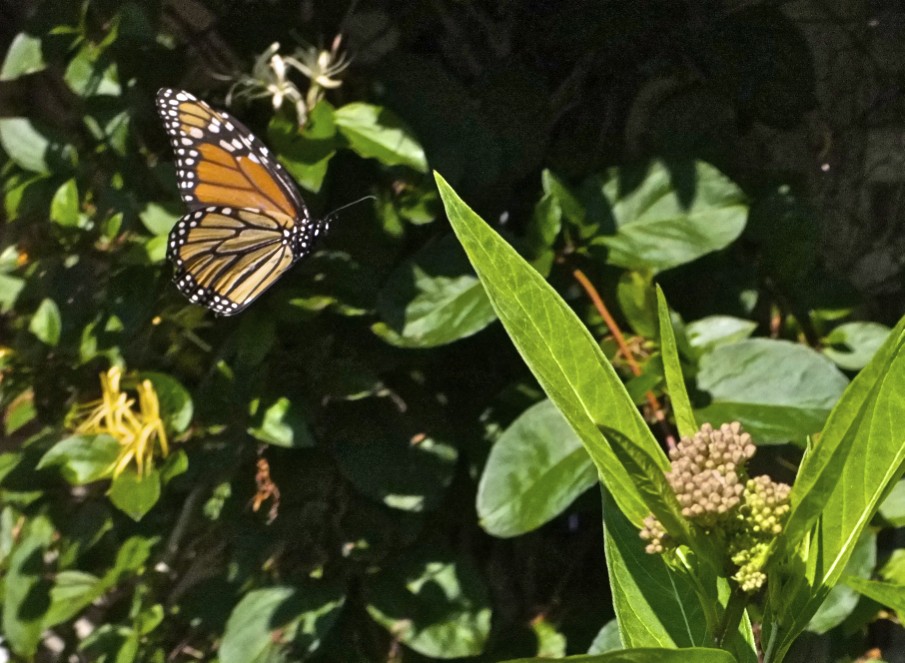
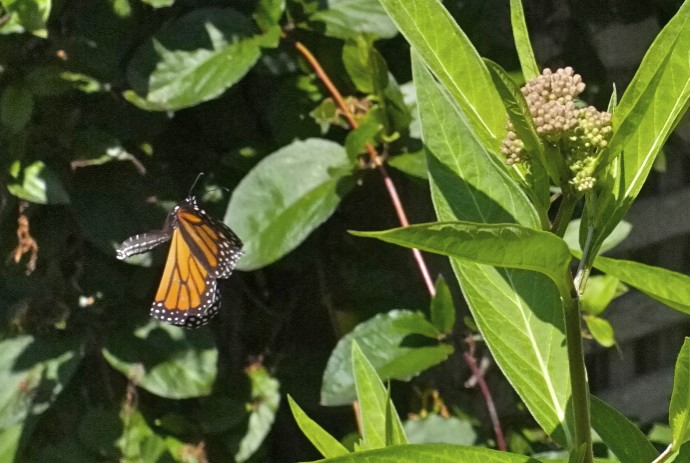
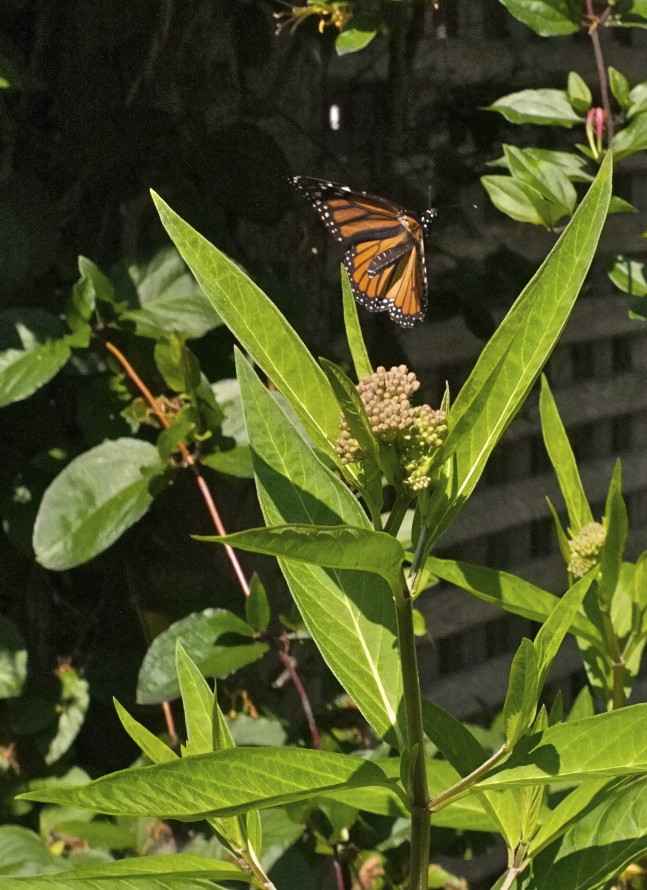
Newly Emerged Monarch Butterflies. I called these two butterflies the” Twins,” because they completed every stage of their life cycle within moments of each other, including pupating and emerging from their chrysalides.
Everyone who wrote in yesterday and placed an order has been recorded. Anyone interested in ordering either Common or Marsh Milkweed today, please place your order in the comment section of this post or yesterday’s post, which explains the project, and includes all details. Don’t forget to specify whether you are interested in Common or Marsh Milkweed and how many plants you would like.
Thank you so much to everyone who is participating. Keep the orders coming!
Monarch Caterpillars Feeding on Milkweed in the Summer…
In March I shared an article about bringing back the Monarch Butterflies. Great interest in planting milkweed was expressed by many. The way to bring as many Monarchs as possible to our region is to help recreate the butterfly’s habitat in our own gardens. The number one way to do this is by planting native wildflowers, milkweed for the summer caterpillars, and asters and goldenrod for the fall migrants. Number two is to make a commitment not to use pesticides, which will indiscriminately kill all the creatures that your milkweed plants invite to your garden.
Monarch Eggs on Common Milkweed ~ see the tiny yellow pinhead-sized dots on the top of the upper leaves of the milkweed plants (click to view larger)
Milkweed is the only food plant of the Monarch caterpillar and the flower is a fantastic source of nectar for myriad species of bees and butterflies.
So many readers wrote in requesting milkweed plants that my friend Joey from Good Morning Gloucester blog has very generously offered his place of business—Captain Joe and Sons—as our go-to-place for picking up plants!! It’s going to be a super fun morning–stop by with your coffee, visit, learn about milkweed and Monarchs, and pick up your order.
Please place your order today or tomorrow. I am not pre-collecting the money and am fronting the funds to purchase plants. I don’t want to have dozens of homeless plants, so I am asking everyone to please be on the honor system.
We are ordering two types of milkweed. The cost is 7.00 per plant, which will come in a 3.5 inch square pot. The plants are on the smallish side however, that is the ideal size for shipping and transplanting milkweed. I am writing instructions for planting and they will be provided at the time of purchase.
Monarch Caterpillars J-Shape on Common Milkweed Getting Ready to Turn into a Chrysalis
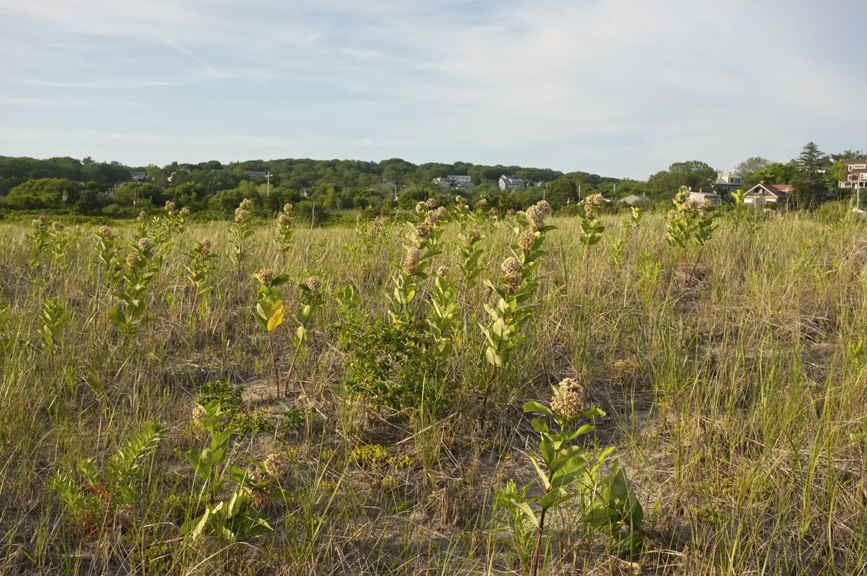
Common Milkweed (Asclepias syriaca) is the milkweed we see most typically growing in our dunes, meadows, roadsides, and fields. It grows quickly and spreads vigorously by underground runners. This is a great plant if you have an area of your garden that you want to devote entirely to milkweed. It prefers full sun, will tolerate some shade, and will grow in nearly any type of soil. The flowers are dusty mauve pink and have a wonderful honey-hay sweet scent.
Marsh Milkweed (Aclepias incarnata) is more commonly found in marshy areas, but it grows beautifully in gardens. It does not care for dry conditions. These plants are very well-behaved and are more clump forming, rather than spreading by underground roots. The flowers are typically a brighter pink than Common Milkweed.
Monarchs deposit their eggs readily on both types of milkweed and in my garden I grow Common Milweed and Marsh Milkweed side-by-side.
The cost of the plants includes shipping from Missouri. Hopefully everyone will be good and if they place an order, will honor their commitment. If there is any money beyond what was spent on plants and shipping we will donate it to the ongoing fundraising drive for the Rocky Neck Cultural Center purchase of the beautiful center on Wonson Street.
Plant pick-up is at Captain Joe and Sons, 95 East Main Street, Gloucester, on Saturday, May 18th from 9:00am to 12noon. If you cannot pick up your plants at that time, please ask a friend.
My order to the nursery is being placed on Tuesday night, so please get your orders in asap. Place Your Milkweed Order in the comment section of this post. Be sure to indicate which type of milkweed, Common or Marsh, and number of plants.
Our deepest thanks to everyone who is participating.
Female and Male Monarch Butterfly on Marsh Milkweed (Asclepias incarnata)
Rain date pick up: Sunday, May 19th from 9am to 12noon.
The above photo of a male (right) and female (left) Monarch Butterflies on Marsh Milkweed is part of the GMG/Cape Ann Giclee Photography show, opening tonight, Friday. Hope to see you there!
I am often asked the following question at my butterfly and pollinator garden design lectures. How exactly are Monsanto’s products ravaging the Monarch Butterfly population?
First, it is important to understand that all butterfly caterpillars rely on plant foods specific to each species of butterfly. For example, Monarch caterpillars only eat members of the milkweed family, Black Swallowtail caterpillars eat plants in the carrot family, and Heliconian butterflies eat plants in the passionflower family. Some caterpillars, like the larvae of the Eastern Tiger Swallowtail eat plants from a wide range of plant families. That being said, it is worth repeating that Monarch caterpillars only survive on members of the milkweed family.
Imagine a farm with row upon row of corn. Growing amongst and around the edges of the cornfields are wildflowers of all sorts, including milkweed. The wildflowers draw to the fields myriad pollinators such as bees, butterflies, and birds.
Monsanto has genetically modified the seed of corn and soybeans so that it will withstand extremely heavy doses of its herbicide, called Roundup. Monsanto’s corn and soybean seed is actually called Roundup Ready. Roundup Ready plants can withstand massive doses of the herbicide Roundup, but the milkweed and other wildflowers growing in the corn and soybean fields cannot.
Each year massive amounts of Roundup are sprayed on the corn and soybean fields, killing everything in sight, except the Roundup Ready corn and soybean. Additionally, Monsanto’s Roundup contains the active ingredient glyphosate, which has been tied to more health and environmental problems than you can possibly imagine.
Now imagine you are a Monarch Butterfly, having flown hundreds of miles northward towards breeding grounds of milkweed. But there is no milkweed to deposit your eggs. The circle in the chain of life is broken.
Since the use of genetically modified Roundup Ready began, milkweed has disappeared from over 100 million acres of row crops, or a roughly 58 percent decrease. Milkweed is not only the Monarch caterpillar host (or food) plant, the nectar-rich florets provide nourishment for hundreds of species of bees and other Lepidoptera.
The Monarch Butterfly migration is one of the great migrations of the world. Climate change and the loss of habitat are also factors in the decrease of butterflies. The Mexican government and the people of Mexico have enacted policies to help protect from logging the remaining oyamel fur trees in the Monarchs winter habitat.
There are several steps that we in the United States can undertake. 1) Avoid as much as possible genetically modified food, especially corn and soybean products. 2) If you own shares of Monsanto stock, get rid of it (Monsanto also developed Agent Orange). Thirdly, we need to start a national movement to cultivate milkweed and to create awareness about the important role wildflowers play in our ecosystem.
Calling Everyone: Plant Milkweed! No matter how small or large your garden, give a spot over to milkweed and watch your garden come to life!
Butterfly caterpillars molt four or five times as they grow. Each different caterpillar stage is called an instar.
In the photo below you can see the caterpillar’s crumpled discarded exoskeleton.
Molting Monarch Caterpillar
The caterpillar first grows a new skin under its old skin. Then the caterpillar draws its head out of its head capsule. Occasionally it will need to use its front legs to help remove the head capsule. Next the caterpillar crawls out of its old skin. This is called molting. After the molt and while the new skin is soft and pliable the caterpillar swallows a lot of air, which expands the body. As the new exoskeleton hardens it lets out the air to allow room to grow.
Molting takes a great deal of energy and after each molt, the caterpillar rests quietly for a brief period before then eating its discarded exoskeleton.
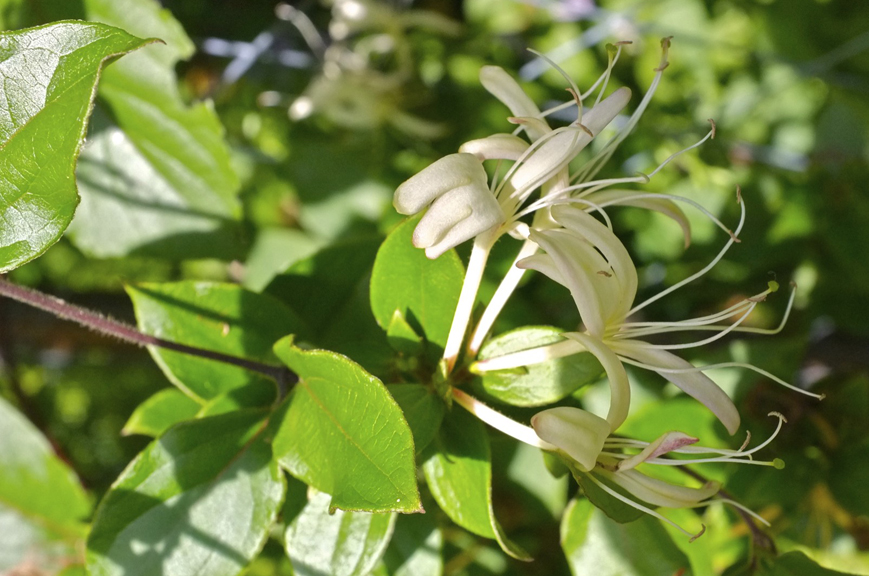
While snapping a photo of the divinely scented honeysuckle embowering the outside shower…
I spotted our first female Monarch butterfly of the season.
She’s arrived a bit earlier than usual this year, or more accurately, the milkweeds in our garden are slightly behind in blossoming time-Marsh Milkweed won’t bloom for another half-week and Common Milkweed won’t flower for another two weeks (both milkweed patches are growing nearby the shower enclosure). However, she did not have nectaring in mind.
Pausing at the emerging buds and foliage of the Marsh Milkweed, then to the Common Milkweed, then back to Marsh, and curling her abdomen to the underside, one by one she oviposited golden egg after golden egg.
Typically, she searches for the uppermost, freshly emerging foliage in which to deposit her eggs. Click the above photo to make it larger. The newly deposited egg, no larger than the size of a pinhead, is a visible pale yellow dot adjacent to her abdomen.
After ovipositing an egg on the Marsh Milkweed, she next deposited several on the Common.
Click the above photo. Five eggs are visible, two on the upper leaf of the plant to the left and three on the upper leaf of the plant to the right.
I never tire of watching butterflies, especially Monarchs, whether in our garden or further afield, and eagerly anticipate their arrival each year. Monarchs are particularly gratifying to observe and record because they are one of the larger butterflies that grace our region. Oftentimes when I am photographing a smaller butterfly such as a Summer Azure, with a mere one-inch wingspan, I don’t know what I have captured through the camera’s lens until returning to the computer to download and edit. Monarchs, with their big and bold wing patterning and approachableness (is that a word?) are a joy to photograph. Because of their extraordinary migration, I believe the Monarch butterflies are one of the natural wonders of the world. We are so blessed to live in a community that plays host to such great numbers. PLANT MILKWEED and you, too, will have Monarchs! I guarentee it!
Common Milkweed in full bloom at Good Harbor Beach this week.
Common Milkweed (Asclepias syriaca) found along the shoreline grows in sandy soil and is exposed daily to windy seaside conditions. In these rough and tumble conditions it typically grows two- to two and a half -feet tall. Conversely, where in our garden it grows in fertile, friable soil and lives in a sheltered corner protected from wind, Common Milkweed often grows six to seven feet tall.
Walking along the boardwalk I often catch the sweet honey-hay fragrance of the Common Milkweed when in full bloom. Marsh Milkweed has little to no fragrance. Several Monarchs were seen while photographing this patch of milkweed.
Blooming along the pathway leading to the outdoor shower is the magnificent hummingbird attractant Torch Lily (Kniphofia uvaria) and bee magnet Helenium, commonly called Sneezeweed or Dog Tooth Daisy.
The foliage of the diminutive Mexican marigolds (Tagetes tenuifolia), commonly referred to by the Mexican people as “flowers of the dead,” bears a fabulous spicy citrus fragrance. Flowers and foliage are edible and add both a tangy color and taste. I grow it in a pot, keeping it sometimes near the shower and sometimes moving it to the dining area.
The female Monarch stayed the morning and I have not seen her since. Lucky us, though. I found fifteen eggs, without really trying too hard, and will now have lots of caterpillars and chyrsalids for upcoming butterfly programs!
End Note regarding Japanese honeysuckle: The variety discussed here is a purple-stemmed variant and I have seen it written as Lonicera japonica var. repens and Lonicera japonica ‘Purpurea.’ In our zone 6 garden, I have found it to be well-behaved, neither bearing fruit nor sending runners. I do not recommend planting in zones 7 and above. Lonicera ‘Purpurea is highly attractive to all manner of bees. As richly scented as the species, the blossoming time of L. ‘Purpurea’ lasts well over six weeks, equating weeks of showering while enwrapped in the spellbinding sweet scent of honeysuckle.
Lonicera japonica var. repens or Lonicera japonica ‘Purpurea’
In organizing my Monarch book proposal to send to a friend, who has a friend who publishes children’s books, I am sorting through my illustrations. This painting was completed at the end of summer last and illustrates a male Monarch (above) and female (below) ascending towards a maple tree during their mating flight. He carries her and together they stay joined, abdomen to abdomen, for several hours–truly a beautiful thing to observe.
I lay down on the ground under a neighboring maple tree and sketched while looking up into the canopy. This is what I imagine the leaf net canopy looks like to the Monarchs as they ascend into the trees.
PLANT MILKWEED AND YOU, TOO, WILL HAVE MONARCHS MATING IN YOUR GARDEN!!
Milkweed is the food plant of the Monarch caterpillars. I often observe females drinking nectar from the milkweed blossoms one moment and the very next, depositing an egg on the underside of a freshly unfurled leaf, near the top of the plant. We observe the greatest numbers of caterpillars on the foliage of Common Milkweed (Asclepias syriaca) and Marsh Milkweed (Asclepias incarnata).
Recently a friend inquired that if I had to choose one native New England plant to grow to attract butterflies to the garden, which would it be, and why. It was a challenging question because butterflies are typically drawn to the garden planted with a rich and varied, yet very specific, combination of species. A successful Lepidoptera habitat is comprised of many elements all working in tandem. Sunny and protected areas in which to warm their wings, trees and shrubs that provide shelter, and a host of nectar plants for the adults, as well as specific caterpillar food plants, create the successful Lepidoptera garden.
Perhaps if I had to choose a favorite butterfly and therefore a favorite plant to grow to drawthis butterfly to my garden it would have to be common milkweed (Asclepias syriaca), which is both a larval host plant and nectar plant for the elegant Monarch butterfly. People often speak unkindly about common milkweed, rather I think it deserves applause for it is plant without rue and thrives wherever found—in the cracks of city sidewalks and along country roadsides, highly-trafficked soccer fields, and in the most neglected of neighborhoods. Whether in the garden, along the shoreline, or local meadow, it is on the foliage of common milkweed that we find the vast majority of Monarch eggs and caterpillars. Noteworthy also is that we observe many different species of butterflies and skippers nectaring at common milkweed—sulphurs, swallowtails, and fritillaries, to name but a few. In our garden we grow common milkweed alongside marsh milkweed (Asclepias incarnata); marsh milkweed blooms slightly earlier than common milkweed as it is sited in a sunnier locale. Both species attract a wide variety of winged pollinators. Male and female Monarchs nectar from the blossoms, while the males simultaneously patrol for females. The females utilize the foliage of both species to oviposit their eggs. Typically we observe females freely flitting alternatively between our common and marsh milkweed, depositing their eggs on the choicest leaves and buds, while pausing frequently to nectar.
Monarch Butterfly Egg on Common Milkweed Leaf
The milky sap that flows through milkweed veins lends the genus its common name. Monarch butterflies and their caterpillars have evolved to withstand the toxic milk, but not the predatory bird that attempts to eat one. The adult Monarch’s unique wing pattern and caterpillar’s striped suit warn of its dreadful taste and lethal toxins. A bird that is tempted becomes sick and may even die, and if it survives, remembers never again to try to eat a Monarch. “The larvae sequester cardiac glycosides from the milkweed leaves that they consume. Concentrations of these heart toxins in their bodies may be several times higher than those occurring in milkweed leaves. The glycosides consumed by the caterpillars are carried forward both into the chrysalis and adult stages, affording them protection as well.” (Caterpillars of North America David L. Wagner).
Common milkweed is highly adaptable and grows in nearly any soil. The size of the developing colonies and individual plants reflect the conditions in which it is grown. Planted in a rich, moist soil, protected from the wind and where it receives some light shade, it will grow six to seven feet. I use it extensively in my butterfly garden designs, planting in rich, average, and dry conditions, and find it especially appealing and useful for shoreline gardens. In sandy soil, sand dunes, and meadows, where it is exposed to wind and/or salt spray, common milkweed is equally as vigorous, but of a much shorter stature, typically obtaining the height of two to three feet.
A. syriaca thrives in full sun to light shade. In a moist, protected area, plant in the back of the border. In a more exposed site, plant in the mid-ground. Because of its ability to spread readily and rapidly, use in an informal, natural setting as opposed to planting in formal beds.
Common milkweed is highly fragrant and is the most richly scented of the species of milkweeds found in Massachusetts (A. incarnata, A. syriaca, A. quadrifolia, A. tuberosa, A. amplexicaulis, A. exaltata, A. pupurascens, and A. verticillata), with a complex wild flower honey fragrance. I have heard it described as similar to the scent of lilacs, but find lilacs have a much sweeter fragrance than common milkweed. Fragrance is highly mutable and subjective.
One- to two-year-old plants are easier to transplant than established plants. Common milkweed takes approximately three years to flower from seed. The method in which I have had the greatest success in propagating Asclepias syriaca, best attempted in early summer, is to dig up a rhizome, found at the base of a plant with newly emerging shoots. The rhizome would ideally be obtained from a friend’s garden. If collected in the wild, be sure to dig from an area where there are many shoots present. You need a fairly large chunk, at least a half-foot, with both roots and new shoots present. Replant the rhizome at the same depth. Water throughout the summer. Towards the end of the growing season you will be rewarded with newly emerging shoots. Common milkweed self-seeds readily, but spreads primarily (and rambunctiously) by its rhizomatic root structure.
Milkweed in general, and in particular, common milkweed, attracts a host of pollinators—bees, wasps, butterflies, and purportedly hummingbirds. I have yet to see the Ruby-throated hummingbird nectar from common milkweed, but it may also be the case that they are attracted to the plant for the multitude of tiny insect populations frequenting the flowers (over ninety percent of a Ruby-throated hummingbird’s diet is comprised of insects). We typically findMonarch eggs and caterpillars on milkweed plants during the months of July and August.
Buddleia davidii ’Nanho Blue,’ with blue-violet racemes, melds beautifully with the muted lavender rose florets of the softly drooping flower heads of common milkweed. The brilliant white of native Phlox davidii and vivid purple-pink of Liatris ligulistylus attractively offsets both. All are famously attractive to Monarchs (and myriad other species of Lepidoptera) and will provide a long season of nectar-rich blossoms and Monarch caterpillar food.
Monarch Butterflies Mating on Common Milkweed Leaves
A note about the video: Monarch butterflies deposit eggs on common milkweed (Asclepias syriaca) and marsh milkweed (Asclepias incarnata) in eastern Massachusetts. The chrysalis in this video was attached to a marsh milkweed stem. For a wealth of information on butterfly gardening, read Oh Garden of Fresh Possibilities!