Tag Archives: common milkweed

MONARCH EGGS FREE FOR THE TAKING!

A friend with a lovely garden just loaded with milkweed would like help this summer raising Monarchs. She is located in the Annisquam area. Last year Jane had so many eggs and caterpillars, she had a real time of it trying to take care of all. This year promises to be as good as, if not better than, last year.

If you would like Monarch eggs and information on how to take care of the eggs and caterpillars, please comment in the comment section, and we will provide you with Monarch babies!

Raising Monarchs with kids is the best!

Quick snapshot of Jane’s garden


MONARCH BUTTERFLY FILM UPDATE

A very brief update to let all our Friends know that work is progressing on my documentary Beauty on the Wing: Life Story of the Monarch Butterfly. The new footage from this year’s magnificent migration in Mexico has been added. My amazing team, Eric and Kristen, are plugging in the newly recorded voice over.

For the next several weeks, I’ll be planting my client’s pollinator gardens and getting them underway for the summer. After mid-June, we’ll be back in the editing studio with Eric and Kristen finessing the color correction and audio, with plans for a mid-summer release. Happy Butterfly Days!

Tree-top view – standing at the top of the mountain looking down into the valley below. All the orange bits and flakes in the trees are Monarchs.

In early March, the native wildflower White Snakeroot (Ageratina altissima) was at bloom in Cerro Pelon and the Monarchs couldn’t get enough of it!

So many Monarchs this early in the season portends a possibly great summer for butterflies in our meadows and gardens. It’s the perfect time of year to plant Common Milkweed (Asclepias syriaca) seeds and many of our local nurseries carry Marsh Milkweed  (Asclepias incarnata) plants. These two species are the most productive for Monarch eggs and caterpillars in our region.

Monarchs mating in a patch of Common Milkweed.

Monarch drinking nectar from Common Milkweed florets.
Female depositing egg on Marsh Milkweed foliage.

The milkweed we grow in the north supports spectacular migrations such as the one that took place this past winter of 2018-2019.

MORE MONARCH BUTTERFLIES SPIED AROUND CAPE ANN!

Monarch Butterfly on native Buttonbush blossoms

David Rhinelander had one two days in a row at his garden on Pine Street, Heather Hall spotted a Monarch at the Hamilton Library, Jennie Meyer had one in her garden and sent along some photos, Donna Soodalter-Toman had one in her yard, Jen in Rockport has them, and Susan Donelan Burke saw a Monarch in Magnolia. This is very early and thank you so much to Everyone for writing!

Keep your eyes peeled for Red Admirals and Painted Ladies, too.

Red Admirals nectaring at lilacs. The last time we had so many Red Admirals in our garden in May was in 2012 and that was a banner year for butterflies of many species.

Painted Ladies

In the above photo compare the Monarch to the Painted Lady. If you see a “small” Monarch, it may be a Painted Lady or a Red Admiral.

AMAZING!!! MONARCH BUTTERFLIES HAVE ALREADY ARRIVED TO CAPE ANN

There are Monarchs on Cape Ann, and they are laying eggs!!! Check your milkweed Friends! This is nearly a month earlier than usual.

Jane Danekis had a female several days ago in her garden on Revere Street and she deposited over 100 eggs on shoots of newly emerging milkweed.

Michele Del Vecchio saw a Monarch at Good Harbor Beach today, too!

Please let us know if you have seen a Monarch recently, and take a snapshot if you can. Thank you 🙂

A Monarch egg is pale golden yellow in color and shaped like a tiny ridged dome. The egg is no larger than a pinhead.

Morgan Faulds Pike spotted a female Monarch nectaring on her lilacs. Photo courtesy Morgan.

BEST MILKWEED TO PLANT FOR MASSACHUSETTS GARDENS, MEADOWS, FIELDS, AND DUNE RESTORATION

Friends often ask, and I cover this topic extensively in my Monarch programs, “What is the best milkweed to plant in our region?” Without a doubt, the two most important and productive are Common Milkweed (Asclepias syriaca) and Marsh Milkweed (Asclepias incarnata).

Marsh Milkweed also goes by the name Swamp Milkweed, but Marsh sounds so much more appealing, don’t you think? Milkweeds already have the suffix weed attached to their names. To some folks any wildflower that includes the word weed seems invasive, and we don’t want to frighten people from planting our sweet native wildflowers by inferring they are a swamp dweller, too.

Gallery of Marsh Milkweed

When a weed is not a weed  – It’s unfortunate that so many of our native beauties end in “weed.” Ironweed, Joe-pye Weed, Sneezeweed, Thimbleweed, Butterfly Weed, and Milkweed are just some examples. Why were these native wildflowers at one time long ago named “weed.” Because the earliest colonists brought from their home countries flowering plants that were beloved and familiar to them, delphiniums and larkspurs, for example. In their new American home gardens, these treasured European plants would have been easily overtaken by our more vigorous American wildflowers.

To return to the topic of milkweed, Common Milkweed spreads by both underground and by seed. It’s ideal for dunes, meadows, and fields. Marsh Milkweed is more clump forming and stays relatively close to where you plant it. You can control how much it spreads by deadheading, or not, before the seed heads turn to fluff and sail away. I grow both Marsh Milkweed and Common Milkweed side-by-side. In our garden, the female Monarch does not discern the difference between the two species of milkweeds, she will flit from one to the other, and back again, depositing her eggs all along the way.

Gallery of Common Milkweed

By the way, both A. syriaca and A. incarnata are also the easiest milkweeds to grow in Massachusetts.

A ten-year nation-wide study was recently published. Across the country, Marsh and Common proved to be the most productive, in other words, more eggs were laid on these two species than on any other species of milkweed.

The map provided below is somewhat helpful; I write somewhat with a word of advice. If you click on Massachusetts, for example, not only are Common and Marsh Milkweeds listed but also Purple Milkweed (A. pupurascens), Fourleaf Milkweed (A. quadrifolia), Butterfly Weed (A. tuberosa), Poke Milkweed (A. exaltata), Whorled Milkweed (A. verticillata), and Clasping Milkweed (A. amplexicaulis). We grow a nice patch of Whorled Milkweed and I have never, ever seen a Monarch once visit the foliage or flowers. Purple Milkweed can be very challenging to get started, and Butterfly Weed is not as hardy in our region as are Common and Marsh.

Milkweeds are the only food plant for Monarch caterpillars and also provide nectar to a host of pollinators including many, many species of butterflies, bees, beetles, and even hummingbirds. Plant for the pollinators and they will come!

This is an image from my recent adventure to Cerro Pelon. I am dying to write about the trip, but have had a very full schedule finishing up my film, organizing landscape jobs for the season, and hoping to get the PiPls settled in. The Monarchs in the photo are mud-puddling. Tens of thousands leave the butterfly trees during the heat of the day, sucking up water and much needed nutrients from the mud at nearby mountain streams

HIGHER NUMBERS GIVE HOPE FOR MONARCHS

By Kim Smith

January 31, 2019

The World Wildlife Fund Mexico and Monarch Butterfly Biosphere Reserve (MBBR) announced on January 30th that this year the Monarch Butterfly population has increased significantly.

Each year the orange and black winged beauties return to the oyamel fir and pine tree forests, which are located in the heart of Mexico’s trans volcanic mountain belt. In December and January, Lepidoptera population specialists and citizen scientists measure the area the Monarch colonies cover at their over wintering sites. This year (2018-2019) the butterflies are blanketing 6.05 hectares (approximately 15 acres), up from an all-time low of only 0.67 hectares (1.65 acres) during the winter of 2013-2014.

Not since 2006-2007 has this great an area been covered by the butterflies, although the numbers are still quite low when compared to the numbers recorded in the late 1970s when the butterfly’s winter roosts were first discovered by Dr. Fred Urquhart.

I have been following the butterfly counts around the US as they were reported. The Monarch population has been decimated in California. This year only about 30,000 butterflies were counted, down from several million just two decades ago. There is the very real possibility that the Monarch butterfly will become extirpated (extinct from an area) on the West coast. The winter count is down drastically in Florida as well.

It was clear though that east of the Rockies–the Midwest and Northeast regions of the US, as well as southern provinces of Canada–there were many more Monarchs in gardens and on the wing than in recent previous summers.

Leading Monarch scientists are reluctant to become excited about the increase, and justifiably so. Last spring the weather was slightly cooler in Texas, which allowed more Monarch eggs to hatch, which in turn allowed more caterpillars to mature. A greater number of butterflies emerged and set the stage for a strong breeding season throughout the summer. That scenario, along with the overall good weather during the summer of 2018, also helped create ideal conditions. It was a true “goldilocks” summer, not too hot, not too cold, but just right.

In autumn of 2018, the Monarchs arrived to Mexico about a week later than usual, but once they began to arrive, a kaleidoscope of butterflies poured into their winter roosting grounds.

The 2018-2019 Eastern population count is a reprieve from the past ten years of heartbreaking news, but one good year does not change what the butterflies need most, which is protection for the Monarchs under the Endangered Species Act.

Monarch and Mexican Sunflower (Tithonia)

There is disagreement among scientists whether planting milkweed has any bearing on the health of the Monarch butterfly population. Does creating corridors of Monarch habitat help mitigate the death and destruction caused by climate change, modern agricultural practices, the devastating use of pesticides and herbicides, and the planting of GMO crops (corn, sorghum, and soybeans, for example) that were engineered to withstand the deadly poisons, but which wildflowers and caterpillars cannot?

Monarch Butterflies and New England Aster, Gloucester, 2018

I think the answer to that question is a resounding yes. Monarchs are a bellwether species. The love for this one butterfly has helped to shape a consciousness towards all species at risk. An uncomplicated stand of milkweed and asters can make every public walkway, park, community center, church, school, and backyard a haven for Monarchs and together we can bring about a conservation victory for the pollinators.

Tightly Packed Cargo Ready to Sail

Milkweed seedpods in the afternoon sun

SNAPSHOTS FROM PATTI PAPOW’S MAGICAL BUTTERFLY GARDEN

Photos from a recent visit to friend and East Gloucester resident Patti Papows delightful in-every-way butterfly and pollinator garden

Snowberry Clearwing Moth

Although I was only able to visit for a few hours, it was wonderful to see all that she has planted for the pollinators, and as a result, all the pollinators drawn to her garden. You could spend a week in Patti’s garden and not see everything. The afternoon I was there, the deep magenta red butterfly bush was in full glorious bloom and was the star pollinator attractant of the day. Snowberry Clearwing Moths, Tiger Swallowtails, Monarchs, Catbirds, Robins, Bumble Bees, Honey Bees, and every other winged creature in the neighborhood was enjoying sweet nectar and the fruits from Patti’s blossoms. Bees and butterflies love variety and in a garden as richly planted as Patti’s, everyday is a party for the pollinators!

I am looking forward to returning to Patti’s garden when the Morning Glories are in full bloom 🙂

THANKS TO A CANADIAN CHEMICAL ENGINEER, A VERMONT ACADEMIC AGRONOMIST, RISK-TAKING FARMERS, AND VISIONARY CLOTHING COMPANY FOR A FABULOUS NEW USE FOR MILKWEED

What’s old is new again!

Common Milkweed (Ascleipias syriaca) is the essential food plant for populations of the Northeastern and Atlantic coast Monarchs. During Colonial times, the silky floss found in the dried seed heads was used to stuff quilts and pillows. In the 1860s, in Salem Massachusetts, Common Milkweed silk was used as a mattress filling.

During WWII, Common Milkweed became the substitute for kapok, a soft cottony material from the kapok tree that was the preferred filling for life vests. Japan cut off the supply of kapok from Java, the main source of the material, and part of the wartime effort included children sent to fields to gather millions of pounds of Milkweed seed heads for the armed services.

“What is a weed? A plant whose virtues have not been discovered.” ~ Ralph Waldo Emerson

An innovative Canadian clothing manufacturer, the Quartz Company and Altitude Sports, has created the first modern insulated jacket using milkweed silk. Hundreds of acres of Common Milkweed have been planted in Vermont and Quebec. Particularly noteworthy is that the fields of Milkweed are not harvested until after the Monarchs have left.

READ THE STORY HERE  

Milkweed Silk and Monarch Butterfly Chrysalis

WWII Common Milkweed photos courtesy Google image search.

LOOK WHAT PATTI PAPOWS MADE FOR SUNDAY’S MILKWEED SEED DISTRIBUTION EVENT!!

Thank you to Patti Papows for putting together these utterly charming pouches of milkweed seeds for our event tomorrow. We also have loads of milkweed pods and Joe-Pye seeds to distribute so come on down to Captain Joe’s dock Sunday morning from 10:30 to noon. We hope to see you there!

Captain Joes is located at 95 East Main Street, Gloucester.

To donate toward the completion of my documentary film Beauty on the Wing: Life Story of the Monarch Butterfly, please visit the film’s website at www.monarchbutterflyfilm.com

COMMUNITY MILKWEED SEED POD PROJECT FOR THE POLLINATORS!

MILKWEED SEED COLLECTION AND DISTRIBUTION PROJECT SUNDAY OCTOBER 15TH

Collect ripe milkweed seed pods (only Common Milkweed and Marsh Milkweed please). Place in a paper bag, not plastic, as plastic can cause the seed pods to become damp and moldy.

Bring seedpods to Captain Joe and Sons on Sunday morning between 10:30 and noon. Captain Joes is located at 95 East Main Street, East Gloucester.

If you’d like to distribute seeds, meet at the dock between 10:30 and noon and I will show you what to do.

NOTE: It is easy to tell when milkweed seedpods are ripe. The seeds inside turn brown. Do not collect the pods when the seeds are white or green. If you pick them too soon, they will never be viable. You can check the seed pods by slitting the pod a tiny bit and peeking inside.

Any questions, please comment in the comment section or email me at kimsmithdesigns@hotmail.com. Thank you and I hope to see you Sunday morning!

To learn more about how you can help fund the documentary Beauty on the Wing and the Monarch Butterfly Film Online Fundraising event, please visit the film’s website at monarchbutterflyfilm.com.

KIM SMITH POLLINATOR GARDEN PROGRAM FREE AND OPEN TO THE PUBLIC THURSDAY EVENING

Please join me Thursday evening, August 10th, at 7:00pm, at the Peabody Institute Library, South Branch. I will be giving my talk about how to create a garden to benefit a host of pollinators and screening several short films. I hope to see you there! 

The day we planted blueberries, is the day the Catbirds moved in. Many species of songbirds are pollinators, too!

Painted Lady nectaring at wildflower Joe-pye, Good Harbor Beach

https://www.instagram.com/p/BW7wfw-F5o9/


#POLLINATORHERO

Bees and butterflies, as we all know, pollinate flowers, but did you know that bats, songbirds, hummingbirds, wasps, beetles, moths, flies, midges, and even nasty mosquitoes also deliver pollen from plant to plant?

Flower pollinating Green-eyed Wasp drinking nectar from Common Milkweed florets.

The eyes of the male Green-eyed Wasp are larger than the females, all the better to see her, and predators. Green-eyed Wasps are also known as sand wasps because females excavate burrowing nests in sand (as well as soil).

Male Monarch Butterfly flitting about our garden and drinking nectar from the Marsh Milkweed florets.

Notice the mass of orange Milkweed Aphids in the background. Lady Beetles are another pollinator super hero because they help milkweed plants by eating aphids.

https://www.instagram.com/p/BXTNYD9F_We/

MONARCHS HERE, THERE, AND EVERYWHERE PART TWO AND PLEASE CONTINUE TO REPORT YOUR MONARCH SIGHTINGS

The title of the post could just as easily have read Monarchs, Eggs, and Caterpillars Here, There, and Everywhere. I haven’t seen this much Monarch activity on Cape Ann in over ten years and hope so much the number of Monarchs seen in gardens, meadows, and dunes indicates a strong migration.

Thank you to everyone who has written in with your Monarch sightings! The reports are tremendously informative and fun to read, so please, do continue to let us know. The rainy cool weather has temporarily put the kibosh on mating and egg laying, but they are here on our shores and just waiting for a few warm hours and the sun to come out to renew breeding activity.

Monarchs not only drink nectar from the florets of milkweed, it is the only species of plant on which they deposit their eggs. In the above photo you can clearly see the Monarch probing for nectar with her proboscis, or drinking straw. 

Look for the butterflies, eggs, and caterpillars wherever milkweed grows. In our region, they are most often found on pink flowering Common Milkweed (Asclepias syriaca) and Marsh Milkweed (Asclepias incarnata), as opposed to the orange milkweeds, A. curassavica and A. tuberosa.

Female Monarch depositing an egg on an upper leaf of Common Milkweed.

The eggs are typically laid on the underside of the leaf, near the top of the plant. Tiny golden domes, no larger than a pinhead, Monarch eggs are easily confused with the eggs of other insects.

Once the tiny caterpillar emerges, it will stay towards the top of the plant, venturing further to larger leaves as it grows.

Four Monarchs in One Photo!

I was trying to take a snapshot of two Monarchs flying but not until I returned home did I realize that resting on a leaf were a pair of Monarchs mating. Lara Lepionka had just sent a photo the day before of a pair mating in a tree above her garden. Typically Monarchs will begin mating on the ground, or the foliage of a lower plant plant such as squash or milkweed. They will join together abdomen to abdomen and, once securely attached, the male then carries the female to a safer location. A male and female Monarch will stay coupled together for four to five hours before releasing (see photo below of a pair of Monarchs mating, towards center left.

Lara Lepionka cell phone photo of Monarchs mating in a tree.

Monarch and Common Milkweed Good Harbor Beach

Not everyone has a gorgeous milkweed patch like Patti Papows. Don’t despair. You don’t have to go far! I am finding tons of eggs and caterpillars on the Common Milkweed that grows around the edge of the parking lot at Good Harbor Beach.

Patti Papows Common Milkweed with Monarch and Bee.

https://www.instagram.com/p/BXBPKguFU2C/

https://www.instagram.com/p/BW7wfw-F5o9/

https://www.instagram.com/p/BXDTPFllQh9/

https://www.instagram.com/p/BW1R9IEFAoI/

https://www.instagram.com/p/BXAv8MHF0bO/

PATTI’S CATTIES AND OTHER TALES FROM THE PAPOWS BEAUTIFUL GARDEN

My friend Patti Papows very thoughtfully invited me to come film and take photos in her gorgeous garden, especially her milkweed patch. Patti purchased milkweed plants from our Cape Ann Milkweed Project several years ago, both the Common and Marsh Milkweed that we offered.

Patti’s Common Milkweed has really taken off this year. The plants are about five feet tall, lush and healthy, and bursting with sweetly fragrant blossoms. The Monarchs are daily visitors, coming not by the ones and twos, but by the dozen. Not only are her milkweed blossoms beckoning to the Monarchs, but the plants are also attracting every bee species imaginable found in a Cape Ann garden, as well as myriad other pollinating insects.

I showed Patti how to find Monarch caterpillars. She found three in about three minutes; we weren’t even trying that hard! They are safer from spiders in my terrariums, so I brought her tiny caterpillars home where they are developing nicely alongside a dozen Monarch eggs. These eggs were discovered in my garden, and at the Common Milkweed plants growing along the edges of the Good Harbor Beach parking lot.

https://www.instagram.com/p/BW7y-ywl3kb/

Patti’s patch of native high bush blueberries attracts loads of Catbirds, and dozens more species of songbirds and small mammals. This morning the foliage made a perfect perch for a male Monarch butterfly.

In the above photo you can clearly see the Monarch’s two-part tubular drinking straw, called a proboscis. The Monarch is probing deep into the Milkweed floret for a sip of sweet nectar.

Who, me? I’m innocent! Chipmunk snacking at the buffet-of-plenty in Patti’s garden.

Patti placed the purple chair in the midst of the milkweed patch so that visitors can enjoy being surrounded by the beautiful pollinators buzzing all around and the delightful fragrance emitted by the Common Milkweed. I tried it out and her plan worked, it is pure Heaven!

I had an absolutely wonderful morning filming and photographing, despite the limiting overcast skies, and plan to return on a sunnier day, hopefully this week while the Monarchs are here on Cape Ann busy egg-laying and pollinating our gardens!

Patti shares that at the end of the day, her Monarchs are nectaring from the flowering hosta. She sent these photos this morning, taken yesterday afternoon with her cell phone.

HOORAY FOR OUR TWENTY-THREE-DAY-OLD PIPING PLOVER CHICK!

Bravo to our little chick, who this evening, we are celebrating day twenty-three! Thank you to all our volunteers who are working so conscientiously to help the GHB PiPl survive Gloucester’s busiest beach.

Despite the fact that he can’t exactly still fit under Papa and Mama, at twenty-three-days-old, Little Chick still needs snuggles to thermoregulate.

Note how large Little Chick’s beak is growing.

Twenty-three-day-old Piping Plover: Of the four Piping Plover chicks that hatched on the morning of June 22nd (the first hatched at about 6am, and all had hatched by noontime), our little chick is the sole survivor.

At 6:30 this morning another fight with the interloper took place. I was able to capture some of it on film and, surprisingly, a very similar battle took place later this morning between the Coffin’s Beach Piping Plovers.

The Good Harbor Beach dunes are teeming with life. I spied five Monarch Butterflies on the Common Milkweed this afternoon, with many reports shared by readers of Monarch sightings all around Cape Ann and Massachusetts. We’ll do a post about Monarchs this coming week, and in the meantime, please share your Monarch sightings.

Dragonflies are predacious, and like our Piping Plover chick eat tiny invertebrates.

Beach bunny munching wild salad greens for breakfast.

Monarch Butterfly and Common Milkweed, Good Harbor Beach

AWESOME VOLUNTEERS MONITORING THE PIPING PLOVER CHICKS AT GOOD HARBOR BEACH!

Day six, and all four Good Harbor Beach Piping Plovers are thriving! Their survival is in large part due to the efforts of Ken Whittaker, Dave Rimmer, and a growing assemblage of wonderful volunteers. If you would like to volunteer to take a shift babysitting the PiPl, please email Ken Whittaker at kwhittaker@gloucester-ma-gov. Ken is meeting groups on the beach to explain the protocol. The shifts are brief and it’s great fun to be at GHB as an ambassador for the Plovers while monitoring and answering questions.

https://www.instagram.com/p/BV44XOzF3s4/

Catherine Ryan and her sons Charles and George King have the early morning shifts, from 6am to 7:30, and they are splitting it three ways, each taking a half hour. Piping Plover watchers are invited to take notes–here are one of the volunteers, Hazel’s, excellent notes:

“I was there from about 11.30 to 1 pm today June 26..

During that time I only saw one adult at a time, probably about once every 20 minutes, not doing much – preening, sitting on the sand, resting under a bush, moving around relatively slowly. I also saw one baby at a time moving about – except for the last 20 minutes when I saw 2, possibly 3, moving around at the same time (I had lent my binoculars to some interested bystanders so not sure of the number).

I spoke to 2 groups of young people playing with a ball and a frisbee – they were unaware of the plover nest and very agreeable to moving further away. One couple were seated very close to the rope, and also unaware of the plovers.  They said they would watch out for babies coming outside the enclosure, and later had been watching one of the babies moving around inside.

Two other groups were close to the enclosure and already aware. The second group arrived when two or three babies were moving around and excited to see them through binoculars.

I will be back tomorrow from 11 to 1 pm.

Hazel”

Loved reading the King brother’s notes. Great job Charles and George!!

https://www.instagram.com/p/BV45kMdlCg_/


Five Day-Old Piping Plover Chick Foraging for Insects

While walking through the dunes on boardwalk 3 at Good Harbor on the way to volunteer, or simply to visit the PiPl, notice the Common Milkweed that is in full glorious bloom. You may catch a whiff of its wonderful honey-hay scent. And quite possibly, a Monarch sighting, or two!

Male Monarch Nectaring from Common Mikweed, Good Harbor Beach Dune

COMMON MILKWEED ABLOOM, HERE, THERE, AND EVERYWHERE!

Common Milkweed and Bee Asclepias syriaca ©Kim Smith 2015A patch of Common Milkweed (Asclepias syriaca) in bloom has a wonderfully sweet honey-hay scent. Look for it growing along the sand dunes, roadside edges, fields, meadows, and where ever there is a neglected patch. And keep your eyes peeled for Monarchs; the earliest arrivals (for the most part) are synchronized to the flowering of Common Milkweed.

https://instagram.com/p/4opJl6DyjS/

Friend me on Facebook and follow me on TwitterInstagram, and Vine. You can also subscribe to my design website at Kim Smith Designs, and film’s websites at Beauty on the Wing ~ Life Story of the Monarch Butterfly, Gloucester’s Feast of Saint Joseph Community Film Project, and Life Story of the Black Swallowtail Butterfly.

Please Don’t Weed the Milkweed

Common Milweed Asclepias syriaca ©Kim Smith 2014Once established, native Common Milkweed grows vigorously and rambunctiously, making itself known even in the thinnest of sidewalk cracks. Here’s a patch growing along East Main Street. I think it beautiful! What do you think?

*    *    *

If you caught Tom Ashbrook’s On Point broadcast on NPR yesterday morning you heard Doctor Lincoln Brower, Karen Oberhausser, and Rick Mikula, three of the world’s leading butterfly experts, speaking about the disappearance of the Monarch and the main reason why–most notably because of the sterilization of the American landscape through the use Monsanto’s Roundup and GMO corn and soybean crops.

The following is a list of a few suggestions on ways in which we can all help turn the tide:

Plant milkweed and wildflowers. Teach members of your family and friends what milkweed looks like and why we don’t want to weed it out of the garden. The above patch of milkweed is growing next to a shop on East Main Street. About a month ago, I went into the store and, very, very politely inquired as to whether or not they knew that the plant growing outside their doorway was a terrific patch of milkweed. They had no idea. I explained what the benefits were to the Monarchs and have since noticed that the milkweed patch is still growing beautifully!

Ban GMO crops. Genetically modified seeds have been altered to withstand megadoses of Roundup. Millions and millions of tons of herbicides are poured onto Roundup Ready fields of crops, preventing any other plant that has not been genetically altered from growing (in other words, wildflowers). The application of Monsanto’s deadly destructive herbicide Roundup is creating vast sterilized agricultural wastelands, which will, over time, only need heavier and heavier does of their lethal chemicals to continue to be viable.

Don’t apply herbicides and pesticides in your own gardens.

Create wildflower corridors in backyards and highways.

Reduce salt wherever possible (and where it wouldn’t cause harm to human life). Large amounts of road salt, as was needed during this past snowiest of winters, is detrimental to wildlife habitats.

Hooray for Pathways for Children’s Brand Spanking New Butterfly Garden!

Pathways for Children we ©Kim Smith 2014HOLY CANNOLI and WOW–look how beautifully the Pathway’s Staff is taking care of their brand new one-month old butterfly garden–every plant looks well-loved!!!Pathways for Children Butterfly Garden ©Kim Smith 2014 copy

Pathways for Children Butterfly Garden BEFORE ©Kim Smith 2014 copy

Spring 2014 Before Photo

Pathways for Children Butterfly Garden  After ©Kim Smith 2014.

Same View After July 18, 2014

Elizabeth's Toad ©Kim Smith

Toads Welcome!

My sincerest thanks to Caroline Haines for her vision to create a butterfly garden for the children at Pathways.

Thank you to the many donors who have made the butterfly gardens at Pathways possible.

Thank you to the Manchester Garden Club for their tremendous assisitance in planting the garden.

Thank you to the volunteers from Liberty Mutual for tearing out the old plantings.

And special thanks to Bernie Romanowski, Pathways for Children facilities director, for all his hard work and his extraordinary care and attention to detail, from the project’s inception through its continued maintenance. Pathways for Children Butterfly Garden Zinnia ©Kim Smith 2014. Pathways for Children Butterfly Garden Sunflower ©Kim Smith 2014. Pathways for Children Butterfly Garden Milkweed ©Kim Smith 2014.Common Milkweed (Asclepias syriaca) ~ Notice the pretty moth nectaring from the milkweed in the upper right.

The gardens are alive with pollinators of every species imaginable, including butterflies, bees, hummingbirds, songbirds, moths, and sundry insects! Bernie Romanowski ©Kim Smith 2014 copy

Bernie Romanowski

Manchester Garden Club at Pathways ©Kim Smith 2014

Manchester Garden Club

*     *     *

Antennae for Design ~

The picnic table and trellis were designed to be stained a classic seaside blue. Why would we want to paint or stain the trellis and not simply allow it to gain a weathered patina? From an aesthetic point of view, the wood used for both the picnic table and trellis are two different types and will age very differently from each other. If this were a very large garden, it wouldn’t matter so much, but in a cozy garden room such as this, the difference will become quite noticeable and unappealing over time. Additionally, the blue will offset the flowers and foliage handsomely and is a cheery choice with children in mind.

From a very practical standpoint, untreated wood will quickly degrade in our salty sea air and neither piece will last more than ten years without protection. An opaque stain is the best solution because as the trellis and picnic table age, the obvious differences in wood will be disguised. An opaque stain also requires the least amount of effort to maintain over time. The architectural details were designed to be a coordinated focal point in the garden. Many, many have donated their time and provided generous funding to the garden and hopefully, the integrity of the garden’s design will continue to be honored by all. Rotting untreated trellis ©Kim Smith 2014The above is a photo of an untreated trellis, allowed to weather, and was installed approximately ten years ago. _DSF8394 Pathways for Children Butterfly Garden school bus ©Kim Smith 2014.
Related Posts:

On Behalf of Pathways for Children and Myself ~ Thank You to the Beautiful Manchester Garden Club Ladies!!!

Thank You to Everyone Who Participated in This Year’s Cape Ann Milkweed Project!!!

Monarch Butterflies Pink New England Aster ©Kim Smith 2012Monarch Butterflies Nectaring at Pink New Enlgand Aster, Gloucester

Thank you so much to our most awesome community for participating in the Cape Ann Monarch Milkweed and Aster Project. Today was a huge and wonderful success and we were non-stop with folks dropping in to pick up their seeds and learn more about how they can help the Monarchs. Thank you, thank you, thank you!!!

And my most heartfelt thanks to Joey. He nudged me into doing the sale again this year by inquiring just about a month ago if we were planning a repeat of last year’s plant sale. Joey’s hospitality and interest in everyone who stops by makes Captain Joe’s a wonderfully fun place to have a community event!

Note to anyone who could not pick up their seeds or who was planning to have them sent via a self-addressed stamped envelope: You will recieve an email with information on where to send the check and order amount total. Thanks again to everyone!

Monarch Butterfly fur ©Kim Smith 2012Fun fact about butterflies: Butterflies do not grow fur. The fur-like structures that you see on butterflies are many single cells conjoined to form one long string.

*     *     *

In case you misplace the instructions on how to prepare your milkweed seeds for spring planting ~

How to Vernalize Milkweed Seeds for Spring Planting

Seeds of most temperate plants need to be vernalized—in other words, exposed to cold temperatures. The best way to vernalize is by stratification, which means subjecting seeds to a cold and moist environment for a short period of time. By stratifying, the seed’s natural break of dormancy that occurs when the seed spends the winter in the ground is simulated.

#1 Method of Stratifying Milkweed

Open the bag of seeds and place them between very slightly moistened paper towels in a plastic bag in the refrigerator. After vernalizing for 3-6 weeks, the seeds can be planted out in the garden in warm 70º soil.

#2 Method of Stratifying Milkweed

Place ¼ cup of sand mixed with ¼ tsp. of water in a plastic bag. Add the seeds and mix again. Store in plastic bag in the refrigerator. After vernalizing for 3-6 weeks, the seeds can be planted out in the garden in warm 70º soil.

Prepare the planting bed in a sunny location. Scatter seeds, or plant in rows, and cover with no more than ¼ inch of soil.

For natural vernalization, sow collected seeds directly into a prepared bed in the fall and the seed will germinate the following spring.

Monarch Caterpillars Common Milkweed ©Kim Smith 2012Monarch Butterfly Caterpillars Munching on Milkweed

Reminder: Monarch Milkweed and Aster Seed Pickup and Information Day is Next Sunday, May 18th, from 9:30 to Noon

male-female-monarch-butterfly-marsh-milkweed-2-c2a9kim-smith-2012-copyMale and Female Monarch Butterfly on Marsh Milkweed (Asclepias incarnata)

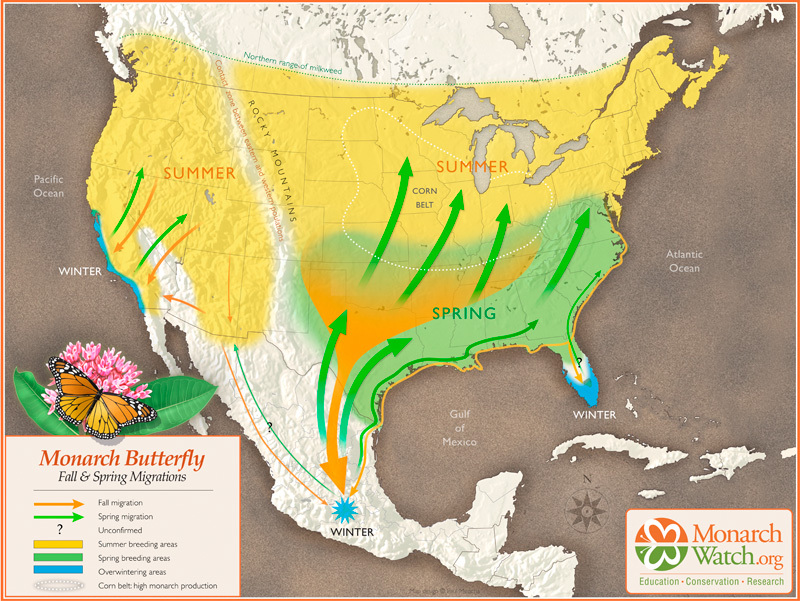
Where are the Monarchs today in their northward migration? They have spread throughout the Great Plains and Southern States. Some have already been sighted as far north as Michigan and Wisconsin!

Monarch Migration Map

Our Milkweed and New England Aster seed pickup day is next Sunday from 9:30 to noon at Captain Joe and Sons. Captain Joe’s is located at 95 East Main Street and you can find directions posted on their website here. Thank you so much to Joey for offering to host the event at the dock. See You There!

monarch-new-england-aster-c2a9kim-smith-2013Monarch Butterfly and New England Aster

Top Native Bee Friendly Plants

Obedient Plant and Bee Physostegia virginiana ©Kim Smith 2013Obedient Plant (Physostegia virginiana)

Below is a list of some favorite nectar- and pollen-rich bee-friendly North American wildflowers for attracting native bees and honey bees to your gardens. They are listed in order of bloom time, from spring through late summer, to provide your foragers with nourishment all growing season long.

Mexican Sunflower © Kim Smith 2013Mexican Sunflower (Tithonia rotundifolia)

Wild strawberry (Fragaria viginiana)

Wild Blue Lupine (Lupinus perennis)

Common Milkweed (Asclepias syriaca)

Marsh Milkweed (Asclepias incarnata)

Black-eyed Susan (Rudbeckia hirta)

Sunflower (Helianthus annus)

Obedient Plant (Physostegia virginiana)

Seaside Goldenrod (Solidago sempervirens)

Great Blue Lobelia (Lobelia siphilitica)

Joe-pye Weed (Eupatorium purpureum)

New York Ironweed (Veronia noveboracensis)

New England Aster (Aster novae-angliae)

Sailor Stan sunflower and bee ©Kim Smith 2011Sailor Stan Sunflower (Helianthius annus)

Eupatorium and Bee ©Kim Smith 2012Joe-pye Weed (Eupatorium purpureum)

Ironweed Bee ©KIm Smith 2011New York Ironweed (Veronia noveboracensis)

ORDER YOUR MILKWEED SEEDS TODAY!

Monarch Caterpillars Eating Common Milkweed ©Kim Smith 2012JPGMonarch Caterpillars Munching on Milkweed

Ordering information:

Please note that the milkweed seeds are available in two different species and two different quantities. Please place your order amounts in the comment section of this post as follows:

Your Name, Your Email Address (optional), and Seed Type and Quantity.

For Example:

Pippi Longstocking, villavillakula@gmail.com

1 Packet Common Milkweed 3.50

1 oz. Marsh Milkweed 15.00

2 Packets Pink New England Aster @ 3.50 ea. = 7.00

My order total: $25.50

We are not collecting money ahead of time for the seeds. The orders are placed entirely by the honor system. Last year we did not have a single stiff and I will accept cash or check at the time of pick up. Seed pick up and information day will be Sunday, May 18th, from 9:30 to noon, at Captain Joe and Sons.

The packets of milkweed seeds (200-300 seeds) are perfect for a relatively smallish patch.

The larger ounce quantity is ideal for planting larger areas. On average, plan on 50 seeds per square foot. If your patch is 10 feet x 10 feet, that equals 100 square feet, and would require approximately 5,000 seeds.

Additionally, we are also offering pink and purple New England aster seeds. I’ve never grown New England asters from seed, but have read that they are relatively easy to start (although slow to germinate). New England asters make a beautiful border and will not only offer sustenance to southward migrating Monarchs, but in late summer also provide nectar for myriad species of bees and butterflies.

SEEDS

Common Milkweed (Asclepias syriaca)

Seed Packet (300 seeds) 3.50

1 ounce (4900 seeds) 12.00


Marsh Milkweed (Asclepias incarnata)

Seed packet (200 seeds) 3.50

1 oz. (5,200 seeds) 15.00


Pink New England Aster (Aster novae-angliae variation)

Seed Packet (1000 seeds) 3.50


Purple New England Aster (Aster novae angliae)

Seed Packet (1750seeds) 3.50

*    *    *

Why is it so important to plant milkweed for the Monarchs? Milkweed is the only food plant of the Monarch butterfly caterpillar. The Monarch butterfly migration is in serious peril due to loss of habitat in the United States by the use of Monsanto’s genetically modified Roundup Ready corn, soybean, and sorghum crops. Global climate change is also a factor in the weakening migration. We can all help mitigate some of the destruction by planting milkweed and nectar-rich wildflowers.

Common Milkweed (Asclepias syriaca) is the milkweed we see most typically growing in our dunes, meadows, roadsides, and fields. It grows quickly and spreads vigorously by underground runners. This is a great plant if you have an area of your garden that you want to devote entirely to milkweed. It prefers full sun, will tolerate some shade, and will grow in nearly any type of soil. The flowers are dusty mauve pink and have a wonderful honey-hay sweet scent.

monarch-caterpillars-common-milkweed-c2a9kim-smith-2011Common Milkweed and Monarch Caterpillars J-shape

Marsh Milkweed (Aclepias incarnata) is more commonly found in marshy areas, but grows beautifully in gardens. It does not care for dry conditions. These plants are very well-behaved and are more clump forming, rather than spreading by underground roots. The flowers are typically a brighter pink than Common Milkweed.

Monarch Butterfly marsh Milkweed ©Kim Smith 2012Marsh Milkweed and Monarch Butterfly

New England Aster (Aster novae-angliae) is a hardy late summer perennial that grows approximately 36 inches to 60 inches. New England asters prefer wet to medium soil, grow well in full sun, and will tolerate part shade.

New England Aster and Monarch Butterfly ©Kim Smith 2014Monarch Butterfly Nectaring at New England Aster

Cape Ann Milkweed Project Continues ~ Plant Milkweed Seeds to Save the Monarchs!

Monarch Butterfly Common Milkweed Asclepias syriaca Honey Bee©Kim Smith 2013Good Harbor Beach Common Milkweed

Last year was the beginning of our first and wonderfully successful Cape Ann Milkweed Project. My friend Joe Ciaramitaro from Good Morning Gloucester generously offered to hold the plant sale at Captain Joe and Sons, which is very conveniently located on East Main Street, and we had a fantastic turnout. This year I am thinking about doing things a little differently. Rather than shipping and handling live small plants, I am planning to purchase milkweed seeds in bulk. My question is, and this is not the official order form, but just to get a sense of participation, does anyone have an interest in planting milkweed from seed in their gardens, meadows, and/or abandoned areas around our community?

I think I can get good quantities of seed of Marsh Milkweed, Common Milkweed, and Prairie Milkweed. All three are very easy to grow from seed and take about 14 days to germinate. I will provide complete information and tips on growing milkweed from seed.

Please answer in the comment section if you are interested in growing milkweed from seed.

monarch-butterfly-overwintering-graph-journey-northWhy is it so important to plant milkweed for the Monarchs? I’ve written much about that and at the end of the post, please find a list of posts previously published about the importance of milkweed. In a nutshell, milkweed is the only caterpillar food plant of the Monarch Butterfly. The Monarch Butterfly migration is in serious peril One way we can all take action to is to plant milkweed to help mitigate the loss of habitat, partly due to global climate change and primarily due to the use of Monsanto’s GMO Roundup Ready corn, soybean, and sorghum seed along with the massive use of their herbicide Roundup.

Cape Ann Milkweed Project

News Release: MONARCH WATCH ANNOUNCES ‘BRING BACK THE MONARCHS’ CAMPAIGN

How Exactly is Monsanto’s Roundup Ravaging the Monarch Butterfly Population?

Where Are All the Monarchs?


Monarch Butterfly Marsh Milkweed ©Kim Smith 2012