 Flowering Crabapple
 Fragrant Snowball Viburnum (Viburnum x carlecphalum)
 Narcissus’ Geranium’
 Fothergilla ‘Mount Airy’

Flowering Crabapple
Fragrant Snowball Viburnum (Viburnum x carlecphalum)
Narcissus’ Geranium’
Fothergilla ‘Mount Airy’
You could say I have an obsession with spring flowering trees, especially our native dogwoods. Is it a mystery why?

I adore flowers, and branches shrouded with tree-flowers are even more romantic, perhaps because we are seeing repeating flower shapes, en masse.

Native Flowering Dogwood ~ Cornus florida
Even with only the tiniest bit of space, I encourage everyone to plant a tree-garden. Contact me if you need help in finding the perfect tree for your garden.
This is a view into the courtyard garden I designed for Willowdale Estate. The tulips are at their peak. I call this mix of colors my ‘Bridal Mix,’ because it provides a symphony of watercolor hues for the April and May weddings. Don’t you think too that the satiny sheen of the tulip petals looks like the silk satin gowns of wedding parties?
 Spring Flowering Tulips Willowdale Estate
Click photo to view larger image. More from Willowdale spring to come.
No exciting news yet to report on our Giant Silk Moth Cocoon. The leaves of the American Birch Tree are unfurling, but no movement within the cocoon.
Number Three is Magnolia ‘Forrest’s Pink’

Forrest’s Pink Magnolia
Forrest’s Pink is new to our garden. I purchased it several years ago through the mail and it arrived as nothing more than a stick with several side branches. FP is coming along beautifully and I was thrilled when last fall its very first bud had formed. Forrest’s Pink purportedly flowers slightly later, which is ideal for our predictably unpredictable New England spring. I also found very appealing its descriptions of delicious shell pink blooms, without a hint of purple. Although, what is most appealing is knowing that it’s parentage is that of the Lily Tree, or Yulan Magnolia (Magnolia denudata, synonomous with M. heptapetala)–the most dreamily scented of all the magnolias.
I was excited to show you a photo of its first flower but some devilish creature chewed the bud to the base of the tree. The bud had formed very low to the ground—perhaps it made a great bunny feast. The list of critters who eat magnolia flowers is long and includes snakes, deer, squirrels, moles, mice, and opossums. In China, the sweet citrus-scented flowers of the Lily Tree are pickled and used as a flavoring for rice. The lovely ornamental seed heads of many species of magnolias provide food for a wide range of birds. Hopefully by next year at this time we will have more than one bud to gaze upon and to photograph.
 Newly developing seed head of Magnolia ‘Alexandrina’
Nearly the moment the fruits of our magnolia trees ripen, they are devoured by the Catbirds and Mockingbirds.
Image of Forrest’s Pink Magnolia courtesy Google image search
Is there a tree more lovely in flower than the North American native dogwood?

Whether flowering with the classic white bracts, the stunning rubra bracts, or the less often seen pale, creamy rose-tinted bracts, our native dogwood (Cornus florida) never ceases to give pause for beauty given.
 NATIVE TREES SUPPORT NATIVE POLLINATORS!
At this time of year when traveling along southern New England roadways we are graced by the beauty of the dogwood dotting sunny roadside borders where meets the woodland edge. The bracts and flowers emerge before the leaves, serving only to heighten their loveliness. The fresh beauty of the bract-clad boughs is offset by the impressionistic symphony of tree foliage unfurling, shimmering in hues of apple green, chartruese, moss, and lime peel.
*Bract – A bract is a leaf-like structure surrounding a flower or inflorescence. The colorful bracts of poinsettias, the hot pink bracts of bougainvillea, and the bracts of dogwoods are often mistaken for flower petals.

The open florets (pea-green colored) and unopened buds are surrounded by the rose red-shaded bracts.
Read about how to help prevent an attack by the lethal dogwood anthracnose.
Dear Friends,
You’ve heard me talking about my butterfly documentary (for Months now!). I began filming the black swallowtails last July and am only now close to premiering my film. I am so excited to share this project with you and hope you enjoy the trailer.
My daughter Liv and our dear friend Kathleen Adams collaborated on a beautiful rendition of “Simple Gifts.” The music in the background is an improv interlude from their recording session.
Coming soon: Documentary about the Life Story of the Black Swallowtail Butterfly, from egg, to caterpillar, to chryrsalis, to adult. Filmed in a garden and along the seashore, Gloucester, Massachusetts. Featuring the black swallowtail butterfly, wildflowers, pollinators, the sun, the garden, and more.
 ‘Minnow’ and Greigii Tulips
The first photo is of the petite and scented jonquil ‘Minnow,’ offset by the coral red Greigii species tulip. Both are low-growing, which makes them ideal for rock gardens, and both varieties reliably return annually. The second photo is an ever-increasing little patch of narcissus and I know not the cultivar’s name. It was a spring gift that had been purchased as a potted plant from the grocery market, then planted in the garden in early summer.

The third photo is perhaps my all time favorite and consider it the very best for several reasons. ‘Geranium’ is divinely scented—sweet with a hint of fresh lemon blossom; its color and shape meld beautifully with a wide range of spring flowering bulbs; and ‘Geranium’ not only reliably returns each spring, it also increases in number.
 Narcissus tazetta ‘Geranium’
For more information about narcissus and jonquils, including a list of the most sweetly scented varieties, see my book Oh Garden of Fresh Possibilities! ~ Notes from a Gloucester Garden, page 178.
Before Liv retuned to school last month, she installed Instagram on my iPhone so that we could easily share photos. Instagram is very simple to understand–spoken by a techno-challenged person (although my friend Joey from GMG blog recently pointed out that for someone my age, I am not too horribly technologically challenged). There has been much in the news about Instagram recently as the app was purchased by Mark Zuckerberg, for one billion dollars, twice its estimated worth.
 Instagram with Kelvin Filter ~ Good Harbor Beach Sunrise

Original Photo
Flowering Plum Tree ~ Prunus cerasifera ‘Thundercloud’
Filmed on Plum Street, Gloucester. Liltingly fragrant and a hummingbird attractant, Prunus cerasifera ‘Thundercloud’ is the most widely planted purple-leaf street tree in the U.S.
Rendering and compressing are very, very fast in this application; it is designed for ease of use and for speed. There are are no editing transitions, audio overlays, or other extra features included in this app, however that is not necessary when you want to capture, edit, and share in the fastest time possible.
Open Video Edit, click on the plus sign in the lower right corner, chose a clip from your camera roll, and click Choose in the lower right hand corner. Wait while the application compresses the video clip; a one minute clip took about 20 seconds to compress. You can add up to twenty clips and rearrange the clips in any order by dragging the clips in the timeline with your fingertip. Next type in the title, click Done. Click the check mark in the upper right corner, which brings you to the Render To page. You can render to iPhone, Email, Facebook, or YouTube. The 2 minute and 9 second video took less than ten seconds to render to my iPhone and twelve minutes approximately to render to youtube.
Native to Japan, the Yoshino cherry (Prunus x yedoensis) is cultivated extensively and is also found growing wild on plains and mountains countrywide. For more than ten centuries, and continuing with no less enthusiasm today, cherry blossom time has been cause for joyful celebration that is deeply integrated in the Japanese culture.
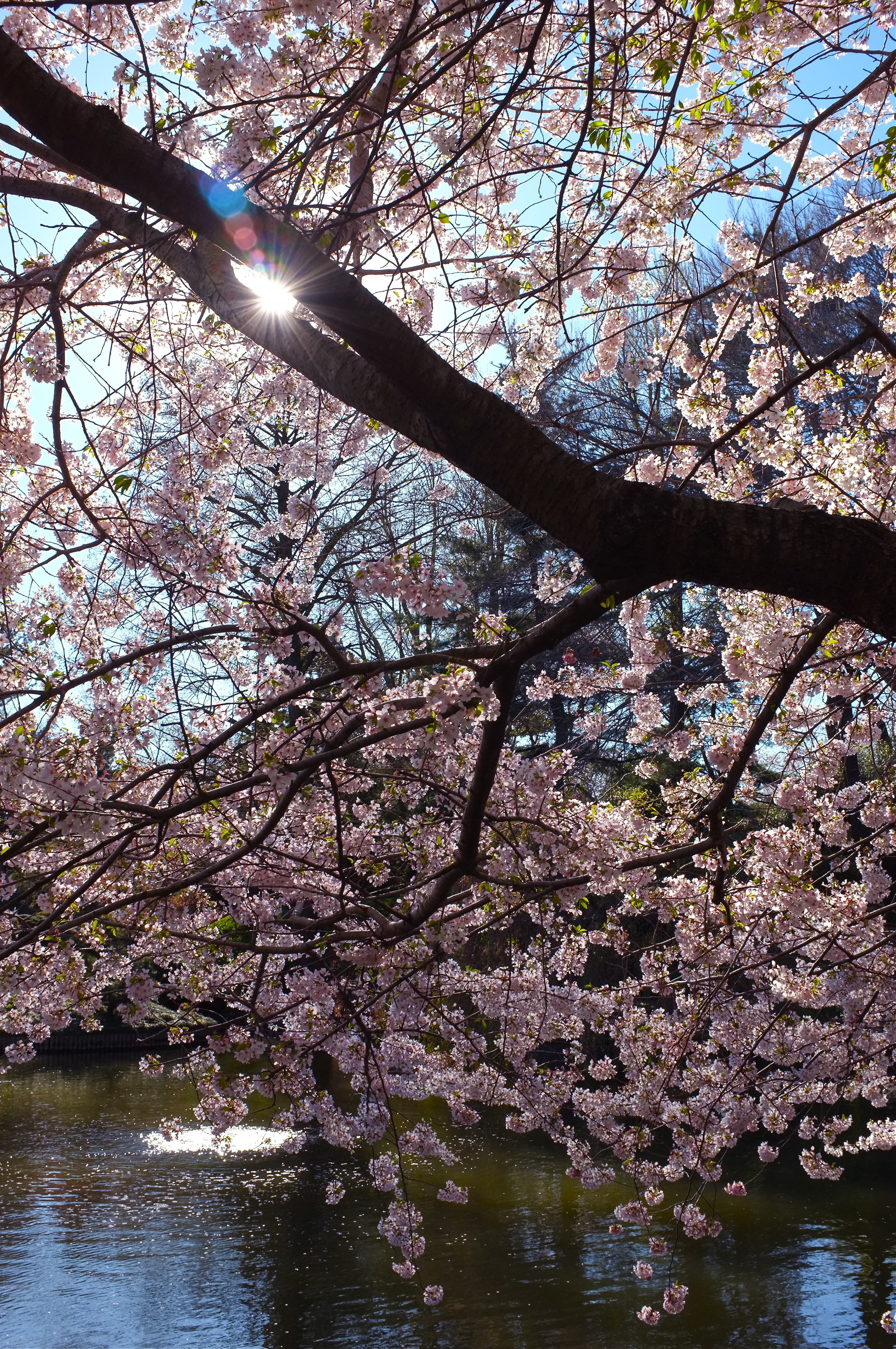
When cherry blossoms begin to fall heavily, the flurry of blossoms is called “cherry snowstorm.” The following is a traditional Japanese song that has been passed down for generations.
Sakura
Cherry blossoms, cherry blossoms
As far as you can see.
Across yayoi skies
Is it mist? Is it clouds?
Ah, the fragrance!
Let us go, Let us go and see!
To see a cherry blossom snowstorm:
In the Japanese language the cherry is called “sakura,” which is generally believed to be a corruption of the word “sukuya” (blooming). Poets and artists strive to express the loveliness of its flowers in words and artistry. Called the flower of flowers, when the Japanese use the word “hane” (flower) it has come to mean sakura, and no other flower. Since the Heian period “hanami” has referred to cherry blossom viewing; the term was used to describe cherry blossom parties in the Tale of Gengi. Aristocrats wrote poetry and sang songs under the flowering trees for celebratory flower viewing parties. The custom soon spread to the samurai society and by the Edo period, hanami was celebrated by all people.

The delicacy and transience of the cherry blossom have poignant and poetic appeal, providing themes for songs and poems since the earliest times. The motif of the five petal cherry blossoms is used extensively for decorative arts designs, including kimonos, works in enamel, pottery, and lacquer ware. Cherry tree wood is valued for its tight grain and is a lustrous reddish brown when polished. The wood is used to make furniture, trays, seals, checkerboards, and woodblocks for producing color wood block prints.

In modern times the advent of the cherry blossom season not only heralds the coming of spring, but is also the beginning of the new school year and the new fiscal year for businesses. Today families and friends gather under the blooms and celebrate with picnicking, drinking, and singing. The fleeting beauty of the blossoms, scattering just a few days after flowering, is a reminder to take time to appreciate life. In the evening when the sun goes down, viewing the pale-colored cherry blossoms silhouetted against the night sky is considered an added pleasure of the season.
The tradition of celebrating cherry blossom season began in the United States when, on Valentine’s Day in 1912, Tokyo mayor Yukio Okaki gave the city of Washington, D.C., 3,000 of twelve different varieties of cherry trees as an act of friendship. First Lady Helen Taft and the wife of the Japanese ambassador, Viscountess Chinda, planted the initial two of these first cherry trees in Potomac Park. Today cherry blossom festivals are celebrated annually not only in Wash- ington, D.C., but in Brooklyn, San Francisco, Seattle, and Macon, Georgia.
It is said that the true lover of cherry blossoms considers the season is at its height when the buds are little more than half open—for when the blossoms are fully opened there is already the intimation of their decline.
 Yesterday while visiting our daughter Liv we stopped briefly at the Brooklyn Botanic Garden. We could not have come on a more perfect day to see both the magnolias and the cherry trees in the Japanese garden in full, spectacular bloom.

You may recall that in a previous “Top Five Magnolias” post I mentioned that Magnolia ‘Elizabeth’ was patented by the Brooklyn Botanic Garden in 1977. She was first hybridized in 1956 and is named after Elizabeth Van Brunt, a patron of the garden.


Everyone was taking snapshots of Elizabeth!
I am so excited to tell you about this wonderful find. I was walking my pooch Rosie on our usual route down to the harbor and, dangling at eye level from a tree that I have passed a hundred times this winter , there was this structure. Thinking it was what it is, I ran home and checked my Lepidoptera books, and it is the cocoon of a member of the Giant Silk Moth Family, Saturniidaee (not to be confused with the oriental silk moth, Bombyx mori, from which silk fabric is spun).

Hanging from the tip of the American White Birch branch you could easily mistake it for a dry withered leaf, and that is exactly what the caterpillar has done, weaving the leaf around itself to pupate within. The cocoon is quite a good size, approximately two inches in length by one inch in width. The caterpillar pupates during the summer, overwinters in the cocoon stage, then emerges sometime in May or June. Giant Silk Moths live only for about a week. They mate soon after eclosing and then perish. Giant Silk Moths do not have mouth parts; all eating is done during the caterpillar stage.
 Giant Silk Moth Cocoon
Several members of the Giant Silk Moth family of caterpillars eat birch leaves. I am hoping (and it looks a great deal like) it is the cocoon of the simply stunning Luna Moth, however it could also be the beautiful Polyphemus Moth.


Luna Moth ~ Images courtesy Google

Polyphemus Moth ~ Image courtesy wiki
Top Five Recommended Magnolias: Magnolia ‘Elizabeth’

Liv photo
When Liv was attending Boston University I would often pick her up for lunch, and if the weather were fine, we’d end up at the Arnold Arboretum. After a winter of wearying shades of gray and brown, imagine our shared delight in coming upon the lovely Magnolia ‘Elizabeth.’. Not only is her beauty great, but the sweet lemony scent, divine. Magnolia ‘Elizabeth’ is a cross between Magnolia acuminata, the Cucumber Tree, a native to the eastern regions of the United States and Canada and the Yulan Magnolia (Magnolia denudata), native to China; both species are much appreciated for their heady fragrance.
The Brooklyn Botanic Garden patented Magnolia ‘Elizabeth’ in 1977. I find the luminous primrose yellow blossoms much, much more preferable to the more common and relatively newer cultivar, Magnolia ‘Butterflies.’ Besides, M. ‘Butterflies” has comparatively ZERO scent.
Magnolia ‘Elizabeth’ is pyramidal in habit with elegantly tapered buds, characteristic of its parent the Yulan Magnolia. I would grow the Yulan Magnolia in a heartbeat if only we lived in a slightly warmer climate because it is the most dreamily scented of all the magnolias; its parentage is what gives both Magnolia ‘Elizabeth’ and the Saucer Magnolias their gorgeous fragrance.

Magnolia ‘Elizabeth’ grows 20 to 35 feet and does best when sited in full sun in Cape Ann gardens. Magnolias like moist soil, but hate wet feet, in other words, they require excellent drainage.
Does your magnolia look like this:
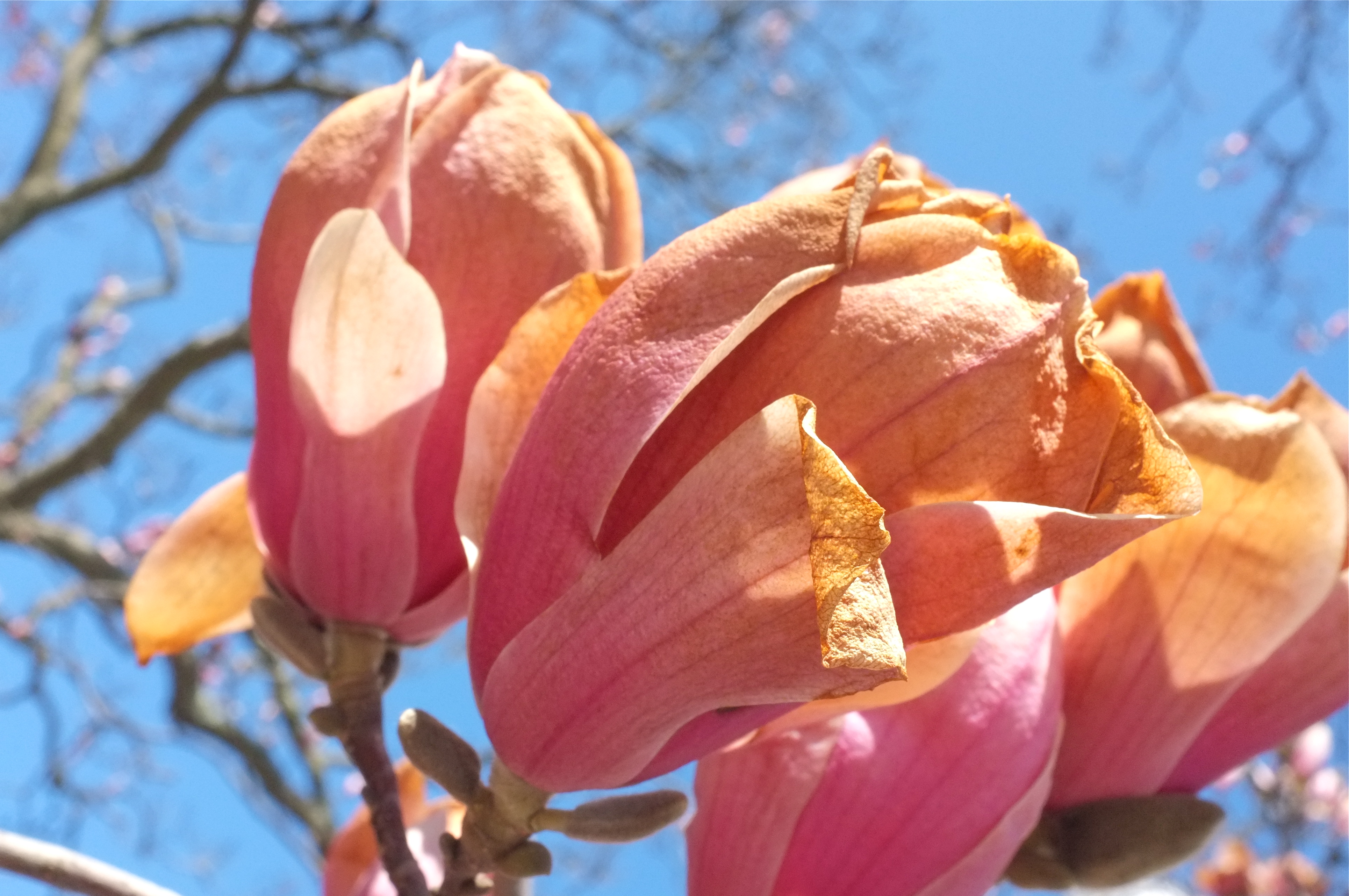 Magnolia blossoms ruined by hard frost
Rather than this:
 Magnolia soulangiana ‘Alexandrina’
Today begins a series on my top five magnolias, based on many years of observing and writing about this most highly appreciated species. Magnolias are one of the loveliest of springtime flowers, with silky buds developing into waxy fragrant goblets, and with their stunning display juxtaposed against bare branches, few trees are more breathtakingly beautiful than a mature magnolia in full glorious bloom. If you have a favorite magnolia, please write and let me know why!
Foremost in recommending magnolias are that the flowers have a beautiful shape, which will hold up well even in inclement weather, that they are intensely fragrant, and no less importantly, that they come into flower a bit later in the spring, or early summer. I had formerly recommended the Star Magnolia (see Joey’s photos Blooming Baby) however, Star Magnolias (Magnolia stellata) bloom the earliest of all the magnolias and they are the most susceptable to damage from a hard frost. Their bloom time is fleeting, at best, and the flowers are often quickly ruined.
Today’s recommendation is for the Saucer Magnolia (Magnolia soulangiana x ‘Alexandrina’). The saucer magnolia is the magnolia of Boston’s Commonwealth Avenue fame. A simply stunning and mature pair can be seen in Gloucester flanking the front entryway to the Classic Revival brick house on the way to Eastern Point (opposite Niles Beach). The outer petals of ‘Alexandrina’s’ flowers are a richly colored deep pink, shaded white and pale pink inside, with a lovely fragrance. This variety has an upright habit, which makes it ideal for standard tree forms. Plant in full sun, to very, very, light shade.
Tip –if you hold fragrance in as high regard as do I, go to the nursery when the species of tree that you are shopping for is in full bloom. Oftentimes a tree may identified as a particularly fragrant variety, but then again it may not be accurately identified. Through no fault of the nursery– perhaps tags were switched, or perhaps their distributor has not accurately labeled the plant; whatever the case, take your nose from tree to tree.
No group of trees and shrubs is more favorably known or more highly appreciated in gardens than magnolias, and no group produces larger or more abundant blossoms.” ~ Ernest “Chinese” Wilson, botanist and plant explorer
Global climate change is creating extremes in weather worldwide. The horticultural problems created by a spring cycle of freezing-thawing-freezing temperatures are only going to increase. The gardener’s best defense is to plant species that can withstand these new horticultural parameters.
Sent via darling daughter Liv–

This post is for my friend Donna. A Carolina Wren flew in through her open windows last week. I wrote this several years ago but thought you would enjoy it today.
That Chipmunk
Bird Come-to-me, come-to-me, come-to-me, repeated from sun up to sundown. Mellow and sweet—though loud enough to attract my attention—what was this new-to-my-ears birdsong coming from the thicket of shrubs? Occasionally we would catch a quicksilver glimpse of a petite sparrow-sized songbird singing energetically atop the fence wall or rapidly pecking at the chinks of bark on our aged pear tree. But this was definitely not a sparrow. His is a rounded little body with tail held upward. He has pale orangey-buff underparts and rich russet plumage, with white and black barred accents on the wings, and long white eye-stripes. Because his coloring is so similar to, my husband took to calling it “that chipmunk bird.”

Carolina Wren
After much running to the window and out the back door at his first few notes I was able to identify our resident Carolina Wren. All summer long and through the fall we were treated to his beautiful and sundry melodies. Here it is late winter and he is again calling me to the window. We can have a longer look through bare trees and shrubs. Much to our joy there is not one wren, but a pair!
The Carolina Wren (Thryothorus ludovicianus) is common throughout the southeast; so populous it is the state bird of South Carolina. When found on Cape Ann it is at its most northern edge of its territory. Gradually, as the climate has warmed over the past century, its range has expanded. They are sensitive to cold and will perish during severe weather. The Carolina Wren is a highly adaptable creature, dwelling in swamps, forests, farms, and tree-filled urban and suburban communities. They hop around leaf litter and dense brush, using their elongated bills to forage for food close to the ground. A pair may bond any time of the year and will stay together for life. It is the ardent male who sings the loud song and he is apt to anytime and anywhere. Carolina Wrens work together to construct their nests and feed their young. Their nesting sites are varied, built in both man-made and natural nooks and crannies; tree holes and stumps, and just as frequently, windowsills, mailboxes, tin cans, garage shelves, and holes found in porches, fence posts, and barns.
During the breeding season they have a voracious appetite for insects, supplemented with fruit, nuts and seeds. Hoping to keep our pair healthy and in residence, and worried that they would not have enough fat in their diet, I made a peanut butter feeder. It took under an hour and cost less than five dollars. I am experimenting with different recipes and will let you know which songbirds are attracted to what mixture and whether ornot the squirrels become intolerable.
How to make a Peanut Butter Bird Feeder

Materials and tools needed: Portion of driftwood or fallen branch, approximately 4 to 6 inches in diameter; one dowel, approximately 1⁄4 inch diameter; one 1-inch open S hook; one size 12 screw eye; approximately six feet of chain; saw; drill, with one large bit, and one small bit that is slightly larger than the dowel; sandpaper; wood glue.
It took several tries to find driftwood that was not soft, wet, and mushy inside. Look for wood from hardwood. The driftwood in the photograph was cut to eight inches in length, after determining where the center hole and holes for the perches should be drilled. Mark, with a pencil, a two- to three-inch diameter hole, depending on the diameter of the wood. Mark the two spots for the perches, about 1 and 1⁄2 inches below the hole. Drill the side holes for the perches one inch deep. Drill the center hole, approximately two to three inches deep, again depending on the diameter of the log. Smooth the center hole with sandpaper. Cut two perches from the dowel, 4 inches in length, and glue into the drilled perch holes. Allow to dry overnight. Center and screw the screw eye into the top of the feeder and add the S-hook. Loop the chain around a tree limb so that it hangs five to six feet off the ground. Attach the S hook through the screw eye and chain. With pliers, close the upper end of the S-hook firmly around the chain and the opposite end just enough to hold the screw eye firmly in place, but not too tight that the feeder cannot be removed for easy filling and cleaning. Fill with peanut butter mixture.
Peanut Butter and Fruit Recipe ~
Basic recipe: Mix one or two tablespoons of peanut butter with an apple slice that has been finely diced. Add a teaspoon of raisins, coarsely chopped. This makes a perfectly appetizing and healthy mix. For variety, add dried cranberries, currants, chopped almonds, sunflower seeds, millet, and/or crumbled whole grain crackers.
Two events I am especially looking forward to this week are the Good Morning Gloucester Spring Fling, Saturday (March 21, 6:00 pm) at Bodin Historic Photo Gallery, and the premier of Wim Wenders Pina at Cape Ann Community Cinema.
If you attended the GMG Christmas party, then you know you are in for a fabulously fun night. GMG contributors will all be there, and I especially love meeting the people who comment regularly on the blog. Fred Bodin and Joey Ciaramitaro are the perfect hosts. BYOB, bring food, or not-not required, and bring your fun-self! The party is for FOBs, FOGs, contributors, and is open to all.

Just a few of the GMG artists and FOBs you’re likely to meet at the Spring Fling!
Pina premires locally at Cape Ann Community Cinema on Friday, March 30th at 2:30, 7:30, and 9:45, with a special sneak preview at 6:00 pm tonight, Monday, March 26th.
PINA is a film for Pina Bausch, the great German choreographer, by Wim Wenders. He takes the audience on a sensual, visually stunning journey of discovery into a new dimension: straight onto the stage with the legendary Tanztheater Wuppertal Pina Bausch ensemble; he follows the dancers out of the theatre into the city and the surrounding areas of Wuppertal – the place, where for 35 years, was the home and centre for Pina Bausch’s creativity.

Pina ~ A Film for Pina Bausch by Wim Wenders
For more dates and showtimes visit Cape Ann Community Cinema.

Cape Ann Community Cinema
Last Saturday for my birthday my husband Tom treated me to a beautiful and fabulous dinner at Duckworth’s. The following morning I met my Good Morning Gloucester friends for brunch at Passports–talk about spoiled–Duckworths and Passports are two of my very favorite restaurants and two of the very finest restaurants on the North Shore.
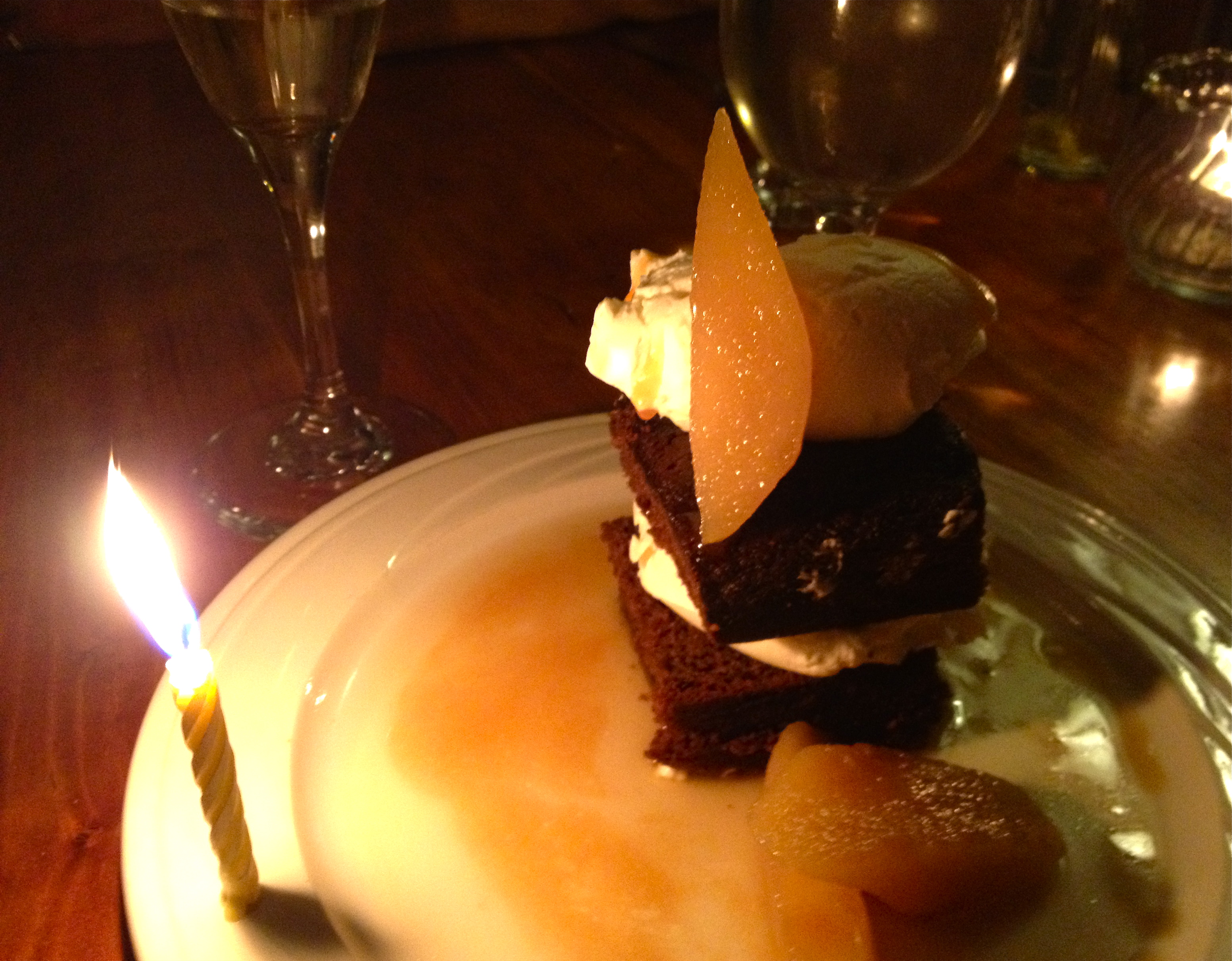
I had only my iPhone camera with me at Duckworths and don’t like the way most of the photos turned out–too little light for the iPhone’s tiny image sensor .
Nicole Duckworth’s Fabulous Desert ~ Gingerbread with Marscapone and Poached Pears
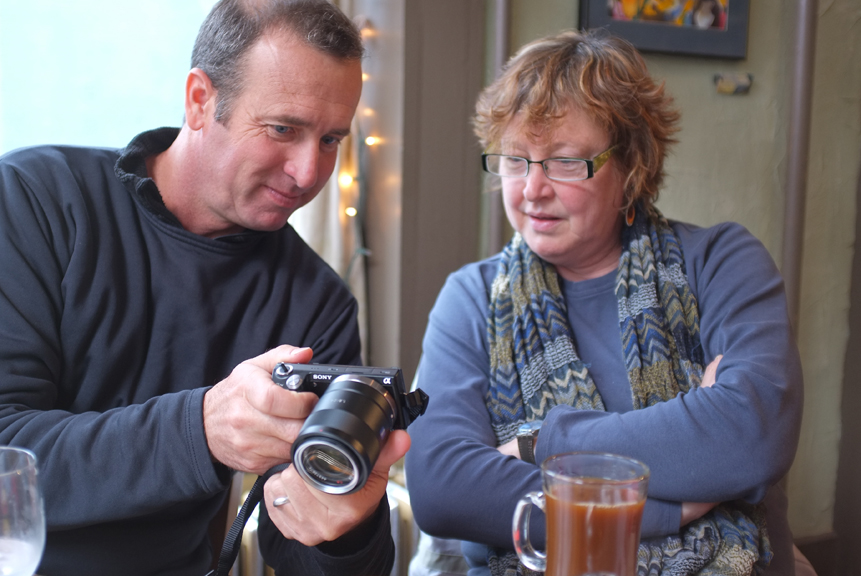
Brunch at Passports
Joey and Susan -Fujifilm x100 photo
 Susan and Paul -Fujifilm x100 photo
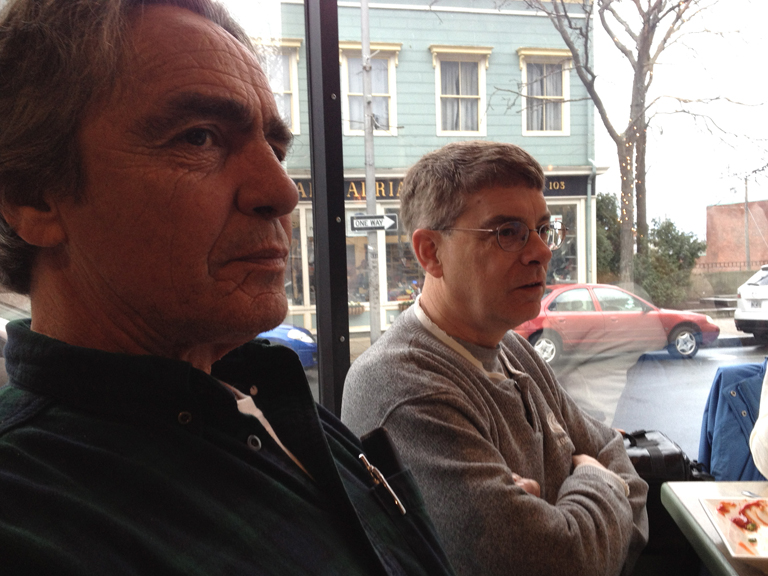 Ed and Rick -iPhone 4S photo
 Donna and Greg -iPhone 4S photo
 Greg and Joey -iPhone 4S photo
Click Link: East Gloucester Residents Please Note.

In looking for music for my butterfly documentary I heard a very beautiful folk version of “Simple Gifts,” then found the John William’s recording, “Air and Simple Gifts,” with YoYo Ma and Itzhak Perlman created for Obama’s inauguration, which led to discovering Aaron Copland’s score for Martha Graham’s Applachian Spring (1944). The melody is perfect for my film. I then fortuitously ran into Kathleen Adams, the music director of the Annisquam Village Church, and Liv’s former teacher and mentor, at a cocktail party, and asked her advice. Kathleen graciously volunteered to share her talents and offered she and the church to record “Simple Gifts.” While Liv was home over spring break she very sweetly offered to sing.
Finding copyright free music is difficult and costly. I am eternally grateful for Kathleen and Liv’s generosity and for sharing their gifts. Kathleen recommended Phil Davis, who is an expert in recording classical music and artist in his own right.

Kathleen Adams and Liv standing next to the gorgeous organ that Jeremy Adams, Kathleen’s husband, built for the Annisquam Village Church
I can’t wait for you to hear Liv and Kathleen’s rendition, played as written and with their beautiful improvising!
Although many people think that the tune of ‘Simple Gifts” is a traditional Celtic song, “Simple Gifts” was an American Shaker dance song written in 1848 by Elder Joseph Brackett. The song has been widely adapted. Perhaps the best known example is “Lord of the Dance,” published in 1963, which was then used without coyright permission for Michale Flatley’s dance musical Lord of the Dance.
‘Tis the gift to be simple, ’tis the gift to be free
‘Tis the gift to come down where we ought to be,
And when we find ourselves in the place just right,
When true simplicity is gain’d,
To turn, turn will be our delight,
The photos of Grace Church and Saucer Magnolia (Magnolia soulangiana) were sent by my daughter Liv- a preview of blossoms to come (NYC is several weeks ahead of Gloucester in spring flowering).


Grace Church, a gothic revival masterpiece, was designed by James Renwick, Jr. when he was only 23 years old. The church was consecrated on March 7, 1846. Grace Church is located at 802 Broadway, NY, NY.
Happy Spring!
My friend Joey showed me how to live blog for his stellar Cape Ann community blog, Good Morning Gloucester. I thought live blogging may come in handy at some point for my blog as well and enabled it for Kim Smith Designs.
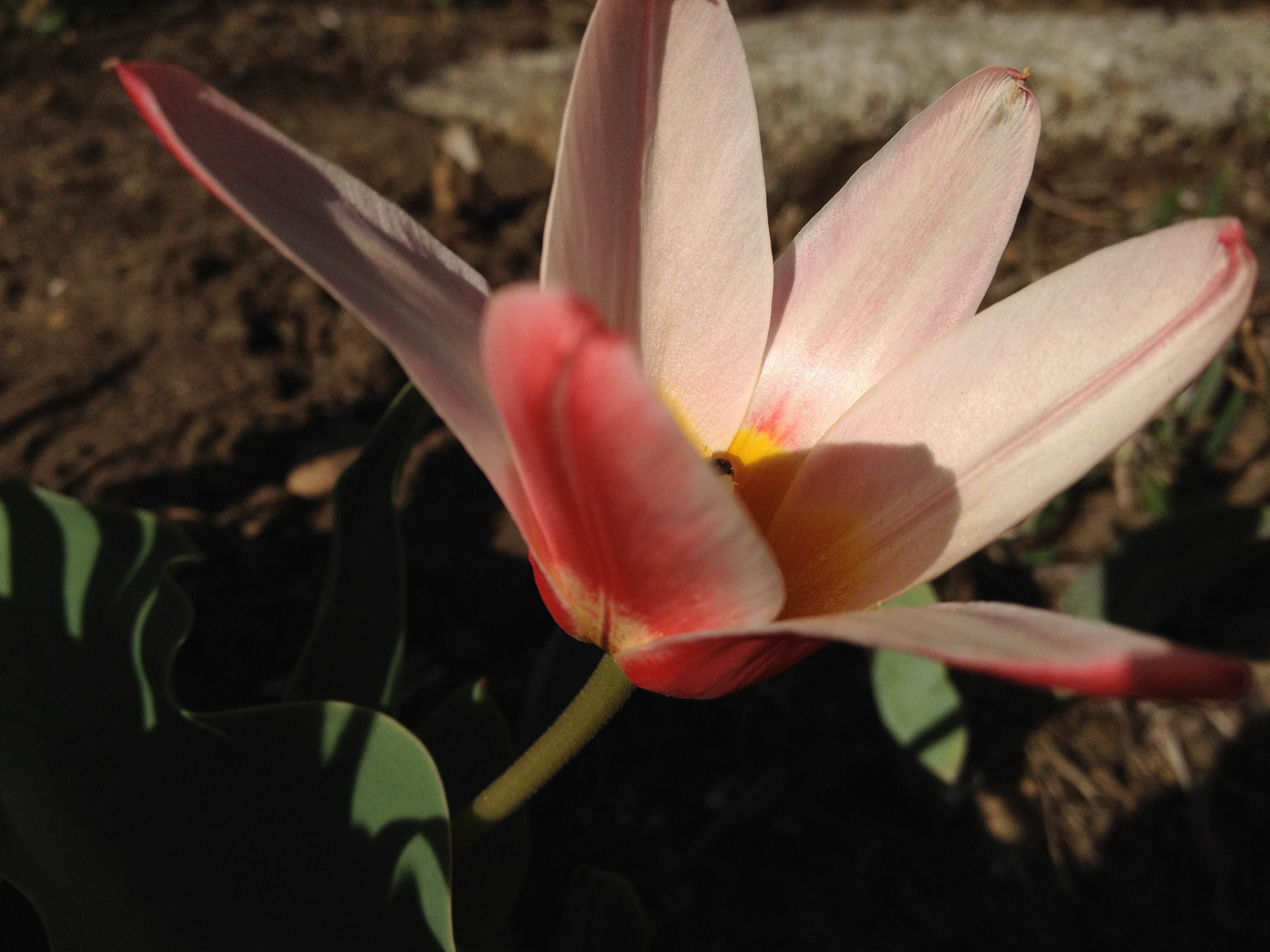
iPhone 4s Photo ~ Annually reblooming species tulip
My beautiful son, born on the first day of spring, during a snow storm, March 20, 1993.
 Alex, on his first day of college this past September. I don’t have too many recent photos of Alex; he was in the camera shy stage for all his high school years–although lately I am getting the feeling he doesn’t mind so much his Mom with her cameras.
 Best friends favorite breakfast of bacon and chocolate chip pancakes and strawberry smoothies ~ Shaffy, Alex, Sam, Mike, Cam, and Andrew 2006
 Alex and Liv August 2006
My darling daughter is home from grad school for a few days during spring break. I adore her and we just have the best time together.  iPhone 4s photo ~ Liv and Rosie
My husband Tom gave me a new iPhone for my early birthday present, while Liv is home, so that she can show me how to use it. My previous phone, a fossil from the Stone Age (as my son Alex often referred to it as) was not fun to use. When Siri started talking to us, I was just on the floor laughing in amazement.
