Tag Archives: Fragrant magnolias

Best Magnolias

Number Three is Magnolia ‘Forrest’s Pink’

Forrest’s Pink Magnolia

Forrest’s Pink is new to our garden. I purchased it several years ago through the mail and it arrived as nothing more than a stick with several side branches. FP is coming along beautifully and I was thrilled when last fall its very first bud had formed. Forrest’s Pink purportedly flowers slightly later, which is ideal for our predictably unpredictable New England spring. I also found very appealing its descriptions of delicious shell pink blooms, without a hint of purple. Although, what is most appealing is knowing that it’s parentage is that of the Lily Tree, or Yulan Magnolia (Magnolia denudata, synonomous with M. heptapetala)–the most dreamily scented of all the magnolias.

I was excited to show you a photo of its first flower but some devilish creature chewed the bud to the base of the tree. The bud had formed very low to the ground—perhaps it made a great bunny feast. The list of critters who eat magnolia flowers is long and includes snakes, deer, squirrels, moles, mice, and opossums. In China, the sweet citrus-scented flowers of the Lily Tree are pickled and used as a flavoring for rice. The lovely ornamental seed heads of many species of magnolias provide food for a wide range of birds. Hopefully by next year at this time we will have more than one bud to gaze upon and to photograph.

Newly developing seed head of Magnolia ‘Alexandrina’

Nearly the moment the fruits of our magnolia trees ripen, they are devoured by the Catbirds and Mockingbirds.

Image of Forrest’s Pink Magnolia courtesy Google image search

Magnolia ‘Elizabeth’

Top Five Recommended Magnolias: Magnolia ‘Elizabeth’

Liv photo

When Liv was attending Boston University I would often pick her up for lunch, and if the weather were fine, we’d end up at the Arnold Arboretum. After a winter of wearying shades of gray and brown, imagine our shared delight in coming upon the lovely Magnolia ‘Elizabeth.’. Not only is her beauty great, but the sweet lemony scent, divine. Magnolia ‘Elizabeth’ is a cross between Magnolia acuminata, the Cucumber Tree, a native to the eastern regions of the United States and Canada and the Yulan Magnolia (Magnolia denudata), native to China; both species are much appreciated for their heady fragrance.

The Brooklyn Botanic Garden patented Magnolia ‘Elizabeth’ in 1977. I find the luminous primrose yellow blossoms much, much more preferable to the more common and relatively newer cultivar, Magnolia ‘Butterflies.’ Besides, M. ‘Butterflies” has comparatively ZERO scent.

Magnolia ‘Elizabeth’ is pyramidal in habit with elegantly tapered buds, characteristic of its parent the Yulan Magnolia. I would grow the Yulan Magnolia in a heartbeat if only we lived in a slightly warmer climate because it is the most dreamily scented of all the magnolias; its parentage is what gives both Magnolia ‘Elizabeth’ and the Saucer Magnolias their gorgeous fragrance.

Magnolia ‘Elizabeth’ grows 20 to 35 feet and does best when sited in full sun in Cape Ann gardens. Magnolias like moist soil, but hate wet feet, in other words, they require excellent drainage.

Top Five Recommended Magnolias

Does your magnolia look like this:

Magnolia blossoms ruined by hard frost

Rather than this:

Magnolia soulangiana ‘Alexandrina’

Today begins a series on my top five magnolias, based on many years of observing and writing about this most highly appreciated species. Magnolias are one of the loveliest of springtime flowers, with silky buds developing into waxy fragrant goblets, and with their stunning display juxtaposed against bare branches, few trees are more breathtakingly beautiful than a mature magnolia in full glorious bloom. If you have a favorite magnolia, please write and let me know why!

Foremost in recommending magnolias are that the flowers have a beautiful shape, which will hold up well even in inclement weather, that they are intensely fragrant, and no less importantly, that they come into flower a bit later in the spring, or early summer. I had formerly recommended the Star Magnolia (see Joey’s photos Blooming Baby) however, Star Magnolias (Magnolia stellata) bloom the earliest of all the magnolias and they are the most susceptable to damage from a hard frost. Their bloom time is fleeting, at best, and the flowers are often quickly ruined.

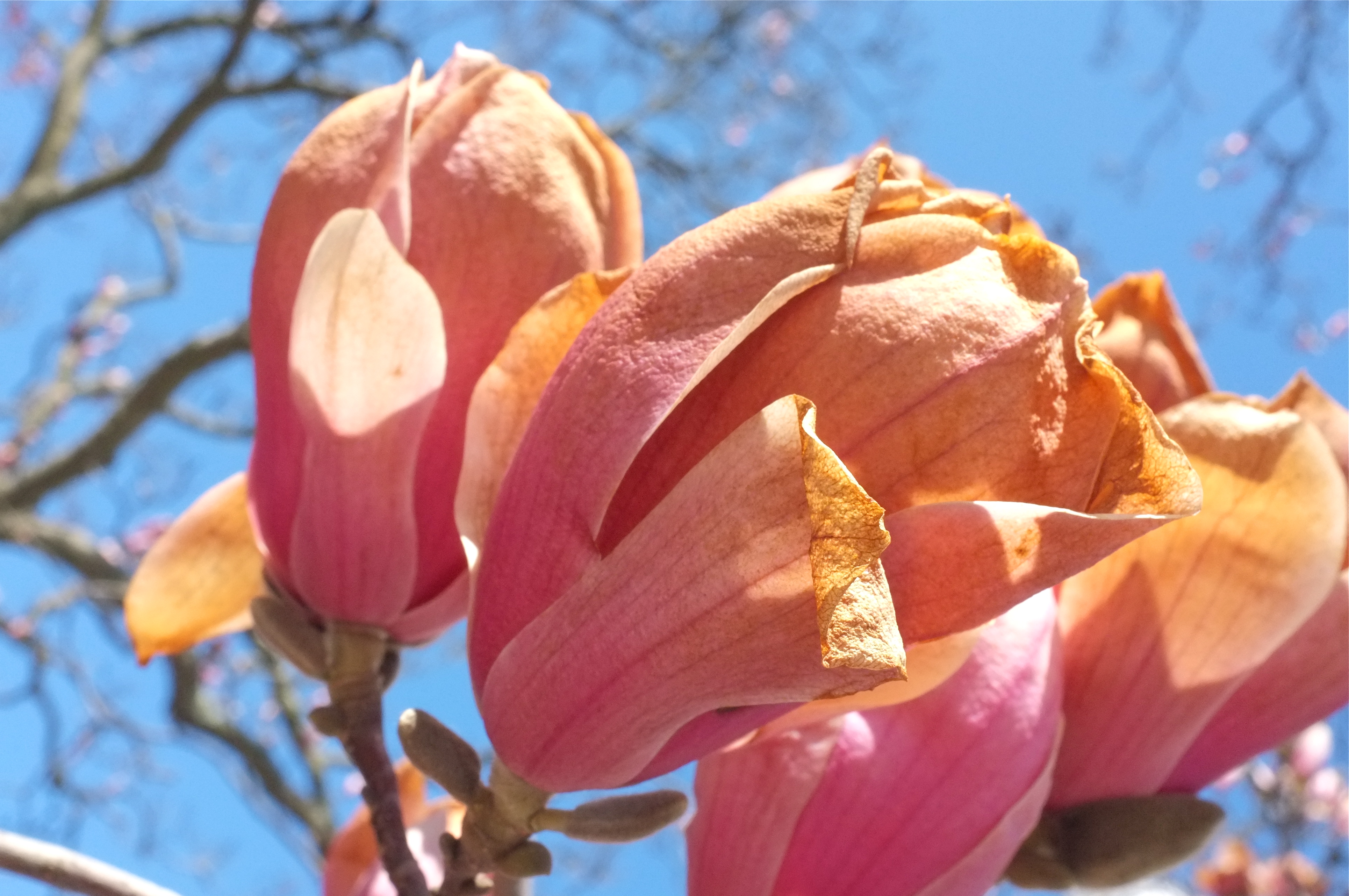
Today’s recommendation is for the Saucer Magnolia (Magnolia soulangiana x ‘Alexandrina’). The saucer magnolia is the magnolia of Boston’s Commonwealth Avenue fame.  A simply stunning and  mature pair can be seen in Gloucester flanking the front entryway to the Classic Revival brick house on the way to Eastern Point (opposite Niles Beach). The outer petals of ‘Alexandrina’s’ flowers are a richly colored deep pink, shaded white and pale pink inside, with a lovely fragrance. This variety has an upright habit, which makes it ideal for standard tree forms. Plant in full sun, to very, very, light shade.

Tip –if you hold fragrance in as high regard as do I, go to the nursery when the species of tree that you are shopping for is in full bloom. Oftentimes a tree may identified as a particularly fragrant variety, but then again it may not be accurately identified. Through no fault of the nursery– perhaps tags were switched, or perhaps their distributor has not accurately labeled the plant; whatever the case, take your nose from tree to tree.

No group of trees and shrubs is more favorably known or more highly appreciated in gardens than magnolias, and no group produces larger or more abundant blossoms.”  ~  Ernest “Chinese” Wilson, botanist and plant explorer

Global climate change is creating extremes in weather worldwide. The horticultural problems created by a spring cycle of freezing-thawing-freezing temperatures are only going to increase. The gardener’s best defense is to plant species that can withstand these new horticultural parameters.