Category Archives: Swallowtails

Looking for a Black Swallowtail Chrysalis

I am looking for a Black Swallowtail chrysalis to film. The last generation of the previous summer’s black swallowtail caterpillars spends the winter in their chrysalis form. Often times the winter chrysalis is a woody brown, not green. The late season caterpillar may pupate under the eaves of a house, along a porch or deck rail, or on a fence. I am hoping that amongst all my many readers, someone has a brown Black Swallowtail chrysalis in their garden.

Black Swallowtail chrysalis, green form

There are several distributors from where butterfly and moth chrysalis may be purchased, but I would prefer to film a Cape Ann specimen in its natural habitat (or at least a Black Swallowtail chyrsalis from the New England area). Please let me know if you think you have the brown form of the Black Swallowtail chrysalis. THANK YOU!!!

Black Swallowtail chrysalis, brown form–image courtesy Google image search

Reminder Thursday Night Premiere

Dear Friends,

A full schedule is planned this week–fall plantings, the premiere of The Butterfly Garden at Willowdale, and my lecture in New Hampshire. Rather than cooking half the night away, I planned ahead and spent the weekend making lots of treats for Thursday’s premiere. I hope you can come!!

Thursday morning’s lecture in Amherst, Butterfly Gardening, promises to be a joyful, and informative, program. This summer my Fujifilm x100 gave me many new photos that I can include in my lecture series and I couldn’t resist creating an entirely new slide show. I sorted though thousands of new photos over the weekend. And now, to tackle the video footage shot this summer and autumn—a daunting task ahead, but one I am sure will be  rewarding!

I hope you are warm and cozy and not without power. Sixty-degree temperatures are predicted for the weekend! New England weather—so very predictably unpredictable!

Warmest wishes, Kim

 Eastern Tiger Swallowtail Willowdale Estate

Oriental Lily Casa Blanca

Monarch Butterfly Emerging from Chrysalis

Black Swallowtail Pooping and Eating Fennel Simultaneously

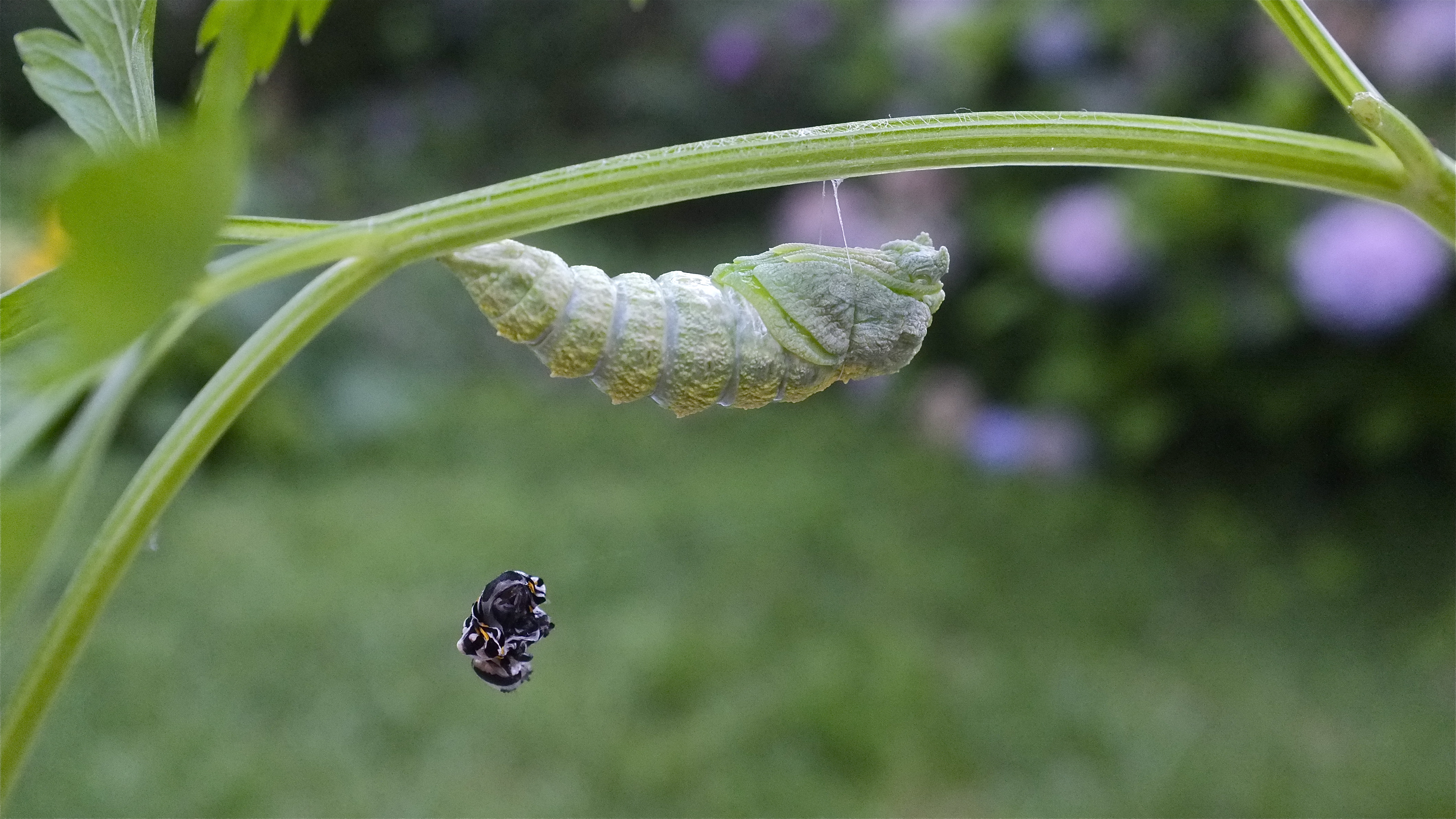
Black Swallowtail Newly Pupated, Discarded Skin-Caught Mid-air!

Butterfly Eyes

Eye to Eye

Black Swallowtail Butterfly

A butterfly’s eyes are relatively enormous, spherical structures referred to as compound eyes. Consisting of thousands of hexagonal shaped omatidea, each omatidea, or mini-sensor, is directed at a slightly different angle from the others. Collectively they are directed forwards, backwards, left, right, up, and down. For this reason, butterflies are able to see in nearly every direction simultaneously.

Hackberry Emperor Butterfly

Monarch Butterfly Eye

Vision is well developed in butterflies and most species are sensitive to the ultraviolet spectrum. The ability to see colors may be widespread but has been demonstrated in only a few species.

Black Swallowtail Butterfly

Black Swallowtail Butterfly Emerges During Hurricane Irene

This gorgeous female Black Swallowtail butterfly emerged during Hurricane Irene. What to do when a butterfly ecloses during inclement weather? Take a moment to enjoy it’s beauty close-up, provide food in the way of nectar plants, and wait until the storm abates before releasing.

Newly Emerged Female Black Swallowtail Butterfly (Papilio polyxenes)

Butterflies of Massachusetts

July Butterfly Update

Great Spangled Fritillary Nectaring on Coneflower at Willowdale EstateGreat Spangled Fritillary nectaring at native Coneflower (Echinacea purpurea)

Dear Friends,

Have you noticed the sheer numbers of our winged friends? Returning this evening from a swim at 6:45, I bumped into three Monarchs nectaring and a Red-spotted Purple (all in pristine, newly emerged condition). Early evening is an unusually late time of day for butterflies on the wing, especially when skies are slightly overcast. This, after a day of observing and shooting numerous numbers of butterflies, caterpillars and hummingbirds–and never leaving our garden. I work for a bit, but then the garden calls and I’m out the door with both video and still cameras. If this fabulously warm weather keeps up, I think we are in for another banner year with the butterflies, and skippers too.

Currently, we have 28 Monarchs, in various stages of development, residing in our kitchen, and seven Black Swallowtail caterpillars and chrysalids.

Black Swallowtail CaterpillarBlack Swallowtail Caterpillar–note the fine “girdle” spun by the pupating caterpillar. Attached to the stem by both the girdle and a silky mat in which his last proleg is hooked, the caterpillar is securely latched. The proleg becomes the cremaster during pupation.

Black Swallowtail Chrysalis newly formedNewly formed chyrsalis

Black Swallowtail Chrysalis The darkening chyrsalis–perhaps it will emerge tomorrow! After ten days, the silky girdle and cremaster continue to perfectly support the pupa.

I am often asked why I collect butterfly eggs and don’t simply leave them in the garden. Butterfly larvae have a roughly one in ten chance of survival in the wild. In our kitchen, the odds increase exponentially, with a ten in ten rate of survival. For instance, I have learned, that after observing a butterfly deposit her eggs on a host plant, to gather them up quickly. If I become distracted and wait even only an hour, they often disappear, usually having been eaten or parasitized.

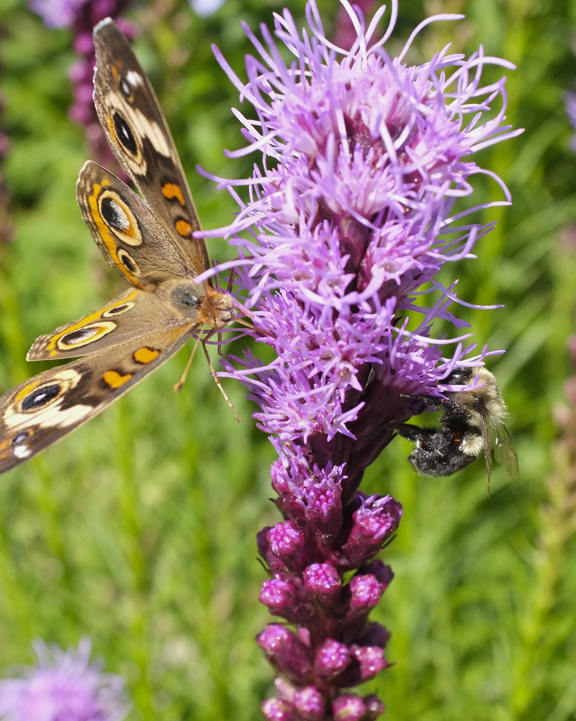
Common Buckeye and bee nectaring at native Gayfeather (Liatris spicata)Common Buckeye and bee nectaring at native Gayfeather (Liatris spicata)

More detailed information on each species will be forthcoming. Much footage to edit…

Question Mark Butterfly and Patrice

Question Mark Butterfly and Patrice ~ My favorite photo of the season (click on the photo to see full size). Yesterday afternoon, Lisa Smith, one of the producers over at Cape Ann TV, with her After the Beach Video Club for Teens, were filming in the garden. While Patrice was interviewing me, this Question Mark alighted briefly on her shoulder several times. I was prepared the second time, with camera ready and adjusted to the appropriate settings. The Question Mark’s cooperation throughout the day’s shoot–nectaring, sunning itself, and taking long sips of sap through the chinks of bark in the weathered old pear tree–was very much appreciated by all; he was the true star of the day!

Oh Joyous July!

No, that is not a Monarch caterpillar on your parsley plant.

I am often asked “why is that green, yellow, and black Monarch caterpillar eating my parsley”?

Eastern Black Swallowtail Butterfly caterpillarBlack Swallowtail Caterpillar

Chances are, you will never see a Monarch caterpillar on your parsley. By far and away it is more likely that you have the caterpillar of the gorgeous Black Swallowtail Butterfly (Papilio polyxenes).

Caterpillars that are actively feeding are usually only found on their larval host plant(s), the plant they have developed a distinctive coevolutionary relationship with over millennia. Monarch caterpillars do not eat parsley and Black Swallowtail caterpillars do not eat milkweed, and if either attempted, they would not survive. Black Swallowtails were in the past commonly referred to as the Parsnip Swallowtail as their caterpillar food plants belong to members of the Umbelliferae, or Carrot Family. The diet  of the Black Swallowtail caterpillar includes the foliage and flowers of carrot plants, fennel, dill, parsley, Queen Anne’s lace, and parsnips.

Monarch CaterpillarMonarch Caterpillars

The Monarch caterpillar is yellow, black, and white. The Black Swallowtail caterpillar is green, black, and yellow.

Please see my Life Story of the Black Swallowtail Butterfly film’s website for videos and more photos documenting the butterfly’s life cycle.

Eastern Black Swallowtail Butterfly caterpillarMetamorphosing from this

to this…

Eastern Black Swallowtail ButterflyBlack Swallowtail Butterfly (Papilio polyxenes)

See Life Story of the Black Swallowtail Butterfly film website for videos and more photos documenting the butterfly’s life cycle.

Our Beautiful Native Sweet Bay Magnolia

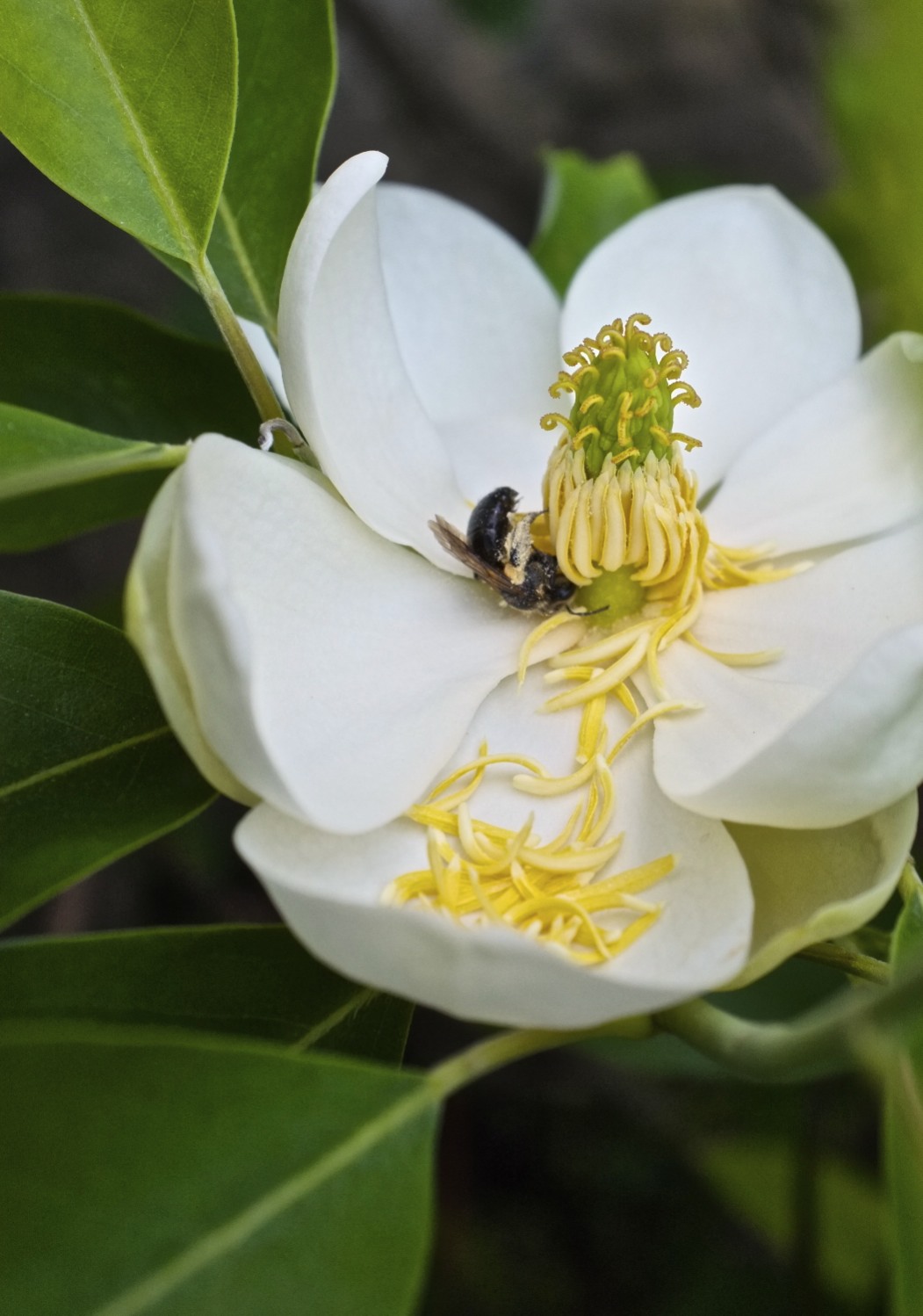
Magnolia virginiana ~ Sweet Bay Magnolia

Located in the heart of Ravenswood Park in Gloucester there is a stand of Magnolia virginiana growing in the Great Magnolia Swamp. It is the only population of Magnolia virginiana known to grow this far north. I took one look at the native sweet bay magnolia and breathed in the fresh lemon-honeysuckle scent of the blossoms, fell in love, and immediately set out to learn all I could about this graceful and captivating tree. Recently having returned from a trip to visit my family in northern Florida, I had tucked the bud of a Magnolia grandiflora into my suitcase. I was dreaming of someday having a garden large enough to accommodate a Magnolia grandiflora and was overjoyed to discover the similarities between M. virginiana and M. grandiflora. For those not familiar with the Southern magnolia, it is a grand, imposing specimen in the landscape, growing up to fifty feet in the cooler zones five and six, and one hundred feet plus in the southern states. M. grandiflora is the only native magnolia that is reliably evergreen in its northern range, flowering initially in the late spring and sporadically throughout the summer. The creamy white flowers, enormous and bowl-shaped (ten to twelve inches across), emit a delicious, heady sweet lemon fragrance.

Sweetbay Magnolia virginiana Gloucester Massachusetts

In contrast, the flowers of the sweetbay magnolia are smaller, ivory white, water-lily cup shaped, and sweetly scented of citrus and honeysuckle. The leaves are similar in shape to the Magnolia grandiflora, ovate and glossy viridissimus green on the topside, though they are more delicate, and lack the leathery toughness of the Southern magnolia. The lustrous green above and the glaucous silvery green on the underside of the foliage creates a lovely ornamental bi-color effect as the leaves are caught in the seasonal breezes.

Sweetbay Magnolia virginiana bud Gloucester Massachusetts

Magnolia virginiana is an ideal tree for a small garden in its northern range growing to roughly twenty feet compared to the more commanding height of a mature Southern magnolia. Sweet bay grows from Massachusetts to Florida in coastal freshwater wetland areas as an understory tree. The tree can be single- or multi-stemmed. Sweet bay is a stunning addition to the woodland garden with an open form, allowing a variety of part-shade loving flora to grow beneath the airy canopy. The leaves are a larval food for the Eastern Tiger Swallowtail butterfly. Almost immediately after planting we began to notice the swallowtails gliding from the sunny borders of the front dooryard, where an abundance of nectar-rich flowers are planted specifically to attract butterflies, around to the shady border in the rear yard where our sweet bay is located.

Our garden is continually evolving and part of our garden has given way to a limited version of a woodland garden, for the shady canopy created by the ever-growing ceiling of foliage of our neighbor’s trees has increasingly defined our landscape. We sited our Magnolia virginiana in our diminutive shaded woodland border where we can observe the tree from the kitchen window while standing at the kitchen sink. Gazing upon the tree bending and swaying gracefully in the wind, displaying its shifting bi-color leaves, provides a pleasant view when tending daily chores and the dreamy fragrance emitted from freshly opened blossoms make the chores all that less tiresome.

Excerpt from “Oh Garden of Fresh Possibilities!” Notes from a Gloucester Garden (David R. Godine Publisher), written and illustrated by Kim Smith.

Magnolia virginiana in Gloucester, Massachusetts

Magnolia virginiana in Massachusetts written by Peter Del Tredici.

Sweetbay Magnolia virginiana Gloucester Massachusetts Fujifilm x100

History

The sweet bay magnolia swamp in Gloucester, Massachusetts has been a botanical shrine since its discovery in 1806. Early New England naturalists and botanists of all types, from Henry David Thoreau to Asa Gray, made pilgrimages to the site of this northern- most colony of Magnolza virginiana. The local residents of Gloucester were so impressed with a “southern”plant growing this far north that they changed the name oft he Kettle Cove section of the town to Magnolia in the mid-1800s. It is probably no coincidence that this name change occurred at the same time the area was starting up its tourist trade.

In addition to its isolation, the Gloucester Magnolia population was remarkable for having escaped notice until 1806 in an area that was settled in 1623. This fact has led at least one author to speculate that the colony was not wild but escaped from a cultivated plant (Anonymous, 1889). However, the overwhelming consensus of earlier botanists is that the population is, in fact, native. Whatever its origin, the swamp remains today the unique and mysterious place it has been for almost 200 years.

Very little has been written about the magnolia swamp in recent years. The latest, and best, article about it was wntten by Dr George Kennedy, and appeared in 1916 in Rhodora, the Journal of the New England Botanical Club. Dr. Kennedy summarized the history of the stand, and cleared up the confusion about who discovered it by publishing a letter he found, written by the Honorable Theophilus Parsons to the Reverend Manassah Cutler in 1806. The letter captures the emotion of the moment of discovery:

Reverend and Dear Sir:

In riding through the woods in Gloucester, that are between Kettle Cove and Fresh Water Cove I discovered a flower to me quite new and unexpected in our forests. This was last Tuesday week [July 22, 1806]. A shower approaching prevented my leaving the carriage for examination, but on my return, on Friday last, I collected several of the flowers, in different stages, with the branches and leaves, and on inspection it is unquestionably the Magnolia glauca Mr. Epes Sargent has traversed these woods for flowers and not having discovered it, supposes it could not have been there many years. It was unknown to the people of Gloucester and Manchester until I showed it to them. I think you have traversed the same woods herborizing. Did you dis-cover it? If not, how long has it been there? It grows in a swamp on the western or left side of the road as you go from Manchester to Gloucester, and before you come to a large hill over which the road formerly passed. It is so near the road as to be visible even to the careless eye of the traveler. Supposing the knowledge of this flower, growing so far north, might gratify you, I have made this hasty communication.

Your humble servant, Theoph. Parsons

To read Mr. Del Tredici’s fascinating article in full click here Magnolia virginiana in Massachusetts, including an excerpt from when Henry David Thoreau visited the swamp and wrote about it in his Journal.

Peter Del Tredici is a Senior Research Assistant at the Arnold Arboretum and Lecturer at Harvard Graduate School of Design. Peter writes the following for the Arnold Arboretum: “My research interests are wide ranging and mainly involve the interaction between woody plants and their environment. Over the course of thirty plus years at the Arnold Arboretum, I have worked with a number of plants, most notably Ginkgo biloba, conifers in the genera Tsuga and Sequoia, various magnolias, and several Stewartia species (family Theaceae). In all of my work, I attempt to integrate various aspects of the botany and ecology of a given species with the horticultural issues surrounding its propagation and cultivation. This fusion of science and practice has also formed the basis of my teaching at the Harvard Graduate School of Design (since 1992), especially as it relates to understanding the impacts of climate change and urbanization on plants in both native and designed landscapes. Most recently, the focus of my research has expanded to the subject of spontaneous urban vegetation which resulted in the publication of “Wild Urban Plants of the Northeast: A Field Guide” (Cornell University Press, 2010).”

Lilac Cuture

Lilacs are found growing (where winters are cold enough to afford proper growth and ample blossoms) from the smallest rural village to the urban courtyard. They grow the very best in zones 3, 4, and 5, in the colder regions of zones 6 and 7, and in the warmer regions of zone 2. They will tolerate temperatures of -35 to -40f, though they may suffer some damage from windchill. If temperatures dip to such extreme cold in your region, site the lilac out of the path of chilling winter winds. Lilacs will tolerate frozen ground but not frozen pockets where water does not drain properly. Requiring excellent drainage, they grow best along rocky, limestone hillsides, suggesting just how important good drainage is. When planted in a mesic site, lilacs flower adequately, although, by late summer the foliage may wilt and turn moldy.

Syringa vulgaris President GrevySyringa vulgaris ‘President Grevy’

Lilacs perform best in sandy, gravelly loam mixed with organic matter such as compost and aged manure. Keep the surrounding soil free from weeds with an annual mulch of compost. In early spring sprinkle a cup of wood ashes around the base of the lilac and work it gently into the top layer of soil. Every three years or so apply a cup of ground limestone to the soil, again gently working it into the soil so as not to injure the roots.

Lilacs require full sun to nearly full sun to set flower buds. Where optimal sunlight isn’t always available, one may have some success with pushing the envelope. We are growing lilacs in several locations in half sun, and although they would be fuller in form with far more flowers, all are growing well.

The overall shape of lilacs is greatly improved with an annual pruning. Immediately after flowering is the ideal time to attend to this not unpleasant task. The job becomes less manageable as the shrub grows tall and leggy in a few short years.

After the lilac has become established and is a desirable size and shape, cut to the ground approximately one third of the oldest branches and thinnest suck- ers. This allows the bush to renew itself and for the energy of the bush to go into the remaining growth. Leaving the strongest trunks that form the armature of the shrub, prune diseased or pest-infested shoots or branches, and remove all declining stems, thin suckers, and small, twiggy branches. Some lilacs produce suckers rarely, if at all, and others sucker aggressively. Remove all spent flowers immediately after blooming, snipping very close to the tail end of the panicle so as not to remove the new growth that will provide you with next year’s flowers.

If you are growing lilacs as a background shrub or as a small tree, allow only two to three main stems as trunks, removing lower branches and cutting all other shoots to the ground. ’Beauty of Moscow’, ‘Madame Florent Stepman’ and the common lilac, both var. purpurea and alba, are all well suited for growing into a small multi-stemmed tree. Conversely if you do not want your lilac to become a tree, prune to a height of eight to nine feet, which keeps the blossoms at eye level.

Pagoda dogwood (Cornus alternifolia)Natives Pagoda Dogwood (Cornus alternifolia) and Catawba Rhododendron (Rhododendron catawbiense)

Pagoda dogwood (Cornus alternifolia)The small florets of  the pagoda dogwood are a bee-magnet.

With its versatile form and lovely heart-shaped leaves the lilac is an exceptional companion to a wide range of flowering trees and shrubs. The extended period of florescence a well-planned lilac hedge provides coincides with the long flowering period of our native pagoda dogwood (Cornus alternifolia) and Catawba rhododendrons. Just as the Sargent crabapple (Malus sargentii) is at its flowering peak, with masses of sublimely scented white blossoms, the earliest lilacs begin their fragrant parade. In our garden, the blossoms of Prunus, namely peach, pear and plum, overlap with the flowering of ‘Beauty of Moscow,’ ‘Maidens Blush,’ and ‘President Grevy.’ They are planted in close vicinity along the garden path. The newly emerging fragrant blossoms of Prunus interwoven with the pervasive perfume of lilacs give The Scent of All Spring!

Lilacs are one of the loveliest shrubs to grow as a tall hedge, and they integrate magnificently into the country hedge of mixed shrubs and trees. The ineffable beauty and fragrance of lilacs are enhanced by the many varieties of suitable companion plants. The short list of plants described here is particularly appealing during the lilac’s period of flowering, for their compatible scents, colors, and foliage or for creating a sequentially blooming combination of fragrances. ‘Korean Spice’ viburnum, nearing the end of its florescence while the lilacs are beginning theirs, blooms in pink infused white, snowball shaped flower heads, with an intensely sweet and spicy aroma. Variegated Solomon Seal, Viola ‘Etain,’ late-season jonquils and narcissus, and lily of-the-valley all bloom simultaneously with early lilacs. The most sublimely scented tree peony ‘Rockii,’ with white petals washed with pale rose, and magenta-purple splotches at its heart center, also flowers during lilac time. Later in the season, to coincide with later-flowering lilacs, come the Iris pallidaIris germanica, and native Iris versicolor, English bluebells, early species daylilies with their honey-citrus scent, ‘Bridal Wreath’ spirea, blue and white columbine ‘Origami,’ and white bleeding hearts (Dicentra spectabilis ‘Alba’). Although not at all fragrant, I find the warm, rich yellow color of native honeysuckle Lonicera ‘John Clayton’ particularly appealing with the white and cool blue-lavender-hued lilacs. Just as ‘Therese Bugnet,’ the earliest of roses to flower (with its Rugosa heritage) joins the scene, the lilacs are finished for the season. Lilacs, when pruned to a small tree shape, allow a variety of plants to grow happily at their feet. Herbaceous peonies, although their blooming period usually does not coincide with lilacs, make an ideal garden companion. In our yard, Paeonia lactiflora follow lilacs almost to the day in order of sequential blooming. The dense, full mounds of foliage of the herbaceous peonies visually fill the space left by the trunk of the lilacs, as do hosta. The foliage of hosta, planted on the shady side, makes a companionable partner. Hosta will appreciate the filtered sun and both plants benefit from an annual blanket of compost. Species daylilies, Montauk daisies, and chrysanthemums are ideal companions when planted on the sunnier side of lilacs.

Lonicera ‘John Clayton’

Spring never lasts long enough in New England, with some years leaping from bitter cold to balmy, summer-like temperatures. Despite freezing rain and late spring snow, lilacs bloom and bloom resplendently. For the extended period of time in which the spires of sweet florets are in bloom, our garden is redolent with their heavenly fragrance. The blossoms of Syringa vulgaris, and especially the fragrant sorts, are a nectar source for the Eastern Tiger Swallowtail. The diminutive “violet afloat,” better known by its common name Spring Azure, is captivatingly beautiful floating about the pure white flowers of ‘Marie Legraye.’ Throughout the seasons our lilac hedge is alive with a chattering collection of songbirds. The height and the crooks of the branches are enticing to the innumerable songbirds, though it is the cadmium orange oriole alighting on the blue-hued spires of ‘President Grevy’ that causes the heart to skip a beat.

End Notes: Occasionally one must dig a bit deeper to find the value of a plant in relationship to pollinators for the landscape designed for people and wild creatures. First and foremost a garden should be an inviting habitat for the people who dwell there. What better way to create an invitation than with the beauty and fragrance of the lilac? Although not native to North America, lilacs (Syringa vulgaris) are celebrated in this country as they are part of our cultural heritage. From cuttings tucked into belongings, the earliest settlers connected their previous home to their home of new beginnings. The ease in which lilacs are cultivated is famous and testifies to their success and popularity. At a lecture I attended not too long ago, an example of a white oak, which supports nearly one hundred species of Lepidoptera, was compared to the lilac, which is known to support just twenty-five. From a gardener’s perspective that is like comparing apples to oranges. Very few have space enough to grow an 80-foot-tall white oak, whereas a ten-foot-tall and easily cultivated lilac can find a place in nearly any garden. Besides, twenty-five species of Lepidoptera is not bad. Additionally, lilacs are a rich source of nectar for swallowtails. Our native eastern redbud—although stunning, and providing nectar for bees and  hummingbirds—is much more challenging to cultivate and hosts two species of Lepidoptera. Plant what you like, as long as it is not invasive in your particular region. As much as possible, utilize native plants in your garden design and combine with well-investigated and well-behaved ornamentals.

For an expanded version on the history of lilacs, Lilacs the Genus Syringa written by Fr. John L. Fiala is highly recommended. Filled with hundreds of color photographs and including chapters on the culture of lilacs, hybridizing techniques, and propagation, I have turned to this book repeatedly. Fortunately it has been reprinted and is once again available through Timber Press.

Butterflies of Ohio

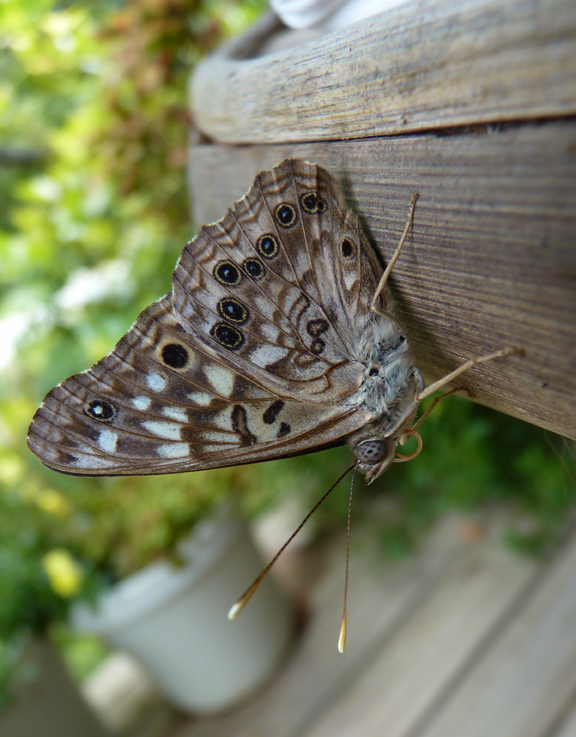
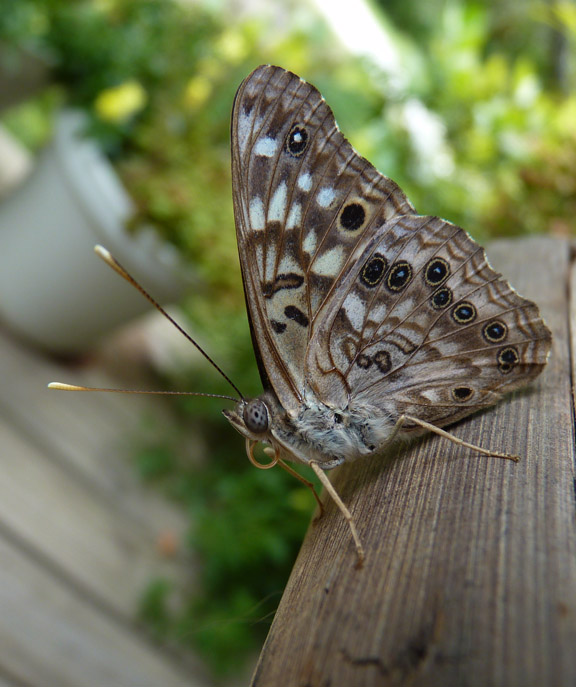
Hackberry EmperorMale Hackberry Emperor


A BUTTERFLY BONANZA!

Recently I returned from a trip to southwestern Ohio to visit my sister-in-law Amy, who is recovering from hip replacement surgery. She is mending beautifully and determined to get back on her feet —only a few days after returning home from the hospital the visiting nurse said she was doing as well as their typical patient at three weeks out!

While Amy was resting I would grab my camera and head into her garden and the surrounding fields because here was a Butterfly and Hummingbird Bonanza! I encountered dozens of Ruby-throated Hummingbirds, typically feeding and frolicking in groups of threes and fours, and many differing species of butterflies. For the most part, the butterflies that I photographed are the same species of butterflies that are found on Cape Ann and throughout New England. Having no expectation of encountering myriad butterflies, in both range of species and in legions of each, I had not planned accordingly and only packed my Panasonic Lumix. I love this camera, but like all cameras it does have certain limitations. Lesson learned—that is to say—always travel prepared for anything to happen!

Spicebush Swallowtail at Rose of SharonMale Spicebush Swallowtail Dusted with Pollen

Amy is a working architect and, as time and her work schedule have permitted, she has (along with her recently deceased dear husband Tim) redesigned and restored her lovely old farmhouse and gardens. There are several cozy porches and a deck under construction in which to sit and observe the wildlife dramas that play out almost daily.

Ohio Farmhouse

What makes Amy’s garden so inviting to the pollinators? The old farmhouse is approached by traveling down a crushed limestone driveway. On either side of the drive are fields, either overgrown with wildflowers, or maintained as mowed grass. The fields meet the forest edge. There are several neighboring houses along the drive but privacy is afforded because the houses are sited a fair distance apart and because there are naturalized arrangements of native trees and shrubs. Flower borders are planted in close proximity to her home and also further afield. Beyond the flower borders is a large vegetable garden, approximately twenty feet deep by sixty feet long, with a row of sunflowers bordering the back length and a cheerful patch of zinnias running along the fore edge. Beyond the vegetable garden is a vigorous crop of blackberries and beyond that is a clump of wildflowers, including common milkweed (Asclepias syriaca), which were covered in Monarch caterpillars, and the tall growing New York Ironweed (Veronia noveboracensis), which was in full bloom. All of these elements provide clues as to why Amy’s garden is a haven for the butterflies and hummingbirds. Additionally, adjacent to the house is an old peach tree, which bears great quantities of fruit. Because Amy has been under the weather from her hip injury she was not able to maintain the peach tree this past season. The peaches were falling to the ground and rotting—not really a bad thing as you will soon see—imagine the not intolerable odor of vinegary peach juice.

Yellow Sulphur Butterfly Zinnia elegansYellow Sulphur

The combination of the atypically lengthy stretch of hot, sultry weather, punctuated by soaking rain storms, along with the salt and mineral-rich limestone driveway, flowering plants, wildflowers, surrounding woodlands that provide shelter and larval food for caterpillars, hummingbird feeders, and rotting peaches—all work in tandem to create a paradise for the pollinators—bees, butterflies, and hummingbirds.

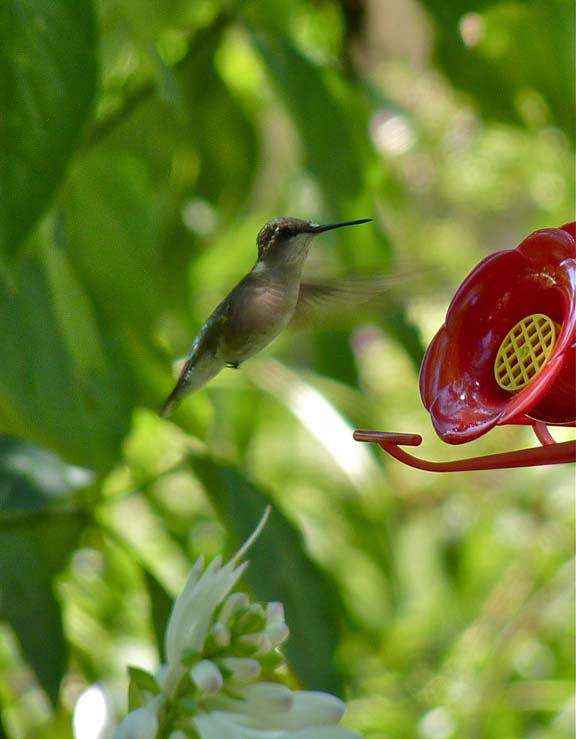
Female Ruby-throated HummingbirdFemale Ruby-throated Hummingbird

In the morning I would find Buckeyes, Question Marks, and Red-spotted Purples drinking salts and minerals from moist patches in the driveway. Hungry families of Ruby-throated Hummingbirds were noisily nectaring from the flowers and feeders; one feeder is sited beneath the peach tree and the other about twenty feet away, under the lilacs, a hummingbird superhighway of sorts, with inviting nectar flowers along the route. The male and female hummingbirds are both territorial and, when encountering anything out of the ordinary (my camera and I, for example) will threaten by whizzing  and whirling, albeit harmlessly, close to your head.

Common Buckeye ButterflyCommon Buckeye

By mid-day the hummingbird and butterfly scene was full underway. Spicebush Swallowtails at the Rose-of-Sharon, tiger swallowtails, yellow sulphurs, Eastern Tailed-Blues, Monarchs, checkerspots, and angelwings nectaring at the zinnia patch, phlox, and lobelia, and most remarkable of all, were the number of butterflies that were drawn to the pungent lure of rotting peaches. By late afternoon dozens of Hackberry Emperors, Red-spotted Purples, Question Marks, and Red Admirals were to be found intently imbibing from the fermenting peaches, and by day’s end, I believe they were drunken butterflies, making extraordinarily easy subjects to photograph. I would be down on my hands and knees with the lens held so closely it was nearly touching them, and several times that did happen as they fluttered or hopped onto the camera’s lens. In the lingering remnants of late day’s light, the hummingbirds were there again at the feeders and flowers, and all manner of swallowtails in the wildflower meadow were nectaring from the New York Ironweed.

Spicebush Swallowtail at Rose of SharonSpicebush Swallowtail Nectaring at Rose of Sharon


Pipevine Swallowtail Butterfly Pipevine Swallowtail Nectaring at Phlox

Red-spotted Purple ButterflyRed-spotted Purple

The three different species of butterflies in the above group of photographs have a unique relationship. The Red-spotted Purple and Spicebush Swallowtail (both palatable to predatory birds) are thought to have evolved to mimic the Pipevine Swallowtail (center photograph), which is highly toxic and foul tasting.

I was sad to say goodbye to my sister-in-law but glad to return home to my family. My unexpected yet welcome encounter with the butterflies of Southwest Ohio reminded me once again that butterflies are a symbol of transformation, joy, and beauty throughout cultures the world over. Perhaps Amy’s butterflies mirror the transformative journey to which she has embarked.

Eastern Tailed-Blue ButterfliesEastern Tailed-Blues

Red Admiral ButterflyRed Admiral Mimicking Peach Tree Bark

Milkweed and IronweedIronweed and Milkweed

 Tiger Swallowtail at IronweedTiger Swallowtail Nectaring at Ironweed

Cicada lying in waitMale Cicada Disguised Amongst Rose of Sharon Buds

Ohio Vegetable gardenVegetable Garden

Farmhouse road