Category Archives: Cape Ann

Outphloxed by Our Phlox!

Look how lovey our patch of Summer Phlox has grown. I wish I could say it was my genius garden design skills but alas, this is all nature’s doing!

Where this border is growing I originally had only planted the mildew resistant and pure white Phlox paniculata ‘David.’ Some distance away, we planted the striking P. paniculata ‘Bright Eyes,’ a light pink with deep magenta centers and adjacent to ‘Bright Eyes,’ a pretty lavender called ‘Franz Shubert. ‘

Several years have gone by and we now have a patch of volunteers blooming in beautiful shades of pink, lavender, and magenta. I think this may have happened because the plants have cross-pollinated and are allowed to reseed. We don’t deadhead and don’t mulch and that encourages little seedlings to take hold and spread far and wide in our garden.

Phlox paniculata is native to the eastern US and grows in a range of conditions. The location in our garden where it is thriving is partially shaded by the Magnolia grandiflora. This beautiful, beautiful wildflower is also wonderfully fragrant, with a heady floral scent especially potent in the early morning and late in the day. I have on occasion seen Ruby-throated Hummingbirds and Eastern Tiger Swallowtails drinking nectar from the blossoms but mostly the blooms are especially attractive to Bumblebees.

Pollen-dusted Bumblebee

Did I mention that P. paniculata blooms for many weeks??

Plant this native beauty. I promise, you will be delighted for many years to come.

Mystery Plover at Good Harbor Beach

The morning after the first super high tide at Good Harbor Beach we were surprised and delighted to see a third Plover had joined our Fierce Dad and his almost-fledged chick. We found the three on the narrowest strip of beach that had not been impacted by the hurricane tide. They have been seen together ever since!

Mystery/Butterball left, Fierce Dad right30 day old Piping Plover chick

I think my daughter may have solved the Mystery and we believe this Plover could be what would now be the 54-day-old fledgling we were calling Butterball. He appears to be a similar stage of development and it makes sense; after Butterball’s Dad departed, Butterball attempted to forage alongside Fierce Dad’s chick several weeks back, but FDad would have none of it and was in maximum defensive mode for his little one at that time. Now that his chick is older and more independent perhaps he feels it’s safe to socialize with other Plovers; although at one point FDad planted himself firmly between his chick and Mystery.

Below are photos of 40 to 42 day old Plovers from years past and they are the only photos I can locate at the moment of Plovers past 36 days. Our Mystery Plover looks to be at least as old as the Plovers in the photos

This last photo is of HipHop, Super Dad, and HipHop’s 46-day-old sibling. Although the sibling is out of focus, you can see its feather patterning is similar to the Mystery Plover. This was such a sweet sibling; he stayed with HipHop until he could fly. You may recall HipHop who was developmentally challenged. The first year Mom returned to Good Harbor Beach missing a foot, one of her chicks sustained a hip injury.He was nicknamed HipHop for his hopping gait and it took him many, many weeks to catch up to his siblings. Both Super Dad and this one sibling gave HipHop lots of snuggles and stayed with him well beyond the time frame in which they would typically migrate.

For my New Jersey Friends and Family –

For my New Jersey Friends and Family – Montclair Film and The Nature Conservancy of NJ are hosting a special screening of The Piping Plovers of Moonlight Bay on Tuesday, August 26th at 7pm. QandA with me to follow. To purchase tickets, please go here: https://theclairidge.org/events/the-piping-plovers-of-moonlight-bay/

I hope you can come!

Piping Plover August Update

Dear PiPl Friends,

The anticipated update for the 2025 season with these most beautiful and most vulnerable of mini beach friends I feel is finally ‘safe’ to write. I only write safe because we try very hard to find a balance between sharing information to help create an awareness about the Plovers and also not bringing too much attention to the nesting birds.

First off I would like to thank our outstanding crew of kind-hearted volunteers, especially our core group who sign up for shifts that are an hour or longer and come everyday. This summer we had a very extended season with the chicks (more about that below) yet despite that, they stuck it out to the very end. Thank you to Jennie Meyer, Paula and Alexa Niziak, Kim Bouris, Steve Spina, Sandy Barry, Deborah Brown, Barbara Boudreau, Jill Ortiz, and Marty Coleman. We’d also like to thank our subs Heidi, Velia, Sally, and Jonathan.

If you see these kind and caring people around town, please thank them for their dedicated wildlife conservation work that they do so graciously and so tirelessly.

Thank you to Lyra Brennan, Rose Caplan, Jamie Infanti, and all our Audubon partners. We saw a great deal of Emma this summer and she is wonderful, staying extra long hours in the summer’s heat to watch over the chicks. Audubon does such great work and are responsible for not only Good Harbor Beach, but many other shorebird nesting areas all along the Massachusetts coastline. We appreciate their thoughtful and action oriented responses so much, especially  when it comes to some of the more serious issues that arise over the course of the season. With thanks and gratitude to Lyra, Rose, Jamie, Will, Emma, Charles, and Claudia.

Thank you also to Gloucester’s  Joe Lucido, Tom Nolan, and the entire DPW Crew. These guys are amazing and are always working so hard to make our beaches safe and presentable. Despite the double load imposed on the Crew (because of the additional work they are doing during the garbage strike), they are ever present and so very much appreciated.

DPW Crew setting the roping in place n March

We’d also like to thank several gentlemen who are at GHB nearly every single morning, starting in the spring. While most beach visitors are still sleeping, these gentlemen voluntarily pick up the plethora of garbage found littering the beach leftover from the previous day. They ensure our beaches look pristine by the time the gate opens at 8am. Chris Cefalo, his brother Fred, Michael Cook (and there is a fourth gentleman whose name I don’t know), work tirelessly cleaning the beach, from the tiniest bits of plastic to hauling off the larger items like chairs, tables, umbrellas, and tents. If you see these gentlemen around town, please thank them for the good work they do.

And a huge shout out to all the many, many beachgoers who express interest in the Plovers, want to learn more, give the chicks lots of space, and respect the cordoned off areas.

Piping Plover Smooshies

One of the many gifts we receive as Plover Ambassadors is watching tiny baby birds the size  marshmallows develop into beautiful little flyers. The clips are of Fierce Dad and FairFeathered Mom’s offspring; the first clip is of two-day-old hatchlings, the second clip is of two-week-old chicks, and the last clips of the three- and a half-week-old chick.  When Plovers hatch they can feed themselves entirely independent of the parent however, they need to thermoregulate to keep warm (otherwise known as thermo-snuggles and smooshies). The birds instinctively know to tuck under Mom and Dad’s wing to keep warm.

The 2025 Piping Plover Season at Good Harbor Beach

The season started phenomenally well, with the earliest arrival ever of Super Dad and our footless Handicapped Mom. Fierce Dad also arrived on the very same day as this original pair. It is always a much anticipated and joyful moment when we begin to see the first Plovers returning, especially Super Mom and Dad. This resilient little pair are at least 11 years old. We know this because they began nesting at Good Harbor Beach in 2016 and Plovers have to be at least one year old before they can begin breeding. Each year its become more and more tenuous as to whether or not we will see the return of our wonderful original pair. Plovers only live on average 3 to 5 years and this pair, at 11 years young, are quite a respectable age for their species.

Piping Plover Courtship

Fierce Dad and Original Dad spent a good part of the first few weeks in competition for territory and for Super Mom, with Fierce Dad even putting the moves on Mom several times. At one point we had nine Plovers, and four were nesting pairs, the most ever! There were lots of territorial disputes, some ending in serious smackdowns but for the most part, the birds began to settle in to brood their eggs.Piping Plovers Mating

Original Mom and Dad’s clutch was nearing hatch date when on May 22nd, the coast of Massachusetts was walloped by a late season nor’easter. The tide rose higher than we have ever seen in late May and three of the four nests were washed away. As devastating as that was, it was a joy to find one remaining nest, the young parents that are a new pair to Good Harbor Beach. From their nest of three eggs, two chicks hatched.

Over time original Mom and Dad attempted to re-nest.  After a brief recovery period, Mom laid a new clutch of three eggs. However, this second clutch of eggs was predated by a Crow. As the season progresses there are more and more Crows and gulls scavenging the beach, seeking garbage left behind by people. We know it was a Crow from the tracks found around the nest.

Remarkably Mom and Dad laid four more eggs, a grand three clutches, 11 eggs in total. Once again, the eggs were snatched and Crow tracks were found encircling the nest scrape.  Our Handicapped Mom left shortly after the third nest was lost. Super Dad hung on for a bit longer but he too departed. All was not lost as the one remaining chick from the young parents grew and developed into a lovely, albeit super chunky, fledgling and has begun its southward migration. Note – we love super chunky fledglings. They’ll have lots of stored fat reserves to get them through their first migration.

FairFeathered Mom and one-day-old hatchling

Today we still have one almost-fledged chick remaining at Good Harbor Beach. This little chunkola is Fierce Dad and FairFeathered Mom’s offspring, from their re-nest.  Because the eggs hatched so late in the season and the females usually begin migrating before the males, FairFeathered Mom left when her chick was only five days old, leaving Fierce Dad to raise the chick solo. Fierce Dad has lived up to his name, fighting off every gull, crow and even other shorebirds that dare to come within 100 yards of his offspring. He is still parenting the chick who is quite independent at this point. Nonetheless, the almost fledged chick still goes in for snuggles and smooshies and relies on Dad to keep the gulls at bay.

Along with a great bounty of seaweed washed in with the late May nor’easter, the seaweed was littered with zillions of pieces of small yellow and green plastic

Just as has happened at GHB this summer, nests were washed out along the entire coastline of Massachusetts. With many pairs re-nesting, the conservation biologists from every Mass coastal region saw much lower productivity with these second nests, and in some cases (Super Mom and Dad), third nests.  What does low-productivity mean? Not as many eggs were laid and of the eggs that were laid, fewer than usual hatched. So, for example a second clutch with only three eggs, only one or two of the eggs may hatch.  And all coastal areas across the region experienced higher than usual heavy predation by Herring and Great Black-backed Gulls, Crows, and Eastern Coyotes. My own theory for that is because when chicks hatch in May for example there are far fewer flocks of seagulls on the beach. But when chicks hatch in July and August, Crows, Gulls, and Coyotes are acclimated to finding free food, i.e. garbage, at the beach, which leads to greater interest in shorebird eggs and chicks. Also at this later time in the summer, there are thousands of hungry fledglings on beaches begging their parents for food.

We are hopeful that next year we won’t have another late, late nor’easter and all the pairs that attempted to nest at GHB this season will return and try again. If you would like to join our volunteer team of Plover Ambassadors, please contact me either by leaving a comment or emailing me at kimsmithdesigns@hotmail.com. We would love to have you!

If you would like to learn more about how we can all help protect shorebird wildlife and their habitats, please watch our film The Piping Plovers of Moonlight Bay. Our documentary is streaming on the PBS Passport AP anytime you would like to watch it. Everyone can become a member of PBS Passport by donating to PBS. It’s so worthwhile, especially for young children with curious minds.  What other streaming service can you get for $5.00 a month!!

If you are interested, please click here to read a recent PSA about why dogs are not permitted on beaches during the summer.


PSA: Dogs on Beaches

Why Can’t I Bring My Dog to the Beach?

According to the Gloucester City ordinance code, it is a $300.00 fine (doubled during the season) to bring a dog to Good Harbor Beach. For example, if you bring two dogs, that is 600. x 2 = $1200.

But stating the fines right off doesn’t explain why.

Health and Safety

Our beaches are wonderfully filled with beachgoers during the summer months. Can you imagine adding dogs, either on or off leash, to the mix? Dog ownership is at a record high, much greater than even a generation ago. In 2000 there were roughly 68 million pet dogs, today there are about 90 million dogs. What if everyone who owns a dog brought theirs to the beach?

Let’s face the facts, a great many dogs are not on voice command. We have dogs jumping on children, knocking over the young and old, biting people, and getting into dog fights and biting each other. That is not a safe scenario for any beachgoer.

But what if the law were changed to allow dogs on leash?

We would have half abiding by the leash law and half saying “I left my leash at home,” or “I thought it was okay to let my dog off leash after 5pm,” or “I thought it was okay before 8am,” etc. etc. How do we know this? Because we already hear these statements during the off leash/on leash days at Good Harbor Beach.Pile of poop at the Good Harbor Beach snack bar area

Dog Poop is a consequential environmental issue. During the season when dogs are allowed on the beach we see the gamut of poop-maintenance behaviors. Most people clean up after their pet. However, many people bury the poop in the sand or leave their poop bags behind. When someone leaves their bag by the footbridge, then other dog owners take it as a sign as a place to deposit their bag. The pile of dog poop in a rainbow color of bags grows and grows. Do we want beachgoers stepping in sand covered poop or being confronted with piles of dog poop? There is no poop cleaning fairy. It is left  to our awesome DPW or one of the very nice volunteers, like Chris Cefalo, his brother, and Michael Cook who regularly cleans GHB to remove garbage and also the bags of poop.

Good Harbor Beach footbridge

Keeping Dogs out of the Dunes During the Growing Season Helps Protect the Dune Ecosystem

If you regularly visit Good Harbor Beach during the off season, you can’t help but notice, the “Keep out of Dunes” signs are frequently ignored by pet owners. There are many who do respect this vital habitat, but also many who don’t. Dogs running and playing vigorously through the vegetation tears at the roots and weakens the plants. Vegetation holds the dune sand in place and without plants the dunes continually recede.

Over the past several years, you may also have noticed the vast improvement in the overall health of the dunes. There is a direct correlation to keeping the symbolically roped off areas up through out the summer season and into the fall because by preventing people and pets from recreating right up to the base of the dunes, it allows just that much more room for vegetation to take hold, and is one fantastic tool in the tool box against fighting erosion.

Dog going pooh within nesting area

Keeping Dogs off the Beach Helps Nesting Shorebirds Survive

Last, but not least, dogs on the beach are a well-known threat to shorebird nests and especially to young birds that can’t yet fly to escape danger.

How so you may wonder? “My dog is so sweet and would never harm a baby bird.”

When there are baby birds on the beach, the Plover parents do their absolute utmost best to keep the chicks safe. The parents exhibit all sorts of distraction behaviors including dragging and fluttering their wings on the ground to fake injury, thereby encouraging the predator to follow it and drawing the threat away from their most vulnerable chicks.

Plovers cannot tell the difference between a domestic dog, Fox, or Coyote. Dogs bound exuberantly on the beach through nesting areas and Coyotes and Fox dig in the sand for eggs and chicks. The ever vigilant Plover parent will  leave the nest and fly at any creature Canid. Often, both parents will fly away from the nest in a sort of tag team distraction method. But while they are busy defending the chicks from a member of the dog family, that is the perfect time for a gull, crow, hawk, or falcon to swoop in and snatch the eggs or eat the baby chicks. Crows focus on eggs and gulls not only eat the eggs, they also eat chicks at every stage of development, even fledglings that have grown as large as the parent. Coyotes eat both eggs and chicks.

Especially during pupping season, Red Fox scavenge the beach looking for shorebird eggs, small mammals, and birds to feed their growing family. Plovers cannot distinguish the difference between a Coyote, Fox, or domestic dog. 

Fierce Dad and FairFeathered Mom tag team distracting a Herring Gull

As I am writing this message, please know that we still have young birds at Good Harbor Beach that can’t yet fly well enough to escape predators. This is extremely late in the season and is due to the tremendous loss of nests during the May Nor-easter; losses all along the coast of Massachusetts. Many of the nesting birds eventually re-nested and we are seeing their offspring. Shorebird managers across Massachusetts  are contending with taking care of these late flying chicks.

Here are on Cape Ann we are blessed with many beautiful alternative locations to walk our dogs, including Crab Beach (adjacent to  the Boulevard), which is open year round to dogs and dog owners.

If you would like to see scenes of Plovers displaying their fascinating distraction techniques and learn more about predators on beaches, please watch our film The Piping Plovers of Moonlight Bay, which I created specifically for people to learn more about how we can all help protect shorebird wildlife and their habitats.  Our documentary is streaming on the PBS Passport AP 24/7. Anyone can become a member of PBS Passport by donating to PBS. It’s so worthwhile, especially for young children with curious minds.  What other streaming service can you get for $5.00 a month!!

As I first wrote, it is a $300.00 fine and doubled during the season to bring dogs to Good Harbor Beach, so please dog owners, for your sake, for the health of the beach ecosystem, and for the safety of growing shorebirds, please do not walk your dog at Good Harbor Beach or any beach where there is precious habitat and baby birds. Thank you!The No Dogs from April 1st through September 30th signs are boldly displayed at every entryway to Good Harbor Beach

Piping Plovers of Moonlight Bay at the New Hope Film Festival Monday!

I am very delighted to write that our Piping Plovers of Moonlight Bay is screening on Monday, August 18th at 6:00pm. We are sharing the billing with another animal welfare documentary, The Ramba Effect, about an Asian Elephant and her 2,550 mile journey to her new home at an elephant sanctuary. If you are in the New Hope area and would like to see The Piping Plovers of Moonlight Bay and The Rhamba Effect, please go here: https://www.goelevent.com/NewHopeFilmFestival/e/AnimalWelfareDocumentaries

Ruby-throated Hummingbirds, Jewelweed, and Canna Lily

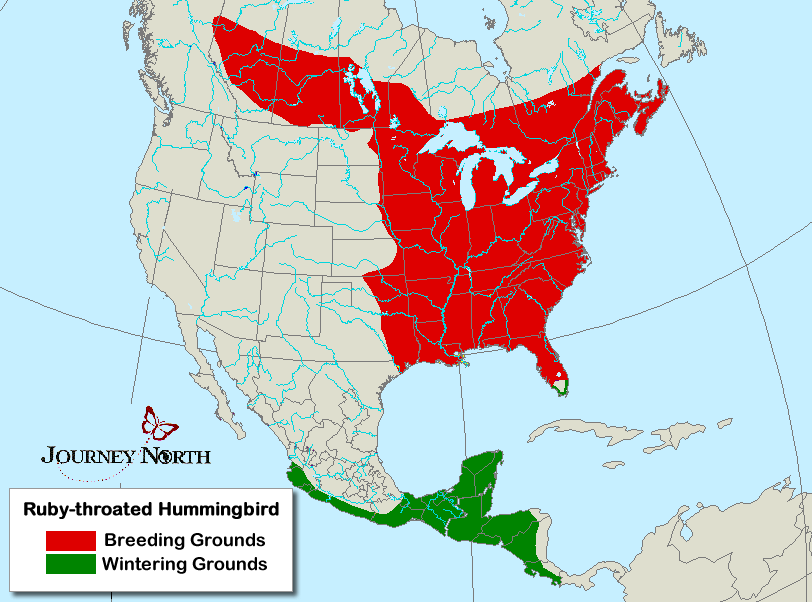
I loved filming Ruby-throated Hummingbirds on the beautiful bold flowering stalks of Canna Lilies (Canna indica) and just as much, I love seeing them drinking nectar from our North American native wildflower Jewelweed (Impatiens capensis). Even though not native to North Ameirca, it makes perfect sense that RTH forage from Canna Lilies as they grow natively in the Tropical Americas, the birds winter home!

Some fun things to know about Jewelweed:

Jewelweed has long been used in Native American medicine. Apply the watery sap topically to relieve itching and pain from Poison Ivy, Stinging Nettle, and hives.

The fruit of Jewelweed is an elongated capsule and at the slightest touch will burst open and send a little seed popper some distance, a fun activity to do with children and adults alike 🙂

You can grow Jewelweed in your native plant’s garden provided it is in a somewhat shaded and somewhat moist location. The Ruby-throated Hummingbirds, bees, and butterflies will thank you!

Ruby-throated Hummingbird Range Map courtesy Journey North

Dance of the Halloween Dragonfly

It’s not always the case that a wild creature’s name befits its appearance but I think whoever gave the Halloween Pennant its common name was spot on. The male is the darker orange dragonfly, on top.

Mating Behavior and Oviposition

The mating behavior of Halloween Pennants is similar to that of other dragonfly species. The male will use his cerci (paired appendages on the rear segments) to grasp the female behind her head so that they are hooked together. The female will then curl her abdomen forward so that her genital opening comes into contact with the male genitalia, which are located closer to the male’s thorax than to the tip of the abdomen (Cordero-Rivera and Córdoba-Aguilar 2010). This is known as the wheel formation, as the dragonfly bodies form a closed circle. In a study done in south Florida, Celithemis eponina were observed mating only between 8:00 and 10:30 AM (Miller 1982; Dunkle 1989).

After copulation, the female lays eggs in water, while the male remains with the tip of the male’s abdomen attached to the female’s head (Taber 2005).

Internet Archive Royalty Free Music: Jena-Pierre Rampal, Francoise Bonnet Fantaisie brillante sur des thèmes de l’opéra “Carmen” de Bizet – ℗ 1965

Halloween Pennant Dragonflies Mating image courtesy wiki commons media from the Herrick Lake Forest Reserve

I

Massachusetts is Leading the Way in Piping Plover Recovery – Outstanding Coastal Waterbird Cooperators’ Meeting!

Carolyn Mostello, the Massachusetts Coastal Waterbird Biologist

Last week I has the opportunity to attend the Massachusetts Coastal Waterbird Cooperators’ Meeting. The meeting is held annually to bring together people and organizations that are involved with population monitoring and conservation efforts on behalf of coastal waterbirds.

Representatives from the seven Massachusetts coastal regions gather to share information, anecdotes, and data collected throughout the season. This year the meeting was held at Audubon’s stunning Barnstable Great Marsh Wildlife Sanctuary; hosted by Audubon staff and Carolyn Mostello, the Massachusetts Coastal Waterbird Biologist.

American Oystercatcher chicks

Threatened and endangered species such as Least Terns, Piping Plovers, Roseate Terns, and American Oystercatchers are given the greatest attention.

It’s fascinating to learn how we are all sharing similar experiences including egg predation by Crows, gulls, and Coyotes, disturbances of all shapes and kinds, low egg hatching, and storm washouts. Carolyn directs the event and she does an extraordinary job of weaving all the information together.

Reporting population numbers is followed by “Strange and Unusual,” a super fun section where field agents share funny/odd occurrences, photos, and videos. A special tribute was given to honor Shiloh Schulte, who perished in a tragic helicopter crash while studying shorebirds in Alaska. Shiloh Shulte was a beloved friend and mentor to shorebird conservationists every where and one of the  coordinators for the American Oystercatcher Recovery Program. You can read more about Shiloh and his work HERE.

The afternoon programs are especially interesting with presenters sharing experiments, projects, and best practices, including two of special interest to our region; one on launching in-depth data collection on fireworks, and best practice for engaging with landowners. All the programs are wonderfully educational.

Handicapped Mom and Super Dad’s second attempt at nesting

Despite an extremely challenging year, largely due to the fact that most of the nests around the State were washed out in a late spring storm, perhaps the most outstanding take-away is that this year again, Massachusetts is at the leading edge edge of Piping Plover recovery.  We should be super proud of our state. While many regions are seeing very little, none, or even worse, declining numbers, Massachusetts is leading the way in Piping Plover recovery!


Piping Plovers at the New Hope Film Festival!

Dear PiPl Friends,

I hope you are having a lovely summer. I am so looking forward to these last three weeks of August and then we go into the wonderfully atmospheric months of September and October. Is there anywhere in the north Atlantic region where these months aren’t sublime?

I have held off on writing about PiPls all summer because we have had some very late season nesters. I’ll share an extensive report about the Plovers when I feel its safe for them and they are well on their way to fledging. In the meantime, I am very delighted to write that our Piping Plovers of Moonlight Bay has been accepted to the New Hope Film Festival and is screening on Monday, August 18th at 6:00pm. We are sharing the billing with another animal welfare documentary, The Ramba Effect, about an Asian Elephant and her 2,550 mile journey to her new home at an elephant sanctuary. If you are in the New Hope area and would like to see The Piping Plovers of Moonlight Bay and The Rhamba Effect, please go here: https://www.goelevent.com/NewHopeFilmFestival/e/AnimalWelfareDocumentaries

For the NHFF official program guide, please go here: https://online.flippingbook.com/view/102134961/

We also have all new Plover Lover T-shirts in all sizes and a great color, a sort of light sea green. For fans of West Coast Snowy Plovers, these chicks could easily pass for Snowy Plovers too.  Please let me know if you like the new color. They are a beautiful quality, all cotton, unisex sizing from xs to xl. The Tees are 30.00 plus 5. shipping.

We have had some adorable “Butterballs” on the beach this summer. I define a Butterball as a fledgling that is so pudgy it looks nearly as big, if not bigger, than its parent and barely seems as though it can become airborne. Rest assured these Butterballs do fly, eventually <3

Common Tern fledgling squawking to parent, “Feed Me, Feed Me, I’m Starving!”

Happy Summer,
xxKim

Beetlejuice! Beetlejuice! Beetle…

Come see Beetlejuice at the Cape Ann Y! Tonight is the last night to see this phenomenal show, performed by the Cape Ann Y summer theatre team and directed by Heidi Dallin. I promise you won’t be disappointed. Tickets on sale at the door. Show begins at 5:00pm.

You can see from the photos how much fun the kids are having! Beetlejuice Junior is a fantastic show for kids, so much humor and action. The team worked so hard and put this show together in less than four weeks. Despite the fact that they had to move the entire stage and staging out of the rain yesterday afternoon, and performed in an entirely different location than from where they had practiced, all did an absolutely amazing job. Lead performers Molly, as Beetlejuice, and Aubrey as Lydia Deetz are so talented  and not to be missed. Hats off to Director Heidi Dallin, Julia, Leia, Wren, Seania McCarthy, Mr. Presti, all the teens that are helping, all the parents and grandparents lending a hand (and I am so sorry I know I am forgetting to mention a few names). Our family loved every minute and you will, too!

The Cape Ann YMCA is located at 7 Gloucester Crossing in Gloucester.

My favorite photo of the evening is this one, photobombed by a little demon <3

Leads Molly and Aubrey as Beetlejuice and Lydia

Our Charlotte plays Juno, Beetljuice’s Mom

Milkweed is the Bees Knees!

This vibrantly hued milkweed is most commonly known as Butterflyweed (Asclepias tuberosa). Orange Milkweed, Pleurisy Root, Chigger Flower, and Chiggerweed are a few of its other common names.

Butterflyweed blooms in a range of hot colors from buttery yellow to Spanish orange to fire orange red and is a welcome source of nectar for butterflies and bees.

Happy July 4th from Glorious Good Harbor Beach!

Snapshots from St. Peter’s Mass and Sunday Morning Procession

A joy to film and photograph our beautiful community. Viva San Pietro!

MAX ALLEN Your 2025 Greasy Pole Saturday Champion!

Congratulations to Max Allen! Max also won last year’s Friday night competition. He is the third generation in his family to win the flag, following in the footsteps of his uncle and grandfather.

Buona Festa! – A Most Joyous St. Peter’s Fiesta Opening Night

Viva San Pitero!

Beginning at St. Peter’s Club, the Procession winds up and around the Legion Hall, ending at St. Peter’s Square.  The effigy is is placed oh so gently on the stage where it will stay until Sunday morning’s procession through the City.

All Are Welcome to the Beautiful Saint Peter’s Fiesta Novena

Come one, come all! 

With love and gratitude to the Novena Ladies who each year tirelessly organize the Novena, decorate the Legion Hall and altar in a unique and beautiful way, lead the attendees in prayer and song, and nightly serve refreshments. Viva San Pietro.Left to right: Grace Cusumano, Nina Groppo, Anne Sanfillippo, Joanne Auello, Jean Linquata, Caryn Ryder, Faye Quinlan

The 2025 St. Peter’s Fiesta Novena continues every night through Tuesday. Saturday, Sunday, and Monday the Novena begins at 7:00pm. Tuesday is the very special conclusion. The Novena begins at 6:30, followed by the Mass, followed by the Saint Peter procession to Beach Court.


Crazy Hat Lady sisters Robyn and Amy, sans hats. I wonder what wonderfully imaginative designs they will add to the hats this year!


Happy Summer Solstice

Not the post I planned for this longest of days but it was just so beautiful watching three bucks foraging in the marsh this morning I had to share. Don’t you love their big brown soulful eyes and fuzzy antlers? Happy Solstice <3

Here is an image of one of them, no idea which, from the spring. Note the antler buds beginning to grow in.

YOUR 2025 SAINT PETER’S FIESTA SCHEDULE!

WOW! So Much Great Stuff Happening at Cedar Rock Gardens!

Elise at Cedar Rock Gardens says, It’s Not Too Late to Plant — and HAVE WE GOT A SALE FOR YOU!

Rainy weekends and a chilly spring couldn’t stop us—and now it’s officially go-time in the garden.

It is not too late to plant – We have a sale for you and Lettuce!

Come Visit Us for a sale this week!— Bring a Box or Tray to shop.
To help you get growing and keep growing, we’re offering 30% off all seedlings in the nursery starting on Wednesday, June 18th until Sunday, June 22nd. Yes, all of them. As a little bonus, every purchase comes with a free lettuce plant, because you deserve something green, crunchy, and satisfying after this soggy spring.

Our business hours:
Monday – Closed
Tuesday – Closed
Wednesday – 8 am to 4 pm
Thursday – 8 am to 5 pm
Friday – 8 am to 4 pm
Saturday – 8 am to 4 pm
Sunday – 9 am to 3 pm
Hello friends,

We know—this spring’s been a journey. Between the endless rainy weekends and a chill that just wouldn’t quit, it felt like summer might never show up. I was totally ahead of myself predicting a warm spring – so much for that! Now that the weather is finally good enough for tender edible crops to grow lets keep a close eye on pests and critters. The soil is finally warm, the skies are (mostly) clearing, and the gardens are ready to GROW.

If you’ve been waiting to plant, now is your moment.
It is not too late to get your veggie garden going! In fact, it’s a great time to plant seedlings—especially for all those warm-weather crops that will flourish this time of year.

And for all you clever succession planters, leafy greens like lettuce, kale, chard, and herbs are ready for another round. Keep those salads coming well into summer. Direct Seed bush and pole beans now along with radish, hakurei, baby bok choy, greens and arugula.

We’d love to see your faces back at the nursery. The nursery is bursting with life, lots of bastil, squash, cutting flowers, tomatoes and peppers!

Catch Us at the Gloucester Farmers Market!
Every Wednesday from 2:30–6:30pm, you’ll find us at The Backyard Growcery at Burnhams field. Starting this week!!
We’ll have fresh-picked produce from our fields and plenty of hardy seedlings to fill your garden gaps.

Come say hi, grab a bunch of something delicious, and let us hook you up with a lettuce pun or two (we can’t help ourselves).

🌈 Happy Pride Month 🌈
At Cedar Rock Gardens, we believe that love is good, communities, just like gardens, are better with a wild mix of colors and personalities, and every person deserves to grow and thrive exactly as they want to be. We stand proudly with our queer community—not just this month, but always.

Here’s to vibrant veggies, inclusive spaces, and the joy of growing something beautiful together. 💚💜💛

From the Field: June Journal

Why are we closed on Mondays and Tuesday?? First, it is to have a full day to spend with our small children and keep the work/life balance in tact during this especially busy time of year. We are a small business and we are a couple running a farm, a family, a crew and a life outside of work. We are on 7 days a week all day keeping thousands of plants and a couple small humans alive and in order to navigate this livelihood we chose to be closed to the public 2 days a week. Second because, as stated above, we are farming greenhouse and field crops all year and we need all hands on deck a few days a week to plant, weed, prune, harvest wash and pack – for those of you who have asked.
We’ve officially changed our greenhouses over from seedling production and packed all 12,000 square feet of our greenhouses with summer crop stars: tomatoes, sweet and hot peppers, eggplant, basil, cucumbers, ginger, sweet potatoes and so many other warm-loving goodies.

Out in the fields, lettuce and greens are growing along beautifully. Bush beans are just about to get seeded, and both summer and winter squash are just about to go in the ground—and we are just about ready to tuck in our potatoes on July 2nd, right on schedule.

Why July 2nd? Because we’ve got beef with the Colorado potato beetle. These striped little tank-like pests emerge early in the season and love nothing more than feasting on tender potato foliage. By delaying planting until July, we dodge their peak egg-laying window—and still get a strong fall harvest without the beetle drama. Take that, nature’s tiny bulldozers.

Here are a few things I find myself repeating a lot at the nursery so I though I may share them here and hopefully give someone a tidbit that may help!
Pest Patrol + Growing Tips
Squash + Cucumber Success:

Use lightweight row cover early on to protect seedlings from bugs and cool nights. Remove the cover when the plants flower so they can be pollinated!
Mulch around the base with straw to deter squash bugs – or try the tip below from a neighbor!
Keep leaves dry by morning watering so they dry out over the day to discourage powdery mildew.
Harvest often and remove damaged or wilted fruit to keep plants productive.
And here’s a gem from our neighbor Newt: He cuts drinking straws into 3-inch segments, snips them open, and wraps them around the stems of his young cucurbits. It’s a surprisingly brilliant way to stop cutworms from snipping plants at the soil line—and may just discourage squash vine borers too. We raise a hoe to you, Newt.
Tomato TLC:

Prune lower leaves to improve airflow and reduce disease risk.
Mulch to retain moisture and prevent soil splash-up.
Tomatoes love heat—give them full sun and space to breathe.
Feed every couple weeks with a balanced organic fertilizer once they start fruiting.
Water consistently to prevent blossom end rot.
Pepper Wisdom:

Peppers want warmth—plant them in a sunny, wind-sheltered spot.
They’re slow to start but reward patience. Mulch them in, water evenly, and don’t overdo nitrogen (it’ll grow leaves, not fruit).
We won’t sugarcoat it: the political scene right now? A real mess. Between the corporate greenwashing, book bans, and folks who think “climate change” is just a suggestion—it’s enough to make you want to throw your phone into the compost pile.

But here’s the thing: planting seeds, supporting small farms, feeding your neighbors, and standing up for inclusion and sustainability? That’s hopeful. That’s powerful.

So let’s plant more. Grow more. Share more. Support with our dollars, our forks, and our hearts.

With muddy hands and a hope for sunshine,
— Elise and the Cedar Rock Gardens crew

Tunnel of Love

With temperatures expected to hit 90 later in the week I thought I had better take a few snapshots of the roses blooming around our front porch; they’ll fade rapidly once the heat kicks in.

The white rose with the single flowers that climbs up to the second floor bedroom window is Darlow’s Enigma. I love this rose for its highly scented blossoms and for its vigor but the stalks became so huge it collapsed in last months nor’easter. It’s made for a wonderful tunnel. A bit out of control, I’ll have to trim Darlow’s way back after it blooms but it sure has been fun having a rose embowered tunnel, albeit briefly.

We planted only the most highly fragrant roses I could locate and currently the sweet scent of roses is permeating our entire home. Happy June!
This is the Only Monarch We are Interested In!

Thank you Michele Del for sharing your beautiful block print, and thank you to Michelle B for sharing the photo!

Happy Father’s Day to All the Great Men in Our Lives!

Happy Father’s Day to all the kind, funny, hard working, thoughtful, and loving Husbands, Dads, Sons, Grandpas, Uncles, Brothers, Father Figures, and Friends. Rock on! <3 <3 <3


We are so very blessed – my father-in-law turned 100 years old on May 5th this year – <3

No Kings Cape Ann!

Tremendous Turnout for No Kings Cape Ann!

People from all around Cape Ann attended the No Kings march. I have yet to confirm, but heard there were upwards of 3,000 marchers.  Passersby in vehicles were showing their full support as well. From youth to grannies, Cape Ann showed up for democratic values. The message is clear, It’s Up To Us! 


Above photo courtesy Michelle Barton

NO KINGS Gloucester Day of Defiance

This event will be a walk from Stage Fort Park down to the Fishermen’s Wives Memorial. It will run from noon to 2pm. Gloucester residents with a 2025 beach parking sticker can park for free at the park, and parking is free on Stacy Blvd, but car pooling is encouraged as turn out is expected to be strong. In addition to the No Kings Theme, participants are encouraged to bring their American flags, as it is OUR flag and not the property of any political party.

There will be speakers at the memorial, including founder of CAI, Paul Saint-Amand, and Gloucester’s Mayor Verga, who will speak at 1:30.  A local choir will lead us in “Can you hear the people sing?”, among other protest songs, as we make our way down from a Stage Fort Park to the Memorial.

Sign up or just come!