Category Archives: Bees

KIM SMITH POLLINATOR GARDEN PROGRAM FREE AND OPEN TO THE PUBLIC THURSDAY EVENING

Please join me Thursday evening, August 10th, at 7:00pm, at the Peabody Institute Library, South Branch. I will be giving my talk about how to create a garden to benefit a host of pollinators and screening several short films. I hope to see you there! 

The day we planted blueberries, is the day the Catbirds moved in. Many species of songbirds are pollinators, too!

Painted Lady nectaring at wildflower Joe-pye, Good Harbor Beach

https://www.instagram.com/p/BW7wfw-F5o9/


PATTI’S CATTIES AND OTHER TALES FROM THE PAPOWS BEAUTIFUL GARDEN

My friend Patti Papows very thoughtfully invited me to come film and take photos in her gorgeous garden, especially her milkweed patch. Patti purchased milkweed plants from our Cape Ann Milkweed Project several years ago, both the Common and Marsh Milkweed that we offered.

Patti’s Common Milkweed has really taken off this year. The plants are about five feet tall, lush and healthy, and bursting with sweetly fragrant blossoms. The Monarchs are daily visitors, coming not by the ones and twos, but by the dozen. Not only are her milkweed blossoms beckoning to the Monarchs, but the plants are also attracting every bee species imaginable found in a Cape Ann garden, as well as myriad other pollinating insects.

I showed Patti how to find Monarch caterpillars. She found three in about three minutes; we weren’t even trying that hard! They are safer from spiders in my terrariums, so I brought her tiny caterpillars home where they are developing nicely alongside a dozen Monarch eggs. These eggs were discovered in my garden, and at the Common Milkweed plants growing along the edges of the Good Harbor Beach parking lot.

https://www.instagram.com/p/BW7y-ywl3kb/

Patti’s patch of native high bush blueberries attracts loads of Catbirds, and dozens more species of songbirds and small mammals. This morning the foliage made a perfect perch for a male Monarch butterfly.

In the above photo you can clearly see the Monarch’s two-part tubular drinking straw, called a proboscis. The Monarch is probing deep into the Milkweed floret for a sip of sweet nectar.

Who, me? I’m innocent! Chipmunk snacking at the buffet-of-plenty in Patti’s garden.

Patti placed the purple chair in the midst of the milkweed patch so that visitors can enjoy being surrounded by the beautiful pollinators buzzing all around and the delightful fragrance emitted by the Common Milkweed. I tried it out and her plan worked, it is pure Heaven!

I had an absolutely wonderful morning filming and photographing, despite the limiting overcast skies, and plan to return on a sunnier day, hopefully this week while the Monarchs are here on Cape Ann busy egg-laying and pollinating our gardens!

Patti shares that at the end of the day, her Monarchs are nectaring from the flowering hosta. She sent these photos this morning, taken yesterday afternoon with her cell phone.

SAVE THE DATE FOR MY POLLINATOR GARDEN LECTURE

The Pollinator Garden at the South Branch of the Peabody Library

The South Branch is excited to welcome landscape designer and professional photographer Kim Smith to talk about gardens designed to attract pollinators. She will be presenting a slideshow with stunning, original photographs and a lecture on how to work with the rhythm of the season to create a garden that will attract bees, butterflies, birds and other wildlife essential to pollination for beautiful blooms. She will discuss native plants and organic and architectural features that have value to certain species that can visit (and even help!) your garden. This program is ideal for anyone who gardens, enjoys wildlife photography or likes to learn about nature.

Kim Smith is a celebrated landscape designer, documentary film maker, photographer and author. Her specialty is creating butterfly and habitat gardens that primarily utilize North American wildflowers and native trees, shrubs and vines. For more information about Kim Smith, you can visit her website: kimsmithdesigns.com

The Pollinator Garden will take place at the South Branch of the Peabody Institute Library, 78 Lynn St. on Thursday, August 10 at 7PM. The program is free, but space is limited and registration is required. For more information and to reserve your free spot, please go to www.peabodylibrary.org or call 978-531-3380. This program is generously sponsored by the Friends of the Peabody Institute Libraries.

Help With the HarborWalk and Thank You Maggie Rosa!

Would you like to help us spruce up the pollinator gardens at the HarborWalk? The wonderful Maggie Rosa called last week expressing interest in helping care for the garden. We had a nice walk through the HarborWalk and talked about weed versus wildflower. Maggie has already made a tremendous improvement. If you would like to volunteer, I’ll be at the HarborWalk on Sunday morning from 7am to 8:30, before the podcast, and happy to show anyone interested how to identify the wildflowers. Please feel free to comment in the comment section or email me at kimsmithdesigns@hotmail.com if you have any questions. Thank you.

LEARN HOW YOU CAN HELP THE POLLINATORS AT THE SAWYER FREE LIBRARY TONIGHT!

Seaside Goldenrod for Bees and Butterflies

Come on over to the Sawyer Free Library tonight and learn how you can create a welcoming haven for birds, bees, and butterflies!

Plant Cosmos for the Songbirds, Bees, and Butterflies

Marsh Milkweed for the Butterflies and Bees

Male and Female Luna Moths

Zinnias for Ruby-throated Hummingbirds, Bees, and Butterflies

Mexican Sunflower and Bee

Monarch and Hibiscus

Kim Smith Pollinator Garden Talk at the Sawyer Free Library

Dear Friends,

Please join me April 6th at 7pm, at the Sawyer Free Library where I will be giving my Pollinator Garden talk and screening several short films. The event is free and open to the public. I am looking forward to presenting this program at our wonderful Sawyer Free and hope to see you there!!

Thank you to Diana Cummings at the Sawyer Free Library for making the lovely poster!

Echinacea and Bee

Kim Smith Pollinator Garden Lecture at the Sawyer Free Library

Love this poster Diana Cummings made for my talk at the Sawyer Free next month. Many thanks to Diana!

Save the Date for My Upcoming Pollinator Garden Program at the Sawyer Free Library!

Dear Friends,

Please join me April 6th at 7pm at the Sawyer Free Library where I will be giving my Pollinator Garden program and screening several short films. This event is free and open to the public. I am looking forward to presenting this program at our wonderful Sawyer Free and hope to see you there!!

Female Ruby-throated hummingbird and zinnia – ornithophily is the pollination of flowering plants by birds. They carry off the pollen on their heads and neck to the next flower they visit.

This newly eclosed Monarch is clinging to its chrysalis case. Within moments of emerging, the two-part Monarch proboscis must zip together to form a siphoning tube. If the two parts do not join, the butterfly will not be able to drink nectar. In this photo, you can see the proboscis is not yet fully zipped.

“Following the rhythm of the seasons, celebrated landscape designer Kim Smith presents a stunning slide show and lecture demonstrating how to create a welcoming haven for bees, birds, butterflies, and other wildlife. Native plants and examples of organic and architectural features will be discussed based on their value to particular vertebrates and invertebrates.”

AMERICAN EXPERIENCE “RACHEL CARSON” PREMIERES TONIGHT ON PBS (AND DEBORAH CRAMER IS IN IT!)

I’ve been very much looking forward to the debut of Rachel Carson and posted it on facebook yesterday as it is premiering tonight. Cape Ann environmental author Deborah Cramer then shared that she is in the documentary!!!

From an American Experience, “Rachel Carson is an intimate portrait of the woman whose groundbreaking books revolutionized our relationship to the natural world. When Silent Springwas published in September 1962 it became an instant bestseller and would go on to spark dramatic changes in the way the government regulated pesticides.

Rachel Carson premieres January 24 at 8/7c on PBS.”

Visit Deborah’s website for more about her beautiful book The Narrow Edge: A Tiny Bird, An Ancient Crab, and An Epic Journey, which was named Best Book by the National Academy of Sciences, and is the winner of both the Rachel Carson Book Award and the Reed Award in Environmental Writing.

carson

Cape Ann Wildlife: A Year in Pictures

snowy-owl-gloucester-massachusetts-c2a9kim-smith-2015My husband Tom suggested that I write a year-end post about the wildlife that I had photographed around Cape Ann. Super idea I thought, that will be fun and easy. Not realizing how daunting and many hours later, the following is a collection of some favorite images from this past year, beginning with the male Snowy Owl photographed at Captain Joe’s dock last winter, to December’s Red-tailed Hawk huntress.
red-tailed-hawk-eating-prey-gloucester-massachusetts-21-copyright-kim-smith

Living along the great Atlantic Flyway, we have been graced with a bevy of birds. Perhaps the most exciting arrival of all occurred when early summer brought several pairs of nesting Piping Plovers to Gloucester’s most beloved (and most highly trafficked) of beaches, Good Harbor Beach. Their story is being documented on film.

piping-plovers-chicks-nestlings-babies-kim-smithWork on Mr. Swan’s film will also resume this January—the winters are simply not long enough for all I have planned!swan-outstretched-wings-niles-pond-coyright-kim-smith

While photographing and filming Red-winged Blackbirds this past spring, there was a face-to-face encounter with a hungry coyote, as well as several River Otter sightings.

female-red-winged-blackbird-copyright-kim-smitrhFemale Red-winged Blackbirdeastern-coyote-massachusetts-kim-smith

The summer’s drought brought Muskrats out from the reeds and into full view at a very dry Henry’s Pond, and a short film about a North American Beaver encounter at Langsford Pond. Numerous stories were heard from folks who have lived on Cape Ann far longer than I about the extraordinary number of egrets, both Snowy and Great, dwelling on our shores.
three-muskrat-family-massachusetts-copyright-kim-smithThree Muskrateers
female-monarch-depositing-eggs-1-copyright-kim-smithnewly-emerged-monarch-butterfly-copyright-kim-smith-jpgThere were few Monarch sightings, but the ones seen thankfully deposited eggs in our garden. Thank you to my new friend Christine who shared her Cecropia Silkmoth eggs with me and thank you to the countless readers who have extended an invitation to come by and photograph an exciting creature in their yard.

cecropia-moth-caterpillar-copyright-kim-smith

Pristine beaches, bodies of fresh water, and great swathes of protected marsh and woodland make for ideal wildlife habitat, and Cape Ann has it all. With global climate change pushing species further away from the Equator, I imagine we’ll be seeing even more creatures along our shores. Butterfly and bee populations are overall in decline, not only because of climate change and the use of pesticides, but also because of loss of habitat. As Massachusetts has become less agrarian and more greatly forested, fields of wildflowers are becoming increasingly rare. And too fields often make the best house lots. Farmers and property owners developing an awareness of the insects’ life cycle and planting and maintaining fields and gardens accordingly will truly help the butterflies and bees.
female-mallard-nine-ducklings-kim-smith

Thank you to all our readers for your kind comments of appreciation throughout the year for the beautiful wild creatures with which we share this gorgeous peninsula called Cape Ann.

The images are not arranged in any particular order. If you’d like to read more about a particular animal, type the name of the animal in the search box and the original post should come up.

I wonder what 2017 will bring?

nine-piping-plovers-napping-gloucester-copyright-kim-smith

sandpipers-copyright-kim-smith

Hello Sunshine!

I spent the afternoon in New Hampshire today at my publisher’s warehouse picking up a batch of books. Although there was evidence of the drought all along the route, the lack of rain didn’t seem to effect these roadside beauties (or the intoxicated bee, see Instagram video below).sunflower-helianthus-annuus-copyright-kim-smith sunflower-helianthus-annuus-2-copyright-kim-smith

https://www.instagram.com/p/BKY-VbgDiiS/

Super Cool Bee Swarm at Cape Pond Ice

Honey Bee Swarm -2 copyright Kim SmithCape Pond Ice and City Councilor Scott Memhard are the Bees Knees!

There was plenty of excitement at Cape Pond Ice this morning when a swarm of honey bees was discovered on the brick wall at the Ice House alley. Scott called honey bee remover Marty Jessel. Marty is a wealth of information about honey bees, which he shared generously with the crowd that soon gathered to watch him carefully vacuum the bees with a special bee removing technique (do not try this on your own).

Honey Bee Swarm Cape Pond Ice Scott Memhard Marty Jessel copyright Kim SmithCity Councilor Scott Memhard and Marty Jessel, honey bee remover

https://www.instagram.com/p/BHztz59jFTl/

Watch in action and listen as Marty describes one aspect of bee communication, the waggle dance.

https://www.instagram.com/p/BHztbGHDRaC/

Saving One Bee Hive One Bee at a Time  ~ Marty Jessel may be reached at m.jessel@comcast.net

Follow this link from the Essex County Beekeepers Association to learn more about honey bee swarms.

Cape Pond Ice is open for tours seven days a week during the summer. For hours visit the Cape Pond Ice website here. While there check out the Ice House Art House. ART@the IceHouse Gallery is thrilled to be exhibiting wonderful original marine and working waterfront paintings by Gloucester artists Peter F. Vincent ASMA (1946-2012),http://peterfvincent.com, and Capt. Phil Cusumano, http://www.philcusumanoart.com, as well as photography by Eoin Vincent.

ART@the IceHouse Gallery on the Fort is open 7-days a week, Monday – Friday 9-4, Saturday 9-3 and Sunday 9-Noon.

https://www.instagram.com/p/BH0JoiLDEXS/

Honey Bee Swarm vacuuming bees copyright Kim Smith

Kim Smith Pollinator Program at Cox Reservation Tonight at 6pm

36. Zinnia Black Swallowtail Butterfly -1 ©Kim Smith 2013 copy

I hope to see you there!

The event is free.

RSVP to alice@ecga.org.

For more information: Planting an Essex County Pollinator Garden

Monarchs Gloucester MA ©Kim Smith 2012 -1269 copy


Kim Smith Event for Essex County Greenbelt, Thursday March 5th: Planting An Essex County Pollinator Garden

 Catbird eating Pagoda dogwwod fruits ©Kim Smith 2014.Catbird Eating Dogwood Fruits

Please join me at the Essex County Greenbelt’s Cox Reservation headquarters on Thursday, March 5th, from 6:30 to 8:30. I will be presenting my pollinator garden program. The program is free. RSVP to alice@ecga.org.

I look forward to seeing you! 

American Lady Butterfly New York Ironweed ©Kim Smith 2014 Painted Lady Butterfly and New York Ironweed, Gloucester HarborWalk Butterfly Garden

From the ECGA website:

Our second session to our pollinator film/lecture series will feature local designer, writer, filmmaker and gardening expert Kim Smith. Kim specializes in creating pollinator gardens, as well as filming the butterflies that her plants attract. She will present a 90-minute slide show and lecture about how to create a welcoming haven for bees, birds, butterflies, and other wildlife. Native plants and examples of organic and architectural features will be discussed based on their value to particular vertebrates and invertebrates. Kim will also discuss specific ways to be sure your gardening practices are not harming pollinators. There will be time for questions from the audience about particular problems and quandaries they may have with pollinators and their gardens.

To learn more about Kim Smith’s work, visit her website here. This lecture will take place at our headquarters on the Cox Reservation in Essex, from 6:30 to 8:30 pm. Light refreshments will be served. Please RSVP to alice@ecga.org.

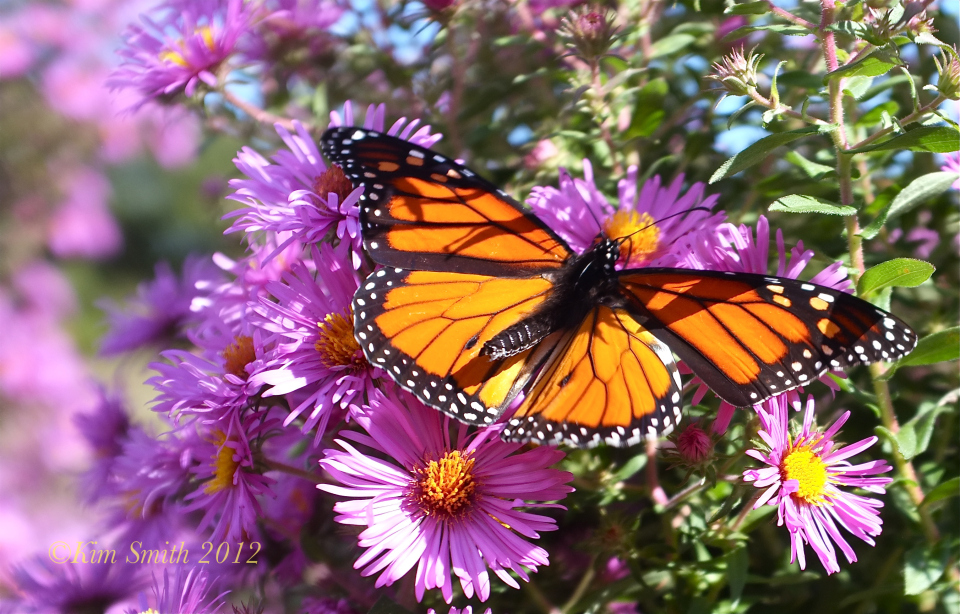
monarch-butterfly-c2a9kim-smith-2012-1Monarch Butterfly Nectaring at New England Asters

Harbor Walk Butterfly Garden ©Kim Smith 2012Gloucester HarborWalk Butterfly Garden

Kim Smith Guest Speaker at the Rockport Garden Club Monday, October 6th

Rockport Garden Club ©Kim Smith 2014Sign Posted at the Rockport Community Center Garden

Next Monday afternoon at the Community House I will be presenting my “Pollinator Garden” program to the Rockport Garden Club. I am looking forward to meeting with this great group of civic-minded gardeners. I see their signs all around town at the various gardens they maintain and they do a simply outstanding job! The program begins at 1:15 and the doors open to the public at 1:00.

The Pollinator Garden

Following the rhythm of the seasons, celebrated landscape designer Kim Smith presents a stunning slide show and lecture demonstrating how to create a welcoming haven for bees, birds, butterflies, and other wildlife. Native plants and examples of organic and architectural features will be discussed based on their value to particular vertebrates and invertebrates.

Please visit the Programs Page of visit my website for a complete list of program offerings.

Whirling Butterflies (Gaura lindheimeri) ©Kim Smith 2014Whirling Butterflies (Gaura lindheimeri) at the Rockport Community House and Senior Center

Gaura is not a only a fabulous drought tolerant plant for the water-wise garden, it is also a caterpillar food plant for the beautiful day-flying White-lined Sphinx Moth.

Hummingbird-Hawk-Moth-Life-CycleGraphic Source: Animalbook.org

White-lined_sphinxAbove White-lined Sphinx Moth image courtesy wiki commons media.

The Rockport Community House is located at 58 Broadway, Rockport.

Berkshire Museum Presents My Butterfly Documentary and Lecture Saturday September 20th

bst_banner_final[PITTSFIELD, MA] – The Berkshire Museum will present a workshop and documentary screening with landscape designer and filmmaker Kim Smith on Saturday, September 20, 2014. Both events are included with regular Museum admission. The slide-illustrated talk, Creating a Bee, Bird, and Butterfly Garden, begins at 10 a.m.and the screening of the film, Life Story of the Black Swallowtail, will follow the talk, beginning at 11:30 a.m. Both programs are part of the Museum’s BeMuse program series.

Creating a Bee, Bird, and Butterfly Garden

Saturday, September 20, 10 a.m.

Following the rhythm of the seasons, Kim Smith presents a stunning slide show and lecture demonstrating how to create a welcoming haven for bees, birds, butterflies, and other wildlife. Native plants and examples of organic and architectural features will be discussed based on their value to particular vertebrates and invertebrates. Pollinator plant list handout included with workshop.

Black Swallowtail osmeterium ©Kim Smith 2011 copy

Life Story of the Black Swallowtail Butterfly

Saturday, September 20, 11:30 a.m. (time approximate; screening follows workshop)

Life Story of the Black Swallowtail Butterfly is a 45-minute narrated film that takes place in a garden and at the sea’s edge. Every stage of the butterfly’s life cycle is experienced in vibrant close-up, from conception to pupation to metamorphosis. The film is suitable for all ages so all can gain a deeper understanding of the symbiotic relationship between wildflowers and pollinators and the vital role they play in our ecosystem. The film was shot in Gloucester, Massachusetts. A discussion and Q & A with Kim Smith, the filmmaker, will follow the screening. Life Story of the Black Swallowtail is the first film in a trilogy about butterflies and will be followed next year by Beauty on the Wing ~ Life Story of the Monarch Butterfly.

Black swallowtail Butterfly finger ©Kim Smith 2011 copy

About Kim Smith

Kim Smith is a filmmaker, designer, author, illustrator, photographer, and naturalist who documents, in a variety of media, the world around her. She is the author and illustrator of Oh Garden of Fresh Possibilities! Notes from a Gloucester Garden (David R. Godine, publisher, 2009). Kim’s landscape and interior design firm, Kim Smith Designs, works with clientele to create highly individualized homes and gardens, and she specializes in creating butterfly and songbird habitat gardens in public spaces. Smith is a daily contributor to the stellar community blog Good Morning Gloucester. 

 MAP to BERKSHIRE MUSEUM, thanks to Cat Ryan!

About the Berkshire Museum

Located in downtown Pittsfield, Massachusetts, at 39 South St., the Berkshire Museum, a Smithsonian Affiliate, is open from 10 a.m. to 5 p.m. Monday through Saturday, and noon to 5 p.m. on Sunday. Admission is $13 adult, $6 child; Museum members and children age 3 and under enjoy free admission. Admission to the Butterfly Pavilion is an additional $2 per person. For more information, visit Berkshire Museum or call 413.443.7171.

In association with the Smithsonian since 2013, Berkshire Museum is part of a select group of museums, cultural, educational, and arts organizations that share the Smithsonian’s resources with the nation.

Established by Zenas Crane in 1903, Berkshire Museum integrates art, history, and natural science in a wide range of programs and exhibitions that inspire educational connections between the disciplines. Butterflies is on view throughOctober 26, 2014. Objectify: A Look into the Permanent Collection is currently on view. Little Cinema is open year-round. Feigenbaum Hall of Innovation, Worlds in Miniature, Aquarium, and other exhibits are ongoing.

SEE PREVIOUS POST ABOUT BUTTERFLIES! AT THE BERKSHIRE MUSEUM

Dedication of the Pathways Butterfly Garden

Caroline Haines butterfly garden Patheways for Children ©Kim Smith 2014Carolin Haines on ukelele singing with the Pathways Children “The Garden Song,” written by David Mallett 

Pathways for Children butterfly garden ©Kim Smith 2014

The dedication of the new butterfly garden at Pathway’s for Children was celebrated with speeches of thanks, and a song and poem performed by the Pathways children. The sun was shining, the bees and butterflies were on the wing, and there were lots of smiles of joy on the faces of the children and attendees. My most heartfelt thanks and deepest appreciation to all who have given so much to make the garden a success! Pathways for Children butterfly garden -3 ©Kim Smith 2014

Pathways for Children butterfly garden -4 ©Kim Smith 2014Just some of the wonderful people who made the garden possible: Andrew, Bernie Romanowski, Beth Graham, and Peter Van Demark. 

Pathways for Children butterfly garden sunflower ©Kim Smith 2014

Pathways for Children butterfly garden before ©Kim Smith 2014Before Photo Pathways for ChildrenPathways for Children butterfly garden -8 ©Kim Smith 2014

Pathways for Children butterfly garden -7 ©Kim Smith 2014

See previous post on the new butterfly garden at Pathways here: HOORAY FOR PATHWAYS FOR CHILDREN’S BRAND SPANKING NEW BUTTERFLY GARDEN

Top Native Bee Friendly Plants

Obedient Plant and Bee Physostegia virginiana ©Kim Smith 2013Obedient Plant (Physostegia virginiana)

Below is a list of some favorite nectar- and pollen-rich bee-friendly North American wildflowers for attracting native bees and honey bees to your gardens. They are listed in order of bloom time, from spring through late summer, to provide your foragers with nourishment all growing season long.

Mexican Sunflower © Kim Smith 2013Mexican Sunflower (Tithonia rotundifolia)

Wild strawberry (Fragaria viginiana)

Wild Blue Lupine (Lupinus perennis)

Common Milkweed (Asclepias syriaca)

Marsh Milkweed (Asclepias incarnata)

Black-eyed Susan (Rudbeckia hirta)

Sunflower (Helianthus annus)

Obedient Plant (Physostegia virginiana)

Seaside Goldenrod (Solidago sempervirens)

Great Blue Lobelia (Lobelia siphilitica)

Joe-pye Weed (Eupatorium purpureum)

New York Ironweed (Veronia noveboracensis)

New England Aster (Aster novae-angliae)

Sailor Stan sunflower and bee ©Kim Smith 2011Sailor Stan Sunflower (Helianthius annus)

Eupatorium and Bee ©Kim Smith 2012Joe-pye Weed (Eupatorium purpureum)

Ironweed Bee ©KIm Smith 2011New York Ironweed (Veronia noveboracensis)

Top Ten Tips for Attracting and Supporting Native Bees

Bees, butterflies, and songbirds bring a garden to life, with their grace in movement and ephemeral beauty.Bee and Monarch Butterfly ©Kim Smith 2012

Many of the plants that are the most highly attractive to butterflies are also the most appealing to bees, too!

Bees are also a “keystone organism,” which means they are critical to maintaining the sustainability and productivity of many types of ecosystems. Without bees, most flowering plants would become extinct, and fruit and seed eating birds and mammals (such as ourselves) would have a much less healthy and varied diet.

Native bees come in an array of beautiful colors, size, and shapes. Some are as small as one eighth of an inch and others as large as one inch. They may wear striped suits of orange, red, yellow, or white, or shimmer in coats of metallic iridescene. Their names often reflect the way in which they build their nests, for example, carpenter bees, leafcutter bees, mason bees, plasterer bees, digger bees, and wool carder bees.

Approximately 4,000 species of native bees have been identified north of Mexico. They are extremely efficient pollinators of tomatoes, apples, berries, pumpkins, watermelons, and many other crops.

Native Bee Pollinating Apricot Tree ©Kim Smith 2009Native Carpenter Bee and Apricot Tree

Listed below are what I have found to be the most successful tips for supporting and attracting native bees to your garden.

1). Choose plants native to North America. Over millennia, native bees have adapted to native plants. If planting a non-native plant, do not plant invasive aliens, only well-behaved ornamentals.

2). Choose non-chemical solutions to insect problems, in other words, do not use herbicides or pesticides.

3). Choose plants that have a variety of different flowers shapes to attract a variety of bees, both long-tongued and short-tongued bees.

4). Avoid “fancy” plants, the hybrids that have been deveolped with multiple double frilly layers. This only confuses bees when they are looking for nectar and gathering pollen.

5). Provide a succession of nectar-rich and pollen bearing blooms throughout the growing season. Select plants that flower during the earliest spring, during the summer months, and until the first hard frost.

6.) Plant a clover lawn, or throw some clover seed onto your existing grass lawn to create a mixed effect.

7.) Bee Friendly–bees only sting when provoked. When encountering an angry bee, stay calm and walk away slowly.

8.) Plant lots of blue, purple, and yellow flowers, a bees favorite colors.

9). Provide a source of pesticide-free water and mud in your bee paradise.

The first nine tips are for any garden, large or small. The last is for people with larger land areas.

10). Establish hedgerows, or clumps of native woody shrubs and trees, and wildflower fields. Contact the USDA NRCS (Natural Resources Conservation Services) for available funding opportunities.

Tomorrow I’ll post our top ten native plants for attracting and supporting native bees.

Cornus alternifolia ©Kim Smith 2009One of the most elegant of all native trees is the not-widely planted Cornus alternifolia, or Pagoda Dogwood. Where ever I plant this tree of uncommon grace and beauty it becomes a magnet for all manner of bees and butterflies.

Why Bees Are Disappearing and More Importantly, HOW YOU CAN HELP~ Marla Spivak TED Talk

MUST SEE! ~a timely, informative talk accompanied by stunning photos!

Bee and Sunflower ©Kim Smith 2013

“The Pollinator Garden” at the Beverly Public Library

On Tuesday evening, October 15th, at 7 pm, I’ll be giving my program, “The Pollinator Garden,” at the Beverly Public Library. Following the rhythm of the seasons, I present a slide show (with over 100 photos!) and lecture demonstrating how to create a welcoming haven for bees, birds, butterflies, and other wildlife. Native plants and examples of organic and architectural features will be discussed based on their value to particular vertebrates and invertebrates. I hope you’ll come join me!

Sunflower and bee  ©Kim Smith 2013Helianthus annuus

Fields From Which Dreams Are Made

So many thanks to the Donovan Family for allowing me continued access to film and photograph B-roll for my Monarch film, at their beautiful…

Wildflower Field of Dreams

Donovan Wildflower Field & House ©Kim Smith 2013 copySkylar’s Field

Goldfinch and Cosmos ©Kim Smith 2013Male American Goldfinch Eating Seed Heads ~ click to view larger

Large file Juvenile Blue Heron & Cosmos Donovan ©Kim Smith 2013Juvenile Blue Heron

Sunflower Donovan Field ©Kim Smith 2013 copySunflower (Helianthus annuus)

Monarda is the Bees Knees!

Come Join Me for a Tour of the Butterfly Gardens at the HarborWalk

Please come join me on Saturday, July 13th, at 1:00 and at 2:00, for guided tours of the butterfly gardens I designed for the Gloucester HarborWalk. The guided tour is included in the cost of the ticket for the Gloucester Garden Tour. Please feel free to email me with any questions about the butterfly garden tour at the HarborWalk at kimsmithdesigns@hotmail.com.

One of my favorites, and in bloom now at the Gloucester HarborWalk Gardens, is the stunning North American native wildflower Culver’s Root or Veronicastrum virginicum. The plant typically grows to five feet and, when in flower, creates a lovely, airy candelabrum effect. Culver’s Root prefers full sun and moist well-drained soil. When I was there checking on the gardens several days ago all manner of bees and butterflies were nectaring from the diminutive florets of the spikey racemes of the Veronicastrum.

Veronicastrum virginicum Culver's Root ©Kim Smith 2013

Veronicastrum virginicum and Cabbage White Butterfly, Gloucester HarborWalk Butterfly Garden

Europe Bans Bee-Harming Pesticides

Europe took a significant step as a majority of EU member states voted for a partial ban of three bee-killer pesticides. This, despite fierce behind-the-scenes lobbying from insecticide firms Syngenta and Bayer.  “A series of high-profile scientific studies has linked neonicotinoids to huge losses in the number of queens produced and big increases in “disappeared” bees – those that fail to return from foraging trips. Pesticide manufacturers and UK ministers have argued that the science is inconclusive and that a ban would harm food production, but conservationists say harm stemming from dying pollinators is even greater.” (The Guardian, UK).

Sunflower bees Sailor Stans ©Kim Smith 2012

It  is a landmark vote and was supported by petitions signed by millions of people.  Although it is only a two year ban, the hope is the ban will give the beleaguered bee a break, and allow time for reexamination of data. Under the EU measures, restricions on the following apply: for treating seeds, soil and leaves on flowering crops attractive to bees such as corn, sunflowers and rapeseed (the source of canola oil). The products may still be used on crops like winter wheat for which the danger to bees is deemed to be small. Use by home gardeners will be prohibited.

The three banned insecticides are imidacloprid, thiametoxam, and clothianidin. The neonicotinoid I see commonly listed on pesticides that are readily available to the home gardener is imidacloprid. I urge every home gardener not to use pesticides. I don’t use them, ever, in my own garden, and never in both the private and public gardens that I design and maintain. Several years ago, I reported that Alain Baraton, the head gardener at the Palace of Versailles stopped using pesticides at the palace gardens. Within the year, a natural balance began to take hold in the gardens, including the return of songbirds to the gardens which in turn eat the insects. If the no-pesticide policy is successful at Versailles, which receives millions upon millions of annual visitors, a pestide ban can certainly be implemented for our private homes and public spaces.

Korean daisy for bees©Kim Smith 2011

A dear friend of mine, Heidi Kost-Gross, is Vice Chair of the Natural Resources Commission for the Town of Wellesley (garden club readers–she is also President of the Federated Garden Club of Massachusetts). Heidi has been instrumental in pesticide reduction throughout Massachusetts. The Wellesley Natural Resources Commission has created an outstanding Pesticide Reduction Resource Guide for Citizens and Municipalities of Massachusetts, which is available for free to distribute anything found in the guide.

Magnolia virginiana Eastern Carpenter Bee Kim Smith 2011 copy

Magnolia viginiana and Eastern Carpenter Bee