New to our garden this year is the Quilled Sweet Coneflower. The finely quilled sunny yellow petals are simply lovely, as is the overall shape of the plant. The wildflower is a North American native and bears the name of the southern Illinois horticulturist and prairie restoration specialist who found it growing in a railroad prairie remnant.
When lightly rubbed, the leaves of Rudbeckia subtomentosa reveal their sweet vanilla scent. I’ll let you know if it attracts bees, butterflies, and songbirds when the center florets open.
Railroad Prairie Remnants
“…the only remnant of any virgin, unplowed prairie that remains is along railroad tracks. When the railroads were originally built in the 1800′s, if they were going over a natural prairie, all they had to do was lay down the wooden crossties, pack in bed fill, and lay the rails….the remaining right-of-way remained essentially undisturbed. In many locales, a road also was constructed parallel to new tracks, so that the few hundred feet of railroad right-of-way trapped between the tracks and the road remained unplowed to this day, and in many areas has reserved a remarkable diversity of prairie species. In most areas, accidental fires happen fairly regularly, which enhances the vigor of the prairie vegetation.” Larry Lowman, Arkansas nurseryman and native plants specialist.
3 minute video featuring the Eastern Carpenter Bee. The music is the opening movement of Aaron Copland’s Appalachian Spring, performed by the Boston Symphony Orchestra.
The Eastern Carpenter Bee (Xylocopa virginica) is an important pollinator for many open-faced spring flowers including the blossoms of fruiting trees—crabapple, apple, pear, peach, plum, and wild cherry—as well as holly and brambles. X. virginica has an especially bad reputation with blueberry growers because they have strong mouthparts (capable of boring into wood), which will easily tear flowers with a deep corolla—blueberries and azaleas, for example. In the video you can see the bee probing into the sides of, and in some instances tearing, the petals to gather nectar from the blossoming Japanese Andromeda (Pieris japonica). The damage done to wood is usually minimal and cosmetic.
Carpenter Bees are regularly mistaken for bumblebees. Their shiny black abdomen most easily distinguishes them. Male and female carpenter bees can easily be differentiated at a glance. The male has a patch of yellowish-white cuticle at the top its head; the females face is entirely black.
Male Eastern Carpenter Bees are aggressively territorial. They will fly at you noisily and vigorously when in their territory, but it is all just show—they are incapable of stinging!
Is there a tree more lovely in flower than the North American native dogwood?
Whether flowering with the classic white bracts, the stunning rubra bracts, or the less often seen pale, creamy rose-tinted bracts, our native dogwood (Cornus florida) never ceases to give pause for beauty given.
NATIVE TREES SUPPORT NATIVE POLLINATORS!
At this time of year when traveling along southern New England roadways we are graced by the beauty of the dogwood dotting sunny roadside borders where meets the woodland edge. The bracts and flowers emerge before the leaves, serving only to heighten their loveliness. The fresh beauty of the bract-clad boughs is offset by the impressionistic symphony of tree foliage unfurling, shimmering in hues of apple green, chartruese, moss, and lime peel.
*Bract – A bract is a leaf-like structure surrounding a flower or inflorescence. The colorful bracts of poinsettias, the hot pink bracts of bougainvillea, and the bracts of dogwoods are often mistaken for flower petals.
The open florets (pea-green colored) and unopened buds are surrounded by the rose red-shaded bracts.
Read about how to help prevent an attack by the lethal dogwood anthracnose.
“Beauty and seduction, I believe, is nature’s tool for survival, because we will protect what we fall in love with.” –Louie Schwartzberg
Friends who are aware of my butterfly and nature film projects send me the most exquisite images and links to films and videos. Thank you Emily for sharing The Hidden Beauty of Pollination, created by Louis Schwartzberg, award winning photogragher and cinemetagrapher, who has been filming time-lapse flowers and pollinators for over thirty years. Once on youtube, click the icon to see the full screen version, which is without a doubt the best way to view this extraordinary short film (only about 7 minutes in length). The second link leads to a brief talk given by Schwartzberg, also very well worth seeing.
The second sentence in Schwartzberg’s quote reminded me of a quote from Baba Dioum, the noted Senegalese poet, “In the end we will conserve only what we will love. We will love only what we understand. We will understand only what we are taught.”
Recently a design colleague wrote inquiring as to the best time to mow her client’s fields as she was concerned about disrupting the breeding cycle of the Monarch butterfly. I am often asked this question and it is well worth considering, not only for the sake of the Monarchs, but for the survival of the myriad species of butterflies, bees, and other pollinating and beneficial insects that find food and shelter in untilled fields.
Newly Emerged Monarch Butterfly
Dear Laurel,
I generally advise my readers and design clients that own similar untilled fields to alternately mow in stages–half a field at a time. The Monarch is a large, charismatic butterfly with an easily observed life cycle. The typical field comprised of native (and introduced) wildflowers and grasses creates a rich biodiversity, supporting innumerable species of butterflies and beneficial insects. It is hard to know when exactly to mow for each different species and when to mow for even one single species because, from year to year, depending on many variables including temperature and air currents, the insects breeding times are somewhat variable. For example, this year I have had three broods each of both Monarchs and Black Swallowtails, when in a more typical year I may only have two broods.
Monarch Butterfly Caterpillars Attached to Milkweed (Asclepias syriaca)
I think of not too long ago when we were primarily an agrarian society. Farmers then would have mowed different fields at different times during the growing season. A woman in our community, whose field is rife with common milkweed, always mows in late June or early July. Initially I thought that this was perhaps not good practice for the Monarchs, but the thing with Common Milkweed (Asclepias syriaca) is that when mown to the ground in early summer, it shoots right back up again. By the time the late July, early August Monarchs have arrived and are breeding in our region, her milkweed has re-sprouted, grown at least a foot, is lush and green, and flowering.
That your client is interested in caring for the flora and fauna that abounds in her fields is wonderful! We want weeds (wildflowers) growing in our fields–they provide food and shelter for benefiel insects and wildlife and also help to retain moisture in the soil.
The single greatest threat to the Monarch butterfly is the use of Monsanto’s Roundup Ready genetically modified corn and soy bean seed, which are designed to tolerate potent does of Monsanto’s herbicide Roundup, however, Roundup kills all other surrounding plants and all beneficials insects and their larvae. Additional threats include the extreme weather condiitons caused by climate change, overdevelopment in the US, which has led to loss of habitat, and the unrelenting poverty in rural Mexican villages, which is leading to the deforestation of the butterflies habitat in Michoacán
Monarch Butterfly Chrysalids
At a lecture I attended presented by Doug Tallamy, Professor and Chair of Entomology and Wildlife Ecology at the University of Delaware, he also suggested mowing fields in alternate stages, so we are in good company!
An additional suggestion is to give a corner of your field or garden over to a patch of milkweed, which would then insure a steady supply for the Monarchs. We grow both Common Milkweed and Mash Milkweed (Asclepias incarnata) side-by-side. The marsh flowers slightly earlier, attracting earlier Monarchs. The males intently patrol the milkweed patch and after mating, the females flit from flower to leaf, alternatively depositing eggs on both species of milkweeds, while taking sips of nectar from whichever milkweed is in flower.
Kind regards,
Kim
Note form Laurel:
Hello Kim,
I have a new client who has both cultivated ornamental gardens, which I am caring for, and open meadows, which she has mown once or twice per season. There is lots of milkweed in the field, with some seedlings sprouting in the garden. We pulled the seedlings and brought them home to later place in a field near where I live. We had them in jars in water and were surprised and delighted when a few days later we discovered 7 tiny Monarch larvae. We have raised them to the butterfly stage and released them. Fascinating! During the process I did some reading about the Monarch and learned that there are 4 or 5 generations each season, with the final butterflies, in September, making the trek to Mexico for the winter, and then flying north in the spring to start the cycle over again. My question is about the timing of the mowing of the fields. If it is mown at any time during the breeding season (May – September?), isn’t the current generation almost or completely wiped out? Do you know when the best time is to mow for the butterflies? I assume it is late fall, but since the mowing of meadows has been happening for centuries, is it perhaps ok to mow during the season? (or perhaps this is one contributing reason for the demise of these lovely creatures….) Thank you in advance for any info!
Located in the heart of Ravenswood Park in Gloucester there is a stand of Magnolia virginiana growing in the Great Magnolia Swamp. It is the only population of Magnolia virginiana known to grow this far north. I took one look at the native sweet bay magnolia and breathed in the fresh lemon-honeysuckle scent of the blossoms, fell in love, and immediately set out to learn all I could about this graceful and captivating tree. Recently having returned from a trip to visit my family in northern Florida, I had tucked the bud of a Magnolia grandiflora into my suitcase. I was dreaming of someday having a garden large enough to accommodate a Magnolia grandiflora and was overjoyed to discover the similarities between M. virginiana and M. grandiflora. For those not familiar with the Southern magnolia, it is a grand, imposing specimen in the landscape, growing up to fifty feet in the cooler zones five and six, and one hundred feet plus in the southern states. M. grandiflora is the only native magnolia that is reliably evergreen in its northern range, flowering initially in the late spring and sporadically throughout the summer. The creamy white flowers, enormous and bowl-shaped (ten to twelve inches across), emit a delicious, heady sweet lemon fragrance.
In contrast, the flowers of the sweetbay magnolia are smaller, ivory white, water-lily cup shaped, and sweetly scented of citrus and honeysuckle. The leaves are similar in shape to the Magnolia grandiflora, ovate and glossy viridissimus green on the topside, though they are more delicate, and lack the leathery toughness of the Southern magnolia. The lustrous green above and the glaucous silvery green on the underside of the foliage creates a lovely ornamental bi-color effect as the leaves are caught in the seasonal breezes.
Magnolia virginiana is an ideal tree for a small garden in its northern range growing to roughly twenty feet compared to the more commanding height of a mature Southern magnolia. Sweet bay grows from Massachusetts to Florida in coastal freshwater wetland areas as an understory tree. The tree can be single- or multi-stemmed. Sweet bay is a stunning addition to the woodland garden with an open form, allowing a variety of part-shade loving flora to grow beneath the airy canopy. The leaves are a larval food for the Eastern Tiger Swallowtail butterfly. Almost immediately after planting we began to notice the swallowtails gliding from the sunny borders of the front dooryard, where an abundance of nectar-rich flowers are planted specifically to attract butterflies, around to the shady border in the rear yard where our sweet bay is located.
Our garden is continually evolving and part of our garden has given way to a limited version of a woodland garden, for the shady canopy created by the ever-growing ceiling of foliage of our neighbor’s trees has increasingly defined our landscape. We sited our Magnolia virginiana in our diminutive shaded woodland border where we can observe the tree from the kitchen window while standing at the kitchen sink. Gazing upon the tree bending and swaying gracefully in the wind, displaying its shifting bi-color leaves, provides a pleasant view when tending daily chores and the dreamy fragrance emitted from freshly opened blossoms make the chores all that less tiresome.
Excerpt from “Oh Garden of Fresh Possibilities!” Notes from a Gloucester Garden (David R. Godine Publisher), written and illustrated by Kim Smith.
The Massachusetts Butterfly Club Guide to Good Butterfly Sites
From the Berkshires to the Cape and Islands, this guide will lead you through twenty six of the best butterfly locations in the state. Massachusetts Butterfly club field experts describe each site in detail, with original trail maps, sightings lists, directions, and hot tips. Edited by Sharon Stichter, with maps by Richard Hildreth.
Excerpt from Gloucester’s own Doug Savich, writing about Waring Field and the Cranberry Marsh ~ “Waring Field is a five acre meadow surrounded by trees and shrubs. It is owned by the town of Rockport and is cut for hay once or twice a year. A small stream runs across the meadow. Waring field is home to a number of meadow species. Be sure to check the flowering shrubs and wildflowers that grow along the edges of the field.”
Pearly Crescentspot (left) and Silver-bordered Fritillary
At Waring Field and the Cranberry Marsh, I often find assemblages of Pearly Crescentspots and Silver-bordered Fritillaries on the wing and nectaring at goldenrod.
The North Shore Garden Club is hosting a beautiful exhibition of all things flowers, which will be held at historic Willowdale Estate in Topsfield, Massachusetts. The grounds are open to the public and the event includes classes in flower arranging, photography, and horticulture, and all is free.
Butterfly Courtyard at Willowdale Estate
The North Shore Garden Club (established in 1915) is a member of the Garden Club of America and was created for the purpose of stimulating interest in all aspects of gardening as well as to support civic beauty and conservation of natural resources.
Viridiflora Tulip ‘Greenland’
Lavender and Cabbage White Butterfly
Native Iris versicolor
Native Pinkshell Azalea and Golden Pollen-Dusted Carpenter Bee
We are sending our most heartfelt thoughts and prayers to the Japanese people. Viewing the broadcasts reminds me that it was just over a year ago that the devastating earthquake struck Port au Prince. Can a person ever fully recover from such an event? The utter destruction of the tsunami is confounding, now coupled with threats of nuclear meltdown. My wish for the people of Japan and their nation is as speedy a recovery as is possible.
We are so very blessed living where we do. Perhaps I mentioned that I am developing a television series, which will air on our local cable television station, Cape Ann TV, as well as other cable stations. I believe it was early last summer that Donna Gacek, the director of Cape Ann TV, approached me about the possibility of creating a show based around my writings and butterfly photos. A tv show would be a magnificent medium to share about the joys of creating organic habitats designed for people and pollinators. We can visit gardens, fields, meadows, and wildlife sanctuaries–and connect how to translate habitat information found there to our own gardens, examine gardening trends, loves, and literature, conduct interviews, undertake how-to projects–the possibilities are limitless. I hope, too, for some room for spontaneity and fun–once I get a handle on the process. I knew what I was getting myself into and knew it would be enormously time consuming, which it is, however I am so pleased with our initial progress and thought I would bring you this trailer for the first episode as well as behind the scenes updates.
Instinctively it was clear that the first step in development would be to film and photograph as much as time would allow, especially as this past summer, gratefully so, was THE summer to photograph Lepidoptera–day after day of hot, dry, sunny weather–a butterfly, and a butterfly photographer’s, dream conditions The past few months have been spent organizing all photos and footage from this summer, as well as footage and photos from previous summers, into handy categories from which I can draw, while simultaneously writing the first script, and thinking about future scripts.
I chose the butterfly garden I designed at Willowdale to be my first subject for several reasons. I know the grounds and garden intimately; the Lepidoptera seen there are the same species seen all around the northshore, and throughout New England for that matter; the setting is undeniably gorgeous; over the past few years I have shot many photos there and some video footage; and because the garden is on occasion open to the public.
While writing the script I tried to imagine how the information would relate to, and be of interest to, a wide audience. Creating ‘wild gardens’ (by wild gardens I mean to say gardens that utilize native wild flowers that support wild life) is meant to be joyful and easy for everyone– for the millions as well as the millionaire! The next phase was to organize the video and still photos, loosely, around the script. Then, and this part was really new and challenging for me, came layering the narrated voice tracks and precisely synching it to the footage, and still retain existing ambient nature sounds audibly. Much tweaking was necessary. Have you ever wondered where your speaker is on your computer? It took me the longest time to locate mine (iMac)– a pinhead-sized hole in the center of the top, right above the camera lens–and they do not produce very good or usable quaility input sound. All the audio will have to be redone at the tv studio, however, it was time well spent as I was able to experiment and learn the basics on my own time.
The first production meeting with Donna went really well. The next phase will be to redo the audio tracks, under the guidance of the staff at the tv station, and continue to work on the next two episodes. In developing a series, it is suggested that you have at least three to begin with – getting all your ducks in order, so to speak. I am working furiously on all because spring and summer are my peak seasons for garden design work and for presenting lectures and programs.
So far, everything has fallen into place, from the gorgeous weather of last summer, to finding a beautiful recording for the into and outro, to working with Donna and the staff at CATV!
My mission for this wonderful project is to create as vibrantly beautiful, and as informative and interesting, a viewing experience as is possible. I am also very interested in working in collaboration with anyone who may have an interest.
Perhaps after reading the above you can help me decide the title of the show–so important to get it right! I love the title of my book Oh Garden of Fresh Possibilities! because there is no other like it. Perhaps I shall call it The Garden of Fresh Possibilities Show.
Some other candidates:
The American Gardener’s Journal
Through the Garden Gate
Garden for All Seasons
Welcome to the Wild Garden
Any comments, thoughts, or suggestions would greatly appreciated.
The Pollinator Garden has been rescheduled for Monday morning, Apriil 18th. Updated information to follow.
Dear Gardening Friends,
Come join me Monday morning, February 28th, from 10:00 to 12:00 at the Espousal Center in Waltham, where I will be giving a talk and photo presentation about creating The Pollinator Garden for the Garden Club Federation of Massachusetts. Although this is a state Garden Club Federation event, everyone is welcome. Cost is free for members and $5. for non-members. My extensive pollinator planting list is provided with lecture.
Scroll down to see a short video tour of the Limonaia, along with much good information about growing citrus in colder climes, excerpted from Oh Garden of Fresh Possibilities!
Keep warm and cozy and–take heart–the vernal equinox and the first day of spring are officially less than one month away!
In anticipation of spring and your spring planting plans (and as I am sorting through mountains of photos, film footage, and text for the butterfly gardening show), I am planning a little series here on the blog. The focus is all about sharing information and photos about individual plant species that provide sustenance and shelter for the pollinators that grace our gardens.
Trumpet Creeper (Campsis radicans)
Two of our very favorite native plant species for attracting Ruby-throated Hummingbirds are the blossoms of the northern catalpa tree (Catalpa speciosa) and trumpet creeper (Campsis radicans), both of which belong to the Bignonia family. Catalpa trees bear white flowers with violet nectar guides and, despite their color differences, Catalpa blossoms and the red-orange flowers of trumpet creeper reveal several similarities, The reproductive structures are positioned inside at the top lip of the opening, surrounded by five asymmetrically shaped petals fused together. As the hummingbird pokes its head deep inside the trumpet-shaped blossom to extract nectar, the pollen-bearing sticky stamens and pistils attach to its forehead and transfer pollen from one blossom to the next.
Nectar volume influences the blossoms’ attractiveness to the Ruby-throated Hummingbird. The small florets of plants such as those of butterfly bushes and zinnias offer nectar, though they require many visits to make it worthwhile. Our native Campsis radicans produces one of the highest known volumes of floral nectar per flower. Hummingbird fledglings quickly learn from their mothers the blossoms that contain the most nectar.
Campsis radicans is found growing throughout much of the eastern half of the country. Unable to support itself vertically, it trails along the ground until it reaches a tree. Tiny aerial rootlets are formed to adhere itself to the surface of the tree to then allow it to climb skyward towards the sunlight. Unlike vines such as Chinese wisteria and bittersweet, which gird and then strangle a tree, trumpet creeper clings tightly. Campsisradicans is a very fast growing and top-heavy vine. It is unsuitable for anything but the strongest structure. As it blooms on the current year’s growth, it can be grown along a solid fence and cut back very vigorously in early spring.
For the intimate garden or garden room, where a less rampant (but no less hardy) grower is a more suitable choice, there are several hybrids of C. radicans with flowers that are as equally attractive to the hummingbirds. ‘Madame Galen’ (Campsis radicans x tagliabuana) flowers in lovely shades of apricot-orange. The newer cultivar ‘Indian Summer’ is described with the less persistent and dense growth characteristics similar to that of ‘Madame Galen’ and beautiful blossoms of apricot-orange with a deeper red eye.
The extended period of florescence of C. radicans corresponds to the span of time in which ruby-throated hummingbirds are living in their northern range. Like Chinese wisteria, trumpet creeper can take six years or more to flower from seed. Plant the largest specimen one’s budget will allow.
Pictured above are cascading mounds of Korean daisies blooming in the autocourt at Willowdale Estate, located in Topsfield, Massachusetts. Korean daisies will continue to bloom through several light frosts and support myriad late-on-the-wing pollinators. This photograph was taken on Veteran’s Day, November 11, 2010.
Update: Monarch Butterfly Migration Late Summer 2010
Magical Seaside Goldenrod Meadow
Dear Gardening Friends,
So many have telephoned or emailed inquiring about the status of the annual Monarch butterfly migration through our region. This past summer I have observed umpteen Monarch butterflies and caterpillars in cultivated gardens, wildflower meadows, and along the shoreline; however, I did not see the great numbers in great heaps roosting in any one particular place that I have in some years past. Rather I would find a small passel here and a small passel there—perhaps several dozen at a time—roosting in the wild black cherry trees (Prunus serotina) at Eastern Point, awakening in the early morning and nectaring at the Seaside Goldenrod in the meadow below.
Monarchs Mimic Withering Foliage of Black Cherry Tree
Although the Monarchs are guided genetically, using their internal sun-compass navigation and circadian clock, each year the annual southward migration takes a different form that depends on many variables, primarily the weather conditions in their overwintering site in Michoacán, Mexicoas well as weather patterns in their US and Canadian breeding grounds. Because Cape Ann is located at approximately 43 degrees latitude north, our peak migration pattern is estimated at around September 11, but I modify this pattern because of the strong winds and storms we often experience in the late summer living along the coastline.
I have read reports of fantastic migrations that are taking place this year, from Long Island, south to Cape May, and west to Virginia—some saying it is the best they have seen in decades! I continue to remain on the look out because the air temperatures were atypically warmer this summer, creating a longer breeding season than usual, which would indicate that there may be newly emerging Monarchs on the scene. While photographing during this year’s migration, I encountered a pair of Monarchs mating, a very unusual occurrence at this time of year. The “Methuselah” Monarchs that we see in late summer and early autumn are generally speaking sexually immature and do not mate until next year, after they journey south and after they overwinter and awaken in Mexico.
Monarchs Mating Amidst the Goldenrod
Monarchs observed in late summer and early autumn are intent on nectaring and not easily distracted. This later generation of Methuselah Monarchs is feeding aggressively to increase and store their lipid reserves for the long journey south. We provide plenty of nectar-rich blossoms to help the Monarchs in their exhaustive migration, taking cues from marsh and meadow. Blooming freely at this time of year are copious members of the Composite family—goldenrods, asters, pearly everlasting, zinnias, ironweed, Mexican sunflowers, and Korean daisies. If one diligently deadheads the butterfly bushes and Verbena bonariences, they too will be available for the migrating Monarchs.
My favorite goldenrod isSeaside Goldenrod (Solidago sempervirens), which blooms from August to November. Seaside Goldenrod is the gorgeous brilliant golden wildflower we see growing and glowing along the edge of the sea. It is easily differentiated from other New England goldenrods in that the flowerheads are comparatively larger and the leaves are thicker and fleshier, with a waxy feel, an adaptation to the drying effect of salty sea spray. Seaside Goldenrod grows prolifically in rich, moisture retentive soil, less so in drier conditions.
Although I strongly discourage digging plants from local marsh and meadow, perfectly acceptable is the practice of collecting ripened seed stalks and shaking them about. That is just how we obtained our Smooth Asters (Aster laevis). With cheery one-inch button-shaped flowers borne along the lengths of the stalks, the pale-hued lavender-blue ray flowers and yellow disk florets of Smooth Asters are attractive to bees and butterflies. We have observed Common Sulphers, Pink-fringed Sulphurs, Monarchs, American Ladies, Red Admirals, and Cabbage Whites nectaring simultaneously on a clump growing in the sheltered border along our fragrant path. Pinch back the developing growth tips during the early part of the growing season (until roughly July fourth) to encourage a bushier and more compact plant. Asters provides nourishing sustenance for transitory butterflies when many nectar-rich plants have finished blooming for the season. Not particularly fussy in regard to soil conditions, Smooth Aster grows and flowers profusely in full sun to light shade. Smooth Aster and Purple-stemmed Aster (Aster puniceus) are the asters we see blooming along the backshore at this time of year. With golden yellow florets at the center of their ray flowers, asters and goldenrods create a convenient landing pad for nectaring Lepidoptera. Flowering alongside ripening red berries and surrounded by changing autumnal leaf color, goldenrods and asters transform the seasonal tapestry.
Pollen-dusted Male Monarch
While photographing the Monarchs, I couldn’t help but notice two noisy Mockingbird fledglings, who were going at each other for over a half hour.
Butterfly Days are Here! This gorgeous stretch of warm weather has allowed myriad species of butterflies to thrive. Yesterday in our garden I filmed a Red-spotted Purple, Black Swallowtail, Eastern Tiger Swallowtail, two male Monarchs, a Question Mark, Pearly Crescentspot, Red Admirals, Painted Ladies, many clearwing moths, and, at dusk, a female hummingbird. This is highly unusual to have so many and I will be posting photos to help you identify what you may be seeing in your gardens.
Our daughter Olivia was home from Tanglewood for the day last Sunday. We celebrated her 22nd birthday with fabulous lobsters fresh from Captain Joe’s. She was here with her friend and accompanist, Michael Sherman. While they were rehearsing for the beautiful concert they gave later that evening, I was videotaping a male Monarch in the garden. You can hear Michael in the background playing Maurice Ravel’s Jeux d’eau. I peaked in and captured Liv and Michael rehearsing Mozart’s Exultate jubilate.
Lastly, I am creating a new show for Cape Ann TV, about butterflies, gardening, gardening for the pollinators—I haven’t decided what to call it. Any and all suggestions would be greatly appreciated. Gardening for People and Pollinators, something like that. Donna Gacek, the director at Cape Ann TV suggested the series and I think it is a great idea. The beauty that surrounds here on Cape Ann has provided me with a million ideas. I will be writing, editing, filming, photographing, interviewing. What I need help with is finding one or two people, who on a regular basis, can help video tape the parts that I am in—the introduction to each segment as well as interviews on location. Please pass the word around if you know of someone who has this skill, or who would be interested in learning. More information will be forthcoming and we will be talking about it with Heidi Dallin on the Cape Ann Report, which airs August 4th at 6:00pm.
Recently a friend inquired that if I had to choose one native New England plant to grow to attract butterflies to the garden, which would it be, and why. It was a challenging question because butterflies are typically drawn to the garden planted with a rich and varied, yet very specific, combination of species. A successful Lepidoptera habitat is comprised of many elements all working in tandem. Sunny and protected areas in which to warm their wings, trees and shrubs that provide shelter, and a host of nectar plants for the adults, as well as specific caterpillar food plants, create the successful Lepidoptera garden.
Perhaps if I had to choose a favorite butterfly and therefore a favorite plant to grow to drawthis butterfly to my garden it would have to be common milkweed (Asclepias syriaca), which is both a larval host plant and nectar plant for the elegant Monarch butterfly. People often speak unkindly about common milkweed, rather I think it deserves applause for it is plant without rue and thrives wherever found—in the cracks of city sidewalks and along country roadsides, highly-trafficked soccer fields, and in the most neglected of neighborhoods. Whether in the garden, along the shoreline, or local meadow, it is on the foliage of common milkweed that we find the vast majority of Monarch eggs and caterpillars. Noteworthy also is that we observe many different species of butterflies and skippers nectaring at common milkweed—sulphurs, swallowtails, and fritillaries, to name but a few. In our garden we grow common milkweed alongside marsh milkweed (Asclepias incarnata); marsh milkweed blooms slightly earlier than common milkweed as it is sited in a sunnier locale. Both species attract a wide variety of winged pollinators. Male and female Monarchs nectar from the blossoms, while the males simultaneously patrol for females. The females utilize the foliage of both species to oviposit their eggs. Typically we observe females freely flitting alternatively between our common and marsh milkweed, depositing their eggs on the choicest leaves and buds, while pausing frequently to nectar.
Monarch Butterfly Egg on Common Milkweed Leaf
The milky sap that flows through milkweed veins lends the genus its common name. Monarch butterflies and their caterpillars have evolved to withstand the toxic milk, but not the predatory bird that attempts to eat one. The adult Monarch’s unique wing pattern and caterpillar’s striped suit warn of its dreadful taste and lethal toxins. A bird that is tempted becomes sick and may even die, and if it survives, remembers never again to try to eat a Monarch. “The larvae sequester cardiac glycosides from the milkweed leaves that they consume. Concentrations of these heart toxins in their bodies may be several times higher than those occurring in milkweed leaves. The glycosides consumed by the caterpillars are carried forward both into the chrysalis and adult stages, affording them protection as well.” (Caterpillars of North America David L. Wagner).
Common milkweed is highly adaptable and grows in nearly any soil. The size of the developing colonies and individual plants reflect the conditions in which it is grown. Planted in a rich, moist soil, protected from the wind and where it receives some light shade, it will grow six to seven feet. I use it extensively in my butterfly garden designs, planting in rich, average, and dry conditions, and find it especially appealing and useful for shoreline gardens. In sandy soil, sand dunes, and meadows, where it is exposed to wind and/or salt spray, common milkweed is equally as vigorous, but of a much shorter stature, typically obtaining the height of two to three feet.
A. syriaca thrives in full sun to light shade. In a moist, protected area, plant in the back of the border. In a more exposed site, plant in the mid-ground. Because of its ability to spread readily and rapidly, use in an informal, natural setting as opposed to planting in formal beds.
Common milkweed is highly fragrant and is the most richly scented of the species of milkweeds found in Massachusetts (A. incarnata, A. syriaca, A. quadrifolia, A. tuberosa, A. amplexicaulis, A. exaltata, A. pupurascens, and A. verticillata), with a complex wild flower honey fragrance. I have heard it described as similar to the scent of lilacs, but find lilacs have a much sweeter fragrance than common milkweed. Fragrance is highly mutable and subjective.
One- to two-year-old plants are easier to transplant than established plants. Common milkweed takes approximately three years to flower from seed. The method in which I have had the greatest success in propagating Asclepias syriaca, best attempted in early summer, is to dig up a rhizome, found at the base of a plant with newly emerging shoots. The rhizome would ideally be obtained from a friend’s garden. If collected in the wild, be sure to dig from an area where there are many shoots present. You need a fairly large chunk, at least a half-foot, with both roots and new shoots present. Replant the rhizome at the same depth. Water throughout the summer. Towards the end of the growing season you will be rewarded with newly emerging shoots. Common milkweed self-seeds readily, but spreads primarily (and rambunctiously) by its rhizomatic root structure.
Milkweed in general, and in particular, common milkweed, attracts a host of pollinators—bees, wasps, butterflies, and purportedly hummingbirds. I have yet to see the Ruby-throated hummingbird nectar from common milkweed, but it may also be the case that they are attracted to the plant for the multitude of tiny insect populations frequenting the flowers (over ninety percent of a Ruby-throated hummingbird’s diet is comprised of insects). We typically findMonarch eggs and caterpillars on milkweed plants during the months of July and August.
Buddleia davidii ’Nanho Blue,’ with blue-violet racemes, melds beautifully with the muted lavender rose florets of the softly drooping flower heads of common milkweed. The brilliant white of native Phlox davidii and vivid purple-pink of Liatris ligulistylus attractively offsets both. All are famously attractive to Monarchs (and myriad other species of Lepidoptera) and will provide a long season of nectar-rich blossoms and Monarch caterpillar food.
Monarch Butterflies Mating on Common Milkweed Leaves
A note about the video: Monarch butterflies deposit eggs on common milkweed (Asclepias syriaca) and marsh milkweed (Asclepias incarnata) in eastern Massachusetts. The chrysalis in this video was attached to a marsh milkweed stem. For a wealth of information on butterfly gardening, read Oh Garden of Fresh Possibilities!
This beautiful Summer Azure butterfly (Celastrina ladon ‘neglecta’), seen in our Gloucester garden, is ovipositing eggs amongst the buds of native meadowsweet (Spirea latifolia).
She tightly curls her abdomen in a c-shape and deposits her eggs amongst the unopened flower buds, while pausing every now and then to drink nectar from the opened florets. Just as many species of milkweed plants (Asclepias) are utilized by Monarch butterflies, to both take nectar from the florets and as a larval host plant for their caterpillars, the blossoms of meadowsweet provide nectar and the foliage is a food plant for the caterpillars of the Summer Azure butterfly.
Plant native meadowsweet near to where you will enjoy their delicately shaded rose-pink blossoms and the insects attracted. We grow ours along a sunny path and also grow a patch in the dappled shade cast by our pear trees. The plants sited in sun bear far more blossoms. The shrub grows fairly quickly, three to four feet high and equally as wide, and is easily divided. To create a tidy shape, prune lightly, in very early spring. Playing host to the azures, long season of blossoms, and lovely bright green and finely-cut foliage, meadowsweet is a fabulous native shrub for the ‘wild’ garden.
Located on the southeast side of our home is the primary pathway, which we walk up and down many times in the course of the day. We built the path using bricks from a pile of discarded chimney bricks. Ordinarily I would not recommend chimney bricks, as they are fired differently from paving bricks and are therefore less sturdy. We laid the brick in a herring bone pattern and luckily they have held without cracking and splitting. The warm red tones of the brick complement the creamy yellow clapboards of the house. A tightly woven brick path is a practical choice for a primary path as it helps keep mud out of the home.
Planted alongside the house walls and on the opposing side of the path, in close proximity to our neighbor’s fence, are the larger plantings of Magnolia virginiana, ‘Dragon Lady hollies,’ Syringa, Philadelphus, and semi-dwarf fruiting trees, Prunus and Malus. Weaving through the background tapestry of foliage and flowers are fragrant flowering vines and rambling roses. These include the most richly scented cultivars of honeysuckle and Bourbon roses. Viburnum carlcephalum, butterfly bushes, meadowsweet, New Jersey tea, and Paeonia rockii comprise a collection of mid-size shrubs. They, along with perennials, bulbs, and annuals—narcissus, tulips, iris, herbaceous peonies, lavender, Russian sage, lilies, and chrysanthemums —are perfect examples of fragrant plants growing at mid-level. Closer to the ground is a carpet of scented herbs, full and abundant and spilling onto the brick walkway. The length of our pathway is lined with aromatic alpine strawberries, thyme, and sweet alyssum. This most sunny area in our garden permits us to grow a variety of kitchen herbs. The foliage of the herbs releases their scents when brushed against. Including herbs in the flower borders provides an attractive and practical addition to the fragrant garden.
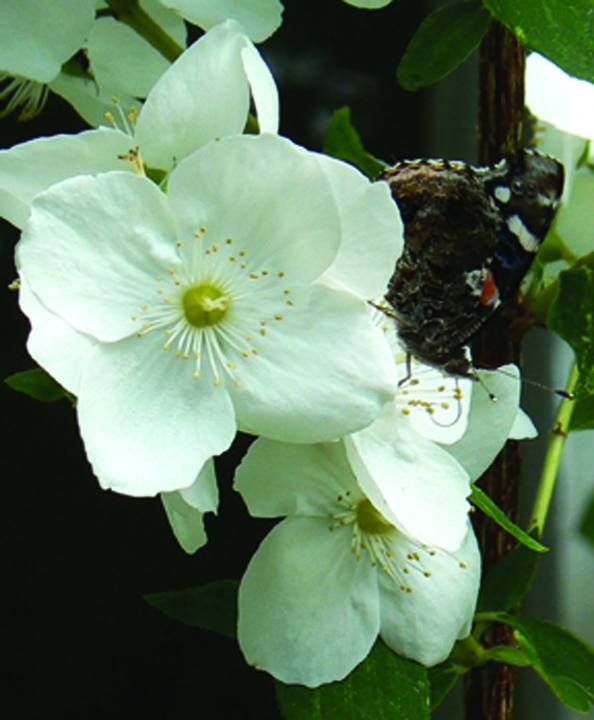
Mock Orange (Philadelphus ‘Innocence’) and the Friendly Red Admiral Butterfly
The fragrances are held within by the house and neighboring fence and the living perfumes of flowers and foliage are noticeable throughout the growing season. All the plants are immediately available to see, touch, and smell. The intimate aspects of the garden are revealed by the close proximity of plantings along a much-used garden path.
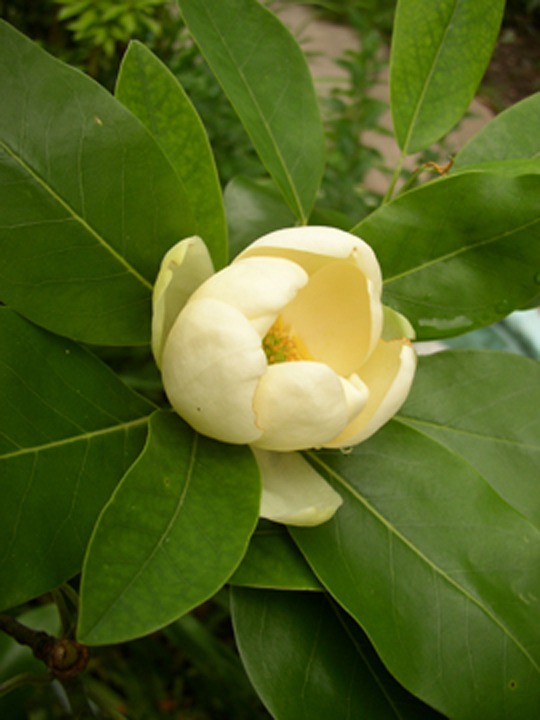
Native Sweetbay Magnolia (Magnolia virginiana)
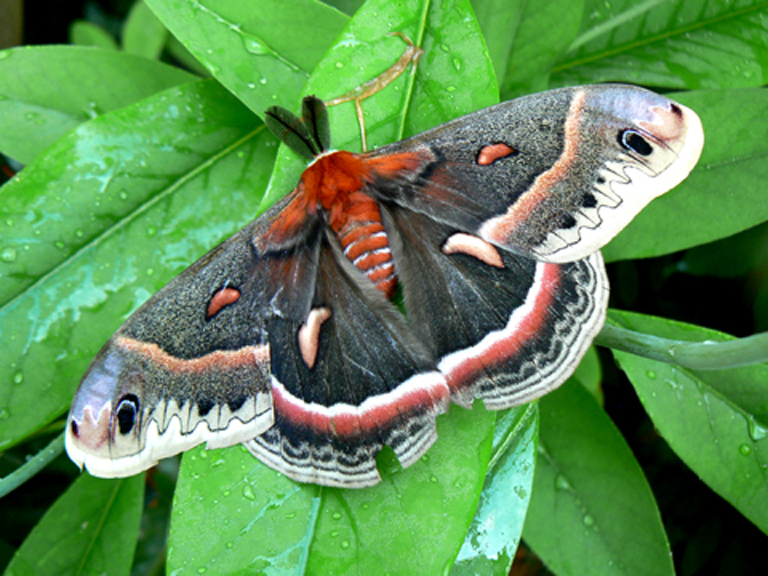
Male Cecropia Moth on Sweetbay Foliage
When selecting plants for a fragrant garden, it is not wise to assume that just because your Mom had sublimely scented peonies growing in her garden, all peonies will be as such. This simply is not the case. Take the time to investigate nurseries and arboretums during plants’ blooming period and read as much literature as possible. There is an abundance of information to be gleaned and sifted through to find the most richly scented version of a plant. When seeking a fragrant cultivar, one may find that it is usually an older variety, one that has not had scent replaced for an improbable color, convenient size, or double blossoms by a well-meaning hybridizer. And despite our best effort to find the most richly scented version, there will be disappointments along the way, as fragrance is highly mutable. Soil conditions and climate play their role, and some plants simply don’t perform as advertised.
Paeonia rockii
A well-thought-out pathway looks inviting when seen from the street and the fragrance beckons the visitor to enter. The interwoven scents emanating from an array of sequentially blooming flowers and aromatic foliage create a welcoming atmosphere. Have you noticed your garden is more fragrant after a warm summer shower or on a day when the morning fog has lifted? Scented flowers are sweetest when the air is temperate and full of moisture. Plant your garden of fragrance to reflect the time of year when you will most often be in the garden to enjoy your hard work.
There are few modern gardens planted purely for fragrance. Maybe this is because there is now a tremendous variety of appealing plant material, offered by growers to eager gardeners ready to purchase what is visually enticing, by color and by size. Perhaps it is so because in the past fragrant plantings served the function of disguising unpleasant odors from outhouses and farmyards, and we no longer have to address these concerns. But the pendulum has begun to swing (albeit slowly) toward planting a garden designed for fragrance. Scent, along with rhythm, scale, harmony in color, and form, should ideally be an equal component in garden design. Plant scented flowering shrubs under windows and close to and around the porch. Plant fragrant vines to climb up the walls near window sashes that will be open in the summertime. Plant scented white flowering plants near to where you might brush against them while dining al fresco or to embower a favorite garden spot designed for rest and rejuvenation.
“True vespertine flowers are those that withhold their sweetness from day and give it freely at night. “(Louise Beebe Wilder). Imagine the dreamlike enchantment of the fragrant path through the night garden. The vibrantly colored flowers have vanished. All that you will see are the white and palest shades of pink, yellow, and lavender flowers reflecting the moonlight. Perhaps you will have the breathtaking experience of an encounter with a Lunar moth. Syringa vulgaris ‘Beauty of Moscow,’ Madonna lily, Philadelphus, Japanese honeysuckle, Lilium regale, Nicotianna alata, Oriental lily, tuberose, night phlox, peacock orchid, Stephanotis floribunda, gardenia, Jasminum sambac, Angel’s trumpet, and moonflowers are but a few of the white flowers with exotic night-scents for an entrancing sleeping garden.
A thing of beauty is a joy for ever:
Its loveliness increases; it will never
Pass into nothingness; but still will keep
A bower quiet for us, and a sleep
Full of sweet dreams, and health, and quiet breathing.
— J o h n K e a t s ( 1 7 9 5 – 1 8 2 1 )
Excerpt from Oh Garden of Fresh Possibilities! (David R. Godine, Publisher)
The genus Prunus evokes a multitude of images of picturesque spring flowering and summer fruit-bearing trees. The wands of branches shrouded in five-petal blossoms hold their color high up while the floor of the garden is carpeted in companionable tulips, jonquils, forget-me-nots, and lily of-the-valley. Falling blossoms swirling like snow sift their fragrant petals through the floral carpet, clinging and scattering along the pathways.
The apricot tree (Prunus armeniaca), abricocke as it was known of old, may seem like an odd selection of fruit tree for a garden in the northeastern region of the United States. Apricots are generally considered more suitable for a warmer Mediterranean climate, though several cultivars are hardy through zone five! Prunus armeniaca was formerly thought to originate from Armenia, therein the name armeniaca. There is little doubt that its original habitat was in the temperate areas of Asia. Never having seen a living apricot tree, nonetheless we were inspired to grow Prunus armeniaca from an old photograph of one pictured in an enclosed garden setting, as well as by our desire to make apricot tarts from our own tree-ripened fruit.
With its ornamental round-headed silhouette and broad, oval leaves, it is a tree of graceful beauty. The sweetly scented pure white flowers issue forth from plump violet colored sepal-enclosed buds. The two colors of violet and white are visible while the tree is leafless and in bloom and, from a distance, create the illusion of a delicately pale pink flower. We sited our apricot tree at the top of our fragrant path to savor the lilting honey scent of its blossoms.
The apricot buds swell at the earliest hint of warm air and are the first fruit bearing trees to flower in our garden. Unfortunately the flowers, and therefore the fruit crop, may be damaged by a late spring frost. Spring in New England is predictably unpredictable; some years the tree sets fruit and some years it does not. Nevertheless, the apricot is a worthy specimen for the beauty of its blooms and branches alone.
There are several varieties of European apricots that are suitable to grow in a northern climate. We chose ‘Harglow’. Named varieties beginning with ‘Har’ (‘Harval,’ ‘Hargrand,’ Harcot,’ and ‘Harlayne’) were developed in Canada at the Harrow Research Station. For the most part, these cultivars are resistant to fungal and bacterial diseases caused by exceedingly damp, wet springs and humid summers. They are an ideal choice for a garden in a temperate zone where the growing season is shorter than a Mediterranean climate and are grown extensively in the Pacific Northwest.
Apricots are also a sound selection for the urban garden as they are less affected by air pollution than other fruit trees. ‘Harglow’ is a perfect cultivar for the small garden. They are self-pollinating and grown on a semi-dwarf rootstock, ultimately reaching only fifteen to eighteen feet in height. For four seasons of beauty I encourage every gardener who lives in a suitable climate, including those with only a wee bit of space, to consider growing the elegant apricot tree. When planning where to site an apricot tree, choose a sunny, sheltered location out of the path of drying winter winds. Plant apricot trees in loose soil with excellent drainage. After the first hard frost, cover the root area with several inches of compost. Water apricot trees deeply, once a week during the growing season and more if you are experiencing drought-like conditions.
Standard and semi-dwarf apricot trees require regular pruning to maintain their height for ease of harvesting fruit and to allow light and air to penetrate the interior of the tree. Most fruits are borne on one- to three-year-old spurs that look like short, stubby branchlets. To best see the overall shape of the tree, prune in late winter or early spring, just after flowering, while the tree is leafless.
Apricots are plagued by many of the same pests as peach trees. Be on the lookout for signs of the Oriental fruit moth and peachtree borer. Peachtree borers burrow into the bark of the tree, leaving a gummy exudate of sap and tree dust. To prevent this problematic creature from destroying the tree, wrap the trunk of a newly planted tree with strips of brown paper up to the first lateral branch. Cultivate the soil four inches deep within the drip-line of the tree, being mindful of the tree’s root system. With its distinguishable black body banded with vermilion or yellow, the adult peach tree borer moth is easy to detect, and unlike most moths, this one flies during the day. From the first indication of an infestation of Oriental fruit moth, you will observe the new growing tips have a drooping and wilted appearance. Caused by adult moths burrowing into the tips of the tender new shoots, the subsequent generations of larvae will then burrow into the fruit. Cut (and discard) the infested twig tips back to healthy growth. Again, working the soil at the base of the tree will help to destroy the pupae and therefore any future attacks by the Oriental fruit moth. The adult Oriental fruit moth is a mottled gray-brown with a relatively small wingspan (1⁄2 inch).
At the first sign of disease or pest problem, cut out the infected growth. Practicing good housekeeping and growing disease-resistant varieties may be the best remedies for growing healthy, strong fruit trees. Weak and stressed plants are at a much greater risk than those that are healthy and vigorous.
Apricots are ready to be picked when all traces of their green color have disappeared and they turn a glowing golden yellow. Gently grasp the fruit and pull with a bit of an upward twist. As with pear trees, do not pull the fruit off vigorously. The fruit-bearing spurs may be damaged, thereby reducing next year’s potential harvest. The Persians referred to apricots as “seeds of the sun.” Some cultivars (‘Stark Sweethearts’ for example) produce fruits with large and edible sweet pits inside the stone fruit. And since apricots and almonds are closely related, the edible pits taste characteristically like an almond.
Excerpt from OhGarden of Fresh Possibilities! Notes from a Gloucester Garden, written and illustrated by Kim Smith (David R. Godine, Publisher).
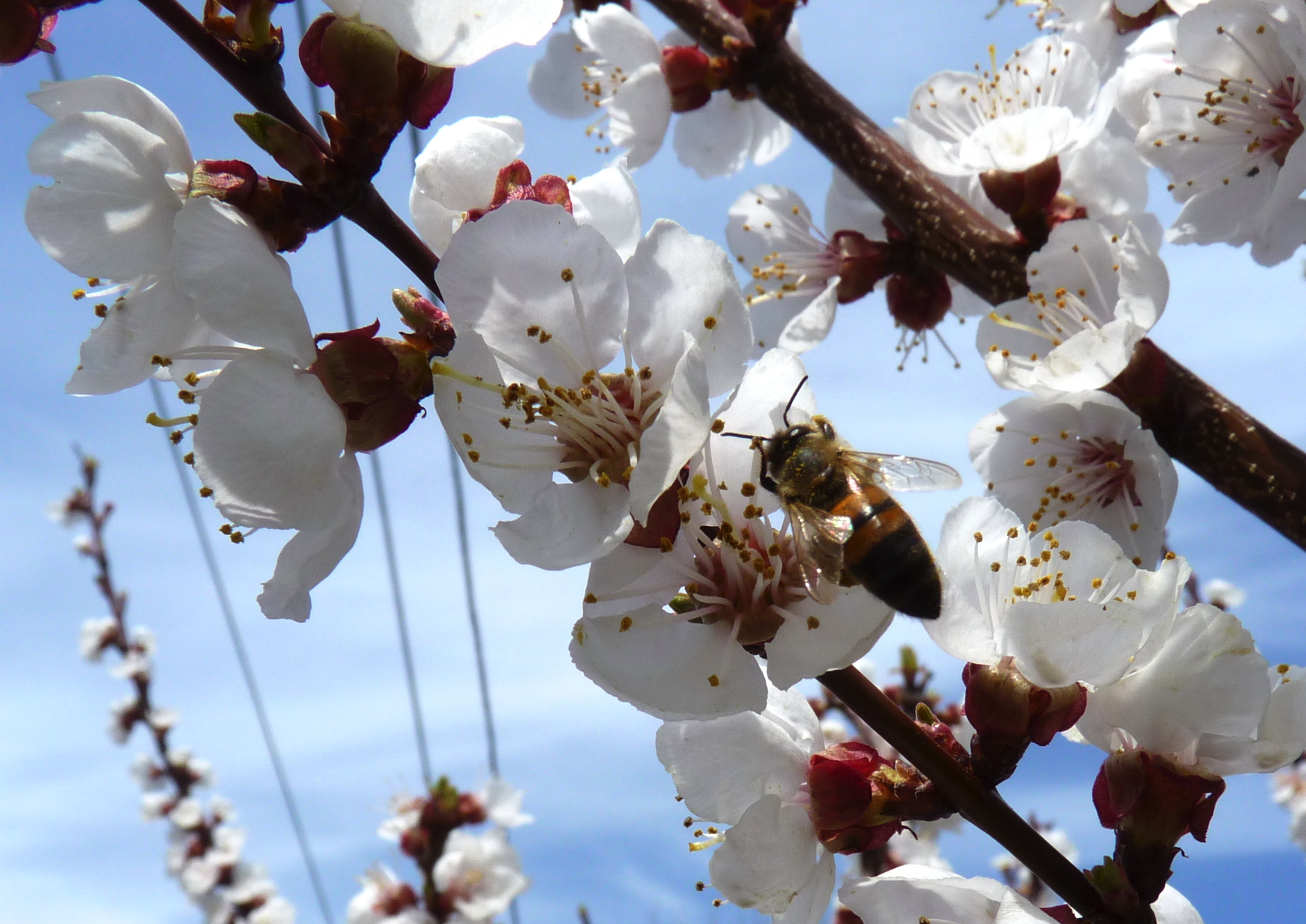
With family visiting for the past week, in honor of our darling daughter’s senior recital, I have been up to my elbows in cooking. I did manage to run out into the garden to photograph our apricot tree in full glory. Apricot trees provide a fantastic source of nectar for native bees in early spring. The blossoming time of apricots is fleeting and, as the petals were drifitng like snowflakes all around me, the pollinators were working furiously. I counted at least seven different species of bees, some so tiny they did not photograph at all well. The first photo is of a carpenter bee and the other two have yet to be identified.
While planting for design clients and organizing plant lists for the class I am teaching at the Arnold Arboretum of Harvard University I thought you would like to know about some of the great shrubs we have been working with. A well-sited flowering and fruiting shrub will often provide at least several, if not four, seasons of beauty; are long-lived (as compared to woody perennials); and provide sustenance and shelter for songbirds, butterflies, and bees. The following are several native favorites well worth considering when planting for people and for pollinators.
The accompanying photograph is of pinkshell azalea (Rhododendron vaseyi) and the much-maligned Eastern Carpenter bee (Xylocopa virginica), taken in mid-May at the Arnold Arboretum where a stunning massed bank of R. vaseyi is planted alongside the Meadow Road. Carpenter bees are an important pollinator for many open-faced spring flowers such as the blossoms of fruiting trees—crabapple, apple, pear, peach, plum, and wild cherry—as well as holly and brambles. The damage done to wood is usually minimal and cosmetic. X. virginica has an especially bad reputation with blueberry growers because they have strong mouthparts (capable of boring into wood), which will easily tear flowers with a deep corolla—blueberries and azaleas, for example.
Xylocopa virginica
Class: Insecta
Order: Hymenoptera
Suborder: Apocrita
Superfamily: Apoidea
Family: Apidae
Subfamily: Xylocopinae
Genus: Xylocopa
Species: virginica
Carpenter bees are regularly mistaken for bumblebees. Their shiny black abdomen most easily distinguishes them, although in the photograph, this carpenter bee was covered in shimmering golden pollen, which could lend a similar appearance to that of a bumblebee. While photographing at the Arnold I observed dozens of carpenter bees and at least half a dozen other species of native pollinators nectaring at the blossoms of the pinkshell azaleas.
Pinkshell is a deciduous azalea discovered in 1878 by George Vasey, the botanist in charge of the United States National Herbarium. Named after Vasey by Harvard botanist Asa Gray, pinkshell is found growing naturally in only six counties in the mountains of western North Carolina. R. vaseyi was introduced into cultivation by the Arnold Arboretum in 1880 and is now widely grown. Although able to attain fifteen feet in height, the pinkshell azaleas at the Arboretum are pruned to approximately chest height. The blossoms of pinkshell are typically seashell pink, but can vary from white to reddish-purple. The upper lobes are usually spotted red, but pink, green, and brown spotted blossoms are also common variants. When grown in a sunny location, the leaves turn a striking reddish hue in fall. R. vaseyi is very easy to grow and is highly adaptable to a wide variety of conditions from mountain ravines, swamps, bogs, stream banks, and high elevation coniferous and oak forests. At the turn of the previous century, it was once found in the wild in Massachusetts, apparently having naturalized at an abandoned nursery near Halifax, and was growing in a swamp as well as in sandy soil. Native species azaleas (Rhododendron spp.) are a nectar source for the Eastern Tiger Swallowtail butterfly and Ruby-throated Hummingbird and larval host plants for the Azalea Sphinx Moth (Darapsa choerilus).
Ilex glabra, or inkberry, is a fine-textured evergreen shrub, often confused with the less cold-hardy Japanese holly (Ilex crenata). Inkberry is found growing naturally along the East and Gulf coasts, from Nova Scotia to Florida and west to Texas. The species form matures at approximately eight feet high and equally as wide, with an upright oval growth habit. The commonly available cultivars, with names such as ‘Compacta’ and ‘Densa,’ are generally more compact, less leggy, and less suckering than the species form. The compact cultivars and species are ideal for creating year-round screening to disguise a neighboring eyesore. With periodic shearing, the plants can be maintained to the desired density.
The Atlantic (or Holly) Azure butterfly caterpillar (Celestrina ‘idella’) feeds on the male flowers of Ilex, including inkberry and American Holly (I. opaca). The diminutive cream-colored flowers appear in June on male and female plants. When a male pollinator plant is growing nearby, by September green berries ripen to ink-black berries on the female plants, providing sustenance for many songbirds including the Mourning Dove, Northern Bobwhite, and Hermit Thrush. There is much misinformation regarding which cultivars bear fruit; adding to this confusion is the fact that plants are often mis-labeled. When selecting plants for a client, I make a point of looking for remaining fruit on the individual specimens to ensure that we are indeed purchasing a fruit-bearing plant. Inkberry grows in part shade to full sun and prefers moist acidic soil, but is highly adaptable to soil conditions. To avoid winterburn, in general, broadleaf evergreen shrubs should not be sited in a south-or west-facing exposure, although inkberry performs better than most in such adverse conditions.
As usual, I am running out of space and time. A quick note about the early spring blooming pollinator magnets, Fothergilla, both F. major and F. gardenii. The fothergillas are native to the Allegany Mountain region, primarily around Georgia, but also occur in North and South Carolina, Tennessee, Alabama, Arkansas, and Florida. Fothergilla major ‘Mount Airy’ is a deciduous rounded shrub, growing from 6 to 8 feet with scented, white bottle-brush flowers. Although the species name gardenii may lead you to believe it to be more fragrant than
F. major, it is not, rather F. gardenii is slightly less fragrant. The flowers are also a bit smaller and less showy. Fothergilla gardenii fits the bill when a similar, but smaller than, shrub to ‘Mt. Airy’ is required. As we were planting F. gardenii at Willowdale Estate several weeks ago, immediately a Spring Azure butterfly joined the scene and began nectaring at the blossoms. The summer foliage of ‘Mt. Airy’ is a lovely soft shade of blue-green, turning brilliant red and yellow during autumn—making it, too, a lovely multi-season plant.
Save the dates of Friday, June 4th through Saturday, June 5th for the first ever Cape Cod Rhododendron Festival and Garden Tours, presented by the Heritage Museums and Thornton W. Burgess Society of Sandwich, MA. I will be there both days with my book Oh Garden of Fresh Possibilities! and speaking about habitat gardening at 11:00 on Friday. Much more information and updates to follow. This promises to be a beautiful event!
Rhododendron vaseyii and Carpenter bee photographed at the Arnold Arboretum, Boston


 ‘Henry Eiler’s’ Sweet Coneflower (Rudbeckia subtomentosa)