Tag Archives: Ruby-throated hummingbird

Ruby-throated Hummingbird

Dear Gardening Friends, Happy Easter! In a future post I plan to bring you more about the Ruby-throated Hummingbird, today however I will be brief as I have more holiday preparations to tend. This is a reminder to set your hummingbird feeders out as soon as possible. This past week, sightings of the Ruby-throated Hummingbird have been reported as far north as Maine–the northward hummingbird migration is full underway!

A hummingbird’s diet is comprised of nectar and insects. We can lure them to our gardens by providing nectar-rich tubular-shaped flora in shades of red and orange, along with flowers comprised of small florets that attract small insects. At this time of year there isn’t much to offer in the way of flowering sustenance for the hummingbirds. Several weeks ago I took our feeders out of storage, gave them a good wash with vinegar, soap, and water, filled them with a sugar and water mixture, and hung them throughout the garden.

Red Riding Hood Tulip gregiiRed Riding Hood (Tulip gregii)

The eye-cathing Red Riding Hood tulips (although not a particularly good source of nectar, will attract by the sheer brilliance of their color) are a wonderful species tulip that reliably returns year after year, and multiplies. The tulips are planted beneath the boughs of flowering and fruiting trees and shrubs, in hopes, that they too will lure the hummingbirds to our garden during their northward migration. And then, again with high hopes, that the hummingbirds will nest in our garden. For the past five years or so, it has been our great good fortune to host throughout the nesting season female Ruby-throated Hummingbirds and offspring.

Four Flower Frolic Feeder

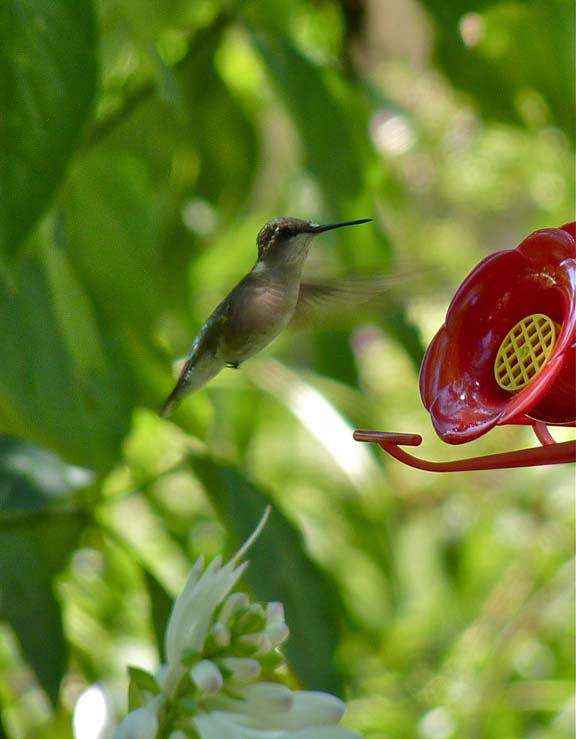
Hummingbirds, along with bats and certain species of moths, have an unusual method of drinking nectar called swing-hovering, which allows them to nectar while in mid-air. Ruby-throated hummingbirds expend vast amounts of energy during their migration–averaging approximately 52 wingbeats per minute. For this reason, I find the best hummingbird feeders are those that also offer a a place to perch while feeding (see photo and videoclip).

Ruby-throated Hummingbird

Sugar water recipe: 4 parts water to 1 part sugar. Stir to dissolve thoroughly. Never add red dye or replace the sugar with honey. Provide fresh sugar/water every 4 – 5 days.

Warmest wishes, for spring and for chocolate in your Easter basket!

Native Trumpet Creeper

In anticipation of spring and your spring planting plans (and as I am sorting through mountains of photos, film footage, and text for the butterfly gardening show), I am planning a little series here on the blog. The focus is all about sharing information and photos about individual plant species that provide sustenance and shelter for the pollinators that grace our gardens.

Trumpet creeper, hummingbird vine, trumpet vine, cow-itch vineTrumpet Creeper (Campsis radicans)

Two of our very favorite native plant species for attracting Ruby-throated Hummingbirds are the blossoms of the northern catalpa tree (Catalpa speciosa) and trumpet creeper (Campsis radicans), both of which belong to the Bignonia family. Catalpa trees bear white flowers with violet nectar guides and, despite their color differences, Catalpa blossoms and the red-orange flowers of trumpet creeper reveal several similarities, The reproductive structures are positioned inside at the top lip of the opening, surrounded by five asymmetrically shaped petals fused together. As the hummingbird pokes its head deep inside the trumpet-shaped blossom to extract nectar, the pollen-bearing sticky stamens and pistils attach to its forehead and transfer pollen from one blossom to the next.

Nectar volume influences the blossoms’ attractiveness to the Ruby-throated Hummingbird. The small florets of plants such as those of butterfly bushes and zinnias offer nectar, though they require many visits to make it worthwhile. Our native Campsis radicans produces one of the highest known volumes of floral nectar per flower. Hummingbird fledglings quickly learn from their mothers the blossoms that contain the most nectar.

Campsis radicans is found growing throughout much of the eastern half of the country. Unable to support itself vertically, it trails along the ground until it reaches a tree. Tiny aerial rootlets are formed to adhere itself to the surface of the tree to then allow it to climb skyward towards the sunlight. Unlike vines such as Chinese wisteria and bittersweet, which gird and then strangle a tree, trumpet creeper clings tightly. Campsis radicans is a very fast growing and top-heavy vine. It is unsuitable for anything but the strongest structure. As it blooms on the current year’s growth, it can be grown along a solid fence and cut back very vigorously in early spring.

For the intimate garden or garden room, where a less rampant (but no less hardy) grower is a more suitable choice, there are several hybrids of C. radicans with flowers that are as equally attractive to the hummingbirds. ‘Madame Galen’ (Campsis radicans x tagliabuana) flowers in lovely shades of apricot-orange. The newer cultivar ‘Indian Summer’ is described with the less persistent and dense growth characteristics similar to that of ‘Madame Galen’ and beautiful blossoms of apricot-orange with a deeper red eye.

The extended period of florescence of C. radicans corresponds to the span of time in which ruby-throated hummingbirds are living in their northern range. Like Chinese wisteria, trumpet creeper can take six years or more to flower from seed. Plant the largest specimen one’s budget will allow.

Kingdom Plantae – Plants
Subkingdom Tracheobionta – Vascular plants
Superdivision Spermatophyta – Seed plants
Division Magnoliophyta – Flowering plants
Class Magnoliopsida – Dicotyledons
Subclass Asteridae
Order Scrophulariales
Family Bignoniaceae – Trumpet-creeper family
Genus Campsis Lour. – campsis
Species Campsis radicans

Butterflies of Ohio

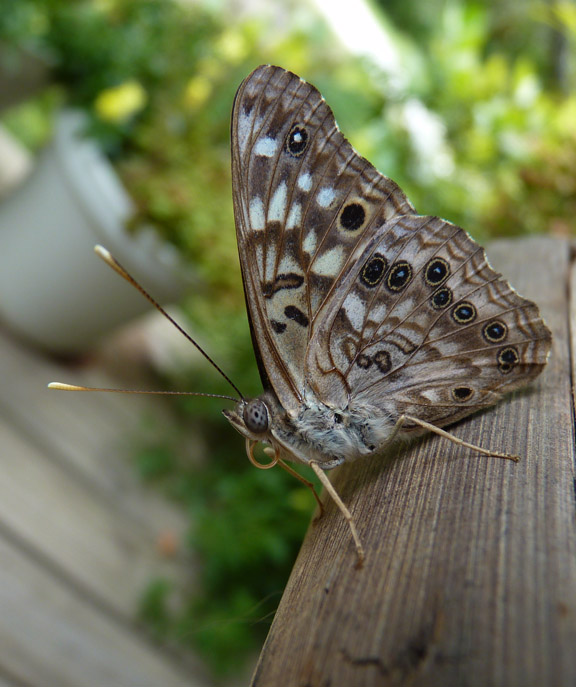
Hackberry EmperorMale Hackberry Emperor


A BUTTERFLY BONANZA!

Recently I returned from a trip to southwestern Ohio to visit my sister-in-law Amy, who is recovering from hip replacement surgery. She is mending beautifully and determined to get back on her feet —only a few days after returning home from the hospital the visiting nurse said she was doing as well as their typical patient at three weeks out!

While Amy was resting I would grab my camera and head into her garden and the surrounding fields because here was a Butterfly and Hummingbird Bonanza! I encountered dozens of Ruby-throated Hummingbirds, typically feeding and frolicking in groups of threes and fours, and many differing species of butterflies. For the most part, the butterflies that I photographed are the same species of butterflies that are found on Cape Ann and throughout New England. Having no expectation of encountering myriad butterflies, in both range of species and in legions of each, I had not planned accordingly and only packed my Panasonic Lumix. I love this camera, but like all cameras it does have certain limitations. Lesson learned—that is to say—always travel prepared for anything to happen!

Spicebush Swallowtail at Rose of SharonMale Spicebush Swallowtail Dusted with Pollen

Amy is a working architect and, as time and her work schedule have permitted, she has (along with her recently deceased dear husband Tim) redesigned and restored her lovely old farmhouse and gardens. There are several cozy porches and a deck under construction in which to sit and observe the wildlife dramas that play out almost daily.

Ohio Farmhouse

What makes Amy’s garden so inviting to the pollinators? The old farmhouse is approached by traveling down a crushed limestone driveway. On either side of the drive are fields, either overgrown with wildflowers, or maintained as mowed grass. The fields meet the forest edge. There are several neighboring houses along the drive but privacy is afforded because the houses are sited a fair distance apart and because there are naturalized arrangements of native trees and shrubs. Flower borders are planted in close proximity to her home and also further afield. Beyond the flower borders is a large vegetable garden, approximately twenty feet deep by sixty feet long, with a row of sunflowers bordering the back length and a cheerful patch of zinnias running along the fore edge. Beyond the vegetable garden is a vigorous crop of blackberries and beyond that is a clump of wildflowers, including common milkweed (Asclepias syriaca), which were covered in Monarch caterpillars, and the tall growing New York Ironweed (Veronia noveboracensis), which was in full bloom. All of these elements provide clues as to why Amy’s garden is a haven for the butterflies and hummingbirds. Additionally, adjacent to the house is an old peach tree, which bears great quantities of fruit. Because Amy has been under the weather from her hip injury she was not able to maintain the peach tree this past season. The peaches were falling to the ground and rotting—not really a bad thing as you will soon see—imagine the not intolerable odor of vinegary peach juice.

Yellow Sulphur Butterfly Zinnia elegansYellow Sulphur

The combination of the atypically lengthy stretch of hot, sultry weather, punctuated by soaking rain storms, along with the salt and mineral-rich limestone driveway, flowering plants, wildflowers, surrounding woodlands that provide shelter and larval food for caterpillars, hummingbird feeders, and rotting peaches—all work in tandem to create a paradise for the pollinators—bees, butterflies, and hummingbirds.

Female Ruby-throated HummingbirdFemale Ruby-throated Hummingbird

In the morning I would find Buckeyes, Question Marks, and Red-spotted Purples drinking salts and minerals from moist patches in the driveway. Hungry families of Ruby-throated Hummingbirds were noisily nectaring from the flowers and feeders; one feeder is sited beneath the peach tree and the other about twenty feet away, under the lilacs, a hummingbird superhighway of sorts, with inviting nectar flowers along the route. The male and female hummingbirds are both territorial and, when encountering anything out of the ordinary (my camera and I, for example) will threaten by whizzing  and whirling, albeit harmlessly, close to your head.

Common Buckeye ButterflyCommon Buckeye

By mid-day the hummingbird and butterfly scene was full underway. Spicebush Swallowtails at the Rose-of-Sharon, tiger swallowtails, yellow sulphurs, Eastern Tailed-Blues, Monarchs, checkerspots, and angelwings nectaring at the zinnia patch, phlox, and lobelia, and most remarkable of all, were the number of butterflies that were drawn to the pungent lure of rotting peaches. By late afternoon dozens of Hackberry Emperors, Red-spotted Purples, Question Marks, and Red Admirals were to be found intently imbibing from the fermenting peaches, and by day’s end, I believe they were drunken butterflies, making extraordinarily easy subjects to photograph. I would be down on my hands and knees with the lens held so closely it was nearly touching them, and several times that did happen as they fluttered or hopped onto the camera’s lens. In the lingering remnants of late day’s light, the hummingbirds were there again at the feeders and flowers, and all manner of swallowtails in the wildflower meadow were nectaring from the New York Ironweed.

Spicebush Swallowtail at Rose of SharonSpicebush Swallowtail Nectaring at Rose of Sharon


Pipevine Swallowtail Butterfly Pipevine Swallowtail Nectaring at Phlox

Red-spotted Purple ButterflyRed-spotted Purple

The three different species of butterflies in the above group of photographs have a unique relationship. The Red-spotted Purple and Spicebush Swallowtail (both palatable to predatory birds) are thought to have evolved to mimic the Pipevine Swallowtail (center photograph), which is highly toxic and foul tasting.

I was sad to say goodbye to my sister-in-law but glad to return home to my family. My unexpected yet welcome encounter with the butterflies of Southwest Ohio reminded me once again that butterflies are a symbol of transformation, joy, and beauty throughout cultures the world over. Perhaps Amy’s butterflies mirror the transformative journey to which she has embarked.

Eastern Tailed-Blue ButterfliesEastern Tailed-Blues

Red Admiral ButterflyRed Admiral Mimicking Peach Tree Bark

Milkweed and IronweedIronweed and Milkweed

 Tiger Swallowtail at IronweedTiger Swallowtail Nectaring at Ironweed

Cicada lying in waitMale Cicada Disguised Amongst Rose of Sharon Buds

Ohio Vegetable gardenVegetable Garden

Farmhouse road


Moon Vine

It was my joy to give the lecture, held at the Wenham Museum’s North Shore Design Show, on gardening for fragrance. Thank you to Lindsay, Yvonne, Leon, Pauline, Elizabeth, Julie, Lisa, Sandra, Polly, Eliza, and everyone else whose name I did not get, for your interest and great questions.

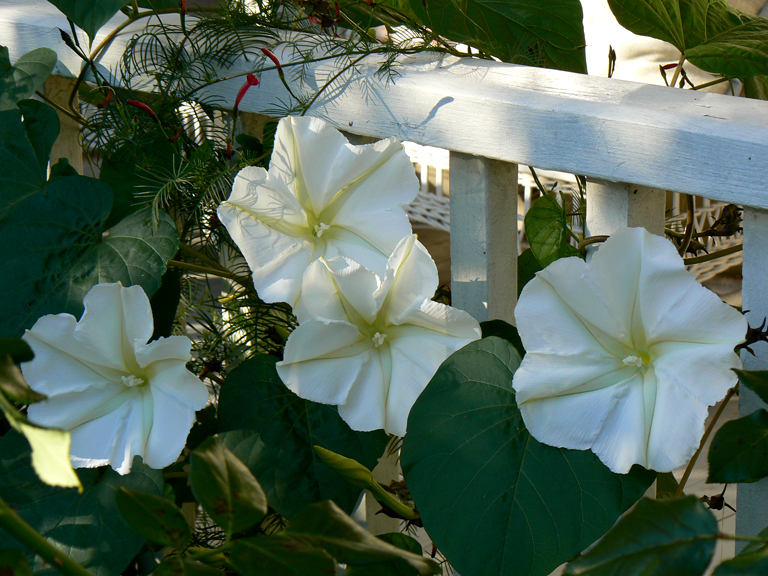
No garden planted for fragrance would be complete without growing moon vine. Plant moonflowers and cypress vines in late May and early June for September blossoms. Moon vine will give you dreamily-scented late summer nights and cardinal climber will provide nectar for southward migrating Ruby-throated hummingbirds

Moon Vine, Moonflowers (Ipomoea alba)Our moon vine-embowered porch in September

“You can tell in the afternoon which buds will open that night. In the South, where I used to live, it was the custom to keep an eye on the moon vine, and when sixty or so buds showed they would open that night, to ask people over to watch them. Unfortunately, people in the country talk so much that I cannot recall seeing the buds open very often. They tremble and vibrate when they open. Usually someonewould say “the flowers are out,” and everyone would run over to admire them, then back to jabbering.

Equally festive is the night-blooming cereus. In our neighborhood there lived an old cereus in a tub. It was ninety-seven years old, the last time I saw it, and produced 120 flowers open at once. When it bloomed (and you can tell by afternoon which buds will open) its proud owner would phone round the neighbors and there would be punch or champagne (rather dangerous in hot weather) and cucumber sandwiches for refined persons, and ham and potato salad for mere mortals. These parties, once such a feature of the American summer, were always spontaneous, since you only had a few hours to plan them and invite people. It was always astonishing to see how many people could come at the last minute.”

— Henry Mitchell ~ The Essential Earthman


Ruby-throated Hummingbird and Cardinal Climber, Cypress Vine Ipomoea x multifida

Perhaps this is the summer we will have our first moon vine party–and I will provide tea sandwiches for my refined friends and ham and potato salad for we mere mortals. What fun to imagine. Grow cardinal climber and moon vine together for a delightful combination of delicately toothed  and bold heart-shaped leaves–day flowering red trumpets for the hummingbirds and night blooming sweetly scented blossoms for you.

*Logees Greenhouse carries night-blooming cereus (Epiphyllum oxypetalum).