Tag Archives: birds of cape ann

NEW VIDEO: SNOWY OWL AT CAPTAIN JOES!

Snowy Owl Gloucester Massachusetts ©Kim Smith 2015So many thanks to my friends Joey and Tom Ring for the wonderful tip. The Snowy is gorgeous!!! My right arm is a little unsteady with robo-cast but still managed to get a few moments. Notice how the Snowy Owl rotates its head, giving him nearly a 360 degree viewing vantage. The crows and a Peregrine Falcon were noisily dive-bombing the Snowy, but he held his ground. I hope we see him again soon

Snowy Owl Captain Joe and Sons ©Kim Smith 2015

BON VOYAGE BONNIE BONAPARTE’S

Bonaparte's Gull diving Gloucester ©Kim Smith 2015Bonaparte's Gulls Gloucester ©Kim Smith 2015Perhaps the last batch of photo as I haven’t observed any Bonaparte’s Gulls for several days. What a treat to have these beautiful creatures grace our shores!

Bonaparte's Gulls Gloucester -2 ©Kim Smith 2015

BONNY BONAPARTE’S GULLS!

Bonaparte's Gulls Massachusetts -4 ©Kim Smith 2015While recording audio for film projects this past week I was wonderfully surprised to come upon this small flock of the beautiful and graceful Bonaparte’s Gulls feeding at low tide!.

Bonaparte's Gull winter plumage Massachusetts ©Kim Smith 2015Bonaparte's Gull Massachusetts Diving ©Kim Smith 2015The water was very clear and I think in the above photo you are seeing partly the gull’s reflection, and also its open mouth plunge for tiny shrimp.

Bonaparte's Gulls Massachusetts ©Kim Smith 2015Non-breeding plumage.

Bonaparte’s Gulls are exquisite creatures to observe. Appearing to delight in riding the waves, they twirl every which way before diving for krill.

In this flock you can see very clearly the changing feather patterns from breeding to non-breeding, with the signature charcoal gray smudge behind the ear on the gull on the left. Typically by mid-August they have gained their winter plumage. During breeding season the feathers of the hood become entirely black.

We see Bonaparte’s Gulls in Massachusetts in spring on their northward migration to the boreal forests of Alaska and Canada and again in the summer as they return to winter grounds along the Gulf of Mexico and southern Great Lakes region. I at first thought that these were Laughing Gulls but the pinkish-orange feet and legs and buzzy vocalizations tell us otherwise.

I ran into my friend and long-time Annisquam resident Hank Junker on Lighthouse Beach and he reports that every summer he sees at least one Bonaparte’s at Lighthouse Beach or the adjacent Cambridge Street Beach. Hank also mentioned that they are typically here earlier in the summer, around the first week of August.

Bonaparte's Gull Massachusetts ©Kim Smith 2015Black wing-tips and pink-orange feet suggest Bonaparte’s Gulls

Bonaparte's Gull -Ring-backed Gull Massachusetts ©Kim Smith 2015Ring-billed Gull in the background, Bonaparte’s in the fore.

The Bonaparte’s Gull is about half the size of the Ring-billed Gull. I have learned to observe closely groups of gulls because different species sometimes feed together and you never know what fascinating bird may be amongst the flock.
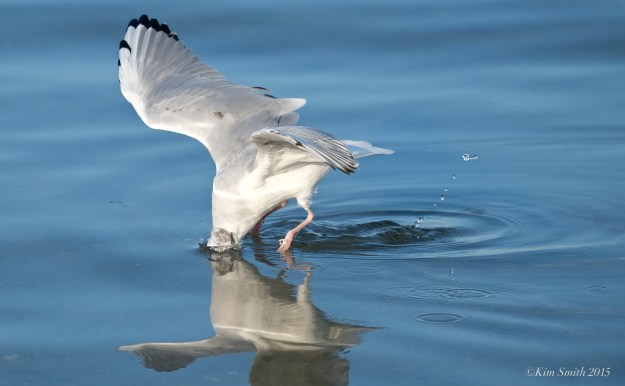
Bonaparte's Gull Diving ©Kim Smith 2015Bonaparte's Gull Diving -3 Massachusetts ©Kim Smith 2015The gulls are finding a smorgasbord at dawn’s low tide, feeding on krill and other crustaceans.   They get into tussles over feeding turf and, with a flourish of wings and a sharp, rasping “keh-keh,” they give each other the business, in no uncertain terms!

Two more photos here Continue reading

Quarky Pants Junior!

Juvenile Black Crowned Night heron ©Kim Smith 2015Allowing me to get a little closer, perhaps one of these days (before he/she’s all grown up), I’ll catch a side-by-side of Black-crowned Night Heron parent and juvenile. Here he is standing on one leg, just as do mom and dad!

Great Blue Heron ©Kim Smith 2015A little ways off was a Great Blue Heron also hunting amongst the reeds. I captured him in fight with my movie camera as he flew to the other side of the pond. Thanks to a friend, who was on a morning walk and pointed out the general vicinity to where he had landed, I was able to get another clip of the heron flying.

I am searching for quiet places to record harbor and shore sounds, away from the roar of the surf, as well as where boat and machine engines don’t muffle or drown out every other sound. Its harder than you may imagine especially because there can be little to no wind. If you know of a quiet place where you especially love to listen to the music of Cape Ann, please answer in the comments section or email me at kimsmithdesigns@hotmail.com. Thank you! 

MR. AND MRS. QUARKY PANTS HAD A BABY!

Black-crowned Night Heron Gloucester -1 ©Kim Smith 2015For the past several months on my filming forays around Niles Pond I have encountered a pair of Black-crowned Night Herons. With a loud quark, at least one flies up into the trees as soon as my presence is detected and I can never get a good photo with both in the same shot.

Black-crowned Night Heron Gloucester -4 ©Kim Smith 2015I was wondering if they were a nesting pair or even husband and wife; I mean they could be siblings. Today before daybreak I saw their fledgling, but only for the briefest second.

Black-crowned Night Heron fledgling Gloucester -5 ©Kim Smith 2015Hoping to get a better shot of the fledgling (above) before it gains its adult feather.

Black-crowned Night Heron Gloucester -2 ©Kim Smith 2015It flew off, along with one of the parents, but one did stay while I was recording daybreak foley.

Black-crowned Night Heron Gloucester -3 ©Kim Smith 2015Black-crowned Night Heron standing on one leg, a characteristic many birds share, which they do primarily to conserve energy and save body heat.
Black-crowned Night Heron Gloucester ©Kim Smith 2015
A Face Only a Mother Could Love

Sunrise Niles Pond ©Kim Smith 2015Today’s Niles Pond Sunrise

Ducks in a Row

I wonder from where the idiom “getting your ducks in a row” comes? 🙂

Ducks in a Row ©Kim Smith 2015

Ducklings Aplenty at Niles Pond!

Niles Pond Duckling ©Kim Smith 2015Last week, Mom Mallard had to cut a path through the lily pads.

https://instagram.com/p/47ICxxjyra/

This morning, the duckling led the way!Niles Pond Ducklings -5 ©Kim Smith 2015

Niles Pond Duckling Gloucester ©Kim Smith 2015There are half a dozen duckling families at Niles Pond, all at seemingly different ages of development, from the smallest, an “only” duckling, to “tweens,” and “teens.”  I am happy to see many have made it past snapping-turtle-breakfast-age!

Niles Pond Ducklings -2 ©Kim Smith 2015The “Tweens”

Niles Pond Ducklings -3 ©Kim Smith 2015The “Teens”

Niles Pond Ducklings ©Kim Smith 2015Camouflaged

Niles Pond Ducklings -4 ©Kim Smith 2015Listen up!

Glossy Ibis Flock in Magnolia

Glossy Ibis Gloucester Massachusetts ©Kim Smith 2015JPGThank you to the wonderful Anderson Family for sharing their Glossy Ibis sighting. After Chris’s super tip, I easily found them foraging in the fields several mornings in a row. I think there are anywhere between 20 to 30 members to the flock. They don’t allow you to get very close. Someone with a a 300-400mm lens may be able to take much better close ups. Nonetheless, they are fun to watch. I imagine since they are here at the end of June, the ibis may be nesting.

Dear Readers, If you see the Glossy Ibis, can you please share the time and day of your sighting. I understand from Mass Audubon that they rarely breed in our region and it would be exciting if we sighted a breeding pair. Thank you!

And thank you once again to the Andersons who this past year have supplied us with Snow Goose, Brant Geese, Snowy Owl, and now Glossy Ibis tips!!!

Glossy Ibis in flight Gloucester Massachusetts  ©Kim Smith 2015JPG

Beautiful Baby Swan Gone

Mute swan cygnet  Massachusetts  -1©Kim Smith 2015 The beautiful single cygnet at Henry’s Pond has disappeared. Did anyone by chance see what happened?

Mute swan cygnet pen, female Massachusetts ©Kim Smith 2015May 28, 2015

Mute swan cygnet cob pen, female male Massachusetts ©Kim Smith 2015May 30th, male, or cob on the left, female pen on the right, cygnet tucked between the two

Mute swan cygnet -3  Massachusetts ©Kim Smith 2015June 7th, adeptly preening, or oiling its feathers.

Mute swan cygnet pen, female Massachusetts -2 ©Kim Smith 2015Anytime is nap time.

Mute swan cygnet pen, female Massachusetts -3 ©Kim Smith 2015June 12th early morning, last sighting.

Loblolly Cove ~ Red-winged Blackbird Habitat

Loblolly Cove Rockport Massachusetts ©Kim Smith 2015Loblolly Cove, Rockport

Male Red-winged Blackbird Massachusetts -4 ©Kim Smith 2015Male Red-winged Blackbird

Star of the Marsh

Male Red-winged Blackbird Massachusetts ©Kim Smith 2015Heard at nearly every New England marsh, one can’t help but notice the beautiful and seemingly never ending song of the male Red-winged Blackbird. From sunrise to sunset he’s calling to his girl. Early this spring I set out to record the sounds of the marsh for my Monarch film. The male Red-winged Blackbirds are the stars of the marsh and while capturing their vocalizations over the past several months, I also was also able to capture footage of their fascinating behaviors. 

Male Red-winged Blackbird Massachusetts -5 ©Kim Smith 2015Male Red-winged Blackbirds Perching on Cattails (and Eating the Seed Heads, Too)

You’ll see many more males because they perch on higher ground, at the top of the cattails, phragmites, scrubby shrubs, phone lines, and treetops. They are defending their territory through song and a showy display of red and yellow wing bars. The males too, often swoop to the edge of the pond’s shoreline and peck at the sand.

Female Red-winged Blackbird Massachusetts  -3©Kim Smith 2015

Plain Jane Female ~ What’s All the Fuss About!

The female Red-winged Blackbird, with her more subdued feathers of brown and beige, typically stays closer to the ground, building her nest and eating insects.

Female and Male Red-winged Blackbird Massachusetts ©Kim Smith 2015

Female Red-winged Blackbird in the foreground with male in the background. As you can see in the photo, the female looks like a large dark sparrow.

Loblolly Cove ©Kim Smith 2015Loblolly Cove ~ Red-winged Blackbird Superhighway

See More Photos Here Continue reading

Eider Encounter

Finishing up filming cygnets and ducklings for the morning, I noticed a Great Blue heron swoop onto the shore. I got my gear back out and headed over to where it appeared to have landed along the rocky coastline. With eyes peeled for the heron I nearly tripped over the female Common Eider. Literally. Oval-shaped and seemingly immobile, the eider looked just like another rock on the beach. She didn’t budge while I kneeled down on the sand and photographed and filmed her, cameras positioned no more than a foot away. I only stayed close for a few moments and then moved further away and watched for awhile as she thoroughly oiled her feathers. She didn’t appear to be injured. Concerned as I was that she could easily become a coyote’s breakfast if she wasn’t able to fly, still I thought it best to leave her be. As I returned to my car and turned for one last look, she was flying straight up, helicopter fashion, and then forward towards the sea.

Female Common Eider Rockport Massachusetts ©Kim Smith 2015Female Common Eider

Day Three Filming the Ducklings

Mallard Duck Family ©Kim Smith 2015I’m a bit sad to write that all but one of the ducklings that I have been filming has survived. He stays very close to Mama Mallard and Pa is never too far away. Today I saw filmed two different Mallard families, one with three ducklings and the other with five. I hope they have a better survival rate.

Mallard Duckling ©Kim Smith 2015

Mallard Duckling Grooming ©Kim  Smith 2015

Sleeping Mallard Duckling ©Kim Smith 2015Nap Time

NO GEESE ALLOWED!

Don’t mess with Mama Swan!

Mute Swan attacking ©Kim Smith 2015Mute Swans are extraordinarily powerful birds and I have seen them turn on a dime, especially at this time of year when the cygnets are beginning to hatch. The above Canadian Goose tried to make a landing but was immediately rebuffed, in no uncertain terms. Several times since, I have observed geese circling overhead, but as soon as the swan is seen, they immediately change course.

DAY 2 FILMING THE DUCKLING FAMILY

Mallard Duckling ©Kim Smith 2015The Mallard Duck family that I have been filming during the early morning hours this past week is allowing me to get very close, venturing to within two feet from where I am tucked in amongst the reeds by the water’s edge. The ducklings mirror the parent’s every action and they are especially adorable learning how to oil their feathers. Although the female attempts to stay close, and the male is always hovering nearby, one is becoming increasingly independent, a little too independent if you ask me. I can’t get over the ducklings vulnerability–its a miracle any survive to adulthood.

Female Mallard and Ducklings ©Kim Smith 2015The mixed flock of ducks is comprised mostly of Mallards, with several pairs of American Black Ducks mixed in. A single pair of Blue-winged Teals was spotted for several days.

Blue-winged Teal adult male breeding ©Kim Smith 2015Blue-winged Teal Adult Male Breeding Plummage

American Black Duck ©Kim smith 2015American Black Duck

Make Way for Ducklings

Mallard Duckilngs ©Kim Smith 2015JPGI was standing so still while filming yesterday morning that I don’t think the female mallard was at first aware of my presence. What a wonderful treat to see she and the ducklings emerge from the reeds growing along the water’s edge. They are amazingly fast and adeptly darted through the water and across the beach, as though they had been born months earlier. I was getting a tremendous cramp and had to stand quickly, which was mama mallard’s cue to chide the ducklings back into the tall grass.

Mallard female Duckling ©Kim Smith 2015

Female Mallard and Duckilng -1 ©Kim Smith 2015

Green Heron!

Green Heron Massachusetts Cape Ann ©Kim Smith 2015Male Green Heron

What mystery bird, new to my eyes, was I seeing as it cautiously appeared from the knot of tall reeds? Its neck extended like a heron’s, but was smaller in size than even the Black-crowned Night Heron. I caught a glimpse and then waited for movement, and then waited, and then waited some more when the furtive bird at last flew into a tangle of trees where its shape was unfortunately barely distinguishable. I took a few photos knowing they would be far too grainy to post, thinking nonetheless that a photo would be at least useful for a bird id. Suddenly the mystery bird took flight to the far end of the pond, landing at the water’s edge. I stealthily made my way over and for a few moments had a clear view through the emerging grass and cattails and was able to both film and photograph.

The neck of the male Green Heron is a striking chestnut color and the wing backs are a gorgeous velvety deep greenish-blue gray. As usual, the female’s plumage is more subduedly colored. Green Herons begin to arrive in Massachusetts in May, where they will stay through the summer, dispersing southward in September. The heron’s population is concentrated around inland wetlands and coastal marshes.

From reading several species accounts, the Green Heron’s claim to fame is that it is one of the few animals that utilizes tools to capture prey. It will float a stick or bread crust on the water’s surface to lure small fish, tadpoles, and crayfish. Wouldn’t that be amazing to film! Green Heron’s also eat small snakes, earthworms, and insects.

Green Heron Cape Ann Massachusetts ©Kim Smith 2015

The Uncommonly Common Yellowthroat

Common Yellowthroat Warbler ©Gloucester MA -2 ©Kim Smith 2015Male Common Yellowthroat fluffing and drying feathers after his many baths.

Splashing, and then dashing to a nearby tree, splashing and dashing again, and then returning for yet a third bath, this little male Common Yellowthroat seemed to relish in the fresh water at our birdbath. His more subduedly colored mate stayed well hidden and close to the ground and I was thrilled to see them both. This sweet pair of warblers have been in our garden for several days now and perhaps they’ll build their nest here!

Common Yellowthroat Warbler ©Gloucester MA -1 ©Kim Smith 2015Common Yellowthroats were at one time common however, their numbers have been steadily decreasing since the 1960s. Throughout the yellowthroat’s range they are suffering from habitat degradation and loss. Because they live in wetlands and eat primarily insects they, like countless wild creatures, are adversely affected by pesticides and poor water quality.

Common Yellowthroat Warbler ©Gloucester MA ©Kim Smith 2015

Please, Please, Please Don’t Feed Our Beautiful Wild Creatures Crappy Junk Food

Mute Swan Cygnus olor ©Kim Smith 2015Mute Swan

Early Sunday morning was spent filming along the water’s edge. It was a gorgeous scene and I observed dozens of different species of wildlife foraging for seaweed, seagrass, seed heads, and sundry other native plants and grasses.

I left for a moment to go back to my car to change a camera lens and when I returned, there was an old woman throwing crackers at the ducks and the shoreline was littered with the unmistakeable bright orange of CHEETOS. Seriously??? First denying she had dumped the Cheetos, she stared mutely when I suggested that it is really not a good idea to feed our beautiful water birds junk food. Wildlife face challenges enough adapting to climate change and habitat destruction; it’s just plain common sense not to feed them garbage. She had her dog with her and I wanted to ask if she fed her dog junk food, too.

cheetos-c2a9kim-smith-20153A bounty of food for wildlife, at this time of year especially, grows naturally along the shores, marshes, and meadows of Cape Ann. If you are interested in feeding a particular avian species, find out what is safe and healthy. For example, the best food for ducks such as mallards are those that provide nutrients, minerals, and vitamins and they include cracked corn, wheat or similar whole grains, chopped lettuce, spinach, and mealworms. The absolute worst and most unhealthy are bread, chips, crackers, popcorn, and it should go without saying, Cheetos.

How to Tell the Difference Between Geese and Ducks

During a recent Good Morning Gloucester podcast we were talking about the wonderful influx of Brant Geese that have been seen all around the coves of Cape Ann. Joey asked a great question, “how to tell the difference between ducks and geese?” Ducks, geese, and swans all belong to the Anatidae family and I could only answer that size is the predominate difference between duck and goose. If you are out on the water or onshore and trying to id whether duck or goose I think the surest way to tell is that geese are larger, with longer necks and bodies. I was curious to learn more and google led to interesting differences, some obvious and correlate to what we observe in our region, and some not so obvious.

Geese are generally white, gray, or monochromatic and both males and females are the same color. Ducks are multicolored and there are obvious pattern differences between the males and females.

Geese migrate further distances. We have seen that this past year with our Snow Goose visitor, a bird that breeds in colonies on the Canadian tundra, as do the Brants.

Another quick way to determine whether goose or duck is by what they are eating; geese generally eat grasses and grains; ducks eat fish and insects. The Snow Goose that visited Good Harbor Beach this past winter foraged for sea grass alongside the Canadian Geese.

Snow Goose Juvenile Canadian Geese Gloucester Massachusetts Essex County  ©Kim Smith 2015Snow Goose and Canadian Geese Foraging for Sea Grass

Photographer and fisherman Brian O’Connor reported that a fisherman mentioned to him that Brants are observed in an area when there is a heavy crop of sea “vegetables” and that is precisely what is occurring in our region–the “green” waves. Sea lettuce is a staple of the Brant’s diet and it is sometimes referred to as “Brant lettuce!”

Brants Cape Ann Massachusetts ©Kim Smith 2015Brants in Sea Vegetable Heaven

Please let us know if you see any Brants, where and at what time. Thank you to Zefra for writing last week about Brants at Lighthouse Beach. And thank you to Bill Hubbard who wrote to say that during the 40s and 50s hundreds were often seen, less so beginning in the late 50s.

Snow Goose Juvenile Gloucester Massachusetts -4 ©Kim Smith 2015

Juvenile Snow Goose Good Harbor Beach Gloucester

Brant Geese Invasion

Brant Geese Plum Cove Beach Gloucester Massachusetts ©Kim Smith 2015Brant Geese Plum Cove Beach Gloucester

Just kidding, however, they have recently been spotted all around Cape Ann! Several weeks ago I noticed three on Niles Beach, yesterday another 20 or so bobbing and diving in the waves off a little beach in Rockport, and this morning Michelle Anderson emailed that her son Atticus, with his eagle eyes, had spotted a blizzard at Plum Cove Beach. I was working on a design project in Andover and wasn’t able to get there until afternoon. The Brants were still there! Perhaps there were 50 or so feeding at the shoreline and another several hundred further off shore.

Brant Goose Plum Cove Beach Gloucester Massachusetts ©Kim Smith 2015The geese are shy. At one point while photographing, I lay flat down in the beach grass trying to blend in with the landscape while inching forward, but they were not deceived. Too far away for my camera to get a good close up, and heavily overcast today, nonetheless you can see that they are quite beautiful creatures.

Brant Geese Plum Cove Beach Rockport Massachusetts ©Kim Smith 2015Brant Geese Rockport

Smaller than Canadian geese, the Brant Goose, also called Brent, Black Brant, and American Brant, is a coastal bird that breeds in the Arctic tundra. It migrates along both the Atlantic and Pacific flyways. With white or buff belly, black head and neck, and contrasting white bars at the neck, Brants are easy to identify. They feed on green plants including sea lettuce and eel grass. Brants have a highly developed salt gland, which allows them to consume salt water.

PLEASE LET US KNOW IF YOU SEE ANY BRANTS, AT WHAT LOCATION AND WHEN. We would love to hear from you!

Brant Geese Plum Cove Beach Rockport Massachusetts -2 ©Kim Smith 2015

EASTERN POINT SUNRISE SCENES

Harbor Seals Brace Cove Sunrise ©Kim Smith 2015Photos from around Eastern Point early morning walks. 

Male Red-breasted Mergansers ©kim Smith 2015Two Male Red-Breasted Mergansers Sunning on a Rock

Black-crowned Night Heron -2 ©Kim Smith 2015Black-crowned Night Heron ~ One of a nesting pair possibly?

https://instagram.com/p/1p4QoDjyg-/

Male Red-winged Blackbird Love Song (turn up your volume)

SEE MORE PHOTOS HERE Continue reading

Welcome Swans!

The swans are returning to Cape Ann ponds and marshes!

During periods of extremely cold weather Mute Swans depart our region to search for vegetation to forage for at unfrozen bodies of water. The deep freeze of this past winter was especially difficult for our feathered friends.

Swan Male Cob

Note the fleshy black knob at the base of the bill. For most of the year, the male and female’s knobs are about the same size. During mating season, which we are coming in to, it is much easier to do a side-by-side identification to determine if cob or pen because the male’s knob swells and becomes more prominent.

Synchronized Divers ©kim Smith 2015Synchronized Diving

Swan foot ©kim Smith 2015Swans use their large feet as both rudder and paddle when diving for vegetation.

Swan Male Cob Cape Ann ©Kim Smith 2015Mute Swans have 23 separate vertebrate in their necks, which is more than any other bird, including other swan species.

*      *      *

Friend me on Facebook and follow me on TwitterInstagram, and Vine. You can also subscribe to my design website at Kim Smith Designs, and film’s websites at Beauty on the Wing ~ Life Story of the Monarch Butterfly, Gloucester’s Feast of Saint Joseph Community Film Project, and Life Story of the Black Swallowtail Butterfly.

Helping Our Feathered Friends Make It Through The Last Weeks of Bitter Cold

American Robin Crabapple ©Kim Smith 2015Outside my office window is a pair of stately hollies, our “Dragon Ladies;” aptly named for their prickly foliage, and adjacent to the hollies is a sweet scented flowering crabapple. The autumn fruits of this particular crabapple are chunkier than most and, I simply assumed, must bear the worst tasting crabapples imaginable because year in and year out, the fruit is never, ever eaten by the birds. When flocks of robins arrive in our garden in late January, the winterberry and hollies are stripped bare of their fruits in a day, or two, at the most, after which the robins head to our neighbor’s sumac and then further down Plum Street to our other neighbor’s smaller and much better tasting crabapples.

American Robin eating in crabaplle tree Turdus americanus ©Kim Smith 2015

Not this year! A pair of robins is setting up house along the garden path and they vigorously defend the crabapples from other robins. In late winter, robins typically switch over to worms, but with the ground still frozen solid, they are continuing to look for tree fruits. Unfortunately, much of it has been consumed.

American Robin eating crabapples Massachusetts ©Kim Smith 2015Repeatedly, I noticed that our robin couple was struggling to eat the crabapples. They would snip off a stem and then drop it onto the brick path below and peck and peck and peck. A robin’s bill did not evolve to crack open grains and as it seems in this case, nor for penetrating our unusually hard crabapples. A great deal of energy was being spent to get a morsel of food, which is never a good thing because it can leave a creature weakened and at risk of freezing to death.

Robin flying ©Kim Smith 2015Robin on the wing

I picked a few berries and made a crabapple mash, placed it under the tree and, within hours, all the fruits were devoured! Now when feeding the pets and filling the bird feeders each morning I pluck a small handful of crabapples, mash, and place in the pie tin below the tree. I’ve experimented with adding blueberries and raspberries to the dish, but they prefer the crabapples.

If we move very slowly when walking down the path, they now allow us to come quite close—and what a treat to observe from this distance—beautiful, beautiful robins!

American Robin Turdus americanus ©Kim Smith 2015JPGDo you think we will be rewarded with a nearby nest? I hope so!Crabapple in snow ©Kim Smith 2015

Do Birds Have Teeth?

Snow Goose teeth tomia Gloucester Massachusetts ©Kim Smith 2015Snow Goose Beak and Tomia

If I had thought about the answer to that question when I was five, I would have said yes, most definitely. At that time, our family was living on a lake in north central Florida. A friend’s unruly pet goose chased me home, nipping my bottom all the way to our front stoop!

The jagged points in the serrated-edge jaw of the Snow Goose are not called teeth because teeth are defined as having an enamel coating. There is a special word for the points and they are called tomia. During the Mesozoic era birds had teeth. Over time, birds developed specialized beaks suited to their diets. Bird beaks do the job teeth and lips once did. The Snow Goose’s tomia are not as tough as teeth but are perfectly suited to slicing through slippery grass.

The super graphic below, found on wiki, illustrates types of beaks and how the different shapes relate to the bird’s diet and foraging habits.

Wiki Bird Beak Graphic copy