Category Archives: Ruby-throated hummingbird

Ruby-throated Hummingbirds, Jewelweed, and Canna Lily

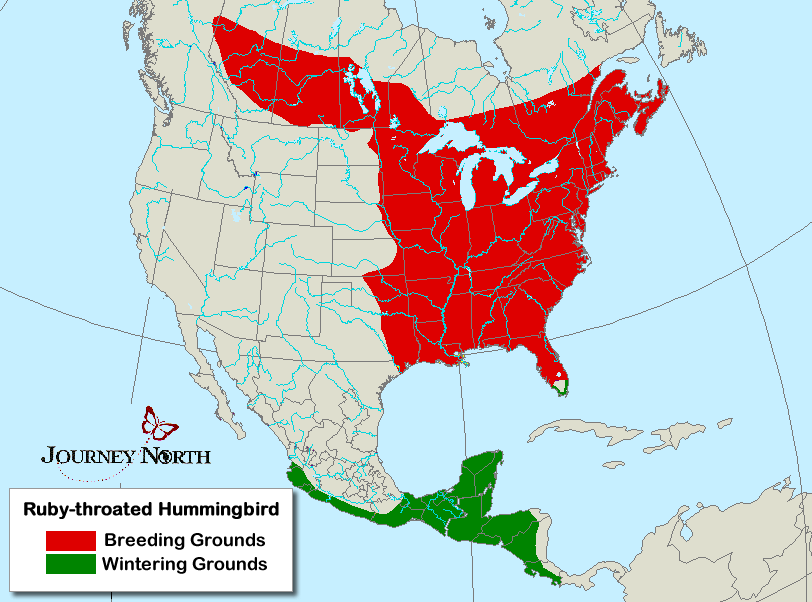
I loved filming Ruby-throated Hummingbirds on the beautiful bold flowering stalks of Canna Lilies (Canna indica) and just as much, I love seeing them drinking nectar from our North American native wildflower Jewelweed (Impatiens capensis). Even though not native to North Ameirca, it makes perfect sense that RTH forage from Canna Lilies as they grow natively in the Tropical Americas, the birds winter home!

Some fun things to know about Jewelweed:

Jewelweed has long been used in Native American medicine. Apply the watery sap topically to relieve itching and pain from Poison Ivy, Stinging Nettle, and hives.

The fruit of Jewelweed is an elongated capsule and at the slightest touch will burst open and send a little seed popper some distance, a fun activity to do with children and adults alike 🙂

You can grow Jewelweed in your native plant’s garden provided it is in a somewhat shaded and somewhat moist location. The Ruby-throated Hummingbirds, bees, and butterflies will thank you!

Ruby-throated Hummingbird Range Map courtesy Journey North

Our Beautifully Industrious Yellow-bellied Sapsucker Has Returned!

Last spring I wrote about a female Yellow-bellied Sapsucker that stayed in our garden for over a month. We were fascinated watching her daily activities; so much so  that I was inspired to write a poem and Charlotte nicknamed her Miss Featherton. We are excited beyond measure to see the return of our beautiful YBSS. Just as she did in the spring, Miss Featherton perches in the Dragon Lady Holly throughout the day.  She cautiously guards, and continues to maintain, the sap wells that she so pertinaciously dug. The sap is not flowing as vigorously as during the spring months but there is enough for her to take in a bunch of licks and the wells continue to attract insects. This morning I filmed her snatching a Yellowjacket that had stopped by to investigate the sweet sap.

We read that YBSS drill holes in unhealthy trees and were concerned our tree may beginning to decline. No need to worry though as you can see in the film clip, the holly is absolutely loaded with plump cadmium red berries.

My Yellow-bellied Sapsucker poem –

Sap-licker

Startled songbird silently flings
from approaching steps.

Behavior not usually seen by the insouciant
feathered friends that call our garden home.

Why so timorous?

Neatly arranged squares and holes
riddle the bark of the Dragon Lady Holly.

The masterfully drilled, cambium pierced checkered grid is glistening
in the sun – with deep wells and narrow streamlets of sweetness.

A sap-lick!

I wait to see her, half hidden and as
quiet as the owl after a long night

Weary and bedraggled, the Sapsucker returns
An arduous migration, no doubt.

She pauses guardedly
No one must know of her creation
with its treasured life fluid seeping down branches.

Her soft yellow belly and stippled feather patterning
Mirrors the spotty bark.

Her camouflage is not blown. She dives in with tender gusto
Delicately excavating the holes with brush tongue.

Wind rustles through leaves and she flings off
Only to return again and again and again
To her life-giving channels of gold flowing through tree veins.

YBSS are the only woodpeckers that are completely migratory. They breed further north and west of eastern Massachusetts and spend the winter months in warmer climates; some females traveling as far south as Panama. I wonder if we will see the return of the male this fall as well. It was just a year ago in December that we had our first ever Yellow-bellied Sapsucker, a male, and he was eating the fruits of the Pokeberry bush. It was also the first year with a Pokeberry. The plant is rather ungainly and I had some trepidation about allowing it to take hold but if a bit of awkwardness is the price to pay for a garden inviting Yellow-bellied Sapsuckers and Ruby-throated Hummingbirds, I’ll take it!

Male Yellow-bellied Sapsucker and Pokeberry – note the male has a red chin as well as a red cap.

Timeline of Yellow-bellied Sapsucker and Pokeberry –

Summer 2023 – Newly seeded Pokeberry bush grows six feet first summer (most likely the seed was deposited by a bird).

December 2023 – First ever male YBSS. Stays for several days eating Pokeberries.

March – May 2024 –  Female YBSS created striking grid pattern of sap wells on both the Holly and Magnolia trees, concentrating her efforts much more on the Holly. She spends many weeks drinking the sap, digging more wells, and eating insects attracted to the sap flows. Ruby-throated Hummingbirds discover the sap wells.

Summer 2024 – Ruby-throated Hummingbirds daily drink nectar from the small pinkish whiteish flowers of the Pokeweed.

October 2024 – Female Yellow-bellied Sapsucker returns, with daily visits into November. How long will she stay?

Grow native and they will come!

More from the Industrious Yellow-bellied Sapsucker and Time to Hang Your Hummingbird Feeders!

Despite that our little woodpecker friend has an injury under her right wing, the extraordinarily industrious Yellow-bellied Sapsucker has, for the past five days, worked on, and dined from, her sapwells. She arrives each morning at sunrise, departing around noontime. The timelapse video shows only one hour of her morning, compressed into one minute.

Dubbed Miss Featherton by Charlotte, the Yellow-bellied Sapsucker arrived bedraggled and injured but I think is becoming rejuvenated from the sap. Insects, too, are beginning to appear at the wells. I read that Ruby-throated Hummingbirds often follow the migration of sapsuckers as they too will imbibe on the sap and insects attracted. We usually hang our Ruby-throated Hummingbird feeders out at the end of March, but with all the sap flowing, we hung our feeders a few days ago.Notice the red wound under her right wing from the still taken from the video

Happy World Wildlife Day! #WWD2024

Every year on March 3rd, United Nations World Wildlife Day (WWD) is celebrated  The purpose of the celebration is to recognize the unique roles and contributions of wildlife to people and the planet.  Read more here.

A special event for World Wildlife day is being held at the UN tomorrow, March 4th, that anyone is welcome to tune into. Here is the link and more information:

#SaveTheDate 📅 🌱 Tune in online to watch the hashtag#WorldWildlifeDay 2024 UN Celebration!

When: 4 March (10AM-1PM EST)
Where: webtv.un.org

This year, we are exploring digital innovation and highlighting how digital conservation technologies and services can drive wildlife conservation, sustainable and legal wildlife trade and human-wildlife coexistence, now and for future generations in an increasingly connected world. 📱💻🐟🐯🌳

Meet our organizing partners: UNDP, ifaw, Jackson Wild, and WILDLABS Community

hashtag#WWD2024 hashtag#ConnectingPeopleAndPlanet hashtag#DigitalInnovation hashtag#TechForWildlife


PLEASE JOIN ME AT THE MASSACHUSETTS HORTICULTURAL SOCIETY FOR “THE HUMMINGBIRD GARDEN!”

HELLO FRIENDS!

Please join me Wednesday evening, April 20th, at 6:30pm for “The Hummingbird Garden” virtual lecture and slideshow. We’ll talk about how to create a beautiful hummingbird habitat and how to be good stewards of the tender tiny Ruby-throated Hummingbird, Massachusetts smallest breeding bird. We’ll also touch on hummingbirds found in other parts of North America.

I have a full schedule of lectures and program this upcoming week for Earth Day week (Earth Day is Friday, April 22nd). On Tuesday I will be screening Beauty on the Wing in Quebec and screening again later in the week in Connecticut (all virtual presentations!). The public is invited to the Mass Hort presentation, but I am not sure about the screenings. Please email at kimsmithdesigns@hotmail.com if you would like to attend and I will find out more.

GOOD MORNING MAMA IN THE HIBISCUS!

Last spring I picked up a pair of braided Chinese Hibiscus topiaries (Hibiscus rosa-sinensis) at Stop and Shop. The foliage was crushed and bedraggled but the shapes were lovely so I took a chance. I sure am happy with my decision! These two five foot beauties throw us big blowsy blooms everyday, at least one, and sometimes five or six at a time.

I went with the straight red for maximum Ruby-throated Hummingbird attracting potential and it has worked like a charm. Mama and the kids never fail to stop at the Hibiscus when making their daily rounds throughout the garden.  As I was walking (more like walk-hobbling) down the garden path, just finishing up photographing Monarchs in the Joe-pye, I was finally able to snap a photo of her at the Hibiscus! And also at our little window feeder, purchased with Charlotte in mind. The RTHummingbirds don’t seem to like this feeder as much as the free hanging feeders. Any movement inside startles them but doesn’t it look like she is peering into the window to see if anyone is home?

HUMMINGBIRD USES HER TINY TOES TO CLEAN HER BILL!

As has been the case for many summers (ever since we first planted Cardinal Climber), we have had a Mama Ruby-throated Hummingbird nesting nearby. I have looked and looked for the nest, but our garden is a bit of a jungle and I don’t have any real hopes of finding her half-walnut shell sized nest; it’s just fun to look.

This past week her two young fledglings have been joining her at the feeders and special flowers planted just for them. The youngsters are more playful than the Mama and give chase to each other. I wish I could get a snapshot of all three but am happy with what I can get.

One of the three perched in the pear tree several days ago and proceeded to giver herself a thorough grooming from tip to toe.

She first floofed and fluffed.


Then rubbed both sides of her bill, back and forth, against the gnarly rough bark of the pear tree.

Then used her tiny mouse-sized toes to clean her bill from the base to the tip!

Lastly, she used her toes to arrange (or scratch) her neck feathers.

All floofed and ready for action

GOOD NEWS CAPE ANN! – EPISODE 5

Good News Cape Ann! – Episode #5

 Sounds of Cape Ann, fog horn, songbirds, boats

Red-winged Blackbird singing across the marsh and calling to his mate in the reeds below.

Musing over name of show-  Good News Cape Ann, Finding Hope, my friend Loren suggested Beauty of Cape Ann, and husband Tom suggests Coastal Currents – what do you think?

Loren Doucette beautiful pastels and paintings. Follow her on Facebook and Instagram.

Castaways gift certificate

Fishermans Wharf Gloucester now also selling lobsters in addition to scallops, haddock, and flounder. Our son made a fabulous scallop ceviche this week, so easy and delicious.

Cedar Waxwings, Hummingbird, Yellow-Rumped Warbler, Baltimore Orioles, and Palm Warbler

Mini tutorial on how to plant a hummingbird garden

TWO MONARCH CONTORVERSIES! Is it okay to raise Monarchs at home? What is the problem with Butterfly Bushes?

Jesse Cook new release “One World One Voice”

Beautiful Piping Plover courtship footage – Piping Plovers in the field, what are they doing right now?

Charlotte stops by.

Take care and be well <3

Alex’s Scallop Ceviche Recipe

1 lb. sea scallops completely submerged in fresh lime juice

Dice 1/2 large white onion. Soak in a bowl with ice water to the reduce bitterness.

Dice 1 garden fresh tomato, 1 jalapeño, and cilantro to taste

Strain the onions.

Strain scallops but leave 1/4 of the lime juice.

Gently fold all ingredients. Add cubed avocado just prior to serving.