Category Archives: Monarch Butterfly Migration

Please Share Your Monarch Butterfly Sightings ~ Thank You!

There have been few Monarch sightings this summer but I have been hoping for a strong fall migration. The migration is peaking in Kansas and we are always a little bit behind. Please let me know if you see a Monarch, and where. Thank you very kindly!

https://www.instagram.com/p/BKqhTISjOjG/

Monarchs are emerging daily in our garden, from eggs collected at my friend’s field in Salem. This too would be an indication that we may be seeing them soon.

newly-emerged-monarch-butterfly-copyright-kim-smith-jpgThis newly eclosed Monarch is clinging to its chrysalis case. Within moments of emerging, the two-part Monarch proboscis must zip together to form a siphoning tube. If the two parts do not join, the butterfly will not be able to drink nectar. In this photo, you can see the proboscis is not yet fully zipped. Note its wet, crumpled wings.

Happy First Day of Autumn

Look for Seaside Goldenrod blooming across marsh and meadow–it also makes a wonderful addition to the garden, and is one of the top ten plants for migrating Monarchs.

seaside-goldenrod-solidago-sempervirens-gloucester-copyright-kim-smith

Synopsis: Beauty on the Wing: Life Story of the Monarch Butterfly

Writing proposals and organizing the film’s website this past week. This is a longer version of the synopsis. Oh my goodness, the last application was ten pages long. I think (hope) it will get easier the more I do it!

*  * *

Beauty on the Wing ~ Life Story of the Monarch Butterfly is a documentary film that tells the story of the monarch butterfly at it unfolds along the shores of Cape Ann and in the heart of Mexico’s forested volcanic mountains. Filmed in Gloucester, Massachusetts and Angangueo, Michoacán, the film illuminates how two communities, separated by 3,000 miles, are ecologically interconnected.

Every stage of the butterfly’s life cycle is experienced in vibrant close-up, from egg to caterpillar to adult. Set against the background of sea and forest, sun and wind, by the millions and millions the intrepid monarchs journey thousands of miles. The most magical thing is that this migration happens in our midst, taking place in backyards, farms, meadows, and along the shoreline, wherever milkweed and wildflowers grow.

The monarch’s life story is one of nature’s most incredible examples of adaptation and survival. There are no other butterflies in the world that journey thousands of miles over such a great and vast area, ecologically linking Canada and Mexico, to nearly every region within the United States.

The story opens in the industrial port of Gloucester, Massachusetts. Well known for her legendary fishing industry, Schooner Festival,  Italian feasts and fiestas, rich artistic heritage, and stunning coastline, Gloucester makes up much of the peninsula of Cape Ann, located on the coast of Massachusetts just north of Boston.

As are most regions along the length of the Eastern Seaboard, Cape Ann lies within a largely unrestricted north-south corridor for migratory species of birds and butterflies. This means that birds, butterflies, and other insects travel along the Atlantic flyway without being impeded by either mountain ranges or large bodies of water to cross. There is a tremendous sense of urgency in this great movement of life. Whether traveling by land or by sea, wildlife must reach its seasonal destination while life-sustaining food is abundant.

Cape Ann and Angangueo emerge as characters in the film, places where we have much to gain by preserving the habitats of these unique ecosystems and where, through neglect, the loss will be devastating.

Beauty on the Wing is a film for all ages, created for all to gain a deeper understanding of the symbiotic relationship between habitats, wildflowers, and pollinators, and the vital role that they play in our interconnected ecosystems.

In seeking funding to finish the film, I am currently in the process of writing grant proposals. Recently, I was invited to join the Filmmakers Collaborative, which is a dynamic organization that is providing excellent advice and will also act as the fiscal sponsor for the film. Each filmmaker represented by the Filmmakers Collaborative has a project page on the FC website and I invite you to visit mine here: Filmmakers Collaborative.

MY MONARCH BUTTERFLY FILM TRAILER!

Dear Friends,

I am super excited to write that today I am launching the trailer for my monarch butterfly documentary, Beauty on the Wing: Life Story of the Monarch Butterfly. I hope so much you enjoy watching as much as I have loved creating!

I am asking a huge favor of all my Good Morning Gloucester, Facebook, Twitter, and Instagram friends and that is to please share the trailer, hit all like buttons, and if you have time, to please comment.

In seeking funding to finish the film, I am currently in the process of writing grant proposals. Recently, I was invited to join the Filmmakers Collaborative, which is a tremendous and well-respected organization that is providing excellent advice and will also act as the fiscal sponsor for the film. Each filmmaker represented by the Filmmakers Collaborative has a project page on the FC website and I invite you to visit mine here: Filmmakers Collaborative.

The next stages in finishing the documentary are title design, audio mixing, and color correcting. I’ll keep you posted on progress made through GMG, the film’s website, and my website.

Look for Pilar, Meadow, and Atticus in the trailer. They were wonderful and I am so appreciative of their assistance. There were additional kids from our East Gloucester troupe that participated in making the film however, I couldn’t squeeze them all in the trailer. I think you’ll love all the children’s parts in the finished film!

For more information about the documentary, please visit the film’s website here: Beauty on the Wing

My most sincerest thanks to everyone for your kind support!

DISCOVERED: THE MONARCHS MEXICAN HAVEN

national-geographicForty one years ago today, January 9th is celebrated as the day the Monarchs winter habitat was “discovered.” The woman who led the discovery, Catalina Aguado, was  born in Michoacán, the Mexican state that is home to the butterflies wintering grounds. Catalina is the only living member of the original team featured in the following 1976 National Geographic article.

Excerpt from “Discovered: The Monarchs Mexican Haven”

Doctor Fred Urquhart, the Canadian zoologist who had been studying and tracking the butterflies since 1937 writes the following:

“In our search for the overwintering place, years passed, years of frustration. Norah, late in 1972, wrote to newspapers in Mexico about our project, asking for volunteers to report sightings and to help with tagging.

In response came a letter, dated February 26, 1973, from Kenneth C. Brugger in Mexico City. “I read with interest,” he wrote, “your article on the monarch. It occurred to me that I might be of some help. . . .”

Ken Brugger proved the key that finally unlocked the mystery.

Traveling in his motor home with his dog, Kola, he crisscrossed the Mexican countryside. He searched especially in areas where tagged monarchs had been recaptured, and places where other visitors had reported numerous butterflies. “Go out in the evening,” we instructed him. “That’s when you’ll see the monarchs moving about looking for a place to roost.”

In a letter written in April 1974, Ken reported seeing many monarch butterflies in the Sierra Madre flying at random as if dispersing from a congregating site.

“Your data and observations are exciting,” I replied. “We feel that you have zeroed in on the right area.”

Ken Brugger doubled his field capability by marrying a bright and delightful Mexican, Cathy. Late in 1974 he wrote of finding many dead and tattered butterflies along the roads in a certain area. “You must be getting really close,” we responded. These butterfly remains suggested that birds had been feeding on large flocks of monarchs.

Swiftly came the dramatic conclusion. On the evening of January 9, 1975, Ken telephoned us from Mexico. “We have located the colony!” he said, unable to control the excitement in his voice. “We have found them—millions of monarchs—in evergreens beside a mountain clearing.”

Mexican woodcutters, prodding laden donkeys, had seen swarming butterflies and had helped point the way.”

The complete article is available to read online here.

BEAUTY ON THE WING ~ THURSDAY NOVEMBER 12TH AT THE SAWYER FREE LIBRARY!

Monarch Butterfly Exposion -2 ©Kim Smith 2014 300dpi copyMonarch Butterfly Explosion

What is a Monarch Butterfly explosion? The butterflies migrate to Mexico to keep from freezing to death in northern climates. The air is cool and moist in the trans-Mexican volcanic mountains, cool enough to keep them inactive and in a state of sexual immaturity, called diapause, but not so cold that they will freeze. As spring approaches and the Earth’s temperature begins to rise, the butterflies sleeping in the oyamel fir forests need to get out of the hot sun. Millions explode from the trees, drink water from nearby mountain streams, and move to a cooler, shadier spot on the mountain.

I hope you’ll come join our program Thursday night at 7pm at the Sawyer Free Library. We’ll be talking all things Monarchs including the current status of the butterfly’s migration, habitat destruction here in our own community, and most importantly, ways in which we can all help the Monarch possibly survive the warming of the earth.

We will be premiering the trailer for my forthcoming film about the Monarchs, too (also titled Beauty on the Wing). I hope to see you there!

For more information, visit the Programs page of my website and the Sawyer Free Library Facebook page.Monarch Butterfly Explosion -1 ©Kim Smith 2014 300dpi copy

MONARCHS WEAPONIZE MILKWEED TOXINS

Monarch Caterpillars Common Milkweed ©Kim Smith 2012Milkweed Munching Monarchs

Although scientists have long known that the toxic sap that flows through milkweed veins, called cardenolides, can make a bird very sick if it attempts to eat a Monarch caterpillar, it was unclear whether the butterfly’s acquired adaption to the toxicity was a side effect that allowed the caterpillar to eat the milkweed or had developed separately as a defensive mechanism against predators. A Cornell University study recently published in Proceedings B of The Royal Society Publishing reveals that they have indeed evolved to weaponize milkweed toxins! Thank you so much to Maggie Rosa for sharing “The Scientist” article and you can read more about it here. 

“Monarch butterfly caterpillars have evolved the ability to store toxins known as cardenolides, obtained from their milkweed diet, specifically to make themselves poisonous to birds, as has at least one other species of milkweed-munching caterpillar, according to a study published Wednesday (November 4) in Proceedings of the Royal Society B.

“This finding is fascinating and novel,” Stephen Malcolm, a professor at Western Michigan University who studies cardenolides but was not involved in the new research, wrote in an email to The Scientist. “It is exciting to have evidence for the importance of top-down influences from predators.” Continue Reading

Please join me Thursday evening, November 12th, at 7pm at the Sawyer Free Library for my illustrated talk, Beauty on the Wing ~ Life Story of the Monarch Butterfly. Looking forward to seeing you there!

Meadow monarch caterpillar ©Kim Smith 2015Meadow Anderson and Milkweed Caterpillar

SAFE TRAVELS MONARCHS!

Cape Ann Monarch Butterfly Migration Update

Monarch Butterfly bougainvillea ©Kim Smith 2015Female Monarch and Bougainvillea

Monarch Butterflies Daisies ©Kim Smith 2015Methuselah Monarchs Heading to Mexico

Our last batch of Monarchs emerged from their chrysalides, dried their wings, and caught the tailwinds to Michoacán. I hope they arrive to their winter roosting sites at the trans-Mexican volcanic mountaintops safely!

Although not many migrating Monarchs were reported on the shores of Cape Ann, a great batch was seen migrating over Lake Erie in late summer. Cape May, which is 400 miles south of Cape Ann, also had a strong showing. Keep on the lookout though because on Election Day in 2007, I photographed a Monarch refueling at Korean Daisies.

The Monarchs are counted by the Mexican scientists in December and the numbers released in January. Last year a tiny increase from 2013 was noted (2013 was the year the lowest numbers were ever recorded). Lets keep our hopes up that the population will continue to improve.

Monarch Butterfly sunflower ©Kim Smith 2015Last Sunflowers of the SeasonMonarch Butterfly daisy ©Kim Smith 2015

Monarch Butterfly pink bougainvillea ©Kim Smith 2015

MY MONARCH BUTTERFLY PROGRAM AT THE SAWYER FREE LIBRARY

Dear Friends,

Please join us at the Sawyer Free Library on Thursday November 12th at 7:00 pm for my Monarch butterfly program. I am especially, especially excited to present to our community. I hope to see you there! Please note that this is my photo and lecture program, not the new film, which will be coming soon.

For more information visit my website Kim Smith Designs.

Special thanks to Valerie Marino at the Sawyer Free for creating the program flyer!

KimSmith1

MONARCH CATERPILLAR NONUPLETS

Thank you so much to my friends Charles and George Ryan and Mom Catherine for helping with my Monarch film project. Charles and George Ryan Monarch caterpillars ©Kim Smith 2015

Nature’s Compass ~  My current group of nine Monarchs are synchronized, all lined up on a north-south axis and pupating within moments of each other.

Monarch caterpillars north south ©Kim Smith 2015JPGFrom the moment a caterpillar emerges, internally it begins to form the adult parts of its body. Adult Monarchs have magnetic receptors along the inner margins of their thorax, which help guide them on their south to north, north to south migration. I wonder if the magnetic receptors are here at work in the caterpillars north-south pattern of pupating.

Monarch caterpillars J-shape, pupating ©Kim Smith 2015All nine hung in a J-shape on the north-south axis as well. Since I took this photo three more have also pupated on the north-south axis. In the above photo, you can see the center caterpillar and caterpillar to the far left are in the midst of changing from a caterpillar to a chrysalis (pupating).

MONARCH DAY! STARRING THE EAST GLOUCESTER NEIGHBORHOOD GANG

Pilar Monarch Day ©Kim Smith 2015Pilar has started a new fashion trend, Monarchs as hair accessory.

Enchanted by Monarchs!  We had a fantastic day filmmaking, thanks to Emma, Pilar, Frieda, Annie Kate, Lotus, April, Elijah, Esme, Charlie, Atticus, and last but not least, Meadow. And an extra huge thank you to all the moms and dads for not minding the early morning wake up calls and texts to let the kids know the butterflies were emerging! I was tied up filming and so wish I’d taken more stills.

Annie kate, Emma, Pilar Monarch Day ©kim Smith 2015 copyAnnie Kate, Emma, and Pilar

Meadow Monarch Day ©Kim Smith 2015 copyMeadow

See More Photos Here Continue reading →

Crazy for Caterpillars!

Meadow monarch caterpillar ©Kim Smith 2015An integral part of the Monarch film is to show the connection between wildflowers and caterpillars. Emma, Pilar, Atticus, and Meadow were fantastic with the caterpillars and a huge help with the project. We are so blessed to know these bright and curious kids, and their incredible parents!Pilar Atticus Meadow Emma monarch caterpillar ©Kim Smith 2015

Pilar Atticus Meadow Emma monarch caterpillars ©Kim Smith 2015Thank you Pilar, Atticus, Meadow, and Emma for all your help filmmaking!

Atticus Monarch caterpillar ©Kim Smith 2015

GOOD MORNING FROM CABOT FARM!

For Nancy Lutts. Thank you dear lady!

After collecting Monarch eggs last weekend, Nancy graciously allowed me to return to her gorgeous Cabot Farm to film and to photograph. I was there at sunrise, which is relatively early in the day for butterfly sightings however, I did see four Monarchs and two were females depositing eggs all over the field!

Bench Cabot Farm Salem ©Kim Smith 2015Nancy’s Pollinator Garden

Sunrise Cabot Farm Salem ©Kim Smith 2015View from Nancy’s Milkweed Field

Cabot Farm Salem ©Kim Smith 2015Scarlet runner Beans Cabot Farm Salem ©Kim Smith 2015Scarlet Runner Bean; the blossoms are beloved by hummingbirds.

Sunflowers Cabot Farm Salem ©Kim Smith 2015Barn Cabot Farm Salem ©Kim Smith 2015READ MORE HERE Continue reading →

Three Cats Taking a Nap

Monarch Caterpillars ©Kim Smith 2015Monarch Caterpillars that is.

MONARCH BUTTERFLY EGG BONANZA!

Milkweed Field ©Kim Smith J.PGNancy’s Milkweed Field

Ninety-nine thank yous to Nancy Lutts of Salem who responded to my plea for Monarch butterfly eggs. She follows both my blog and Good Morning Gloucester and emailed immediately after reading the posts. Nancy has the most amazing farm and fields located along the Danvers River. She and her family have been farming the land for decades. Nancy invited me to come and collect eggs. She had come to one of my lectures, but you hardly get to actually know people at the programs so it was a delight to meet her and super fun to peruse her fields for eggs while chatting and sharing butterfly info.

milkweed butterfly eggs ©Kim Smith 2015Interestingly, Nancy’s plow wasn’t working as well as usual, so the mowing of her fields, which usually takes place in early summer, happened later than usual. Good thing! The two-inch tall emerging milkweed shoots were the female’s preference. This goes to a topic that is often brought up in the lectures that I give and one of the most frequently asked questions, “What is the best time of year to plow my fields?” I recommend plowing in early fall, well after the monarchs have emerged from their chrysalides and headed to Mexico. Although, the very, very best practice for the pollinators is to mow half a field annually, alternating from one side of the field to the other every other year. This allows for the pollinators to complete their life cycle within a two year time frame. The single greatest threat to Monarchs, as well as all bees and butterflies, is habitat destruction in the United States, whether it be from Monsanto’s Roundup or from mismanagement and loss of fields and meadows.

Nancy Lutts Salem ©kim Smith 2015Nancy has a truly fabulous butterfly and hummingbird garden that I’ll be back to photograph on a sunnier day.Nancy Lutts garden ©kim Smith 2015

MONARCH BUTTERFLY HELP NEEDED!

Butterfly Days are Here!

Monarch Butterfly Female -2 ©Kim Smith 2015Female Monarch Butterfly Necating at Red Clover, Waring Field, Rockport

I am looking for Monarch eggs and will travel! Monarch eggs are found on the upper leaves of milkweed plants. The eggs are tiny and dome-shaped, only as large as a pinhead, and are a pale golden yellow color.

Monarch Butterfly Egg ©Kim Smith 2015Monarch Butterfly Egg

Waring Field supports myriad species of pollinators and is simply a fantastic place to explore. Although I didn’t find any eggs on my search on the leaves at the Common Milkweed patch at Waring this morning, I did see four adult Monarchs, three male and one female, along with fritillaries, a Common Ringlet, a bevy of Pearly Cresentspots, Blue Azures, and Yellow Sulphurs. The Monarchs, Ringlet, and Sulphurs were nectaring at the great field of Red Clover and the Pearl Crescents at the milkweed.

Pearl Crescent  Butterfly Female Milkweed ©Kim Smith 2015Female Pearl Crescent Nectaring at Marsh Milkweed

Common Ringlet Butterfly Waring Field Rockport ©Kim Smith 2015Common Ringlet

Monarch Butterfly Female -3 ©Kim Smith 2015Newly Emerged Female Monarch Butterfly

Please email me at kimsmithdesigns@hotmail.com or leave a comment in the comment section if you have Monarch eggs you’d like to share. Thank you!

   *    *    *

Emerging from the woods onto the sunny lower field, I startled a small herd of White-tailed Deer foraging. If you click on the photo to enlarge, you can see the male deer antlers are covered in velvet. Antlers are true bone structures and are an extension of the skull. The velvet provides blood flow that supplies nutrients and oxygen.

Waring Field Deer ©Kim Smith 2015White-tailed Deer

Rain Forest Publications and Mourning Cloaks

Rain Forest Publications Butterfies of Mexico Guide Kim Smith cover photo ©Kim Smith 2015Recently brochures from Rain Forest Publications arrived. Don’t you love pocket guides, for the very reason the name infers–so easy to tuck along when traveling and hiking. That’s my photo on the cover of “Mexico Butterflies.” The photo was taken not in Mexico, but in Gloucester!

Be on the lookout for the first butterfly of spring, which will most likely be the Mourning Cloak Butterfly. Mourning Cloaks do not spend the winter in the cool volcanic mountains of Mexico as do the Monarchs, or as a chrysalis in our gardens, like the Black Swallowtail, or as a caterpillar rolled up in a tight little ball under a leaf, as does the Wooly Bear, but as an adult butterfly!

Pussy Willows, Salix discolor ©Kim Smith 2014Pussy Willow (Salix discolor)

During the winter months Mourning Cloaks live tucked away in cracks and crevices, between chinks of tree bark, for example. At the first warm breath of spring they begin to take flight, searching for a mate. You’ll often see them on the wing around Pussy Willows, one of the Mourning Cloak caterpillar’s food plants.

Mourning_Cloak_Butterfly_in_South_Central_AlaskaMourning Cloak image courtesy wiki commons media

Kim Smith Pollinator Program at Cox Reservation Tonight at 6pm

36. Zinnia Black Swallowtail Butterfly -1 ©Kim Smith 2013 copy

I hope to see you there!

The event is free.

RSVP to alice@ecga.org.

For more information: Planting an Essex County Pollinator Garden

Monarchs Gloucester MA ©Kim Smith 2012 -1269 copy


Kim Smith Event for Essex County Greenbelt, Thursday March 5th: Planting An Essex County Pollinator Garden

 Catbird eating Pagoda dogwwod fruits ©Kim Smith 2014.Catbird Eating Dogwood Fruits

Please join me at the Essex County Greenbelt’s Cox Reservation headquarters on Thursday, March 5th, from 6:30 to 8:30. I will be presenting my pollinator garden program. The program is free. RSVP to alice@ecga.org.

I look forward to seeing you! 

American Lady Butterfly New York Ironweed ©Kim Smith 2014 Painted Lady Butterfly and New York Ironweed, Gloucester HarborWalk Butterfly Garden

From the ECGA website:

Our second session to our pollinator film/lecture series will feature local designer, writer, filmmaker and gardening expert Kim Smith. Kim specializes in creating pollinator gardens, as well as filming the butterflies that her plants attract. She will present a 90-minute slide show and lecture about how to create a welcoming haven for bees, birds, butterflies, and other wildlife. Native plants and examples of organic and architectural features will be discussed based on their value to particular vertebrates and invertebrates. Kim will also discuss specific ways to be sure your gardening practices are not harming pollinators. There will be time for questions from the audience about particular problems and quandaries they may have with pollinators and their gardens.

To learn more about Kim Smith’s work, visit her website here. This lecture will take place at our headquarters on the Cox Reservation in Essex, from 6:30 to 8:30 pm. Light refreshments will be served. Please RSVP to alice@ecga.org.

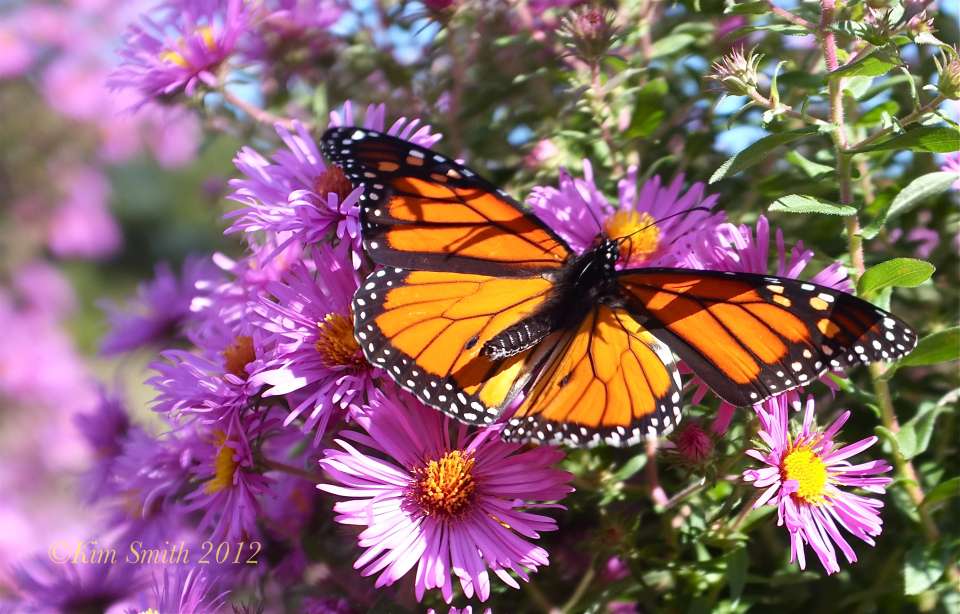
monarch-butterfly-c2a9kim-smith-2012-1Monarch Butterfly Nectaring at New England Asters

Harbor Walk Butterfly Garden ©Kim Smith 2012Gloucester HarborWalk Butterfly Garden

Monarchs Eyed for Possible Inclusion Under US Endangered Species Protection

Cape Ann Milkweed and Monarch Habitat, Eastern Point

The U.S. Fish and Wildlife Service is considering adding Monarchs as a threatened species under the Endangered Species Act. A one-year review is underway to monitor the butterfly’s status. Since the 1990s the population has plummeted from about one billion to approximately 35 million. That may seem like a substantial number, but the Monarchs need stronger numbers to be resilient to other threats such as harsh weather.

The reason for the decline is primarily because of loss of milkweed habitat in the agricultural heartland of the United States. With the development of Monsanto’s Roundup and Roundup Ready (glyphosate resistant) seed, farmers are now able to spray glyphosate directly on their corn, soybean, and sorghum crops. Roundup also destroys milkweed. Secondly, with the push for ethanol, farmers have begun to plant corn on conservation land.

If the Fish and Wildlife Service determines that the Monarchs are threatened, they will set aside land for milkweed.

You can read more about the the Monarch Butterfly Endangered Species Act here:

FAQs on the Monarch Butterfly Endangered Species Act Petition

Monarch Butterfly Wildflower Joe-pye ©Kim Smith 2012Monarch Butterfly Drinking Nectar from Native Wildflower Joe-pye Weed

You can learn more about the Monarch migration and the loss of Monarch habitat from Professor Tom Emmel here ~ 

NEW FILM: A FLIGHT OF MONARCHS

When watching, know that the first two minutes of the film were shot in Gloucester. I think you will be dazzled by the sheer numbers of Monarchs that travel through Cape Ann’s backyards and meadows during the peak of migration.

I began photographing the Monarchs in 2006, which was a year when we had an extraordinary number of Monarchs visiting our shores. At that time, I became determined that if ever again this phenomenon were to occur on Cape Ann, I was going to have the ability to document on film, rather than only through still images, this beautiful event for my community. It’s hard to imagine without observing and here you can see what I have wanted to share.

A Flight of Monarchs begins on a September day as first one and then passels of Monarchs begin to arrive to the fields and meadows of Cape Ann, carried across Massachusetts Bay on a tailwind. By the early evening light they begin to pour into the surrounding trees, clustering to stay warm in the branches furthest away from the prevailing breezes. The following morning as the sun begins to touch their wings, they alight from the trees, seeking the freshest wildflowers from which to drink nectar to help build their lipid reserves for the several thousand mile journey south. They drink and drink until the last of the sun’s rays dip below the tree line. As they arrived on a tailwind, they again depart, and are carried to the next gathering area. For coastal Monarchs, Allens Pond, which is located in Westport, Massachusetts is often the next stop.

In the next scene, the butterflies have arrived to the sacred oyamel fir forests of Angangueo, Michoacán, deep in the heart of the Trans-Mexican Volcanic Belt. It’s early morning and the butterflies are suspended in great primordial branched clusters that may become so heavy from the weight of so many butterflies the boughs of the trees bend to the breaking point. Later in the day, as the sun begins to warm their wings, the butterflies begin to stir. During the winter, it is imperative that the Monarch’s body temperature remains relatively low. They leave the sunniest branches in search of shade and a drink of water from nearby mountain streams. Occasionally in late February, as the air temperatures begin to warm with the coming springtime, for a short period during the day, the butterflies leave the trees all at once. This phenomenon is called a butterfly “explosion,” and is a truly magnificent event to observe.

A Flight of Monarchs is set to the evocative and tender “Fields of Blue,” written and performed by composer and guitarist Jesse Cook and his band, to which permission was granted by the artist for the purpose of this short film. Here is a link to Cook’s website. I highly, highly recommend attending a live performance of Jesse Cook and Company. As was I, you will be completely taken by their gorgeous music, exquisite artistry, and with Cook’s songwriting, will travel in beautiful melodies inspired from around the world.

I am currently editing my feature length documentary, Beauty on the Wing, which after months and months of organizing and editing three years of footage, is currently running at approximately twelve hours in length. At eleven hours too long, I have a great deal of editing to accomplish in the coming winter months!

A Flight of Monarchs presented here is the shorter version of the film that I created for the Berkshire Museum’s “Butterflies” exhibit. The first version is six minutes long and played on a continuous loop in the main gallery of the exhibit hall. The longer version will soon be posted on Vimeo.

Checkout Rainforest Publications!

Rainforest Publications recently licensed one of my Monarch photos, which was shot on Eastern Point, for the cover of their newest pocket field guide, Butterflies of Mexico. You can get a preview of the new field guide by clicking here; look towards the bottom of the page.

Monarchs Gloucester MA ©Kim Smith 2012 -1269 copy

I requested their field guide on Mexican Flowers, which Larry, the publisher, kindly sent along. I love it–the guide is beautifully illustrated, and well, just so pocketable! I wished I had it on my trip last winter to Agangueo to film the Monarchs and especially appreciate how the guide is organized by plant family as opposed to alphabetically.

If any my world-traveling readers are planning a trip to Costa Rica, Mexico, Florida, Hawaii, Panama, Peru, California, Nicaragua, Belize, or the Pacific Northwest I recommend checking out their website, Rainforest Publications. Specific to each region, they offer field guides on marine animals, birds, orchids, wildflowers, butterflies, trees, reptiles, amphibians, and more. They even have a field guide for marine mammals of the North Atlantic. At only $5.95. I think this would be ideal for whale watchers (and for whale watching companies like Seven Seas to carry the guides).

Looking for Monarchs ~ Fall 2014 Monarch Migration Update

There have been many inquires in my inbox asking “where are the monarchs?” I’ve been checking in my garden and along the shoreline and haven’t seen any travelers as of yet however, we have reason to be hopeful that this year’s migration will be better than last year’s. Based on reports coming from the mid-west, the migration has begun and the numbers are higher than what was reported in September 2013 for that region.

Monarch Butterfly ©Kim Smith 2012-1Look for Monarchs in your garden, and also in fields, meadows, and along the shore nectaring at native wildflowers, such as different species of goldenrods and asters.

Reminder ~ Screening of my documentary Life Story of the Black Swallowtail Butterfly and Lecture is this coming Saturday, September 20th, at the Berkshire Museum in Pittsfield. I hope to see you there! For details see recent post here.

Dedication of the Pathways Butterfly Garden

Caroline Haines butterfly garden Patheways for Children ©Kim Smith 2014Carolin Haines on ukelele singing with the Pathways Children “The Garden Song,” written by David Mallett 

Pathways for Children butterfly garden ©Kim Smith 2014

The dedication of the new butterfly garden at Pathway’s for Children was celebrated with speeches of thanks, and a song and poem performed by the Pathways children. The sun was shining, the bees and butterflies were on the wing, and there were lots of smiles of joy on the faces of the children and attendees. My most heartfelt thanks and deepest appreciation to all who have given so much to make the garden a success! Pathways for Children butterfly garden -3 ©Kim Smith 2014

Pathways for Children butterfly garden -4 ©Kim Smith 2014Just some of the wonderful people who made the garden possible: Andrew, Bernie Romanowski, Beth Graham, and Peter Van Demark. 

Pathways for Children butterfly garden sunflower ©Kim Smith 2014

Pathways for Children butterfly garden before ©Kim Smith 2014Before Photo Pathways for ChildrenPathways for Children butterfly garden -8 ©Kim Smith 2014

Pathways for Children butterfly garden -7 ©Kim Smith 2014

See previous post on the new butterfly garden at Pathways here: HOORAY FOR PATHWAYS FOR CHILDREN’S BRAND SPANKING NEW BUTTERFLY GARDEN

Please Don’t Weed the Milkweed

Common Milweed Asclepias syriaca ©Kim Smith 2014Once established, native Common Milkweed grows vigorously and rambunctiously, making itself known even in the thinnest of sidewalk cracks. Here’s a patch growing along East Main Street. I think it beautiful! What do you think?

*    *    *

If you caught Tom Ashbrook’s On Point broadcast on NPR yesterday morning you heard Doctor Lincoln Brower, Karen Oberhausser, and Rick Mikula, three of the world’s leading butterfly experts, speaking about the disappearance of the Monarch and the main reason why–most notably because of the sterilization of the American landscape through the use Monsanto’s Roundup and GMO corn and soybean crops.

The following is a list of a few suggestions on ways in which we can all help turn the tide:

Plant milkweed and wildflowers. Teach members of your family and friends what milkweed looks like and why we don’t want to weed it out of the garden. The above patch of milkweed is growing next to a shop on East Main Street. About a month ago, I went into the store and, very, very politely inquired as to whether or not they knew that the plant growing outside their doorway was a terrific patch of milkweed. They had no idea. I explained what the benefits were to the Monarchs and have since noticed that the milkweed patch is still growing beautifully!

Ban GMO crops. Genetically modified seeds have been altered to withstand megadoses of Roundup. Millions and millions of tons of herbicides are poured onto Roundup Ready fields of crops, preventing any other plant that has not been genetically altered from growing (in other words, wildflowers). The application of Monsanto’s deadly destructive herbicide Roundup is creating vast sterilized agricultural wastelands, which will, over time, only need heavier and heavier does of their lethal chemicals to continue to be viable.

Don’t apply herbicides and pesticides in your own gardens.

Create wildflower corridors in backyards and highways.

Reduce salt wherever possible (and where it wouldn’t cause harm to human life). Large amounts of road salt, as was needed during this past snowiest of winters, is detrimental to wildlife habitats.