Happy Thanksgiving Eve <3


 One of a pair of Snow Bunting spotted recently, on a sunnier morning.

A mini flock of mini birds – every few years or so I am fortunate enough to catch the Golden-crowned Kinglets traveling through our neighborhood. In perpetual motion when foraging, they are challenging to film and even more so to photograph. You would think the Kinglets would be interested in the magnificent buffet of ripe crabapples but no, they were devouring the insects and web encased egg sacs found mostly on the undersides of leaves.
One of these days I may be lucky enough to see a Golden-crowned Kinglet with his crown puffed out like this-

Photo courtesy American Bird Conservancy

Dear Friends,
I hope you are doing well. What a lovely weekend weather wise for we in southern New England although we’re getting ready for the big cold snap coming. Right after Dia de Muertos, we plant paperwhites and amaryllis bulbs to force indoors. We switch up the colors of the soft furnishings in the music living room from warm weather blues and greens to white, rose, red, and greens. It’s a cozy (and gradual) way to get in the holiday spirit.


I am so very delighted to write that we received the Best Director Feature Film award at the London Vision Film Festival. It’s a wonderful honor and my first ‘Best Director’ award. I thank all of you everyday. Both Beauty on the Wing and The Piping Plovers of Moonlight Bay would not have been made possible without your generosity and I am so very grateful for your interest and kind support.
If you have a chance, there’s a very fun new film about the vibrant music scene in Boston during the 70s and 80s, Life on the Other Planet. Beautifully produced and directed by Vincent Straggas, we went to the premiere at the Regent Theatre in Arlington several weeks ago and it is again playing at the Regent on Thursday, November 19th. Along with a great many Boston musicians, my husband Tom Hauck and Fred Pineau from The Atlantics are featured, as well as local Gloucester musicians Willie Alexander and Jon Butcher. There is talk of Life on the Other Planet coming to The Cut!
The Rat
Here’s a link to a short video and photos of the amazing Pectoral Sandpiper that stopped over for a day on its arduous migration to southern South America. I mentioned the pair last time I wrote and wanted to make the video before too much time had passed. I wonder what the predicted whoosh of arctic weather will bring to our shores next!
Sending you kind thoughts and much gratitude,
xxKim

I am so very honored to receive a nomination from our Ward One City Councilor, Scott Memhard, for the City of Gloucester’s 2025 Kindness Campaign. I accept this nomination on behalf of myself and all our Piping Plover Ambassadors, DPW, Conservation Commission, and Mass Audubon. Our Gloucester Plovers are very fortunate to have such a dedicated and kind team working to keep them safe and their habitat intact.
I’d also like to thank Scott especially, who has been a supporter since the Plovers first arrived in 2016. He has been a tremendous help navigating with the City to develop conservation protocols for the Plovers. The Plovers are under Scott’s ‘jurisdiction,’ so to speak, as Good Harbor Beach is part of Scott’s ward, and we couldn’t ask for a more helpful and engaged advocate.
Thank you to Scott, all our PiPl Ambassadors, the Gloucester DPW, Conservation Commission, Mass Audubon, and all our Plover friends and advocates <3
“I would nominate Kim Smith for her tireless environmental advocacy & her documentary photography and film educational outreach, now on PBS.
For years Kim has worked tirelessly with the Gloucester DPW, Conservation Commission & MA Audubon. Kim has organized the local citizen group of the Piping Plovers Ambassadors at Good Harbor Beach.
In addition to the Piping Plovers, with her new documentary “Piping Plovers of Moonlight Bay”, and working to protect Good Harbor Beach and dunes, Kim has produced a remarkable film documentation “Beauty on the Wing” of migrating Monarch butterflies which pass through Cape Ann every Fall.
Kim is a blessing & a credit to Gloucester. “
To learn more about Gloucester’s Kindness Campaign, please go here.
 And thank you to our little photobomber, Holly, who is generally not allowed on the dining room table

I thought the warblers were attracted to the bushes because of the abundance of berries but no; watch how she snatches a winged insect and only eats the abdomen, tossing aside the wings.
Yellow Warblers primarily eat a wide variety of insects including caterpillars, beetles, spiders, mosquitos, and moths. During the fall and winter months especially, they also eat fruits and berries.

Dear PiPl Friends,
I am delighted to share two good things. The Piping Plovers of Moonlight Bay has been accepted to the Brampton Canada International Film Festival, which is a relatively new festival based in Ontario, and we are having a film screening in December at the City Cinema, sponsored by the Island Nature Trust, which is located at Prince Edward Island. We love our neighbors to the north and I am deeply honored. Thank you BCIFF and Island Nature Trust. We are so very grateful for the opportunity to share our documentary with Canadians.
Recently I attended a great talk given by the entomologist and conservationist Doug Tallamy, which was sponsored by a fantastic local organization, 400 Trees Gloucester and hosted by the Annisquam Village Church. Please read more about local efforts to grow native here.
Winged wonders continue to migrate across our shores, with Little Blue Herons the most recently departed. I posted photos of LBHerons and Snowy Egrets, along with a short video of a dragonfly run-in with a Little Blue here. Monarch Butterflies and native wildflower Seaside Goldenrod (Solidago sempervirens)
We had another wave of migrating Super Monarchs, the third this season however, the wind conditions have kept the butterflies moving and that is why we are not seeing many in our gardens during this year’s migration. Continue to keep on the lookout. Goldenrods are winding down their blooming period but asters, especially New England Asters and Smooth Asters, are still flowering.
Please continue to share what creatures you are seeing in your neighborhoods. Thank you 🙂 This morning I saw a tiny little member of the weasel family, a Short-tailed Weasel, also called an Ermine or a Stout. She was only about six inches in length, with chocolate brown fur and a bright white belly. She was so fast and darted between rocks before I could take a photo, but we did have a few seconds of startled eye to eye contact. Just adorable!
Thinking about Jane Goodall – her beautiful, thoughtful spirit and the extraordinary gift she left, inspiring all to protect our planet.
xxKim

Gombe, Tanzania – Jane Goodall and infant chimpanzee reach out to touch each other’s hands. (National Geographic Creative/ Hugo Van Lawick)

Can you tell which photo is of a Little Blue Heron?


If you thought all three images are Little Blue Herons, you are correct!
Friends often tell me about the “egrets” they are seeing at our local ponds. You would think yes, a small white heron is a Snowy Egret but look more closely. Snowy Egrets and Little Blue Herons are about the same size but a quick way to differentiate the two is that Snowy Egrets sport unmistakeable bright cadmium yellow feet whereas the legs and feet of a first hatch year Little Blue Heron are an even yellowish-grayish-greenish. Snowy Egrets also have yellow lores at the base of their bills that the Little Blues lack (see gallery at the bottom of the page).
In the gallery at the top of the page, the white bird is a first hatch year Little Blue; the calico patterned bird is a second year Little Blue transitioning from white to blue plumage; and the last photo is the adult Little Blue Heron with its body feathers a beautiful deep slate blue and neck feathers a rich magenta. Although the adult plumages of both birds are entirely different, the two species are closely related members of the genus Egretta.


You can also tell the difference by how the herons forage. Little Blues when feeding at our local ponds hunt in a stealthy manner. They stride slowly through the mud and hold very still, then strike swiftly for the fish, frog, dragonfly, or other insect. Little Blue Herons have another method of foraging called “aerial hunting.” The LBH flies out over the water looking for frogs. It will hover briefly overhead before plunging into the water to grab its prey.
Snowy Egrets appear much more excited when hunting. They animatedly run back and forth, and with their bright yellow feet, stir up the sand and mud to flush out prey. This hunting strategy is called “foot stirring.”
Watch as the Little Blue Heron gets an easy meal when the dragonfly perches on its leg!
A gallery of Snowy Egrets to compare the differences.


What are Homegrown National Parks? HNP is an exciting movement that raises awareness and urgently inspires EVERYONE to address the biodiversity crisis. How can we as individuals and organizations do this? By adding native plants and removing invasives where we live, work, learn, pray, and play.
We all know that wildlife populations are crashing the world over. The statistics are staggering, with approximately one-third of our breeding birds lost since 1970, or about 3 billion birds, and 40 percent of our insects (bird food!) in the past 40 years. HNP is showing people how we can address this crisis, backyard by backyard.
Sunday evening, Doug Tallamy, the esteemed entomologist, author, and co-founder of Homegrown National Parks, presented “The Power of Plants.” The event was hosted by 400 Trees and the Annisquam Village Church, and was followed the next morning by an informal idea-sharing discussion at our newly renovated gorgeous library. The presentation was rich with imagery and case studies of what can be accomplished in our own backyards, from teeny urban lots to suburban homes to substantial acreage. The group discussion was especially thoughtful and interesting, providing a wonderful opportunity to meet people in our community with similar interests, missions, and goals, Many, many thanks to Peter Lawrence and Sara Remsen for organizing the Tallamy talk and discussion.
Visit the Homegrown National Parks website. It is overflowing with super helpful information to get you started on your native plants journey. You can also listen to several of his excellent talks right there on the website. I have been teaching people how to grow pollinator gardens and documenting the wildlife supported by native trees, shrubs, wildflowers, and ground covers for over twenty years now. Not a day goes by where I don’t observe and learn some new, vital and fascinating information about the beautiful ecosystems created in a native plant’s habitat. When you plant native they will come!
1. Plant Native
2. Remove Invasives
3. Get on the Map


Images courtesy Doug Tallamy “The Power of Plants”
Identify the most productive plants. How to find native plants keystone species –
Native Plant Finder from the National Wildlife Federation: go to the following website and type in your zip code for an extensive list of highly valuable native trees, shrubs, wildflowers, and ground covers specifically beneficial to wildlife in your region. https://nativeplantfinder.nwf.org/
I was listening to Doug’s talk via Zoom in my office, which is also Charlotte’s art room. Charlotte is illustrating a book she is working on, all about the history of Gloucester’s monsters. It’s very imaginative and even includes mini side bars of illustrations of the eggs unique to each monster, along with the monster’s baby pictures (Nessie is well-represented). She was also enjoying glancing over at all the fascinating caterpillar images in Doug’s slideshow, when she overheard the expression ‘keystone species.’ She commented, “just like oysters are a keystone species for the ocean.” We had been to the Seacoast Science Center a week earlier where she had learned about the importance of keystone species in an ecosystem. I just thought how wonderful for her to connect the two and how much like mental sponges are these beautiful curious-minded children of the up and coming generation. I surely never learned at eight years old what a keystone species is, but how easy it was for her to understand the concept. If for no other reason, our beautiful children, and our children’s children, are why we simply can not leave to them a barren, diversity-less world.

For over a week an elusive pair of Whimbrels was foraging along our rocky shores. They were fattening up for the next leg of their journey. About half of the eastern population of Whimbrels is thought to stop next at Deveaux Bank in South Carolina. This special place was only discovered in 2019 when Felicia Sanders, a biologist working for the South Carolina Department of Natural Resources, happened to witness masses arriving after sunset. You can read more about Whimbrels at Deveaux Bank Here.
Like many, many shorebird species the world over, the Whimbrel population is in decline. More than 50 percent of the population has been lost in the past fifty years. Cape Ann’s many beaches, both public and the more undisturbed locales, offer refueling stations for these winged wonders. Our community is so very blessed to experience a window into their travels and is only made possible because we are providing safe places for the birds to rest and to forage.

Whimbrels are a member of the Curlew family of shorebirds. They are elegant and large with long, decurved bills, perfect for probing deeply into the sand to extract invertebrates. This is only the third time I have seen Whimbrels on Cape Ann, all three during the autumn migration; once at Good Harbor and twice at Brace Cove. The birds are returning from their breeding grounds in the subarctic and alpine tundra.
When I was visiting our daughter in Los Angeles this past winter we were delighted to see several Whimbrels foraging along the Central Coast.


 We see Yellowlegs at our local waterways during both the spring and summer migration. Yellowlegs are fairly easy to identify when foraging, with their purposeful gait and bright yellow legs however, are these Greater or Lesser Yellowlegs? I think Greater because I heard their penetrating call from overhead but if you know differently, please write 🙂

What a delight to spy this adorable baby Wild Turkey in mid-September. Based on its size, I think it is only about three weeks old, which is very late in the season for poults.
At one point the hen and poult were separated and they were softly vocalizing back and forth to each other. The poult then flew into a low lying tree branch. Poults learn to fly early on in life to keep safe from predators.
Wild Turkey poults eat a wide variety of insects and gradually begin to include nuts, seeds, and berries. Watch how the hen is teaching the poult how to forage. I think the poult is taking an insect from the hen’s beak but I can’t tell for sure if it is berry or bug.
 Wild Turkey Mom looking for her poult

Happy Bday to our 45-day-old Piping Plover fledgling! He/she is the last of the Good Harbor Beach flyers. The photo/video was taken on Thursday when the little one was 42 days, or six weeks old. This is the age when we typically see them head out for their southbound migration. He’s still here as of Saturday but we are hoping to not see him any day now 🙂
I am very sorry to share that the rescue Plover did not survive. Tufts wrote that the chick had multiple chronic healed fractures and that the wing was held in a permanently drooped position. He would never be able to fly. I was at first feeling extremely low about this but both our partners at Audubon and Lis from DCR wrote that if left on the beach its demise would have been very traumatic and, if not eaten by a predator, would slowly starve to death.
Thank you so very much to everyone who wrote with well-wishes for the injured Plover.

Our Plover partners at Audubon received a call over the weekend that there was a Piping Plover at Coffins Beach with a broken wing. Plover Ambassador Deborah B located the Plover yesterday afternoon and Charlotte and I headed over to Coffins. Sure enough, its left wing was dragging on the ground but it appeared otherwise in good shape, foraging and running the length of the beach. It also seemed very bonded with another Plover, possibly a sibling.
Through Carolyn Mostello, the Massachusetts Coastal Waterbird Biologist with Mass Wildlife, we received clearance to rescue the Plover. Because Plovers are listed as a threatened species there are specific protocols that must be followed before handling the bird. Next we needed to get the go ahead from Tufts Wildlife Clinic that they could at this time accept the Plover.
After the all clear, Lis Kernan , Mass DCR Shorebird Recovery Program Coordinator, and I met at Coffins. We quickly found the Plover. Lis had brought two nets and she expertly guided me on how we could safely steer the bird into the nets. She was soooo fast and in no time, the bird was safely tucked into a waiting cardboard box outfitted with a soft towel, as was recommended by local wildlife rehabber Jodi Swenson from Cape Ann Inc..
As I was driving the little one to Tufts Wildlife Clinic in Grafton he/she began piping. It wasn’t the sharply piercing warning call Plovers make when stressed but the gentle sing-song piping that we hear when they are communicating with one another. I think it was calling to see if there were other Plovers in the vicinity. I responded (with words, not piping) and we seemed to have a back and forth conversation but then I wanted it to conserve its energy and stop piping. I tried singing lullabies to see if that would soothe its little soul, but he kept piping all along until the car stopped.
A very kind staff member, Patrick, was waiting at the clinic. He provided us with a case number so that we can check in periodically. If all goes well, it should take about three weeks for the broken wing to heal and then several more weeks to learn how to fly. I am afraid it will miss peak migration and see a road trip to North Carolina in our future 🙂
As Jamie from Audubon mentioned, today was a great example of cross-organization collaboration to help an injured creature.

Above photos courtesy Lis Kernan


Dear PiPl Friends,
Our youngest fledgling has resurfaced at Good Harbor Beach! He/she had not been since the morning of the fierce hail and rain storm but there she was in the soft sand today, preening and sleeping alongside a mini flock of Semipalmated Plovers. Will they migrate south together? Piping Plovers are reportedly solitary but are often seen during the non-breeding months foraging in mixed groups of Semipalmated Plovers, Sanderlings, and Dunlins. Several years ago, during their southward migration, I saw a flock of a dozen Piping Plovers tucked in with several hundred Semipalmated Plovers, all resting on the upper part of the beach.


39 day old Piping Plover fledgling with Semipalmated Plovers
Semipalmated Plover range map – orange = breeding, yellow = migration, blue = wintering grounds
You can see from the map that the range of Semipalmated Plovers is vast when compared to Piping Plovers. They nest in subarctic and arctic environments and that is why we do not see them nesting at our local beaches. August is the peak time of year for the Semipalmated Plover’s southbound migration and we have seen many at Good Harbor Beach over the past month. Partners in Flight estimates the global population to be about 200,000 while the Piping Plover population as of 2020 was only about 8,000 adults.
Semipalmated Plovers are often mistaken by beachgoers for Piping Plovers. During the southward migration, their feathers are faded and worn, which only increases confusion.


Semipalmated Plovers are called as such because only their two outer toes are webbed, ie. semi. The photos show the webbed tracks and the partial webbing of the toes.
From Life Traces of a Georgia Coast

 Piping Plover tracks
Enjoy this beautiful Labor Day,
xxKim

Many, many thanks to Debbi Bernstein from Montclair Film, Mary Conti from The Claridge Theatre, and The Nature Conservancy in New Jersey for a fantastic screening and QandA of The Piping Plovers of Moonlight Bay. We had a full house and a very engaged audience with many thoughtful questions. Thank you so much to everyone that attended!
I especially enjoyed sharing the Qand A panel with Damon Noe, who is the Critical Lands Manager at the Nature Conservancy in New Jersey. He has been working on the restoration of South Cape May Meadows, an area on the New Jersey coastline that was destroyed by storms in the 1990s. Least Terns, Piping Plovers, and American Oystercatchers breed at South Cape May Meadows. New Jersey Coastal land managers are dealing with all the same issues that we are struggling with along the Massachusetts coastline, including predation, flooding, and nest wash outs. I loved learning about the innovative methods they are trying and I think we too on Cape Ann can benefit from trying their very successful experiments.

Photos courtesy Montclair Film and The Claridge

The morning after the first super high tide at Good Harbor Beach we were surprised and delighted to see a third Plover had joined our Fierce Dad and his almost-fledged chick. We found the three on the narrowest strip of beach that had not been impacted by the hurricane tide. They have been seen together ever since!
 Mystery/Butterball left, Fierce Dad right
 30 day old Piping Plover chick
I think my daughter may have solved the Mystery and we believe this Plover could be what would now be the 54-day-old fledgling we were calling Butterball. He appears to be a similar stage of development and it makes sense; after Butterball’s Dad departed, Butterball attempted to forage alongside Fierce Dad’s chick several weeks back, but FDad would have none of it and was in maximum defensive mode for his little one at that time. Now that his chick is older and more independent perhaps he feels it’s safe to socialize with other Plovers; although at one point FDad planted himself firmly between his chick and Mystery.
Below are photos of 40 to 42 day old Plovers from years past and they are the only photos I can locate at the moment of Plovers past 36 days. Our Mystery Plover looks to be at least as old as the Plovers in the photos


This last photo is of HipHop, Super Dad, and HipHop’s 46-day-old sibling. Although the sibling is out of focus, you can see its feather patterning is similar to the Mystery Plover. This was such a sweet sibling; he stayed with HipHop until he could fly. You may recall HipHop who was developmentally challenged. The first year Mom returned to Good Harbor Beach missing a foot, one of her chicks sustained a hip injury.He was nicknamed HipHop for his hopping gait and it took him many, many weeks to catch up to his siblings. Both Super Dad and this one sibling gave HipHop lots of snuggles and stayed with him well beyond the time frame in which they would typically migrate.

For my New Jersey Friends and Family – Montclair Film and The Nature Conservancy of NJ are hosting a special screening of The Piping Plovers of Moonlight Bay on Tuesday, August 26th at 7pm. QandA with me to follow. To purchase tickets, please go here: https://theclairidge.org/events/the-piping-plovers-of-moonlight-bay/
I hope you can come!


Dear PiPl Friends,
The anticipated update for the 2025 season with these most beautiful and most vulnerable of mini beach friends I feel is finally ‘safe’ to write. I only write safe because we try very hard to find a balance between sharing information to help create an awareness about the Plovers and also not bringing too much attention to the nesting birds.
First off I would like to thank our outstanding crew of kind-hearted volunteers, especially our core group who sign up for shifts that are an hour or longer and come everyday. This summer we had a very extended season with the chicks (more about that below) yet despite that, they stuck it out to the very end. Thank you to Jennie Meyer, Paula and Alexa Niziak, Kim Bouris, Steve Spina, Sandy Barry, Deborah Brown, Barbara Boudreau, Jill Ortiz, and Marty Coleman. We’d also like to thank our subs Heidi, Velia, Sally, and Jonathan.
If you see these kind and caring people around town, please thank them for their dedicated wildlife conservation work that they do so graciously and so tirelessly.
Thank you to Lyra Brennan, Rose Caplan, Jamie Infanti, and all our Audubon partners. We saw a great deal of Emma this summer and she is wonderful, staying extra long hours in the summer’s heat to watch over the chicks. Audubon does such great work and are responsible for not only Good Harbor Beach, but many other shorebird nesting areas all along the Massachusetts coastline. We appreciate their thoughtful and action oriented responses so much, especially when it comes to some of the more serious issues that arise over the course of the season. With thanks and gratitude to Lyra, Rose, Jamie, Will, Emma, Charles, and Claudia.
Thank you also to Gloucester’s Joe Lucido, Tom Nolan, and the entire DPW Crew. These guys are amazing and are always working so hard to make our beaches safe and presentable. Despite the double load imposed on the Crew (because of the additional work they are doing during the garbage strike), they are ever present and so very much appreciated.

DPW Crew setting the roping in place n March
We’d also like to thank several gentlemen who are at GHB nearly every single morning, starting in the spring. While most beach visitors are still sleeping, these gentlemen voluntarily pick up the plethora of garbage found littering the beach leftover from the previous day. They ensure our beaches look pristine by the time the gate opens at 8am. Chris Cefalo, his brother Fred, Michael Cook (and there is a fourth gentleman whose name I don’t know), work tirelessly cleaning the beach, from the tiniest bits of plastic to hauling off the larger items like chairs, tables, umbrellas, and tents. If you see these gentlemen around town, please thank them for the good work they do.
And a huge shout out to all the many, many beachgoers who express interest in the Plovers, want to learn more, give the chicks lots of space, and respect the cordoned off areas.
Piping Plover Smooshies
One of the many gifts we receive as Plover Ambassadors is watching tiny baby birds the size marshmallows develop into beautiful little flyers. The clips are of Fierce Dad and FairFeathered Mom’s offspring; the first clip is of two-day-old hatchlings, the second clip is of two-week-old chicks, and the last clips of the three- and a half-week-old chick. When Plovers hatch they can feed themselves entirely independent of the parent however, they need to thermoregulate to keep warm (otherwise known as thermo-snuggles and smooshies). The birds instinctively know to tuck under Mom and Dad’s wing to keep warm.
The 2025 Piping Plover Season at Good Harbor Beach
The season started phenomenally well, with the earliest arrival ever of Super Dad and our footless Handicapped Mom. Fierce Dad also arrived on the very same day as this original pair. It is always a much anticipated and joyful moment when we begin to see the first Plovers returning, especially Super Mom and Dad. This resilient little pair are at least 11 years old. We know this because they began nesting at Good Harbor Beach in 2016 and Plovers have to be at least one year old before they can begin breeding. Each year its become more and more tenuous as to whether or not we will see the return of our wonderful original pair. Plovers only live on average 3 to 5 years and this pair, at 11 years young, are quite a respectable age for their species.
 Piping Plover Courtship
Fierce Dad and Original Dad spent a good part of the first few weeks in competition for territory and for Super Mom, with Fierce Dad even putting the moves on Mom several times. At one point we had nine Plovers, and four were nesting pairs, the most ever! There were lots of territorial disputes, some ending in serious smackdowns but for the most part, the birds began to settle in to brood their eggs. Piping Plovers Mating
Original Mom and Dad’s clutch was nearing hatch date when on May 22nd, the coast of Massachusetts was walloped by a late season nor’easter. The tide rose higher than we have ever seen in late May and three of the four nests were washed away. As devastating as that was, it was a joy to find one remaining nest, the young parents that are a new pair to Good Harbor Beach. From their nest of three eggs, two chicks hatched.
Over time original Mom and Dad attempted to re-nest. After a brief recovery period, Mom laid a new clutch of three eggs. However, this second clutch of eggs was predated by a Crow. As the season progresses there are more and more Crows and gulls scavenging the beach, seeking garbage left behind by people. We know it was a Crow from the tracks found around the nest.
Remarkably Mom and Dad laid four more eggs, a grand three clutches, 11 eggs in total. Once again, the eggs were snatched and Crow tracks were found encircling the nest scrape. Our Handicapped Mom left shortly after the third nest was lost. Super Dad hung on for a bit longer but he too departed. All was not lost as the one remaining chick from the young parents grew and developed into a lovely, albeit super chunky, fledgling and has begun its southward migration. Note – we love super chunky fledglings. They’ll have lots of stored fat reserves to get them through their first migration.
 FairFeathered Mom and one-day-old hatchling
Today we still have one almost-fledged chick remaining at Good Harbor Beach. This little chunkola is Fierce Dad and FairFeathered Mom’s offspring, from their re-nest. Because the eggs hatched so late in the season and the females usually begin migrating before the males, FairFeathered Mom left when her chick was only five days old, leaving Fierce Dad to raise the chick solo. Fierce Dad has lived up to his name, fighting off every gull, crow and even other shorebirds that dare to come within 100 yards of his offspring. He is still parenting the chick who is quite independent at this point. Nonetheless, the almost fledged chick still goes in for snuggles and smooshies and relies on Dad to keep the gulls at bay.
Along with a great bounty of seaweed washed in with the late May nor’easter, the seaweed was littered with zillions of pieces of small yellow and green plastic
Just as has happened at GHB this summer, nests were washed out along the entire coastline of Massachusetts. With many pairs re-nesting, the conservation biologists from every Mass coastal region saw much lower productivity with these second nests, and in some cases (Super Mom and Dad), third nests. What does low-productivity mean? Not as many eggs were laid and of the eggs that were laid, fewer than usual hatched. So, for example a second clutch with only three eggs, only one or two of the eggs may hatch. And all coastal areas across the region experienced higher than usual heavy predation by Herring and Great Black-backed Gulls, Crows, and Eastern Coyotes. My own theory for that is because when chicks hatch in May for example there are far fewer flocks of seagulls on the beach. But when chicks hatch in July and August, Crows, Gulls, and Coyotes are acclimated to finding free food, i.e. garbage, at the beach, which leads to greater interest in shorebird eggs and chicks. Also at this later time in the summer, there are thousands of hungry fledglings on beaches begging their parents for food.
We are hopeful that next year we won’t have another late, late nor’easter and all the pairs that attempted to nest at GHB this season will return and try again. If you would like to join our volunteer team of Plover Ambassadors, please contact me either by leaving a comment or emailing me at kimsmithdesigns@hotmail.com. We would love to have you!
If you would like to learn more about how we can all help protect shorebird wildlife and their habitats, please watch our film The Piping Plovers of Moonlight Bay. Our documentary is streaming on the PBS Passport AP anytime you would like to watch it. Everyone can become a member of PBS Passport by donating to PBS. It’s so worthwhile, especially for young children with curious minds. What other streaming service can you get for $5.00 a month!!

According to the Gloucester City ordinance code, it is a $300.00 fine (doubled during the season) to bring a dog to Good Harbor Beach. For example, if you bring two dogs, that is 600. x 2 = $1200.
But stating the fines right off doesn’t explain why.
Our beaches are wonderfully filled with beachgoers during the summer months. Can you imagine adding dogs, either on or off leash, to the mix? Dog ownership is at a record high, much greater than even a generation ago. In 2000 there were roughly 68 million pet dogs, today there are about 90 million dogs. What if everyone who owns a dog brought theirs to the beach?
Let’s face the facts, a great many dogs are not on voice command. We have dogs jumping on children, knocking over the young and old, biting people, and getting into dog fights and biting each other. That is not a safe scenario for any beachgoer.
But what if the law were changed to allow dogs on leash?
We would have half abiding by the leash law and half saying “I left my leash at home,” or “I thought it was okay to let my dog off leash after 5pm,” or “I thought it was okay before 8am,” etc. etc. How do we know this? Because we already hear these statements during the off leash/on leash days at Good Harbor Beach. Pile of poop at the Good Harbor Beach snack bar area
Dog Poop is a consequential environmental issue. During the season when dogs are allowed on the beach we see the gamut of poop-maintenance behaviors. Most people clean up after their pet. However, many people bury the poop in the sand or leave their poop bags behind. When someone leaves their bag by the footbridge, then other dog owners take it as a sign as a place to deposit their bag. The pile of dog poop in a rainbow color of bags grows and grows. Do we want beachgoers stepping in sand covered poop or being confronted with piles of dog poop? There is no poop cleaning fairy. It is left to our awesome DPW or one of the very nice volunteers, like Chris Cefalo, his brother, and Michael Cook who regularly cleans GHB to remove garbage and also the bags of poop.
Good Harbor Beach footbridge
If you regularly visit Good Harbor Beach during the off season, you can’t help but notice, the “Keep out of Dunes” signs are frequently ignored by pet owners. There are many who do respect this vital habitat, but also many who don’t. Dogs running and playing vigorously through the vegetation tears at the roots and weakens the plants. Vegetation holds the dune sand in place and without plants the dunes continually recede.
Over the past several years, you may also have noticed the vast improvement in the overall health of the dunes. There is a direct correlation to keeping the symbolically roped off areas up through out the summer season and into the fall because by preventing people and pets from recreating right up to the base of the dunes, it allows just that much more room for vegetation to take hold, and is one fantastic tool in the tool box against fighting erosion.
 Dog going pooh within nesting area
Last, but not least, dogs on the beach are a well-known threat to shorebird nests and especially to young birds that can’t yet fly to escape danger.
How so you may wonder? “My dog is so sweet and would never harm a baby bird.”
When there are baby birds on the beach, the Plover parents do their absolute utmost best to keep the chicks safe. The parents exhibit all sorts of distraction behaviors including dragging and fluttering their wings on the ground to fake injury, thereby encouraging the predator to follow it and drawing the threat away from their most vulnerable chicks.
Plovers cannot tell the difference between a domestic dog, Fox, or Coyote. Dogs bound exuberantly on the beach through nesting areas and Coyotes and Fox dig in the sand for eggs and chicks. The ever vigilant Plover parent will leave the nest and fly at any creature Canid. Often, both parents will fly away from the nest in a sort of tag team distraction method. But while they are busy defending the chicks from a member of the dog family, that is the perfect time for a gull, crow, hawk, or falcon to swoop in and snatch the eggs or eat the baby chicks. Crows focus on eggs and gulls not only eat the eggs, they also eat chicks at every stage of development, even fledglings that have grown as large as the parent. Coyotes eat both eggs and chicks.
 Especially during pupping season, Red Fox scavenge the beach looking for shorebird eggs, small mammals, and birds to feed their growing family. Plovers cannot distinguish the difference between a Coyote, Fox, or domestic dog.
 Fierce Dad and FairFeathered Mom tag team distracting a Herring Gull
As I am writing this message, please know that we still have young birds at Good Harbor Beach that can’t yet fly well enough to escape predators. This is extremely late in the season and is due to the tremendous loss of nests during the May Nor-easter; losses all along the coast of Massachusetts. Many of the nesting birds eventually re-nested and we are seeing their offspring. Shorebird managers across Massachusetts are contending with taking care of these late flying chicks.

Here are on Cape Ann we are blessed with many beautiful alternative locations to walk our dogs, including Crab Beach (adjacent to the Boulevard), which is open year round to dogs and dog owners.
If you would like to see scenes of Plovers displaying their fascinating distraction techniques and learn more about predators on beaches, please watch our film The Piping Plovers of Moonlight Bay, which I created specifically for people to learn more about how we can all help protect shorebird wildlife and their habitats. Our documentary is streaming on the PBS Passport AP 24/7. Anyone can become a member of PBS Passport by donating to PBS. It’s so worthwhile, especially for young children with curious minds. What other streaming service can you get for $5.00 a month!!
As I first wrote, it is a $300.00 fine and doubled during the season to bring dogs to Good Harbor Beach, so please dog owners, for your sake, for the health of the beach ecosystem, and for the safety of growing shorebirds, please do not walk your dog at Good Harbor Beach or any beach where there is precious habitat and baby birds. Thank you!
 The No Dogs from April 1st through September 30th signs are boldly displayed at every entryway to Good Harbor Beach

 I am very delighted to write that our Piping Plovers of Moonlight Bay is screening on Monday, August 18th at 6:00pm. We are sharing the billing with another animal welfare documentary, The Ramba Effect, about an Asian Elephant and her 2,550 mile journey to her new home at an elephant sanctuary. If you are in the New Hope area and would like to see The Piping Plovers of Moonlight Bay and The Rhamba Effect, please go here: https://www.goelevent.com/NewHopeFilmFestival/e/AnimalWelfareDocumentaries

I loved filming Ruby-throated Hummingbirds on the beautiful bold flowering stalks of Canna Lilies (Canna indica) and just as much, I love seeing them drinking nectar from our North American native wildflower Jewelweed (Impatiens capensis). Even though not native to North Ameirca, it makes perfect sense that RTH forage from Canna Lilies as they grow natively in the Tropical Americas, the birds winter home!


Some fun things to know about Jewelweed:
Jewelweed has long been used in Native American medicine. Apply the watery sap topically to relieve itching and pain from Poison Ivy, Stinging Nettle, and hives.
The fruit of Jewelweed is an elongated capsule and at the slightest touch will burst open and send a little seed popper some distance, a fun activity to do with children and adults alike 🙂
You can grow Jewelweed in your native plant’s garden provided it is in a somewhat shaded and somewhat moist location. The Ruby-throated Hummingbirds, bees, and butterflies will thank you!

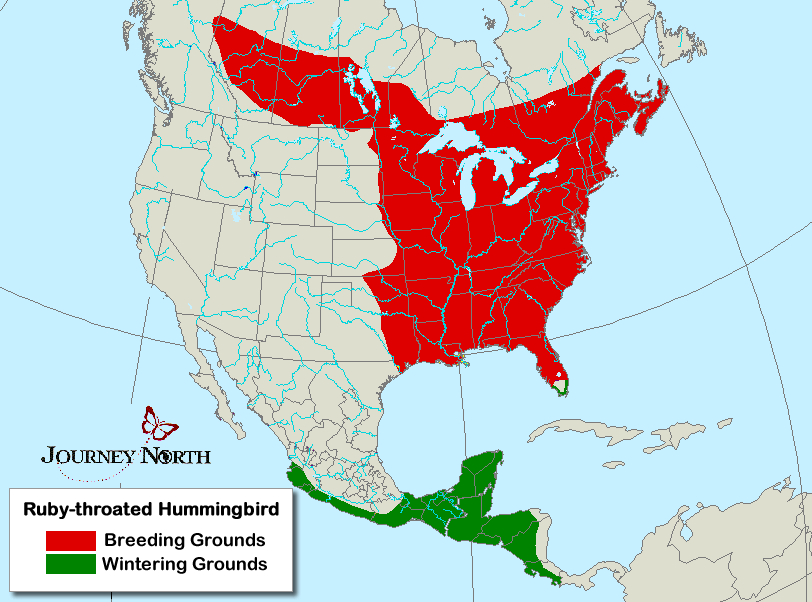 Ruby-throated Hummingbird Range Map courtesy Journey North


Carolyn Mostello, the Massachusetts Coastal Waterbird Biologist
Last week I has the opportunity to attend the Massachusetts Coastal Waterbird Cooperators’ Meeting. The meeting is held annually to bring together people and organizations that are involved with population monitoring and conservation efforts on behalf of coastal waterbirds.
Representatives from the seven Massachusetts coastal regions gather to share information, anecdotes, and data collected throughout the season. This year the meeting was held at Audubon’s stunning Barnstable Great Marsh Wildlife Sanctuary; hosted by Audubon staff and Carolyn Mostello, the Massachusetts Coastal Waterbird Biologist.
 American Oystercatcher chicks
Threatened and endangered species such as Least Terns, Piping Plovers, Roseate Terns, and American Oystercatchers are given the greatest attention.
It’s fascinating to learn how we are all sharing similar experiences including egg predation by Crows, gulls, and Coyotes, disturbances of all shapes and kinds, low egg hatching, and storm washouts. Carolyn directs the event and she does an extraordinary job of weaving all the information together.
Reporting population numbers is followed by “Strange and Unusual,” a super fun section where field agents share funny/odd occurrences, photos, and videos. A special tribute was given to honor Shiloh Schulte, who perished in a tragic helicopter crash while studying shorebirds in Alaska. Shiloh Shulte was a beloved friend and mentor to shorebird conservationists every where and one of the coordinators for the American Oystercatcher Recovery Program. You can read more about Shiloh and his work HERE.
The afternoon programs are especially interesting with presenters sharing experiments, projects, and best practices, including two of special interest to our region; one on launching in-depth data collection on fireworks, and best practice for engaging with landowners. All the programs are wonderfully educational.
Handicapped Mom and Super Dad’s second attempt at nesting
Despite an extremely challenging year, largely due to the fact that most of the nests around the State were washed out in a late spring storm, perhaps the most outstanding take-away is that this year again, Massachusetts is at the leading edge edge of Piping Plover recovery. We should be super proud of our state. While many regions are seeing very little, none, or even worse, declining numbers, Massachusetts is leading the way in Piping Plover recovery!


Dear PiPl Friends,
I hope you are having a lovely summer. I am so looking forward to these last three weeks of August and then we go into the wonderfully atmospheric months of September and October. Is there anywhere in the north Atlantic region where these months aren’t sublime?
I have held off on writing about PiPls all summer because we have had some very late season nesters. I’ll share an extensive report about the Plovers when I feel its safe for them and they are well on their way to fledging. In the meantime, I am very delighted to write that our Piping Plovers of Moonlight Bay has been accepted to the New Hope Film Festival and is screening on Monday, August 18th at 6:00pm. We are sharing the billing with another animal welfare documentary, The Ramba Effect, about an Asian Elephant and her 2,550 mile journey to her new home at an elephant sanctuary. If you are in the New Hope area and would like to see The Piping Plovers of Moonlight Bay and The Rhamba Effect, please go here: https://www.goelevent.com/NewHopeFilmFestival/e/AnimalWelfareDocumentaries
For the NHFF official program guide, please go here: https://online.flippingbook.com/view/102134961/
We also have all new Plover Lover T-shirts in all sizes and a great color, a sort of light sea green. For fans of West Coast Snowy Plovers, these chicks could easily pass for Snowy Plovers too. Please let me know if you like the new color. They are a beautiful quality, all cotton, unisex sizing from xs to xl. The Tees are 30.00 plus 5. shipping.

We have had some adorable “Butterballs” on the beach this summer. I define a Butterball as a fledgling that is so pudgy it looks nearly as big, if not bigger, than its parent and barely seems as though it can become airborne. Rest assured these Butterballs do fly, eventually <3
 Common Tern fledgling squawking to parent, “Feed Me, Feed Me, I’m Starving!”
Happy Summer,
xxKim

Great Black-backed and Herring Gulls are the species most commonly seen in our region. And both species pose a deadly, serious threat to Piping Plovers.
The gulls eat both Plover eggs and chicks. It’s not just tiny hatchlings they go after. We have seen Great Black-backed Gulls swoop in and take out a 25 day-old nearly-adult bird.
Plover parents employ several strategies for trying to prevent this from happening. They often call to their mate to come help and both will try to avert the gull’s attention. A Plover may drag its wing on the ground, faking injury in hopes of luring the gull away, or it may dive bomb the gull, or latch onto its tail feathers, and all the while making an angry, loud rattling call. Usually, the parents are successful, but not always.
In the above sequence you can see both parents left the chicks unattended in order to distract the gull. This tag teaming is usually very effective and the Herring Gull left after a short time. Mom ran back to back to locate her babes, calling to the chicks to rejoin her, and soon the two chicks were thermo-snuggling beneath Mom’s protective wings.
Sometimes it takes a gull many minutes to lose interest and the chicks become increasingly vulnerable to predation. In our documentary, The Piping Plovers of Moonlight Bay, a Herring Gull swooped off with a chick. Despite the parents best attempts to save their offspring, the Gull mortally wounded both the adult male and the chick.
What is the Number 1 way you can help? – Please Don’t Litter
Prior to 1931, Herring and Great Black-backed Gulls did not breed in Massachusetts and were not present year round. Their populations increased significantly during the 20th century because of the food resource available from landfills. They also prey on other birds and their eggs, and compete for nesting sites.
Great Black-backed and Herring Gulls are scavengers and thrive on the trash left behind on beaches. Never feed the gulls on the beach. Please do not leave behind garbage and please do not bury trash. Gulls will find the garbage, as will the Crows, which are another species that is equally as threatening to nesting shorebirds as are Herring and GBBGulls.

Dear PiPl Friends,
I am behind in providing updates and I apologize for that. Frankly, with the scale of all that is so very dark currently taking place in our country, I struggle with focusing on what is positive and good in the world of wildlife. Fortunately for them they know none of this. Happy news to share is that our Good Harbor Beach Plovers are recovered from the very late season nor’easter and are back on track with nesting activities. Not only Gloucester Plovers, but Plovers all around the region are regaining their bearings after the catastrophic loss of nests and habitat.
Plovers will re-nest (in other words, lay another clutch of eggs) as much as 3 to 4 times and in some extreme cases, have been known to re-nest 7 times. We always hope the first clutch is successful for several reasons. The earlier in the season the chicks hatch, the earlier they will fledge and be off the beaches. It is also very taxing on the female to lay additional eggs. Conservation biologists are very protective of breeding pairs, in a way even more so than chicks, because pairs that are known to breed are the birds that will carry on the species.
Wonderful news for our documentary The Piping Plovers of Moonlight Bay, which has been accepted to the New Hope Film Festival, a truly stellar festival founded by a gentleman Doug Whipple, with the intention of highlighting independent filmmakers. New Hope sounds like a fun boho arts community and I am looking forward to attending this festival. The dates are August 15-24th and as we get closer to the event, I’ll let you know more.

Rockport Middle Schoolers Cora and Juniper reached out to me for information about Piping Plovers for a project they were working on for their civics class. Don’t you love that Plovers are part of a civics discussion! I was delighted to help the girls with their project. They did an absolutely fantastic job and with permission, I am sharing the storyboard they put together for their presentation. Many thanks to Juniper and Cora for their interest in Plover conservation. I have been inspired by the two of them to create a shorter program for middle school kids as an hour long film presentation is suitable for high school, but the class periods are shorter in middle school from what I have learned.

My friend Jane in Nova Scotia shares an amazing ‘Plover Resiliency’ photo – the Plovers in her community are nesting at the TOP of the breakwater. The pair have found a tiny bit of grass and sand amidst the rocks. In case you were wondering, as was I, she reports that the tide never goes that high.
And my new Plover friend, Rhonda, in Ocean City, New Jersey, shares that their chicks have hatched and are doing well. Like Good Harbor Beach, the beach where their Plovers are nesting is also a highly trafficked location and has been consistently voted New Jersey’s most popular beach. Rhonda organized a screening of POMB with a virtual QandA at the Ocean City Public Library and the audience was so engaged. It was an utter joy to present to this very enthusiastic crowd. You can read more about the screening here: Ocean City Has Some Good Things to Say About The Piping Plovers of Moonlight Bay
That’s all the Plover news for now. Happy Sunday!
xxKim
