I am in the process of organizing photos for my upcoming season of garden design lectures and am enjoying looking over the past year in photos. This was my first year with the Fujifilm x100 and the photo of the flowering quince below was one of the first photos I took with the x100. I do love my camera!
Chaenomeles speciosa ‘Toyo-Nishiki’
Coaxing Winter Blooms
From mid-February on is the recommended time to prune members of the copious Roseaceae (Rose family) and their cut branches create stunning arrangements. The bare limbs dotted with five-petalled blossoms are particularly evocative juxtaposed against the cool, low light of winter. I am picturing the plum rose of Prunus cerasifera‘Thundercloud,’ the vivid pink of peach blossoms, the elegant sparkling white blossoms of apricot trees (Prunus armeniaca), and the brilliant fiery red-orange ‘Texas Scarlet’ Japanese flowering quince illuminating the rooms in which they are placed. I have to say my favorite of favorites is Chaenomeles speciosa ‘Toyo-Nishiki,’ with buds swollen and ready to burst by mid-winter and flowering in multiple hues of white, rose, and apricot pink, the beauty of their blossoms emphasized by the sharply zigzagging branches.
Note: Flowering quince provides nectar for northward migrating hummingbirds. It is not too early to put out your hummingbird feeders.
More information about Chaenomoles ‘Toyo-Nishiki’ may be found in Chapter Three, “Planting in Harmony with Nature,” Oh Garden of Fresh Possibilities!
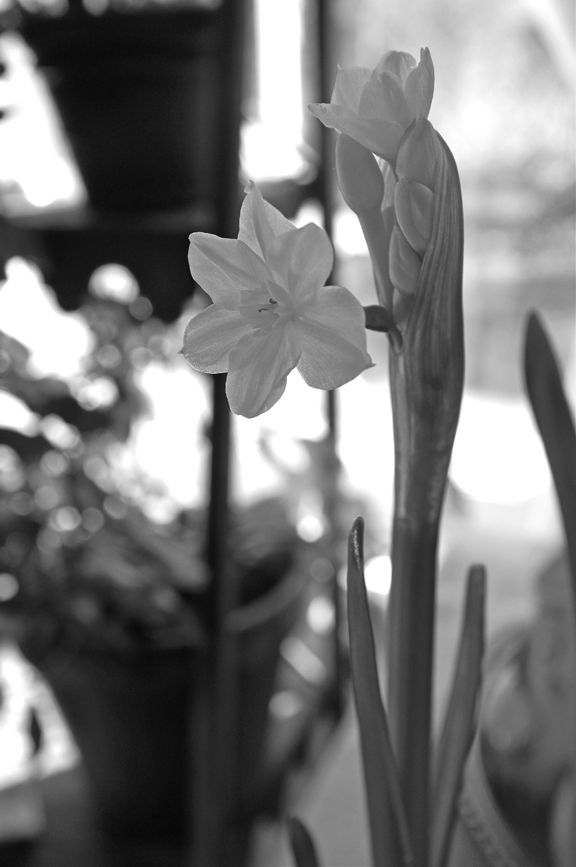
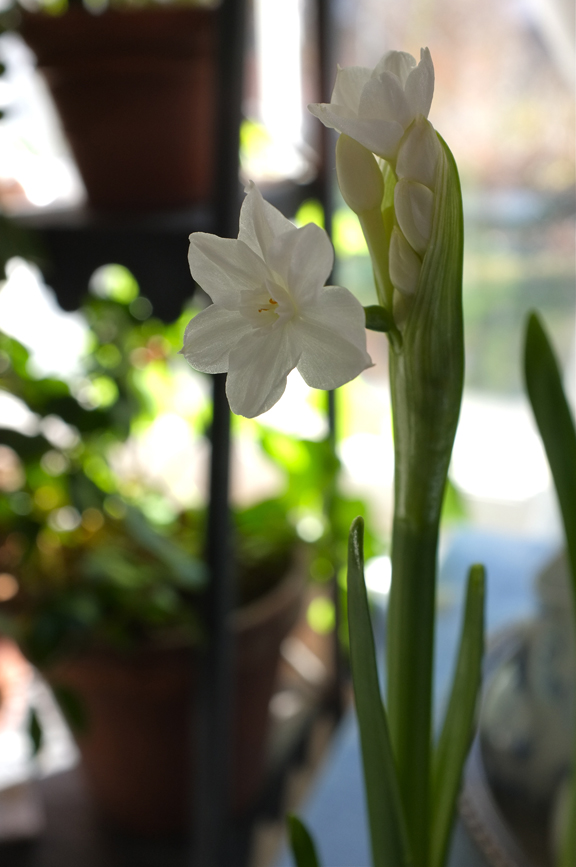
Which version do you prefer, black and white or color?
Beginning in November, we maintain a continuous flow of blooming narcissus by planting a new batch every two weeks or so. Paperwhites ‘Ziva’ blooms before the first of the year and ‘Galilee’ just after the holiday season. The ‘Chinese Sacred Lily’ (Narcissus tazetta var. orientalis) is almost as easy to force and has a sweeter, though no less potent fragrance. The scent is a dreamy blend of orange and honeysuckle. They are also a member of the tazetta group bearing multiple blossoms atop slender stalks, with white petals and cheery yellow cups. The ‘Chinese Sacred Lily,’ brought to this country by Chinese immigrants in the late 1800s, is traditionally forced to bloom for New Year’s celebrations.
With both paperwhites and ‘Chinese Sacred Lilies,’ place the bulbs in bowl or pot and cover with stones. The emerging green tips should be poking though the stones. Water up to the halfway point of the bulb and place in a cool dark room; an unheated basement is ideal. Water periodically and within a week or so, new growth will be visible. Then place the bulbs in the room away from strong light, continue to water as needed, and once in bloom, they will flower and scent your home for a week or more. Illustrations of paperwhites and the Chinese Sacred Lily, as well as the complete chapter, can be found in Oh Garden of Fresh Possibilities! Notes from a Gloucester Garden (David R. Godine, Publisher).
Amaryllis ‘Orange Sovereign’ will be in full bloom by Christmas Day!
For tips on coaxing winter blooms, including forcing bulbs and flowering tree and shrub branches, see Oh Garden of Fresh Possibilities! David R. Godine, Publisher.
It’s that time of year again for holiday gift making and gift giving. Possibly you are one of those fantastically super organized holiday spirits finished with your holiday shopping, or even more probably, you’re not in the mood for another holiday commercial. If so, please forgive, but I am writing to suggest that my book Oh Garden of Fresh Possibilities! ~ Notes from a Gloucester Garden, which I both wrote and illustrated, makes a wonderful holiday gift. If you already own a copy, perhaps you will agree that it would make a thoughtful gift for that someone on your list who loves to garden, or a young couple who may have recently purchased a home and needs sound advice, or someone who simply likes to read about flowers, butterflies, garden lore, and garden-making.
This is a link to the Press Page of my blog, where you can read excerpts of reviews by The Boston Globe’s Carol Stocker, Bloomsbury Review, Patriot Ledger, North American Butterfly Association, and more. With spending any spare hours blogging and with my video projects and garden design newsletter, I am embarrassed to say that my website has not been updated in over a year, however, both the Book Page and Story Page on my website provide more information about Oh Garden!
Oh Garden of Fresh Possibilities!~ Notes from a Gloucester Garden is available at Toad Hall, and wherever fine books are sold.
Excerpted from the introduction ~
We all carry within us the image of a home to create and a garden to tend. Perhaps you dream as I do of a welcoming haven to foster family bonds and friendships and to rejoice in life’s journey. The garden and the home to which it belongs becomes a memory catcher to weave a life’s tapestry.
To imagine a garden paradise one must live in one’s home to listen to its own particular music. Gradually, by degrees, the idea of the garden will grow. A home and a garden should look as though they had grown up together and will when one takes the time and necessary thought. A garden cannot be hurriedly created. Delicious, blissful pleasure is derived from the garden’s use as a continuation of the home.
Our gardens provide a safe harbor from hectic lives, a place to celebrate life and an opportunity to express our creativity. The garden is an inviting sanctuary to guide one through the rhythms and harmonies of the natural world. Planted to nurture the imagination and hearten the soul, a “new” cottage garden is a whimsical, exuberant intermingling of scented flowers and foliage, fresh fruit, and savory herbs.
As a designer, I believe I am here to channel ideas for the benefit of many. This book is my communication of a profound desire to share with readers the immeasurable joy gleaned from creating a personal paradise of one’s own making.
The illustrations are of flowers, songbirds, and butterflies I love to draw and to paint, and selected because they only become more beautiful when intimately observed.
A poetic world lies waiting to be discovered. Let us open the garden gate and take a step within.
And Joe Garland’s lovely blurb for the book’s jacket:
“Drawn by the tender magic of her brush, one feels somehow renewed under the spell of the author’s singular warmth as we stroll within these pages in the intimacy of the secret garden she reveals.”
This past week I gave my Monarch butterfly program to the very interested and very interesting women of the Cape Ann Garden Club; next week I am presenting a simplified version to a group of pre-school children. It comes as no surprise to me that the beautiful life story of the Monarch is as equally enthralling to the young as it is to the young at heart!
Yellow–the color of summer–of sunlight, warmth, and joy. Did you know that yellow daylilies can be fragrant? If you are interested in creating a border of sequentially blooming species daylilies, read Chapter 16 in my book Oh Garden of Fresh Possibilities! where you will find the most comprehensive list of different species of highly fragrant yellow daylilies. I leave you with this photo of the fabulously scented–of honeysuckle and citrus–yellow daylily ‘Hyperion.’
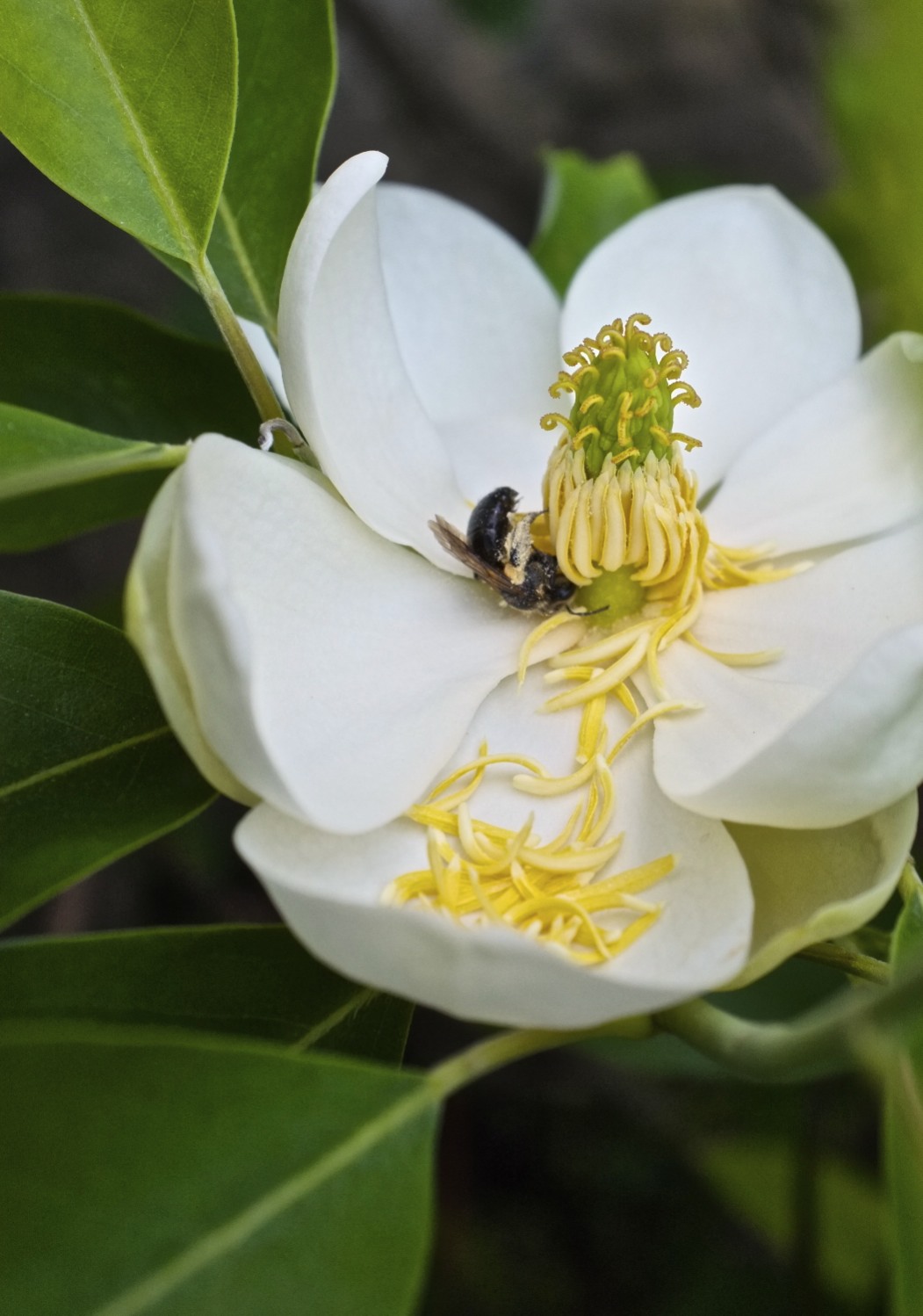
Located in the heart of Ravenswood Park in Gloucester there is a stand of Magnolia virginiana growing in the Great Magnolia Swamp. It is the only population of Magnolia virginiana known to grow this far north. I took one look at the native sweet bay magnolia and breathed in the fresh lemon-honeysuckle scent of the blossoms, fell in love, and immediately set out to learn all I could about this graceful and captivating tree. Recently having returned from a trip to visit my family in northern Florida, I had tucked the bud of a Magnolia grandiflora into my suitcase. I was dreaming of someday having a garden large enough to accommodate a Magnolia grandiflora and was overjoyed to discover the similarities between M. virginiana and M. grandiflora. For those not familiar with the Southern magnolia, it is a grand, imposing specimen in the landscape, growing up to fifty feet in the cooler zones five and six, and one hundred feet plus in the southern states. M. grandiflora is the only native magnolia that is reliably evergreen in its northern range, flowering initially in the late spring and sporadically throughout the summer. The creamy white flowers, enormous and bowl-shaped (ten to twelve inches across), emit a delicious, heady sweet lemon fragrance.
In contrast, the flowers of the sweetbay magnolia are smaller, ivory white, water-lily cup shaped, and sweetly scented of citrus and honeysuckle. The leaves are similar in shape to the Magnolia grandiflora, ovate and glossy viridissimus green on the topside, though they are more delicate, and lack the leathery toughness of the Southern magnolia. The lustrous green above and the glaucous silvery green on the underside of the foliage creates a lovely ornamental bi-color effect as the leaves are caught in the seasonal breezes.
Magnolia virginiana is an ideal tree for a small garden in its northern range growing to roughly twenty feet compared to the more commanding height of a mature Southern magnolia. Sweet bay grows from Massachusetts to Florida in coastal freshwater wetland areas as an understory tree. The tree can be single- or multi-stemmed. Sweet bay is a stunning addition to the woodland garden with an open form, allowing a variety of part-shade loving flora to grow beneath the airy canopy. The leaves are a larval food for the Eastern Tiger Swallowtail butterfly. Almost immediately after planting we began to notice the swallowtails gliding from the sunny borders of the front dooryard, where an abundance of nectar-rich flowers are planted specifically to attract butterflies, around to the shady border in the rear yard where our sweet bay is located.
Our garden is continually evolving and part of our garden has given way to a limited version of a woodland garden, for the shady canopy created by the ever-growing ceiling of foliage of our neighbor’s trees has increasingly defined our landscape. We sited our Magnolia virginiana in our diminutive shaded woodland border where we can observe the tree from the kitchen window while standing at the kitchen sink. Gazing upon the tree bending and swaying gracefully in the wind, displaying its shifting bi-color leaves, provides a pleasant view when tending daily chores and the dreamy fragrance emitted from freshly opened blossoms make the chores all that less tiresome.
Excerpt from “Oh Garden of Fresh Possibilities!” Notes from a Gloucester Garden (David R. Godine Publisher), written and illustrated by Kim Smith.
Magnolia virginiana in Massachusetts written by Peter Del Tredici.
History
The sweet bay magnolia swamp in Gloucester, Massachusetts has been a botanical shrine since its discovery in 1806. Early New England naturalists and botanists of all types, from Henry David Thoreau to Asa Gray, made pilgrimages to the site of this northern- most colony of Magnolza virginiana. The local residents of Gloucester were so impressed with a “southern”plant growing this far north that they changed the name oft he Kettle Cove section of the town to Magnolia in the mid-1800s. It is probably no coincidence that this name change occurred at the same time the area was starting up its tourist trade.
In addition to its isolation, the Gloucester Magnolia population was remarkable for having escaped notice until 1806 in an area that was settled in 1623. This fact has led at least one author to speculate that the colony was not wild but escaped from a cultivated plant (Anonymous, 1889). However, the overwhelming consensus of earlier botanists is that the population is, in fact, native. Whatever its origin, the swamp remains today the unique and mysterious place it has been for almost 200 years.
Very little has been written about the magnolia swamp in recent years. The latest, and best, article about it was wntten by Dr George Kennedy, and appeared in 1916 in Rhodora, the Journal of the New England Botanical Club. Dr. Kennedy summarized the history of the stand, and cleared up the confusion about who discovered it by publishing a letter he found, written by the Honorable Theophilus Parsons to the Reverend Manassah Cutler in 1806. The letter captures the emotion of the moment of discovery:
Reverend and Dear Sir:
In riding through the woods in Gloucester, that are between Kettle Cove and Fresh Water Cove I discovered a flower to me quite new and unexpected in our forests. This was last Tuesday week [July 22, 1806]. A shower approaching prevented my leaving the carriage for examination, but on my return, on Friday last, I collected several of the flowers, in different stages, with the branches and leaves, and on inspection it is unquestionably the Magnolia glauca Mr. Epes Sargent has traversed these woods for flowers and not having discovered it, supposes it could not have been there many years. It was unknown to the people of Gloucester and Manchester until I showed it to them. I think you have traversed the same woods herborizing. Did you dis-cover it? If not, how long has it been there? It grows in a swamp on the western or left side of the road as you go from Manchester to Gloucester, and before you come to a large hill over which the road formerly passed. It is so near the road as to be visible even to the careless eye of the traveler. Supposing the knowledge of this flower, growing so far north, might gratify you, I have made this hasty communication.
Your humble servant, Theoph. Parsons
To read Mr. Del Tredici’s fascinating article in full click here Magnolia virginiana in Massachusetts, including an excerpt from when Henry David Thoreau visited the swamp and wrote about it in his Journal.
Peter Del Tredici is a Senior Research Assistant at the Arnold Arboretum and Lecturer at Harvard Graduate School of Design. Peter writes the following for the Arnold Arboretum: “My research interests are wide ranging and mainly involve the interaction between woody plants and their environment. Over the course of thirty plus years at the Arnold Arboretum, I have worked with a number of plants, most notably Ginkgo biloba, conifers in the genera Tsuga and Sequoia, various magnolias, and several Stewartia species (family Theaceae). In all of my work, I attempt to integrate various aspects of the botany and ecology of a given species with the horticultural issues surrounding its propagation and cultivation. This fusion of science and practice has also formed the basis of my teaching at the Harvard Graduate School of Design (since 1992), especially as it relates to understanding the impacts of climate change and urbanization on plants in both native and designed landscapes. Most recently, the focus of my research has expanded to the subject of spontaneous urban vegetation which resulted in the publication of “Wild Urban Plants of the Northeast: A Field Guide” (Cornell University Press, 2010).”
Beauty on the Wing ~ Life Story of the Monarch Butterfly
In preparing for my upcoming presentation to the Gloucester Garden Club, Wednesday, April 13th, I am discovering new images shot last summer. The photo shows a freshly emerged Monarch clinging to its chrysalis, with crumpled wet wings yet to fully expand. Butterflies Days can’t get here soon enough! Later in the afternoon we will be attending Ellen Lefavour’s art opening and book signing for Did you Know at Alchemy of Art Gallery. I hope to see you there.
My deepest thanks and appreciation to Pat Leuchtman for her wonderful review. Pat has been writing a weekly garden column for The Recorder in Greenfield since 1980. She has been blogging for the past several years and has posted and archived all her columns on her blog Commonweeder. Read more of Pat’s review and spend time perusing her blog, which is brimming with useful information, book reviews, insights, and missives– all beautifully organized.
Pat’s Review: Fresh Possibilities are just what I am looking for at this time of the year, so it is no surprise that I have been spending happy evenings with Kim Smith’s beautiful book that includes so many of her own delicate paintings of flowers, birds and butterflies.
Kim Smith gardens, and paints, in Gloucester. Over the years her garden has grown, as has her concern about conservation and her delight in the roads to literature and art that her garden has opened to her. Oh Garden of Fresh Possibilities: Notes from a Gloucester Garden (David R. Godine Publisher) combines all these aspects of her life in the garden in the most beautiful way.
With its delicate paintings of individual flowers, and butterflies, the book does not look like a how-to book, yet it includes plant lists to attract butterflies, of fragrant flowers and plants through the seasons, seasonal blooms and useful annuals. I can hardly decide which I enjoy more, the charming prose of chapters titled The Narrative of the Garden, Flowers of the Air and The Memorable Garden, the exquisite paintings, or the poetry that ranges from our own Emily Dickinson and Dorothy Parker to Li Bai (701-762 CE), a famous Chinese poet of the Tang Dynasty. I enjoy knowing that Kim has found the same delight in the connections to history and the arts that I find in the garden.
One of the two chapters I particularly found useful as well as beautiful right now is Flowers of the Air which includes information about a variety of butterflies, and the plants that they need for their life cycle. We have to remember that butterflies are not only lovely, they are important pollinators.
It is no surprise that I also enjoy Roses for the Intimate Garden. Kim’s climate is a bit more gentle than mine and she can grow more tender roses that I can, but we are both devoted to the fragrance that roses bring to our gardens and to the uncorseted exuberance of old fashioned roses.
If you want information, but also want the kind of delicious prose you find in evocative essays, an aesthetic sensibility, and beautiful illustrations, this is the book for you. Kim is an inspired gardener and writer, but she isn’t stopping there. Watch for more news about Kim and her latest project soon.
Music to my Ears: The following note is from my dear friend Kate Hines who built a beautiful home on a lovely piece of property—former farmland that borders the lush and fertile Rhode Island coastline. Thank you Kate for sharing!
“I was so inspired reading the section you wrote on hollies in Oh Garden of Fresh Possibilities! that I went to the local nursery and ordered 2 – a female 6′ and a male 5.’ Now they are mixed in with the evergreen grove to the north of the house. They were costly, a big project but soooooo satisfying! Ill send pix.”
XOXO KH
Oh Garden of Fresh Possibilities! makes for a very useful gift for the gardener (and loved-ones dreaming of creating a garden) on your holiday gift giving list. Last year at this time Carol Stocker, the Boston Globe garden columnist wrote the following about Oh Garden:
Oh Garden of Fresh Possibilities!
Boston Globe Best of 2009
For Armchair Gardeners Pining for Spring
“Bleak and snowy outside? These lush reads will have you dreaming green. January and February are the reading months for gardeners trapped indoors. Here are some of the best garden books from 2009. “Oh Garden of Fresh Possibilities! Notes From a Gloucester Garden,’’ written and illustrated by Kim Smith (David R. Godine, Publisher), is a treasure, and perhaps the best garden gift book. Why? Both dream-like and practical, it captures the rapture of a gardener’s journey through her own evolving quarter acre by integrating Smith’s personal essays, hands-on advice, and paintings. I was charmed by her listing of specific scents of favorite peony varieties accompanied by a painted sample of their petal colors…”
Oh Garden of Fresh Possibilities! Written and Illustrated by Kim Smith. Available through your local bookseller, David R. Godine, Publisher, and Amazon.
Inside a moment’s time, the exoskeleton behind the caterpillar’s head splits apart. With undulating wave-like contractions the developing green chrysalis is revealed as the exoskeleton shrivels. With rhythmical repetitious revolutions, twirling first left, then right, and back again, he throws off his last striped suit. More gyrating rotations and he fastens himself securely to the pad of silk with his newly formed cremaster.
Recently a friend inquired that if I had to choose one native New England plant to grow to attract butterflies to the garden, which would it be, and why. It was a challenging question because butterflies are typically drawn to the garden planted with a rich and varied, yet very specific, combination of species. A successful Lepidoptera habitat is comprised of many elements all working in tandem. Sunny and protected areas in which to warm their wings, trees and shrubs that provide shelter, and a host of nectar plants for the adults, as well as specific caterpillar food plants, create the successful Lepidoptera garden.
Perhaps if I had to choose a favorite butterfly and therefore a favorite plant to grow to drawthis butterfly to my garden it would have to be common milkweed (Asclepias syriaca), which is both a larval host plant and nectar plant for the elegant Monarch butterfly. People often speak unkindly about common milkweed, rather I think it deserves applause for it is plant without rue and thrives wherever found—in the cracks of city sidewalks and along country roadsides, highly-trafficked soccer fields, and in the most neglected of neighborhoods. Whether in the garden, along the shoreline, or local meadow, it is on the foliage of common milkweed that we find the vast majority of Monarch eggs and caterpillars. Noteworthy also is that we observe many different species of butterflies and skippers nectaring at common milkweed—sulphurs, swallowtails, and fritillaries, to name but a few. In our garden we grow common milkweed alongside marsh milkweed (Asclepias incarnata); marsh milkweed blooms slightly earlier than common milkweed as it is sited in a sunnier locale. Both species attract a wide variety of winged pollinators. Male and female Monarchs nectar from the blossoms, while the males simultaneously patrol for females. The females utilize the foliage of both species to oviposit their eggs. Typically we observe females freely flitting alternatively between our common and marsh milkweed, depositing their eggs on the choicest leaves and buds, while pausing frequently to nectar.
Monarch Butterfly Egg on Common Milkweed Leaf
The milky sap that flows through milkweed veins lends the genus its common name. Monarch butterflies and their caterpillars have evolved to withstand the toxic milk, but not the predatory bird that attempts to eat one. The adult Monarch’s unique wing pattern and caterpillar’s striped suit warn of its dreadful taste and lethal toxins. A bird that is tempted becomes sick and may even die, and if it survives, remembers never again to try to eat a Monarch. “The larvae sequester cardiac glycosides from the milkweed leaves that they consume. Concentrations of these heart toxins in their bodies may be several times higher than those occurring in milkweed leaves. The glycosides consumed by the caterpillars are carried forward both into the chrysalis and adult stages, affording them protection as well.” (Caterpillars of North America David L. Wagner).
Common milkweed is highly adaptable and grows in nearly any soil. The size of the developing colonies and individual plants reflect the conditions in which it is grown. Planted in a rich, moist soil, protected from the wind and where it receives some light shade, it will grow six to seven feet. I use it extensively in my butterfly garden designs, planting in rich, average, and dry conditions, and find it especially appealing and useful for shoreline gardens. In sandy soil, sand dunes, and meadows, where it is exposed to wind and/or salt spray, common milkweed is equally as vigorous, but of a much shorter stature, typically obtaining the height of two to three feet.
A. syriaca thrives in full sun to light shade. In a moist, protected area, plant in the back of the border. In a more exposed site, plant in the mid-ground. Because of its ability to spread readily and rapidly, use in an informal, natural setting as opposed to planting in formal beds.
Common milkweed is highly fragrant and is the most richly scented of the species of milkweeds found in Massachusetts (A. incarnata, A. syriaca, A. quadrifolia, A. tuberosa, A. amplexicaulis, A. exaltata, A. pupurascens, and A. verticillata), with a complex wild flower honey fragrance. I have heard it described as similar to the scent of lilacs, but find lilacs have a much sweeter fragrance than common milkweed. Fragrance is highly mutable and subjective.
One- to two-year-old plants are easier to transplant than established plants. Common milkweed takes approximately three years to flower from seed. The method in which I have had the greatest success in propagating Asclepias syriaca, best attempted in early summer, is to dig up a rhizome, found at the base of a plant with newly emerging shoots. The rhizome would ideally be obtained from a friend’s garden. If collected in the wild, be sure to dig from an area where there are many shoots present. You need a fairly large chunk, at least a half-foot, with both roots and new shoots present. Replant the rhizome at the same depth. Water throughout the summer. Towards the end of the growing season you will be rewarded with newly emerging shoots. Common milkweed self-seeds readily, but spreads primarily (and rambunctiously) by its rhizomatic root structure.
Milkweed in general, and in particular, common milkweed, attracts a host of pollinators—bees, wasps, butterflies, and purportedly hummingbirds. I have yet to see the Ruby-throated hummingbird nectar from common milkweed, but it may also be the case that they are attracted to the plant for the multitude of tiny insect populations frequenting the flowers (over ninety percent of a Ruby-throated hummingbird’s diet is comprised of insects). We typically findMonarch eggs and caterpillars on milkweed plants during the months of July and August.
Buddleia davidii ’Nanho Blue,’ with blue-violet racemes, melds beautifully with the muted lavender rose florets of the softly drooping flower heads of common milkweed. The brilliant white of native Phlox davidii and vivid purple-pink of Liatris ligulistylus attractively offsets both. All are famously attractive to Monarchs (and myriad other species of Lepidoptera) and will provide a long season of nectar-rich blossoms and Monarch caterpillar food.
Monarch Butterflies Mating on Common Milkweed Leaves
A note about the video: Monarch butterflies deposit eggs on common milkweed (Asclepias syriaca) and marsh milkweed (Asclepias incarnata) in eastern Massachusetts. The chrysalis in this video was attached to a marsh milkweed stem. For a wealth of information on butterfly gardening, read Oh Garden of Fresh Possibilities!
Thank you Jennifer for this truly generous, insightful, and thoughtful review of my book. Jennifer writes: “…What a gift, then, to read Kim Smith’s Oh Garden of Fresh Possibilities! Notes From A Gloucester Garden. Using her own small garden as a backdrop, Smith deftly guides her reader along every stage of cultivation — from quiet observation, through planning and planting, and finally among the blooms — sharing successes, failures, and surprises along the way. Bursting with information, yet much more than a how-to guide, Oh Garden reads like a meditation. Smith envelops the senses with lyrical prose and exquisite watercolor illustrations, infusing poetry and wisdom from across the ages to tap into the soul of the gardener — which insists that the garden’s beauty stems not from finished product, but from the cultivation itself…” To read Jennifer’s full review go to Boston Mamas.
~
Do you know about the wonderful blog Boston Mamas? I wish there had been a Boston Mamas blog when our children were young. Founded in 2006, Chrisitne Koh has a passion for people, communication, art, food, retail, web-surfing, and all things mama-related.
Save the dates of Friday, June 4th through Saturday, June 5th for the first ever Cape Cod Rhododendron Festival and Garden Tours, presented by the Heritage Museums and Thornton W. Burgess Society of Sandwich, MA. I will be there both days with my book Oh Garden of Fresh Possibilities! and speaking about habitat gardening at 11:00 on Friday. Much more information and updates to follow. This promises to be a beautiful event!
Rhododendron vaseyii and Carpenter bee photographed at the Arnold Arboretum, Boston
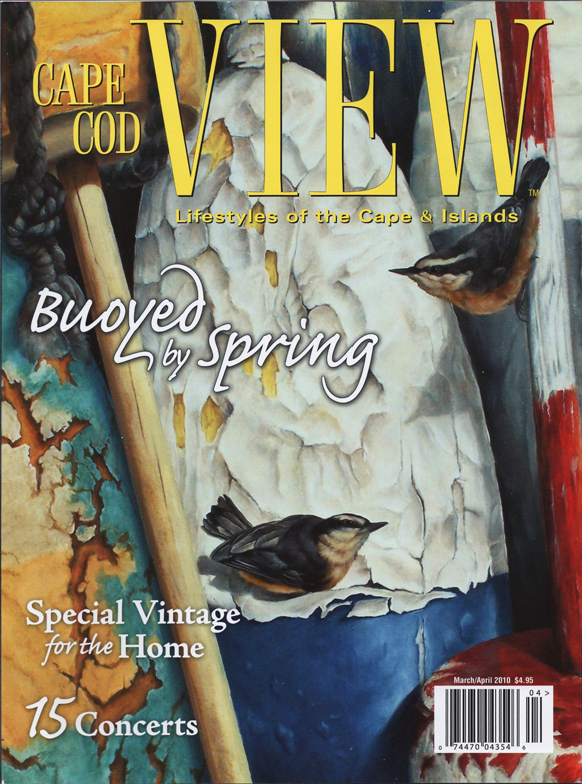
Thank you North and Susan for the wonderful article about myself and fellow garden writer C.L. Fornari that appeared in the March/April issue of Cape Cod View!
North Cairn, editor-in-chief of CCV, writes the following on her editorial page “The View from My Desk:”
“…The Chinese proverb announces that “spring is sooner recognized by plants than men,” but perhpas not when the winter-weary soul finally reawakens to the memory of such glories as the spring ephemeral flowers and the chance to get into the backyard, into the unkempt perennial bed, tousled by the winter winds… It’s all in your point of view – in open eyes and hearts, willing to see the beauty and gifts that reside everywhere; in our homes and favorite outings, among families and friends; in discovery and memory – and the chance for remembrance and renewal that returns each spring.”
Magazine cover painting by Aleta Steward of Harwich

 Chaenomeles speciosa ‘Toyo-Nishiki’