Tag Archives: Dutchman’s Pipevine

PIPEVINE SWALLOWTAIL CATERPILLARS HATCHING!

Our beautiful Mom Pipevine Swallowtail left several clutches of eggs and both hatched yesterday. They are so teeny tiny, but I think there are about 25 caterpillars in all.

She laid several additional clutches over a period of several days and these batches are way up in the treetops. Good thing our Pipevine plant is so vigorous, possibly about 15 feet high, with still plenty of growth left in it for the season.

The eggs were oviposited on August 13, emerging on the 20th – a one week gestation period.

WOWZA! Doing a Victory Dance for Mama Pipevine!

The stunning Pipevine Swallowtail that you see in the video is depositing a clutch of several dozen eggs. Her gift represents a success for me of sorts. Years ago, we had a Pipevine Swallowtail in our garden, a male, and he was investigating the heart shaped leaves of our Moonvine. I made a promise to the Pipevine Butterflies that the next time they made it this far north, I would have a Pipevine growing in the garden on which a traveling female could deposit her eggs. I can’t resist but to add – not a “pipe dream after all!”

You see, Dutchman’s Pipevine is one of the few caterpillar food plants of the Pipevine Swallowtail that grows well in northern climates. Like the Moonvine, the leaves of the Dutchman’s Pipevine are large and heart-shaped.

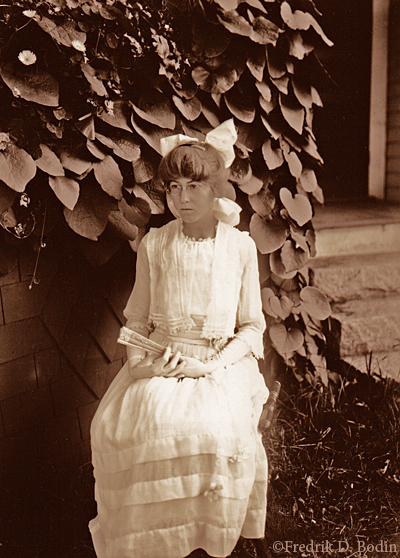
A hundred years or so ago, Pipevine Swallowtails regularly occurred in New England because people planted Dutchman’s Pipevine to embower their porches. In one season, the vine can grow two stories high and equally as wide, providing lush green cooling shade on a hot summer afternoon. When you look at old photographs of porches in New England, most often it’s Pipevine climbing up the porch pillars and along the roof. With the advent of air conditioning, folks no longer needed to plant Dutchman’s Pipevine to cool their homes The vine, and the butterflies, were forgotten.

Julia Lane, later Julia Wheeler, posed for Alice M. Curtis on August 12th, 1915, in Gloucester. Photo courtesy Fred Bodin.

Our visiting Mama Pipevine cautiously investigated the entire plant from top to bottom, fluttering in and out of the large leaves before deciding on this tiny tender leaf to deposit her treasure trove. We had a female come to our garden about ten years after the vine was planted. She deposited a clutch of eggs however, a tiny spider ate them all, every single one. I am not taking any chances this time and placed  the stem with the eggs in a terrarium, covering the terrarium with several layers of cheesecloth, and a wire screen, in hopes of keeping the spiders out.

If you would like to attract the exquisite Pipevine Swallowtail to your garden, plant Dutchman’s Pipevine. It’s an enthusiastic grower, but no need to worry, you can cut it all down to the bare ground after the first frost and it will come back just as beautifully and plush the following spring.

From an older post – Plant! and They Will Come

Nearly five years ago, in late September 2007, I photographed a male Pipevine Swallowtail Butterfly (Battus philenor) nectaring in my garden. I found mesmerizing its dark beauty, with black wings punctuated by brilliant orange spots and shimmering iridescence. The wings flashed electric blue in the fading late day sunlight and I became completely captivated!

Although the Pipevine Swallowtail is not rare in its southern range, this exotic looking butterfly is an unusual occurrence in the northeast, and even more rarely found on the eastern outer reaches of Cape Ann. Mine was a stray, carried in on a southerly breeze. I imagined that if a male can drift into our garden, so can a female. And if a visiting female found in my garden her caterpillar food plant, she would deposit her eggs. The following spring we planted the Dutchman’s Pipevine (Aristolochia macrophylla) Read more here

ALL CREATURES TINY AND SMALL – NEW SHORT FILM – THE SUMMER POLLINATOR GARDEN

Come to our summer pollinator garden and see all the creatures, tiny and small, and the flowers that are planted to attract these beautiful winged wonders.

Pachelbel’s Canon in D Major, The Chamber Music Society of Lincoln Center

Internet Archive of Royalty Free Music 

Featuring all manner of bees, including Honey, Bumble, and Sugar; Cedar Waxwing building a nest; Catbird fledgling and adult; Canadian Tiger Swallowtail, Pipevine caterpillars and chrysalis; Cecropia Moth caterpillar, Pandora Sphinx Moth caterpillars; Clouded Sulphur; male Goldfinch;  Monarchs; teeny only 1/2 inch in length male Spring Peeper; Ruby-throated Hummingbirds male, female, and juveniles; and my favorite creature in our garden, nature girl Charlotte <3

Dutchman’s Pipevine Photo from 1915

Look what Fred Bodin from Bodin Historic Photo shared!

Julia Lane, later Julia Wheeler, posed for Alice M. Curtis on August 12th, 1915, in Gloucester.

Fred read my post about Dutchman’s Pipevine and Pipevine Swallowtail Butterflies that originally appeared on Good Morning Gloucester, titled Plant, and They Will Come!  I mentioned in that post that the Dutchman’s Pipevine had it’s heyday in gardens in the previous two centuries. Pipevine was planted  to climb porches and arbors in pre-airconditioning days, providing  shade and cooling the rooms within. The Pipevine Swallowtail Butterfly is rarely seen in our region today because the Dutchman’s Pipevine is rarely planted.

Thank you Fred for taking the time to find this delightful vintage photo showing the Dutchman’s Pipevine growing on the porch in the background!

Dutchman’s Pipevine is the host plant for the Pipevine Swallowtail Butterfly and makes a wonderful addition to the garden. Back when it was in vogue (and practical) to plant Dutchman’s Pipevine, Pipevine Swallowtail Butterflies were a regular occurrence in the northeast.

 4-day old Pipevine Swallowtail caterpillars, recently molted. Notice their spiny discarded skins.

Note: the flower in the second photo of the Dutchman’s Pipevine is a Rose of Sharon, not the flower of the vine.

Plant! and They Will Come

Nearly five years ago in late September 2007, I photographed a male Pipevine Swallowtail Butterfly (Battus philenor) nectaring in my garden. I found mesmerizing its dark beauty, with black wings punctuated by brilliant orange spots and shimmering iridescence. The wings flashed electric blue in the fading late day sunlight and I became completely captivated!

Although the Pipevine Swallowtail is not rare in its southern range, this exotic looking butterfly is an unusual occurrence in the northeast, and even more rarely found on the eastern outer reaches of Cape Ann. Mine was a stray, carried in on a southerly breeze. I imagined that if a male can drift into our garden, so can a female. And if a visiting female found in my garden her caterpillar food plant, she would deposit her eggs. The following spring we planted the Dutchman’s Pipevine (Aristolochia macrophylla). Four years later, and our pipevine has grown well. With emerald green enormous heart-shaped leaves, she is quite a showstopper clambering over the back fence. The plant is named for its flower, which resembles a Dutchman’s pipe, although when ours flowers, the blooms are so small, so few, and so lost in the foliage, I barely know when it is in bloom. Our pipevine took several years to become established, but once firmly rooted, it grew vigorously, but not invasively. At the end of the growing season, or the beginning of the next, I cut the vine hard, down to the ground. Dutchman’s Pipevine grows in full sun and partial shade and is hardy in zones 4 to 8.

Aristolochia macrophylla had its glory days in gardens during the two previous centuries, prior to the invention of air conditioning. It was planted to cover porches and treillage; cooling and shading the rooms within. When looking through old photos you can easily spot the porches and arbors that are embowered with pipevine because of the distinctive heart-shaped foliage. I imagine Fred Bodin may even have a few pictures of pipevine shrouded porches in his treasure trove of vintage photographs.

 Pipevine Swallowtail Egg Clutch

While doing chores in our backyard, about a week ago Saturday, I noticed the rapid movements of a dark butterfly investigating the pipevine. I immediately paused because say, for example, if it was the more common Eastern Black Swallowtail, which deposits eggs only on members of the carrot family, it would not show the least bit of interest in the pipevine. Upon close investigation, it was a Pipevine Swallowtail and, without doubt, it was a she! After first zooming in and out of the house to grab my camera, I observed her as she fluttered from tendril to tendril. She deliberately chose the tenderest leaves, pausing briefly several times to curl her abdomen to the underside to deposit her eggs. After she departed I ran in the house to tell anyone who would listen of the Great News. In our household my butterfly news is pretty much the family joke, although my husband kindly offered to get the tallest ladder from the basement. He held tight while I climbed to the top rung in search of eggs. I struck gold! Unlike the female Monarch and Eastern Black Swallowtail butterflies, which deposit eggs singularly, the Pipevine Swallowtail oviposits eggs in clusters. I counted somewhere between 25-30 eggs (very approximately) in the clutch we cut from the plant. I hope we have enough pipevine to feed this many hungry Pipevine Swallowtail caterpillars!

Pipevine Swallowtail Caterpillars Several Hours New

One Day New Pipevine Swallowtail Caterpillars

Range Map of Pipevine Swallowtail (Battus philenor)

 ~ Map courtesy NABA