
http://instagram.com/p/y5NrDpDym0/
During this snowiest of winters, we’ve been refilling the bird feeders several times a day. We usually only purchase safflower seeds because squirrels do not much care for the hard shell seeds. Recently though I thought that with all the snow cover, our little bird friends would benefit from some variety and decided to add black oil sunflower seeds to the mix. What a colossal error! This morning at the feeder a fight broke out over the sunflower seeds, with no less than five squirrels defending their new found cache. The sunflower seeds also drew two fat black rats to the feeders last night. We’re back to strictly safflower seeds!
The following are eight common birds that we see at feeders at this time of year and these eight species are content with the safflower seeds provided.
 Male Cardinal
 Song Sparrow
 House Sparrows
 Mourning Dove
 Carolina Wren
 White-breasted Nuthatch
 Black-capped Chickadee
 Tufted Titmouse
Safflowers seeds are available in bulk at the Essex Bird Shop.
 The robins in our community have several different habits for surviving winter. There are year round resident robins that breed throughout Cape Ann during warmer months and also spend the winter here. A second group only breeds in our region, then migrates further south during the winter months. A third group, the robins that we see flocking to our shores beginning round about January 28th, are migrating from parts further north. They are very hungry and are looking for berries, fruit, and small fish.
In early spring, robins begin to disperse from flocks. The ground thaws and worms, insects, and snails once again become part of the robin’s diet. In early spring, too, is when we begin to hear the beautiful liquid notes of the male robin. He is singing to attract a mate. The robin’s song is one of the of most beloved and it is his music with which we associate the coming of spring.
With several edits and updates since I first wrote the following article, I think you’ll find the information helpful in knowing what to feed and to plant for the robins.
 Flock of American Robins Eating Sumac, Halibut Point Rockport
During the winter months Cape Ann often becomes home to large flocks of robins, and we have had the joy of hosting numerous numbers in our garden. I can’t help but notice their arrival. Their shadows descend, crisscrossing the window light, followed by a wild rumpus in the ‘Dragon Lady’ hollies. This pair of hollies is planted on opposing sides of the garden path, alongside my home office. I have learned to stealthily sneak up to a window, as any sudden activity inside startles birds that are investigating our garden, and they quickly disperse. Dining not only on berries of the ‘Dragon Ladies’, but also the ‘Blue Princess’ Meserve holly and winterberry bushes, I find dozens of noisy, hungry robins.
These winter nomads flock to trees and shrubs that hold their fruit through January and February, feasting on red cedar, American holly, Meserve hollies, chokecherries, crabapples, sumac, and juniper. Robins traveling along the shores of Cape Ann also comb the shoreline for mollusks, and go belly-deep for fish fry. Depleting their food supply, they move onto the next location. Gardens rife with fruiting shrubs and trees make an ideal destination for our migrating friends.
Year round resident robins will call your garden home when provided with trays of chopped fruit and raisins, supplemented with meal worms.
What to Plant for Robins
The garden designed to attract nesting pairs of summer resident robins, as well as flocks of winter travelers, would be comprised of trees and shrubs for nest building, plants that bear fruit and berries that are edible during the summer and fall, and plants that bear fruits that persist through the winter months. Suburban gardens and agricultural areas provide the ideal habitat, with open fields and lawns for foraging insects as well as trees and hedgerows in which to build their nests.
The following plants, suggested with robins in mind, will also attract legions of songbirds and Lepidoptera. The list is comprised primarily of indigenous species with a few non-native, but not invasive, plants included.
Trees for nesting ~ American Holly (Ilex opaca), Eastern Red Cedar (Juniperus virginiana), Red Maple (Acer rubrum), Sugar Maple (Acer saccharum), Flowering Dogwood (Cornus florida).
Summer and autumn fruit bearing trees, shrubs and vines for robins ~ Black Cherry (Prunus serotina), Blackberry (Rubus spp.), Flowering Dogwood (Cornus florida), Gray Dogwood (C. racemosa), Red-osier Dogwood (C. sericea), Silky Dogwood (C. amomum), Elderberry (Sambucus canadensis), Apple (Malus pumila), Virginia Rose (Rosa virginiana), Highbush Blueberry (Vaccinium corymbosum), Lowbush Blueberry (Vaccinium angustifolium), Wild Grape (Vitis spp.).
Trees and shrubs with fruits persisting through winter ~ Winterberry (Ilex verticillata), Mountain Ash (Sorbus americana), Crabapple (Malus spp.), Sargent’s Crabapple (Malus sargentii), American Holly (Ilex opaca), Meserve Hollies (Ilex x meserveae), Eastern Red Cedar (Juniperus virginiana), Common Juniper (Juniperus communis), Chokecherry (Prunus virginiana), Smooth Sumac (Rhus glabra), Staghorn Sumac (Rhus typhina).
 American Robin Eating Crabapples
During this past summer while filming B-roll for the monarch film I shot some wonderful little scenes, the baby robins for example. Oftentimes I just happen upon some stunningly beautiful event unfolding and because too many beauty scenes got away from me in the past, I have gotten really smart about nearly always traveling with camera bag in tow.
The four baby robins were in a nest that had been constructed at slightly higher than waist height, in a tree that was for sale at Wolf Hill. My friends at both Wolf Hill and Goose Cove Gardens are always so kind to point out these exciting happenstances, whether robin nestlings or Black Swallowtail caterpillars and eggs, and they are always tremendously accommodating, never minding when I run back to the car to grab my cameras! I only needed approximately fifteen seconds of robin footage, and here you have it! Thank you so much Kate for steering me to the robins!
In my monarch film there is a sequence about the different types of migrations that happen through our region. American Robins are especially interesting as the species has evolved a multi-fold strategy for surviving winter; in the fall, some robins leave Cape Ann for regions further south, some stay throughout the winter, and some arrive in great flocks in January and February from parts further north; for the Canada to Gloucester winter robins, Cape Ann is like their Bermuda!
 Immature Snowy Owl East Gloucester
 Budding Ornithologists Meadow, Atticus, Frieda, Esme, and Pilar
 Thanks so much to my sweet friends Dawn and Michelle for thinking to call me to come see!
 See previous Snowy Owl post: Birds of Cape Ann and the Magic of the Snowy Owl
What a beautiful (and entertaining) surprise I experienced this past summer when filming B-roll and the milkweed patch at Waring Field in Rockport. From a distance the elusive hen was observed and I was delighted to see, upon coming closer to film her, that she had four little babies in tow (turkey babies are called poults).
Happy Thanksgiving!
“Turkey in the Straw” Recorded by Fiddle, Fiddle, Fiddle
 Tufted titmouse ~ Baeolophus bicolor
In my garden design practice, the topic of deadheading flowers comes up often, especially at this time of year. The habitat garden is designed for people and for pollinators and the objective is to find a balance between the two. Esthetically speaking, to some, a garden only looks its best when every plant is tidily trimmed and every spent flower blossom removed. But to a hungry bird on the wing, an expiring sunflower or cosmos is bird food. Some plants should be deadheaded and pruned however, the next time you get a jones to neaten a plant, take a moment to look at it from the perspective of a songbird.
 Black-capped Chicakdee ~ Poecile articapillus
I like a bit of unruliness in the garden and don’t even deadhead cosmos any longer. They will continue to flower whether deadheaded or not. A few weeks ago while working with several of our wonderful HarborWalk volunteers, I was explaining what plants to deadhead and what plants not to deadhead, and why, when at the very moment that I was speaking those very words, three brilliant cadmium yellow goldfinches flew on the scene and began devouring the seed heads of a nearby coneflower!
 American Goldfinch Eating Cosmos Seeds
And too, a batch of Echinacea not only provides mid-winter sustenance to hungry birds, the seed heads sure look pretty silhouetted by new fallen snow.
 Gloucester HarborWalk
 Eastern Bluebird and Poison Ivy Berries
 “Leaflets three, let it be!”
Perhaps the most disliked plant of all is poison ivy, despised throughout its range for the blistering rash that oozes and itches when one has the misfortune to come in contact with any part of the plant. What is the substance that causes that most dreaded of unpleasant of rashes? Poison ivy is infused with usushiol, a compound that not only wards off humans, but caterpillars, too (generally speaking, caterpillars are a plant’s number one enemy).
Several of my landscape design projects are located on Plum Island. I laughed initially when it was first brought to my attention that poison ivy was one of the “approved” plants permitted on Plum Island. Of course, whether approved or not, I wouldn’t dream of planting poison ivy on a client’s property, but I did want to learn more about why it was on the approved list. And here’s the reason why we might want to rethink our dislike towards poison ivy: Plum Island is home to and breeding ground for hundreds of bird species and small animals. The blossoms of poison ivy are a rich nectar source for many pollinators, and the berries are a prime winter staple for dozens and dozens of song birds, including cardinals, mockingbirds, and robins.
 “Berries white, run in fright.” ~ More than 60 species of birds eat the fruit of poison ivy.
Malign poison ivy if you will for its dreadful rash and clamoring habit. Lets rip it out of our backyard play spaces and public pathways. But knowing it holds an important place in our ecosystem, lets allow it to continue to grow wild in wild and appropriate places. Poison ivy is one of the essential reasons why we are privy to the legions and legions of beautiful birds that dwell, nest, and migrate through our region.
 Yellow-rumped Warbler and Poison Ivy Fruits
Yellow-rumped warblers are able to withstand our cold winters by switching from a diet of primarily insects, to one of poison ivy berries, bayberry, and other small fruits.
 “Red hairy vine, no friend of mine!”
The telltale reddish hairs of the vine are clearly evident in the above image; leaves, vines, stems, and hairs are all toxic to humans. As I am constantly exposed to poison ivy due to landscape design projects, and oftentimes filming and photographing in locations where poison ivy is prevalent, my number one solution to avoiding contact is to identify its presence and to wear protective clothing. Knowing poison ivy’s mnemonic rhymes will help with its identification: “Leaves of three, let it be!”, “Berries white, run in fright!”, and “Red hairy vine, no friend of mine!”
* * *
My sincere thanks to Bob Snyder for the use of his photos. Permission to post the bluebird and poison ivy berry photo was requested and John not only graciously allowed the photo, he also forwarded along the photo of the Yellow-rumped Warbler. You can see more of his beautiful photos here: Bob Snyder Photography.
All other images are courtesy Wiki Commons Media.
In the dim light of daybreak at first glance I thought the diminutive duck was somehow related to the female mallard. Both were inconspicuous and camouflaged amongst the cattails. Mrs. Mallard was preening and standing on one leg, a thing birds do to regulate their body temperature, and Mystery Duck was actively diving all around her. As the light grew brighter with the rising sun it was easy to see that they weren’t at all akin; Mystery Duck’s bill was shorter and chunkier when compared to the Mallard’s bill, Mystery was half her size, and its perky cotton white tail feathers were unmissable. The Mallard flew off eventually and our Mystery then traveled away, deeply diving and then reemerging some distance further, staying close to the shoreline and always well hidden.
 Side-by-side comparison: Pied-billed Grebe, left, female Mallard, right.
The Pied-billed Grebe is rarely seen breeding in Massachusetts any longer and is listed as endangered in nearly every New England state. Rhode Island considers the Pied-billed extirpated (locally extinct). The reason for their decline is low breeding numbers and wetland degradation. Their feathers are thick and soft and were used to make hats and earmuffs during the 19th century. Wantonly hunted to near extinction, Pied-billed Grebes never fully recovered in our region. As wetlands have given way to development, the Pied-billed Grebe’s numbers continue to decline dramatically. They are extremely sensitive to human disturbances, and, too, are less likely to be seen as it is a nocturnal bird, traveling mostly during the night.
 Fluffy Cottontail
A fun fact about the marsh-nesting Pie-billed is that both male and female contribute to building what at first appears to be a floating nest in vegetation, near open water. The nest is actually a platform anchored to plant stalks.
I wonder if this Pied-billed is a fall migrant or if on Niles Pond, Pied-billed Grebes were nesting this season. Has anyone else documented or seen a Pied-billed Grebe at Niles Pond during the past few months?
 Niles Pond is Ideal Pied-billed Grebe Habitat
See previous GMG post for more information about why birds stand on one leg.
See more photos and audio links here ~
 A baby turkey is called a poult.
 Where was the Tom?
This little turkey family seemed so vulnerable. Although blending well with the surrounding vegetation, the hen was disabled. She was only able to half walk, half hop. Despite her injury, she kept close watch over the babies as they foraged. I was especially surprised that no Tom came charging to protect the flock, which has been my experience with past turkey encounters.


 Turkey Hen and Poults

The day we planted blueberry bushes is the very same day the catbirds began to call our garden home. We now see Gray Catbirds (Dumetella carolinensis) throughout the seasons, devouring the seeds and fruit of holly, crabapple, winterberry, magnolia, blueberry, and shad. Their cat-like cries, which lends the species their common name, are welcome and often heard. Gray Catbirds are in the Mimidae Family and, like their relatives the Mockingbirds, also mimic the songs of other birds.
Although I have read that catbirds are shy, they seem relatively sociable in our garden and aren’t threatened by the presence of people within close proximity. We keep the bird baths filled with fresh clean water and I especially love to watch the catbirds from our kitchen window as they are so exuberant in their bathing habits–diving and splashing and then drying their wings at the edge of the basin. Oh Joyous Spring!

 Great Blue Heron photographed on a luxuriously warm, late-October morning in the tide pool at Good Harbor Beach. Click image to view full size.
Oftentimes when I come upon a Great Blue Heron fishing in the marsh at dawn, they appear as though they have been there for some time, as if they are nearly finished feeding for the morning. That’s because they may very well be done. Great Blue Herons have specialized rod-type photoreceptors in their eyes which allows them to hunt both day and night!

 Right on schedule! Beautiful and welcome migrant flocks of American Robins arrive annually in Gloucester during the months of January and February, dining on local fruits, berries and fish fry.
During the winter months Cape Ann often becomes home to large flocks of robins, and we have had the joy of hosting numerous numbers in our garden. I can’t help but notice their arrival. Their shadows descend, crisscrossing the window light, followed by a wild rumpus in the ‘Dragon Lady’ hollies. This pair of hollies is planted on opposing sides of the garden path, alongside my home office. I have learned to stealthily sneak up to a window, as any sudden activity inside startles birds that are investigating our garden, and they quickly disperse. Dining not only on berries of the ‘Dragon Ladies’, but also the ‘Blue Princess’ Meserve holly and winterberry bushes, I find dozens of noisy, hungry robins.
These winter nomads flock to trees and shrubs that hold their fruit through January and February, feasting on red cedar, American holly, Meserve hollies, chokecherries, crabapples, and juniper. Robins traveling along the shores of Cape Ann also comb the shoreline for mollusks, and go belly-deep for fish fry. Depleting their food supply, they move onto the next location. Gardens rife with fruiting shrubs and trees make an ideal destination for our migrating friends.
 American Robin Eating Eastern Red Cedar Fruits
Habitat Gardening Tip:
The garden designed to attract nesting pairs of summer resident robins, as well as flocks of winter travelers, would be comprised of trees and shrubs for nest building, plants that bear fruit and berries that are edible during the summer and fall, and plants that bear fruits that persist through the winter months. Suburban gardens and agricultural areas provide the ideal habitat, with open fields and lawns for foraging insects as well as trees and hedgerows in which to build their nests.
The following plants, suggested with robins in mind, will also attract legions of songbirds and Lepidoptera. The list is comprised primarily of indigenous species with a few non-native, but not invasive, plants included.
Trees for nesting ~ American Holly (Ilex opaca), Eastern Red Cedar (Juniperus virginiana), Red Maple (Acer rubrum), Sugar Maple (Acer saccharum), Flowering Dogwood (Cornus florida).
Summer and autumn fruit bearing trees, shrubs and vines for robins ~ Black Cherry (Prunus serotina), Blackberry (Rubus spp.), Flowering Dogwood (Cornus florida), Gray Dogwood (C. racemosa), Red-osier Dogwood (C. sericea), Silky Dogwood (C. amomum), Elderberry (Sambucus canadensis), Apple (Malus pumila), Virginia Rose (Rosa virginiana), Highbush Blueberry (Vaccinium corymbosum), Lowbush Blueberry (Vaccinium angustifolium), Wild Grape (Vitis spp.).
Trees and shrubs with fruits persisting through winter ~ Winterberry (Ilex verticillata), Mountain Ash (Sorbus americana), Crabapple (Malus spp.), Sargent’s Crabapple (Malus sargentii), American Holly (Ilex opaca), Meserve Hollies (Ilex x meserveae), Eastern Red Cedar (Juniperus virginiana), Common Juniper (Juniperus communis), Chokecherry (Prunus virginiana), Smooth Sumac (Rhus glabra), Staghorn Sumac (Rhus typhina).
 Bird Food: Eastern Red Cedar (Juniperus viginiana)
 Bird Food: Winterberry (Ilex verticillata)
 Robin at dawn this morning after the storm
I originally posted this on GMG, where there is a good discussion in the comment section. Please join the conversation at Good Morning Gloucester.
 Female (left) and Male Mute Swans at Niles Pond
The New York State Department of Environmental Conservation’s war on swans includes gassing, shooting, and oiling eggs on nests to prevent them from hatching. Their stated goal is to eliminate all 2,200 Mute Swans in the state of New York by the year 2025.
 Mute Swan and Manky Mallard
Reasons cited are that the swans aggressively defend their young, they attack other waterfowl, and destroy habitat.
Audubon New York and the NYSDEC plan to put forth their agenda to the New York citizenry with their education campaign.
Mute swans were introduced in the previous century to decorate parks and estates. Today, exotic species receive a great deal of attention and generate much concern. Oftentimes information around exotics is too simplistic. Some invasions are life-threatening, but they do not often set off an extinction. They can even spur the evolution of new diversity and strengthen an existing species.
I’ve read contrary opinions, and observed the opposite, to the reasons given for the swan’s extermination. There are a number of issues to consider. Where do our readers stand on this developing story? What have been your observations and experiences when encountering a swan?
Read the complete article here.
 Mute Swan ~ Cygnus olor
 Great Egret (Ardea alba)
On a gorgeous dawn this past season I filmed an epic battle between two, possibly three, Great Egrets at the Good Harbor Beach marsh. The battle lasted nearly ten minutes with the defending egret aggressively flying lower and beneath the intruder, preventing it from landing anywhere on the marsh.
 Great Egrets have very interesting breeding behavior in that the male selects the nesting site and builds a platform nest of sticks and twigs in a tree, shrub, or on the ground near a marsh, prior to selecting a mate. Both parents incubate the eggs and feed the chicks, and both male and female vigorously defend the nesting territory. Perhaps that is what I had observed, a male and/or female defending their nesting site.
 The Good Harbor Beach victor first surveyed the marsh from his perch on the adjacent cottage and, after determining his foe was defeated, swooped to the tide pool below to feed peaceably alonsgide the Great Blue Heron.
 Great Blue Heron and Great Egret
How do you tell the difference quickly between a Great Egret and Snowy Egret? If you saw the two species side-by-side it would be easy as the Great Egret is nearly a third as large as the Snowy Egret. I don’t often see them together so the easiest way for me to tell them apart is to remember that the smaller Snowy Egret has brilliant cadmium yellow feet and a black bill. The Great Egret has black feet and a yellow-orange bill.
 Snowy Egret (Egretta thula)
 Good Harbor Beach Marsh Battleground
 What a treat to happen upon this pair of yellow-legged shorebirds feasting on tiny invertebrates in the mudflats at Henry’s Pond.

The yellowlegs were foraging companionably alongside the Mallards, American Black Ducks, plovers, and Kildeers. I returned the following dawn and they had already departed for parts warmer. Perhaps we’ll see them again during their spring migration as they journey north to breed in the boreal bog forests of Canada and Alaska.
 Lesser Yellowlegs Preening
Here on Cape Ann, we are fortunate to catch fleeting glimpses of species such as yellowlegs during the the great annual fall migration. The map below shows the boreal forest biome (biome is another word for ecosystem), which lies to the south of the tundra and the north of deciduous forests and grasslands. The ground in the boreal forest is damp and boggy because of snowmelt and little evaporation due to cooler summer temperatures. The moist ground and long day length at northerly latitudes during the summer makes for explosive plant growth–Think Bird Food!–not only in the wealth of plants, but myriad insects attracted!
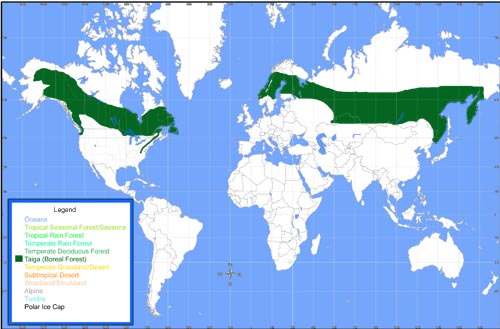 Boreal Forests
I believe the pair to be Lesser Yellowlegs (Tringa flavipes). I am by no means a bird expert and imagine they could also possibly be Greater Yellowlegs. If any of our wonderful expert bird lovers would like to weigh on this, I would be grateful. Songbirds and shorebirds that I have filmed on Cape Ann are featured in my Monarch film and I am in the process of writing the script. I want to insure that all the bird identifications are 100 percent accurate..
Map courtesy google image search.
 The extraordinarily powerful wings and torso of the Mute Swan
The above photo is a lucky capture as I was actually filming the Gadwalls behind the swan. When the swan began to lift out of the water I quickly turned my attention toward it. The first two photos are the same; the first is cropped, the second uncropped so that you can see the tremendous scale of the swan’s body and wings in relation to its environment. The Mute Swan is the second heaviest waterfowl, second only to the Trumpeter Swan. In observing swans, I marvel in nature that a creature this heavy can soar majestically through the clouds and swim so gracefully through water.
 Mute swans feed primarily on submerged and emergent aquatic vegetation and a small percentage of their diet also includes frogs, small fish, and insects. Because swans feed in deep water they do not compete with smaller waterfowl such as ducks. It is thought that food is made more readily available to ducks because the swans do not eat all the food they pull up. This seems logical and factual from my own observations at our local ponds and marshes. I very often see a wide range of waterfowl congenially feeding with the Mute Swans.
 Mute Swan feeding on submerged vegetation at Niles Pond
Note ~ Mute swans, which are a nonnative species, do compete directly for food with North American native Trumpeter Swans, in regions where Trumpeter Swans are indigenous (Trumpeter Swans are not native to Cape Ann).
For more photos, information, and video see previous posts about the Mute Swan:
Next time you see a flock of ducks, look closely. You may be surprised by the range of different species within the group. Although not always the case, but more often than not at this time of year, I see several species within a flock. What typically happens as I try to get closer to photograph or film a flock of shore birds, the Mallards, which seem very comfortable around people will stay and the somewhat less seen species, such as Buffleheads, Gadwalls, and American Wigeons will fly away or swim vigorously out of my camera’s range.
 I counted six different species of birds feeding in the seaweed at Brace Cove in the above photo.
This past autumn, and continuing through this winter, I have been filming and photographing B roll all around the ponds and marshes of Cape Ann. Today begins a mini series about shore birds, ducks, and wading birds, including photos and interesting facts, to help better identify the differences between the ducks and wading birds that migrate through, and winter over, on Cape Ann.
One of several Cape Ann geographical features that allows for such a wonderfully wide range of birds to be found on our shores and marshes is the fact that we lie within a largely unrestricted north south corridor for migratory species of birds and butterflies. What exactly does that mean? From the eastern coastline, all the way from Maine to Florida, and between the Appalachian Mountain range further west is a corridor where there are no barriers such as large bodies of water or mountains to fly over, which allows for unrestricted movement of birds and butterflies.
 Male and Female Buffleheads
Male Buffleheads are one of the easiest birds to distinguish from a distance and within a group because of their sharp black and white coloring, comparatively smaller size, and pert, rounded shape. Upon closer inspection the males heads are marked with striking iridescent green and purplish feathers. The photo above shows three males and one female, and she is differentiated by her all over darker color and the patch of white feathers on her check. Rapid wingbeats make Buffleheads easier to distinguish when in flight as well. Their old-fashioned name of “Butterballs” aptly describes these beautiful and welcome winter migrants!
I am by no means a bird expert. I love to film and photograph the natural world around us and along the way find it fascinating to learn about the wildlife and flora that surrounds. Note to all nature and bird-loving readers ~ I hope you’ll comment with your expertise. I would love to hear from you!
 Great Blue Heron at Good Harbor Beach ~ Click to view larger
There are several theories as to why birds, especially large wading birds such as herons and flamingoes, stand on one leg, or “unipedal resting” as scientist like to refer to the trait. The seemingly most convincing and best-proved theory is that birds stand on one leg to conserve body heat. It is shown that birds stand on one leg more often when wading, which again points to the thermoregulation hypothesis because water draws away more body heat.
 Great Blue Heron (Ardea herodias)
Standing on one leg is not necessarily a sleeping and resting habit. I have filmed Great Blue Herons and Snowy Egrets meticulously preening while standing on one leg. The characteristic is not limited to large wading birds; species with shorter legs, including ducks and swans, also stand on one leg. Another popular theory suggests that wading birds stand on one leg to look less suspicious to aquatic prey.
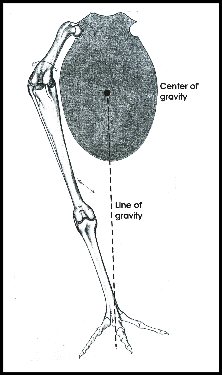 Center of gravity and line of gravity
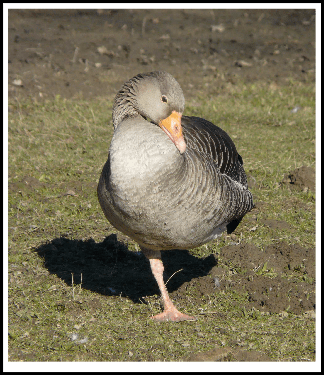 Goose standing on one leg
To read more about avian sensory physiology, visit the website of Professor Dr. Reinhold Necker. Additional images courtesy Professor Necker’s website.

