Category Archives: Oh Garden of Fresh Possibilities!

A Summer of Fragrant Yellow Daylilies

Hemerocallis ‘Hyperion’ at sunrise

Fragrant Yellow Daylily Hyperion

Emily Dickinson writes-

Nature rarer uses yellow

Than any other hue;

Saves she all that for sunsets, –

Prodigal of blue,

Spending scarlet like a woman,

Yellow she affords

Only scantly and selectly,

Like a lover’s words.

No, that is not a Monarch caterpillar on your parsley plant.

I am often asked “why is that green, yellow, and black Monarch caterpillar eating my parsley”?

Eastern Black Swallowtail Butterfly caterpillarBlack Swallowtail Caterpillar

Chances are, you will never see a Monarch caterpillar on your parsley. By far and away it is more likely that you have the caterpillar of the gorgeous Black Swallowtail Butterfly (Papilio polyxenes).

Caterpillars that are actively feeding are usually only found on their larval host plant(s), the plant they have developed a distinctive coevolutionary relationship with over millennia. Monarch caterpillars do not eat parsley and Black Swallowtail caterpillars do not eat milkweed, and if either attempted, they would not survive. Black Swallowtails were in the past commonly referred to as the Parsnip Swallowtail as their caterpillar food plants belong to members of the Umbelliferae, or Carrot Family. The diet  of the Black Swallowtail caterpillar includes the foliage and flowers of carrot plants, fennel, dill, parsley, Queen Anne’s lace, and parsnips.

Monarch CaterpillarMonarch Caterpillars

The Monarch caterpillar is yellow, black, and white. The Black Swallowtail caterpillar is green, black, and yellow.

Please see my Life Story of the Black Swallowtail Butterfly film’s website for videos and more photos documenting the butterfly’s life cycle.

Eastern Black Swallowtail Butterfly caterpillarMetamorphosing from this

to this…

Eastern Black Swallowtail ButterflyBlack Swallowtail Butterfly (Papilio polyxenes)

See Life Story of the Black Swallowtail Butterfly film website for videos and more photos documenting the butterfly’s life cycle.

Monarch Butterfly Program Presented to the Cape Ann Garden Club

This morning I had the pleasure of presenting my Monarch butterfly program to the Cape Ann Garden Club. The meeting was held at the charming and beautifully maintained Annisquam Village Hall, located in the very heart of Annisquam. Thank you Cape Ann Garden Club members for your enthusiasm and for your interest–it was my joy!

Cape Ann Garden Club Annisquam Village Hall Fujifilm x100

These lovely arrangements are created by the members and then gathered up at the end of the meeting to be distributed to nearby nursing homes.

Cape Ann Garden Club Annisquam Village Hall Fujifilm x100

Cape Ann Garden Club Annisquam Village Hall Fujifilm x100Notice the bare spots on the walls of the Hall. The Margaret Fitzhugh Browne portraits of local villagers are temporarily on loan to the Cape Ann Museum.

Cape Ann Garden Club Annisquam Village Hall fujifilm x100.jpgCarolyn Stewart’s peonies from her garden in Vermont–imagine, fresh peonies in July!

Happy Independence Day!

Here’s to the Red (sort of), White, and Blue!

Rosa 'Aloha' Fujifilm x100Sweetly Scented Rosa ‘Aloha’

Variegated Mock Orange Philadelphus Fujifilm x100Deliciously Fragrant Variegated Mock Orange (Philadelphus)

Feverfew and Native Iris versicolor Fujifilm x100Native Blue Flag (Iris versicolor) with Aromatic Feverfew

Our Beautiful Native Sweet Bay Magnolia

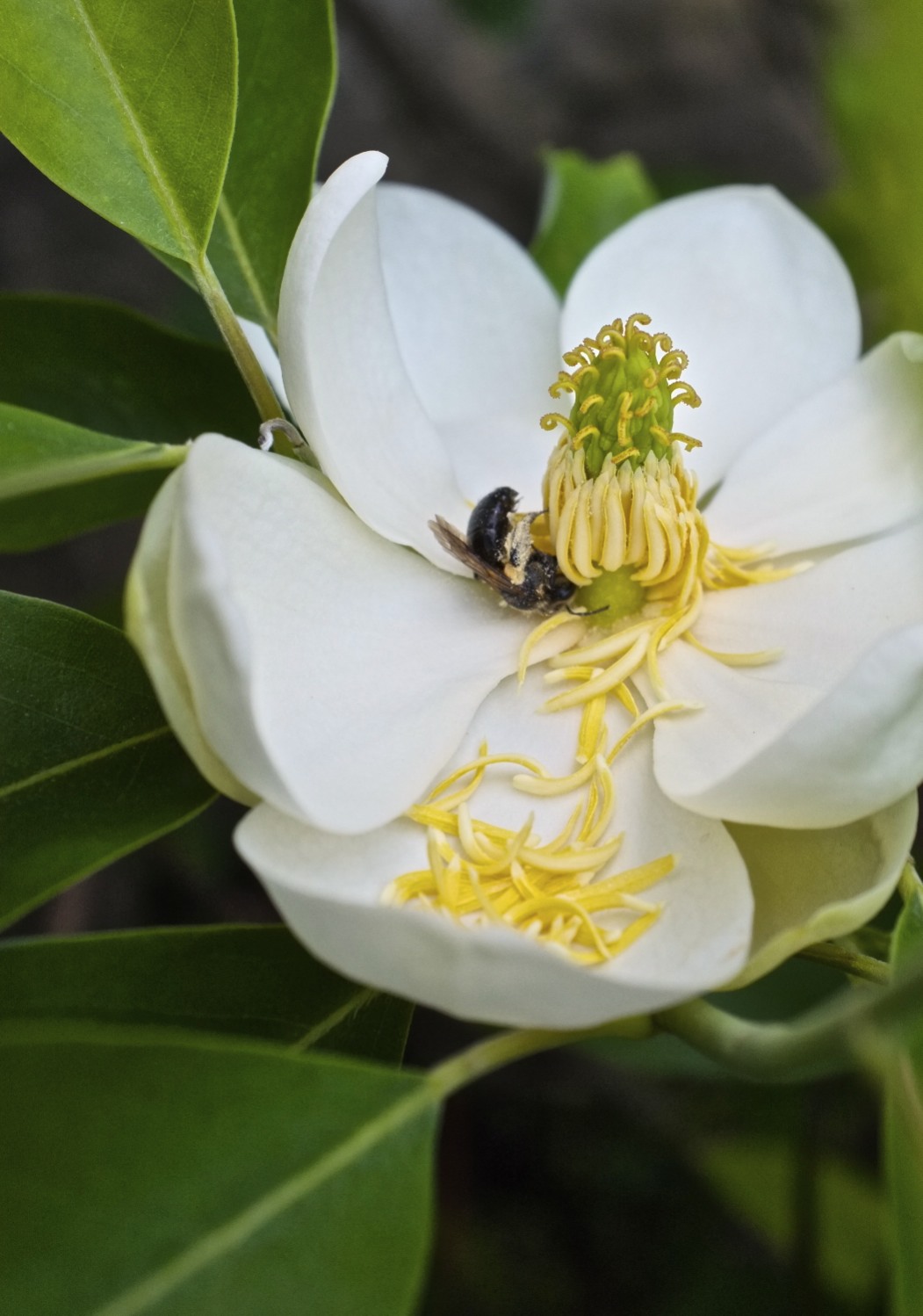
Magnolia virginiana ~ Sweet Bay Magnolia

Located in the heart of Ravenswood Park in Gloucester there is a stand of Magnolia virginiana growing in the Great Magnolia Swamp. It is the only population of Magnolia virginiana known to grow this far north. I took one look at the native sweet bay magnolia and breathed in the fresh lemon-honeysuckle scent of the blossoms, fell in love, and immediately set out to learn all I could about this graceful and captivating tree. Recently having returned from a trip to visit my family in northern Florida, I had tucked the bud of a Magnolia grandiflora into my suitcase. I was dreaming of someday having a garden large enough to accommodate a Magnolia grandiflora and was overjoyed to discover the similarities between M. virginiana and M. grandiflora. For those not familiar with the Southern magnolia, it is a grand, imposing specimen in the landscape, growing up to fifty feet in the cooler zones five and six, and one hundred feet plus in the southern states. M. grandiflora is the only native magnolia that is reliably evergreen in its northern range, flowering initially in the late spring and sporadically throughout the summer. The creamy white flowers, enormous and bowl-shaped (ten to twelve inches across), emit a delicious, heady sweet lemon fragrance.

Sweetbay Magnolia virginiana Gloucester Massachusetts

In contrast, the flowers of the sweetbay magnolia are smaller, ivory white, water-lily cup shaped, and sweetly scented of citrus and honeysuckle. The leaves are similar in shape to the Magnolia grandiflora, ovate and glossy viridissimus green on the topside, though they are more delicate, and lack the leathery toughness of the Southern magnolia. The lustrous green above and the glaucous silvery green on the underside of the foliage creates a lovely ornamental bi-color effect as the leaves are caught in the seasonal breezes.

Sweetbay Magnolia virginiana bud Gloucester Massachusetts

Magnolia virginiana is an ideal tree for a small garden in its northern range growing to roughly twenty feet compared to the more commanding height of a mature Southern magnolia. Sweet bay grows from Massachusetts to Florida in coastal freshwater wetland areas as an understory tree. The tree can be single- or multi-stemmed. Sweet bay is a stunning addition to the woodland garden with an open form, allowing a variety of part-shade loving flora to grow beneath the airy canopy. The leaves are a larval food for the Eastern Tiger Swallowtail butterfly. Almost immediately after planting we began to notice the swallowtails gliding from the sunny borders of the front dooryard, where an abundance of nectar-rich flowers are planted specifically to attract butterflies, around to the shady border in the rear yard where our sweet bay is located.

Our garden is continually evolving and part of our garden has given way to a limited version of a woodland garden, for the shady canopy created by the ever-growing ceiling of foliage of our neighbor’s trees has increasingly defined our landscape. We sited our Magnolia virginiana in our diminutive shaded woodland border where we can observe the tree from the kitchen window while standing at the kitchen sink. Gazing upon the tree bending and swaying gracefully in the wind, displaying its shifting bi-color leaves, provides a pleasant view when tending daily chores and the dreamy fragrance emitted from freshly opened blossoms make the chores all that less tiresome.

Excerpt from “Oh Garden of Fresh Possibilities!” Notes from a Gloucester Garden (David R. Godine Publisher), written and illustrated by Kim Smith.

Magnolia virginiana in Gloucester, Massachusetts

Magnolia virginiana in Massachusetts written by Peter Del Tredici.

Sweetbay Magnolia virginiana Gloucester Massachusetts Fujifilm x100

History

The sweet bay magnolia swamp in Gloucester, Massachusetts has been a botanical shrine since its discovery in 1806. Early New England naturalists and botanists of all types, from Henry David Thoreau to Asa Gray, made pilgrimages to the site of this northern- most colony of Magnolza virginiana. The local residents of Gloucester were so impressed with a “southern”plant growing this far north that they changed the name oft he Kettle Cove section of the town to Magnolia in the mid-1800s. It is probably no coincidence that this name change occurred at the same time the area was starting up its tourist trade.

In addition to its isolation, the Gloucester Magnolia population was remarkable for having escaped notice until 1806 in an area that was settled in 1623. This fact has led at least one author to speculate that the colony was not wild but escaped from a cultivated plant (Anonymous, 1889). However, the overwhelming consensus of earlier botanists is that the population is, in fact, native. Whatever its origin, the swamp remains today the unique and mysterious place it has been for almost 200 years.

Very little has been written about the magnolia swamp in recent years. The latest, and best, article about it was wntten by Dr George Kennedy, and appeared in 1916 in Rhodora, the Journal of the New England Botanical Club. Dr. Kennedy summarized the history of the stand, and cleared up the confusion about who discovered it by publishing a letter he found, written by the Honorable Theophilus Parsons to the Reverend Manassah Cutler in 1806. The letter captures the emotion of the moment of discovery:

Reverend and Dear Sir:

In riding through the woods in Gloucester, that are between Kettle Cove and Fresh Water Cove I discovered a flower to me quite new and unexpected in our forests. This was last Tuesday week [July 22, 1806]. A shower approaching prevented my leaving the carriage for examination, but on my return, on Friday last, I collected several of the flowers, in different stages, with the branches and leaves, and on inspection it is unquestionably the Magnolia glauca Mr. Epes Sargent has traversed these woods for flowers and not having discovered it, supposes it could not have been there many years. It was unknown to the people of Gloucester and Manchester until I showed it to them. I think you have traversed the same woods herborizing. Did you dis-cover it? If not, how long has it been there? It grows in a swamp on the western or left side of the road as you go from Manchester to Gloucester, and before you come to a large hill over which the road formerly passed. It is so near the road as to be visible even to the careless eye of the traveler. Supposing the knowledge of this flower, growing so far north, might gratify you, I have made this hasty communication.

Your humble servant, Theoph. Parsons

To read Mr. Del Tredici’s fascinating article in full click here Magnolia virginiana in Massachusetts, including an excerpt from when Henry David Thoreau visited the swamp and wrote about it in his Journal.

Peter Del Tredici is a Senior Research Assistant at the Arnold Arboretum and Lecturer at Harvard Graduate School of Design. Peter writes the following for the Arnold Arboretum: “My research interests are wide ranging and mainly involve the interaction between woody plants and their environment. Over the course of thirty plus years at the Arnold Arboretum, I have worked with a number of plants, most notably Ginkgo biloba, conifers in the genera Tsuga and Sequoia, various magnolias, and several Stewartia species (family Theaceae). In all of my work, I attempt to integrate various aspects of the botany and ecology of a given species with the horticultural issues surrounding its propagation and cultivation. This fusion of science and practice has also formed the basis of my teaching at the Harvard Graduate School of Design (since 1992), especially as it relates to understanding the impacts of climate change and urbanization on plants in both native and designed landscapes. Most recently, the focus of my research has expanded to the subject of spontaneous urban vegetation which resulted in the publication of “Wild Urban Plants of the Northeast: A Field Guide” (Cornell University Press, 2010).”

Lilac Cuture

Lilacs are found growing (where winters are cold enough to afford proper growth and ample blossoms) from the smallest rural village to the urban courtyard. They grow the very best in zones 3, 4, and 5, in the colder regions of zones 6 and 7, and in the warmer regions of zone 2. They will tolerate temperatures of -35 to -40f, though they may suffer some damage from windchill. If temperatures dip to such extreme cold in your region, site the lilac out of the path of chilling winter winds. Lilacs will tolerate frozen ground but not frozen pockets where water does not drain properly. Requiring excellent drainage, they grow best along rocky, limestone hillsides, suggesting just how important good drainage is. When planted in a mesic site, lilacs flower adequately, although, by late summer the foliage may wilt and turn moldy.

Syringa vulgaris President GrevySyringa vulgaris ‘President Grevy’

Lilacs perform best in sandy, gravelly loam mixed with organic matter such as compost and aged manure. Keep the surrounding soil free from weeds with an annual mulch of compost. In early spring sprinkle a cup of wood ashes around the base of the lilac and work it gently into the top layer of soil. Every three years or so apply a cup of ground limestone to the soil, again gently working it into the soil so as not to injure the roots.

Lilacs require full sun to nearly full sun to set flower buds. Where optimal sunlight isn’t always available, one may have some success with pushing the envelope. We are growing lilacs in several locations in half sun, and although they would be fuller in form with far more flowers, all are growing well.

The overall shape of lilacs is greatly improved with an annual pruning. Immediately after flowering is the ideal time to attend to this not unpleasant task. The job becomes less manageable as the shrub grows tall and leggy in a few short years.

After the lilac has become established and is a desirable size and shape, cut to the ground approximately one third of the oldest branches and thinnest suck- ers. This allows the bush to renew itself and for the energy of the bush to go into the remaining growth. Leaving the strongest trunks that form the armature of the shrub, prune diseased or pest-infested shoots or branches, and remove all declining stems, thin suckers, and small, twiggy branches. Some lilacs produce suckers rarely, if at all, and others sucker aggressively. Remove all spent flowers immediately after blooming, snipping very close to the tail end of the panicle so as not to remove the new growth that will provide you with next year’s flowers.

If you are growing lilacs as a background shrub or as a small tree, allow only two to three main stems as trunks, removing lower branches and cutting all other shoots to the ground. ’Beauty of Moscow’, ‘Madame Florent Stepman’ and the common lilac, both var. purpurea and alba, are all well suited for growing into a small multi-stemmed tree. Conversely if you do not want your lilac to become a tree, prune to a height of eight to nine feet, which keeps the blossoms at eye level.

Pagoda dogwood (Cornus alternifolia)Natives Pagoda Dogwood (Cornus alternifolia) and Catawba Rhododendron (Rhododendron catawbiense)

Pagoda dogwood (Cornus alternifolia)The small florets of  the pagoda dogwood are a bee-magnet.

With its versatile form and lovely heart-shaped leaves the lilac is an exceptional companion to a wide range of flowering trees and shrubs. The extended period of florescence a well-planned lilac hedge provides coincides with the long flowering period of our native pagoda dogwood (Cornus alternifolia) and Catawba rhododendrons. Just as the Sargent crabapple (Malus sargentii) is at its flowering peak, with masses of sublimely scented white blossoms, the earliest lilacs begin their fragrant parade. In our garden, the blossoms of Prunus, namely peach, pear and plum, overlap with the flowering of ‘Beauty of Moscow,’ ‘Maidens Blush,’ and ‘President Grevy.’ They are planted in close vicinity along the garden path. The newly emerging fragrant blossoms of Prunus interwoven with the pervasive perfume of lilacs give The Scent of All Spring!

Lilacs are one of the loveliest shrubs to grow as a tall hedge, and they integrate magnificently into the country hedge of mixed shrubs and trees. The ineffable beauty and fragrance of lilacs are enhanced by the many varieties of suitable companion plants. The short list of plants described here is particularly appealing during the lilac’s period of flowering, for their compatible scents, colors, and foliage or for creating a sequentially blooming combination of fragrances. ‘Korean Spice’ viburnum, nearing the end of its florescence while the lilacs are beginning theirs, blooms in pink infused white, snowball shaped flower heads, with an intensely sweet and spicy aroma. Variegated Solomon Seal, Viola ‘Etain,’ late-season jonquils and narcissus, and lily of-the-valley all bloom simultaneously with early lilacs. The most sublimely scented tree peony ‘Rockii,’ with white petals washed with pale rose, and magenta-purple splotches at its heart center, also flowers during lilac time. Later in the season, to coincide with later-flowering lilacs, come the Iris pallidaIris germanica, and native Iris versicolor, English bluebells, early species daylilies with their honey-citrus scent, ‘Bridal Wreath’ spirea, blue and white columbine ‘Origami,’ and white bleeding hearts (Dicentra spectabilis ‘Alba’). Although not at all fragrant, I find the warm, rich yellow color of native honeysuckle Lonicera ‘John Clayton’ particularly appealing with the white and cool blue-lavender-hued lilacs. Just as ‘Therese Bugnet,’ the earliest of roses to flower (with its Rugosa heritage) joins the scene, the lilacs are finished for the season. Lilacs, when pruned to a small tree shape, allow a variety of plants to grow happily at their feet. Herbaceous peonies, although their blooming period usually does not coincide with lilacs, make an ideal garden companion. In our yard, Paeonia lactiflora follow lilacs almost to the day in order of sequential blooming. The dense, full mounds of foliage of the herbaceous peonies visually fill the space left by the trunk of the lilacs, as do hosta. The foliage of hosta, planted on the shady side, makes a companionable partner. Hosta will appreciate the filtered sun and both plants benefit from an annual blanket of compost. Species daylilies, Montauk daisies, and chrysanthemums are ideal companions when planted on the sunnier side of lilacs.

Lonicera ‘John Clayton’

Spring never lasts long enough in New England, with some years leaping from bitter cold to balmy, summer-like temperatures. Despite freezing rain and late spring snow, lilacs bloom and bloom resplendently. For the extended period of time in which the spires of sweet florets are in bloom, our garden is redolent with their heavenly fragrance. The blossoms of Syringa vulgaris, and especially the fragrant sorts, are a nectar source for the Eastern Tiger Swallowtail. The diminutive “violet afloat,” better known by its common name Spring Azure, is captivatingly beautiful floating about the pure white flowers of ‘Marie Legraye.’ Throughout the seasons our lilac hedge is alive with a chattering collection of songbirds. The height and the crooks of the branches are enticing to the innumerable songbirds, though it is the cadmium orange oriole alighting on the blue-hued spires of ‘President Grevy’ that causes the heart to skip a beat.

End Notes: Occasionally one must dig a bit deeper to find the value of a plant in relationship to pollinators for the landscape designed for people and wild creatures. First and foremost a garden should be an inviting habitat for the people who dwell there. What better way to create an invitation than with the beauty and fragrance of the lilac? Although not native to North America, lilacs (Syringa vulgaris) are celebrated in this country as they are part of our cultural heritage. From cuttings tucked into belongings, the earliest settlers connected their previous home to their home of new beginnings. The ease in which lilacs are cultivated is famous and testifies to their success and popularity. At a lecture I attended not too long ago, an example of a white oak, which supports nearly one hundred species of Lepidoptera, was compared to the lilac, which is known to support just twenty-five. From a gardener’s perspective that is like comparing apples to oranges. Very few have space enough to grow an 80-foot-tall white oak, whereas a ten-foot-tall and easily cultivated lilac can find a place in nearly any garden. Besides, twenty-five species of Lepidoptera is not bad. Additionally, lilacs are a rich source of nectar for swallowtails. Our native eastern redbud—although stunning, and providing nectar for bees and  hummingbirds—is much more challenging to cultivate and hosts two species of Lepidoptera. Plant what you like, as long as it is not invasive in your particular region. As much as possible, utilize native plants in your garden design and combine with well-investigated and well-behaved ornamentals.

For an expanded version on the history of lilacs, Lilacs the Genus Syringa written by Fr. John L. Fiala is highly recommended. Filled with hundreds of color photographs and including chapters on the culture of lilacs, hybridizing techniques, and propagation, I have turned to this book repeatedly. Fortunately it has been reprinted and is once again available through Timber Press.

Thank you

Dear Gardening Friends,

Come join me this Tuesday, June 7th at Willowdale Estate, from 4:00 to 6:00, for a house and garden tour of this beautiful, and beautifully restored, historic Arts and Crafts manse. Members of the Willowdale staff will be giving guided tours of the house and I will be available to talk about the garden, including how the Arts and Crafts movement influenced our horticultural decisions. Admission is free and the event is open to the public.

Thank you for all the thoughtful comments and praise for last week’s column “The most highly scented lilacs…” Next week I will send you information on lilac culture as this is the ideal time of year to trim and shape your lilacs for maximum blooms next year.

Single flowers of the Common White Lilac

Reader Irma wrote the following: I picked my lilacs at their height. In water, in the vase they lasted 2 days and drooped! Last year the same. I couldn’t believe it. Do you know why?

Hi Irma, Lilacs have woody stems and do not easily absorb water in the vase. Depending on whatever tool is handy, I do one of two things,. With a hammer, crush the stems, at least six inches along the length, and immediately place in a vase filled with tepid or warm water. Over the years I have also discovered that peeling the stems with a vegetable peeler is just as effective, and less messy. Peel away the woody outer layer, all around the stem, again at least six inches up the stalk (peel down to green). Still, even with treating the stems, the arrangement will be fleeting and only look beautiful for several days. The scent of the lilacs permeating throughout your home is worth the extra effort!

Beauty of Moscow lilacDouble-flowered ‘Beauty of Moscow’

Many wrote last week to say they enjoyed the excerpt from Amy Lowell’s gorgeous poem Lilacs. Here it is in entirety:

Lilacs

Lilacs,
False blue,
White,
Purple,
Color of lilac,
Your great puffs of flowers
Are everywhere in this my New England.
Among your heart-shaped leaves
Orange orioles hop like music-box birds and sing
Their little weak soft songs;
In the crooks of your branches
The bright eyes of song sparrows sitting on spotted eggs
Peer restlessly through the light and shadow
Of all Springs.
Lilacs in dooryards
Holding quiet conversations with an early moon;
Lilacs watching a deserted house
Settling sideways into the grass of an old road;
Lilacs, wind-beaten, staggering under a lopsided shock of bloom
Above a cellar dug into a hill.
You are everywhere.
You were everywhere.
You tapped the window when the preacher preached his sermon,
And ran along the road beside the boy going to school.
You stood by the pasture-bars to give the cows good milking,
You persuaded the housewife that her dishpan was of silver.
And her husband an image of pure gold.
You flaunted the fragrance of your blossoms
Through the wide doors of Custom Houses—
You, and sandal-wood, and tea,
Charging the noses of quill-driving clerks
When a ship was in from China.
You called to them: “Goose-quill men, goose-quill men,
May is a month for flitting.”
Until they writhed on their high stools
And wrote poetry on their letter-sheets behind the propped-up ledgers.
Paradoxical New England clerks,
Writing inventories in ledgers, reading the “Song of Solomon” at night,
So many verses before bed-time,
Because it was the Bible.
The dead fed you
Amid the slant stones of graveyards.
Pale ghosts who planted you
Came in the nighttime
And let their thin hair blow through your clustered stems.
You are of the green sea,
And of the stone hills which reach a long distance.
You are of elm-shaded streets with little shops where they sell kites and marbles,
You are of great parks where every one walks and nobody is at home.
You cover the blind sides of greenhouses
And lean over the top to say a hurry-word through the glass
To your friends, the grapes, inside. Continue reading

The most highly scented lilacs

Surely at the top of the list of shrubs to grow for creating the framework of an intimate garden or garden room are lilacs, in particular Syringa vulgaris and their French hybrids. Syringa vulgaris are grown for their exquisite beauty in both form and color of blossoms, although it is their fragrance flung far and throughout gardens and neighborhoods that make them so unforgettable.

Not all species of Syringa and cultivars of Syringa vulgaris are scented. The early French hybrids and hybrids of Leonid Kolesnikov have retained their fragrance. Syringa oblata has a similar fragrance, though is not nearly as potent. Several of the Chinese species have a spicy cinnamon scent, while many of the Asian species and their hybrids have very little, if any, fragrance. To find your personal preference, I suggest a visit to a local arboretum, or take your nose to the nursery during the extended period of time (six to eight weeks, or so) in which the different cultivars of S. vulgaris are in bloom.

‘Monge’ Lemoine in the foreground

Nearly everywhere lilacs are grown (and here I am only referring to S. vulgaris), they are called by some variety of the word lilac. Perhaps the word lilac stems from the Persian word Lilak or Lilaf meaning bluish. The French say Lilas, the Spanish say Lila, and the Portuguese Lilaz. In old English lilacs were called Laylock, Lilack, and Lilock.

Lilacs are native to and found growing among the limestone rocks on the hillsides and mountainsides throughout southeastern Europe, in the Balkans, Moldavia, Serbia, Macedonia, and Yugoslavia. Cultivated by local mountain herdsmen, they were taken from the peasant villages of central Europe to the garden courts of Istanbul. In 1563, the Flemish scholar and traveler Ogier Ghiselin, Count de Busbecq, Ambassador of Ferdinand I of Austria to the court of Suleiman the Magnificent, brought back to Vienna gifts from the sultan’s garden. Attracting much attention was the lilac. Seven years later, in 1570, Ogier Ghiselin, Count de Busbecq, and then Curator of the Imperial Court Library, accompanied the Archduchess Elizabeth from Vienna to Paris where she was betrothed to King Charles IX of France. Count de Busbecq journeyed to France with a shoot of Syringa vulgaris, where it soon began to fill the gardens of Paris.

Two color variants sprang up in European gardens beside the wild blue- flowered lilac, a nearly white flowered variant with lighter foliage and a taller- growing variant with deeper purple flowers. Hybridizers quickly set about to create different forms and color versions from these two variants.

Victor Lemoine of the famed nursery Victor Lemoine et Fils at Nancy in Lorraine Province continued the work of hybridizing lilacs. From 1878 to 1950, Victor and his wife, their son Emile, and their grandson, Henri, created 214 lilac cultivars. The cornerstone of the Lemoine’s lilac hybridizing program was a nat- ural sport that bore two corollas, one inside the other, making it the first dou- ble. This double was subsequently named ‘Azurea Plena.’ Because of the Lemoine family’s success in turning ordinary lilacs into fancy double-flowered lilacs in nearly every hue imaginable, they became known as the “French lilacs.” Spreading throughout Europe, the French lilacs were brought to the Russian court by French travelers. Well suited to the soil and climate of Russia, they soon spread far and wide. Several decades later, the Russian hybridist Leonid Kolesnikov continued the successful work of the Lemoines with his own exquisite variants.

‘Beauty of Moscow'  ‘Krasavitsa Moskvy’ ‘Krasavitsa Moskvy’ translated to ‘Beauty of Moscow’ Leonid Alexseevitch Kolesnikov Hybrid

The French and Dutch colonists transported lilacs to North America. These cherished cuttings, wrapped in burlap and wet straw tucked into suitcases for the long journey across the Atlantic, traveled well and were soon growing throughout the colonies. By 1753 the Quaker botanist John Bartram of Philadelphia was complaining that lilacs were already too numerous. One of two of the oldest col- lections of lilacs in North America are at the Governor Wentworth home in Portsmouth, New Hampshire, planted by the governor in 1750. The second collection, perhaps one hundred years older, is at Mackinac Island in Michigan, where French Jesuit missionaries living in the area are thought to have planted them as early as 1650.

With their traveling fragrance, versatility in the landscape, and their ability to live tens, perhaps even hundreds of years, lilacs are garden heirlooms. When selecting lilacs to grow for creating the framework of the garden, take the time to choose wisely. Some lilacs grow readily into a tree shape (‘Beauty of Moscow’), while others are somewhat relatively lower growing cultivars; ‘Wedgwood Blue’ comes to mind, and still others, the common white lilac (Syringa vulgaris var. alba), sucker more freely. And bear in mind that different lilacs bloom over an extended period of time. If you wish to have a blue lilac blooming simultaneously with a white lilac, then it is worthwhile to determine whether a specific cultivar is an early, mid, or late season bloomer. The following is a selection of lilacs growing in our garden, arranged in their sequential progression of flowering, with considerable overlapping. They are all highly scented or we wouldn’t grow them. The last photo below shows the different colors in lilac blossoms of white, pink, blue, lavender, magenta.

Maiden's BlushSyringa x hyacinthiflora ‘Maiden’s Blush’

S. x hyacinthiflora ‘Maiden’s Blush’ (1966) Skinner ~ Single, pale rose pink; shows different colors of pink under different soil conditions. In a warmer climate and lighter soils it is a paler shade of pink, in heavier soils ‘Maiden’s Blush’ has more lavender undertones.

‘Krasavitsa Moskvy’ translated to ‘Beauty of Moscow.’ Leonid Alexseevitch Kolesnikov (1974) ~ Double, lavender-rose tinted buds opening to white-tinted pink. Grown throughout Russia. Vigorous upright habit, useful for growing into a tree-shape. Very extended blooming period.

Syringa vulgaris var. purpurea. Common purple lilac ~ Lavender, the wild species seen growing throughout its native land. The common purple is the most widely distributed form of lilac. The lilac of old gardens.

‘Wedgwood Blue’ John Fiala (1981) ~ Hanging panicles of beautiful true blue florets. Lilac-pink hued buds. Somewhat lower growing.

‘Madame Florent Stepman’ (1908) ~ Satiny ivory white florets from rose- washed buds. Pure white when fully opened. Tall and upright growing. One of the most extensively cultivated for the florist trade.

‘President Grevy’ Lemoine (1886) ~ Pure blue, immense panicles of sweet starry florets.

‘Marie Legraye’ (1840) ~ Single, diminutive florets, radiant white, lighter green foliage.

‘Monge’ Lemoine (1913) ~ Vivid, intense plum wine fading to deepest rose.

‘Andenken an Ludwig Spaeth’ Nursery of Ludwig Spaeth (1883) ~ Single, rich purple-violet with a smaller pointed-head panicle.

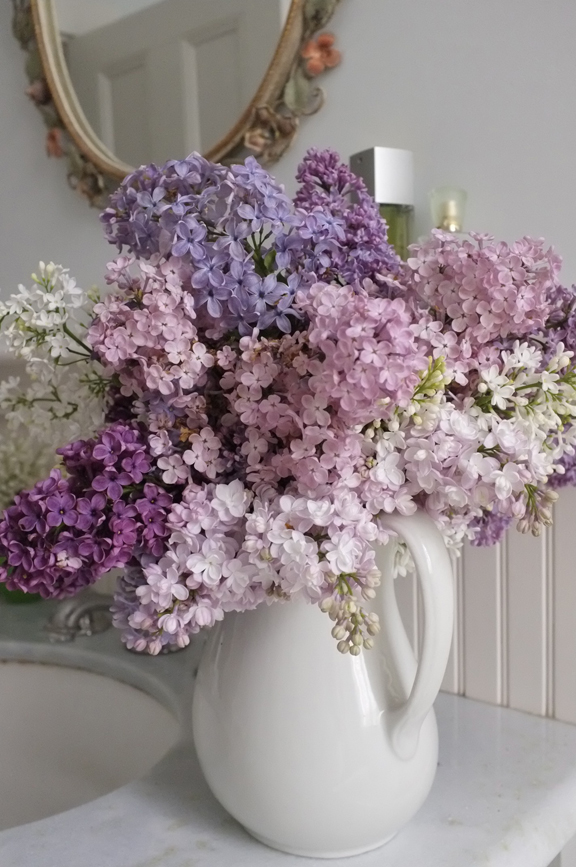
Lilac bouquetClockwise from upper right: Pale pink ‘Maiden’s Blush,’ common white, double-flowered ‘Beauty of Moscow,’ ‘Monge,’ common white, ‘President Grevy’ (blue), and common purple.

Above excerpt from Oh Garden of Fresh Possibilities! Notes from a Gloucester Garden (David R. Godine, Publisher), written and illustrated by Kim Smith.

More on Lilac Culture in the next post.

Wedgwood Blue Lilac

Syringa vulgaris 'Wedgwood'Syringa vulgaris ‘Wedgwood’

Lilacs,

False blue

White

Purple,

Colour of lilac.

Heart-leaves of lilac all over New England,

Roots of lilac under all the soilof New England,

Lilacs in me because I am NewEngland,

Because my roots are in it,

Because my leaves are of it,

Because my flowers are for it,

Because it is my country

And I speak to it of itself

And sing of it with my own voice

Since certainly it is mine.

—from Lilacs by Amy Lowell (1874–1925)


Native Flowering Dogwood

Is there a tree more lovely in flower than the North American dogwood (Cornus florida)? Whether flowering with the classic white bracts, the stunning rubra bracts, or the less often seen pale, creamy rose-tinted bracts, our native dogwood never ceases to give pause for beauty given.

Cornus florida var. rubra

Cornus florida bw Fujifilm x100Cornus florida

At this time of year when traveling along southern New England roadways we are graced by the beauty of the dogwood, dotting sunny roadside borders where meets the woodland edge. The bracts and flowers emerge before the leaves, serving only to heighten their loveliness. The fresh beauty of the bract-clad boughs is offset by the impressionistic symphony of neighboring tree foliage unfurling, shimmering in hues of apple green, chartruese, moss, and lime peel.

Cornus florida rubra-1 Fujifilm x100

Cornus florida rubra-3 Fujifilm x100

Discouragingly, many dogwoods in our region are inflicted with the lethal dogwood anthracnose. I believe the problem is exacerbated by the vast majority of information regarding growing flowering dogwoods, which suggests planting in part shade, and does not differentiate between gardening in the north versus gardening in the Midwest or northern Florida for that matter. If one lives in warmer regions south of New England, yes, perhaps it is possible to grow a healthy C. florida in partial shade.

Dogwood anthracnose is caused by the aptly named fungus Discula destructiva. It will typically kill an untreated Cornus florida within two to three years. As we look to nature for an answer, the native flowering dogwoods growing in the fertile, moist, friable soil of the Northeastern woodlands, as understory trees, are the trees most affected by anthracnose. Cornus florida growing in an open, sunny location are far less afflicted. What we learn from this lesson is to choose a location that has good air circulation and full sun. What we know is that Discula destructiva requires high humidity for infection; therefore trees planted in mesic sites in the shade are more susceptible than trees growing in xeric sites.

Discula destructiva is a soil born disease. Dogwood trees inflicted with anthracnose will begin to show signs of infection by dying from the bottom up. The lower branches will become twiggy and will not flower or leaf-out. This is the opposite of what you may see if a tree is losing foliage along the upper branches because of drought stress, for example.  A tree that is stressed from lack of water or nutrients will, generally speaking, begin to show signs of trouble from the top down.Cornus florida var. rubra -4 Fujifilm x100

Our lovely Cornus florida var. rubra (my second go around with this species; the first was killed by anthracnose) shows signs of drought stress every year, usually during the dog days of late summer. I place the hose at the base of the tree, allowing water to gently flow overnight (never wet the foliage of a dogwood). Visibly, the tree will perk up. Typically this will need to be done every few days, until the next soaking rain. Any tree that is stressed from lack of water is more susceptible to disease. Along with monitoring our tree for drought stress, and because we plant densely beneath the tree’s boughs, I have found these measures, thus far, have served to prevent an outbreak of anthracnose.

Note how beautifully grows this dogwood. Despite the rain-soaked droopy bracts, you can see its gorgeous overall form. The level branches grow horizontally and there are no bald, twiggy areas.

Cornus florida var. rubra -5 Fujifilm x100Cornus florida var. rubra Lynn Fells Parkway, Melrose, Massachusetts

bract – In botany, a bract is a leaf-like structure surrounding a flower or inflorescence. The colorful bracts of poinsettias, the hot pink bracts of bougainvillea, and the bracts of dogwoods are often mistaken for flower petals.

Cornus florida var. rubra -4 Fujifilm x100The open florets (pea-green colored) and unopened buds are surrounded by the rose red-shaded bracts.


My Workshop at Tower Hill Botanic Garden this Sunday, May Day

Come join me this Sunday at 1:00 at the Tower Hill Botanic Garden in Worcester for the perfect May Day event–How to Create a Butterfly Garden. Pre-registration is required:

Monarch Butterflies Nectaring at Smooth AstersMonarch Butterflies Nectaring at Smooth Aster

I will be presenting the necessary elements to help you create a beautiful and welcoming haven for butterflies. Once you begin to think about your garden as food source and shelter, it will influence all your horticultural decisions. Native and well-behaved non-native plants, along with examples of architectural features, will be discussed based on their value to attracting specific butterflies. This lecture and slide presentation will help you gain a deeper understanding of the interconnected world that we human beings share with plants and butterflies and how to translate that information to your own garden. Butterfly gardening plant list included with workshop.

From wiki: The Floralia, also known as the Florifertum, was an ancient Roman Festival dedicated to Flora the goddess of flowers and vegetation. It was held on the IV Calends of May, April 27 to May 3, and symbolized the renewal of the cycle of life, marked with dancing, drinking, and flowers. While flowers decked the temples, Roman citizens wore colorful clothing instead of the usual white, and offerings were made of milk and honey to Flora.

Maurice Prendergast May Day Central Park 1901Maurice Prendergast May Day Celebration Central Park 1901

AND

May Day is synonymous with International Worker’s Day and Labour Day. Read Howard Fast’s May Day – 1947, well-worth revisiting with the continued and increasing efforts to destroy organized labor.

Howard Fast May Day 1947 Rockwell KentRockwell Kent

Gloucester Garden Club

Beauty on the Wing ~ Life Story of the Monarch Butterfly

In preparing for my upcoming presentation to the Gloucester Garden Club, Wednesday, April 13th, I am discovering new images shot last summer. The photo shows a freshly emerged Monarch clinging to its chrysalis, with crumpled wet wings yet to fully expand. Butterflies Days can’t get here soon enough! Later in the afternoon we will be attending Ellen Lefavour’s art opening and book signing for Did you Know at Alchemy of Art Gallery. I hope to see you there.

Monarch Emerging from ChrysalisMonarch Butterfly Newly Emerged from Chrysalis

Fabulous Review for Oh Garden of Fresh Possibilities!

My deepest thanks and appreciation to Pat Leuchtman for her wonderful review. Pat has been writing a weekly garden column for The Recorder in Greenfield since 1980. She has been blogging for the past several years and has posted and archived all her columns on her blog Commonweeder. Read more of Pat’s review and spend time perusing her blog, which is brimming with useful information, book reviews, insights, and missives– all beautifully organized.

Oh Garden of Fresh Possibilities!

Pat’s Review: Fresh Possibilities are just what I am looking for at this time of the year, so it is no surprise that I have been spending happy evenings with Kim Smith’s beautiful book that includes so many of her own delicate paintings of flowers, birds and butterflies.

Kim Smith gardens, and paints, in Gloucester.  Over the years her garden has grown, as has her concern about conservation and her delight in the roads to literature and art that her garden has opened to her. Oh Garden of Fresh Possibilities: Notes from a Gloucester Garden (David R. Godine Publisher) combines all these aspects of her life in the garden in the most beautiful way.

With its delicate paintings of individual flowers, and butterflies, the book does not look like a how-to book, yet it includes plant lists to attract butterflies, of fragrant flowers and plants through the seasons, seasonal blooms and useful annuals. I can hardly decide which I enjoy more, the charming prose of chapters titled The Narrative of the Garden, Flowers of the Air and The Memorable Garden, the exquisite paintings, or the poetry that ranges from our own Emily Dickinson and Dorothy Parker to Li Bai (701-762 CE),  a famous Chinese poet of the Tang Dynasty. I enjoy knowing that Kim has found the same delight  in the connections to history and the arts that I find in the garden.

One of the two chapters I particularly found useful as well as beautiful right now is Flowers of the Air which includes information about a variety of butterflies, and the plants that they need for their life cycle. We have to remember that butterflies are not only lovely, they are important pollinators.

It is no surprise that I also enjoy Roses for the Intimate Garden. Kim’s climate is a bit more gentle than mine and she can grow more tender roses that I can, but we are both devoted to the fragrance that roses bring  to our gardens and to the uncorseted exuberance of old fashioned roses.

If you want information, but also want the kind of delicious prose you find in evocative essays, an aesthetic sensibility, and beautiful illustrations, this is the book for you.  Kim is an inspired gardener and writer, but she isn’t stopping there. Watch for more news about Kim and her latest project soon.

My Television Show

Dear Gardening Friends,

We are sending our most heartfelt thoughts and prayers to the Japanese people. Viewing the broadcasts reminds me that it was just over a year ago that the devastating earthquake struck Port au Prince. Can a person ever fully recover from such an event? The utter destruction of the tsunami is confounding, now coupled with threats of nuclear meltdown. My wish for the people of Japan and their nation is as speedy a recovery as is possible.

We are so very blessed living where we do. Perhaps I mentioned that I am developing a television series, which will air on our local cable television station, Cape Ann TV, as well as other cable stations. I believe it was early last summer that Donna Gacek, the director of Cape Ann TV, approached me about the possibility of creating a show based around my writings and butterfly photos. A tv show would be a magnificent medium to share about the joys of creating organic habitats designed for people and pollinators. We can visit gardens, fields, meadows, and wildlife sanctuaries–and connect how to translate habitat information found there to our own gardens, examine gardening trends, loves, and literature, conduct interviews, undertake how-to projects–the possibilities are limitless. I hope, too, for some room for spontaneity and fun–once I get a handle on the process. I knew what I was getting myself into and knew it would be enormously time consuming, which it is, however I am so pleased with our initial progress and thought I would bring you this trailer for the first episode as well as behind the scenes updates.

Instinctively it was clear that the first step in development would be to film and photograph as much as time would allow, especially as this past summer, gratefully so, was THE summer to photograph Lepidoptera–day after day of hot, dry, sunny weather–a butterfly, and a butterfly photographer’s, dream conditions The past few months have been spent organizing all photos and footage from this summer, as well as footage and photos from previous summers, into handy categories from which I can draw, while simultaneously writing the first script, and thinking about future scripts.

I chose the butterfly garden I designed at Willowdale to be my first subject for several reasons. I know the grounds and garden intimately; the Lepidoptera seen there are the same species seen all around the northshore, and throughout New England for that matter; the setting is undeniably gorgeous; over the past few years I have shot many photos there and some video footage; and because the garden is on occasion open to the public.

While writing the script I tried to imagine how the information would relate to, and be of interest to, a wide audience. Creating ‘wild gardens’ (by wild gardens I mean to say gardens that utilize native wild flowers that support wild life) is meant to be joyful and easy for everyone– for the millions as well as the millionaire! The next phase was to organize the video and still photos, loosely, around the script. Then, and this part was really new and challenging for me, came layering the narrated voice tracks and precisely synching it to the footage, and still retain existing ambient nature sounds audibly. Much tweaking was necessary. Have you ever wondered where your speaker is on your computer? It took me the longest time to locate mine (iMac)– a pinhead-sized hole in the center of the top, right above the camera lens–and they do not produce very good or usable quaility input sound. All the audio will have to be redone at the tv studio, however, it was time well spent as I was able to experiment and learn the basics on my own time.

The first production meeting with Donna went really well. The next phase will be to redo the audio tracks, under the guidance of the staff at the tv station, and continue to work on the next two episodes. In developing a series, it is suggested that you have at least three to begin with – getting all your ducks in order, so to speak. I am working furiously on all because spring and summer are my peak seasons for garden design work and for presenting lectures and programs.

So far, everything has fallen into place, from the gorgeous weather of last summer, to finding a beautiful recording for the into and outro, to working with Donna and the staff at CATV!

My mission for this wonderful project is to create as vibrantly beautiful, and as informative and interesting, a viewing experience as is possible. I am also very interested in working in collaboration with anyone who may have an interest.

Perhaps after reading the above you can help me decide the title of the show–so important to get it right! I love the title of my book Oh Garden of Fresh Possibilities! because there is no other like it. Perhaps I shall call it The Garden of Fresh Possibilities Show.

Some other candidates:

The American Gardener’s Journal

Through the Garden Gate

Garden for All Seasons

Welcome to the Wild Garden

Any comments, thoughts, or suggestions would greatly appreciated.

Happy Spring-is-around-the-Corner!

Warmest wishes,

Kim

The Pollinator Garden ~ Rescheduled due to inclement weather

Eastern Tiger Swallowtail Papilio glaucus Eastern Tiger Swallowtail (Papilio glaucus)

The Pollinator Garden has been rescheduled for Monday morning, Apriil 18th. Updated information to follow.

Dear Gardening Friends,

Come join me Monday morning, February 28th, from 10:00 to 12:00 at the Espousal Center in Waltham, where I will be giving a talk and photo presentation about creating The Pollinator Garden for the Garden Club Federation of Massachusetts. Although this is a state Garden Club Federation event, everyone is welcome. Cost is free for members and $5. for non-members. My extensive pollinator planting list is provided with lecture.

Scroll down to see a short video tour of the Limonaia, along with much good information about growing citrus in colder climes, excerpted from Oh Garden of Fresh Possibilities!

Keep warm and cozy and–take heart–the vernal equinox and the first day of spring are officially less than one month away!

Kim

Growing Citrus Indoors

Tour the Limonaia at Tower Hill Botanic Garden

Register online for my workshop at Tower Hill Botanic Garden: Creating a Butterfly Garden, Sunday, May 1, 1:00 to 3:00. I hope to see you there!

~ Citrus ~

Growing Citrus Indoors excerpted from Oh Garden of Fresh Possibilities!

We would grow citrus, whether they bore fruit or not, for the lilting sweet scents of the blossoms alone. Whether entering a room in which a citrus is in bloom or approaching the plant on the terrace, one cannot help appreciating their exquisite fragrance.

During the Baroque period, orange and citrus fruits became equated with the golden apples from the mythical Garden of Hesperides. In 1664 Louis XIV of France commissioned the architect LeVall to build the first orangerie at Versailles. It was the Sun King’s love for gardens, and in particular his admiration for the “Seville” orange, which brought both citrus plants and the conservatory into prominence. The orangerie protected exotic and tender plants during the winter, and when the plants were moved out of doors during the warmer months, the orangerie was transformed into a setting for courtly events and celebrations.

The genus Citrus is indigenous to southeast Asia, occurring from northern India to China and south through Malaya, the Philippines, and the East Indies. The earliest records of its cultivation date back to about 500 b.c. The four original wild species from which all domesticated fruits are thought to have been hybridized are Citrus medica, Citrus aurantifolia, Citrus grandis, and Citrus reticulata.

The calamondin orange (Citrus mitis), with heavenly scented, pure white flowers, is among the easiest to grow. Although the fruit is too acidic to eat out of hand, it is fine for cooking, seasoning poultry prior to roasting, or combining with honey to make a piquant glaze. The key lime (Citrus aurantifolia), has an insinuating sweet and fresh fragrance and is used for preserves, garnishes, and juice. Oil of citral is extracted from Citrus aurantifolia for use in perfumes. Highly valued in Japan and China for use in Buddhist ceremonies, the Buddha’s Hand (Citrus medica) is a thorny shrub with fragrant fruits that resemble a human hand. The flowers are comparatively large (3–4 inches across), white shaded purple, and intoxicatingly fragrant.

One of the most beautiful and widely available citrus for pot culture is the Meyer lemon (Citrus limon x Citrus sinensis), also known as the Chinese lemon. It grows to a manageable size, less than two feet, and in a standard shape with a nicely rounded-head form. Not a true lemon, but a hybrid cross of C. sinensis, an orange, and C. limon, its fruit is sweeter than that of a pure lemon cultivar. But it is for the flowers that I grow the Meyer lemon. The blossoms are thick and velvety, creamy white tinted rose. Blooming in notes of honeysuckle and jonquil-like fragrances, the tree flowers prodigally.

Citrus thrive in a well-draining soil similar to what is an ideal medium for cactus. They must be grown in clay pots to insure good air circulation. The surest way to kill a citrus is by overwatering. Wait until the soil is thoroughly dried between watering. Place your finger a full three inches into the soil and water only when it feels dry at your finger tips, and then water deeply until a bit of water comes out the bottom of the drainage hole. With regular feedings of fish fertilizer throughout the summer and an all-purpose fertilizer during the winter months (when we find the odor of fish fertilizer to be repugnant indoors), citrus plants grow strong and healthy and are less likely to succumb to insect infestations.

Citrus plants are fairly indestructible, although they will quickly let you know when they’re unhappy. A few leaves will yellow and fall off, and if the problem is not resolved immediately, the entire plant will defoliate. This is typically due to overwatering and/or a soil mixture that does not allow for excellent drainage. Do not be discouraged, even if the entire plant becomes leafless. Water less frequently and try repotting the plant in a more suitable growing medium. Usually, they can be revived.

When grown indoors, citrus are occasionally bothered by spider mites and scale. Spider mites are easy to detect because they make a visible white web. Scale is a more challenging problem to diagnose as the light brown, pinhead sized and hard-bodied pest is difficult to see. They remain well hidden, where they attach themselves to the stems and along the ribs on the underside of the leaves. Scales produce a sticky substance that coats the leaves. For both pests, spray with a solution of diluted rubbing alcohol (three parts water to one part rubbing alcohol) to keep them in check.

Considered a harbinger of prosperity and good fortune, citrus have been grown in Chinese gardens and courtyards for thousands of years. We can take a lesson from how seasonal changes are reflected in a Chinese garden. Different areas of the garden are used in rotation for social events, depending on the prominence of a particular tree or shrub in flower, and flowering plants growing in pots are brought into the current living areas. After blooming, they are moved to a less visible location, and the focus shifts to flowers that are coming into florescence.

Oh Garden of Fresh Possibilities! written and illustrated by Kim Smith (David R. Godine, Publisher)


Pine Siskin ~ Carduelis pinus

Pine Siskin ~ Carduelis pinusPine Siskin ~ Carduelis pinus

We certainly weren’t expecting to see and hear a new-to-our garden species of birds flocking to the Nyjer seed feeder on a frigid mid-January day. American Goldfinch in size, the richly mottled plumage resembled something closer to a sparrow. Their delightful birdsong was new and fresh to my ears and sweetly cheering. Currently in residence is a flock of House Sparrows, with several Song and Savannah Sparrows tagging along, but I had no success with identifying this new entourage when thumbing through the sparrow section of Audubon’s books. Returning to the goldfinch pages, Pine Siskins are closely related to American Goldfinches (the two species comprise the subgenus Spinus), and information was readily available, once on the right track.

To be sure, I emailed a snapshot to Chris Leahy at Mass Audubon and he confirmed that this was indeed a flock of Pine Siskins and that they are having an “irruptive” year. In ecological terms, irrupt is defined as “to increase rapidly and irregularly in number.”

Pine Siskins are “classic,” or true finches—small to moderately large, with twelve tail feathers and nine primary feathers, and strong conical shaped beaks designed to both penetrate the hard external shells of seeds and delicately extract a morsel of food. Members of the genus Carduelis sensu lato feed their young on a highly nutritious and easily digested diet of partially regurgitated, milky cereal-like blend of seeds.

Kingdom: Animalia

Phylum: Chordata

Class: Aves

Order: Passeriformes

Family: Fringillidae

Genus: Carduelis

(Sub) Genus: Spinus

Species: pinus (Pine Siskin)

Species: tristis (American Goldfinch)

Pine Siskins are primarily a northern species, whose irruptive winter activity in the United States occurs in years when seed crops have failed in the boreal forests. Ornithologists believe the severity of winter weather in northern parts of the siskins’ range, as well as factors not completely understood, also contribute to their irruptive cycles. The siskins’ principal foods are the seeds of alder, cedar, birch, hemlock, and a variety of conifers. Occasionally, large flocks will appear as far south as Florida. Protecting coniferous forests will help protect the Pine Siskins.

Nimbly dangling upside down and every which way to feed, battling for a place at the feeder, and seemingly unafraid of my approach with camera in hand, the gregarious Pine Siskins are a fascinating species to observe. I am so glad I took a few snapshots when I did. Today it is snowing, again, and the temperatures are hovering around freezing. Perhaps they will stay (we keep the Nyjer seed feeder well stocked) or perhaps they will continue migrating further south.

Pine Siskins typically breed in coniferous forests. Although monogamous, they nest in both isolated pairs and loose colonies, and pairs may visit one another’s nests. The female constructs the nest on a horizontal branch of a conifer, well hidden and well away from the trunk.The nest resembles a large shallow basket, is watertight, and built of twigs, grass, rootlets, strips of bark, lichen, and leaves, and lined with moss, plant down, feathers, and hair. The female incubates the eggs for about two weeks, rarely leaving the nest. The male brings her food while she incubates and for the first few days after the young hatch. The fledglings leave the nest in approximately two weeks. The male and female continue to feed the young for several more weeks.

Because Pine Siskins forage in flocks and nest in loose colonies, they are particularly susceptible to salmonella. It is important to keep Nyjer seed feeders (all bird feeders) scrupulously clean. Scrub inside and out weekly with a solution of vinegar and water.

American Goldfinches display a dramatic example of sexual dichromatism in their plumage; during breeding season the males molt to brilliant cadmium yellow while the females maintain their olive hue year round. Pine Siskins show a more subtle form of sexual dichromatism. The male is typically identified by yellow patches in the wings and tail feathers. The female shows much less yellow. Sexual dichromatism is the systematic difference in color form between male and female in the same species (Greek, di meaning two, and chromatic relating to color). The yellow color of the pine siskins is not always clearly visible when perching and they are often mistaken for sparrows, with their similar brown, heavily streaked underparts.

Friday is my well-guarded, sacred day to paint, and I am currently finishing my illustrated book about butterflies. If I can’t manage to squeeze in any other time during the week to paint, at least I know I will have my Friday. My painting area is arranged beneath a northeast- facing window, ideal light for painting flora and fauna as the light coming through the left side evenly illuminates the subject placed on the table. Several of the bird feeders hang a mere ten feet from the window and are a wonderful source of distracting entertainment. Today at the bird feeders we observed the flock of Pine Siskins, a Dark-eyed Junco and his Song Sparrow friend (an oddly matched pair who always appear to come and go together), American Goldfinches, Blue Jays, Harrier Hawk, a pair of Northern Cardinals, one Carolina Wren, and the ubiquitous House Sparrows. A Northern Mockingbird, lately joined by an American Robin, comes daily to the winterberry and hollies, helping themselves to only a few berries, and then departing. The days are growing longer; we’re half past January, we only have February to get through, and soon we will be welcoming spring. I am looking forward to black earth revealed, new notes of fresh scents, and the chorus of courting songbirds.

Looking to the Future

Walking along a wooded lane last weekend, I couldn’t help but notice the lack of songbirds. One singular, startled robin, that was all, poking about a hedge of scraggly privet. The time of day was late afternoon, which is the same time of day our yard is typically host to a chorus of songsters. Eerily disquieted, I paused for a moment and closed my eyes, imagining what this same lane would look like if found growing there were winterberry and summersweet, blueberry and chokecherry, juniper and holly, and the chattering collection of songbirds these fruit-bearing plantings would surely attract. Perhaps there was a disappointing lack of songbirds because invasive species such as privet has engulfed both sides of the road, or perhaps because the road abutted a golf course, which is regularly doused with insecticides intended to kill every living insect, the songbird’s primary source of food.

Winterberry (Ilex verticillata)

Dragon Lady Holly (Ilex x meserveae)

Sarent’s Crabapple (Malus sargentii)

A friend forwarded an article, posted from the Guardian U.K., about the charismatic head gardener Alain Baraton, of the Palace of Versailles. Appointed in 1976, Mr. Baraton has made it his mission to transform the 2,000-acre traditional landscape into a model of sustainable gardening. Climate change has affected Versailles in ways Baraton never imagined. Because the chestnut trees are flowering twice a year, they are losing their glorious autumnal hues. Pine trees that have lined the park’s avenues since the reign of Louis XIV are dying in gross numbers. The previous year saw so little rainfall that the lawns did not have to be mowed. It is imperative, Baraton says, to move with the times. “The gardener always has to look to the future,” he explains. “We are witnessing an enormous change in climate.”

Baraton saw in the changing environment an opportunity to reform the long-standing use of pesticides. Realizing the futility of applying chemicals to rid the gardens of bugs, which would only return and in greater numbers with warmer temperatures, insecticides were the first to go and he declared a blanket ban. No matter how tiny, Baraton believes every living creature deserves a place in his garden. Enticed by the prospect of plump, juicy insects to feast on, the birds returned to Versailles in prodigious numbers.

Pine Siskin (Carduelis pinus)

Trees and shrubs have benefited tremendously under Baraton’s guiding hand. Long gone is the tradition of planting the same species in neat ordered avenues. The gardeners vary the plantings to prevent major loss in case any one species becomes diseased.

If the most formal of public gardens, scrutinized under the demanding microscope of an international audience, can afford to forgo the use of insecticides, is there any possible justification for the use of insecticides and herbicides in the individual, business, and public suburban and urban landscape?

Our Dragon Lady hollies have grown tall and the winterberry is flourishing, and because of that, for the past several years we have been graced with a flock of robins in early February (Round Robin Red-Breast). The first winter the robins arrived I noticed that, after they had devoured every morsel of red berry—the winterberry, holly, and crabapple—they moved to a neighboring privet hedge. My first thought was, well at least that’s one good thing about privet–perhaps the robins will eat the overly abundant and plain little blue-black berry of the privet. Not so, the robins did not care too much for it and the flock soon departed our neighborhood.

When we first moved to our property we immediately removed a privet-tree that had seeded itself, growing smack-dab in the sunniest center of our yard. We cut down the trunk and limbs and spent laboriously long hours digging out the root mass. We continually find privet seedlings sprouting in our flower borders. Privet is tedious, and if one has the misfortune to inherit an established hedge, very challenging to remove. On the other hand, a natural arrangement generally requires a modicum of once-yearly maintenance, a light hand with the pruning sheers, to shape or remove dead wood. Imagine if all the suburban privet hedges were replaced with welcoming avenues of flowering and fruiting shrubs that provided nourishment and shelter for the songbirds.

Excerpt from Oh Garden of Fresh Possibilities! ~ The idea of a garden planted in harmony with nature is to create a loosely mixed arrangement of beauty combining native and ornamental fowering trees and shrubs. This informal style of a woodland border or bucolic country hedge is not new and is what the French call a haie champêtre. Perhaps the country hedge evolved because it was comprised of easily propagated, or dispersed by wildlife, native species of plants and perhaps as a revolt against the neatly manicured boxed hedges of formal European gardens. The country hedge is used, as is any hedge, to create a physical and visual boundary, but rather than forming the backdrop for ornamental plants, it is the living tapestry of foliage, owers, fruit and fauna. Working and living in our garden we are enchanted by the creatures drawn to the sheltering boughs, blossoms, and berries.

Looking to the Future was first published Winter 2009.

Round Robin Redbreast

Round Robin Redbreast

What’s that you say? A flock of robins, in winter?

Yes, yes! Sweetly singing liquid notes. A flock in my garden!

What does a hungry round robin find to eat in a winter garden?

Red, red winterberries and holly, rime-sweetend crabapples, and orchard fruits.

And how does a winter robin keep warm?

Why, blanketed together with air-puffed fluffed feathers.

How long will they stay, how long can they last in the frost?

Only as there are fruits on the bough and berries on the bush.

Round robin red breast, silhouette in bare limb,

Calling away winter, cheer, cheerio, and cheer-up!  

– Kim Smith

The widely distributed and beloved American Robin (Turdus migratorius) hardly needs an introduction. The American Robin is the largest member of the thrush family—thrushes are known for their liquid birdsongs and the robin is no exception. Their unmistakable presence is made known when, by early spring, the flocks have dispersed and we see individual robins strutting about the landscape with fat worms dangling. Unmistakable, too, is the male’s beautiful birdsongs, signaling to competing males to establish their territory, as well as to entice prospective females.

The boundaries of the American Robin winter migration areas are not clearly defined. The robin’s winter range covers southern Canada to Guatemala, compared to their summer nesting range, which extends from the tree limit of Canada to southern Mexico. Robins that nest in Massachusetts, for the most part, migrate further south. Robins nesting in northern Canada migrate to their tropic-of-New England get-away.

During the winter months Cape Ann often becomes home to large flocks of robins and we have had the joy of hosting numerous numbers in late afternoon and early morning. I can’t help but notice their arrival to our garden. Their shadows descend, crisscrossing the window light, followed by a wild rumpus in the ‘Dragon Lady’ hollies. This pair of hollies is planted on opposing sides of the garden path, alongside my home office. I have learned to stealthily sneak up to a window, as any sudden activity inside startles birds that are investigating our garden, and they quickly disperse. Dining not only on berries of the ‘Dragon Ladies’, but also the ‘Blue Princess’ Meserve holly and winterberry bushes, are generally speaking dozens of noisy, hungry robins. These winter nomads flock to trees and shrubs that hold their fruit through winter, feasting on red cedar, American holly, Meserve hollies, chokecherries, crabapples, and juniper. Robins traveling near the sea will comb the shoreline for mollusks and go belly-deep for fish fry. Depleting their food supply, they move onto the next location. Gardens rife with fruiting shrubs and trees make an ideal destination for our migrating friends.

The garden designed to attract pairs of summer resident robins as well as flocks of winter travelers would be comprised of trees and shrubs for nest building, plants that bear fruit and berries that are edible during the summer and fall, and plants that bear fruits that persist through the winter months. Suburban gardens and agricultural areas provide the ideal habitat, with open fields and lawns for foraging insects as well as trees and hedgerows in which to build their nests.

Robins in New England breed from April through July, often bearing three clutches. Nests are built in the crotch of trees and dense bushes, five to fifteen feet above ground, and some are occasionally made on the ground or built on protruding ledges of homes. The female robin weaves a cup-shaped foundation of coarse grass, twigs, paper and feathers, and then lines the bowl with mud she smears and packs firmly with her breast. Later she adds soft fibers such as fine grass and downy feathers to cushion the egg. The first nest is usually placed in an evergreen tree or shrub; for each subsequent clutch a new nest is built and generally placed in a deciduous tree.

The following plants, suggested with robins in mind, will also attract legions of songbirds (and Lepidoptera). The list is comprised primarily of indigenous species with a few non-native, but not invasive plants included.

Trees for nesting ~ American Holly (Ilex opaca), Eastern Red Cedar (Juniperus virginiana), Red Maple (Acer rubrum), Sugar Maple (Acer saccharum), Flowering Dogwood (Cornus florida).

Summer and autumn fruit bearing trees, shrubs and vines for robins ~ Black Cherry (Prunus serotina), Blackberry (Rubus spp.), Flowering Dogwood (Cornus florida), Gray Dogwood (C. racemosa), Red-osier Dogwood (C. sericea), Silky Dogwood (C. amomum), Elderberry (Sambucus canadensis), Apple (Malus pumila), Virginia Rose (Rosa virginiana), Highbush Blueberry (Vaccinium corymbosum), Lowbush Blueberry (Vaccinium angustifolium), Wild Grape (Vitis spp.).

Trees and shrubs with fruits persisting through winter ~ Winterberry (Ilex verticillata), Mountain Ash (Sorbus americana), Crabapple (Malus spp.), Sargent’s Crabapple (Malus sargentii), American Holly (Ilex opaca), Meserve Hollies (Ilex x meserveae), Eastern Red Cedar (Juniperus virginiana), Common Juniper (Juniperus communis), Chokecherry (Prunus virginiana), Smooth Sumac (Rhus glabra), Staghorn Sumac (Rhus typhina).

Oh Garden of Fresh Possibilities! for Holiday Giving

Music to my Ears: The following note is from my dear friend Kate Hines who built a beautiful home on a lovely piece of property—former farmland that borders the lush and fertile Rhode Island coastline. Thank you Kate for sharing!


“I was so inspired reading the section you wrote on hollies in Oh Garden of Fresh Possibilities! that I went to the local nursery and ordered 2 – a female 6′ and a male 5.’ Now they are mixed in with the evergreen grove to the north of the house. They were costly, a big project but soooooo satisfying! Ill send pix.”

XOXO KH

Oh Garden of Fresh Possibilities! makes for a very useful gift for the gardener (and loved-ones dreaming of creating a garden) on your holiday gift giving list. Last year at this time Carol Stocker, the Boston Globe garden columnist wrote the following about Oh Garden:

Oh Garden of Fresh Possibilities!

Boston Globe Best of 2009

For Armchair Gardeners Pining for Spring

“Bleak and snowy outside? These lush reads will have you dreaming green. January and February are the reading months for gardeners trapped indoors. Here are some of the best garden books from 2009. “Oh Garden of Fresh Possibilities! Notes From a Gloucester Garden,’’ written and illustrated by Kim Smith (David R. Godine, Publisher), is a treasure, and perhaps the best garden gift book. Why? Both dream-like and practical, it captures the rapture of a gardener’s journey through her own evolving quarter acre by integrating Smith’s personal essays, hands-on advice, and paintings. I was charmed by her listing of specific scents of favorite peony varieties accompanied by a painted sample of their petal colors…”

Oh Garden of Fresh Possibilities! Written and Illustrated by Kim Smith. Available through your local bookseller, David R. Godine, Publisher, and Amazon.


Amaryllis Hippeastrum

Amaryllis Hippeastrum 'Ambiance'Amaryllis ‘Ambiance’

Dear Gardening Friends,

We have been blessed with a delightfully warm autumn, which has made these last few weeks in the garden a delight. As I am preparing gardens for their winter rest, my thoughts turn to the upcoming holidays and the winter blooms that will make the season all that much brighter. I hope you don’t mind—the following is from the chapter on Coaxing Winter Blooms, excerpted from Oh Garden of Fresh Possibilities! With our son’s soccer team headed to the state finals, I haven’t had the ability to focus, spare time to write, or accomplish much of anything besides work. We’re all on pins and needles in anticipation of the Big Game!

Warmest wishes and Season’s Greetings, Kim

P.S. Results of Sunday ‘s game: CONGRATULATIONS VIKINGS, the new Division Three North Massachusetts State Champions!!!!!!!!!!!!!!!!!!! Rockport Vikings 1, St.Mary’s, Lynn 0. Wednesday’s game against the winning southern region state champs will be held in Quincy at 5:00pm. GO VIKINGS!

A Note about Amaryllis

Living in New England the year round, with our tiresomely long winter stretching miles before us, and then a typically late and fugitive, fleeting spring, we can become easily wrapped in those winter-blues. Fortunately for garden-makers, our thoughts give way to winter scapes of bare limbs and berries, Gold Finches and Cardinals, and plant cat-alogues to peruse. If you love to paint and write about flowers as do I, winter is a splendid time of year for both, as there is hardly any time devoted to the garden during colder months. I believe if we cared for a garden very much larger than ours, I would accomplish little of either writing or painting, for maintaining it would require just that much more time and energy.

Coaxing winter blooms is yet another way to circumvent those late winter doldrums. Most of us are familiar with the ease in which amaryllis (Hippeastrum) bulbs will bloom indoors. Placed in a pot with enough soil to come to the halfway point of the bulb, and set on a warm radiator, in several week’s time one will be cheered by the sight of a spring-green, pointed-tipped flower stalk poking through the inner layers of the plump brown bulbs. The emerging scapes provide a welcome promise with their warm-hued blossoms, a striking contrast against the cool light of winter.

Perhaps the popularity of the amaryllis is due both to their ease in cultivation and also for their ability to dazzle with colors of sizzling orange, clear reds and apple blossom pink. My aunt has a friend whose family has successfully cultivated the same bulb for decades. For continued success with an amaryllis, place the pot in the garden as soon as the weather is steadily warm. Allow the plant to grow through the summer, watering and fertilizing regularly. In the late summer or early fall and before the first frost, separate the bulb from the soil and store the bulb, on its side, in a cool dry spot—an unheated basement for example. The bulb should feel firm and fat again, not at all mushy. After a six-week rest, the amaryllis bulb is ready to re-pot and begin its blooming cycle again.  Excerpt Oh Garden of Fresh Possibilities! ~ Coaxing Winter Blooms

Amaryllis Hippeastrum 'Orange'Amaryllis ‘Orange Sovereign’


Amaryllis Hippeastrum


Korean Daisies at Willowdale Estate

Pictured above are cascading mounds of Korean daisies blooming in the autocourt at Willowdale Estate, located in Topsfield, Massachusetts. Korean daisies will continue to bloom through several light frosts and support myriad late-on-the-wing pollinators. This photograph was taken on Veteran’s Day, November 11, 2010.

Chrysanthemum ‘Emperor of China’ and Korean Daisies

Exquisite Flora in Autumn

Green leaves ignite, transformed by a kaleidoscope of incinerating colors—devil-red, burnt tangerine, caramelized amber, searing saffron, and smoldering crimson-purple. The air is impregnated with the aromatic perfume of orchard fruits ripening in the fleeting flush of the sun’s warm light. Hazy, slanting rays gild the late season glory in the garden. Surrounded by flowers of dissipating beauty and juxtaposed against the dazzling brilliance of autumn foliage, we are urged to spend every possible moment savoring our gardens before the onset of winter.

American Lady Nectaring at Korean Daisy

Blossoms thrown in autumn, as opposed to those of spring and summer, are perhaps the most keenly appreciated. Our rambling ‘Aloha’ rose embowering the front entryway abounds in blooms in June, flowering again and again throughout the summer. With a twinge of melancholy, I cherish most Aloha’s lingering remontant rose—inhaling deeply the sensuous fragrance when approaching or upon leaving our home, knowing all will be dormant in only a few short weeks. Manifold members of the composite family hold their flowers well into fall. Forming a substantial clump (four feet wide and equally as tall) is a passalong from a generous friend. From a few cuttings of this heirloom chrysanthemum (Chrysanthemum ‘Single Apricot Korean’), with apricot pink-tinted, daisy-like single flowers, we now have a patch of our own to share with friends. Arrayed with a single row of ray flowers encircling the nectar-rich cadmium yellow disk florets, the Korean daisy is host to sundry late on-the-wing pollinators, including butterflies, bees, and beetles. The form is loose and lovely; opposite in appearance to that of the ubiquitous blobs of mums commonly seen in autumn.

Chrysanthemum ‘Emperor of China’ begins its lovely tableau in mid-fall and continues to bloom through the first hard frost. Plum rose with silvery highlights, the quills shade paler toward the outer margins. When the plant is in full bloom, the rich green foliage shifts colors to vibrant hues of bronze and scarlet red. The ‘Emperor of China’ exudes a delicious lemon-spice fragrance noticeable from some distance.

As with asters, it is helpful to pinch the tips of each shoot to encourage branching and more blossoms. Repeat this process at each four- to six- inch stage of new growth until the middle of July, or when the buds begin to develop. ‘Emperor of China’ is hardy through zone six and thrives in full sun to light shade in well-drained soil. This cultivar forms a 2 and 1/2′ mound in only a few years. Give the plant a top dressing of compost and mulch after the first hard frost.

An ancient variety of chrysanthemum originating from China, the ‘Emperor of China’ resembles and is thought to be the chrysanthemum depicted in early Chinese paintings. Chrysanthemums are also grown for their medicinal properties, and their purported magic juices were an important ingredient in the life-prolonging elixir of the Daoist. Fragrant chrysanthemum tea was considered good for the health, and tonic wine was brewed from an infusion of their petals.

Chrysanthemum Tea

Chrysanthemum tea is a tisane made from dried chrysanthemum flowers. The flowers are steeped in boiling water for several minutes, and rock sugar or honey is often added to heighten the sweet aroma. Popular throughout East Asia, chrysanthemum tea is usually served with a meal. In the tradition of Chinese medicine, the tisane is a “cooling” herb and is recommended for a variety of ailments including influenza, circulatory disorders, sore throats, and fever.

Chrysanthemum ‘Emperor of China’

Although thought to be rich in healing properties and lovely in form, a more modest well-being was conferred by the vigorous blossoming of the chrysanthemum. Perhaps the late flowering chrysanthemum suggests their connection to a long life, for other plants have finished flowering just as the chrysanthemums begin.

The techniques for learning to paint the orchid, bamboo, plum blossom, and chrysanthemum comprise the basis of Chinese flower and bird painting. They are referred to as “The Four Gentlemen” and are thought to symbolize great intellectual ideas. The orchid is serene and peaceful, though sophisticated and reserved from the world. Bamboo is vigorous and survives throughout the seasons, forever growing upright. The plum blossom expresses yin-yang dualities of delicate and hardy, blooming through snow and ice to herald the arrival of spring. Chrysanthemums continue to flower after a frost, are self-sufficient, and require no assistance in propagating themselves.

China owes its astonishing wealth of plant life to a combination of geographical incidents. The mountains escaped the ravages of the great ice caps and unlike much of Europe and North America, where many plants were wiped out, plant species in China continued to evolve. Additionally, the foothills of the Himalayas are moistened by soft winds from the south, creating an ideal climate for alpine plants. In this warm and moderate environment three different floras– that of the colder, drier north; that of the sub-tropical south; and that of the alpine species—all mingled and crossed freely for thousands of years.

Ernest Wilson, one of the world’s greatest plant hunters, was not the first collector to explore this botanical paradise, but his determined efforts to push through to remote areas led him to the “richest temperate flora of the world.” From 1899 to 1911, Ernest “Chinese” Wilson sent the seeds of more than 1,500 different plants to the United States and England. Altogether his collection numbered 65,000 plants, representing about 5,000 species, all gathered from the wild. Through his exploration, and the work of the nurseries for which he collected, more than a thousand plants were established for Western cultivation. Despite the wealth of flora collected by Ernest Wilson and his fellow plant hunters, Chinese gardens remained wholly unaffected. Although shiploads of plants were sent to London, St. Petersburg, Paris, and Cambridge, Massachusetts, Chinese horticulturists continued to develop plants their ancestors had loved and that had long since been domesticated. The tradition of conferring qualities of morality to plants and plants’ allegorical to intellectual ideas made the newly collected wild plants unsuitable for the Chinese garden.

The love of flowers was and continues to be a passion among the Chinese. Trees and plants are genuinely loved as living creatures.

Enjoying flowers with tea is the best, enjoying them with conversation the second and enjoying them with wine the least. Feasts and all sorts of vulgar language are most deeply detested and resented by the spirit of the flowers. It is better to keep the mouth shut and sit  still than to offend the flowers. —from a Ming Dynasty treatise on flowers Walters Art Museum

The idea that flowers can be offended by bad manners reflects the belief that the world we inhabit is an organism in which all phenomena interrelate. By the same reasoning, someone who drinks tea from a peach-shaped pot will live longer (peaches symbolize longevity), and someone who dips his writing brush in a peony-shaped bowl will have good fortune, as the peony is a metaphor for success and wealth.

Several passages from above were excerpted from Oh Garden of Fresh Possibilities! (David R. Godine, Publisher).


Monarch Butterfly Migration

Update: Monarch Butterfly Migration Late Summer 2010

Monarch butterfly migration seaside goldenrodMagical Seaside Goldenrod Meadow

Monarch butterfly migration seaside goldenrod

Dear Gardening Friends,

So many have telephoned or emailed inquiring about the status of the annual Monarch butterfly migration through our region. This past summer I have observed umpteen Monarch butterflies and caterpillars in cultivated gardens, wildflower meadows, and along the shoreline; however, I did not see the great numbers in great heaps roosting in any one particular place that I have in some years past. Rather I would find a small passel here and a small passel there—perhaps several dozen at a time—roosting in the wild black cherry trees (Prunus serotina) at Eastern Point, awakening in the early morning and nectaring at the Seaside Goldenrod in the meadow below.

Monarch butterfly migration Monarchs Mimic Withering Foliage of Black Cherry Tree

Although the Monarchs are guided genetically, using their internal sun-compass navigation and circadian clock, each year the annual southward migration takes a different form that depends on many  variables, primarily the weather conditions in their overwintering site in Michoacán, Mexico as well as weather patterns in their US and Canadian breeding grounds. Because Cape Ann is located at approximately 43 degrees latitude north, our peak migration pattern is estimated at around September 11, but I modify this pattern because of the strong winds and storms we often experience in the late summer living along the coastline.

I have read reports of fantastic migrations that are taking place this year, from Long Island, south to Cape May, and west to Virginia—some saying it is the best they have seen in decades! I continue to remain on the look out because the air temperatures were atypically warmer this summer, creating a longer breeding season than usual, which would indicate that there may be newly emerging Monarchs on the scene. While photographing during this year’s migration, I encountered a pair of Monarchs mating, a very unusual occurrence at this time of year. The “Methuselah” Monarchs that we see in late summer and early autumn are generally speaking sexually immature and do not mate until next year, after they journey south and after they overwinter and awaken in Mexico.

Monarch butterfly migration monarchs mating seaside goldenrodMonarchs Mating Amidst the Goldenrod

Monarchs observed in late summer and early autumn are intent on nectaring and not easily distracted. This later generation of Methuselah Monarchs is feeding aggressively to increase and store their lipid reserves for the long journey south. We provide plenty of nectar-rich blossoms to help the Monarchs in their exhaustive migration, taking cues from marsh and meadow. Blooming freely at this time of year are copious members of the Composite family—goldenrods, asters, pearly everlasting, zinnias, ironweed, Mexican sunflowers, and Korean daisies. If one diligently deadheads the butterfly bushes and Verbena bonariences, they too will be available for the migrating Monarchs.

My favorite goldenrod is Seaside Goldenrod (Solidago sempervirens), which blooms from August to November. Seaside Goldenrod is the gorgeous brilliant golden wildflower we see growing and glowing along the edge of the sea. It is easily differentiated from other New England goldenrods in that the flowerheads are comparatively larger and the leaves are thicker and fleshier, with a waxy feel, an adaptation to the drying effect of salty sea spray. Seaside Goldenrod grows prolifically in rich, moisture retentive soil, less so in drier conditions.

Although I strongly discourage digging plants from local marsh and meadow, perfectly acceptable is the practice of collecting ripened seed stalks and shaking them about. That is just how we obtained our Smooth Asters (Aster laevis). With cheery one-inch button-shaped flowers borne along the lengths of the stalks, the pale-hued lavender-blue ray flowers and yellow disk florets of Smooth Asters are attractive to bees and butterflies. We have observed Common Sulphers, Pink-fringed Sulphurs, Monarchs, American Ladies, Red Admirals, and Cabbage Whites nectaring simultaneously on a clump growing in the sheltered border along our fragrant path. Pinch back the developing growth tips during the early part of the growing season (until roughly July fourth) to encourage a bushier and more compact plant. Asters provides nourishing sustenance for transitory butterflies when many nectar-rich plants have finished blooming for the season. Not particularly fussy in regard to soil conditions, Smooth Aster grows and flowers profusely in full sun to light shade. Smooth Aster and Purple-stemmed Aster (Aster puniceus) are the asters we see blooming along the backshore at this time of year. With golden yellow florets at the center of their ray flowers, asters and goldenrods create a convenient landing pad for nectaring Lepidoptera. Flowering alongside ripening red berries and surrounded by changing autumnal leaf color, goldenrods and asters transform the seasonal tapestry.

Monarch butterfly migration

Monarch butterfly migration seaside goldenrodPollen-dusted Male Monarch

Mockingbird fledglingsWhile photographing the Monarchs, I couldn’t help but notice two noisy Mockingbird fledglings, who were going at each other for over a half hour.