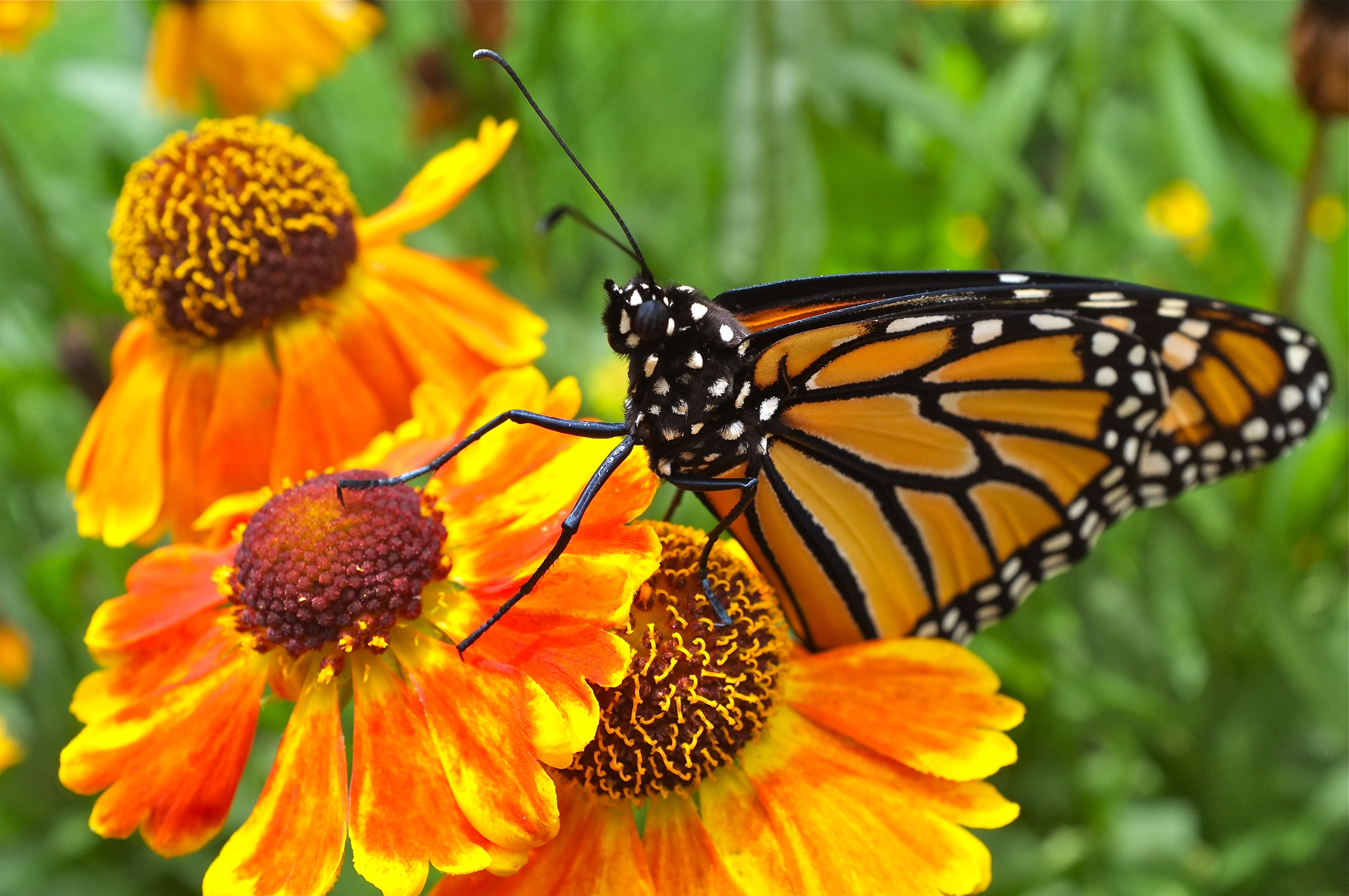
Learn about the life history, decline of, current status, and how big agriculture use of GMO Roundup Ready crops are killing Monarchs and pollinators. Learn how you can help the Monarchs breed in Massachusetts during the summer months and on their annual fall migration to Mexico. Lecture and slide presentation at the Salem Garden Club. For more information, email kimsmithdesigns@hotmail.com
Female Monarch depositing egg on Milkweed foliage and buds.
Category Archives: Monarchs in Mexico
SAVE THE DATE FOR MY UPCOMING PROGRAM “BEAUTY ON THE WING: LIFE STORY OF THE MONARCH BUTTERFLY”
On Thursday, May 4th at 7pm, I am giving my lecture with photos, “Beauty on the Wing: Life Story of the Monarch Butterfly,” along with several short film screenings, for the Salem Garden Club. For more information, see the events page of my website. I hope to see you there!
Newly Emerged Monarch Butterfly and Sunflower, Gloucester
Beauty on the Wing ~ Life Story of the Monarch Butterfly
The Monarch’s life story is one of nature’s most incredible examples of adaptation and survival. But the Monarch migration is in great peril. Learn how you can help. Through photographs and discussion, Beauty on the Wing tells the life story of the Monarch Butterfly, the state of the butterflies migration and why they are in sharp decline, and the positive steps we can take as individuals and collectively to help the Monarchs recover from the devastating effects of habitat loss and climate change. (1-1.5 hours).
Dia de los Muertos Papel Picado
I love the designs of the Papel Picado, especially the Dia de los Muertos skeletons doing everyday things. I found some at Nomad in Cambridge. Deb Colburn, the owner, curates gorgeous folk art for her shop from all around Mexico, and from all around the world. She’s a very sweet person to stop in and visit with, and is also very knowledge about Mexican culture. Nomad is located at 1741 Massachusetts Avenue in Cambridge.
Learning About Day of the Dead Traditions
There is a beautiful ofrenda at the Peabody Museum at Harvard, which is where I learned about the Mexican Purépecha indigenous people’s name for the Monarch butterfly, the “Harvester.” The altar is part of the Museum’s permanent collection and is on display year round.
From the Peabody Museum at Harvard’s Dia de los Muertos exhibit.
The Peabody Museum’s exhibition of a Day of the Dead ofrenda or altar is located in the Encounters With the Americas gallery. The exhibit features pieces from the Alice P. Melvin Collection of Mexican Folk Art and represents the Aztec origins of the holiday and the Catholic symbols incorporated into the tradition, from skeletons to plush Jesus figures.
The altar is contained within a box covered with panels that were decorated by local students and regional and international artists. The altars were designed by the Peabody exhibitions staff and Mexican artists Mizael Sanchez and Monica Martinez.
Originating with the Aztecs, the Mexican Day of the Dead is a unique blend of Mesoamerican and Christian rituals. The holiday, which is celebrated on November 1, All Saints’ Day, is usually dedicated to children; November 2, All Souls’ Day, is dedicated to adults.
Traditions vary from region to region, but generally families gather at cemeteries to tend and decorate the graves of their departed loved ones and remember them by telling stories, eating their favorite foods, and dancing in their honor. Many families build altars at home, decorated with flowers and food, especially pan de muerto or “bread of the dead.” A festive and social occasion, the holiday welcomes the return of those who have died and recognizes the human cycle of life and death.
The Peabody’s permanent altar features items from the Alice P. Melvin collection of Mexican folk art. To see these items, click here.
Curated by Davíd Carrasco, Neil L. Rudenstine Professor of the Study of Latin America and Mexican artist Mizael Sanchez.
To watch a video interview with Mizael Sanchez, click here.
Celebrating Dia de los Muertos
On a recent visit to say hello to ELise and Tucker at Cedar Rock Gardens they were hard at work planting a humongous field of tulips, planned to bloom for next Mother’s Day. Elise generously shared pots of fresh marigolds dug from their fields, not in good enough shape to sell, but perfect for our first ever Day of the Dead altar, Ofrenda de Muertos.
The vibrant colors and fresh citrusy scent of marigolds lure the spirits–marigolds are strewn about and placed around the altar so the souls can find their way. There is a wild version of marigolds that blooms in October and the Spanish name for the flower is flor de muerto, or flower of death.
The altar, or “offering to the dead,” is a sacred Mexican tradition where those who have passed away are honored by the living. The celebration takes place on November 1st and 2nd, on the 1st to honor the souls of children and on the 2nd, to honor adults. I became fascinated with the tradition after learning that Monarchs arrive in Mexico about the same time as Dia de los Muertos is celebrated. In Mexican folklore, butterflies represent the returning souls of departed loved ones. In the native language of the Purépecha, the name for the Monarch is the “harvester” butterfly. The Purépecha are a group of indigenous people centered in the northwestern region of the Mexican state of Michoacán, the very region to where the Monarchs return every year!
There is a beautiful ofrenda at the Peabody Museum, which is where I learned about the “Harvester” butterfly. The altar is part of the Museum’s permanent collection and is on display year round. Here is a link to the exhibit.


Synopsis: Beauty on the Wing: Life Story of the Monarch Butterfly
Writing proposals and organizing the film’s website this past week. This is a longer version of the synopsis. Oh my goodness, the last application was ten pages long. I think (hope) it will get easier the more I do it!
* * *
Beauty on the Wing ~ Life Story of the Monarch Butterfly is a documentary film that tells the story of the monarch butterfly at it unfolds along the shores of Cape Ann and in the heart of Mexico’s forested volcanic mountains. Filmed in Gloucester, Massachusetts and Angangueo, Michoacán, the film illuminates how two communities, separated by 3,000 miles, are ecologically interconnected.
Every stage of the butterfly’s life cycle is experienced in vibrant close-up, from egg to caterpillar to adult. Set against the background of sea and forest, sun and wind, by the millions and millions the intrepid monarchs journey thousands of miles. The most magical thing is that this migration happens in our midst, taking place in backyards, farms, meadows, and along the shoreline, wherever milkweed and wildflowers grow.
The monarch’s life story is one of nature’s most incredible examples of adaptation and survival. There are no other butterflies in the world that journey thousands of miles over such a great and vast area, ecologically linking Canada and Mexico, to nearly every region within the United States.
The story opens in the industrial port of Gloucester, Massachusetts. Well known for her legendary fishing industry, Schooner Festival, Italian feasts and fiestas, rich artistic heritage, and stunning coastline, Gloucester makes up much of the peninsula of Cape Ann, located on the coast of Massachusetts just north of Boston.
As are most regions along the length of the Eastern Seaboard, Cape Ann lies within a largely unrestricted north-south corridor for migratory species of birds and butterflies. This means that birds, butterflies, and other insects travel along the Atlantic flyway without being impeded by either mountain ranges or large bodies of water to cross. There is a tremendous sense of urgency in this great movement of life. Whether traveling by land or by sea, wildlife must reach its seasonal destination while life-sustaining food is abundant.
Cape Ann and Angangueo emerge as characters in the film, places where we have much to gain by preserving the habitats of these unique ecosystems and where, through neglect, the loss will be devastating.
Beauty on the Wing is a film for all ages, created for all to gain a deeper understanding of the symbiotic relationship between habitats, wildflowers, and pollinators, and the vital role that they play in our interconnected ecosystems.
In seeking funding to finish the film, I am currently in the process of writing grant proposals. Recently, I was invited to join the Filmmakers Collaborative, which is a dynamic organization that is providing excellent advice and will also act as the fiscal sponsor for the film. Each filmmaker represented by the Filmmakers Collaborative has a project page on the FC website and I invite you to visit mine here: Filmmakers Collaborative.
MY MONARCH BUTTERFLY FILM TRAILER!
Dear Friends,
I am super excited to write that today I am launching the trailer for my monarch butterfly documentary, Beauty on the Wing: Life Story of the Monarch Butterfly. I hope so much you enjoy watching as much as I have loved creating!
I am asking a huge favor of all my Good Morning Gloucester, Facebook, Twitter, and Instagram friends and that is to please share the trailer, hit all like buttons, and if you have time, to please comment.
In seeking funding to finish the film, I am currently in the process of writing grant proposals. Recently, I was invited to join the Filmmakers Collaborative, which is a tremendous and well-respected organization that is providing excellent advice and will also act as the fiscal sponsor for the film. Each filmmaker represented by the Filmmakers Collaborative has a project page on the FC website and I invite you to visit mine here: Filmmakers Collaborative.
The next stages in finishing the documentary are title design, audio mixing, and color correcting. I’ll keep you posted on progress made through GMG, the film’s website, and my website.
Look for Pilar, Meadow, and Atticus in the trailer. They were wonderful and I am so appreciative of their assistance. There were additional kids from our East Gloucester troupe that participated in making the film however, I couldn’t squeeze them all in the trailer. I think you’ll love all the children’s parts in the finished film!
For more information about the documentary, please visit the film’s website here: Beauty on the Wing
My most sincerest thanks to everyone for your kind support!
DISCOVERED: THE MONARCHS MEXICAN HAVEN
Forty one years ago today, January 9th is celebrated as the day the Monarchs winter habitat was “discovered.” The woman who led the discovery, Catalina Aguado, was born in Michoacán, the Mexican state that is home to the butterflies wintering grounds. Catalina is the only living member of the original team featured in the following 1976 National Geographic article.
Excerpt from “Discovered: The Monarchs Mexican Haven”
Doctor Fred Urquhart, the Canadian zoologist who had been studying and tracking the butterflies since 1937 writes the following:
“In our search for the overwintering place, years passed, years of frustration. Norah, late in 1972, wrote to newspapers in Mexico about our project, asking for volunteers to report sightings and to help with tagging.
In response came a letter, dated February 26, 1973, from Kenneth C. Brugger in Mexico City. “I read with interest,” he wrote, “your article on the monarch. It occurred to me that I might be of some help. . . .”
Ken Brugger proved the key that finally unlocked the mystery.
Traveling in his motor home with his dog, Kola, he crisscrossed the Mexican countryside. He searched especially in areas where tagged monarchs had been recaptured, and places where other visitors had reported numerous butterflies. “Go out in the evening,” we instructed him. “That’s when you’ll see the monarchs moving about looking for a place to roost.”
In a letter written in April 1974, Ken reported seeing many monarch butterflies in the Sierra Madre flying at random as if dispersing from a congregating site.
“Your data and observations are exciting,” I replied. “We feel that you have zeroed in on the right area.”
Ken Brugger doubled his field capability by marrying a bright and delightful Mexican, Cathy. Late in 1974 he wrote of finding many dead and tattered butterflies along the roads in a certain area. “You must be getting really close,” we responded. These butterfly remains suggested that birds had been feeding on large flocks of monarchs.
Swiftly came the dramatic conclusion. On the evening of January 9, 1975, Ken telephoned us from Mexico. “We have located the colony!” he said, unable to control the excitement in his voice. “We have found them—millions of monarchs—in evergreens beside a mountain clearing.”
Mexican woodcutters, prodding laden donkeys, had seen swarming butterflies and had helped point the way.”
BEAUTY ON THE WING ~ THURSDAY NOVEMBER 12TH AT THE SAWYER FREE LIBRARY!
What is a Monarch Butterfly explosion? The butterflies migrate to Mexico to keep from freezing to death in northern climates. The air is cool and moist in the trans-Mexican volcanic mountains, cool enough to keep them inactive and in a state of sexual immaturity, called diapause, but not so cold that they will freeze. As spring approaches and the Earth’s temperature begins to rise, the butterflies sleeping in the oyamel fir forests need to get out of the hot sun. Millions explode from the trees, drink water from nearby mountain streams, and move to a cooler, shadier spot on the mountain.
I hope you’ll come join our program Thursday night at 7pm at the Sawyer Free Library. We’ll be talking all things Monarchs including the current status of the butterfly’s migration, habitat destruction here in our own community, and most importantly, ways in which we can all help the Monarch possibly survive the warming of the earth.
We will be premiering the trailer for my forthcoming film about the Monarchs, too (also titled Beauty on the Wing). I hope to see you there!
For more information, visit the Programs page of my website and the Sawyer Free Library Facebook page.
Rain Forest Publications and Mourning Cloaks
Recently brochures from Rain Forest Publications arrived. Don’t you love pocket guides, for the very reason the name infers–so easy to tuck along when traveling and hiking. That’s my photo on the cover of “Mexico Butterflies.” The photo was taken not in Mexico, but in Gloucester!
Be on the lookout for the first butterfly of spring, which will most likely be the Mourning Cloak Butterfly. Mourning Cloaks do not spend the winter in the cool volcanic mountains of Mexico as do the Monarchs, or as a chrysalis in our gardens, like the Black Swallowtail, or as a caterpillar rolled up in a tight little ball under a leaf, as does the Wooly Bear, but as an adult butterfly!
During the winter months Mourning Cloaks live tucked away in cracks and crevices, between chinks of tree bark, for example. At the first warm breath of spring they begin to take flight, searching for a mate. You’ll often see them on the wing around Pussy Willows, one of the Mourning Cloak caterpillar’s food plants.
Monarchs Eyed for Possible Inclusion Under US Endangered Species Protection
Cape Ann Milkweed and Monarch Habitat, Eastern Point
The U.S. Fish and Wildlife Service is considering adding Monarchs as a threatened species under the Endangered Species Act. A one-year review is underway to monitor the butterfly’s status. Since the 1990s the population has plummeted from about one billion to approximately 35 million. That may seem like a substantial number, but the Monarchs need stronger numbers to be resilient to other threats such as harsh weather.
The reason for the decline is primarily because of loss of milkweed habitat in the agricultural heartland of the United States. With the development of Monsanto’s Roundup and Roundup Ready (glyphosate resistant) seed, farmers are now able to spray glyphosate directly on their corn, soybean, and sorghum crops. Roundup also destroys milkweed. Secondly, with the push for ethanol, farmers have begun to plant corn on conservation land.
If the Fish and Wildlife Service determines that the Monarchs are threatened, they will set aside land for milkweed.
You can read more about the the Monarch Butterfly Endangered Species Act here:
FAQs on the Monarch Butterfly Endangered Species Act Petition
Monarch Butterfly Drinking Nectar from Native Wildflower Joe-pye Weed
You can learn more about the Monarch migration and the loss of Monarch habitat from Professor Tom Emmel here ~
NEW FILM: A FLIGHT OF MONARCHS
When watching, know that the first two minutes of the film were shot in Gloucester. I think you will be dazzled by the sheer numbers of Monarchs that travel through Cape Ann’s backyards and meadows during the peak of migration.
I began photographing the Monarchs in 2006, which was a year when we had an extraordinary number of Monarchs visiting our shores. At that time, I became determined that if ever again this phenomenon were to occur on Cape Ann, I was going to have the ability to document on film, rather than only through still images, this beautiful event for my community. It’s hard to imagine without observing and here you can see what I have wanted to share.
A Flight of Monarchs begins on a September day as first one and then passels of Monarchs begin to arrive to the fields and meadows of Cape Ann, carried across Massachusetts Bay on a tailwind. By the early evening light they begin to pour into the surrounding trees, clustering to stay warm in the branches furthest away from the prevailing breezes. The following morning as the sun begins to touch their wings, they alight from the trees, seeking the freshest wildflowers from which to drink nectar to help build their lipid reserves for the several thousand mile journey south. They drink and drink until the last of the sun’s rays dip below the tree line. As they arrived on a tailwind, they again depart, and are carried to the next gathering area. For coastal Monarchs, Allens Pond, which is located in Westport, Massachusetts is often the next stop.
In the next scene, the butterflies have arrived to the sacred oyamel fir forests of Angangueo, Michoacán, deep in the heart of the Trans-Mexican Volcanic Belt. It’s early morning and the butterflies are suspended in great primordial branched clusters that may become so heavy from the weight of so many butterflies the boughs of the trees bend to the breaking point. Later in the day, as the sun begins to warm their wings, the butterflies begin to stir. During the winter, it is imperative that the Monarch’s body temperature remains relatively low. They leave the sunniest branches in search of shade and a drink of water from nearby mountain streams. Occasionally in late February, as the air temperatures begin to warm with the coming springtime, for a short period during the day, the butterflies leave the trees all at once. This phenomenon is called a butterfly “explosion,” and is a truly magnificent event to observe.
A Flight of Monarchs is set to the evocative and tender “Fields of Blue,” written and performed by composer and guitarist Jesse Cook and his band, to which permission was granted by the artist for the purpose of this short film. Here is a link to Cook’s website. I highly, highly recommend attending a live performance of Jesse Cook and Company. As was I, you will be completely taken by their gorgeous music, exquisite artistry, and with Cook’s songwriting, will travel in beautiful melodies inspired from around the world.
I am currently editing my feature length documentary, Beauty on the Wing, which after months and months of organizing and editing three years of footage, is currently running at approximately twelve hours in length. At eleven hours too long, I have a great deal of editing to accomplish in the coming winter months!
A Flight of Monarchs presented here is the shorter version of the film that I created for the Berkshire Museum’s “Butterflies” exhibit. The first version is six minutes long and played on a continuous loop in the main gallery of the exhibit hall. The longer version will soon be posted on Vimeo.
Checkout Rainforest Publications!
Rainforest Publications recently licensed one of my Monarch photos, which was shot on Eastern Point, for the cover of their newest pocket field guide, Butterflies of Mexico. You can get a preview of the new field guide by clicking here; look towards the bottom of the page.
I requested their field guide on Mexican Flowers, which Larry, the publisher, kindly sent along. I love it–the guide is beautifully illustrated, and well, just so pocketable! I wished I had it on my trip last winter to Agangueo to film the Monarchs and especially appreciate how the guide is organized by plant family as opposed to alphabetically.
If any my world-traveling readers are planning a trip to Costa Rica, Mexico, Florida, Hawaii, Panama, Peru, California, Nicaragua, Belize, or the Pacific Northwest I recommend checking out their website, Rainforest Publications. Specific to each region, they offer field guides on marine animals, birds, orchids, wildflowers, butterflies, trees, reptiles, amphibians, and more. They even have a field guide for marine mammals of the North Atlantic. At only $5.95. I think this would be ideal for whale watchers (and for whale watching companies like Seven Seas to carry the guides).
Please Don’t Weed the Milkweed
Once established, native Common Milkweed grows vigorously and rambunctiously, making itself known even in the thinnest of sidewalk cracks. Here’s a patch growing along East Main Street. I think it beautiful! What do you think?
* * *
If you caught Tom Ashbrook’s On Point broadcast on NPR yesterday morning you heard Doctor Lincoln Brower, Karen Oberhausser, and Rick Mikula, three of the world’s leading butterfly experts, speaking about the disappearance of the Monarch and the main reason why–most notably because of the sterilization of the American landscape through the use Monsanto’s Roundup and GMO corn and soybean crops.
The following is a list of a few suggestions on ways in which we can all help turn the tide:
Plant milkweed and wildflowers. Teach members of your family and friends what milkweed looks like and why we don’t want to weed it out of the garden. The above patch of milkweed is growing next to a shop on East Main Street. About a month ago, I went into the store and, very, very politely inquired as to whether or not they knew that the plant growing outside their doorway was a terrific patch of milkweed. They had no idea. I explained what the benefits were to the Monarchs and have since noticed that the milkweed patch is still growing beautifully!
Ban GMO crops. Genetically modified seeds have been altered to withstand megadoses of Roundup. Millions and millions of tons of herbicides are poured onto Roundup Ready fields of crops, preventing any other plant that has not been genetically altered from growing (in other words, wildflowers). The application of Monsanto’s deadly destructive herbicide Roundup is creating vast sterilized agricultural wastelands, which will, over time, only need heavier and heavier does of their lethal chemicals to continue to be viable.
Don’t apply herbicides and pesticides in your own gardens.
Create wildflower corridors in backyards and highways.
Reduce salt wherever possible (and where it wouldn’t cause harm to human life). Large amounts of road salt, as was needed during this past snowiest of winters, is detrimental to wildlife habitats.
Butterflies! at the Berkshire Museum
Detail of Paul Villinski’s “Arcus,” made from recycled cans.
My friend Sam Jaffe talking about caterpillars.
Friday night I had the joy to attend the fabulous new exhibit at the Berkshire Museum titled “Butterflies!” The galleries are filled with hands on art and science activities, contemporary butterfly sculpture, artifacts from the museum’s collections, live caterpillars, and mixed media of photography and film, including an audio track from Dr. Lincoln Brower discussing what happens within a chrysalis. And, as part of the exhibit, one of the galleries houses a large butterfly pavilion with over 200 live tropical butterflies from around the world!
Underwings of the Blue Morpho Butterfly from the live butterfly pavilion.
“Butterflies” was curated by Maria Mingalone, the museum’s director of interpretation, and she deftly and beautifully combines science, art, and nature in an exhibit that is sure to inspire and delight the very youngest to the most senior of citizens, and every age in between!
The opening was very joyful and buoyant—I most certainly felt that way and, judging from the expressions on visitor’s faces, wasn’t alone. I am convinced that butterflies bring out the happy in people!
The audience for my short film “Flight of the Monarchs”—I watched as many people watched my film many times over, despite the case that because the galleries were so crowded you couldn’t hear the beautiful music. I think there were several thousand people at the event.
The music that I set my film to is “Fields of Blue,” written and performed by Jesse Cook. I wrote the artist and sent him a copy of my film and the most amazing thing happened where, within only the few day whirlwind to create this little film, we were granted permission to use his song!!!!!!!!
My film opens with a clip of a Monarch flying in front of Eastern Point Lighthouse (you can see our Lighthouse in the above photo). Most of the footage that I used for the movie was of butterflies in flight, shot on Cape Ann, and the audience was stunned at how beautiful the migration is through Gloucester. That opening clip of the Lighthouse and the Monarch took several days to capture the exact shot that I wanted. Butterflies don’t take direction!

Some of my photos were used to illustrate Dr. Brower’s audio recording explaining what happens inside a chrysalis.
Sam and his fiance Kathy, also a graduate student in environmental studies.
If you have never been to the Berkshire Museum, their website description reads as follows: “The Berkshire Museum offers a unique array of exhibitions, activities, and attractions for visitors of all ages. From fine art and ancient objects to fossils; from an aquarium of native and exotic creatures to the Feigenbaum Hall of Innovation, we are your community museum: a place where everyone, from toddlers to elders, can learn, play, explore, innovate, be engaged and inspired.”
I arrived early, before “Butterflies” opened its door, and explored the galleries. It’s really a very engaging museum and especially while the exhibit is running, would be a wonderfully fun and interesting day trip with children.
Sam Jaffe making final adjustments to the chrysalis and cocoon display. To see some of Sam’s stunning photography, click on his website here: Sam Jaffee
Olive Ridley Skeleton at the Berkshire Museum
See more photos from the Berkshire Museum galleries Continue reading
Exciting New Film Assignment for the Berkshire Museum and Milkweed Seed Mailing Update
Dear Friends,
I have wonderful news to share about an upcoming exhibit at the Berkshire Museum in which I have been asked to create a film about butterflies in flight. The title of the exhibit is, what else—Butterflies! They are going to be showing 26 of my butterfly photographs. Additionally, during the exhibit, my interview film with Tom Emmel will be running on a continuous loop, as will the new short film about butterflies in flight, titled Flight of the Monarchs. And best of all, screenings of my feature-length Black Swallowtail film and Monarch film will be shown during meet the filmmaker events. This is a fantastic educational project, with a 5,000 square foot exhibit space, which will also house live butterflies. It’s a truly hands-on exhibit, designed with children and adults in mind!
“Butterflies” is scheduled to run through August and will most probably be extended though September. I am attending the opening this coming Friday, May 30th, and will take photos and bring you more information about the Berkshire Museum and the exhibit.
Our Cape Ann Milkweed Project went without a hitch and was lots of fun. Most picked up their seeds and if you sent a self-addressed stamped envelope, your package is ready to mail Tuesday morning. So many thanks to Joey for sponsoring the Cape Ann Milkweed Project at Captain Joe and Sons. Thank you so much to everyone that participated, and most importantly, the Monarchs (and myriad other species of pollinators) thank you!!!
Warmest wishes,
Kim
Xerces Society Letter to President Obama
April 14, 2014
President Barack Obama The Honorable Tom Vilsack, Secretary of Agriculture The Honorable Sally Jewell, Secretary of the Interior
Dear Mr. President, Mr. Secretary of Agriculture, and Madam Secretary of the Interior,
In light of the severe decline of both the eastern and western monarch butterfly populations that has occurred since the late‐1990s, we are writing to ask you to establish a multi‐agency monarch butterfly recovery initiative to restore the habitats that support the extraordinary migrations of this iconic species. We encourage you to direct the Natural Resources Conservation Service (NRCS), Farm Service Agency (FSA), and Forest Service (USFS) of the U.S. Department of Agriculture and the Fish and Wildlife Service (USFWS) and Bureau of Land Management (BLM) of the U.S. Department of the Interior to develop a cooperative, landscape‐ level initiative with the many stakeholders willing to help foster significant monarch recovery.
These migrations can be saved for future generations by restoring to the landscape milkweeds, the host plants for monarch caterpillars, and nectar plants that sustain the adult butterflies. These habitats would support pollinators and a large number of other species as well. The federal agencies that incentivize conservation of wildlife habitat on private lands and that directly manage wildlife habitat on public lands can play key roles in this effort by targeting funding and technical support for such an initiative.
As you know, the eastern monarch population has been declining for more than a decade, and this year scientists observed the lowest numbers ever documented, representing a 90% drop from population numbers recorded in the mid‐1990s. Since then, there has been a significant loss of milkweeds in agricultural areas of the Midwest, which is directly correlated with the declining monarch population. Monarch habitat has also declined sharply in the West.
Paul Mirocha Illustration for Monarch Watch Continue reading
New Film: Monarch Migration Interview with Tom Emmel
Horses neigh, bugs crawl across the lens, and Monarchs flutter in the background —interview on the mountaintop and it was all beautiful! Video includes footage from my forthcoming film, Beauty on the Wing ~ Life Story of the Monarch Butterfly.
Monarch Migration Interview with Tom Emmel, filmed at the summit of the Sierra Chincua Monarch Butterfly Biosphere Reserve, Angangueo, Mexico.
This was Tom’s 40th trip to Angangueo to study the Monarchs. In this interview, he provides some historical perspective from those very first trips to the remote Oyamel fir forests atop the Trans-Mexican Volcanic Mountains. We learn how scientists count millions of Monarchs. Tom discusses the state of the Monarch migration today and why it is in crisis.
Tom Emmel is the Director of the McGuire Center for Lepidoptera and Biodiversity at the Museum of Natural History of the University of Florida, Gainesville. Additional footage shot at El Rosario Monarch Butterfly Reserve and at the base of Sierra Chincua.
Meet McGuire Center Director Tom Emmel at the Monarch Butterfly Biosphere Reserves
Our expedition to the Monarch Butterfly Biosphere Reserves was led by Tom Emmel, Ph.D. Tom is the Directorof the McGuire Center for Lepidoptera and Biodiversity, which is part of the University of Florida’s Museum of Natural History. He is also the university’s professor of zoology and entomology and the author of over 400 publications, including 35 books. Not only is Dr. Emmel a professor and director of the center, he leads expeditions to research biodiversity around the world, including recent trips to Bali to Komodo Island to study the Komodo Dragon (with a great story of how he and his fellow travelers very nearly almost became Komodo Dragon supper), the Galapagos Islands, and Madagascar.
This was Dr. Emmel’s fortieth trip to Angangueo to study the Monarch Butterfly migration. His first trip was in 1980 with Dr. Lincoln Brower who had, at the same time as Dr. Fred Urquhart, discovered the Monarch colonies in 1975. In those first early years of conducting research at the biospheres, Dr. Emmel and Dr. Brower traveled on old mining roads, rode horseback to the colonies, and camped in tents. Today, there are well-marked trails with options for either hiking or horseback riding.
On the second day of our expedition, I interviewed Dr. Emmel at the top of Sierra Chincua Monarch Colony. He was also interviewed by a Mexican television crew at the summit of the Sierra Chincua biosphere. I am in the process of editing the interview footage and will have that ready to post in the near future. Amongst the many aspects of the Monarch’s migration discussed during the interview, Dr. Emmel reveals exactly how one counts millions upon millions of Monarchs and offers several theories as to why the butterflies migrate to the very specific climate zone of the Trans-Mexican Volcanic Belt. We cover the subject of Monarch conservation and precisely how Monsanto’s GMO genetically modified Roundup Ready corn and sorghum, and Bt-corn, are indisputably deadly to the Monarchs. You’ll be surprised at the results of the research that was conducted on our journey in regard to the numbers of Monarchs counted in the biospheres.
This photo was taken early in the day, before the butterflies awaken in the sun. You can see that the limb of the Oyamel tree is so heavily laden with butterflies, it appears as though it will snap at any moment. And oftentimes, the limbs do break! The butterflies scatter and then regroup to another location.
Meeting Dr. Emmel and fellow expedition travelers was one of the most interesting and exciting aspects of the journey. You can’t imagine traveling with a more knowledgeable expert than Dr. Emmel. He is not only a world authority on all aspects of the Monarch’s migration, the history of the development of the biospheres, and the community of Angangueo, he also has extensive knowledge about a wide range of wildlife species and topics relative to biodiversity and the natural world. He shares the information generously and with a sense of humor, too.
Dr. Emmel’s assistants, brothers Ian and Craig Segebarth, are two of the brightest and most helpful young men you could hope to meet. Marie Emerson, who works in the development department at the museum was a joy and also super helpful, as was Josh Dickinson, who was traveling with his wonderfully fun granddaughter, 5th grader Zoie Dickinson. Josh Dickinson has spent a lifetime consulting on forestry management and he will be helping with forestry management at the Monarch biospheres. Josh also speaks Spanish very well and was tremendously helpful, especially when I locked myself out of my hotel room! Thanks again Josh for your kind assistance!
Monarch Expedition: Part One ~ Angangueo Michoacán, Mexico
After the four-hour drive from Mexico City, across a wide canyon of rustic farmland and over and around volcanic mountains, we arrived in the early evening at the beautiful town of Angangueo. Pitched on a steep mountainside, the narrow streets and closely packed buildings with shared stucco walls immediately reminded me of southern European villages. Especially lovely were the modest and many handmade outdoor altars gracing townspeople’s homes and gardens.
Angangueo is located in the far eastern part of the state of Michoacán in the central region of Mexico within the Trans-Mexican Volcanic Belt. During the late 1700s minerals were discovered. Large deposits of silver, gold, copper, and iron ore brought a rush of people to the area. Today, Angangueo is noted as home to two of the most beautiful Monarch Butterfly Biospheres, El Rosario and Sierra Chincua.
Our guesthouse, the Hotel Don Bruno, was utterly charming. As with many of the buildings we passed on the way to Angangueo, a cheery row of glazed terra cotta pots brimming with red and pink geraniums lined the hotel entrance. Through the entryway door and past the front office, guests entered the beautiful inner courtyard garden. All the rooms faced into the courtyard and mine had a delightfully fragrant sunny yellow rose just outside the door. I quickly changed for dinner to meet my fellow travelers in the hotel’s second floor dining room. A long dining table arranged family style, running the length of the room, had been set up for our group, with a view onto the flowering courtyard below.
As he did that evening, and every dinner and breakfast, Chef Jean Gabriel Salazar López had prepared an elegant feast of many different entrees, mostly native Mexican dishes, including and combining a fabulous array of local fruits and vegetables. The proprietors and hotel staff could not have been more friendly and accommodating.
Dinner was followed by a discussion led by Dr. Emmel. Tom Emmel is the Director of the McGuire Center for Lepidoptera and Biodiversity, which is part of the University of Florida’s Museum of Natural History. He is also a professor of zoology and entomology and the author of 35 books (more about Dr. Emmel in the next installment). I recorded several of Dr. Emmel’s lectures and an interview atop the Sierra Chincua Biosphere and will be posting all on youtube.
At daybreak the following morning, I climbed the central outdoor stairwell to the top of the hotel to film the sleepy town awakening. Roosters crowed and the hotel’s freshly washed and drying sheets whipped to the wind in the crisp mountain air. The morning light did not disappoint. Kitty corner across from my rooftop vantage point was one of the small town’s several churches, with a walled courtyard and red and white banners fluttering in the breeze. The village’s main road leads further up to the mountains and is lined with red tiled roofed-homes and sidewalks swept immaculately clean. The sun was just beginning to peek through the mountains when I had to leave to hurry down to breakfast.
Despite the beauty and well-kept appearance of Angangueo, and especially of our charming guesthouse, the town and the Hotel Don Bruno were nearly empty of tourists. Reports of mayhem and murder in Michoacán have drastically reduced the number of people traveling to Angangueo to see the Monarchs at the biospheres.
The gang violence is taking place on the far western side of Michoacán, near the Pacific Coast. Angangueo is located on the far eastern side of the state, bordering the state of Mexico. Not traveling to Angangueo for that reason is as uninformed as if someone decided not to travel to San Francisco because of the gang violence that takes place in Los Angeles! The people of Angangueo have stopped logging to protect the Monarch’s habitat and have come to rely heavily on income from tourism. I was deeply saddened to see the lack of visitors, at this time of year especially, when the Monarchs are at their peak activity at the colonies.
Next installment: Day 1 at the Monarch Colony