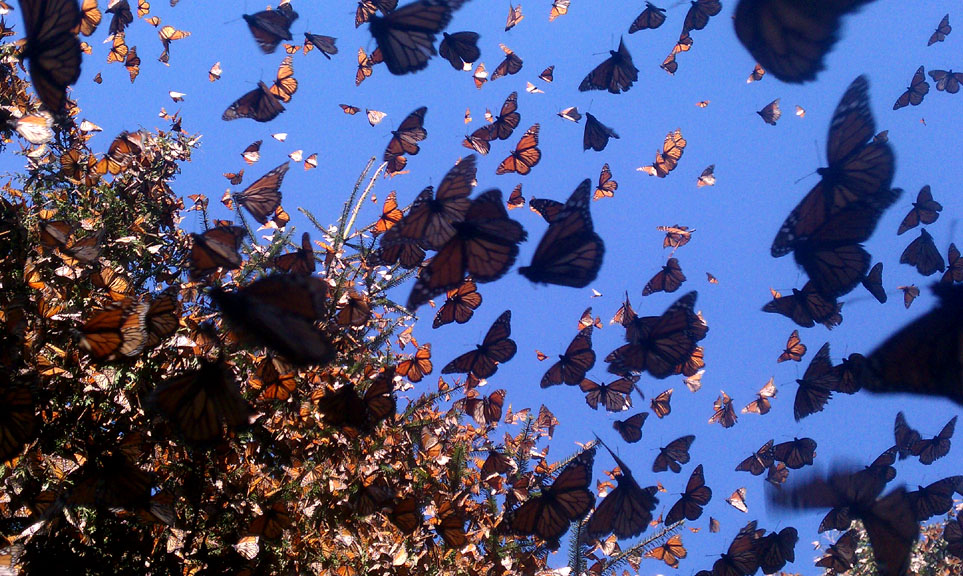
Tag Archives: Monarch butterfly migration

Giving Credit Where Credit is Due (and Monarchs)

Dear Friends,

Recently I attended a lecture given by an expert in a field to which I am passionately involved. I was really looking forward to this lecture and I have on many occasions actively promoted this lecturer. To get to the point, I was stunned to recognize that the third photo into the slideshow was one of my own photos, and it was presented without acknowledgement. I sat stupefied listening to the rest of the lecture. I hoped that no other photos of mine were part of the presentation. Unfortunately that was not the case. One of the last photos presented was one of my best selling photographs and the audience was audibly moved by the photo. It would have been so simple at that point to say something like, “Thanks to Kim Smith, the photographer, who is here with us this evening.”

The following morning I wrote the lecturer a very polite email stating that I don’t mind sharing my work. I simply requested that he use any one of several photos that I attached for him, with my name discreetly added in the lower right corner. In reply I received a curt and condescending note from the lecturer stating he would delete my photos from his presentation and from his files.

I spent three freezing hours before a long workday in a windy wet field hoping to get that shot that the lecturer was using as part of his presentation. Taking credit, either by claiming it as your own, or by lack of acknowledgement is unethical, at the very least. I really empathize with people who experience more extreme cases of appropriation. Some may find this case to be relatively minor; I found it totally unnerving.

I love to share information and photos about wildflowers and butterflies—as my new friend Hannah says, “You am working for the butterflies.” I blame myself for not watermarking the photos, although I believe very sincerely that most people are honest, have integrity, and give credit when credit is due. For example, when Maggie Harper, the producer from the television show Chronicle, borrowed my Greasy Pole footage, they not only ran my name across the top of the footage, they also provided a link to my blog on the Chronicle website. Maggie had seen the footage on Good Morning Gloucester and contacted Joey, who graciously provided her with my contact information. From the Chronicle link, I received many thousands of hits on my own blog. As another example, when a non-profit national wildflower organization wanted to use several photos for their publication, I gladly said yes, and only requested that I receive a photo credit, which they did provide. I am honored and touched beyond measure that people enjoy my photos and films. My policy is the same as many artists in that I request that if someone wishes to use my work for presentation, that they would please let me know, prior to use.

Enough with all that. Many have written requesting information about this year’s Monarch Butterfly migration. I have been shooting daily hours and hours of video and still photos and will be sharing all. I have figured out how to add a watermark in photo shop, but am hoping to find a more efficient and faster method of adding a signature.

Kim Smith PhotoMonarch Butterfly Migration Gloucester Massachusetts 2012

Happy Last Days of Summer!

Many more photos from this year’s migration to come.

When to Mow Fields for Butterflies and Beneficial Insects

Recently a design colleague wrote inquiring as to the best time to mow her client’s fields as she was concerned about disrupting the breeding cycle of the Monarch butterfly. I am often asked this question and it is well worth considering, not only for the sake of the Monarchs, but for the survival of the myriad species of butterflies, bees, and other pollinating and beneficial insects that find food and shelter in untilled fields.

Newly Emerged Monarch Butterfly

Dear Laurel,

I generally advise my readers and design clients that own similar untilled fields to alternately mow in stages–half a field at a time. The Monarch is a large, charismatic butterfly with an easily observed life cycle.  The typical field comprised of native (and introduced) wildflowers and grasses creates a rich biodiversity, supporting innumerable species of butterflies and beneficial insects. It is hard to know when exactly to mow for each different species and when to mow for even one single species because, from year to year, depending on many variables including temperature and air currents, the insects breeding times are somewhat variable. For example, this year I have had three broods each of both Monarchs and Black Swallowtails, when in a more typical year I may only have two broods.
Monarch Butterfly Caterpillars Attached to Milkweed (Asclepias syriaca)
I think of not too long ago when we were primarily an agrarian society. Farmers then would have mowed different fields at different times during the growing season. A woman in our community, whose field is rife with common milkweed, always mows in late June or early July. Initially I thought that this was perhaps not good practice for the Monarchs, but the thing with Common Milkweed (Asclepias syriaca) is that when mown to the ground in early summer, it shoots right back up again. By the time the late July, early August Monarchs have arrived and are breeding in our region, her milkweed has re-sprouted, grown at least a foot, is lush and green, and flowering.
That your client is interested in caring for the flora and fauna that abounds in her fields is wonderful! We want weeds (wildflowers) growing in our fields–they provide food and shelter for benefiel insects and wildlife and also help to retain moisture in the soil.
The single greatest threat to the Monarch butterfly is the use of Monsanto’s Roundup Ready genetically modified corn and soy bean seed, which are designed to tolerate potent does of Monsanto’s herbicide Roundup, however, Roundup kills all other surrounding plants and all beneficials insects and their larvae. Additional threats include the extreme weather condiitons caused by climate change, overdevelopment in the US, which has led to loss of habitat, and the unrelenting poverty in rural Mexican villages, which is leading to the deforestation of the butterflies habitat in Michoacán
Monarch Butterfly Chrysalids
At a lecture I attended presented by Doug Tallamy, Professor and Chair of Entomology and Wildlife Ecology at the University of Delaware, he also suggested mowing fields in alternate stages, so we are in good company!
An additional suggestion is to give a corner of your field or garden over to a patch of milkweed, which would then insure a steady supply for the Monarchs. We grow both Common Milkweed and Mash Milkweed (Asclepias incarnata) side-by-side. The marsh flowers slightly earlier, attracting earlier Monarchs. The males intently patrol the milkweed patch and after mating, the females flit from flower to leaf, alternatively depositing eggs on both species of milkweeds, while taking sips of nectar from whichever milkweed is in flower.
Kind regards,
Kim
Note form Laurel:
Hello Kim,
I have a new client who has both cultivated ornamental gardens, which I am caring for, and open meadows, which she has mown once or twice per season. There is lots of milkweed in the field, with some seedlings sprouting in the garden. We pulled the seedlings and brought them home to later place in a field near where I live. We had them in jars in water and were surprised and delighted when a few days later we discovered 7 tiny Monarch larvae. We have raised them to the butterfly stage and released them. Fascinating! During the process I did some reading about the Monarch and learned that there are 4 or 5 generations each season, with the final butterflies, in September, making the trek to Mexico for the winter, and then flying north in the spring to start the cycle over again. My question is about the timing of the mowing of the fields. If it is mown at any time during the breeding season (May – September?), isn’t the current generation almost or completely wiped out? Do you  know when the best time is to mow for the butterflies? I assume it is late fall, but since the mowing of meadows has been happening for centuries, is it perhaps ok to mow during the season? (or perhaps this is one contributing reason for the demise of these lovely creatures….) Thank you in advance for any info!

Monarch Butterflies Mating

In organizing my Monarch book proposal to send to a friend, who has a friend who publishes children’s books, I am sorting through my illustrations. This painting was completed at the end of summer last and illustrates a male Monarch (above) and female (below) ascending towards a maple tree during their mating flight. He carries her and together they stay joined, abdomen to abdomen, for several hours–truly a beautiful thing to observe.

Monarch butterflies mating Ascending - Pages 22-23

I lay down on the ground under a neighboring maple tree and sketched while looking up into the canopy. This is what I imagine the leaf net canopy looks like to the Monarchs as they ascend into the trees.

PLANT MILKWEED AND YOU, TOO, WILL HAVE MONARCHS MATING IN YOUR GARDEN!!

Milkweed is the food plant of the Monarch caterpillars. I often observe females drinking nectar from the milkweed blossoms one moment and the very next, depositing an egg on the underside of a freshly unfurled leaf, near the top of the plant. We observe the greatest numbers of caterpillars on the foliage of Common Milkweed (Asclepias syriaca) and  Marsh Milkweed (Asclepias incarnata).

Gloucester Garden Club

Beauty on the Wing ~ Life Story of the Monarch Butterfly

In preparing for my upcoming presentation to the Gloucester Garden Club, Wednesday, April 13th, I am discovering new images shot last summer. The photo shows a freshly emerged Monarch clinging to its chrysalis, with crumpled wet wings yet to fully expand. Butterflies Days can’t get here soon enough! Later in the afternoon we will be attending Ellen Lefavour’s art opening and book signing for Did you Know at Alchemy of Art Gallery. I hope to see you there.

Monarch Emerging from ChrysalisMonarch Butterfly Newly Emerged from Chrysalis

Brooke O’Donnell Shares Monarch Photo from Michoacán

Monarchs in Michoacán, Mexico

Brooke O’Donnell Photo from Michoacán

From Brooke’s Mom, Janet:

Hi Kim,

When I looked at the photo, I immediately thought of your inspiring exhibit at the Sawyer Free Library.  Brooke had an eight or more hour bus trip, then an hour horseback ride up to the 10,000 foot elevation in Michoacan state to see the migration.  I wouldn’t be surprised to find you up there!

Back down here at sea level, I wish you a glorious Spring!
Janet

Monarch Butterfly Migration

Update: Monarch Butterfly Migration Late Summer 2010

Monarch butterfly migration seaside goldenrodMagical Seaside Goldenrod Meadow

Monarch butterfly migration seaside goldenrod

Dear Gardening Friends,

So many have telephoned or emailed inquiring about the status of the annual Monarch butterfly migration through our region. This past summer I have observed umpteen Monarch butterflies and caterpillars in cultivated gardens, wildflower meadows, and along the shoreline; however, I did not see the great numbers in great heaps roosting in any one particular place that I have in some years past. Rather I would find a small passel here and a small passel there—perhaps several dozen at a time—roosting in the wild black cherry trees (Prunus serotina) at Eastern Point, awakening in the early morning and nectaring at the Seaside Goldenrod in the meadow below.

Monarch butterfly migration Monarchs Mimic Withering Foliage of Black Cherry Tree

Although the Monarchs are guided genetically, using their internal sun-compass navigation and circadian clock, each year the annual southward migration takes a different form that depends on many  variables, primarily the weather conditions in their overwintering site in Michoacán, Mexico as well as weather patterns in their US and Canadian breeding grounds. Because Cape Ann is located at approximately 43 degrees latitude north, our peak migration pattern is estimated at around September 11, but I modify this pattern because of the strong winds and storms we often experience in the late summer living along the coastline.

I have read reports of fantastic migrations that are taking place this year, from Long Island, south to Cape May, and west to Virginia—some saying it is the best they have seen in decades! I continue to remain on the look out because the air temperatures were atypically warmer this summer, creating a longer breeding season than usual, which would indicate that there may be newly emerging Monarchs on the scene. While photographing during this year’s migration, I encountered a pair of Monarchs mating, a very unusual occurrence at this time of year. The “Methuselah” Monarchs that we see in late summer and early autumn are generally speaking sexually immature and do not mate until next year, after they journey south and after they overwinter and awaken in Mexico.

Monarch butterfly migration monarchs mating seaside goldenrodMonarchs Mating Amidst the Goldenrod

Monarchs observed in late summer and early autumn are intent on nectaring and not easily distracted. This later generation of Methuselah Monarchs is feeding aggressively to increase and store their lipid reserves for the long journey south. We provide plenty of nectar-rich blossoms to help the Monarchs in their exhaustive migration, taking cues from marsh and meadow. Blooming freely at this time of year are copious members of the Composite family—goldenrods, asters, pearly everlasting, zinnias, ironweed, Mexican sunflowers, and Korean daisies. If one diligently deadheads the butterfly bushes and Verbena bonariences, they too will be available for the migrating Monarchs.

My favorite goldenrod is Seaside Goldenrod (Solidago sempervirens), which blooms from August to November. Seaside Goldenrod is the gorgeous brilliant golden wildflower we see growing and glowing along the edge of the sea. It is easily differentiated from other New England goldenrods in that the flowerheads are comparatively larger and the leaves are thicker and fleshier, with a waxy feel, an adaptation to the drying effect of salty sea spray. Seaside Goldenrod grows prolifically in rich, moisture retentive soil, less so in drier conditions.

Although I strongly discourage digging plants from local marsh and meadow, perfectly acceptable is the practice of collecting ripened seed stalks and shaking them about. That is just how we obtained our Smooth Asters (Aster laevis). With cheery one-inch button-shaped flowers borne along the lengths of the stalks, the pale-hued lavender-blue ray flowers and yellow disk florets of Smooth Asters are attractive to bees and butterflies. We have observed Common Sulphers, Pink-fringed Sulphurs, Monarchs, American Ladies, Red Admirals, and Cabbage Whites nectaring simultaneously on a clump growing in the sheltered border along our fragrant path. Pinch back the developing growth tips during the early part of the growing season (until roughly July fourth) to encourage a bushier and more compact plant. Asters provides nourishing sustenance for transitory butterflies when many nectar-rich plants have finished blooming for the season. Not particularly fussy in regard to soil conditions, Smooth Aster grows and flowers profusely in full sun to light shade. Smooth Aster and Purple-stemmed Aster (Aster puniceus) are the asters we see blooming along the backshore at this time of year. With golden yellow florets at the center of their ray flowers, asters and goldenrods create a convenient landing pad for nectaring Lepidoptera. Flowering alongside ripening red berries and surrounded by changing autumnal leaf color, goldenrods and asters transform the seasonal tapestry.

Monarch butterfly migration

Monarch butterfly migration seaside goldenrodPollen-dusted Male Monarch

Mockingbird fledglingsWhile photographing the Monarchs, I couldn’t help but notice two noisy Mockingbird fledglings, who were going at each other for over a half hour.