Tag Archives: birds of cape ann

Birds of New England: Great Egret vs. Great Egret

Great Egret Gloucester - ©Kim Smith 2013Great Egret (Ardea alba)

On a gorgeous dawn this past season I filmed an epic battle between two, possibly three, Great Egrets at the Good Harbor Beach marsh. The battle lasted nearly ten minutes with the defending egret aggressively flying lower and beneath the intruder, preventing it from landing anywhere on the marsh.

Great Egret Gloucester ©Kim Smith 2013Great Egrets have very interesting breeding behavior in that the male selects the nesting site and builds a platform nest of sticks and twigs in a tree, shrub, or on the ground near a marsh,  prior to selecting a mate. Both parents incubate the eggs and feed the chicks, and both male and female vigorously defend the nesting territory. Perhaps that is what I had observed, a male and/or female defending their nesting site.

Great Egret Gloucester Massachusetts ©Kim Smith 2013The Good Harbor Beach victor first surveyed the marsh from his perch on the adjacent cottage and, after determining his foe was defeated, swooped to the tide pool below to feed peaceably alonsgide the Great Blue Heron.

Great Blue Heron Great Egret Gloucester ©Kim Smith 2013Great Blue Heron and Great Egret

How do you tell the difference quickly between a Great Egret and Snowy Egret? If you saw the two species side-by-side it would be easy as the Great Egret is nearly a third as large as the Snowy Egret. I don’t often see them together so the easiest way for me to tell them apart is to remember that the smaller Snowy Egret has brilliant cadmium yellow feet and a black bill. The Great Egret has black feet and a yellow-orange bill.

Snow Egret ©Kim Smith 2013Snowy Egret (Egretta thula)

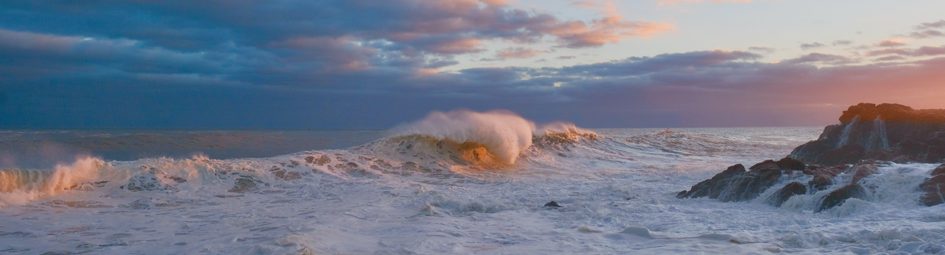
Good Harbor Beach Marsh ©Kim Smith 2013Good Harbor Beach Marsh Battleground
Birds of New England: Yellowlegs and the Boreal Forest Biome

Lesser Yellowlegs Massachusetts © KIm Smith 2014.What a treat to happen upon this pair of yellow-legged shorebirds feasting on tiny invertebrates in the mudflats at Henry’s Pond.
Lesser Yellowlegs Pair Massachusetts © KIm Smith 2014

The yellowlegs were foraging companionably alongside the Mallards, American Black Ducks, plovers, and Kildeers. I returned the following dawn and they had already departed for parts warmer. Perhaps we’ll see them again during their spring migration as they journey north to breed in the boreal bog forests of Canada and Alaska.

Lesser Yellowlegs Massachusetts  © KIm Smith 2014 -.Lesser Yellowlegs Preening

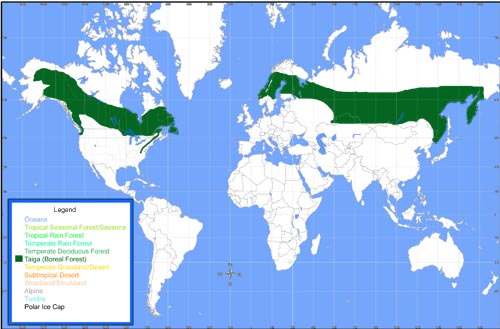
Here on Cape Ann, we are fortunate to catch fleeting glimpses of species such as yellowlegs during the the great annual fall migration. The map below shows the boreal forest biome (biome is another word for ecosystem), which lies to the south of the tundra and the north of deciduous forests and grasslands. The ground in the boreal forest is damp and boggy because of snowmelt and little evaporation due to cooler summer temperatures. The moist ground and long day length at northerly latitudes during the summer makes for explosive plant growth–Think Bird Food!–not only in the wealth of plants, but myriad insects attracted!

taiga_500Boreal Forests

I believe the pair to be Lesser Yellowlegs (Tringa flavipes). I am by no means a bird expert and imagine they could also possibly be Greater Yellowlegs. If any of our wonderful expert bird lovers would like to weigh on this, I would be grateful. Songbirds and shorebirds that I have filmed on Cape Ann are featured in my Monarch film and I am in the process of writing the script. I want to insure that all the bird identifications are 100 percent accurate..

Map courtesy google image search.

Birds of New England: The Majestic Mute Swan

Mute Swan taking flight -2 ©Kim Smith 2014The extraordinarily powerful wings and torso of the Mute Swan

The above photo is a lucky capture as I was actually filming the Gadwalls behind the swan. When the swan began to lift out of the water I quickly turned my attention toward it. The first two photos are the same; the first is cropped, the second uncropped so that you can see the tremendous scale of the swan’s body and wings in relation to its environment. The Mute Swan is the second heaviest waterfowl, second only to the Trumpeter Swan. In observing swans, I marvel in nature that a creature this heavy can soar majestically through the clouds and swim so gracefully through water.

Mute Swan taking flight ©Kim Smith 2014Mute swans feed primarily on submerged and emergent aquatic vegetation and a small percentage of their diet also includes frogs, small fish, and insects. Because swans feed in deep water they do not compete with smaller waterfowl such as ducks. It is thought that food is made more readily available to ducks because the swans do not eat all the food they pull up. This seems logical and factual from my own observations at our local ponds and marshes. I very often see a wide range of waterfowl congenially feeding with the Mute Swans.

Swan food winter ©Kim Smith 2014Mute Swan feeding on submerged vegetation at Niles Pond

Note ~ Mute swans, which are a nonnative species, do compete directly for food with North American native Trumpeter Swans, in regions where Trumpeter Swans are indigenous (Trumpeter Swans are not native to Cape Ann).

For more photos, information, and video see previous posts about the Mute Swan:

Vibrant Throbbing Wingbeats

Where do Swans Go in Winter?

Niles Pond or Brace Cove?

Birds of New England: Divers or Dabblers and the Green-winged Teal

Female Green-winged Teal -- ©Kim Smith 2013.Female Green-winged Teal (Anas crecca) 

While filming at Henry’s Pond in Rockport I at first thought I was seeing a pair of pint-sized, or immature female Mallards amongst a mixed flock of full grown Mallards and American Black Ducks. But no, upon closer examination, their behavior was different from that of the much larger Mallards. They stayed together, the two females, foraging for food along the pond’s edge. When one flashed her brilliant emerald green wing, I realized it was no Mallard but the beautiful Green-winged Teal.

Female Green-winged Teal ©Kim Smith 2013Like the chubby little Bufflehead, the Green-winged Teal is similar in size, about 13-15 inches in length.

I find it interesting that, based on their style of foraging, waterfowl are assembled by ecologists into several groups.“Dabbler” ducks skim food from the surface, or feed in shallow water by tipping forward to submerge their heads (which is exactly what I had observed while filming the petite Green-winged Teal). “Diving” ducks propel themselves underwater with large feet. A few dabblers may dive, but for the most part, dabblers skim.

Dabblers that we see in our region include Green-winged Teal, Mallard, Mottled Duck, Blue-winged Teal, Gadwall, and Northern Shoveler. Diving ducks are the Canvasback, Redhead, Ring-necked Duck, Greater Scaup, Ruddy Duck, Masked Duck, and American Wigeon.

A third category, which includes Buffleheads are called “seaducks.” American Black Duck, Eiders, Scooters, Harlequin Duck, Oldsquaw, Goldeneyes, and Mergansers are encompassed in the seaduck group. Read more about Dabblers vs. Divers here.

Male Mallard, Female Mallard Green -Green-winged Teal ©Kim Smith 2013.In the above photo of a male and female Mallard in the foreground, and Green-winged teal in the background, you can see how close in color are the feathers of the females of the two species. The wing pattern is subtly different and you can also see the difference in size between the two species.

*   *   *

I have been organizing research and lots of photos for our Birds of Massachusetts series. Upcoming stories will feature songbirds, including Mourning Doves, American Robins, and Northern Cardinals, shorebirds of every size and shape including dabblers, divers, and seaducks, and I’ve planned a post just on bird food to grow in your gardens to attract our fine-feathered friends. As I written often, “When you plant, they will come!”

Green-Winged Teal, Birding Center, Port Aransas, TexasMale Green-winged Teal image Wikimedia Commons

Birds of Massachusetts: Buffleheads

Birds of New England: Buffleheads

Next time you see a flock of ducks, look closely. You may be surprised by the range of different species within the group. Although not always the case, but more often than not at this time of year, I see several species within a flock. What typically happens as I try to get closer to photograph or film a flock of shore birds, the Mallards, which seem very comfortable around people will stay and the somewhat less seen species, such as Buffleheads, Gadwalls, and American Wigeons will fly away or swim vigorously out of my camera’s range.

Buffleheads, gulls Brace Cove ©Kim Smith 2014I counted six different species of birds feeding in the seaweed at Brace Cove in the above photo.

This past autumn, and continuing through this winter, I have been filming and photographing B roll all around the ponds and marshes of Cape Ann. Today begins a mini series about shore birds, ducks, and wading birds, including photos and interesting facts, to help better identify the differences between the ducks and wading birds that migrate through, and winter over, on Cape Ann.

One of several Cape Ann geographical features that allows for such a wonderfully wide range of birds to be found on our shores and marshes is the fact that we lie within a largely unrestricted north south corridor for migratory species of birds and butterflies. What exactly does that mean? From the eastern coastline, all the way from Maine to Florida, and between the Appalachian Mountain range further west is a corridor where there are no barriers such as large bodies of water or mountains to fly over, which allows for unrestricted movement of birds and butterflies.

Male and Female buffflerheads ©Kim Smith 2014Male and Female Buffleheads

Male Buffleheads are one of the easiest birds to distinguish from a distance and within a group because of their sharp black and white coloring, comparatively smaller size, and pert, rounded shape. Upon closer inspection the males heads are marked with striking iridescent green and purplish feathers. The photo above shows three males and one female, and she is differentiated by her all over darker color and the patch of white feathers on her check. Rapid wingbeats make Buffleheads easier to distinguish when in flight as well. Their old-fashioned name of “Butterballs” aptly describes these beautiful and welcome winter migrants!

I am by no means a bird expert. I love to film and photograph the natural world around us and along the way find it fascinating to learn about the wildlife and flora that surrounds. Note to all nature and bird-loving readers ~  I hope you’ll comment with your expertise. I would love to hear from you!

Why Do Herons Stand on One Leg?

Great blue Heron one leg -2©Kim Smith 2013Great Blue Heron at Good Harbor Beach ~ Click to view larger

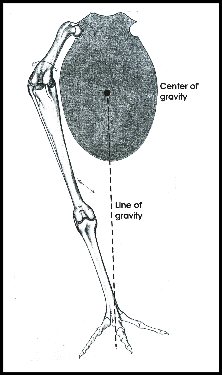
There are several theories as to why birds, especially large wading birds such as herons and flamingoes, stand on one leg, or “unipedal resting” as scientist like to refer to the trait. The seemingly most convincing and best-proved theory is that birds stand on one leg to conserve body heat. It is shown that birds stand on one leg more often when wading, which again points to the thermoregulation hypothesis because water draws away more body  heat.

Great Blue Heon one leg Good Harbor beach ©Kim Smith 2013 copyGreat Blue Heron (Ardea herodias)

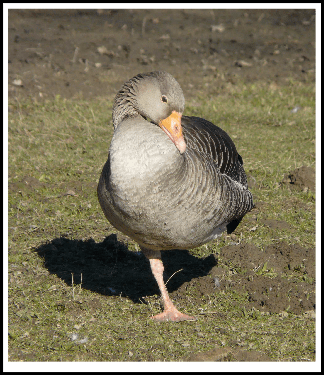
Standing on one leg is not necessarily a sleeping and resting habit. I have filmed Great Blue Herons and Snowy Egrets meticulously preening while standing on one leg. The characteristic is not limited to large wading birds; species with shorter legs, including ducks and swans, also stand on one leg. Another popular theory suggests that wading birds stand on one leg to look less suspicious to aquatic prey.

wp4768443cCenter of gravity and line of gravity

wp0e750516Goose standing on one leg

To read more about avian sensory physiology, visit the website of Professor Dr. Reinhold Necker. Additional images courtesy Professor Necker’s website.