Rare Albino Ruby-throated Hummingbird

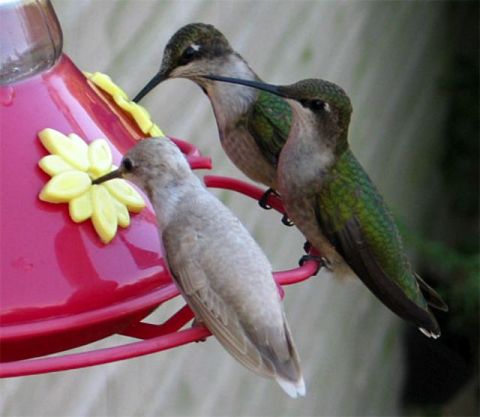
Many thanks to Caroline Haines, the director of Pathways for Children, for forwarding the photos of the rare albino Ruby-throated Hummingbird (Archilochus colubris). The photos were shot by Kevin Shank and four of his sons over a several day period in late August. Caroline has a love for butterflies and birds, and nature in general, and brings her passion to the programing provided for the children at Pathways.

The above photos were taken in Virginia at the beginning of the hummingbird’s annual southward migration; it wouldn’t be unreasonable to think that we may see an albino hummingbird visiting our Cape Ann feeders and flowers as we are in the same migratory corridor.

A true albino hummingbird, as is the above bird, has snowy white plumage and it’s eyes, legs, and bill are pink. True albinos are extraordinarily rare. Leucistic hummingbirds are still rare but are seen more often than true albions. Like the common Ruby-throated Hummingbird, leucistic forms have black, feet, bills, and eyes, but their feathers are some version of white, gray, buffy, and tan; not the typical shades of green.

Leucistic form and common Ruby-throated Hummingbirds

Image courtesy Hilton Pond Center.

Antennae for Design ~ Three Outstanding Films Not to be Missed

Uggie

We were again transported to another time and place—three fabulous and current films, in three weekends. Our wonderfully transportive film nights began with My Week with Marilyn, which takes place in 1956 and was shot in and around the outskirts of London,The Descendants, filmed in present day Honolulu, and last night we saw The Artist, which takes place in Hollywood, from 1927 to 1932. The Artist is a comedy and drama about George Valentin (Jean Dejardin), a silent film star, and Peppy Miller (Bérénice Bejo), a rising “talkie” star, who meet just as the silent film industry is collapsing. The film is partially silent and filmed to look like a black and white silent film. The costumes are to die for, the interior set designs are predominately Hollywood Regency, and the acting charming and sweet and utterly engaging. Uggie, the terrier, will steal your heart.

From an interview with Michael Hazavanicius, director and writer of The Artist, “I had many deep motivations for wanting to make a silent film. As a member of the audience, I absolutely love the way stories are told to me in a silent movie. It’s not a cerebral response. It’s more a child-like response. Because there’s no spoken language, the way the story engages your heart is special. It’s hypnotic, sensual, not at all cerebral, and I love that sensation as an audience member. My motivations as a director were much more selfish. For me, it was a great experience. It’s what cinema is about, in my opinion. I’m telling a story with images and music. With images, you have the actors, you have the sets, you have the costumes, the lights, everything, and that’s how you’re telling the story. You don’t need words for that. It’s the ultimate experience for a director to make a silent movie. I really wanted to try to do it.”   Link to the full interview with Hazavanicius. 

Jean Dujardin and Uggie 

Techno notes for Joey and Marty: The Artist was made in the 1.33:1 screen ratio commonly used in the silent film era. Though presented in black-and-white, it was shot in color. All the technical details, including lenses, lighting and camera moves, were calibrated to get the look just right. To recreate the slightly sped-up look of 1920s silent films, the film was shot at a slightly lower frame rate of 22 fps as opposed to the standard 24 fps. Courtesy wiki.

Images courtesy Google search.

What is Great Pond Status?

The point of the Aftermath video is to showcase the litter, not who owns the pond. Thank you Daniel for pointing out the litter and thank you Anonymous for sharing that Niles Pond has Massachusetts Great Pond Status. And thank you to all who wrote comments-it just goes to show how much we all care about our beautiful Niles Pond and surrounding environment.

Irrespective of who owns the pond, let’s all please not litter, and if you do see trash left behind, clean it up, and if you can’t manage the job yourself, email the wonderfully good eggs Donna Ardizzoni and her One Hour at a Time Gang for the really tough jobs.

Niles Pond Sunrise

From the Massachusetts Department of Environmental Protection website: Chapter 91 comprises four basic areas of geographical jurisdiction. Any activity that takes place in one of the hot link areas listed below requires Chapter 91 authorization. The areas are:

Flowed Tidelands – Any project located in, on, over or under tidal waters seaward of the present mean high water (MHW) shoreline. Jurisdiction in this case extends seaward three miles, to the state limit of territorial jurisdiction.

Filled Tidelands – The limit on filled tidelands is: A.) Outside Designated Port Areas, the first public way or 250 feet from mean high water, whichever is farther landward and B.) Inside Designated Port Areas, the historic MHW shoreline (i.e., all filled areas).

Great Ponds – Any project located in, on, over or under the water of a great pond. A great pond is defined as any pond or lake that contained more than 10 acres in its natural state. Ponds or lakes presently larger than 10 acres are presumed to be great ponds, unless the applicant provides unequivocal evidence to the contrary. Ponds 10 or more acres in their natural state, but which are now smaller, are still considered great ponds.

Non-Tidal Rivers and Streams – Projects located in, on, over, or under any non-tidal, navigable river or stream on which public funds have been expended either upstream or downstream within the river basin, except for any portions not normally navigable during any season by any vessel. Additionally, the Connecticut River, the Merrimack River and portions of the Westfield River are within jurisdiction.

Chapter 91: An Overview and Summary ~ Read more to find out how Great Pond Status directly affects Niles Pond: Continue reading

Aftermath

Isn’t Niles Pond gorgeous?  I posted the photo below on Good Morning Gloucester blog on Sunday; the pond looks especially pristine and sparkly in the snow and ice.

The following day Good Morning Gloucester follower and Eastern Point resident Daniel D. wrote to say, “It does look beautiful, and as a Resident of Eastern Point, I love when others can share in the beauty of our neighborhood. Unfortunately, the picture for today should be all the cans, boxes, and trash left behind by these people when they finished skating that day, all glaringly standing out as the snow melts in that exact spot… Hopefully they read this comment and then quickly come and clean it up before the ice melts this week and it all sinks to the bottom of our lovely pond. I’m Just Saying….”

Hey guys—it looked as though you were having a great time, but then had to leave very suddenly—with trash, half a dozen pucks, and even a shovel left behind. Perhaps there was an emergency—whatever the case—could someone who was playing hockey at Niles on Sunday please come and clean up the mess. I picked up much, of what I could reach, but the embankment is muddy and slippery and you will need tall waders to reach the plastic bottles and shovel. Thank you for your consideration.

As Daniel D. correctly stated, all the trash is going to sink to the bottom. Many species of waterfowl dive for vegetable matter and the seeds, stems, roots, and bulbs of submerged aquatic plants. They can easily became entangled in trash. The last shot of the bird’s nest is meant to symbolize the pond’s fragile ecosystem.

Clip of the stunning Northern Pintail (Anas acuta) at 3 minutes 45 seconds.

Hawaiian Quilts

Antennae for Design The Descendants

Saturday night we went to see The Descendants. I found this movie enjoyable on many levels. The cinematography, of lush Hawaiian landscapes, was gorgeous. Lingering close-up shots of the actors and dreamy transitions added to the telling of story. Interesting, too, were the clips of suburban Honolulu neighborhoods. Never having been to Hawaii, the film was an eye opener—I don’t imagine Honolulu neighborhoods as a typical L.A. hillside suburb, nor downtown Honolulu with eight lane highways jammed with choking traffic.

Vintage Hawaiian Quilt

The set designs by Matt Callahan mirrored the story beautifully, and I found much inspiration in the furnishings and fabrics, including vintage rattan furniture, appliqué pillows, and bark cloth curtains. Several authentic Hawaiian quilts added a unique touch, and one quilt in particular played a leading role in the telling of the story. The main characters comprise a modern day family descended from a Hawaiian princess. Early in the film, we see a sunny golden yellow and white, slightly tattered and homey, quilt arrayed over the mom, who is lying in a hospital bed, in a coma and dying. The quilt has been brought from the family home to the hospital to provide comfort. In the final scene, the father and children make their way one by one to the family sofa, and eventually all are cozy under the same Hawaiian quilt, watching television together, and sharing bowls ice cream.

What we think of as the classic Hawaiian quilt is characterized by a bold, radial symmetric design (similar to that of a snowflake) or bold, stylized design drawn from nature. The motifs are often times cut from one piece of cloth, unlike patchwork quilts, which are assembled from many smaller pieces of fabric. The design motif is then appliquéd to a contrasting background. And, unlike patchwork quilts, with quilting stitches worked in parallel diagonal, straight, or circular lines, Hawaiian quilters practice “echo” or outline quilting. The stitches follow the inner and outer contours of the design motif.

Images courtesy of Google search.

The Descendants is based on the book of the same name, written by Kaui Hart Hemmings.

Antennae for Design

Depression Era Quilts

Depression Era Butterfly Buttonhole Appliqué Quilt 

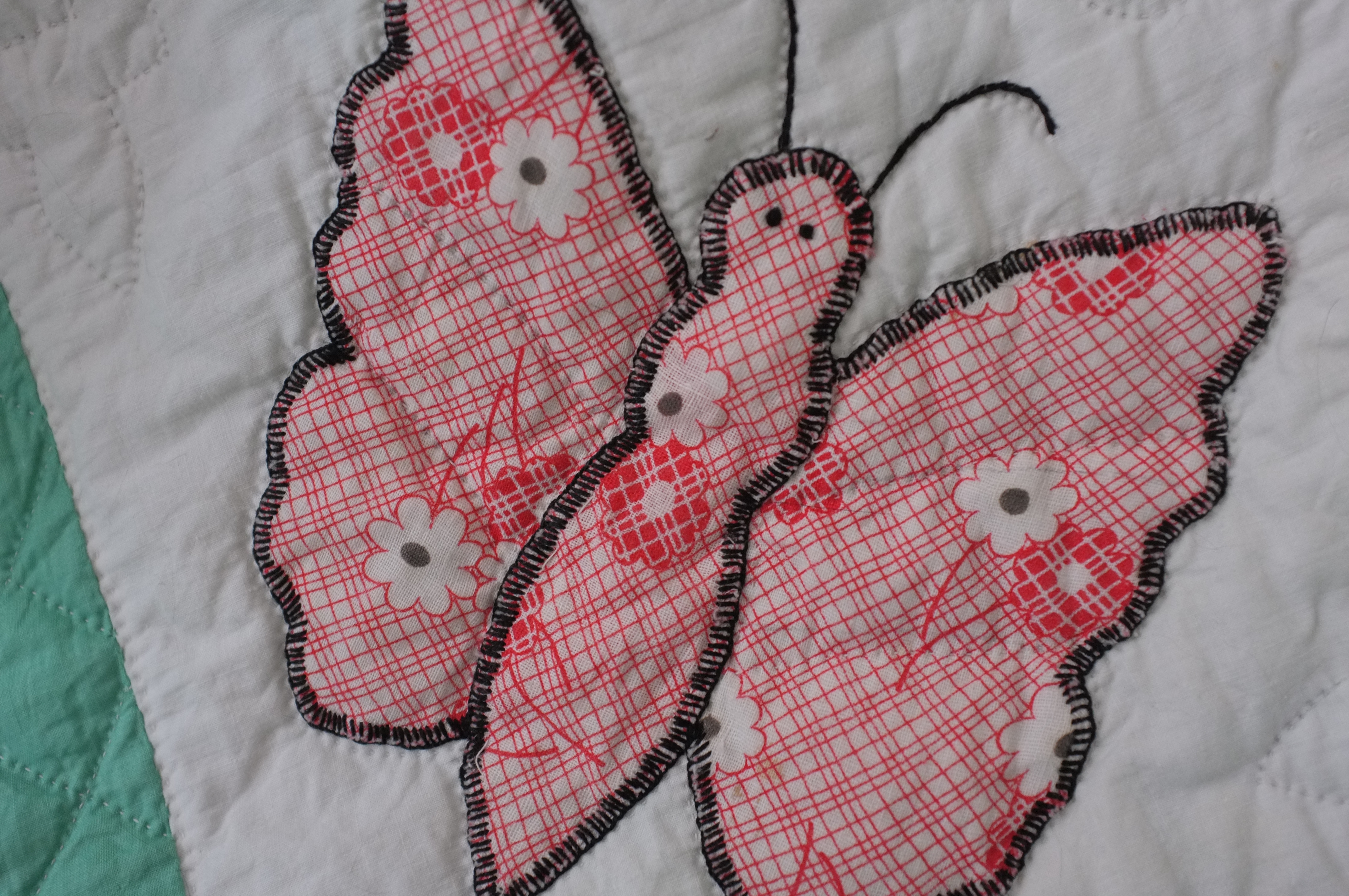
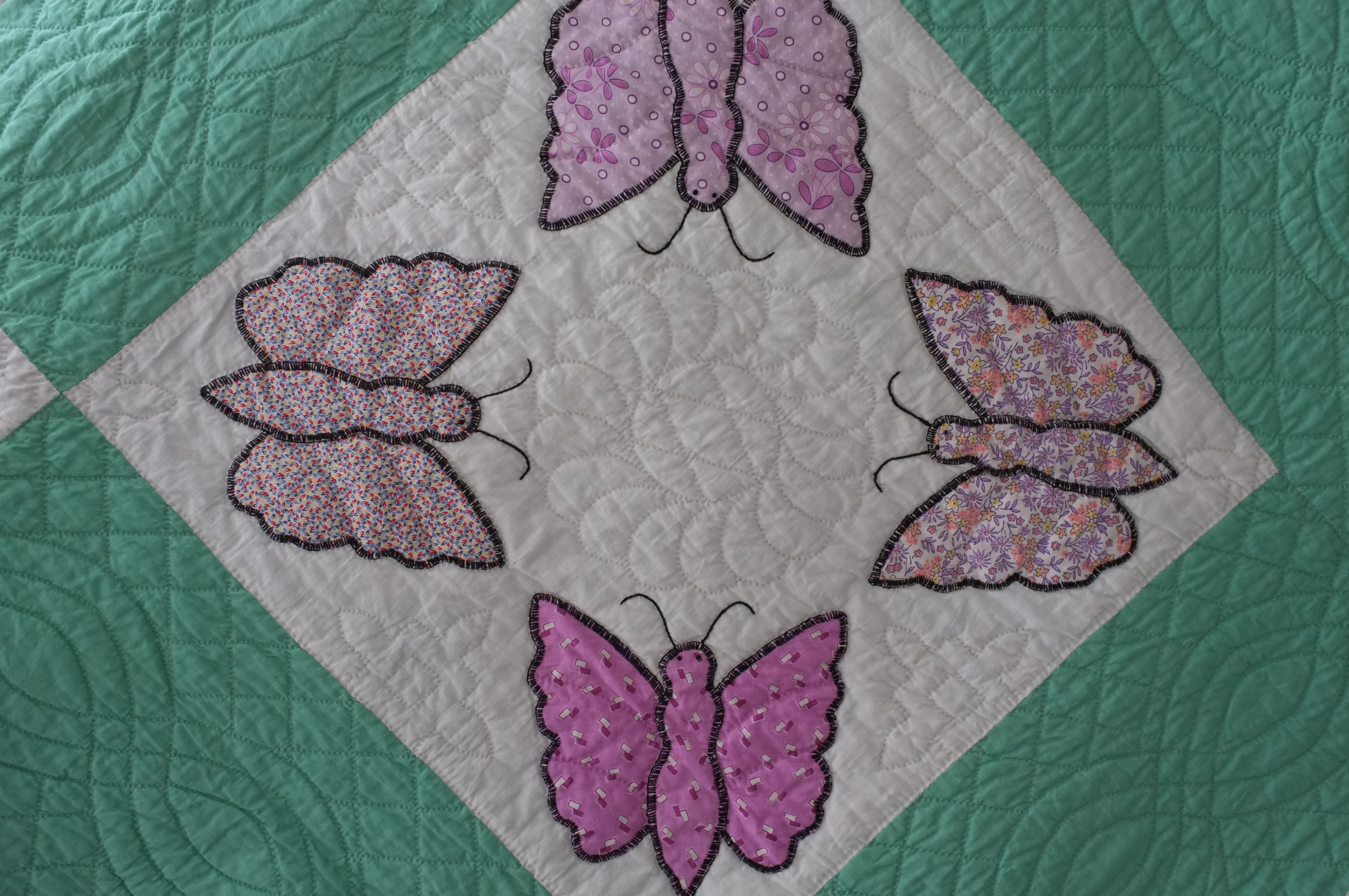
For the first installment of Antennae for Design I wanted to share with you a very special gift that my mother- and father-in-law gave me this Christmas past. My husband’s family lives in Cincinnati, Ohio, a beautiful city sited along the Ohio River. The landscape so reminded early German settlers of the Rhine River and valley, that to this day there is an older area of the city still referred to as ‘Over the Rhine.’ The above butterfly buttonhole appliqué quilt was made in Fostoria, Ohio and Ohio’s long quilt making heritage is similar to that of many states throughout America.

Quilts and quilt making techniques are a reflection of the life and times of the women who made the quilts. The technique of quilting (encasing an insulating fabric between two layers of an outer fabric and stitching firmly in place) has existed throughout history. Quilted garments have been discovered in ancient Egyptian tombs and quilted garments and bedding began to appear in Europe after the return of the Crusaders from the Middle East. The medieval quilted gambeson and aketon were garments worn under, or instead of, armor of maille or plate armor. The oldest American quilts in the Smithsonian date from approximately 1780.

Thinking about the fascinating history of quilts and quilt making in this country, one of my very favorite periods of quilt making was after WWI and through the early 1940’s. Quilts made during this period are commonly referred to as Depression Era quilts; although to look at their cheery colors and patterns, you would never know the women who created them were living in the midst of a depression. Magazines needed to be resourceful during this period of extreme economic hardship, and they were, by selling fashion and optimism. Another way to survive was by including quilt patterns and tips in their publications. Quilting was an activity that women could do to fulfill their creativity while still making something practical for their families. The quilts were typically made from sewing scraps, out-grown clothing, and feed sacks. Part of the war reparations agreement with Germany after the First World War mandated Germany provide the US with their formulas for aniline dyes, which allowed for an explosion in color depth and hues, as well as stability in dyes; purple finally became reliable, as did black.  Charming and sweet prints along with lovely pastels served in stark contrast to the depressive economy. A particular shade of green, now referred to as “thirties green,” was so popular amongst quilters, that the strips that were used to bind the quilt edges came packaged in a can!

Dating quilts is fascinating. If you have a question about a quilt or would like to share information about a family heirloom, please write.

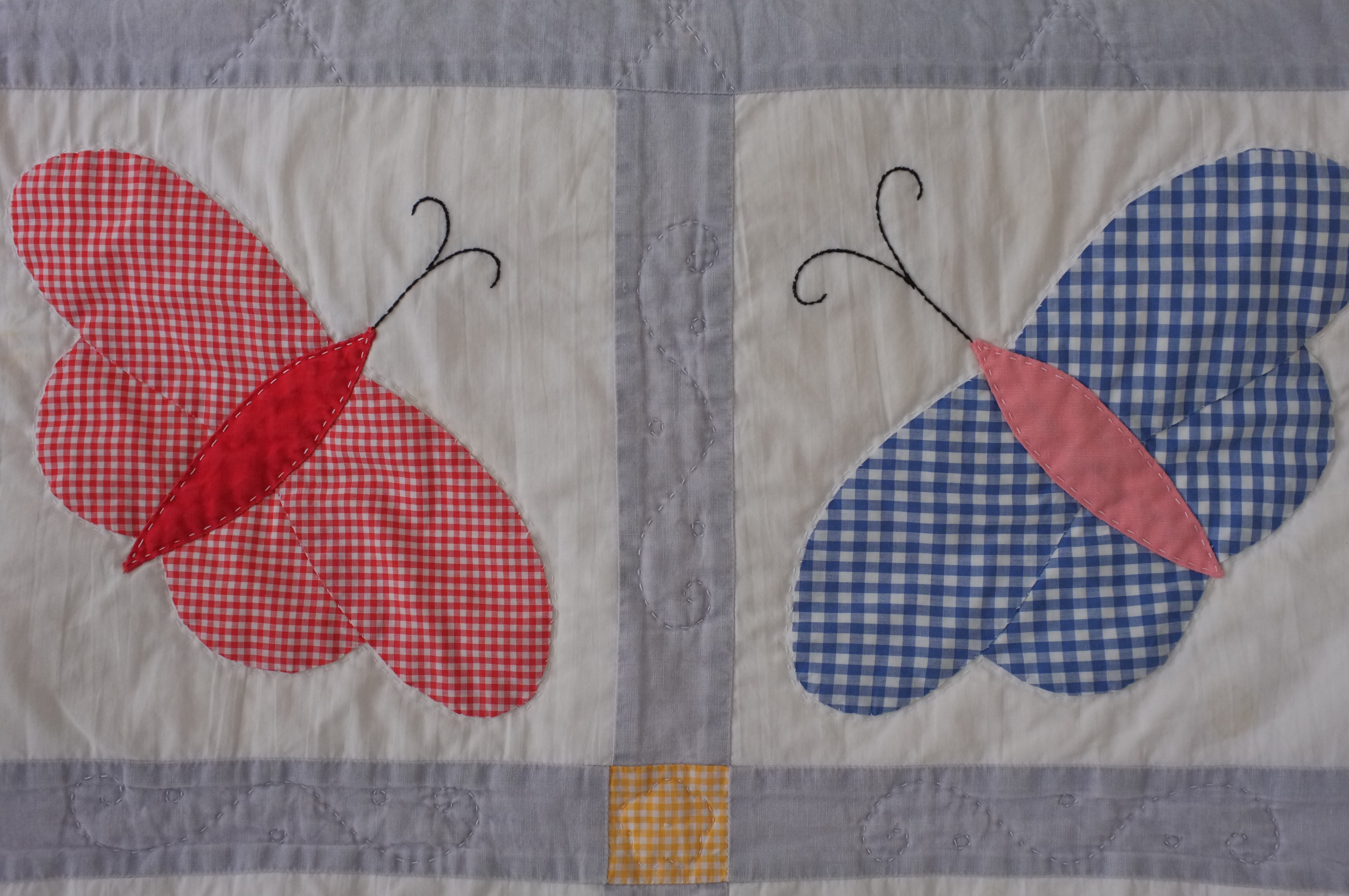
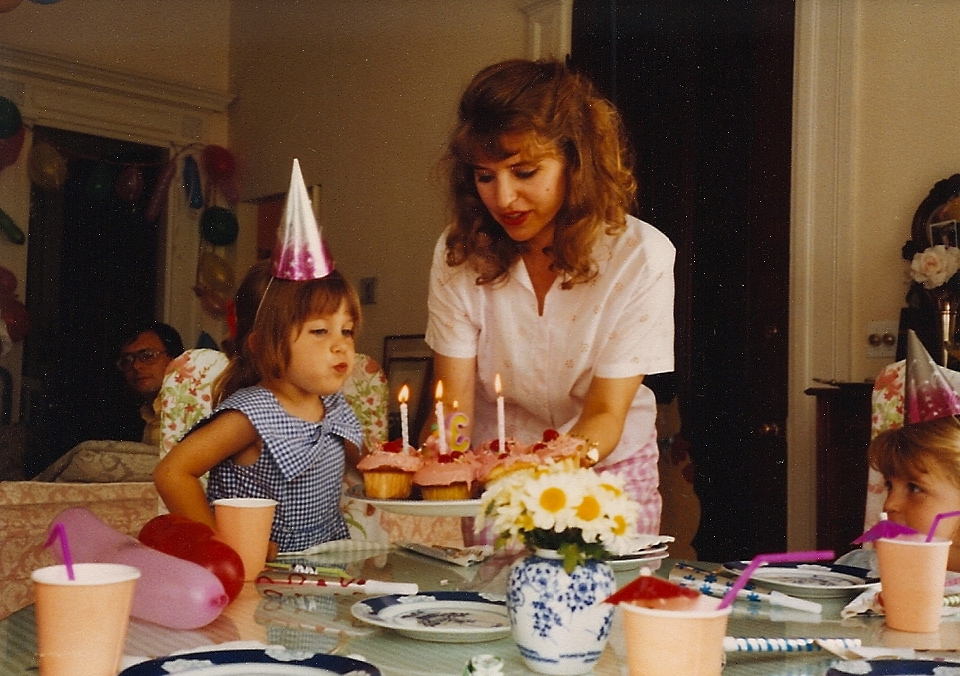
The above quilt was my interpretation of a 1930′s butterfly quilt, which I made for our daughter when she was three. Following in the depression era practice of using what was on hand, you can see the dress scraps from which the quilt was made in her blue gingham dress in the old photo below.

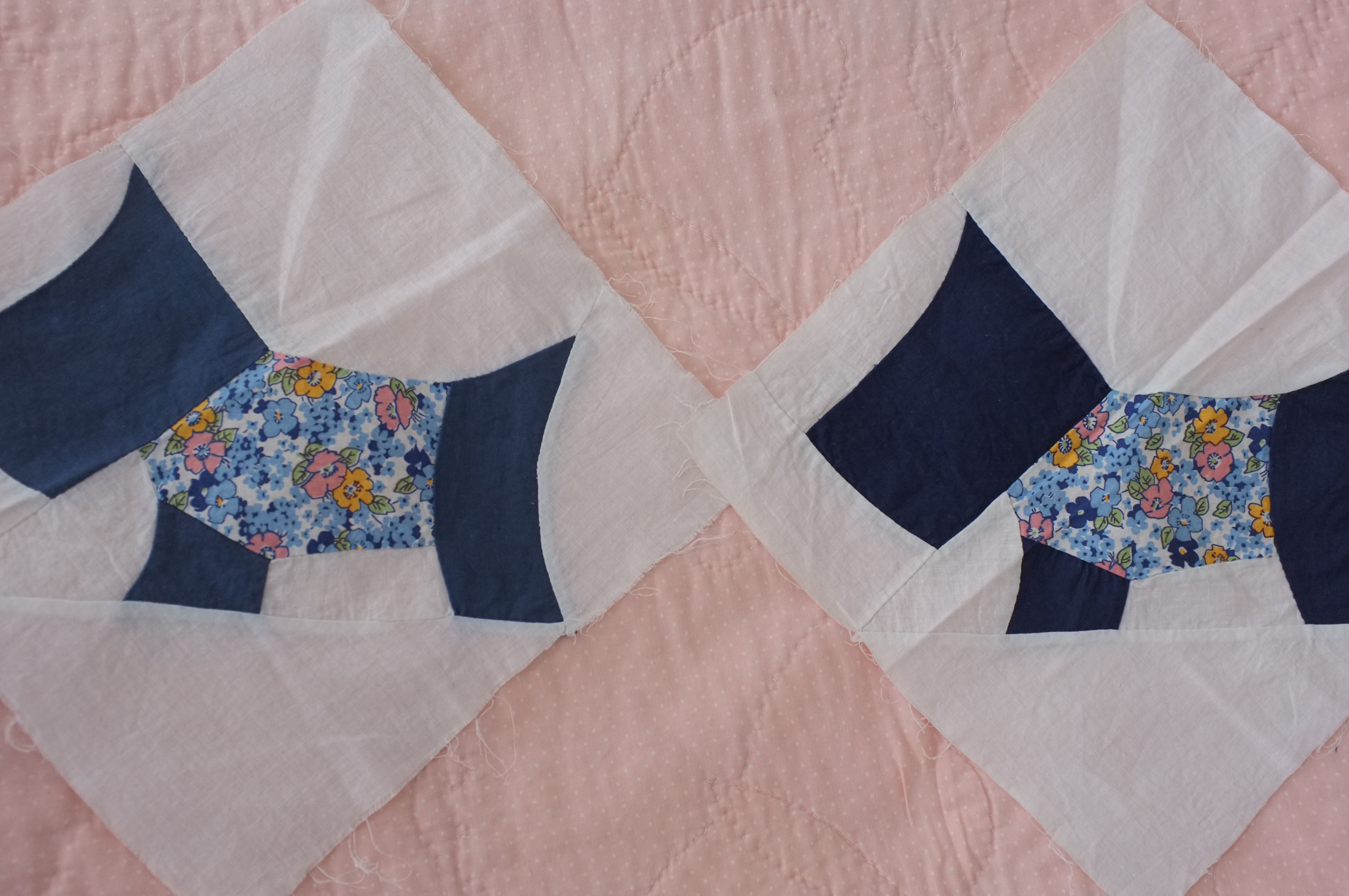
I found a basket full of Scotty dog squares at a yard sale last summer. Scotty dogs were a popular design motif during the first half of the 20th century and this particular Scotty pattern was created in 1940. When I have some spare moments, I’ll look for fabric to back the quilt. Purchasing quilt squares or an unfinished quilt top is a great way to acquire a depression era quilt because, if the squares or top have been properly stored, the fabrics will come back to life with cleaning and pressing, and will not have been used.

Antennae for Design

January, February, March, and for we who dwell in New England, oftentimes well into April, are ideal months for interior home improvements. During these more homebound months I am actively looking for home and garden design inspiration. And, too, with projects that were shelved during the summer months because of seasonal work and summer guests, winter is a great time of year to focus on home improvements. I was inspired to write this weekly series after a recent visit to our home from Joey, Jill, and their two darling daughters. The family stopped by for hot chocolate and story time and Joey was non-stop with investigative questions and curiosity. It got me thinking about the impetus for writing my book, Oh Garden of Fresh Possibilities!, which was originally conceived as a guide for young couples and new home owners (and someday, hopefully, for my children when they will one day have gardens of their own). My book grew to be more than that, but I am again thinking of the couples with young children that have recently moved to our East Gloucester neighborhood.

Plaster Ceiling Medallion

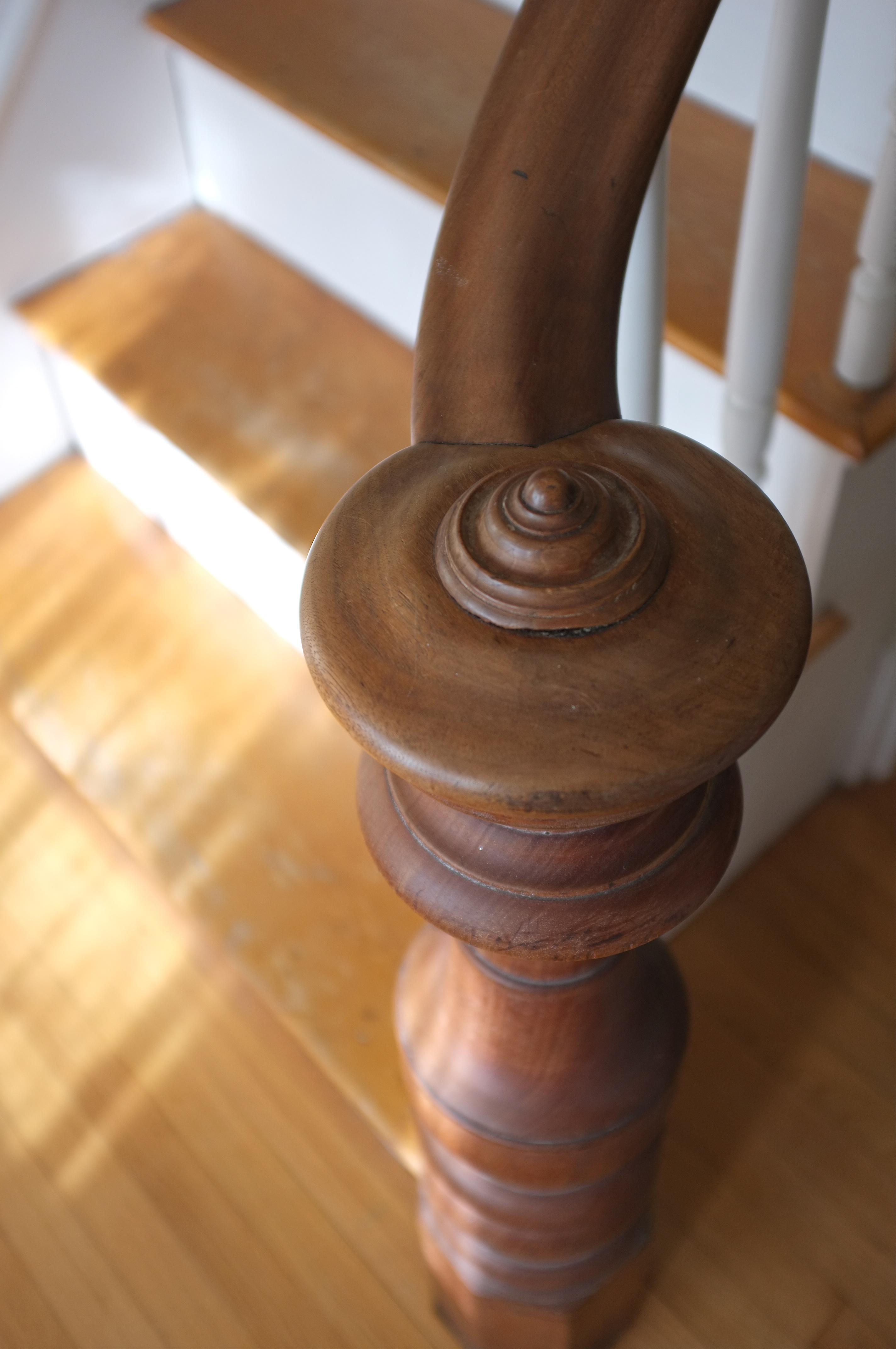
To think of it, we are following in an old Gloucester and northern seacoast tradition by tending to the interior of our homes during these winter months, in that of “house-pride.” The town’s carpenters, many of whom were master shipbuilders and shipwrights, would have had more free time during the winter months. Fine carpentry details are evident throughout our house, which was built in 1851. And, like many of Gloucester’s older houses, our home is graced with details created by the skilled plasterers that emigrated from Italy and settled on Cape Ann. Although a modest house, particularly by today’s “starter castle” standards, I wouldn’t trade our lovely 19th century home, with its quirky and elegant details (along with it’s many foibles) for all the world’s McMansions.

I propose Antennae for Design will encompass home and garden design inspiration, home improvement tips, feature interviews with local business owners who specialize in art and design, and after visiting local well-tended homes and gardens, sharing information found there.  Let me know through the comment section or by emailing at kimsmithdesigns@hotmail.com of your thoughts and any topic that you may find particularly relevant or of interest.

The Flower That Mrs. Kim Gave Us

My friend Joey’s daughter Madeline, also known as Snoop Maddie Mad, created and posted this video on her blog. She is four, I think. Amazing. Note how she politely directs her sister. Dad Joey is preparing her to be the next media magnate in the family.

Joe at the Good Morning Gloucester Art Gallery

As you may or may not know from reading my blog and newsletters, I am a daily (almost everyday) contributor to my friend Joey Ciaramitaro’s blog, Good Morning Gloucester. I am planning a weekly column for GMG titled Antennae for Design, which I will then post on my blog and also email to my readers (more about that later), but I first want to tell you a bit about Good Morning Gloucester. I was a fan before I was a contributor. The blog is the brainchild of Joe Ciaramitaro. Joe grew up in East Gloucester and he, along with his cousin Frank, own the family business started by their grandfather, Captain Joe and Sons Lobster Company, located on Gloucester’s working waterfront and off East Main Street (yes, you can purchase your fresh lobsters there, at the dock, retail—but at wholesale prices!) Along with his family (wife Jill, daughters Madeline and Eloise, and large extended family), Gloucester is Joe’s passion and his blog reflects his deep love for all things Gloucester. Through his writing, films, and photography, Joe works tirelessly to help and to support and to grow local businesses, local arts and music, and community spirit. And with the help of his contributors he accomplishes this everyday, seven days a week, twenty-four seven. Never a dull moment, GMG is filled with hourly postings of upcoming community events, video interviews and human interest stories about local people and events, news and commentary about issues that affect the fishing community, full video and photo coverage of community events, stories garnered from local historians, photos of our surrounding natural beauty–the thoughtful and thought-provoking coverage is continuous. GMG is wholly unique–as far as I know there is nothing like it–and it is founded on one man’s passion and abiding love for his hometown. If you want to know anything and everything, not just about Gloucester, but the Cape Ann region, visit GMG. I subscribe to GMG and read it every morning with my coffee, and then often times check in again later during the day if I need to search for the time and date of a scheduled community event or activity.

 Note–GMG is entirely free of advertisements of any kind.

Daughter Liv in Brooklyn

Photos of our daughter Liv taken by her photographer friend Dave Krugman. Dave says “My favorite way to shoot is to wander through the streets with a close friend, follow the good light, and let the world show itself. Give it a try…” Liv is a graduate student at NYU Steinhardt, studying opera and vocal performance; Dave is a professional photographer based out of Boston. They met while at Boston University. Click the last image to see their Brooklyn album.

Click last image to see Liv and Dave’s photo album

Best Friends

Filmed at Oakes Cove, Rocky Neck, November 7, 2011. “Count on Me” by Bruno Mars, from the album Doo-Wops and Hooligans.

Oakes Cove is a small, protected cove located on the southwestern side of Rocky Neck within Gloucester’s Inner Harbor. The “best friends” were unaware they were being filmed. I loved that they were so familiar with the ledge that they knew the exact location of the perfect perch for watching the setting sun together.

Total length 6 minutes, 20 seconds

Oakes Cove Swan

On that balmiest of all January Saturday’s past, Tom and I walked along the Rocky Neck beaches. The Flynn’s Beach (at Oakes Cove) swan did not at all appreciate the interest shown by our curious pooch.

Mute Swan Hissing

The Mute Swan (Cygnus olor) is native to Europe and Asia and is an introduced species to North America. Called “mute” because they are less vocal than other swan species, the Mute Swan is also distinguished from other swan species by its prominent knob atop the bill. The male swan is called a cob, the female, a pen, and the young, cygnet. The female is slightly smaller than the male, and her knob is less pronounced.

Sand Bath ~ Note the grains of sand around the swan’s bill (click photo for larger view) in the above photo; the swan appeared to be using the sand as an aid in cleaning it’s feathers.

Living in a Fitz Henry Lane Landscape

Wonsons’ Cove

Click photo to see larger image

Locally found treasures ~ a pair of hand-painted Czechoslovakian lamps

A recent find for one of my design clients is this pair of sweetly hand-painted Czechoslovakian lamps, with coordinating shades trimmed in blue silk cord, discovered at a local vintage shop.

Forget-me-nots and Roses

I love the challenge of searching for and finding one of a kind (or in this case, a pair of) treasures for my design clients. And I partuclarly love one of my ongoing design jobs for a simply delightful family, with three lovely and lively daughters, each with their own very distinct personality and style preference. The eldest daughter is zippy and lighthearted with a definite flair for the modern; the second daughter is gently refined and ethereal (I think of watercolor hues for her); and the third daughter is possessed of a warm and sunny character—a radiant sunflower. The pair of Czechoslovakian lamps will add a charming touch to the middle daughter’s bedroom. Whether you are searching for special plants for the garden (the most highly scented specimens, for example) or rare and/or out-of-the-ordinary objects of art and decoration for the home, thoughtfully selected accents create the most welcoming sort of home.

Important Safety Note: Although these lamp bases are in near-perfect vintage condition, the cords are not. Judging from the overall poor condition of the cords, I would guess they were last wired in the late 1950’s or 1960’s. We will re-wire the lamps with soft gold-colored cord, which will better blend with the décor, as opposed to the dark brown or stark white wire. Always, and always very thoroughly, check the wiring when purchasing vintage lighting—for obvious reasons, I cannot stress this enough.


The War on Bugs Change of Venue

Due to popular demand, the location for the The War on Bugs event has been changed to the Harbor Room, 8 Norwood Court,  Gloucester. The Harbor Room is located off East Main Street, directly across the street from the Gloucester Writer’s Center, and down the hill toward the harbor. Suggested donation is $10, $5 for students, and absolutely no one is turned away for lack of funds. For more information, call Annie Thomas at 978.283.7738 or email her at asthomer@yahoo.com

2012 Rocky Neck Plunge

2012 Rocky Neck Plunge with a pre-plunge breakfast hosted by Passports Restaurant. Featuring The Ciaramitaro Family, Donna Ardizzoni and her daughter Erica, E.J., Ed, Mayor Kirk, Nicole, Alicia, Paul, the van Ness Family, and too many more brave souls to mention all by name. Cathy McCarthy and friends set up boxes by the entry to the beach and a truckload of food was collected and donated to The Open Door Food Pantry.

Included is a postlude video short titled New Year’s Day Bath ~ Swan Style. 

HAPPY NEW YEAR!

Filmed at Flynn’s Beach on Oakes Cove Gloucester, Massachusetts.

Beethoven Symphony No. 6 in F Major, Opus 68 Pastoral

Beethoven Symphony No. 9 in D Minor, Opus 125 Choral Finale (Ode to Joy)

Performed by the London Symphony Orchestra

Hippeastrum

A Note about Hippeastrum 

Living in New England the year round, with our tiresomely long winter stretching miles before us, followed by a typically late and fugitive spring, we can become easily wrapped in those winter-blues. Fortunately for garden-makers, our thoughts give way to winter scapes of bare limbs and berries, Gold Finches and Cardinals, and plant catalogues to peruse. If you love to paint and write about flowers as do I, winter is a splendid time of year for both, as there is hardly any time devoted to the garden during colder months. I believe if we cared for a garden very much larger than ours, I would accomplish little of either writing or painting, for maintaining it would require just that much more time and energy.

Coaxing winter blooms is yet another way to circumvent those late winter doldrums. Most of us are familiar with the ease in which amaryllis (Hippeastrum) bulbs will bloom indoors. Placed in a pot with enough soil to come to the halfway point of the bulb, and set on a warm radiator, in several week’s time one will be cheered by the sight of a spring-green, pointed-tipped flower stalk poking through the inner layers of the plump brown bulbs. The emerging scapes provide a welcome promise with their warm-hued blossoms, a striking contrast against the cool light of winter.

Perhaps the popularity of the amaryllis is due both to their ease in cultivation and also for their ability to dazzle with colors of sizzling orange, clear reds and apple blossom pink. My aunt has a friend whose family has successfully cultivated the same bulb for decades. For continued success with an amaryllis, place the pot in the garden as soon as the weather is steadily warm. Allow the plant to grow through the summer, watering and fertilizing regularly. In the late summer or early fall and before the first frost, separate the bulb from the soil and store the bulb, on its side, in a cool dry spot—an unheated basement for example. The bulb should feel firm and fat again, not at all mushy. After a six-week rest, the amaryllis bulb is ready to re-pot and begin its blooming cycle again. Excerpt from Oh Garden of Fresh Possibilities! ~ Coaxing Winter Blooms

Click above photo to see slide show

The taxonomy of the genus Hippeastrum is complicated. Hippeastrum is a genus of about 90 species and over 600 hybrids and cultivars, native to topical and subtropical regions of the Americas from Argentina north to Mexico and the Caribbean. For some time there was confusion amongst botanists over the generic names Hippeastrum and Amaryllis, which led to the application of the common name “amaryllis” when referring to Hippeastrum. The genera Amaryllis refers to bulbs from South Africa.


Tribute from Senator John Kerry to Joe Garland

REMEMBERING JOE GARLAND

Mr. KERRY: Mr. President, over the course of the past half-century, Joe Garland served as the unofficial historian of Gloucester, MA—its fishermen, its boats and its life. But Joe Garland not only wrote history in his books and newspaper column—he was part of history, guiding his beloved hometown through headwinds and troubled waters. Joe Garland passed away August 30, and his family and friends gathered October 1 for a memorial service. I would like to share with the Senate the thoughts and memories of Joe that I shared with those who were part of that service honoring this great champion of all things Gloucester.

If you visit the Fisherman’s Memorial on Gloucester’s waterfront on a stormy winter day, the statue of the Heroic Mariner seems to be steering the whole town into the wind toward fair weather. And if you look closely at the statue, you can almost see Joe Garland in its carved granite face, full of grit and determination, guiding his be- loved Gloucester through headwinds and troubled waters.

‘‘Beating to windward’’ is the art of sailing into the wind. ‘‘Beating to Windward’’ is also the name of the column Joe wrote so many years for the Gloucester Times. And it is no surprise to any of us who knew him that Joe used the column to champion all things Gloucester.

Joe didn’t just chronicle Gloucester’s history—he was a part of it. In his column and in his books, he brought to life the era of the great schooners—like the 122-foot Adventure, the flagship of Gloucester, and the larger-than-life Gloucestermen—like the ‘‘Bear of the Sea,’’ Giant Jim Patillo, and the ‘‘Lone Voyager,’’ Howard Blackburn.

But he also used the sharpness of his pen to make his case on all kinds of civil causes—opposing unbridled economic development, warning about the loss of local control of the hospital and water supply, complaining about compromises on the environment or demanding the preservation of Gloucester’s beauty. And trust me—Joe never hesitated to offer his advice to a certain U.S. Senator, if he felt like I needed it.

Joe wrote with passion, conviction and humor, never with ill will or with the intent to wound. He was a gentleman. And always, whether in his column or in his books, he promoted the interests of Gloucester’s fishing fleet. In my office in Washington, I have a copy of the book he wrote in 2006, ‘‘The Fish and the Falcon,’’ about Gloucester’s role in the American Revolution. His inscription to me expresses his appreciation ‘‘for your efforts to relieve the fiscal crisis that has long haunted our beleaguered fishing industry.’’ He urged me to keep up the fight, and I have.

Joe wrote 21 books, and I always enjoyed his sharing the latest with me. In my Boston office, I have a copy of his book about the Adventure, which he helped to restore. It arrived with an invitation from Joe to tour the schooner and, of course, I didn’t waste any time accepting his invitation. He welcomed me aboard, and his tour made the Adventure’s history come alive—from its construction in 1926 through its career as a ‘‘highliner,’’ the biggest money- maker of them all, landing nearly $4 million worth of cod and halibut during her career.

But the book that spoke to me the most was his last, ‘‘Unknown Soldiers,’’ his memoir of World War II and his journey from a student at Harvard to a ‘‘dogface’’ with a close-knit infantry in Sicily, Italy, France and finally Germany. It is a clear, eloquent and unflinching panorama of the mundane and the horrific in war. It is, by turns, humorous, poignant and gut-wrenching, with the common soldier perspective long associated with journalist Ernie Pyle or cartoonist Bill Mauldin, a point of view with which soldiers from my war, from any war—a band of brothers stretching through generations of Americans—can identify.

I was deeply saddened to learn of Joe’s passing. But I am glad that his passing was gentle, his last moments of his life near the window of his beloved house by the sea, surrounded by loved ones and squeezing the hand of the woman he loved—Helen, his wife, his World War II pen pal.

And how fitting that in those final moments, the schooner Lannon fired a farewell cannon salute to Joe as it headed out to sea. Joe loved the tradition of cannon salutes, so much so that he fired one at the wedding of his stepdaughter, Alison, only to have it backfire, burning a hole in his jacket and covering his face with gunpowder, just in time for the official wedding photos. But that was Joe, and a face smudged with gunpowder underscored what we all know—truly, his was a life well lived.

There is an anonymous quote I once read which may well describe how we should think of Joe’s passing. It says:

“I am standing upon the seashore. A ship at my side spreads her white sails to the morning breeze and starts for the blue ocean. She is an object of beauty and strength, and I stand and watch her until, at length, she hangs like a speck of white cloud just where the sea and sky come down to mingle with each other. Then someone at my side says, ‘‘There! She’s gone.’’

Gone where? Gone from my sight— that is all. She is just as large in mast and hull and spar as she was when she left my side, and just as able to bear her load of living freight to the place of destination. Her diminished size is in me, not in her, and just at the moment when someone at my side says, ‘‘There, she’s gone,’’—there are other eyes watching her coming, and other voices ready to take up the glad shout, ‘‘There she comes!’’ And that is dying.” [See editor’s note.]

Because Joe loved the sea so much— and because he enjoyed watching seagulls soar—I close with a special poem. It is titled ‘‘Sea Joy’’ and it was written in 1939 by a little girl named Jacqueline Bouvier. America eventually came to know her as Jackie Kennedy. But when she was 10 years old, she wrote:

When I go down by the sandy shore

I can think of nothing I want more

Than to live by the booming blue sea

As the seagulls flutter round about me

I can run about—when the tide is out

With the wind and the sand and the sea all about

And the seagulls are swirling and diving for fish

Oh—to live by the sea is my only wish.’’

To Helen and Joe’s family, I extend my deepest sympathy, but with a reminder that Joe’s work, like the sea he loved, is eternal and booming, and that Joe’s life, like the seagulls he enjoyed so much, swirled and soared.

And to Joe, from one sailor to another, I wish him ‘‘fair winds and following seas.’’

Editor’s Note: The quote “I am standing upon the seashore. A ship at my side spreads her white sails to the morning breeze and starts for the blue ocean…” was written by Henry van Dyke (1852- 1933), an American educator, clergyman, and author.

Ring Out, Wild Bells

Ring out, wild bells, to the wild sky,
The flying cloud, the frosty light;
The year is dying in the night;
Ring out, wild bells, and let him die.
 
Ring out the old, ring in the new,
Ring, happy bells, across the snow:
The year is going, let him go;
Ring out the false, ring in the true.
 
Ring out the grief that saps the mind,
For those that here we see no more,
Ring out the feud of rich and poor,
Ring in redress to all mankind.
 
Ring out a slowly dying cause,
And ancient forms of party strife;
Ring in the nobler modes of life,
With sweeter manners, purer laws.
 
Ring out the want, the care the sin,
The faithless coldness of the times;
Ring out, ring out my mournful rhymes,
But ring the fuller minstrel in.
 
Ring out false pride in place and blood,
The civic slander and the spite;
Ring in the love of truth and right,
Ring in the common love of good.
 
Ring out old shapes of foul disease,
Ring out the narrowing lust of gold;
Ring out the thousand wars of old,
Ring in the thousand years of peace.
 
Ring in the valiant man and free,
The larger heart, the kindlier hand;
Ring out the darkness of the land,
Ring in the Christ that is to be.        -Alfred, Lord Tennyson
 
Our daughter Liv posted this poem on her blog Boston to Brooklyn. The sentiments expressed befit our times equally as well as when Tennyson wrote Ring Out, Wild Bells in 1850.
 
Jonathan Dove (1959), the contemporary British composer of opera, choral works, plays, films, and orchestral and chamber music has written a beautiful arrangement to Ring Out, Wild Bells, performed in this video by the Antioch Chamber Ensemble.


I Wonder as I Wander

I Wonder as I Wander (Appalachia) ~ Words and Music collected by John Jacob Niles, 1933

I wonder as I wander out under the sky,
How Jesus the Savior did come for to die.
For poor on’ry people like you and like I…
I wonder as I wander out under the sky.

When Mary birthed Jesus ’twas in a cow’s stall,
With wise men and farmers and shepherds and all.
But high from God’s heaven a star’s light did fall,
And the promise of ages it then did recall.

If Jesus had wanted for any wee thing,
A star in the sky, or a bird on the wing,
Or all of God’s angels in heav’n for to sing,
He surely could have it, ’cause he was the King.

Many thanks to Father Matthew Green from St. Ann’s Church for posting his photo of the St. Ann’s Nativity scene on Good Morning Gloucester blog. I was looking for an image to go with this hauntingly beautiful Christmas carol and was inspired to go see the nativity at the rectory after seeing his photo posted on GMG.

My Interview with Isabelle Lafleche on Pink Lemonade

My dear friend and fellow author Isabelle Lafleche has posted her interview with me on her always super fun and chic blog Pink Lemonade. Isabelle posts the most wonderful high-style photos, garnered from fashion and style publications from all around the globe.

Isabelle’s first novel J’adore New York has been published in French, English, and German and is now available in paperback. More on Isabelle in a future post.

Isabelle’s Upcoming Novel

Home for the Holidays

Both our children are at last home for Christmas! Read Liv’s “Home for the Holidays” post at her delightful blog “Boston to Brooklyn.”

Live writes: The Christmas spirit runs strong in our family, mainly due to our mother’s dedication in making our home a joyous and decadent celebration of the holidays. No room in the house is left without some unique Christmas decoration and our abode smells of paper whites, clementines, and pine needles for the entire blessed month of December. I’m finally home for the holidays after my first semester of graduate school, and nothing makes me happier and more relaxed than being surrounded by Christmas joy and familial love. Read more, with lots of photos, at Boston to Brooklyn.


Liv Hauck iPhone photo

Amaryllis ‘Orange Sovereign’

Amaryllis ‘Orange Sovereign’ will be in full bloom by Christmas Day!

For tips on coaxing winter blooms, including forcing bulbs and flowering tree and shrub branches, see Oh Garden of Fresh Possibilities!  David R. Godine, Publisher.

Snow Dome

For the past week, while at home and in between holiday baking, at different times throughout the day under varying degrees of low winter light, I’ve been taking photos of this snowiest of “snow storms.” The light coming through the living room windows along with the Christmas tree lights created myriad fascinating effects.

Click any photo to see the complete slideshow.

From wiki: Precisely when the first snow globe (also called a “water globe,” “snow storm,” or “snow dome”) was made remains unclear, but they appear to date from France during the early 19th century. They may have developed as a successor to the glass paperweight, which had become popular a few years earlier. Snow globes appeared at the Paris Universal Expo of 1878, and by 1879 at least five companies were producing snow globes and selling them throughout Europe.