Call for Wildflower Locations

While I am finishing editing my Black Swallowtail film, I am also shooting footage for my film about the Monarch butterflies. I am looking for scenes of wildflower meadows and drifts–milkweed, asters, and goldenrod, for example. If you have a favorite place and know of such a scene on Cape Ann (accessible to the public) or are willing to allow me to come film and photograph on your property, please let me know. There is no extensive equipment involved, just me and my camera and tripod. Please feel free to email me directly at kimsmithdesigns1@gmail.com. Thank you.

Eastern Point Gloucester Seaside Goldenrod

New Bistro Lights at Willowdale Estate

Willowdale Estate Courtyard

Monday night I was filming at Willowdale as we are in the early stages of creating a web page about the butterfly gardens for the Willowdale Estate website. I was hoping to film the Ruby-throated Hummingbirds at dusk and did succeed! They were nectaring from the Rose Mallow, hosta, Snowberry Bush, and butterfly bushes.

Verbena bonariensis

I love the new bistro lights in the courtyard garden–so romantic!


Newly Molted Caterpillar

Butterfly caterpillars molt four or five times as they grow. Each different caterpillar stage is called an instar.

In the photo below you can see the caterpillar’s crumpled discarded exoskeleton.

Molting Monarch Caterpillar

The caterpillar first grows a new skin under its old skin. Then the caterpillar draws its head out of its head capsule. Occasionally it will need to use its front legs to help remove the head capsule. Next the caterpillar crawls out of its old skin. This is called molting. After the molt and while the new skin is soft and pliable the caterpillar swallows a lot of air, which expands the body. As the new exoskeleton hardens it lets out the air to allow room to grow.

Molting takes a great deal of energy and after each molt, the caterpillar rests quietly for a brief period before then eating its discarded exoskeleton.

Is Joe-pye a Weed?

Sneezeweed, Butterfly Weed, Ironweed, Milkweed, Joe-pye Weed–these are names European colonists assigned to the wildflowers they found growing in North America. Is it any wonder these native beauties have long been overlooked for gardens. The name Butterfly Weed gives us a clue that what to the early settlers was a “weed,” is a pollinator’s dream.

“What is a weed? A plant whose virtues have not yet been discovered.”

                                                     ~ Ralph Waldo Emerson

For the past week, our blooming patch of six-feet-tall Joe-pye Weed has been covered in a bevy of butterflies including more Painted Ladies than ever I even imagined visiting our garden, dozens of newly emerged Monarch butterflies, Eastern Tiger Swallowtails, Question Marks, and thousands of bees.

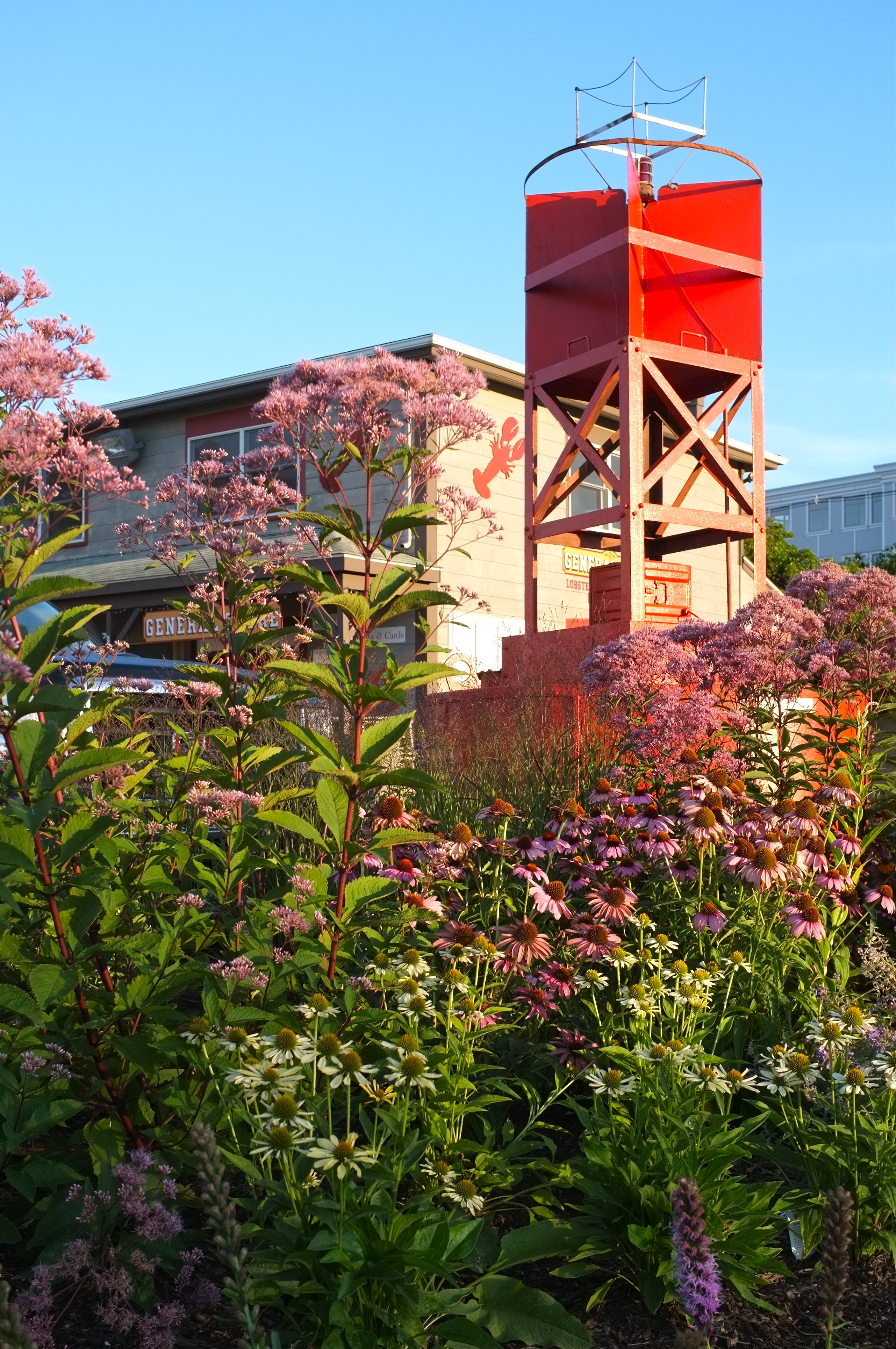
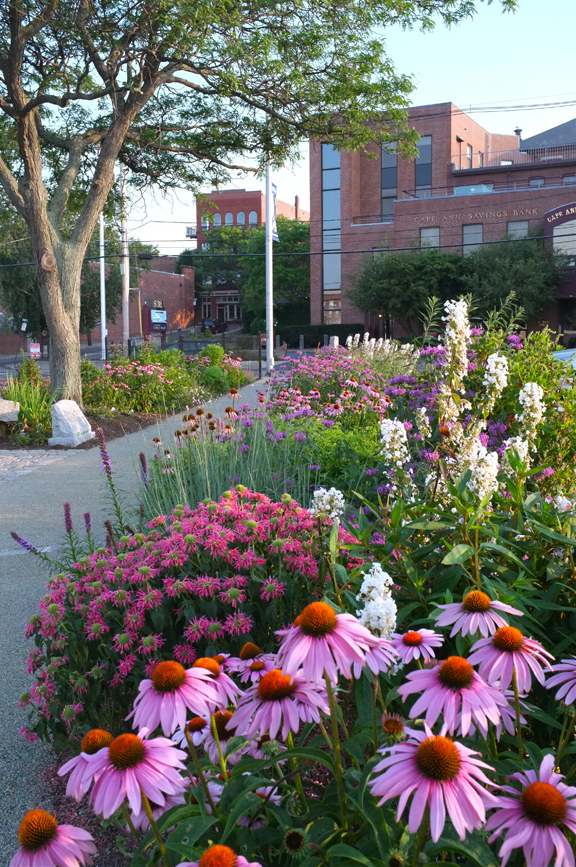
The Eupatorium growing in the Harbor Walk Gardens is a lower growing species called ‘Baby Joe,’ and it too is as equally attractive to the pollinators.

Joey-pye Weed

Madeline and the Monarch

The Ciaramitaro Family stopped by Willowdale for a tour of the butterfly gardens. We were lucky to see several Monarchs and dozens of Painted Ladies.

Click the photo to view larger and you will see the Monarch climbed onto Madeline’s finger–it takes great patience to hold still long enough to allow a butterfly to climb aboard!

Madeline was determined that a butterfly would climb onto her finger–first trying the Painted Ladies and then very, very patiently, and holding very, very still, encouraging the Monarchs. She was thrilled when one did–and it did so several times–very sweet to see her joy. Madeline and Eloise were expertly identifying the male and female Monarchs and explaining to all in how to tell the difference.

Painted Lady Butterfly

Painted Lady–never a more aptly named butterfly! Although ubiquitous, the sheer number of Painted Ladies found in gardens this summer is simply astonishing.

Painted Lady (Dorsal)

This morning in our postage-stamp-of-a-lot, there were quite possibly over one hundred newly emerged Painted Ladies nectaring from the Joe-pye, Baby Joe, zinnias, butterfly bushes, phlox, and Rudbeckia.

Quilled Sweet Coneflower

Introducing ‘Henry Eiler’s’ Quilled Sweet Coneflower ~

New to our garden this year is the Quilled Sweet Coneflower. The finely quilled sunny yellow petals are simply lovely, as is the overall shape of the plant. The wildflower is a North American native and bears the name of the southern Illinois horticulturist and prairie restoration specialist who found it growing in a railroad prairie remnant.

When lightly rubbed, the leaves of Rudbeckia subtomentosa reveal their sweet vanilla scent. I’ll let you know if it attracts bees, butterflies, and songbirds when the center florets open.

Railroad Prairie Remnants

“…the only remnant of any virgin, unplowed prairie that remains is along railroad tracks. When the railroads were originally built in the 1800′s, if they were going over a natural prairie, all they had to do was lay down the wooden crossties, pack in bed fill, and lay the rails….the remaining right-of-way remained essentially undisturbed. In many locales, a road also was constructed parallel to new tracks, so that the few hundred feet of railroad right-of-way trapped between the tracks and the road remained unplowed to this day, and in many areas has reserved a remarkable diversity of prairie species. In most areas, accidental fires happen fairly regularly, which enhances the vigor of the prairie vegetation.” Larry Lowman, Arkansas nurseryman and native plants specialist.

‘Henry Eiler’s’ Sweet Coneflower (Rudbeckia subtomentosa)

Giant Swallowtail Butterfly Alert!!!

Last week the Giant Swallowtail butterfly visited our garden for a brief moment. I ran indoors to get my camera but it had departed by the time I returned. This morning my my friend John, who lives across from Folly Cove, emailed to say he too has spotted a Giant Swallowtail. John and I correspond regularly about butterfly sightings–I love to hear about what he is seeing on the other side of the island– and this is the first time both he and I have observed Giant Swallowtails in our gardens.

Giant Swallowtail Butterfly (Papilio cresphontes) Photo Courtesy Marti Warren

One of my readers, Marti Warren, wrote in on Monday that she spotted a Giant Swallowtail Butterfly last week in her garden in Amherst, New Hampshire. 

From my favorite butterfly book, Butterflies of the East Coast by Cech and Tudor, “Although they are not regular migrants, Giant Swallowtails have appeared with some consistency as vagrants in the North, and occasionally form colonies.”
On the range map provided in the above book, the northern border of Massachusetts is at the end of the Giant Swallowtails range so I think it is fairly unusual to see one in central New Hampshire.
 Male Black Swallowtail Butterfly (Papilo polyxenes)

Three easy ways to know whether you are seeing the more common male Black Swallowtail or the Giant Swallowtail.

1) The wingspan of the male Black Swallowtail is approximately 3.2 inches; the Giant Swallowtail’s wingspan nearly five inches.

2) Both the male and female Giant Swallowtails have a band of yellow spots that converge near the apex.

3) Additionally, the only blue irredescence on the Giant Swallowtail is a semi-circular “eyebrow” over the orange and black eyespots.

Let me know if you think you have seen a Giant Swallowtail in your garden recently. If you have a photo, even better!

Register Now for My Photography Class

Registration is now open for my close-up photography workshop, Nature in Focus, which will be held at the Arnold Arboretum of Harvard, at the Hunnewell Building, on Sunday September 3oth, at 9:00 am.  I especially love teaching at the Arnold Arboretum. The facilities are beautiful, the staff wonderfully helpful, and September is a particularly gorgeous month to visit the gardens of the Arboretum. I hope you can join me!

Nature in Focus: Taking Great Close-ups  Kim Smith, Photographer and Filmmaker1 Session: Sunday, September 30, 9:00am–NoonLocation: Hunnewell BuildingLearn tips for taking great close-up photographs from celebrated butterfly and garden photographer Kim Smith. Through slides and hands on demonstrations, Kim will guide you in capturing the beauty of the flora and fauna found in nature. Bring your camera and questions, and a tripod if you have one. You will gain more from the class if first you familiarize yourself with your camera’s manual. (Note: This is not a macro-photography class.) See examples of Kim’s great images.

Fee $40 member, $55 nonmemb

Male and Female Monarch Butterflies

Baby Joe

In full bloom this month at the Harbor Walk is the fabulous North American native ‘Baby Joe’ (Eupatorium). While maintaining the Harbor Walk gardens, Jay Ramsey of Farm Creek Landscaping reported seeing no less than half a dozen species of butterflies nectaring simultaneously at the ‘Baby Joe’ on a warm sunny morning this past week. Given your average warm sunny summer day, butterflies are typically on the wing throughout the day; I find the very best time of day to see the very most is between 10:00 am until 12 noon.

Gloucester Harbor Walk Gus Foote Dedication Sunday

Tomorrow, Sunday, at noon, is the dedication of the Gus Foote Park. Following the dedication, I will be giving a mini-talk about the butterfly gardens along the walk.  A yummy clam chowder tasting is planned, provided by the Gloucester House Restaurant. At 12:45, we’ll Walk the Walk with Mayor Kirk. The theme of Sunday’s walk is Gloucester’s maritime heritage.

Sunny skies are predicted for tomorrow–perfect weather for strolling through the gardens while listening to sea stories. I hope you’ll come join us!

Cambridge Seven Associates Gloucester Harbor Walk Team

From left to right Peter Sollogub, Principal; Ethan Lacy, Chris Muskopf, Tim Mansfield, and Rosie Weinberg.

~

Gus Foote, now 82 years young, is a retired Gloucester City Councilman. He represented Ward 2 for more than three decades. In 2011, Gus was reappointed by Governor Deval Patrick to serve another five-year term on the Gloucester Housing Authority .

Gus Foote Image Courtesy GMG 2009

Before and After Photos of the Gloucester Harbor Walk

Yesterday was the grand opening ribbon cutting ceremony of the Gloucester Harbor Walk. I designed the pollinator gardens that you see along the walk. While there photographing, deadheading, and weeding in preparation of the big event, not only did I see myriad species of butterflies and bees, a flock of goldfinches flew into the scene and were dining on the seed heads of the Echinacea. Needless to say, I didn’t do much dead heading of the coneflowers!

Helenium autumnale ~ a bee and butterfly attracting magnet

A  few ‘before’ and ‘after’ photos of the area know as I4-C2. The before photos were taken only a few short months ago, in May of this year. The after photos were shot in August. Click photos to view larger images.

I4-C2 May 2012

Gloucester Harbor Walk August 2012

How to Tell the Difference Between a Male and Female Monarch Butterfly

For Devera, who wrote in asking how to tell the difference between a male and female Monarch Butterfly ~

Click photos to view large.

The first photos shows all male Monarch Butterflies necatring at Seaside Goldenrod. Notice the pair of little black pockets, or dots, on the inner vein of the hind wings. These are pockets of pheromones, or what scientists actually refer to as “love dust,” which the male sprinkles on the female during courtship.

The female Monarch Butterfly lacks the the black pockets on her hind wings. Notice too that her wing veination is thicker and smokier.


During courtship, male and female join, and he carries her to higher ground. This photo shows the male and female mating, with the male above.

Stained Glass Butterflies

Click to view enlarged images. 

From our garden ~ Newly emerged female Monarch Butterfly drying her wings. Monday a male emerged, Wednesday a female–looks promising for another batch of Monarchs before summer’s end!

Newly Emerged Female Monarch Butterfly

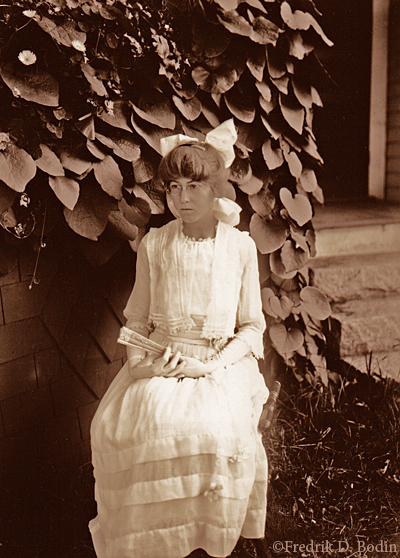
Dutchman’s Pipevine Photo from 1915

Look what Fred Bodin from Bodin Historic Photo shared!

Julia Lane, later Julia Wheeler, posed for Alice M. Curtis on August 12th, 1915, in Gloucester.

Fred read my post about Dutchman’s Pipevine and Pipevine Swallowtail Butterflies that originally appeared on Good Morning Gloucester, titled Plant, and They Will Come!  I mentioned in that post that the Dutchman’s Pipevine had it’s heyday in gardens in the previous two centuries. Pipevine was planted  to climb porches and arbors in pre-airconditioning days, providing  shade and cooling the rooms within. The Pipevine Swallowtail Butterfly is rarely seen in our region today because the Dutchman’s Pipevine is rarely planted.

Thank you Fred for taking the time to find this delightful vintage photo showing the Dutchman’s Pipevine growing on the porch in the background!

Dutchman’s Pipevine is the host plant for the Pipevine Swallowtail Butterfly and makes a wonderful addition to the garden. Back when it was in vogue (and practical) to plant Dutchman’s Pipevine, Pipevine Swallowtail Butterflies were a regular occurrence in the northeast.

 4-day old Pipevine Swallowtail caterpillars, recently molted. Notice their spiny discarded skins.

Note: the flower in the second photo of the Dutchman’s Pipevine is a Rose of Sharon, not the flower of the vine.

Plant! and They Will Come

Nearly five years ago in late September 2007, I photographed a male Pipevine Swallowtail Butterfly (Battus philenor) nectaring in my garden. I found mesmerizing its dark beauty, with black wings punctuated by brilliant orange spots and shimmering iridescence. The wings flashed electric blue in the fading late day sunlight and I became completely captivated!

Although the Pipevine Swallowtail is not rare in its southern range, this exotic looking butterfly is an unusual occurrence in the northeast, and even more rarely found on the eastern outer reaches of Cape Ann. Mine was a stray, carried in on a southerly breeze. I imagined that if a male can drift into our garden, so can a female. And if a visiting female found in my garden her caterpillar food plant, she would deposit her eggs. The following spring we planted the Dutchman’s Pipevine (Aristolochia macrophylla). Four years later, and our pipevine has grown well. With emerald green enormous heart-shaped leaves, she is quite a showstopper clambering over the back fence. The plant is named for its flower, which resembles a Dutchman’s pipe, although when ours flowers, the blooms are so small, so few, and so lost in the foliage, I barely know when it is in bloom. Our pipevine took several years to become established, but once firmly rooted, it grew vigorously, but not invasively. At the end of the growing season, or the beginning of the next, I cut the vine hard, down to the ground. Dutchman’s Pipevine grows in full sun and partial shade and is hardy in zones 4 to 8.

Aristolochia macrophylla had its glory days in gardens during the two previous centuries, prior to the invention of air conditioning. It was planted to cover porches and treillage; cooling and shading the rooms within. When looking through old photos you can easily spot the porches and arbors that are embowered with pipevine because of the distinctive heart-shaped foliage. I imagine Fred Bodin may even have a few pictures of pipevine shrouded porches in his treasure trove of vintage photographs.

 Pipevine Swallowtail Egg Clutch

While doing chores in our backyard, about a week ago Saturday, I noticed the rapid movements of a dark butterfly investigating the pipevine. I immediately paused because say, for example, if it was the more common Eastern Black Swallowtail, which deposits eggs only on members of the carrot family, it would not show the least bit of interest in the pipevine. Upon close investigation, it was a Pipevine Swallowtail and, without doubt, it was a she! After first zooming in and out of the house to grab my camera, I observed her as she fluttered from tendril to tendril. She deliberately chose the tenderest leaves, pausing briefly several times to curl her abdomen to the underside to deposit her eggs. After she departed I ran in the house to tell anyone who would listen of the Great News. In our household my butterfly news is pretty much the family joke, although my husband kindly offered to get the tallest ladder from the basement. He held tight while I climbed to the top rung in search of eggs. I struck gold! Unlike the female Monarch and Eastern Black Swallowtail butterflies, which deposit eggs singularly, the Pipevine Swallowtail oviposits eggs in clusters. I counted somewhere between 25-30 eggs (very approximately) in the clutch we cut from the plant. I hope we have enough pipevine to feed this many hungry Pipevine Swallowtail caterpillars!

Pipevine Swallowtail Caterpillars Several Hours New

One Day New Pipevine Swallowtail Caterpillars

Range Map of Pipevine Swallowtail (Battus philenor)

 ~ Map courtesy NABA

Beauty in Gloucester

I loved this Macy Gray song from the moment I first heard it. The lyrics are full of hope. I found the song  to be perfect for creating a montage of my favorite clips, filmed in and around Gloucester over the course of the past month. The footage is from works-in-progress butterfly films, 2012 Greasy Pole shorts, and random footage from a family picnic. The film showcases just some of the natural beauty found in Gloucester, from sunrise til sunset. Is it too crazy–butterflies and Greasy Pole Walkers–you tell me because I see beauty in everyone and everything.

Filmed at Niles Beach, Pavilion Beach, Good Harbor Beach, Eastern Point, Brace Cove, Gloucester Harbor Walk, and Plum Street. Created for Good Morning Gloucester. Dedicated to Joe Ciaramitaro and his beautiful family and to our beloved Gloucester community.

Thank you Ciaramitaros for your help with my Monarch film!

Thank you to my darling daughter Liv; as Craig said, “a trifecta–beautiful, smart, and funny!”

Beauty in the World Sung by Macy Gray

Featuring:
Liv
Eloise Ciaramitaro
Madeline Ciaramitaro
Joe Ciaramitaro
Stew McGillivray
Ross Carlson
2012 Sunday Greasy Pole Walkers

“Beauty in the World” is by American singer Macy Gray from her album The Sellout, which is Gray’s fifth album and first since her under-performing 2007 album, BigThe Selllout is her return to musical form after almost conforming when her last album didn’t take off. “I thought after Big flopped maybe I should do what everyone else was doing,” she said. “Go out and hire the hottest producers, the best writers, get real skinny. But none of those people called me back.”

The song was inspired by hearing her daughter’s laughter on a down day. “I didn’t even know what she was laughing at. I thought ‘at least she’s happy.’ And I felt at least I hadn’t failed there, because my daughter’s happy.” -wiki

The Greasy Pole Walk is a competition that takes place over a three day period and is an integral part of the Saint Peter’s Fiesta. The Greasy Pole Walk and Greasy Pole Walkers are unique to Gloucester, Massachusetts.

Interview with Lyda Kuth, Director of Love and Other Anxieties

Love and Other Anxieties had it’s Gloucester premier at the Cape Ann Community Cinema on Monday night. I loved the film–hearfelt, poignant, and funny.

Kent, Lily, and Lyda

Kim Smith: We’ve been friends now for at least ten years, when I helped you with the interior design of your home.

Lyda Kuth: I had heard about you—you had been in the film business early on as a set designer, and then you turned interior designer. As soon as we met, I felt we had a shared sensibility, which made working together such a pleasure.  I remember you encouraging me to use a fabric for a couch that I was afraid would be too “busy” for my taste.  But you encouraged me to be bold, and you were absolutely right.

KS: When I saw Love and Other Anxieties in Somerville, I thought it was so beautiful and heartfelt. You speak about your marriage with Kent in such an open way. Everybody who is married asks the kind of questions you ask. It’s a story that everyone can relate to, certainly anyone who is married or in a long-term relationship.

LK: The film is intended to be provocative, and perhaps allow people to voice some things that don’t often get voiced.

KS: I love that your film has examined marriage so intently, by examining yourself, but in such a way that feels universal.  One of these themes is wondering what life will be like after the kids leave home. Is anticipating the empty nest part of why you made Love and Other Anxieties?

LK: Yes, but what’s funny about that, this was largely unconscious at the outset. Over the course of making the film, which took five years from start to finish, it became blatantly obvious. I realize that one of  the things I hope audience members take home is that there is a “second life” that starts to happen after your kids leave home, and it can be equally as rich.

KS: Seeing your daughter Lily on screen, getting ready for prom, reminded me so much of what it felt like for me, when my daughter Olivia was a senior and I was telling her how wonderful college would be but thinking, “Oh my god, she’s leaving and what will our family unit feel like with one is person missing?  We’ll never be a whole family again.”

LK: Did any of your anxieties about this turn out to be true?

KS: I haven’t told this to many people, but at the same time that Olivia left for college, there was a massive Monarch migration through Gloucester– something that only happens every ten to twelve years. I was amazingly transported out of myself and began writing about and  photographing the butterflies, which then led to my learning how to film as well.

LK: Isn’t it interesting how the title of your book, “Oh Garden of Fresh Possibilities!” alludes to fresh beginnings and reflects what lay behind the creative work we each took on, in one way or another? I wasn’t consciously aware that the imminent departure of my only child was motivating me.  And yet some part of myself was preparing me for this transition.  It’s reassuring to know there is something at work, mapping the next step, at a deeper level than my “ruminations,” which are generally circular in nature!

KM:  The other aspect of your life, which also finds its way into your film, is your long time role as director of the LEF Foundation, based in Cambridge.  When we met, you had already been introduced to Gloucester and the Cape Ann community through having supported artists including Henry Ferrini and Dana Salvo.

LK: Yes, and what stands out for me is having the photographer Dana Salvo introduce me to the wonderful, rich tradition of the Feast of St. Jospeh, and being invited into people’s homes to see their alters and to be part of their tradition. I’ll never forget it.

KS: Yes, it is an extraordinary experience.  And Henry Ferrini’s father was the poet laureate of Gloucester; and now Henry, in addition to making films–which is what LEF supported–has co-founded something right in my neighborhood, the Gloucester Writers Center.

KS: Do you foresee having chatting time after the screening at Cape Ann Community Cinema?

LK: Absolutely. The Cape Ann Cinema is just the right kind of place to screen my film– an intimate and somewhat informal setting that allows for conversation.  I’m really looking forward to it!

Tickets include dinner and a screening of the movie with director Lyda Kuth.  Love and Other Anxieties at the Cape Ann Community Cinema on Monday July 23, at 7:30 pm, 21 Main Street, Gloucester.


Gloucester Harbor Walk ~ What a Difference! Construction Phase Accomplished in Only a Few Months!

Congratulations and thank you to Mayor Kirk,  Sarah Garcia, Chris Muskopf, Jay Ramsey, and including everyone involved (there are many, many more than named here–these are the people I have had the pleasure to work with on the project) for having the vision, courage, tenacity, and talent to create Gloucester’s Harbor Walk.

Gloucester Harbor Walk ~  View of Gus Foote Park

The Harbor Walk is nearing completion. Despite the plethora of unforeseeable problems with the landfill at I4-C2, and current drought, the walk looks gorgeous. Come, take a stroll!

Gus Foote Park Last Year at this Time. What a difference–the build phase of the project was accomplished in only a few short months!

I will be bringing you more ‘before and after’ photos, as well as information about the native plants habitat gardens (and how you can translate that information to your own garden), in the coming months.

Baltimore Checkerspot Butterfly

This striking Baltimore Checkerspot was photographed last week in a field of Common Milkweed (Asclepias syriaca). The field is located in Ipswich’s town center.

Notice the Baltimore Checkerspot’s vivid orange antennal clubs and white and orange dotted abdomen. The caterpillar’s food plant, or host plant, is mainly turtlehead (Chelone glabra) in low lands and gerardias upland, e.g., Smooth False Foxglove (Aureolaria flava).

Baltimore Checkerspot (Euphydryas phaeton) Ventral

I find absolutely the most interesting creatures in fields where grows Common Milkweed, which tells us that the plant provides a wealth of nourishment for a diverse range of organisms.

Note: The underside of butterfly wings are referred to as ventral; the upper surface as dorsal. An easy way to remember the difference between the terms dorsal and ventral is to think of the dorsal fin of a dolphin.

Love and Other Anxieties Gloucester Premier

Save The Date 

Filmmaker Event:  On Monday July 23, at 7:30 one of my dearest friends, Lyda Kuth, is showing her beautiful and touching film  Love and Other Anxieties at the Cape Ann Community Cinema. Lyda will be there to talk with the audience and answer questions. Many artists in our community know Lyda from her other role as an arts funder. She is the founding board member and executive director of the LEF Foundation.

Come say hello to Lyda and see her moving film. I’ll be there introducing Lyda and look forward to seeing you ! Click here for Advance Ticket Sales

Faced with the reality that her only child will flee the nest for college, film-funder turned filmmaker Lyda Kuth gets anxious not only about how her daughter will fare in today’s world of love and romance, but also about her relationship with her husband of 20 years.  What will life be like after her daughter leaves?  What is the real meaning of love, marriage, and long-term commitment?

WCVB Channel 5 Chronicle Gloucester Episode

WCVB Channel 5 Chronicle recently aired an episode featuring Gloucester. This is in and of itself was terrific; they also borrowed my footage from my Greasy Pole Sunday film that I created for Good Morning Gloucester.
Special thanks are owed my friend Joey Ciaramitaro for making his stellar community blog Good Morning Gloucester the go to place for people like Maggie Harper, the producer of Chronicle, to discover more about what makes the heart of our community beat. During the entire week of Fiesta, then quickly followed by Independence Day events, GMG covered all, posting countless feature stories, schedule of events, photos, and videos.

Thank you Joey C for all you do for our fair city!


Chasing Rainbows (and Storm Clouds)

The beautiful double rainbow late Saturday afternoon had faded, but I did see this on my way home.

Rainbow over Bass Rocks

The sky was so gorgeous I next stopped at Smith’s Cove to catch the end of the setting sun. The hues quickly changed from vivid yellow-orange to orange-violet-pink.

Smith’s Cove East Gloucester

Click photos to view larger-more dramatic looking!